
Update Site (from NASA)
Explore NASA’s Image and Video Library.
Suggest one object per day for the Interstellar Minds collection. We review each suggestion before adding it.
Sign in to suggest a Marvel.
Find a NASA image ID. Open a NASA record and copy its ID from the end of the details URL.
NASA image records

MSFC · 1971-02-05 · 7120040
Saturn Apollo Program
The moon bound Apollo 14, carrying a crew of three astronauts: Mission commander Alan B. Shepard Jr., Command Module pilot Stuart A. Roosa, and Lunar Module pilot Edgar…
Inspect NASA record
The moon bound Apollo 14, carrying a crew of three astronauts: Mission commander Alan B. Shepard Jr., Command Module pilot Stuart A. Roosa, and Lunar Module pilot Edgar D. Mitchell, lifted off from launch complex 39A at the Kennedy Space Center on January 31, 1971, and safely returned to Earth on February 9, 1971. It was the third manned lunar landing, the first manned landing in exploration of the lunar highlands, and it demonstrated pinpoint landing capability. The major goal of Apollo 14 was the scientific exploration of the Moon in the foothills of the rugged Fra Mauro region. The extravehicular activity (EVA) of astronauts Shepard and Mitchell included setting up an automated scientific laboratory called Apollo Lunar Scientific Experiments Package (ALSEP), shown here fully deployed. In addition, they collected a total of about 95 pounds (43 kilograms) of Moon rock and soil for a geological investigation back on the Earth.
- Record ID
- 7120040
- NASA center
- MSFC
- Date
- 1971-02-05
- Keywords
- Apollo 14, Lunar Surface Experiments Package, ALSEP
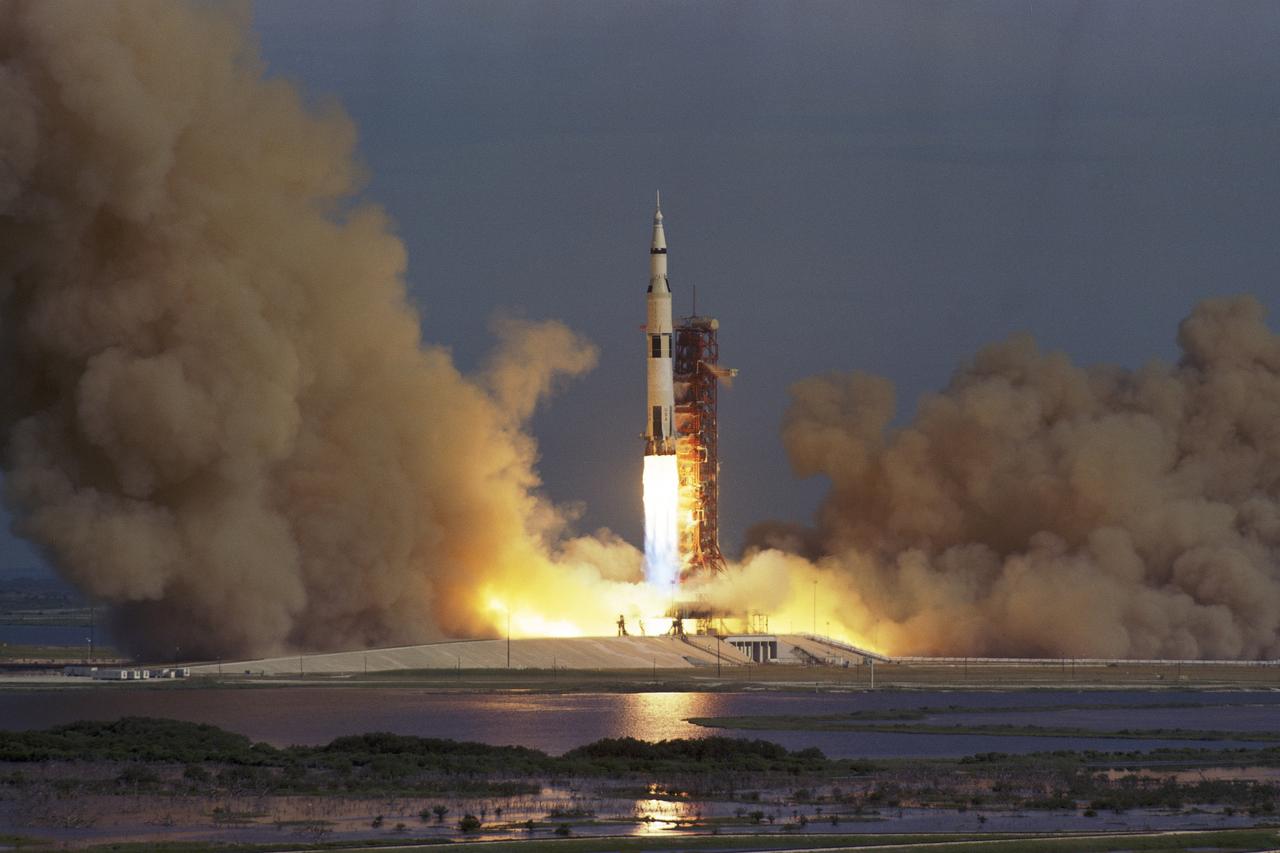
KSC · 1971-07-26 · KSC-71PC-0685
KSC-71PC-0685
CAPE CANAVERAL, Fla. - At NASA's Kennedy Space Center in Florida, Apollo 15's Saturn V rocket lifts off from Launch Pad 39A at 9:34 a.m., EDT, July 26,…
Inspect NASA record
CAPE CANAVERAL, Fla. - At NASA's Kennedy Space Center in Florida, Apollo 15's Saturn V rocket lifts off from Launch Pad 39A at 9:34 a.m., EDT, July 26, 1971, on a lunar landing mission. Aboard the Apollo 15 spacecraft are astronauts David R. Scott, commander, Alfred M. Worden, command module pilot, and James B. Irwin, lunar module pilot. While Apollo 15 astronauts Scott and Irwin will descend in the lunar module to explore the moon's Hadley-Apennine region, astronaut Worden will remain in lunar orbit with the command module. For more information, visit http://www-pao.ksc.nasa.gov/history/apollo/apollo-15/apollo-15.htm Photo credit: NASA
- Record ID
- KSC-71PC-0685
- NASA center
- KSC
- Date
- 1971-07-26
- Keywords
- Kennedy History, Apollo, Launch Complex 39A
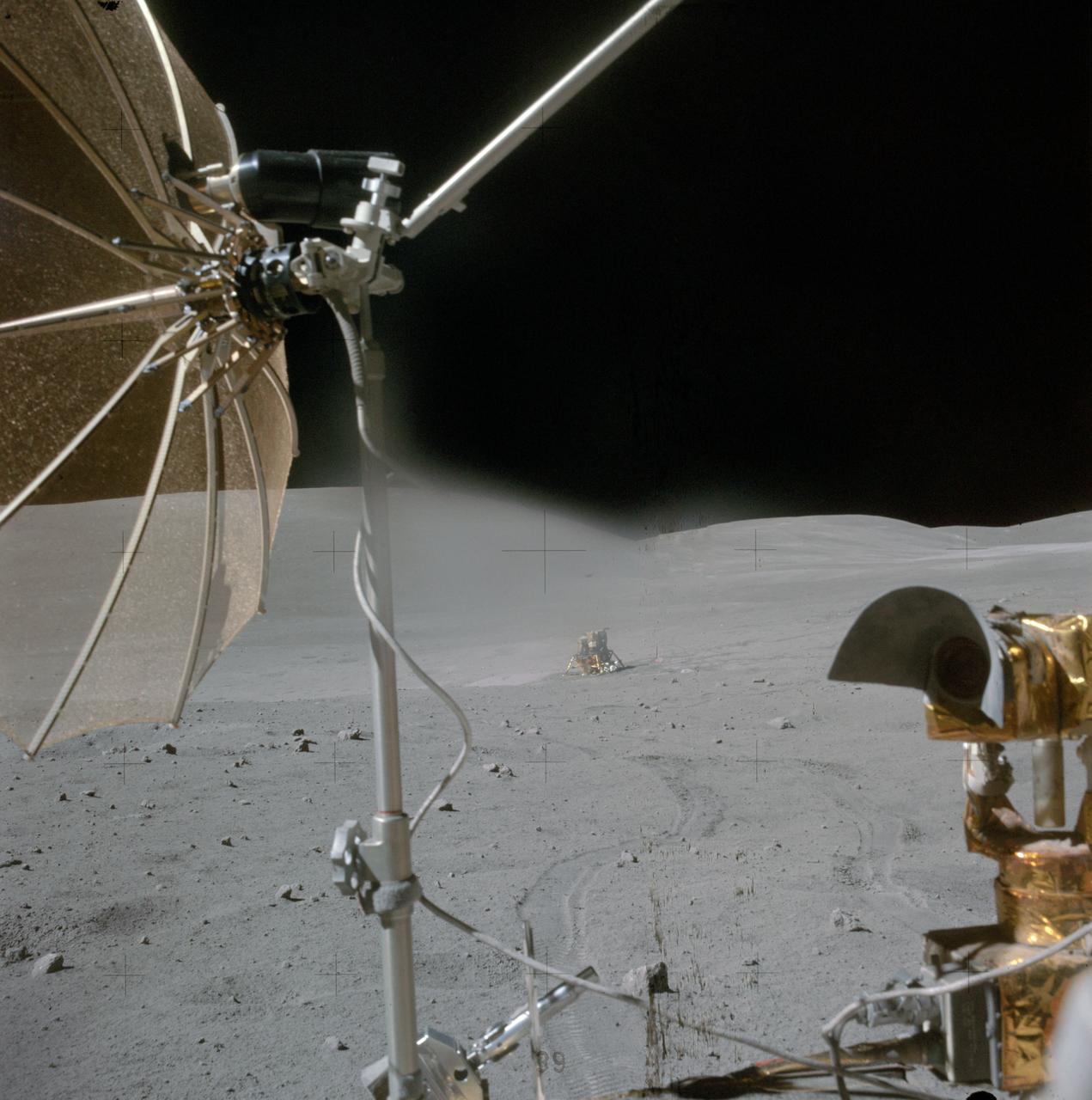
JSC · 1972-04-23 · as16-116-18678
Apollo 16 lunar module "Orion" photographed from distance during EVA
AS16-116-18678 (23 April 1972) --- A view from the moving Apollo 16 Lunar Roving Vehicle (LRV) as the crew men headed "home" at the end of the mission's…
Inspect NASA record
AS16-116-18678 (23 April 1972) --- A view from the moving Apollo 16 Lunar Roving Vehicle (LRV) as the crew men headed "home" at the end of the mission's third and final extravehicular activity (EVA). Astronaut John W. Young called attention to the series of block fields between the Lunar Module (LM) and LRV. Young also noted that, "The LM was obviously sitting in the only flat place around." Stone Mountain stretches about half way across the background. The high gain antenna and the RCA television camera on the LRV are in the foreground. While astronauts Young, commander; and Charles M. Duke Jr., lunar module pilot; descended in the Apollo 16 LM "Orion" to explore the Descartes highlands landing site on the moon, astronaut Thomas K. Mattingly II, command module pilot, remained with the Command and Service Modules (CSM) "Casper" in lunar orbit.
- Record ID
- as16-116-18678
- NASA center
- JSC
- Date
- 1972-04-23
- Keywords
- APOLLO 16 FLIGHT, APOLLO PROJECT, CAMERAS, EXTRAVEHICULAR ACTIVITY, LUNAR MODULE, LUNAR PHOTOGRAPHY, LUNAR ROVING VEHICLES, LUNAR SURFACE TELEVISION SYSTEMS
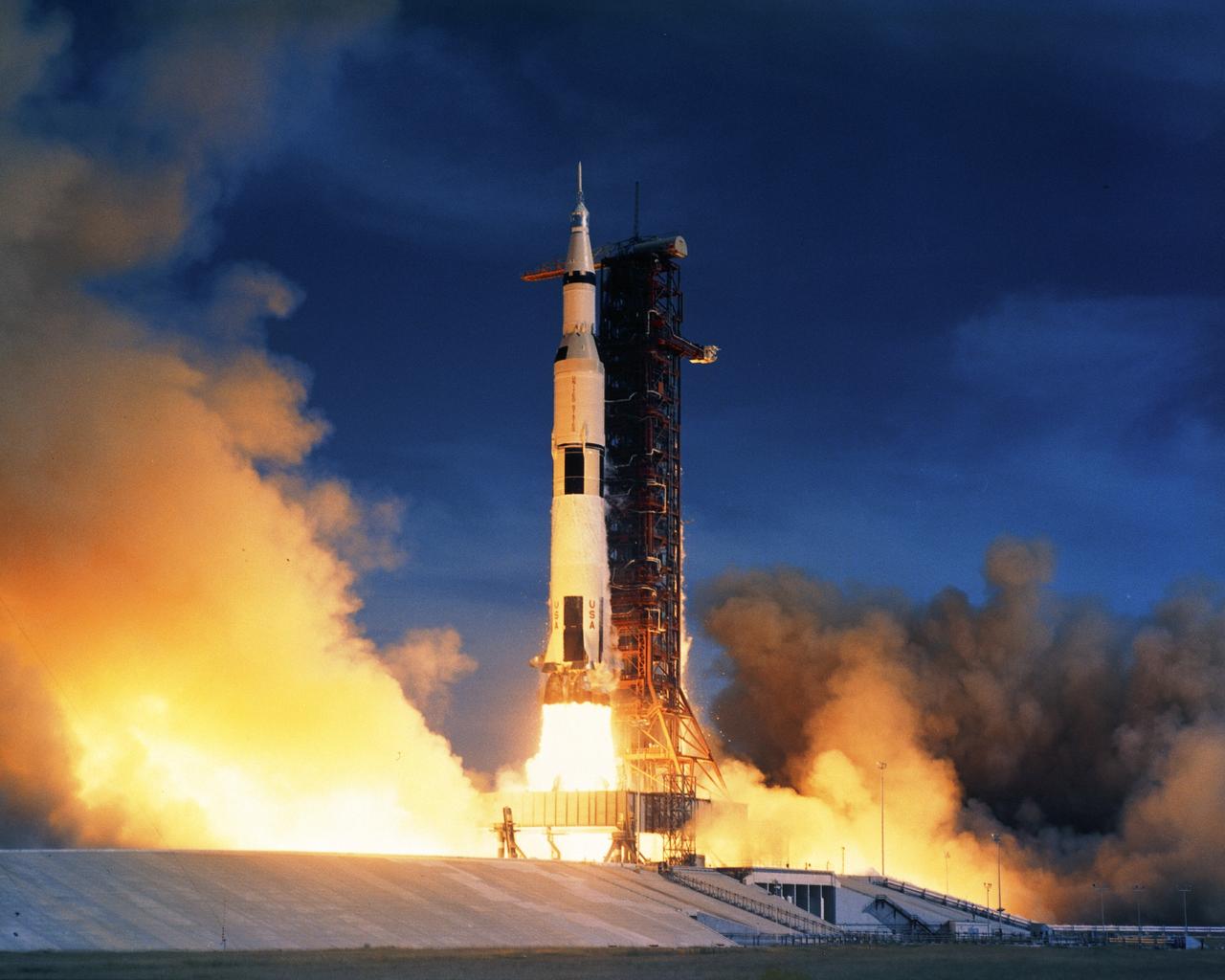
KSC · 1971-07-26 · KSC-71PC-0571
KSC-71PC-0571
CAPE CANAVERAL, Fla. - At NASA's Kennedy Space Center in Florida, Apollo 15's Saturn V rocket lifts off from Launch Pad 39A at 9:34 a.m., EDT, July 26,…
Inspect NASA record
CAPE CANAVERAL, Fla. - At NASA's Kennedy Space Center in Florida, Apollo 15's Saturn V rocket lifts off from Launch Pad 39A at 9:34 a.m., EDT, July 26, 1971, on a lunar landing mission. Aboard the Apollo 15 spacecraft are astronauts David R. Scott, commander, Alfred M. Worden, command module pilot, and James B. Irwin, lunar module pilot. While Apollo 15 astronauts Scott and Irwin will descend in the lunar module to explore the moon's Hadley-Apennine region, astronaut Worden will remain in lunar orbit with the command module. For more information, visit http://www-pao.ksc.nasa.gov/history/apollo/apollo-15/apollo-15.htm Photo credit: NASA
- Record ID
- KSC-71PC-0571
- NASA center
- KSC
- Date
- 1971-07-26
- Keywords
- Kennedy History, Apollo, Launch Complex 39A
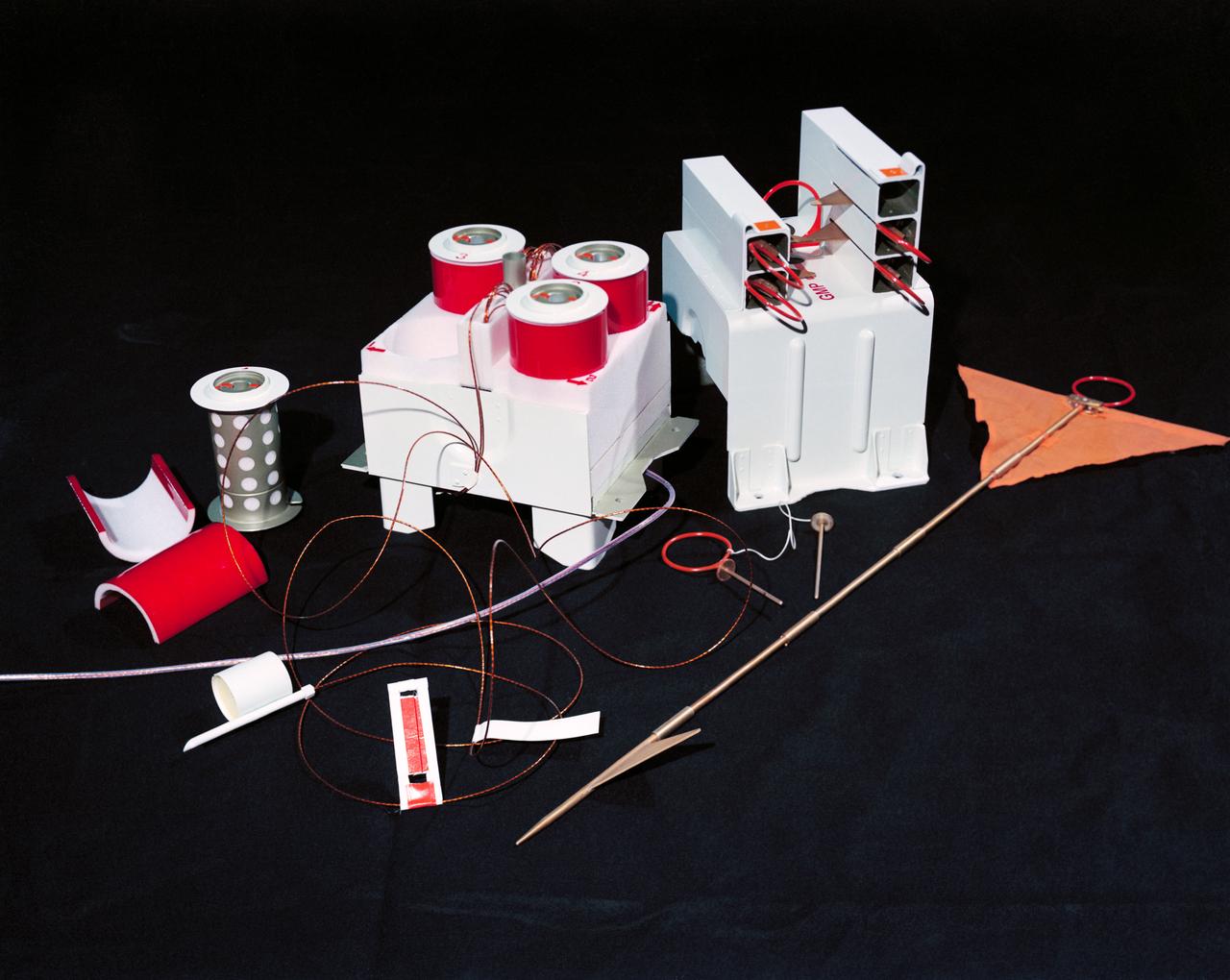
JSC · 1972-11-30 · S72-37259
Apollo 17 Lunar Surface Experiment equipment
S72-37259 (November 1972) --- The Geophone Module and Cable Reels of the Lunar Seismic Profiling Experiment (S-203), a component of the Apollo Lunar Surface Experiments Package which will…
Inspect NASA record
S72-37259 (November 1972) --- The Geophone Module and Cable Reels of the Lunar Seismic Profiling Experiment (S-203), a component of the Apollo Lunar Surface Experiments Package which will be carried on the Apollo 17 lunar landing mission. LSPE components are four geophones similar to those used in an earlier active seismic experiment, an electronics package in the ALSEP central station, and eight explosive packages which will be deployed during the geology traverse. The four geophones will be placed one in the center and one at each corner of a 90-meter equilateral triangle. Explosive charges placed on the surface will generate seismic waves of varying strengths to provide data on the structural profile of the landing site. After the charges have been fired by ground command, the experiment will settle down into a passive listening mode, detecting moonquakes, meteorite impacts and the thump caused by the Lunar Module ascent stage impact.
- Record ID
- S72-37259
- NASA center
- JSC
- Date
- 1972-11-30
- Keywords
- ANTENNAS, APOLLO 17 FLIGHT, APOLLO PROJECT, EQUIPMENT, MEASUREMENT, RECEIVERS, RECORDERS, SEISMOGRAPHS, SPACEBORNE EXPERIMENTS, TRANSMITTERS
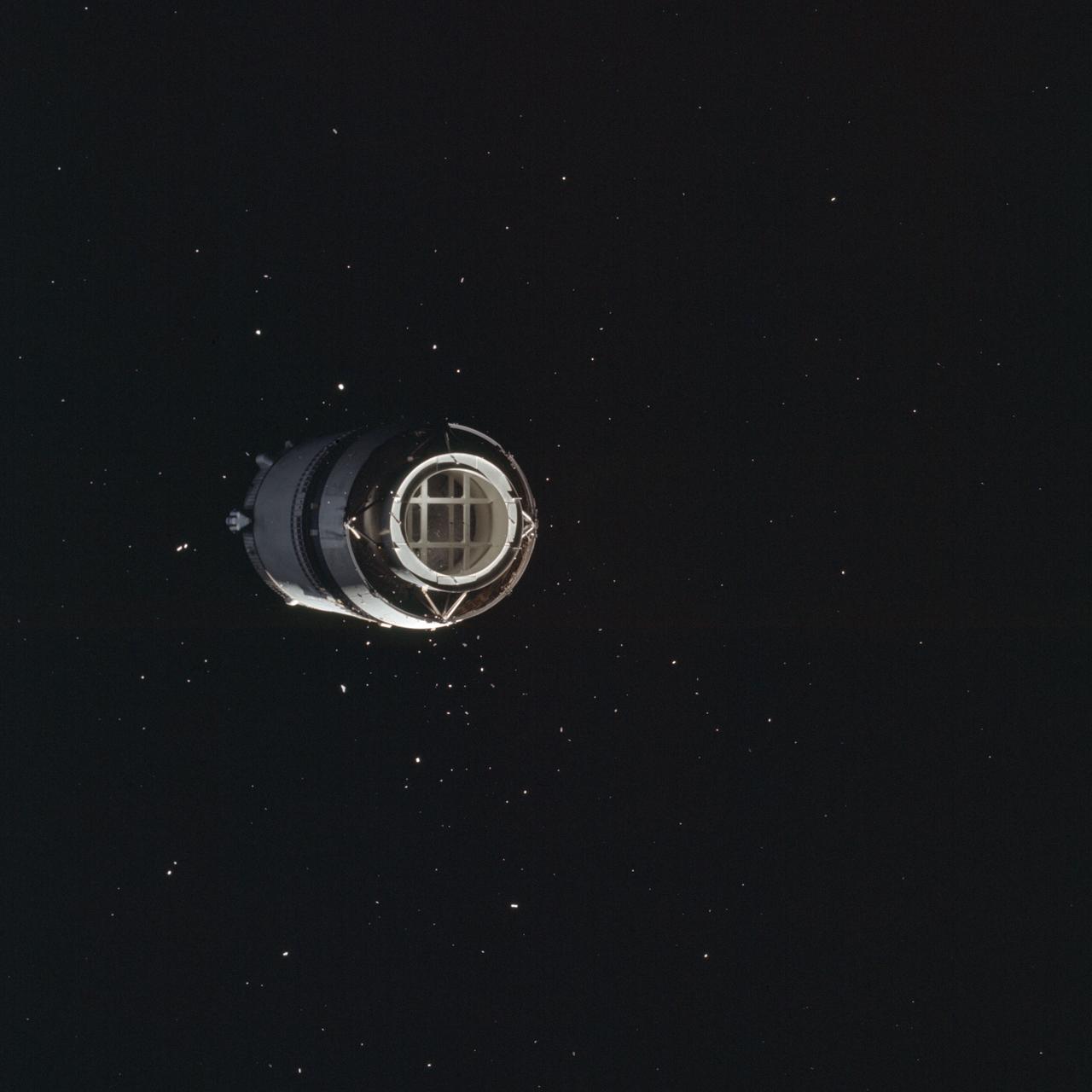
JSC · 1968-12-21 · as08-16-2583
View of the Saturn V third stage from which the Apollo 8 has separated
AS08-16-2583 (21 Dec. 1968) --- This is a photograph taken from the Apollo 8 spacecraft looking back at the Saturn V third (S-IVB) stage from which the spacecraft…
Inspect NASA record
AS08-16-2583 (21 Dec. 1968) --- This is a photograph taken from the Apollo 8 spacecraft looking back at the Saturn V third (S-IVB) stage from which the spacecraft had just separated following trans-lunar injection. Attached to the S-IVB is the Lunar Module Test Article (LTA) which simulated the mass of a Lunar Module (LM) on the Apollo 8 lunar orbit mission. The 29-feet panels of the Spacecraft LM Adapter which enclosed the LTA during launch have already been jettisoned and are out of view. Sunlight reflected from small particles shows the "firefly" phenomenon which was reported by astronaut John H. Glenn Jr. during the first Earth-orbital flight, Mercury-Atlas 6 (MA-6) of the Mercury Program.
- Record ID
- as08-16-2583
- NASA center
- JSC
- Date
- 1968-12-21

MAF · 2019-11-05 · MAF_20191105_P_Eng3_epb-4
NASA Michoud Crews Attach Third RS-25 Engine to Artemis I Rocket Stage
This photo shows the third of four RS-25 engines attached to the core stage for NASA’s Space Launch System rocket for the agency’s Artemis I mission to the…
Inspect NASA record
This photo shows the third of four RS-25 engines attached to the core stage for NASA’s Space Launch System rocket for the agency’s Artemis I mission to the Moon. NASA, Boeing and Aerojet Rocketdyne crews at NASA’s Michoud Assembly Facility in New Orleans attached the third RS-25 engine to the core stage for the SLS rocket on Nov. 5. The engine is one of four RS-25 engines that will provide more than 2 million pounds of thrust to send Artemis I, the first mission of SLS and NASA’s Orion spacecraft, to the Moon. The first two RS-25 engines were structurally mated to the stage in October. Following the mate, engineers and technicians will integrate the propulsion and electrical systems within the structures to complete the installation. Integration of the RS-25 engines to the recently completed core stage structure is a collaborative, multistep process for NASA and its partners Boeing, the core stage lead contractor, and Aerojet Rocketdyne, the RS-25 engines lead contractor. Offering more payload mass, volume capability and energy to speed missions through space, the SLS rocket, along with NASA’s Gateway in lunar orbit and Orion, is part of NASA’s backbone for deep space exploration and the Artemis lunar program. No other rocket is capable of carrying astronauts in Orion around the Moon in a single mission.
- Record ID
- MAF_20191105_P_Eng3_epb-4
- NASA center
- MAF
- Date
- 2019-11-05
- Credit
- ERIC BORDELON
- Keywords
- Artemis, Artemis-1, Boeing, Corestage, Eric Bordelon, MAF, Michoud Assembly Facility, NASA, New Orleans, SLS
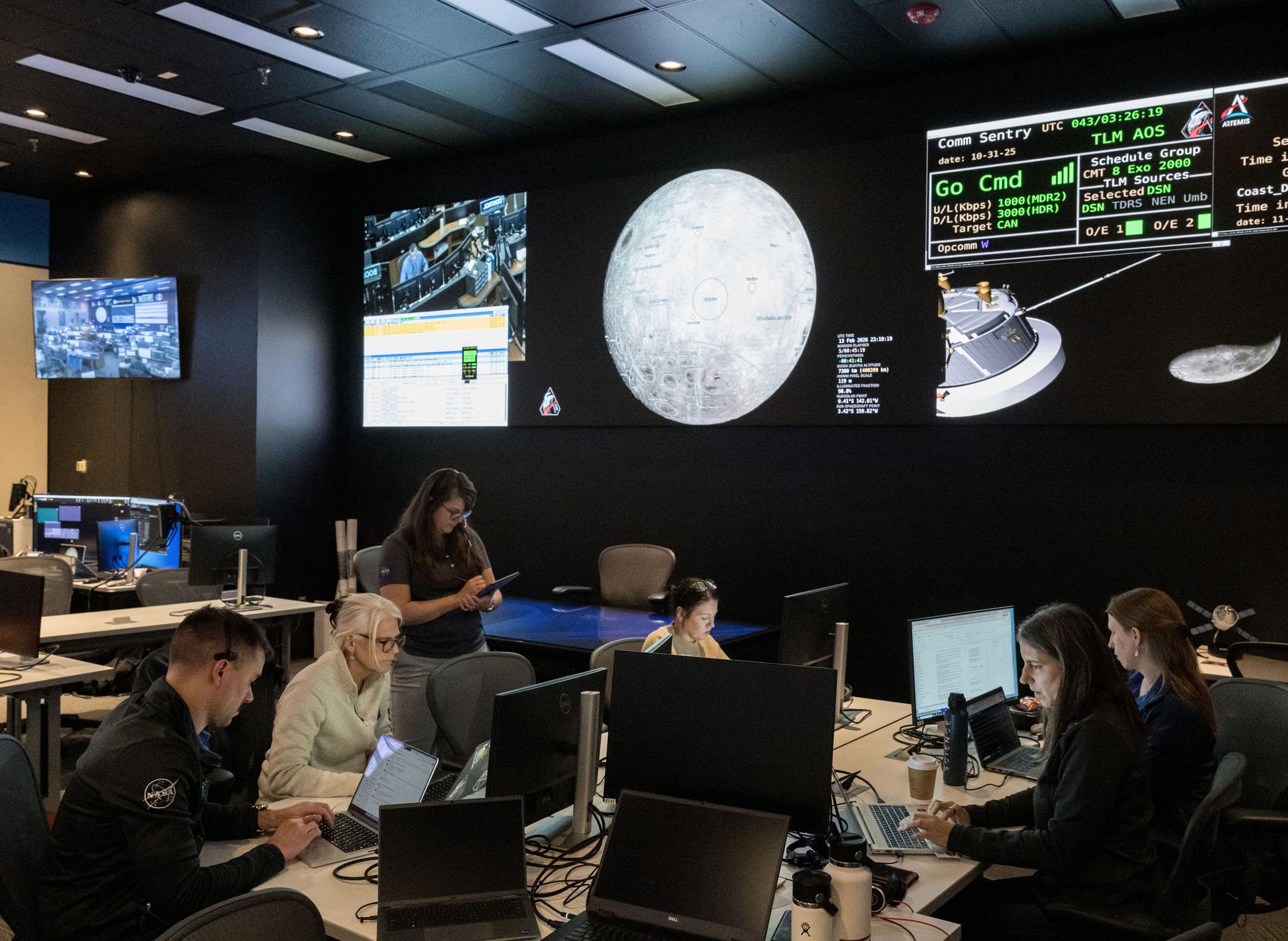
JSC · 2026-01-12 · jsc2026e000849
Artemis II Science Evaluation Room -- jsc2026e000849
jsc2026e000849 --- The Artemis II Lunar Science Team works in the Science Evaluation Room (SER) during a training simulation at the NASA’s Johnson Space Center in Houston. Located…
Inspect NASA record
jsc2026e000849 --- The Artemis II Lunar Science Team works in the Science Evaluation Room (SER) during a training simulation at the NASA’s Johnson Space Center in Houston. Located in the Christopher C. Kraft Jr. Mission Control Center, the SER supports the mission’s main flight control room for lunar science and planetary observations. Built specifically for Artemis missions with these science priorities in mind, the SER is equipped to support rapid data interpretation, collaborative analysis, real-time decision making, and seamless coordination between the science and operations teams. Credit: James Blair
- Record ID
- jsc2026e000849
- NASA center
- JSC
- Date
- 2026-01-12
- Credit
- James Blair - NASA - JSC
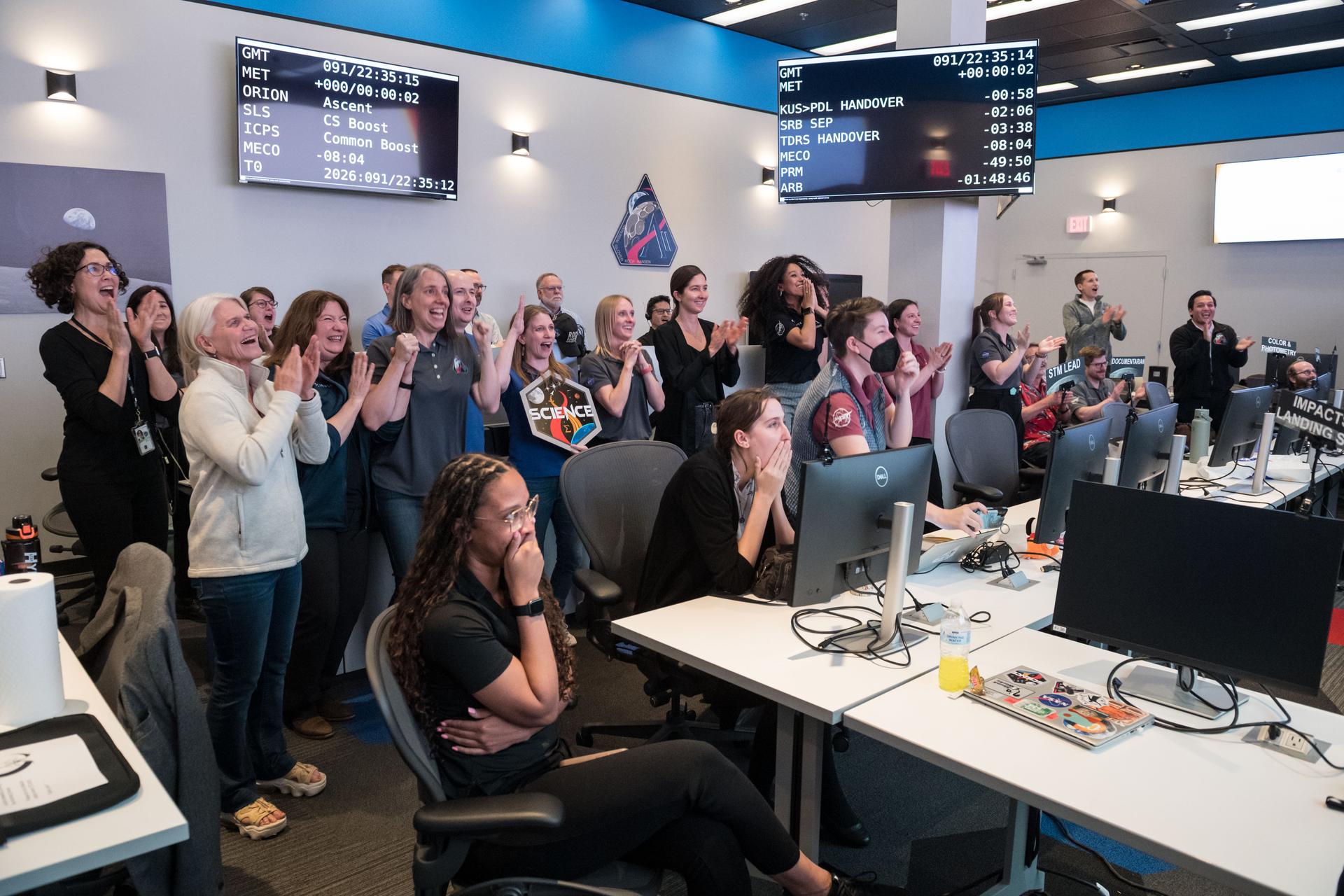
JSC · 2026-04-01 · jsc2026e019568
Artemis II lunar science team members watch launch -- jsc2026e019568
Members of the Artemis lunar science team celebrate the Artemis II launch as they watch from the Science Evaluation Room (SER) in Mission Control at NASA's Johnson Space…
Inspect NASA record
Members of the Artemis lunar science team celebrate the Artemis II launch as they watch from the Science Evaluation Room (SER) in Mission Control at NASA's Johnson Space Center in Houston. The SER supports lunar science and planetary observations for the Artemis science officer in the mission’s main flight control room. Built specifically for Artemis missions with these science priorities in mind, the SER is equipped to support rapid data interpretation, collaborative analysis, real-time decision making, and seamless coordination between the science and operations teams. Credits: NASA/Mark Sowa.
- Record ID
- jsc2026e019568
- NASA center
- JSC
- Date
- 2026-04-01
- Credit
- Mark Sowa - NASA - JSC

JSC · 2026-04-01 · jsc2026e019544
Artemis II lunar science team members watch launch -- jsc2026e019544
Members of the Artemis lunar science team, from left, Sara Schmidt, Megan Borel, Amber Turner, Jacob Richardson, and Juliane Gross pose for a selfie with the Artemis II…
Inspect NASA record
Members of the Artemis lunar science team, from left, Sara Schmidt, Megan Borel, Amber Turner, Jacob Richardson, and Juliane Gross pose for a selfie with the Artemis II launch broadcast on the screen behind them in the Science Evaluation Room (SER) in Mission Control at NASA's Johnson Space Center in Houston. The SER supports lunar science and planetary observations for the Artemis science officer in the mission’s main flight control room. Built specifically for Artemis missions with these science priorities in mind, the SER is equipped to support rapid data interpretation, collaborative analysis, real-time decision making, and seamless coordination between the science and operations teams. Credits: NASA/Mark Sowa.
- Record ID
- jsc2026e019544
- NASA center
- JSC
- Date
- 2026-04-01
- Credit
- Mark Sowa - NASA - JSC
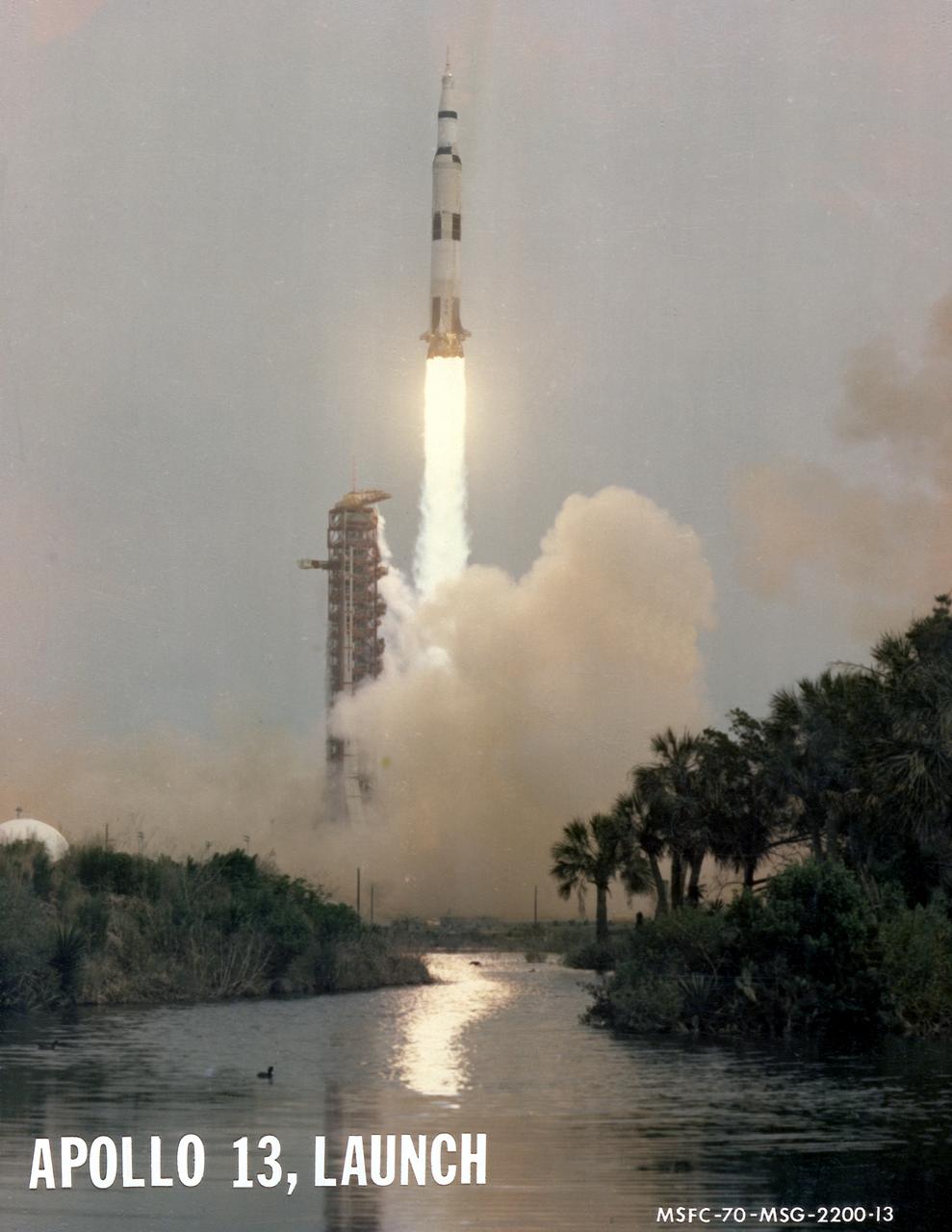
MSFC · 1970-04-11 · 0101247
Saturn Apollo Program
The third marned lunar landing mission, Apollo 13 (SA-508), with three astronauts: Mission commander James A. Lovell Jr., Lunar Module pilot Fred W. Haise Jr., and Command Module…
Inspect NASA record
The third marned lunar landing mission, Apollo 13 (SA-508), with three astronauts: Mission commander James A. Lovell Jr., Lunar Module pilot Fred W. Haise Jr., and Command Module pilot John L. Swigert Jr., lifted off from the Kennedy Space Center launch complex 39A on April 11, 1970. The mission was aborted after 56 hours of flight, 205,000 miles from Earth, when an oxygen tank in the service module exploded. The Command Module, Odyssey, carrying the three astronauts, safely splashed down in the Pacific Ocean at 1:08 p.m. EST, April 17, 1970.
- Record ID
- 0101247
- NASA center
- MSFC
- Date
- 1970-04-11
- Keywords
- Apollo 13, Launch, Lovell, Haise, Swigert

JSC · 2026-04-01 · jsc2026e019571
Artemis II lunar science team members watch launch -- jsc2026e019571
Members of the Artemis lunar science team, from left, Ariel Deutsch, Amber Turner, and Wilfredo Garcia-Lopez, watch the Artemis II launch from the Science Evaluation Room (SER) in…
Inspect NASA record
Members of the Artemis lunar science team, from left, Ariel Deutsch, Amber Turner, and Wilfredo Garcia-Lopez, watch the Artemis II launch from the Science Evaluation Room (SER) in Mission Control at Johnson Space Center in Houston. The SER supports lunar science and planetary observations for the Artemis science officer in the mission’s main flight control room. Built specifically for Artemis missions with these science priorities in mind, the SER is equipped to support rapid data interpretation, collaborative analysis, real-time decision making, and seamless coordination between the science and operations teams. Credits: NASA/Mark Sowa.
- Record ID
- jsc2026e019571
- NASA center
- JSC
- Date
- 2026-04-01
- Credit
- Mark Sowa - NASA - JSC