
Update Site (from NASA)
Explore NASA’s Image and Video Library.
Suggest one object per day for the Interstellar Minds collection. We review each suggestion before adding it.
Sign in to suggest a Marvel.
Find a NASA image ID. Open a NASA record and copy its ID from the end of the details URL.
NASA image records

JSC · 2026-04-06 · jsc2026e020757
Ernie Wright, Artemis II lunar science visualization lead -- jsc2026e020757
Ernie Wright, Artemis II lunar science visualization lead, reacts to hearing the astronauts describe features of the Moon as they few by on April 6, 2026. To prepare…
Inspect NASA record
Ernie Wright, Artemis II lunar science visualization lead, reacts to hearing the astronauts describe features of the Moon as they few by on April 6, 2026. To prepare the crew for this mission, the Artemis II lunar science team trained the astronauts in geology, both in the classroom and in the field. They also built the lunar targeting plan that, which, like an International Space Station spacewalk plan, provides strong, detailed observation guidance, plus flexibility for the crew to make decisions based on what they’re seeing and experiencing in real time. The science team had many moments of celebration during the lunar flyby as the astronauts took images of the Moon and provided verbal descriptions of what they were seeing. This type of information reveals the geologic history of an area and will be critical to collect when future Artemis astronauts explore the Moon's surface. Credits: NASA/Luna Posadas Nava
- Record ID
- jsc2026e020757
- NASA center
- JSC
- Date
- 2026-04-06
- Credit
- NASA/PHOTO_ LUNA_POSADAS_N
- Keywords
- Artemis, Artemis II, Lunar science, lunar geography, lunar flyby, Moon, Science Evaluation Room

KSC · 1969-07-16 · ksc-69pc-395
ksc-69pc-395
KENNEDY SPACE CENTER, FLA. -- The Apollo 11 Saturn V space vehicle lifts off with Astronauts Neil A. Armstrong, Michael Collins and Edwin E. Aldrin Jr. at 9:32…
Inspect NASA record
KENNEDY SPACE CENTER, FLA. -- The Apollo 11 Saturn V space vehicle lifts off with Astronauts Neil A. Armstrong, Michael Collins and Edwin E. Aldrin Jr. at 9:32 a.m. EDT July 16, 1969, from Kennedy Space Center's Launch Complex 39A. During the planned eight-day mission, Armstrong and Aldrin will descend in a lunar module to the Moon's surface while Collins orbits overhead in the command module. The two astronauts are to spend 22 hours on the Moon, including two and one-half hours outside the lunar module. They will gather samples of lunar material and willl deploy scientific experiments which will transmit data about the lunar environment. They will rejoin Collins in the command module for the return trip to Earth
- Record ID
- ksc-69pc-395
- NASA center
- KSC
- Date
- 1969-07-16

JSC · 1969-07-24 · s69-21698
Recovery - Apollo 11
S69-21698 (24 July 1969) --- The three Apollo 11 crew men await pickup by a helicopter from the USS Hornet, prime recovery ship for the historic Apollo 11…
Inspect NASA record
S69-21698 (24 July 1969) --- The three Apollo 11 crew men await pickup by a helicopter from the USS Hornet, prime recovery ship for the historic Apollo 11 lunar landing mission. The fourth man in the life raft is a United States Navy underwater demolition team swimmer. All four men are wearing biological isolation garments. Apollo 11, with astronauts Neil A. Armstrong, commander; Michael Collins, command module pilot; and Edwin E. Aldrin Jr., lunar module pilot, onboard, splashed down at 11:49 a.m. (CDT), July 24, 1969, about 812 nautical miles southwest of Hawaii and only 12 nautical miles from the USS Hornet. While astronauts Armstrong and Aldrin descended in the Lunar Module (LM) "Eagle" to explore the Sea of Tranquility region of the moon, astronaut Collins remained with the Command and Service Modules (CSM) "Columbia" in lunar orbit.
- Record ID
- s69-21698
- NASA center
- JSC
- Date
- 1969-07-24
JSC · 1972-05-10 · S72-37260
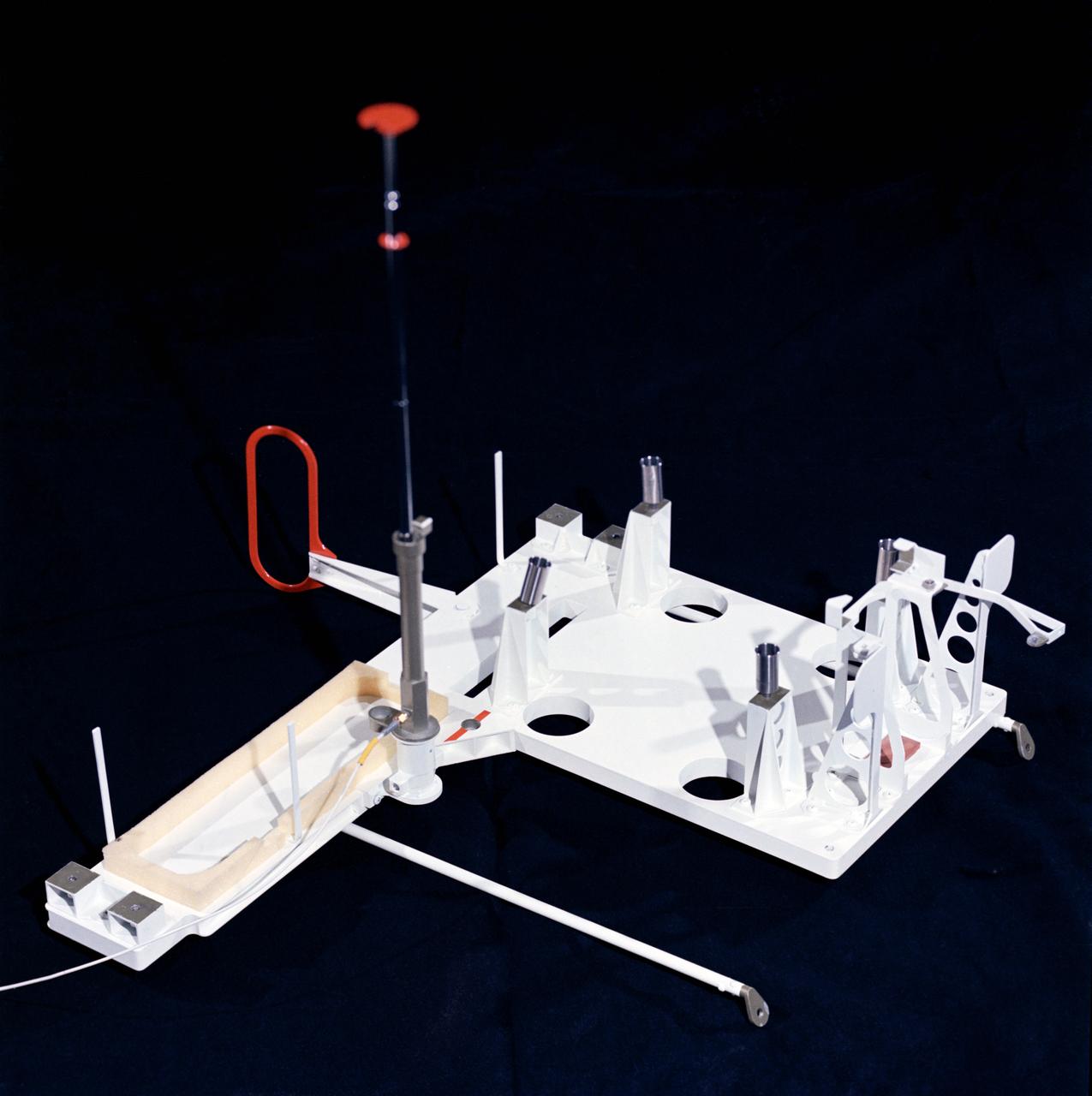
Apollo 17 Lunar Surface Experiments package
S72-37260 (November 1972) --- The remote antenna for the Lunar Seismic Profiling Experiment, Numbered S-203, a component of the Apollo Lunar Surface Experiments Package which will be carried…
Inspect NASA record
S72-37260 (November 1972) --- The remote antenna for the Lunar Seismic Profiling Experiment, Numbered S-203, a component of the Apollo Lunar Surface Experiments Package which will be carried on the Apollo 17 lunar landing mission. LSPE components are four geophones similar to those used in earlier active seismic experiments an electronics package in the ALSEP central station, and eight explosive packages which will be deployed during the geology traverse. The four geophones will be placed one in the center and at each corner of a 90-meter equilateral triangle. Explosive charges placed on the surface will generate seismic waves of varying strengths to provide data on the structural profile of the landing site. After the charges have been fired by ground command, the experiment will settle down into a passive listening mode, detecting moonquakes, meteorite impacts and the thump caused by the Lunar Module ascent stage impact. The antenna is of the telescoping type.
- Record ID
- S72-37260
- NASA center
- JSC
- Date
- 1972-05-10
JSC · 1970-09-18 · S70-19764
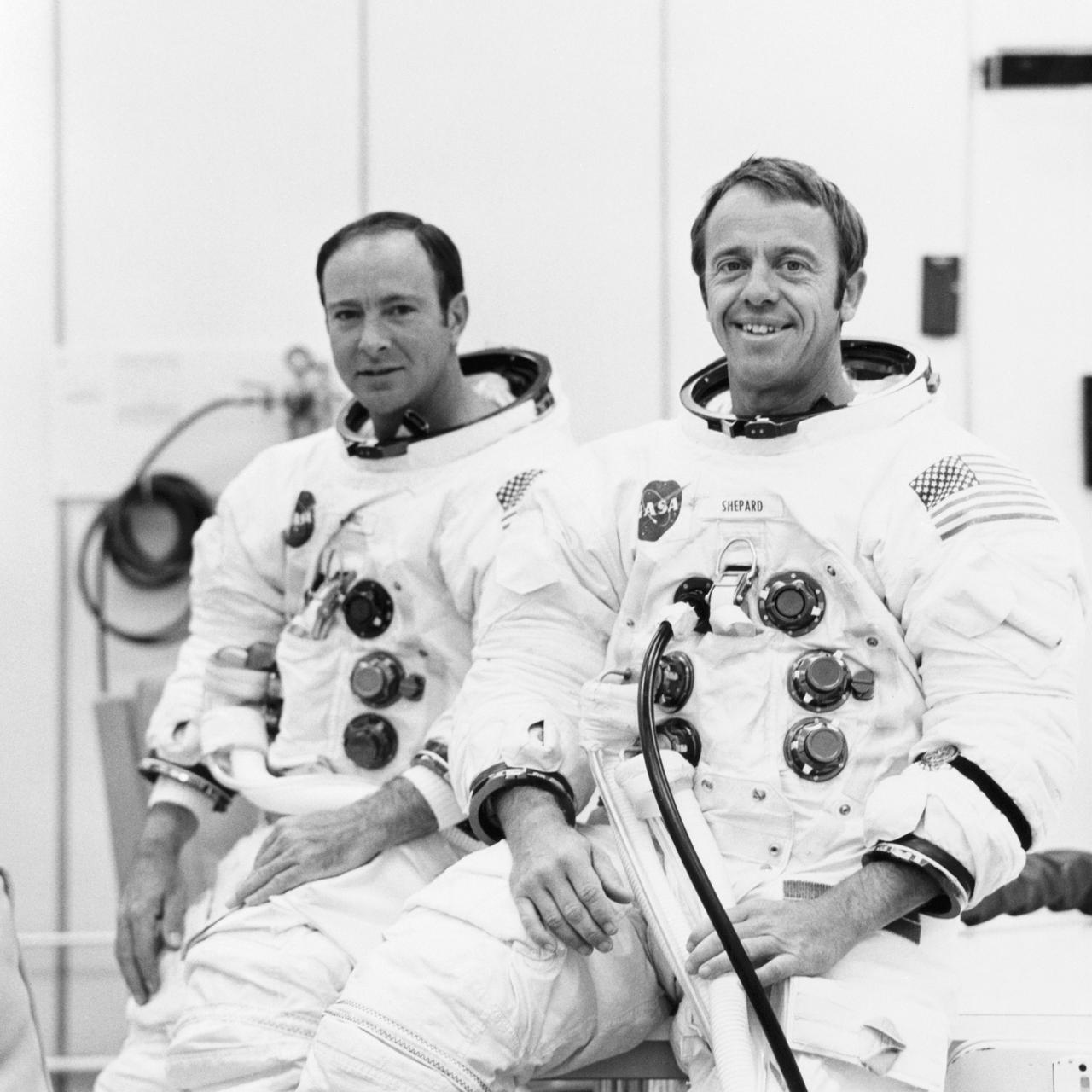
ALTITUDE TESTS - ASTRONAUTS SHEPARD AND MITCHELL - KSC
S70-19764 (18 Sept. 1970) --- Astronauts Alan B. Shepard Jr. (right), commander, and Edgar D. Mitchell, lunar module pilot, are suited up for a manned altitude run in…
Inspect NASA record
S70-19764 (18 Sept. 1970) --- Astronauts Alan B. Shepard Jr. (right), commander, and Edgar D. Mitchell, lunar module pilot, are suited up for a manned altitude run in the Apollo 14 Lunar Module. The manned run in a vacuum chamber of the Manned Spacecraft Operations Building was conducted to validate the LM's communications and guidance and navigation systems. Apollo 14 is scheduled for launch from Cape Kennedy on Jan. 31, 1971, on a lunar exploration mission which is to carry Shepard and Mitchell down to the moon's rugged Fra Maura highlands region. Astronaut Stuart A. Roosa, command module pilot, will remain with the Apollo 14 Command and Service Modules in lunar orbit while the other two astronauts explore the moon.
- Record ID
- S70-19764
- NASA center
- JSC
- Date
- 1970-09-18
KSC · 1998-01-06 · KSC-lp020
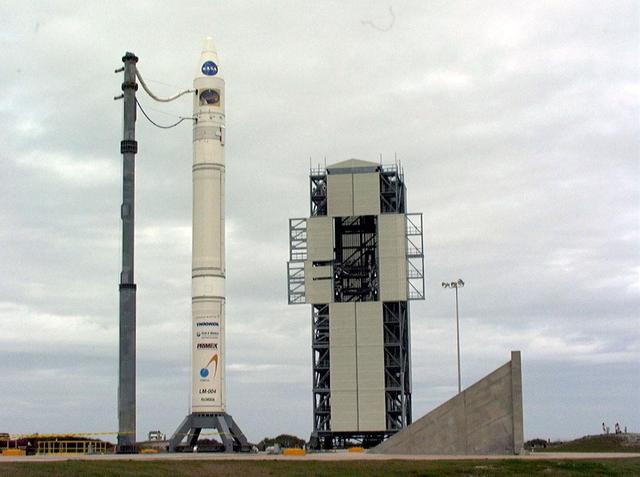
KSC-lp020
NASA’s Lunar Prospector is readied for launch as its gantry-like service tower is rolled back again at Cape Canaveral Air Station’s Launch Complex 46. The launch, previously scheduled…
Inspect NASA record
NASA’s Lunar Prospector is readied for launch as its gantry-like service tower is rolled back again at Cape Canaveral Air Station’s Launch Complex 46. The launch, previously scheduled for Jan. 5, was postponed one day due to a problem with a range safety radar located at Patrick Air Force Base, Fla. Lunar Prospector, built for the NASA Ames Research Center by Lockheed Martin, is a spin-stabilized spacecraft designed to provide NASA with the first global maps of the Moon’s surface and its gravitational magnetic fields, as well as look for the possible presence of ice near the lunar poles. It will orbit the Moon at an altitude of approximately 63 miles during a one-year mission. The launch of Lunar Prospector is now scheduled for Jan. 6, 1998 at 9:28 p.m. EST
- Record ID
- KSC-lp020
- NASA center
- KSC
- Date
- 1998-01-06
JSC · 1972-12-12 · as17-145-22165
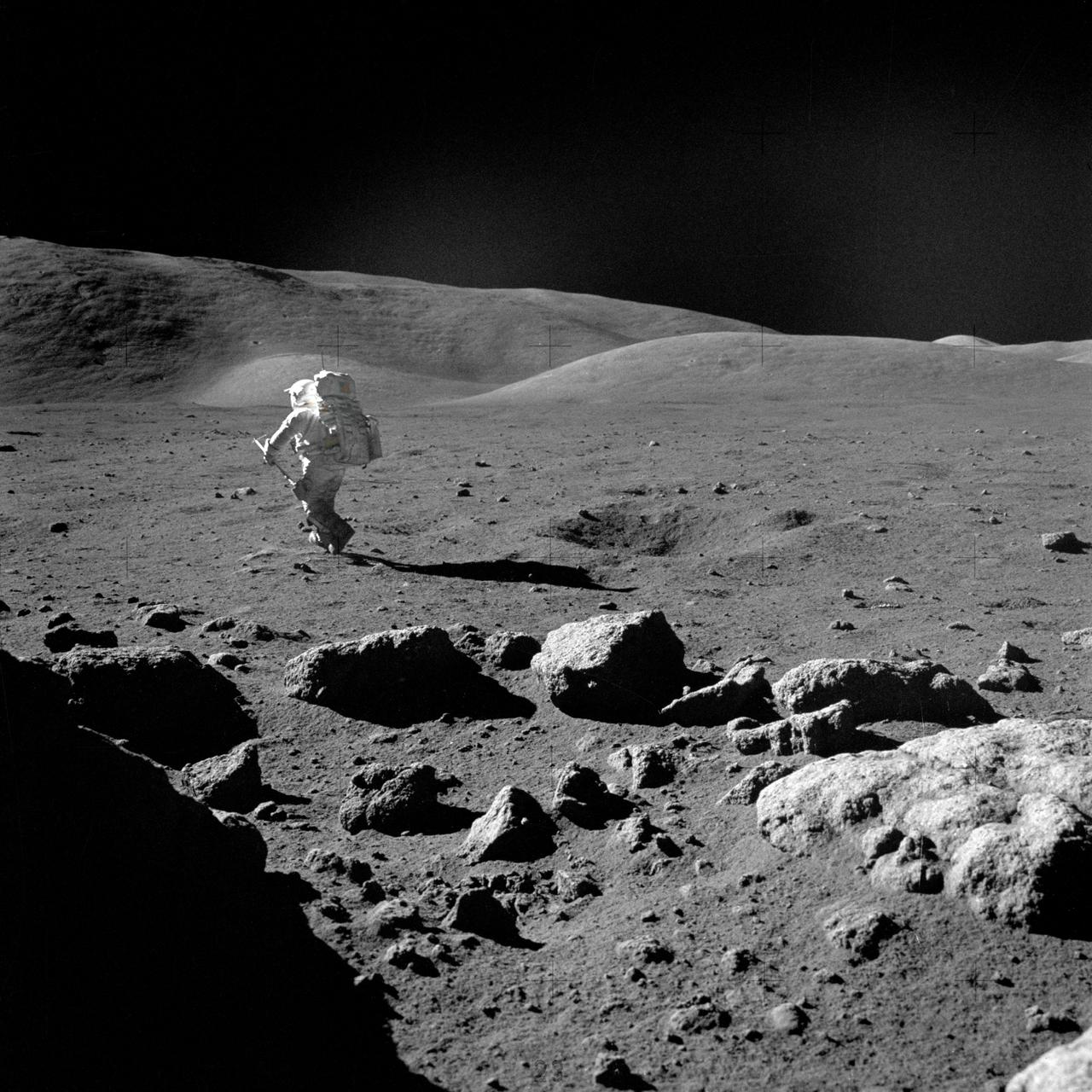
Astronaut Harrison Schmitt retrieving lunar samples during EVA
AS17-145-22165 (12 Dec. 1972) --- Scientist-astronaut Harrison H. Schmitt, lunar module pilot, with his adjustable sampling scoop, heads for a selected rock on the lunar surface to retrieve…
Inspect NASA record
AS17-145-22165 (12 Dec. 1972) --- Scientist-astronaut Harrison H. Schmitt, lunar module pilot, with his adjustable sampling scoop, heads for a selected rock on the lunar surface to retrieve the sample for study. The action was photographed by Apollo 17 crew commander, astronaut Eugene A. Cernan on the mission's second extravehicular activity (EVA), at Station 5 at the Taurus-Littrow landing site. Cernan used a 70mm Hasselblad camera equipped with a 60mm lens and type SO-368 color film for this photograph. While astronauts Cernan and Schmitt descended in the Lunar Module (LM) "Challenger" to explore the Taurus-Littrow region of the moon, astronaut Ronald E. Evans, command module pilot, remained with the Command and Service Modules (CSM) "America" in lunar orbit.
- Record ID
- as17-145-22165
- NASA center
- JSC
- Date
- 1972-12-12
- Keywords
- APOLLO 17 FLIGHT, APOLLO PROJECT, ASTRONAUTS, COLLECTION, EQUIPMENT, SAMPLES EXTRAVEHICULAR ACTIVITY, EXTRAVEHICULAR MOBILITY UNITS, LUNAR ROCKS LUNAR SOIL, LUNAR SURFACE
MSFC · 1969-07-20 · 6902080
Saturn Apollo Program
The first manned lunar landing mission, Apollo 11, launched from the Kennedy Space Flight Center (KSC) in Florida via the Marshall Space Flight Center (MSFC) developed Saturn V…
Inspect NASA record
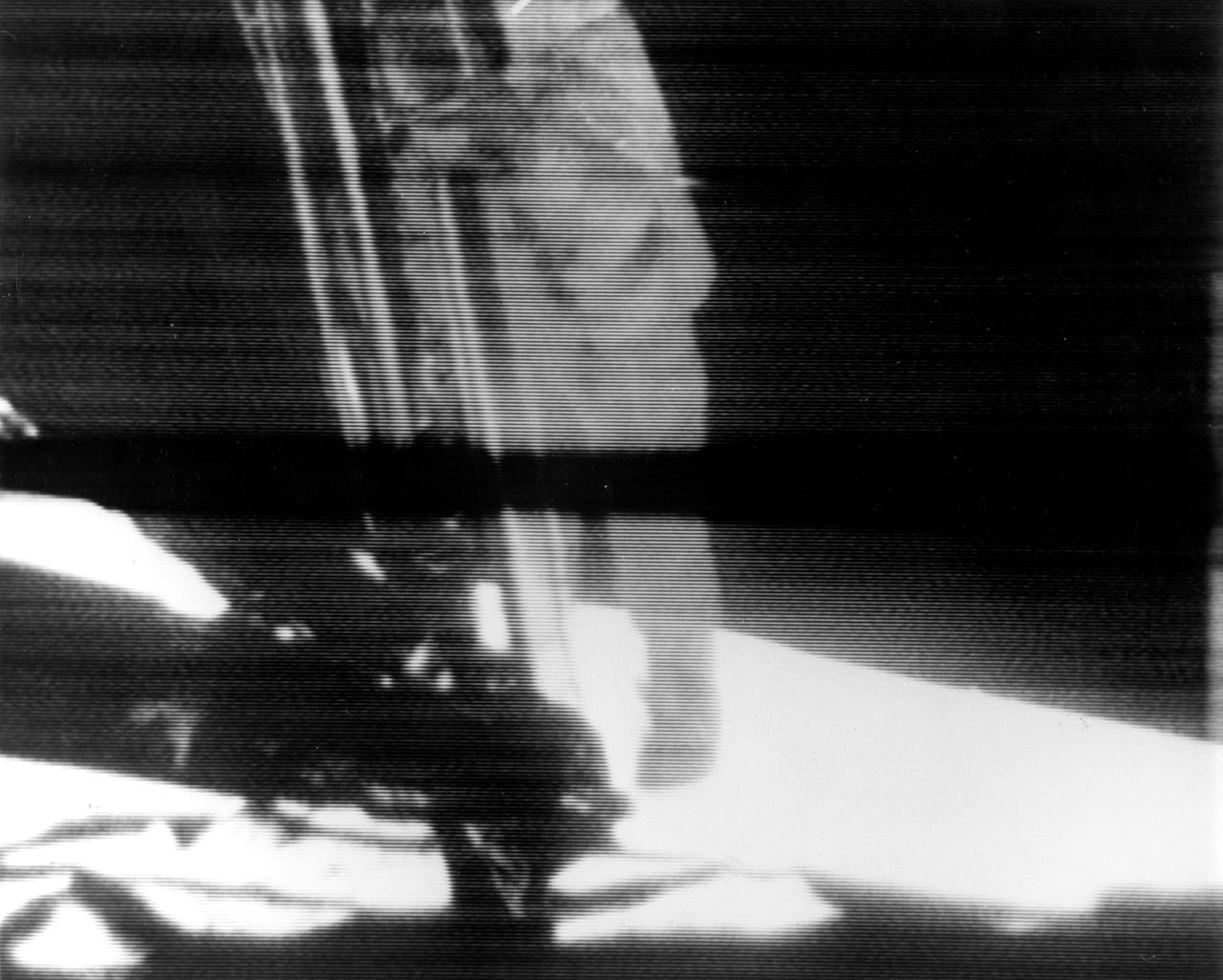
The first manned lunar landing mission, Apollo 11, launched from the Kennedy Space Flight Center (KSC) in Florida via the Marshall Space Flight Center (MSFC) developed Saturn V launch vehicle on July 16, 1969 and safely returned to Earth on July 24, 1969. Astronauts onboard included Neil A. Armstrong, commander; Michael Collins, Command Module (CM) pilot; and Edwin E. Aldrin, Jr., Lunar Module (LM) pilot. The CM, “Columbia”, piloted by Collins, remained in a parking orbit around the Moon while the LM, “Eagle’’, carrying astronauts Armstrong and Aldrin, landed on the Moon in the Sea of Tranquility. On July 20, 1969, Armstrong was the first human to ever stand on the lunar surface, followed by Aldrin. This is a reproduction of the television image that was transmitted to the world on July 20th, as Armstrong egressed the ladder to the lunar surface. The black bar running through the center of the photograph is an anomaly in the TV Ground Data System at Goldstone Tracking Station.
- Record ID
- 6902080
- NASA center
- MSFC
- Date
- 1969-07-20
- Keywords
- Apollo 11, Moon, Armstrong
KSC · 1969-07-09 · 108-KSC-69PC-0316
KSC-69PC-0316
PATRICK AFB, Fla. – Apollo 11 commander Neil A. Armstrong, left, and Donald K. Slayton, chief astronaut and director of flight crew operations, just arrived at Patrick Air…
Inspect NASA record
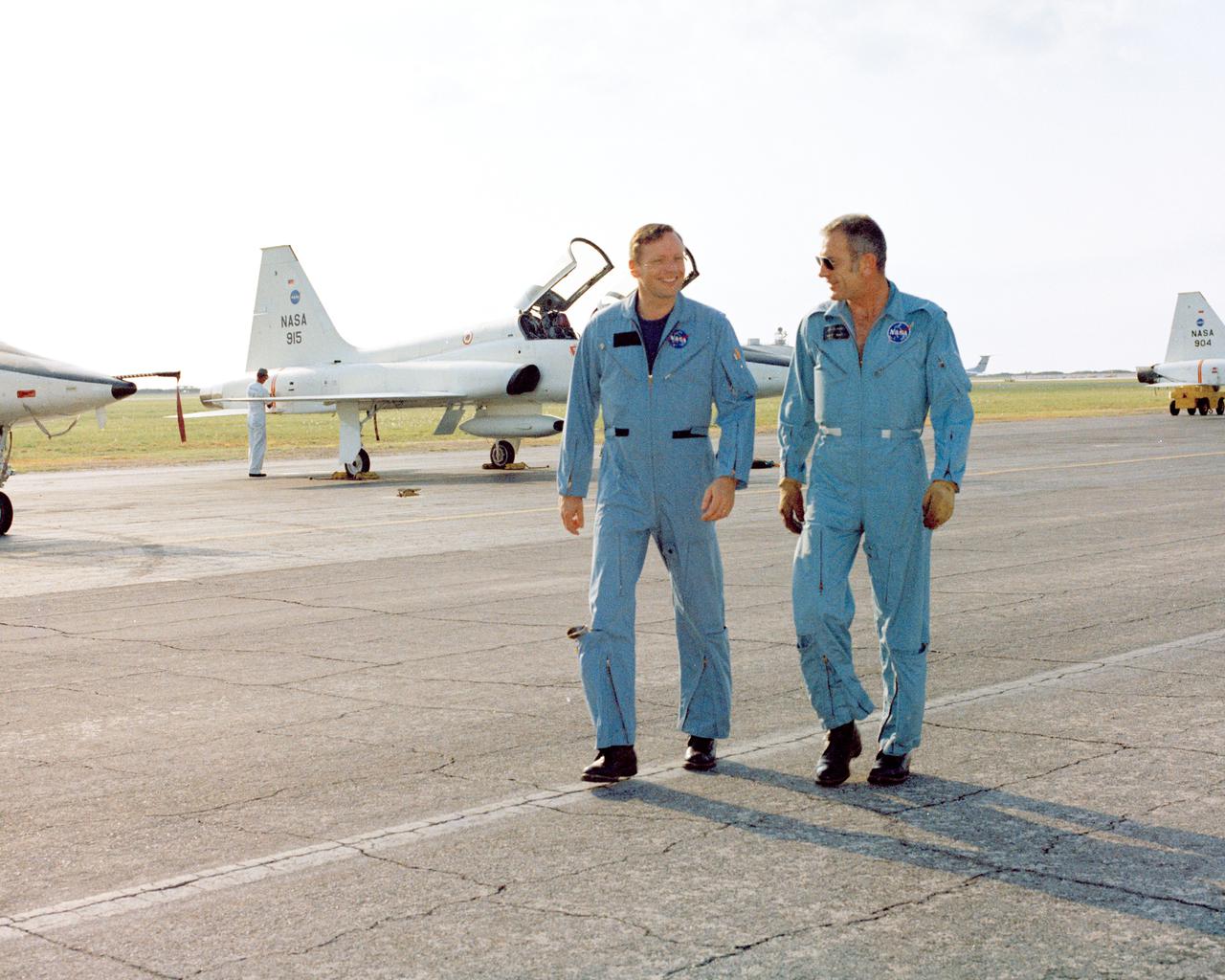
PATRICK AFB, Fla. – Apollo 11 commander Neil A. Armstrong, left, and Donald K. Slayton, chief astronaut and director of flight crew operations, just arrived at Patrick Air Force Base in a T-38 jet in preparation of the nation’s first lunar landing mission. Lift off atop a Saturn V launch vehicle is scheduled for July 16, 1969. During Apollo 11 the command module, Columbia, will remain in orbit around the moon while the lunar module, Eagle, carrying Armstrong and Aldrin, lands on the lunar surface. During 2½ hours of surface exploration, the crew plans to collect lunar surface material for analysis back on Earth. For more: http:__www-pao.ksc.nasa.gov_history_apollo_apollo-11_apollo-11.htm Photo credit: NASA
- Record ID
- 108-KSC-69PC-0316
- NASA center
- KSC
- Date
- 1969-07-09
- Credit
- NASA
- Keywords
- Kennedy_History, Apollo, KSC_Events, Apollo_11
JSC · 1972-12-12 · as17-137-20979
Close-up of lunar roving vehicle at Apollo 17 Taurus-Littrow landing site
AS17-137-20979 (12 Dec. 1972) --- A close-up view of the lunar roving vehicle (LRV) at the Taurus-Littrow landing site photographed during Apollo 17 lunar surface extravehicular activity. Note…
Inspect NASA record
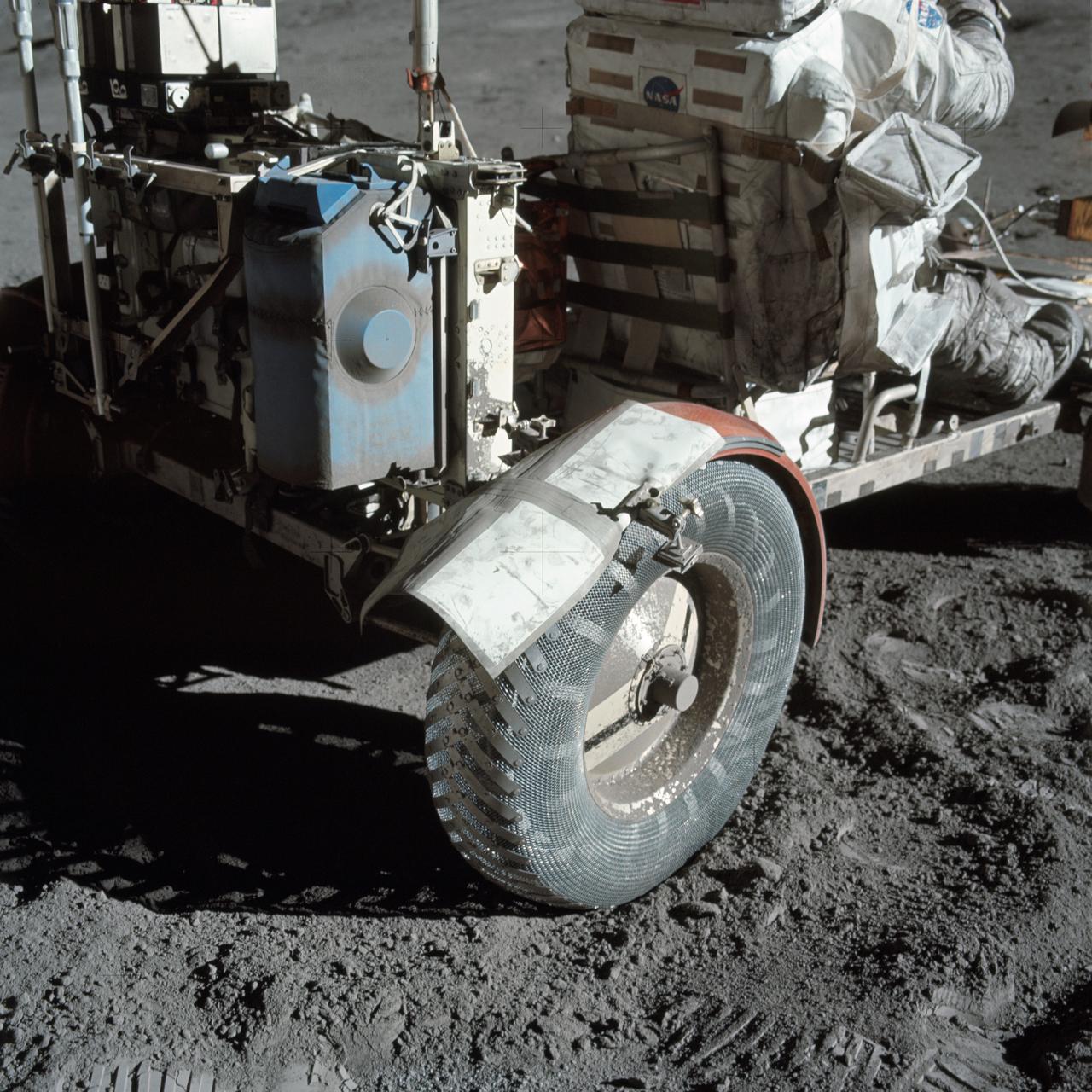
AS17-137-20979 (12 Dec. 1972) --- A close-up view of the lunar roving vehicle (LRV) at the Taurus-Littrow landing site photographed during Apollo 17 lunar surface extravehicular activity. Note the makeshift repair arrangement on the right rear fender of the LRV. During EVA-1 a hammer got underneath the fender and a part of it was knocked off. Astronauts Eugene A. Cernan and Harrison H. Schmitt were reporting a problem with lunar dust because of the damage fender. Following a suggestion from astronaut John W. Young in the Mission Control Center at Houston the crewmen repaired the fender early in EVA-2 using lunar maps and clamps from the optical alignment telescope lamp. Schmitt is seated in the rover. Cernan took this picture.
- Record ID
- as17-137-20979
- NASA center
- JSC
- Date
- 1972-12-12
- Keywords
- APOLLO 17 FLIGHT, APOLLO PROJECT, EXTRAVEHICULAR ACTIVITY, LUNAR SURFACE, LUNAR LANDING SITES, LUNAR ROVING VEHICLES, LUNAR SURFACE VEHICLES REPAIRING
KSC · 1998-01-06 · KSC-98pc104
KSC-98pc104
NASA’s Lunar Prospector is readied for launch as its gantry-like service tower is rolled back again at Cape Canaveral Air Station’s Launch Complex 46. The launch, previously scheduled…
Inspect NASA record
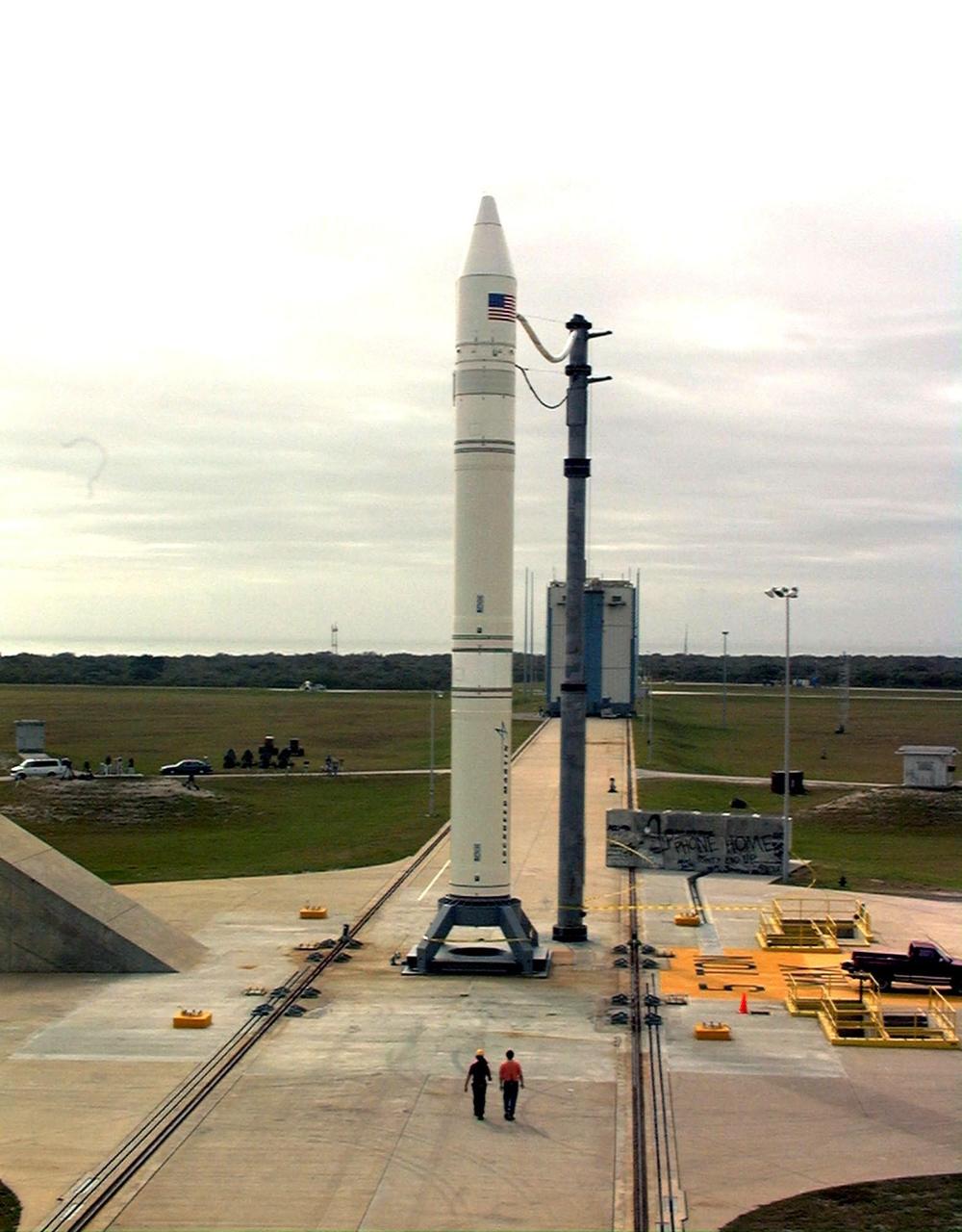
NASA’s Lunar Prospector is readied for launch as its gantry-like service tower is rolled back again at Cape Canaveral Air Station’s Launch Complex 46. The launch, previously scheduled for Jan. 5, was postponed one day due to a problem with a range safety radar located at Patrick Air Force Base, Fla. Lunar Prospector, built for the NASA Ames Research Center by Lockheed Martin, is a spin-stabilized spacecraft designed to provide NASA with the first global maps of the Moon’s surface and its gravitational magnetic fields, as well as look for the possible presence of ice near the lunar poles. It will orbit the Moon at an altitude of approximately 63 miles during a one-year mission. The launch of Lunar Prospector is now scheduled for Jan. 6, 1998 at 9:28 p.m. EST
- Record ID
- KSC-98pc104
- NASA center
- KSC
- Date
- 1998-01-06

JSC · 1969-07-18 · S69-39532
APOLLO TV TRANSMISSION - 07/18/1969
S69-39532 (18 July 1969) --- The face of astronaut Edwin E. Aldrin Jr., lunar module pilot of Apollo 11 lunar landing mission, is seen in this color reproduction,…
Inspect NASA record
S69-39532 (18 July 1969) --- The face of astronaut Edwin E. Aldrin Jr., lunar module pilot of Apollo 11 lunar landing mission, is seen in this color reproduction, taken from the third television transmission, from the Apollo 11 spacecraft during its trans-lunar journey toward the moon. Aldrin is inside the Lunar Module (LM). In the background are some the LM's controls and displays. A LM window is on the right. The LM was still docked nose to nose with the Command and Service Modules (CSM). Apollo 11 was approximately 176,000 nautical miles from Earth, and traveling at a speed of about 3,200 feet per second when this photograph was taken. Also, in the LM with Aldrin was astronaut Neil A. Armstrong, Apollo 11 commander. Astronaut Michael Collins, command module pilot, remained in the Command Module (CM).
- Record ID
- S69-39532
- NASA center
- JSC
- Date
- 1969-07-18