
Update Site (from NASA)
Explore NASA’s Image and Video Library.
Suggest one object per day for the Interstellar Minds collection. We review each suggestion before adding it.
Sign in to suggest a Marvel.
Find a NASA image ID. Open a NASA record and copy its ID from the end of the details URL.
NASA image records

HQ · 2022-07-12 · NHQ202207120037
JWST’s First Full-Color Images Media Briefing
NASA Public Affairs Officer Alise Fisher, left, moderates a briefing with NASA James Webb Space Telescope Program Scientist and Astrophysics Division Chief Scientist Eric Smith, NASA James Webb…
Inspect NASA record
NASA Public Affairs Officer Alise Fisher, left, moderates a briefing with NASA James Webb Space Telescope Program Scientist and Astrophysics Division Chief Scientist Eric Smith, NASA James Webb Space Telescope Deputy Project Scientist for Exoplanet Science Knicole Colón, NASA James Webb Space Telescope Project Scientist at ESA (European Space Agency) Christopher Evans, NASA James Webb Space Telescope project scietntist, Space Telescope Science Institute, Klaus Pontoppidan, Principal Investigator for the Canadian Near-Infrared Imager and Slitless Spectrograph at the University of Montreal René Doyon, NASA James Webb Space Telescope Deputy Project Scientist for Communications Amber Straughn, and NASA James Webb Space Telescope Operations Project Scientist Jane Rigby following the release of the first full-color images from NASA’s James Webb Space Telescope, Tuesday, July 12, 2022, at NASA’s Goddard Space Flight Center in Greenbelt, Md. The first full-color images and spectroscopic data from the James Webb Space Telescope, a partnership with ESA (European Space Agency) and the Canadian Space Agency (CSA), are a demonstration of the power of Webb as the telescope begins its science mission to unfold the infrared universe. Photo Credit: (NASA/Bill Ingalls)
- Record ID
- NHQ202207120037
- NASA center
- HQ
- Date
- 2022-07-12
- Credit
- NASA/Bill Ingalls
- Keywords
- Alise Fisher, Canadian Space Agency (CSA), ESA (European Space Agency), Goddard Space Flight Center, Greenbelt, James Webb Space Telescope (JWST), Maryland, Northrop Grumman, Space Telescope Science Institute (STScI)
JPL · 2004-04-13 · PIA05733
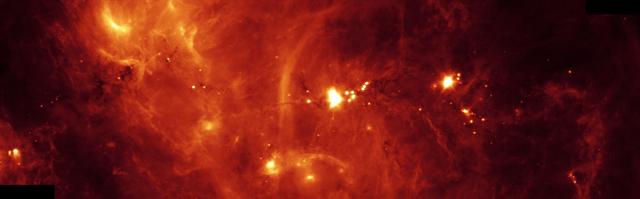
Stormy Clouds of Star Birth
Hidden behind a shroud of dust in the constellation Cygnus is an exceptionally bright source of radio emission called DR21. Visible light images reveal no trace of what…
Inspect NASA record
Hidden behind a shroud of dust in the constellation Cygnus is an exceptionally bright source of radio emission called DR21. Visible light images reveal no trace of what is happening in this region because of heavy dust obscuration. In fact, visible light is attenuated in DR21 by a factor of more than 10,000,000,000,000,000,000,000,000,000, 000,000,000,000 (ten thousand trillion heptillion). New images from NASA's Spitzer Space Telescope allow us to peek behind the cosmic veil and pinpoint one of the most massive natal stars yet seen in our Milky Way galaxy. The never-before-seen star is 100,000 times as bright as the Sun. Also revealed for the first time is a powerful outflow of hot gas emanating from this star and bursting through a giant molecular cloud. This image shows a 24-micron image mosaic, obtained with the Multiband Imaging Photometer aboard Spitzer (MIPS). This image maps the cooler infrared emission from interstellar dust found throughout the interstellar medium. The DR21 complex is clearly seen near the center of the strip, which covers about twice the area of the IRAC image. Perhaps the most fascinating feature in this image is a long and shadowy linear filament extending towards the 10 o'clock position of DR21. This jet of cold and dense gas, nearly 50 light-years in extent, appears in silhouette against a warmer background. This filament is too long and massive to be a stellar jet and may have formed from a pre-existing molecular cloud core sculpted by DR21's strong winds. Regardless of its true nature, this jet and the numerous other arcs and wisps of cool dust signify the interstellar turbulence normally unseen by the human eye. http://photojournal.jpl.nasa.gov/catalog/PIA05733
- Record ID
- PIA05733
- NASA center
- JPL
- Date
- 2004-04-13
- Credit
- NASA/JPL-Caltech
- Keywords
- Spitzer Space Telescope, Cygnus

JPL · 2019-05-30 · PIA23126
Cepheus C and Cepheus B Region by Spitzer (Two-Instrument)
This image was compiled using data from NASA's Spitzer Space Telescope using the Infrared Array Camera (IRAC) and the Multiband Imaging Photometer (MIPS) during Spitzer's "cold" mission, before…
Inspect NASA record
This image was compiled using data from NASA's Spitzer Space Telescope using the Infrared Array Camera (IRAC) and the Multiband Imaging Photometer (MIPS) during Spitzer's "cold" mission, before the spacecraft's liquid helium coolant ran out in 2009. The colors correspond with IRAC wavelengths of 3.6 microns (blue), 4.5 microns (cyan) and 8 microns (green), and 24 microns (red) from the MIPS instrument. The green-and-orange delta filling most of this image is a nebula, or a cloud of gas and dust. This region formed from a much larger cloud of gas and dust that has been carved away by radiation from stars. The bright region at the tip of the nebula is dust that has been heated by the stars' radiation, which creates the surrounding red glow. The white color is the combination of four colors (blue, green, orange and red), each representing a different wavelength of infrared light, which is invisible to human eyes. The massive stars illuminating this region belong to a star cluster that extends above the white spot. On the left side of this image, a dark filament runs horizontally through the green cloud. A smattering of baby stars (the red and yellow dots) appear inside it. Known as Cepheus C, the area is a particularly dense concentration of gas and dust where infant stars form. This region is called Cepheus C because it lies in the constellation Cepheus, which can be found near the constellation Cassiopeia. Cepheus-C is about 6 light-years long, and lies about 40 light-years from the bright spot at the tip of the nebula. The small, red hourglass shape just below Cepheus C is V374 Ceph. Astronomers studying this massive star have speculated that it might be surrounded by a nearly edge-on disk of dark, dusty material. The dark cones extending to the right and left of the star are a shadow of that disk. The smaller nebula on the right side of the image includes a blue star crowned by a small, red arc of light. This "runaway star" is plowing through the gas and dust at a rapid clip, creating a shock wave or "bow shock" in front of itself. https://photojournal.jpl.nasa.gov/catalog/PIA23126
- Record ID
- PIA23126
- NASA center
- JPL
- Date
- 2019-05-30
- Credit
- NASA/JPL-Caltech
- Keywords
- Spitzer Space Telescope
JPL · 2019-05-30 · PIA23127
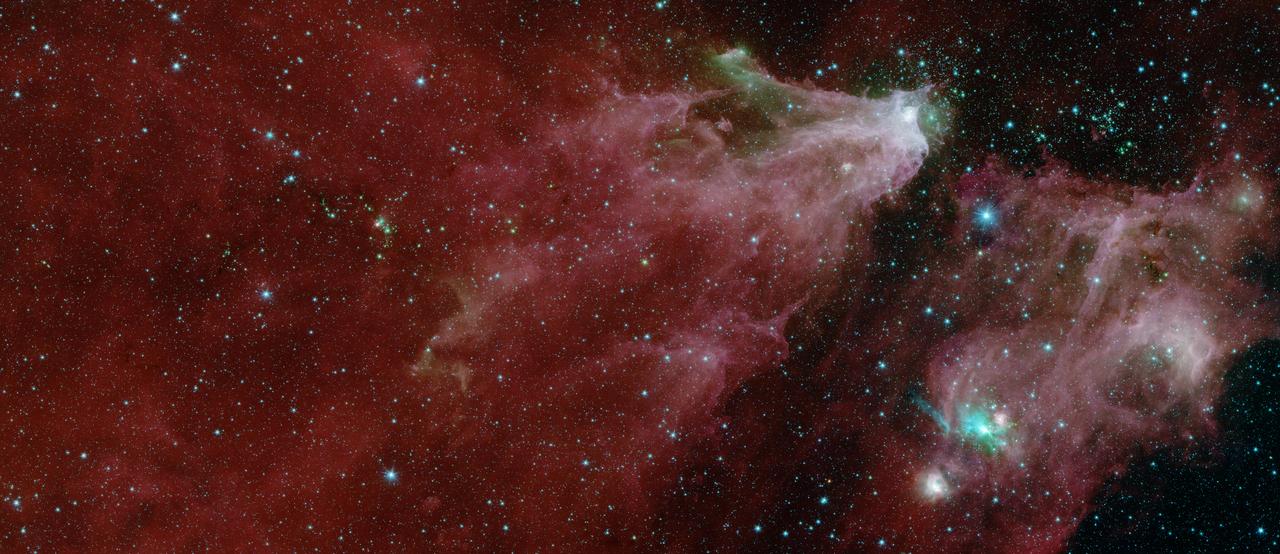
Cepheus C and Cepheus B Region by Spitzer (One-Instrument)
This image shows data from NASA's Spitzer Space Telescope, from the IRAC instrument, with colors corresponding to wavelengths of 3.6, 4.5, 5.8 and 8.0 µm (shown as blue,…
Inspect NASA record
This image shows data from NASA's Spitzer Space Telescope, from the IRAC instrument, with colors corresponding to wavelengths of 3.6, 4.5, 5.8 and 8.0 µm (shown as blue, green, orange and red). The grand red delta filling most of the image is a far-away nebula, or a cloud of gas and dust. A second nebula is located in the lower right portion of the image. Within the first nebula, on the left side of this image, a dark filament runs horizontally through the green cloud. A smattering of baby stars (the red and yellow dots) appear inside it. Known as Cepheus C, the area is a particularly dense concentration of gas and dust where infant stars form. This region is called Cepheus C because it lies in the constellation Cepheus, which can be found near the constellation Cassiopeia. Cepheus-C is about 6 light years long, and lies about 40 light-years from the bright spot at the tip of the nebula. Two features identified in the annotated image are visible only in the multi-instrument version of the image, found here. The first is V374 Ceph in the larger nebula. The second is the "runaway star" in the smaller nebula. A second star cluster is located just above the second large nebula on the right side of the image. Known as Cepheus B, the cluster sits within a few thousand light-years of our Sun. A study of this region using Spitzer found that the dramatic collection is about 4 million to 5 million years old — slightly older than those in Cepheus C. Also found in the second nebula is a small cluster of newborn stars that illuminates the dense cloud of gas and dust where they formed. It appears as a bright teal splash. https://photojournal.jpl.nasa.gov/catalog/PIA23127
- Record ID
- PIA23127
- NASA center
- JPL
- Date
- 2019-05-30
- Credit
- NASA/JPL-Caltech
- Keywords
- Spitzer Space Telescope
JPL · 2018-08-09 · PIA22565
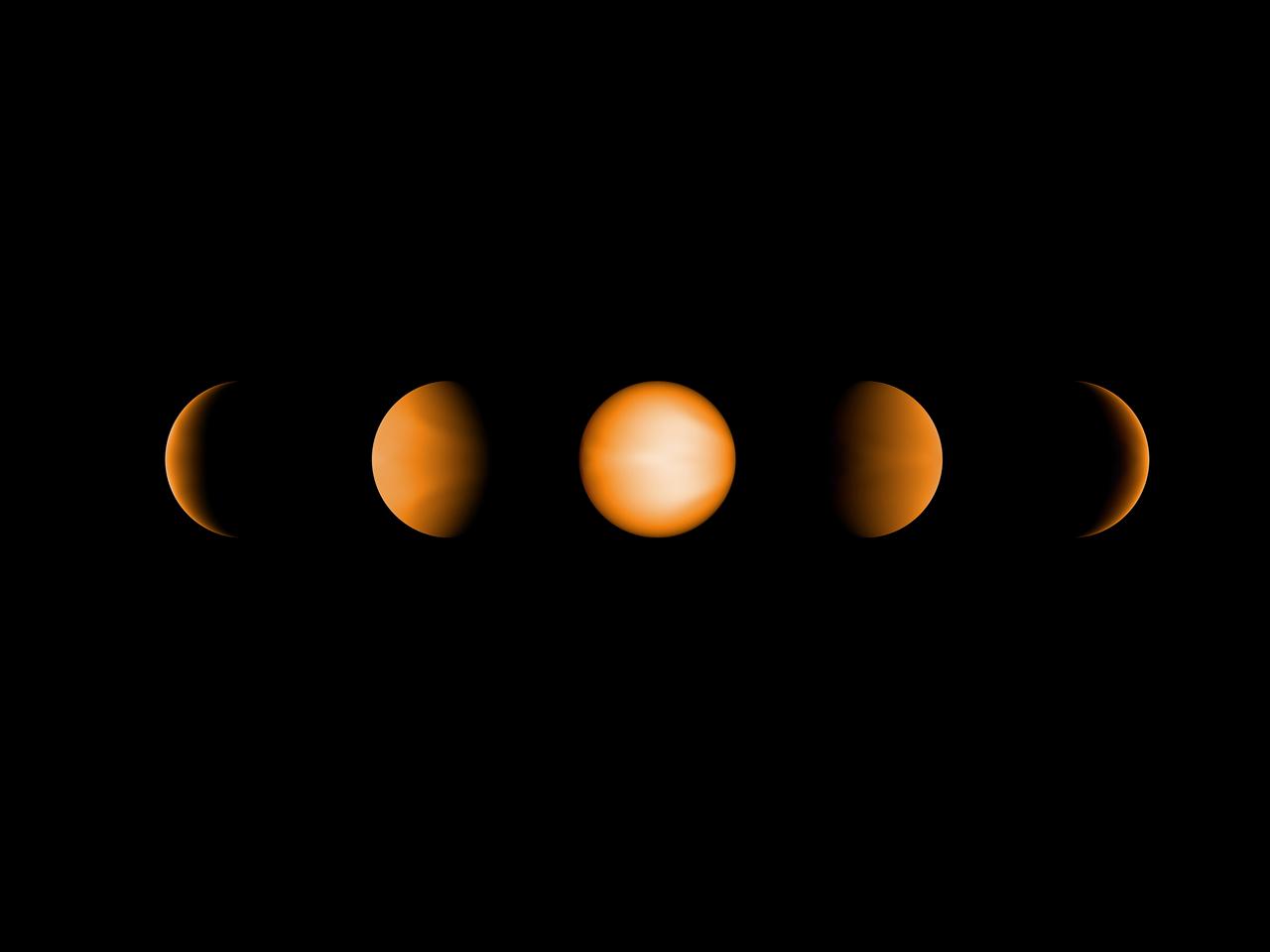
Ultrahot Jupiter WASP-121b
These simulated views of the ultrahot Jupiter WASP-121b show what the planet might look like to the human eye from five different vantage points, illuminated to different degrees…
Inspect NASA record
These simulated views of the ultrahot Jupiter WASP-121b show what the planet might look like to the human eye from five different vantage points, illuminated to different degrees by its parent star. The images were created using a computer simulation being used to help scientists understand the atmospheres of these ultra-hot planets. Ultrahot Jupiters reflect almost no light, rather like charcoal. However, the daysides of ultrahot Jupiters have temperatures of between 3600°F and 5400°F (2000°C and 3000°C), so the planets produce their own glow, like a hot ember. The orange color in this simulated image is thus from the planet's own heat. The computer model was based on observations of WASP-121b conducted using NASA's Spitzer and Hubble space telescopes. https://photojournal.jpl.nasa.gov/catalog/PIA22565
- Record ID
- PIA22565
- NASA center
- JPL
- Date
- 2018-08-09
- Credit
- NASA/JPL-Caltech/Aix-Marseille University (AMU)
- Keywords
- Hubble Space Telescope, Spitzer Space Telescope, Jupiter WASP-121b
JPL · 2007-05-17 · PIA09412
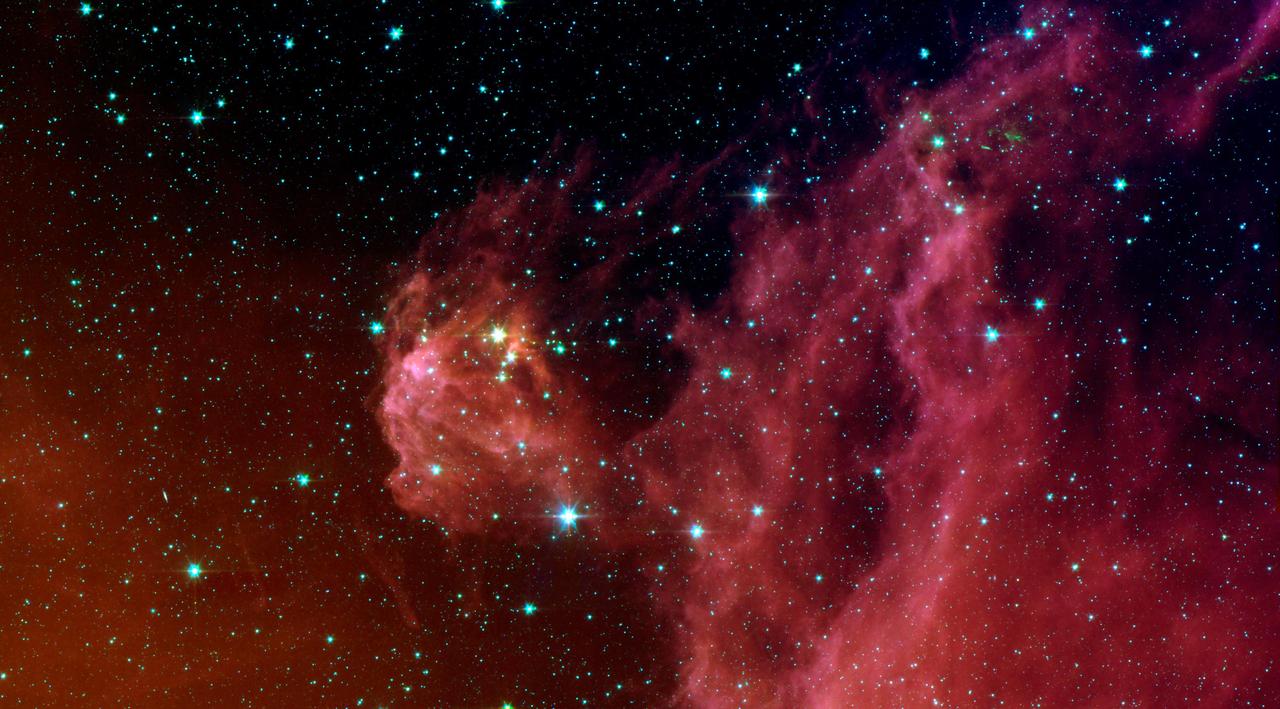
Young Stars Emerge from Orion Head
This image from NASA's Spitzer Space Telescope shows infant stars "hatching" in the head of the hunter constellation, Orion. Astronomers suspect that shockwaves from a supernova explosion in…
Inspect NASA record
This image from NASA's Spitzer Space Telescope shows infant stars "hatching" in the head of the hunter constellation, Orion. Astronomers suspect that shockwaves from a supernova explosion in Orion's head, nearly three million years ago, may have initiated this newfound birth . The region featured in this Spitzer image is called Barnard 30. It is located approximately 1,300 light-years away and sits on the right side of Orion's "head," just north of the massive star Lambda Orionis. Wisps of red in the cloud are organic molecules called polycyclic aromatic hydrocarbons. These molecules are formed anytime carbon-based materials are burned incompletely. On Earth, they can be found in the sooty exhaust from automobile and airplane engines. They also coat the grills where charcoal-broiled meats are cooked. This image shows infrared light captured by Spitzer's infrared array camera. Light with wavelengths of 8 and 5.8 microns (red and orange) comes mainly from dust that has been heated by starlight. Light of 4.5 microns (green) shows hot gas and dust; and light of 3.6 microns (blue) is from starlight. http://photojournal.jpl.nasa.gov/catalog/PIA09412
- Record ID
- PIA09412
- NASA center
- JPL
- Date
- 2007-05-17
- Credit
- NASA/JPL-Caltech/ Laboratorio de Astrof?sica Espacial y F?sica Fundamental
- Keywords
- Barnard 30, Spitzer Space Telescope, Orion
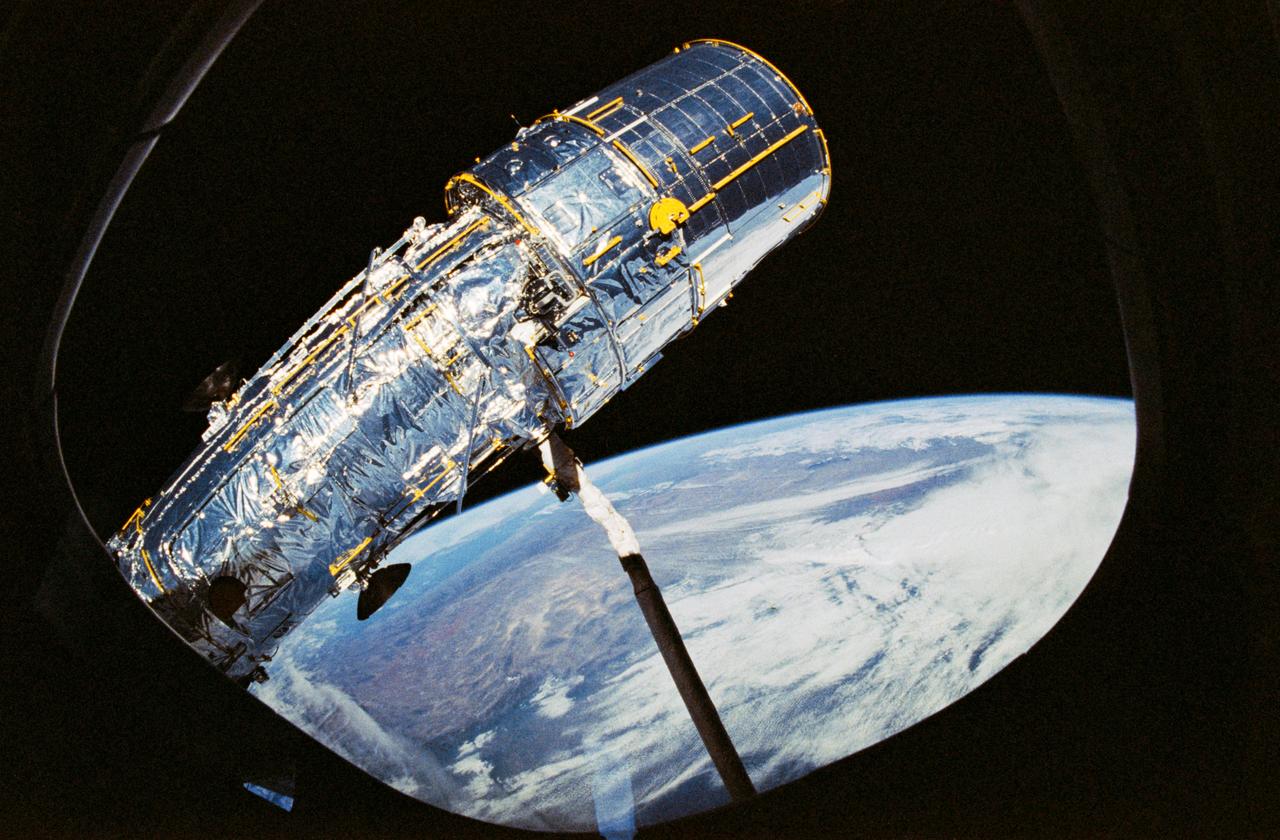
JSC · 1990-04-25 · s31-10-023
Hubble Space Telescope (HST) solar array (SA) panel deployment during STS-31
STS031-10-023 (25 April 1990) --- View of the Hubble Space Telescope (HST) on the end of Discovery's Remote Manipulator System (RMS) arm prior to deployment of its antennae…
Inspect NASA record
STS031-10-023 (25 April 1990) --- View of the Hubble Space Telescope (HST) on the end of Discovery's Remote Manipulator System (RMS) arm prior to deployment of its antennae and solar array panels.
- Record ID
- s31-10-023
- NASA center
- JSC
- Date
- 1990-04-25
- Keywords
- ANTENNAS, DISCOVERY (ORBITER), EARTH LIMB, EARTH SURFACE, SOLAR ARRAYS, HUBBLE SPACE TELESCOPE, PAYLOAD DEPLOYMENT & RETRIEVAL SYSTEM, STS-31 REMOTE MANIPULATOR SYSTEM

JPL · 2022-12-21 · PIA25436
Roman Coronagraph Instrument Color Filter Assembly
This image shows a series of color filters on the Color Filter Assembly for the Coronagraph Instrument on NASA's Nancy Grace Roman Space Telescope. Each filter blocks all…
Inspect NASA record
This image shows a series of color filters on the Color Filter Assembly for the Coronagraph Instrument on NASA's Nancy Grace Roman Space Telescope. Each filter blocks all but a specific color, or wavelength, of light. Many of the filters appear dark in this photo because they block all visible light – the range of wavelengths that are visible to the human eye – but are transparent to infrared light, which encompasses a range of wavelengths slightly longer than visible light. Most of the filters will be used by the instrument for calibration purposes, but there are scientific uses for some of the filters as well. The presence or absence of different wavelengths can reveal properties of exoplanets (planets around other stars) including their chemical composition and the presence of clouds high or low in their atmospheres. For example, cold gas giant planets with high clouds will appear redder, like Jupiter, compared to those without high clouds, like Neptune. https://photojournal.jpl.nasa.gov/catalog/PIA25436
- Record ID
- PIA25436
- NASA center
- JPL
- Date
- 2022-12-21
- Credit
- NASA/JPL-Caltech
- Keywords
- Nancy Grace Roman Space Telescope
JPL · 2016-08-25 · PIA20913
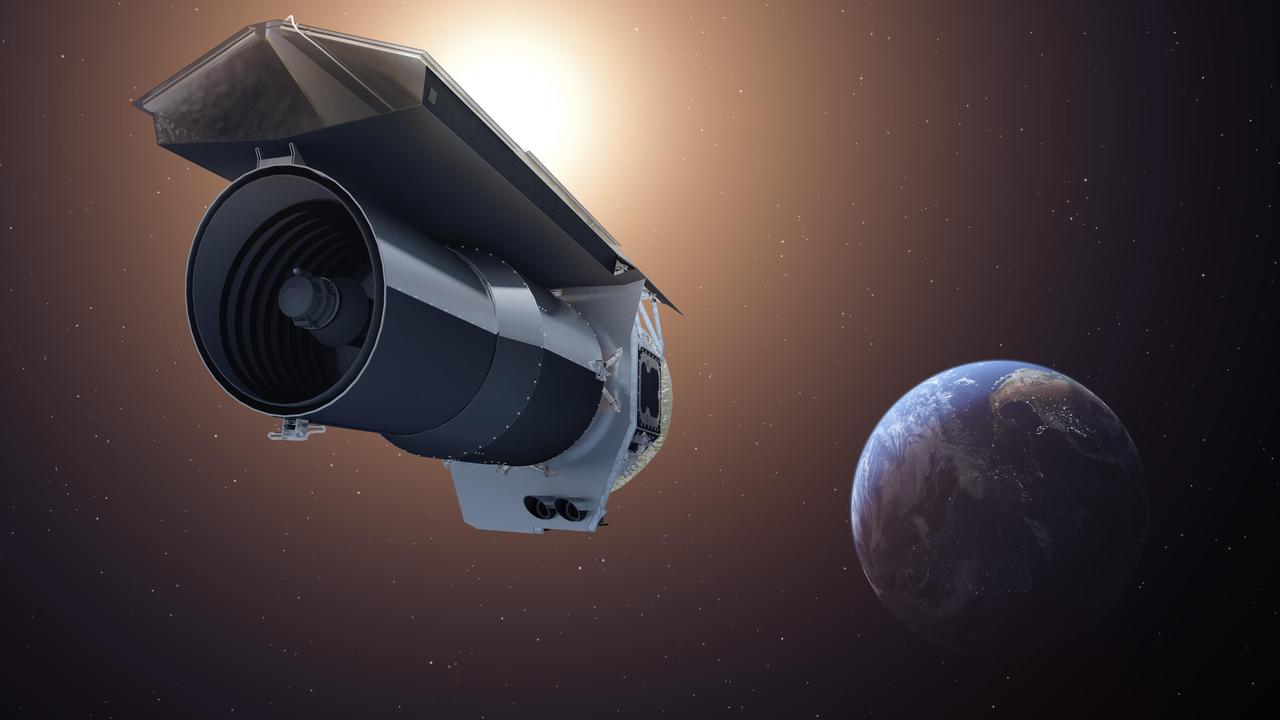
Spitzer Beyond Artist Concept
This artist's concept shows NASA's Spitzer Space Telescope. Spitzer begins its "Beyond" mission phase on Oct. 1, 2016. Spitzer is depicted in the orientation it assumes to establish…
Inspect NASA record
This artist's concept shows NASA's Spitzer Space Telescope. Spitzer begins its "Beyond" mission phase on Oct. 1, 2016. Spitzer is depicted in the orientation it assumes to establish communications with ground stations. Spitzer is over 130 million miles (210 million kilometers) away from Earth, or about 1.5 times the distance between Earth and the Sun. The selected research proposals for Spitzer's Beyond phase include a variety of objects that the mission was not originally planned to address -- such as galaxies in the early universe, the black hole at the center of the Milky Way and exoplanets. Spitzer faces increasing challenges and risks in its Beyond phase. To enable this riskier mode of operations, the mission team will have to override some autonomous safety systems. Mission engineers are hard at work preparing for these new challenges. http://photojournal.jpl.nasa.gov/catalog/PIA20913
- Record ID
- PIA20913
- NASA center
- JPL
- Date
- 2016-08-25
- Credit
- NASA/JPL-Caltech
- Keywords
- Spitzer Space Telescope, artist concept
MSFC · 1990-04-24 · 9013119
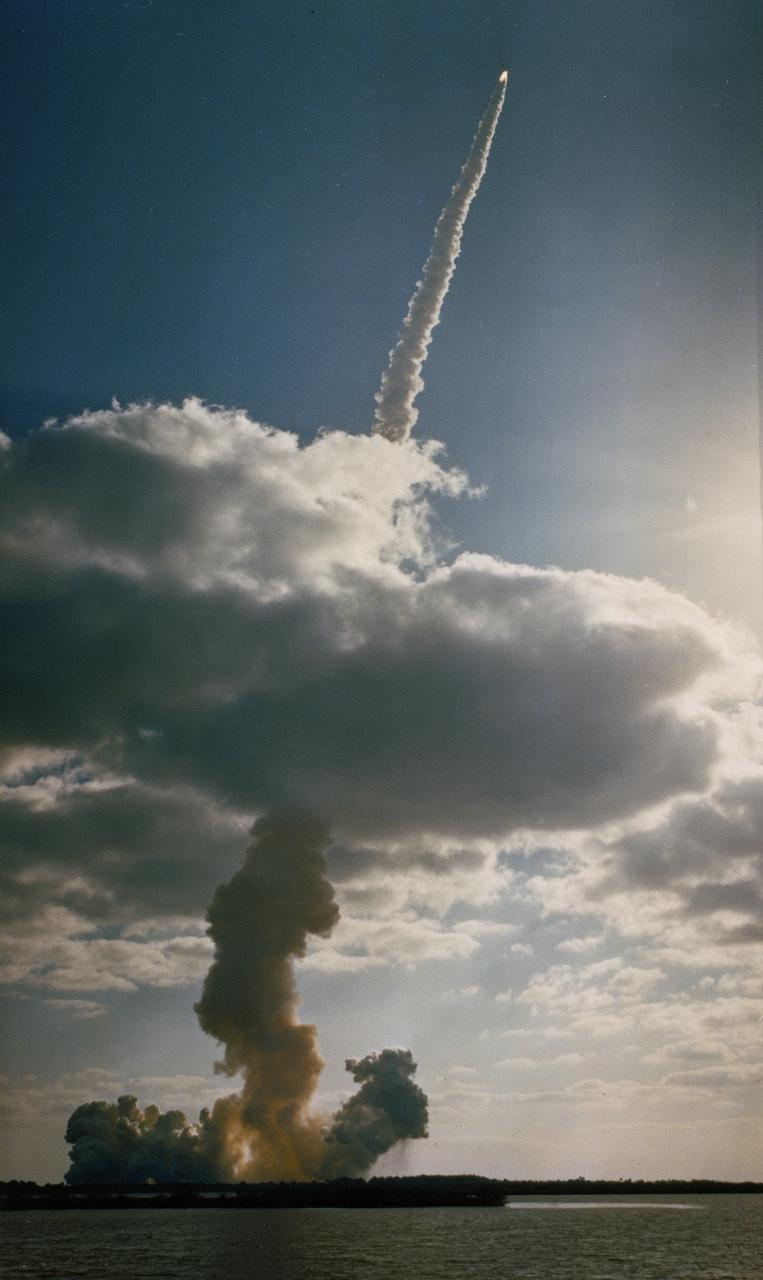
History of Hubble Space Telescope (HST)
The STS-31 crew launched aboard the Space Shuttle Discovery on April 24, 1990 at 8:33:51am (EDT). Included in the crew of five were Loren J. Shriver, commander; Charles…
Inspect NASA record
The STS-31 crew launched aboard the Space Shuttle Discovery on April 24, 1990 at 8:33:51am (EDT). Included in the crew of five were Loren J. Shriver, commander; Charles F. Bolden, pilot; and Steven A. Hawley, Bruce McCandless, and Kathryn D. Sullivan, all mission specialists. The primary goal of the mission was the deployment of the Hubble Space Telescope (HST) which was a Marshall Space Flight Center (MSFC) managed program.
- Record ID
- 9013119
- NASA center
- MSFC
- Date
- 1990-04-24
- Keywords
- STS-31, Launch
HQ · 2018-07-25 · NHQ201807250009
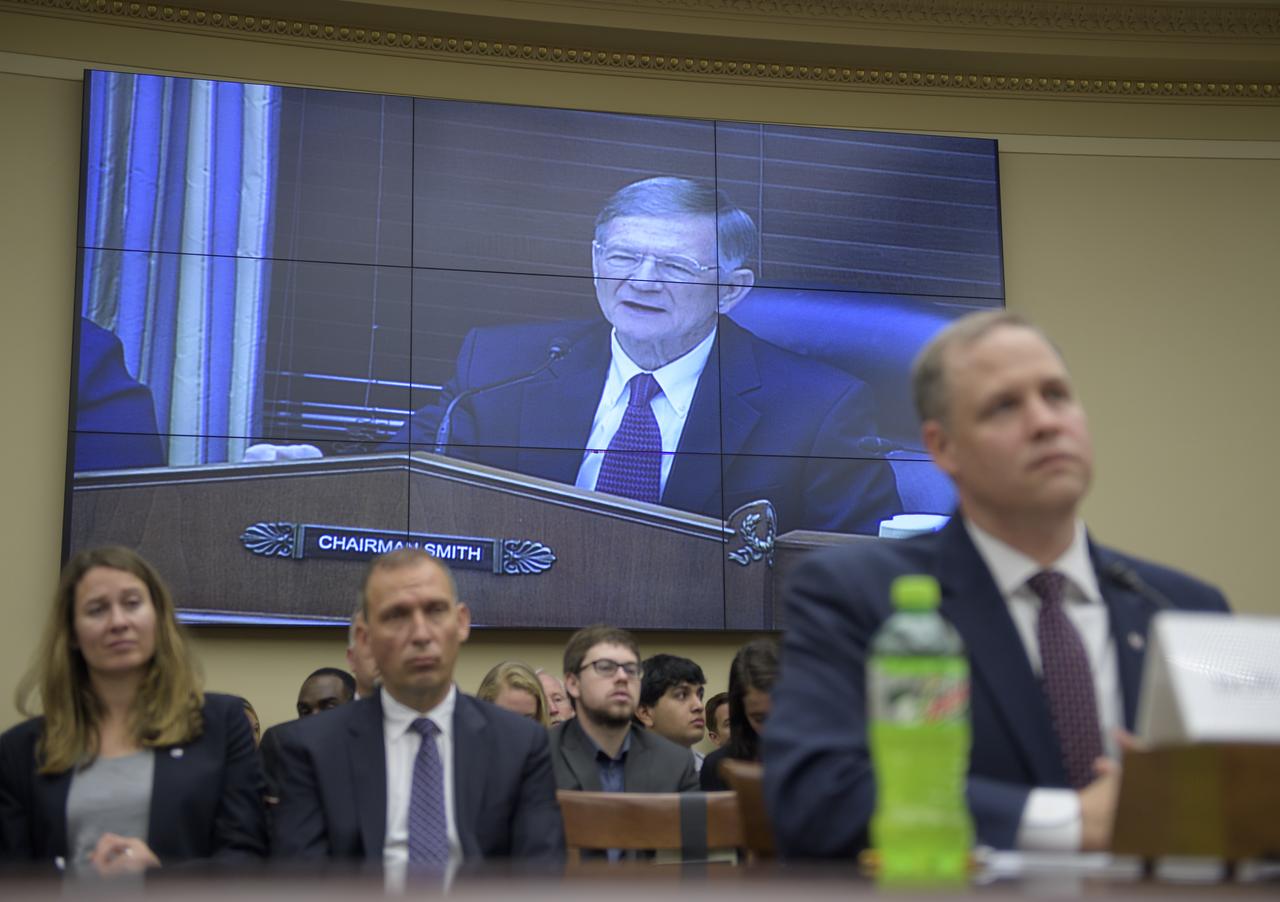
Hearing on James Webb Space Telescope
Rep. Lamar Smith, R-Texas, Chairman of the House Committee on Science, Space, and Technology questions NASA Administrator Jim Bridenstine during a House Committee on Science, Space, and Technology…
Inspect NASA record
Rep. Lamar Smith, R-Texas, Chairman of the House Committee on Science, Space, and Technology questions NASA Administrator Jim Bridenstine during a House Committee on Science, Space, and Technology hearing on the James Webb Space Telescope, Wednesday, July 25, 2018 at the Rayburn House Office Building in Washington. Photo Credit: (NASA/Bill Ingalls)
- Record ID
- NHQ201807250009
- NASA center
- HQ
- Date
- 2018-07-25
- Credit
- NASA/Bill Ingalls
- Keywords
- Committee on Science Space and Technology, DC, House Hearing, Lamar Smith, NASA Administrator, Rayburn House Office Building, U.S. Representative, Washington
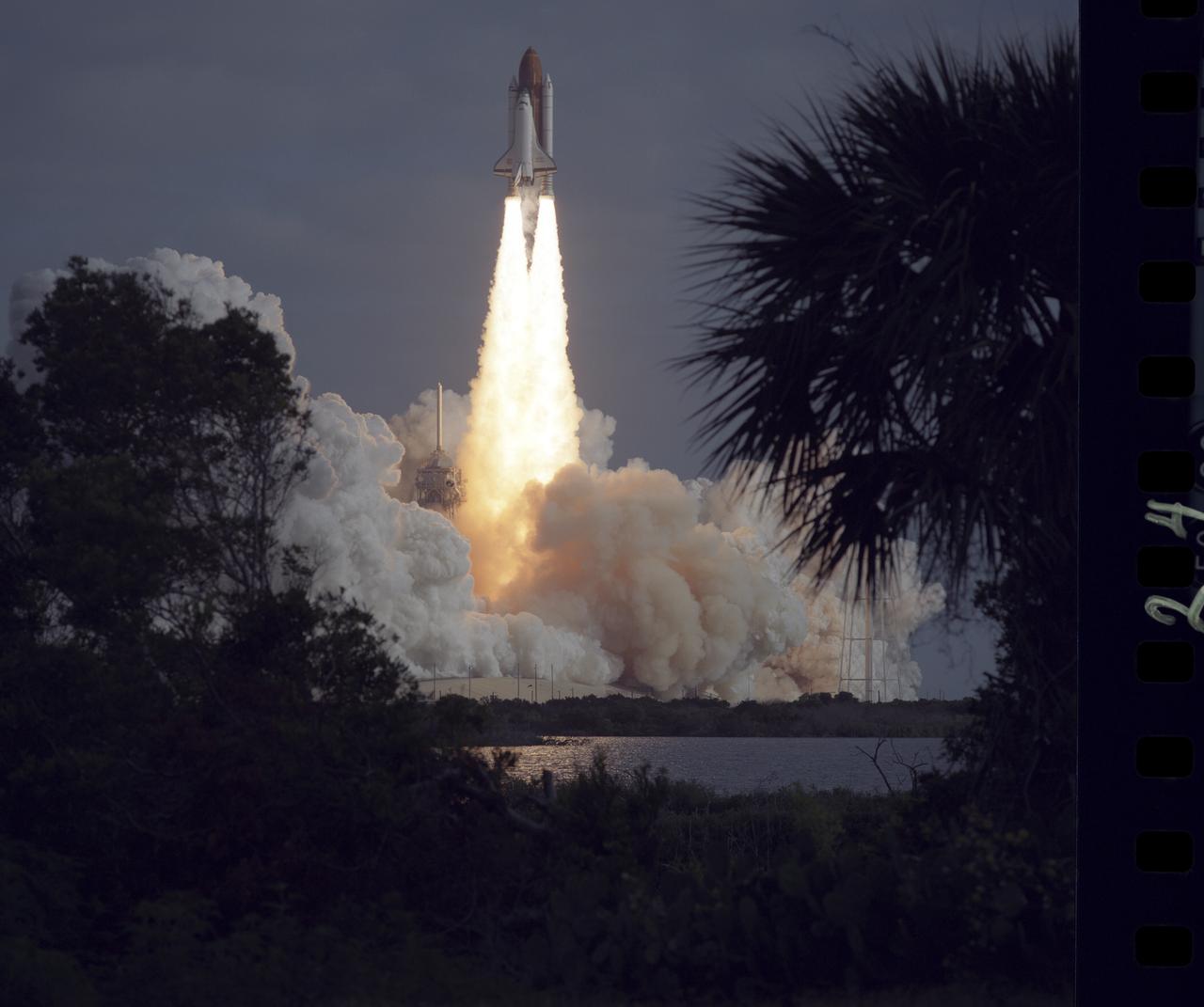
MSFC · 1990-04-24 · 9009633
History of Hubble Space Telescope (HST)
The STS-31 crew launched aboard the Space Shuttle Discovery on April 24, 1990 at 8:33:51am (EDT). Included in the crew of five were Loren J. Shriver, commander; Charles…
Inspect NASA record
The STS-31 crew launched aboard the Space Shuttle Discovery on April 24, 1990 at 8:33:51am (EDT). Included in the crew of five were Loren J. Shriver, commander; Charles F. Bolden, pilot; and Steven A. Hawley, Bruce McCandless, and Kathryn D. Sullivan, all mission specialists. The primary goal of the mission was the deployment of the Hubble Space Telescope (HST) which was a Marshall Space Flight Center (MSFC) managed program.
- Record ID
- 9009633
- NASA center
- MSFC
- Date
- 1990-04-24
- Keywords
- STS-31, Launch