
Update Site (from NASA)
Explore NASA’s Image and Video Library.
Suggest one object per day for the Interstellar Minds collection. We review each suggestion before adding it.
Sign in to suggest a Marvel.
Find a NASA image ID. Open a NASA record and copy its ID from the end of the details URL.
NASA image records
JSC · 1969-11-24 · S69-22271
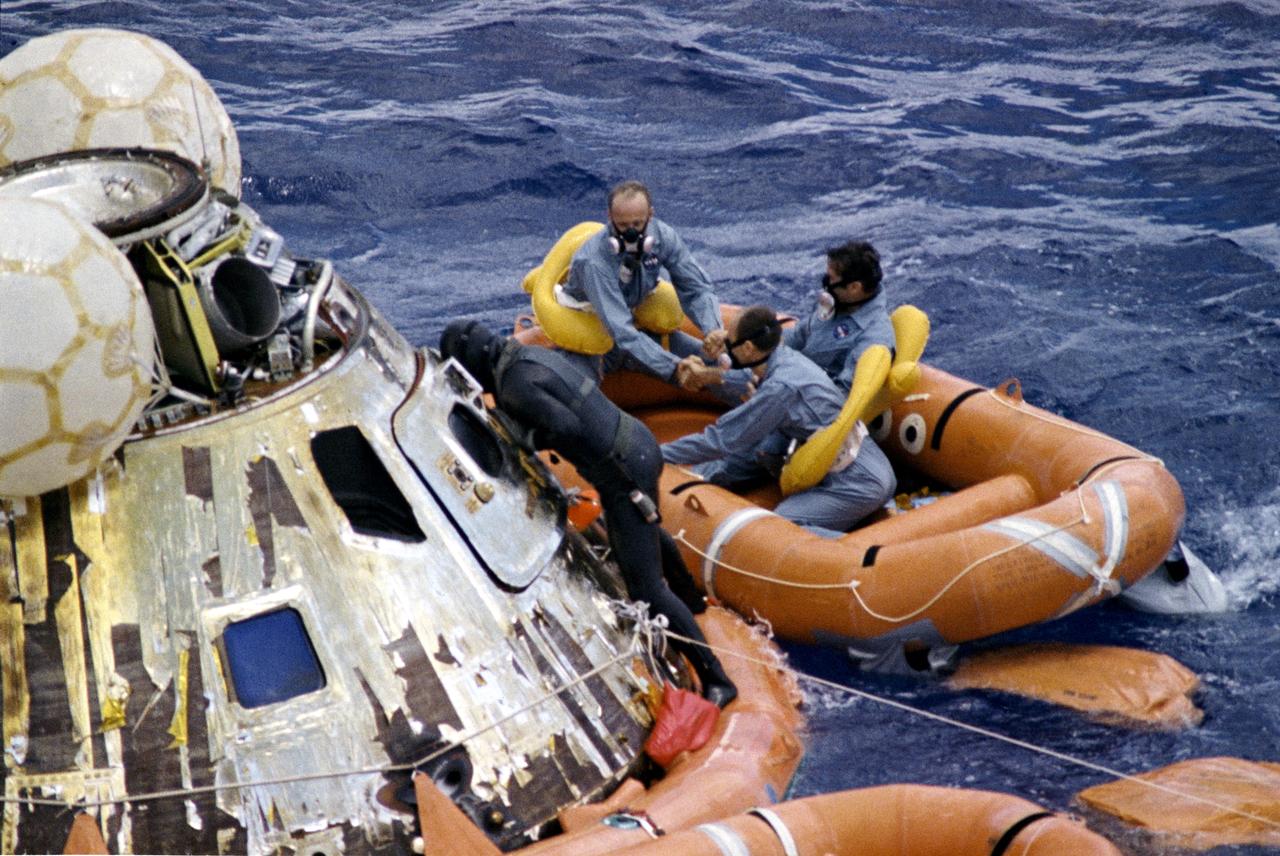
Apollo 12 crew assisted with egressing command module after landing
S69-22271 (24 Nov. 1969) --- A United States Navy Underwater Demolition Team swimmer assists the Apollo 12 crew during recovery operations in the Pacific Ocean. In the life…
Inspect NASA record
S69-22271 (24 Nov. 1969) --- A United States Navy Underwater Demolition Team swimmer assists the Apollo 12 crew during recovery operations in the Pacific Ocean. In the life raft are astronauts Charles Conrad Jr. (facing camera), commander; Richard F. Gordon Jr. (middle), command module pilot; and Alan L. Bean (nearest camera), lunar module pilot. The three crew men of the second lunar landing mission were picked up by helicopter and flown to the prime recovery ship, USS Hornet. Apollo 12 splashed down at 2:58 p.m. (CST), Nov. 24, 1969, near American Samoa. While astronauts Conrad and Bean descended in the Lunar Module (LM) "Intrepid" to explore the Ocean of Storms region of the moon, astronaut Gordon remained with the Command and Service Modules (CSM) "Yankee Clipper" in lunar orbit.
- Record ID
- S69-22271
- NASA center
- JSC
- Date
- 1969-11-24
- Keywords
- APOLLO 12 FLIGHT, ASTRONAUTS
JSC · 1970-03-16 · S70-30828
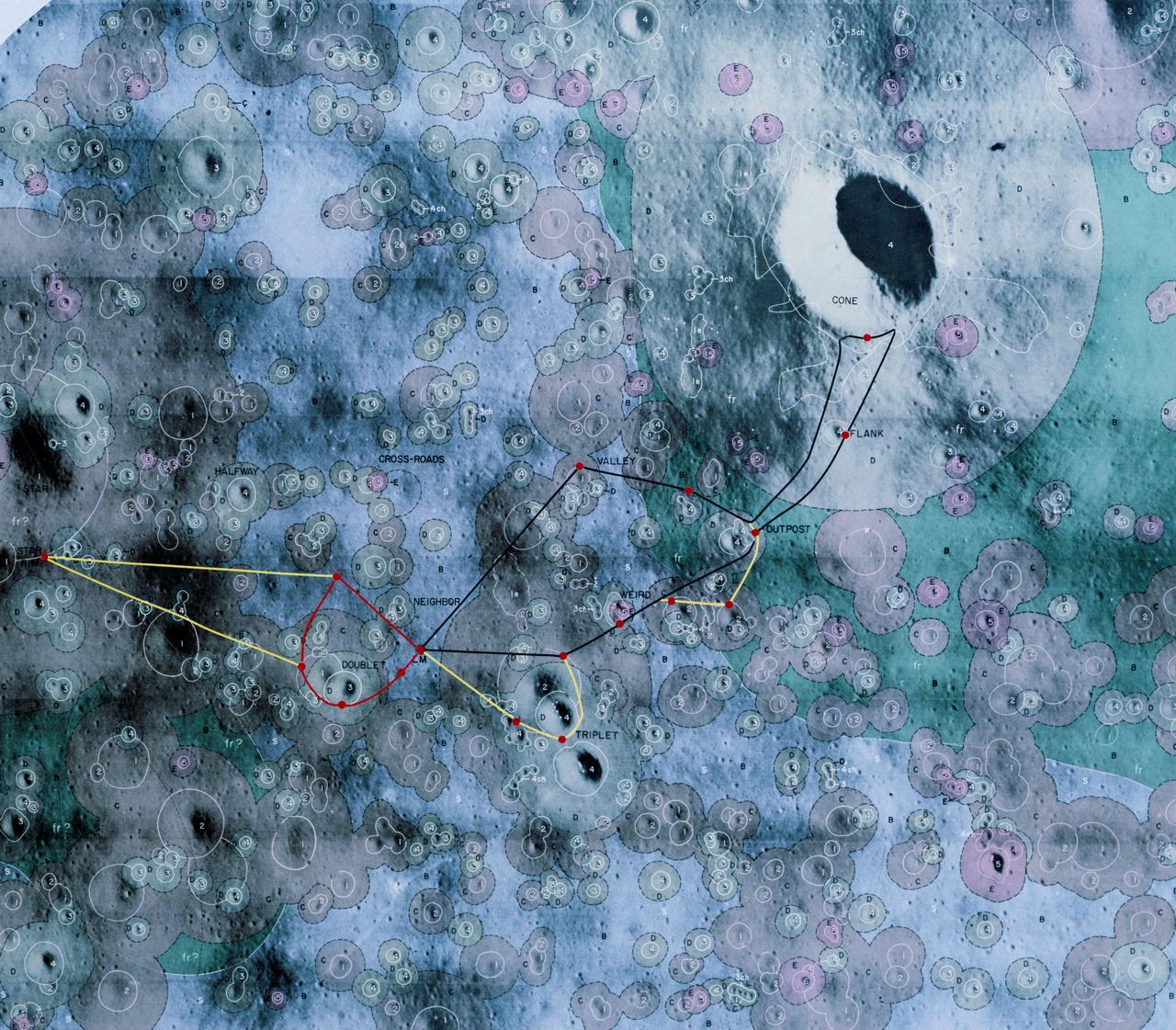
APOLLO XIII - INFLIGHT (CREW ACTIVITIES)
S70-30828 (March 1970) --- A photographic illustration of the Fra Mauro area showing the scheduled traverses planned for the extravehicular activity (EVA) on the Apollo 13 lunar landing…
Inspect NASA record
S70-30828 (March 1970) --- A photographic illustration of the Fra Mauro area showing the scheduled traverses planned for the extravehicular activity (EVA) on the Apollo 13 lunar landing mission. The larger red dot marked LM indicates the landing point of the Apollo 13 Lunar Module (LM). The red line shows the path of the first EVA traverse. The second EVA traverse is marked with a black line. The yellow line denotes the extension of each traverse in the event a decision is made to do so. The red dots indicate the points of interest for samples and for observation. Participating in the Apollo 13 EVA will be astronauts James A. Lovell Jr., commander; and Fred W. Haise Jr., lunar module pilot. Astronaut Thomas K. Mattingly II , command module pilot, will remain with the Command and Service Modules (CSM) in lunar orbit.
- Record ID
- S70-30828
- NASA center
- JSC
- Date
- 1970-03-16
KSC · 1971-07-07 · 71pc0469
KSC-71pc-0469
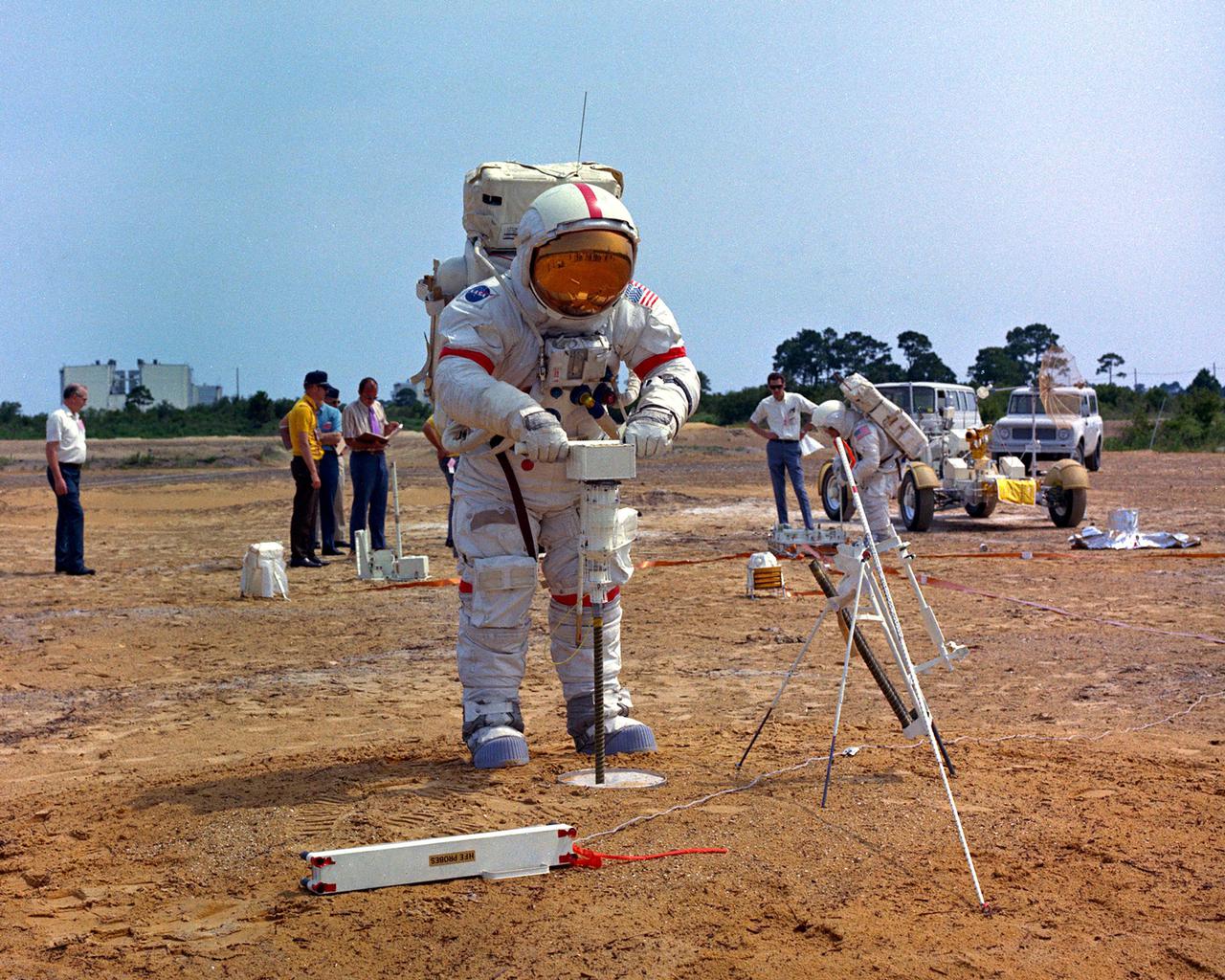
KENNEDY SPACE CENTER, FLA. - Apollo 15 Commander David R. Scott operates the battery-powered Lunar Surface Drill during a training exercise at a man-made replica of the Moon's…
Inspect NASA record
KENNEDY SPACE CENTER, FLA. - Apollo 15 Commander David R. Scott operates the battery-powered Lunar Surface Drill during a training exercise at a man-made replica of the Moon's Hadley-Apennine region at the Kennedy Space Center. During his upcoming mission, scheduled to begin no earlier than July 26, 1971, Scott will drill to a depth of about 10 feet to obtain lunar surface core samples and conduct the Heat Flow Experiment. This experiment is designed to measure the rate of heat loss from the interior of the Moon. Lunar Module Pilot James B. Irwin will accompany Scott on the surface while Astronaut Alfred M. Worden will pilot the Command Module while in lunar orbit.
- Record ID
- 71pc0469
- NASA center
- KSC
- Date
- 1971-07-07
- Credit
- NASA or National Aeronautics and Space Administration
JSC · 2011-09-09 · jsc2011e118358
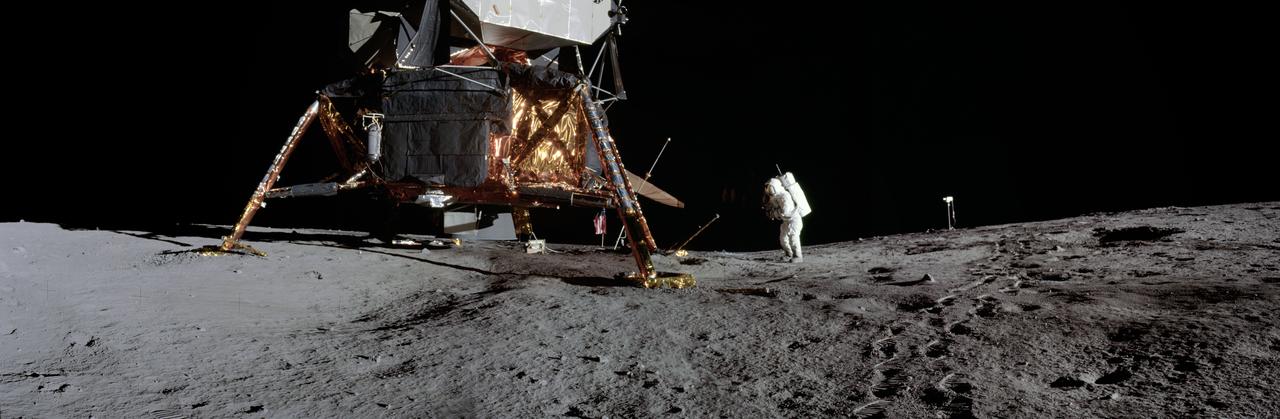
Apollo 15 lunar panorama
jsc2011e118358 - Panorama view of Apollo 12 lunar surface photos with lunar module pilot Alan L. Bean and the TV taken from just inside the rim of Surveyor…
Inspect NASA record
jsc2011e118358 - Panorama view of Apollo 12 lunar surface photos with lunar module pilot Alan L. Bean and the TV taken from just inside the rim of Surveyor Crater on the first moonwalk of the mission. The panoramas were built by combining Apollo 12 images starting with frame AS12-46-6777 thru end frame AS12-46-6780. The panoramic images received minimal retouching by NASA imagery specialists, including the removal of lens flares that were problematic in stitching together the individual frames and blacking out the sky to the lunar horizon. These adjustments were made based on observations of the Moon walkers who reported that there are no stars visible in the sky due to the bright lunar surface reflection of the Sun.
- Record ID
- jsc2011e118358
- NASA center
- JSC
- Date
- 2011-09-09
KSC · 1971-07-07 · 71pc0468
KSC-71pc-0468
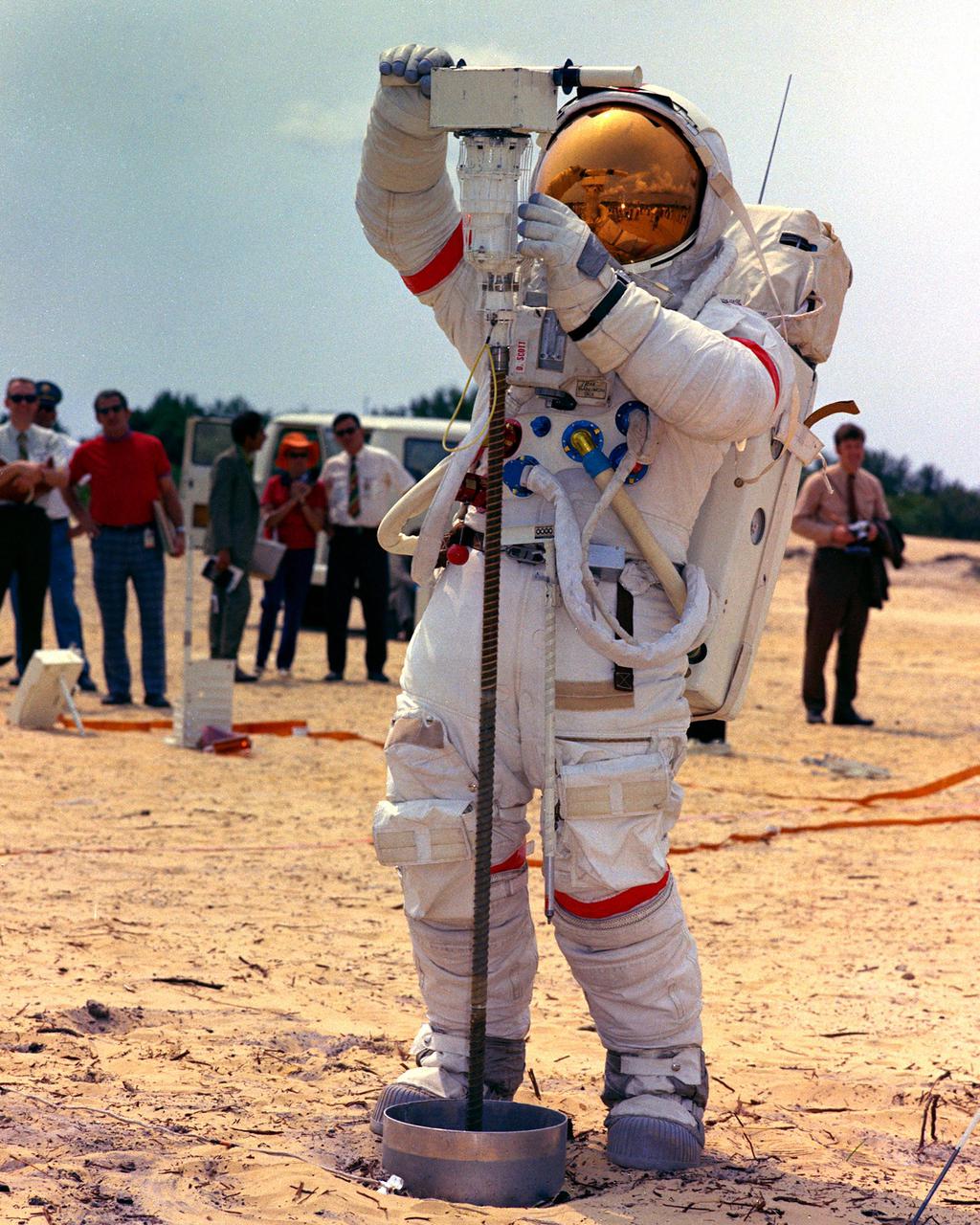
KENNEDY SPACE CENTER, FLA. - Apollo 15 Commander David R. Scott operates the battery-powered Lunar Surface Drill during a training exercise at a man-made replica of the Moon's…
Inspect NASA record
KENNEDY SPACE CENTER, FLA. - Apollo 15 Commander David R. Scott operates the battery-powered Lunar Surface Drill during a training exercise at a man-made replica of the Moon's Hadley-Apennine region at the Kennedy Space Center. During his upcoming mission, scheduled to begin no earlier than July 26, 1971, Scott will drill to a depth of about 10 feet to obtain lunar surface core samples and conduct the Heat Flow Experiment. This experiment is designed to measure the rate of heat loss from the interior of the Moon. Lunar Module Pilot James B. Irwin will accompany Scott on the surface while Astronaut Alfred M. Worden will pilot the Command Module while in lunar orbit.
- Record ID
- 71pc0468
- NASA center
- KSC
- Date
- 1971-07-07
- Credit
- NASA or National Aeronautics and Space Administration
JSC · 1969-05-18 · S69-34143
APOLLO X - LAUNCH - PAD 39B - KSC
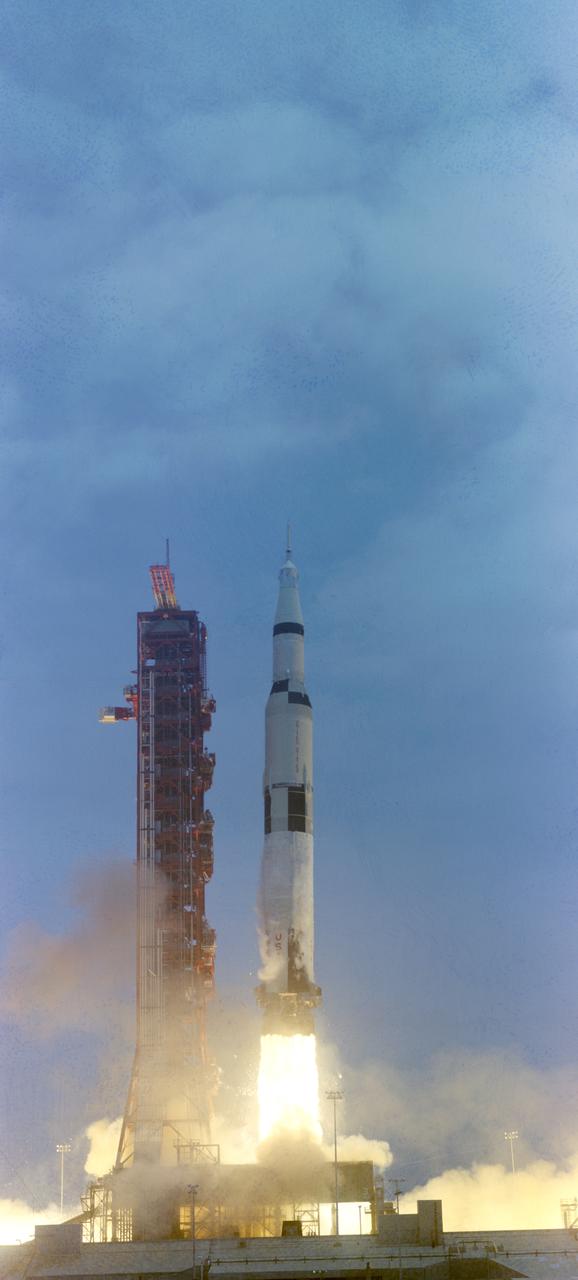
S69-34143 (18 May 1969) --- The Apollo 10 (Spacecraft 106/Lunar Module 4/Saturn 505) space vehicle is launched from Pad B, Launch Complex 39, Kennedy Space Center at 12:49…
Inspect NASA record
S69-34143 (18 May 1969) --- The Apollo 10 (Spacecraft 106/Lunar Module 4/Saturn 505) space vehicle is launched from Pad B, Launch Complex 39, Kennedy Space Center at 12:49 p.m. (EDT), May 18, 1969. Aboard the spacecraft are astronauts Thomas P. Stafford, commander; John W. Young, command module pilot; and Eugene A. Cernan, lunar module pilot. The eight-day, lunar orbit mission will mark the first time the complete Apollo spacecraft has operated around the moon and the second manned flight for the Lunar Module. Two Apollo 10 astronauts, Stafford and Cernan, are scheduled to descend within eight nautical miles of the moon's surface in the LM.
- Record ID
- S69-34143
- NASA center
- JSC
- Date
- 1969-05-18
- Keywords
- Apollo, Apollo 10, KSC, Launch
KSC · 1998-01-06 · KSC-lp0014
KSC-lp0014
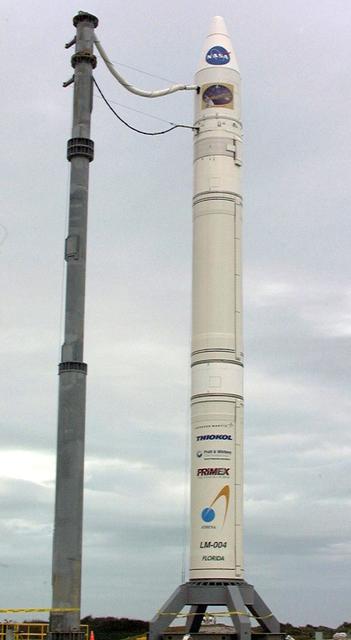
NASA’s Lunar Prospector is readied for launch as its gantry-like service tower is rolled back again at Cape Canaveral Air Station’s Launch Complex 46. The launch, previously scheduled…
Inspect NASA record
NASA’s Lunar Prospector is readied for launch as its gantry-like service tower is rolled back again at Cape Canaveral Air Station’s Launch Complex 46. The launch, previously scheduled for Jan. 5, was postponed one day due to a problem with a range safety radar located at Patrick Air Force Base, Fla. Lunar Prospector, built for the NASA Ames Research Center by Lockheed Martin, is a spin-stabilized spacecraft designed to provide NASA with the first global maps of the Moon’s surface and its gravitational magnetic fields, as well as look for the possible presence of ice near the lunar poles. It will orbit the Moon at an altitude of approximately 63 miles during a one-year mission. The launch of Lunar Prospector is now scheduled for Jan. 6, 1998 at 9:28 p.m. EST
- Record ID
- KSC-lp0014
- NASA center
- KSC
- Date
- 1998-01-06
JSC · 1969-07-24 · S69-40758
Apollo XI Command Module (CM) - Mobile Quarantine Facility (MQF) - U.S.S. Hornet
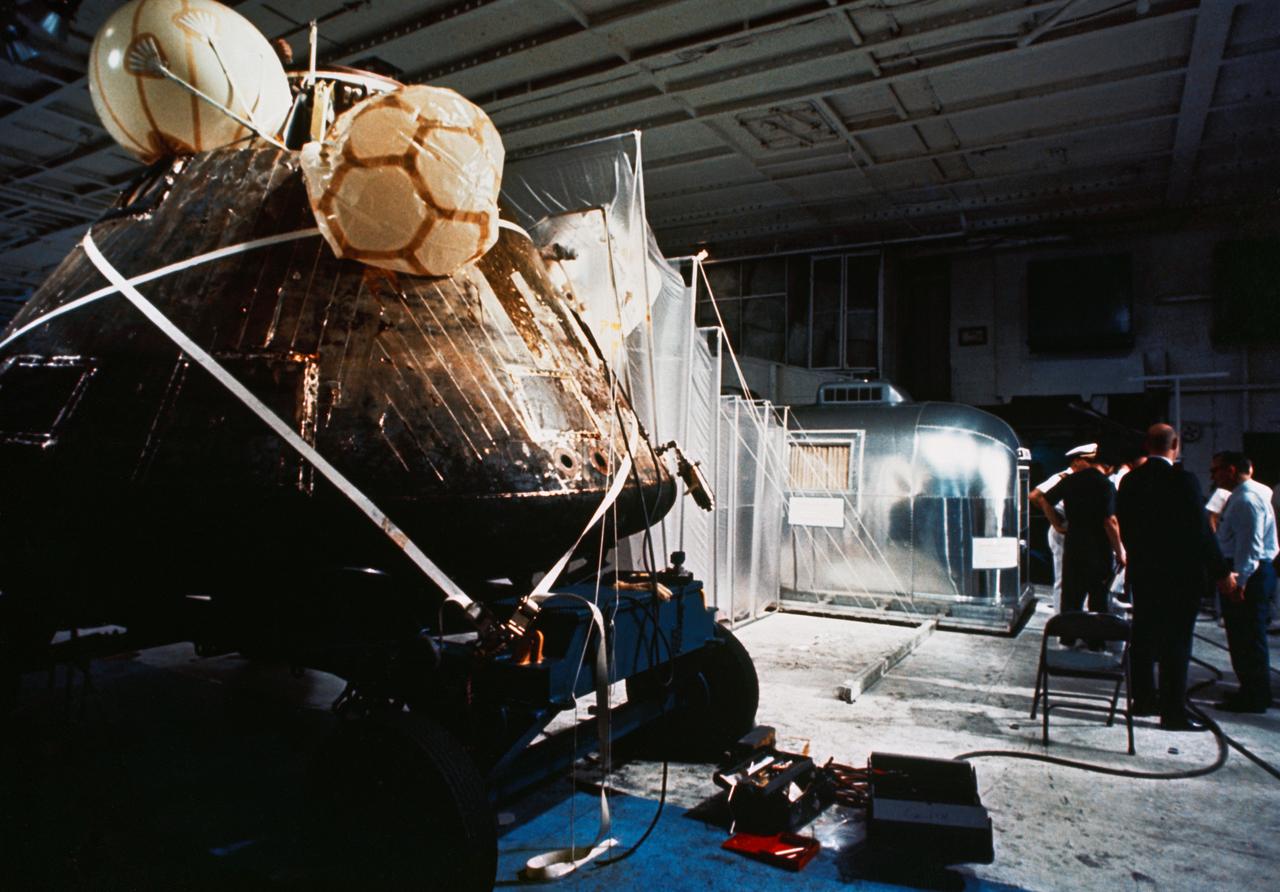
S69-40758 (24 July 1969) --- The Apollo 11 spacecraft Command Module (CM) and the Mobile Quarantine Facility (MQF) are photographed aboard the USS Hornet, prime recovery ship for…
Inspect NASA record
S69-40758 (24 July 1969) --- The Apollo 11 spacecraft Command Module (CM) and the Mobile Quarantine Facility (MQF) are photographed aboard the USS Hornet, prime recovery ship for the historic first lunar landing mission. The three crewmen are already in the MQF. Apollo 11 with astronauts Neil A. Armstrong, Michael Collins and Edwin E. Aldrin Jr. aboard splashed down at 11:49 a.m. (CDT), July 24, 1969, about 812 nautical miles southwest of Hawaii and only 12 nautical miles from the USS Hornet. While astronauts Armstrong, commander, and Aldrin, lunar module pilot, descended in the Lunar Module (LM) "Eagle" to explore the Sea of Tranquility region of the moon, astronaut Collins, command module pilot, remained with the Command and Service Modules (CSM) "Columbia" in lunar orbit.
- Record ID
- S69-40758
- NASA center
- JSC
- Date
- 1969-07-24
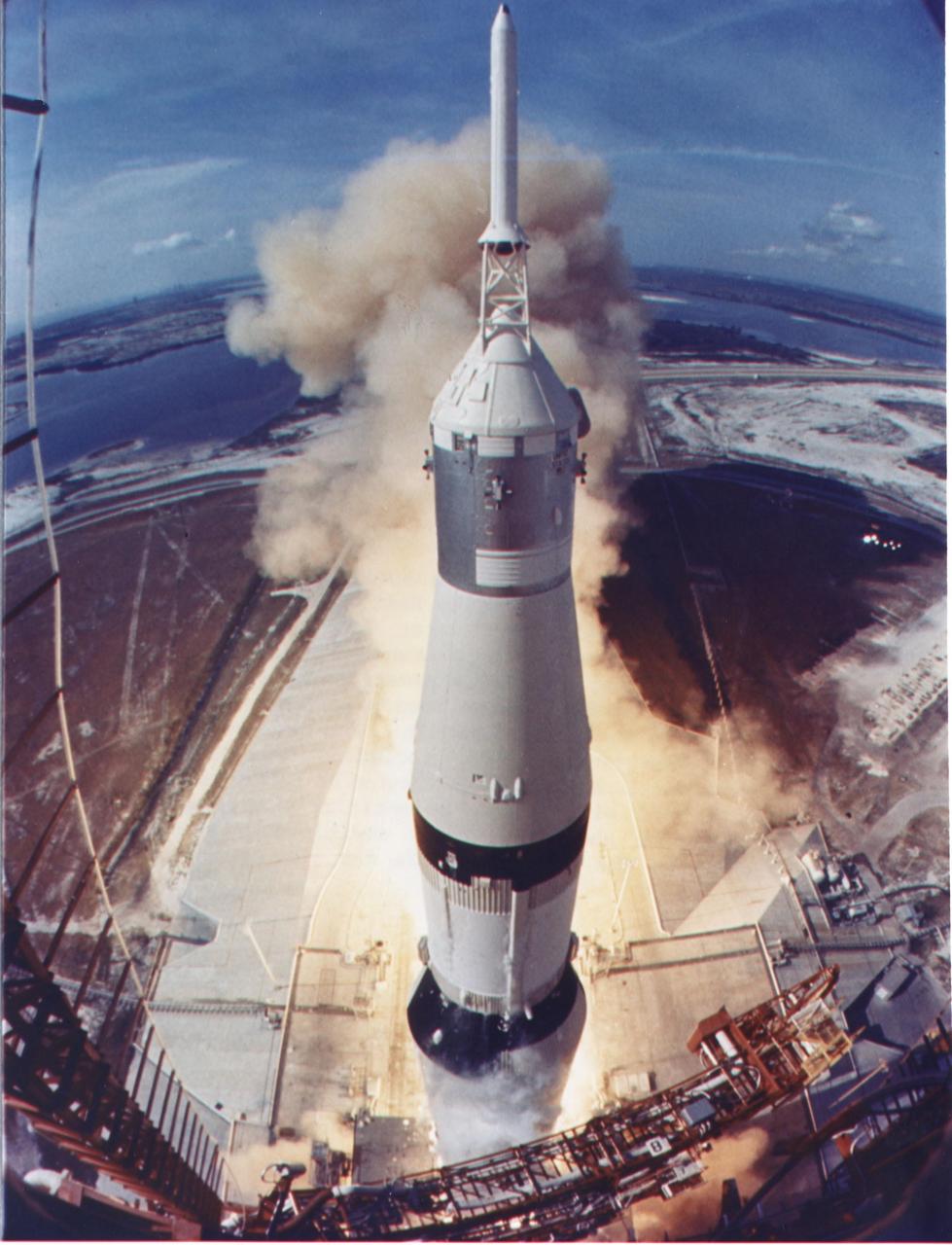
KSC · 1969-07-16 · ksc-69pc-420
ksc-69pc-420
KENNEDY SPACE CENTER, FLA. -- The Apollo 11 Saturn V space vehicle lifts off with Astronauts Neil A. Armstrong, Michael Collins and Edwin E. Aldrin Jr. at 9:32…
Inspect NASA record
KENNEDY SPACE CENTER, FLA. -- The Apollo 11 Saturn V space vehicle lifts off with Astronauts Neil A. Armstrong, Michael Collins and Edwin E. Aldrin Jr. at 9:32 a.m. EDT July 16, 1969, from Kennedy Space Center's Launch Complex 39A. During the planned eight-day mission, Armstrong and Aldrin will descend in a lunar module to the Moon's surface while Collins orbits overhead in the command module. The two astronauts are to spend 22 hours on the Moon, including two and one-half hours outside the lunar module. They will gather samples of lunar material and willl deploy scientific experiments which will transmit data about the lunar environment. They will rejoin Collins in the command module for the return trip to Earth
- Record ID
- ksc-69pc-420
- NASA center
- KSC
- Date
- 1969-07-16

KSC · 1969-07-16 · ksc-69pc-422
ksc-69pc-422
KENNEDY SPACE CENTER, FLA. -- The Apollo 11 Saturn V space vehicle lifts off with Astronauts Neil A. Armstrong, Michael Collins and Edwin E. Aldrin Jr. at 9:32…
Inspect NASA record
KENNEDY SPACE CENTER, FLA. -- The Apollo 11 Saturn V space vehicle lifts off with Astronauts Neil A. Armstrong, Michael Collins and Edwin E. Aldrin Jr. at 9:32 a.m. EDT July 16, 1969, from Kennedy Space Center's Launch Complex 39A. During the planned eight-day mission, Armstrong and Aldrin will descend in a lunar module to the Moon's surface while Collins orbits overhead in the command module. The two astronauts are to spend 22 hours on the Moon, including two and one-half hours outside the lunar module. They will gather samples of lunar material and willl deploy scientific experiments which will transmit data about the lunar environment. They will rejoin Collins in the command module for the return trip to Earth
- Record ID
- ksc-69pc-422
- NASA center
- KSC
- Date
- 1969-07-16
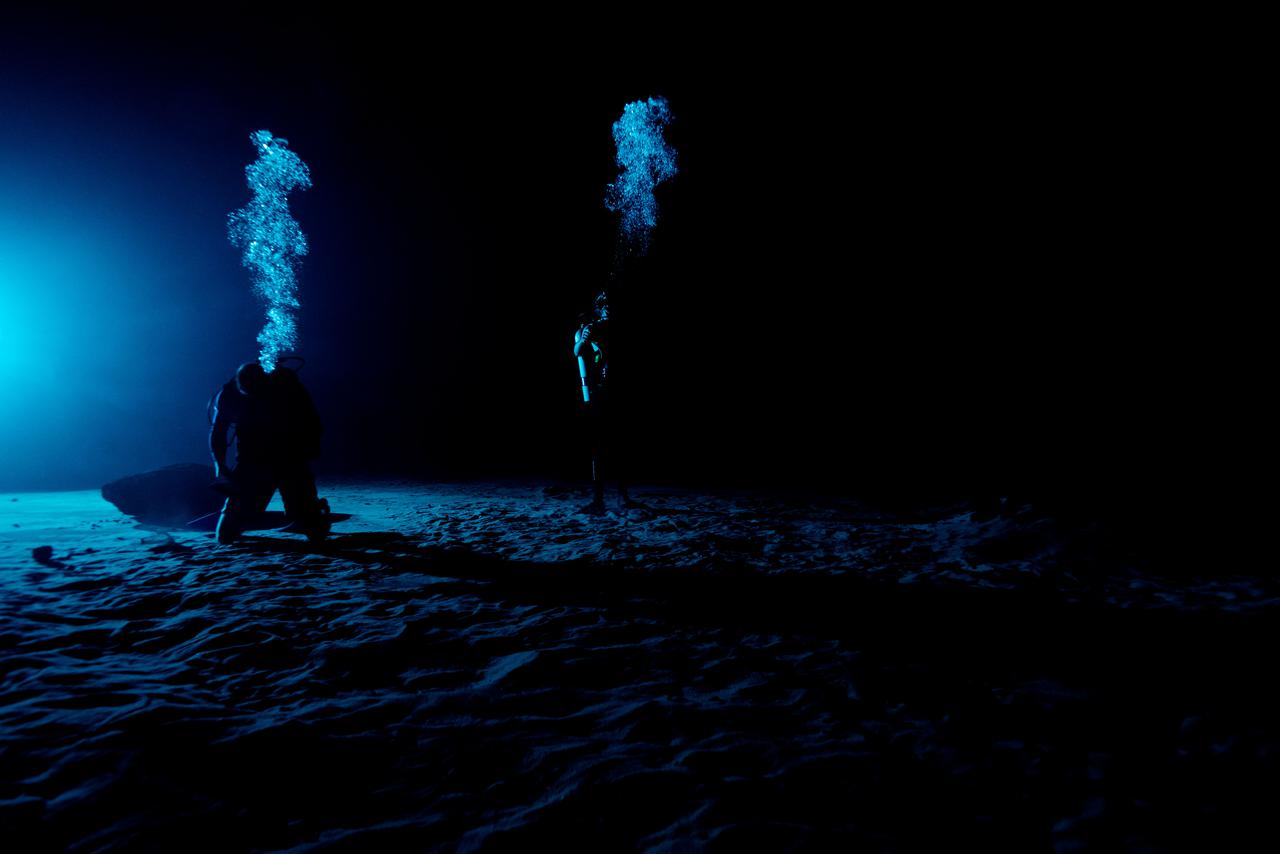
JSC · 2021-12-08 · jsc2022e001695
Shadow Assessment
Test subjects performing mission-relevant tasks and evaluating shadow quality during NBL Preliminary Lunar Lighting Evaluation. Divers at the Neutral Buoyancy Laboratory (NBL) in Houston are setting the stage…
Inspect NASA record
Test subjects performing mission-relevant tasks and evaluating shadow quality during NBL Preliminary Lunar Lighting Evaluation. Divers at the Neutral Buoyancy Laboratory (NBL) in Houston are setting the stage for future Moonwalk training by simulating lunar lighting conditions. At the Lunar South Pole, the Sun will remain no more than a few degrees above the horizon, resulting in extremely long and dark shadows. To prepare astronauts for these challenging lighting conditions, the team at the NBL has begun preliminary evaluations of lunar lighting solutions at the bottom of the 40-foot deep pool. This testing and evaluation involved turning off all the lights in the facility, installing black curtains on the pool walls to minimize reflections, and using a powerful underwater cinematic lamp, to get the conditions just right ahead of upcoming training for astronauts.
- Record ID
- jsc2022e001695
- NASA center
- JSC
- Date
- 2021-12-08
- Credit
- Lauren Maples
- Keywords
- Lunar, Moon, NBL, Lunar Training, Diver
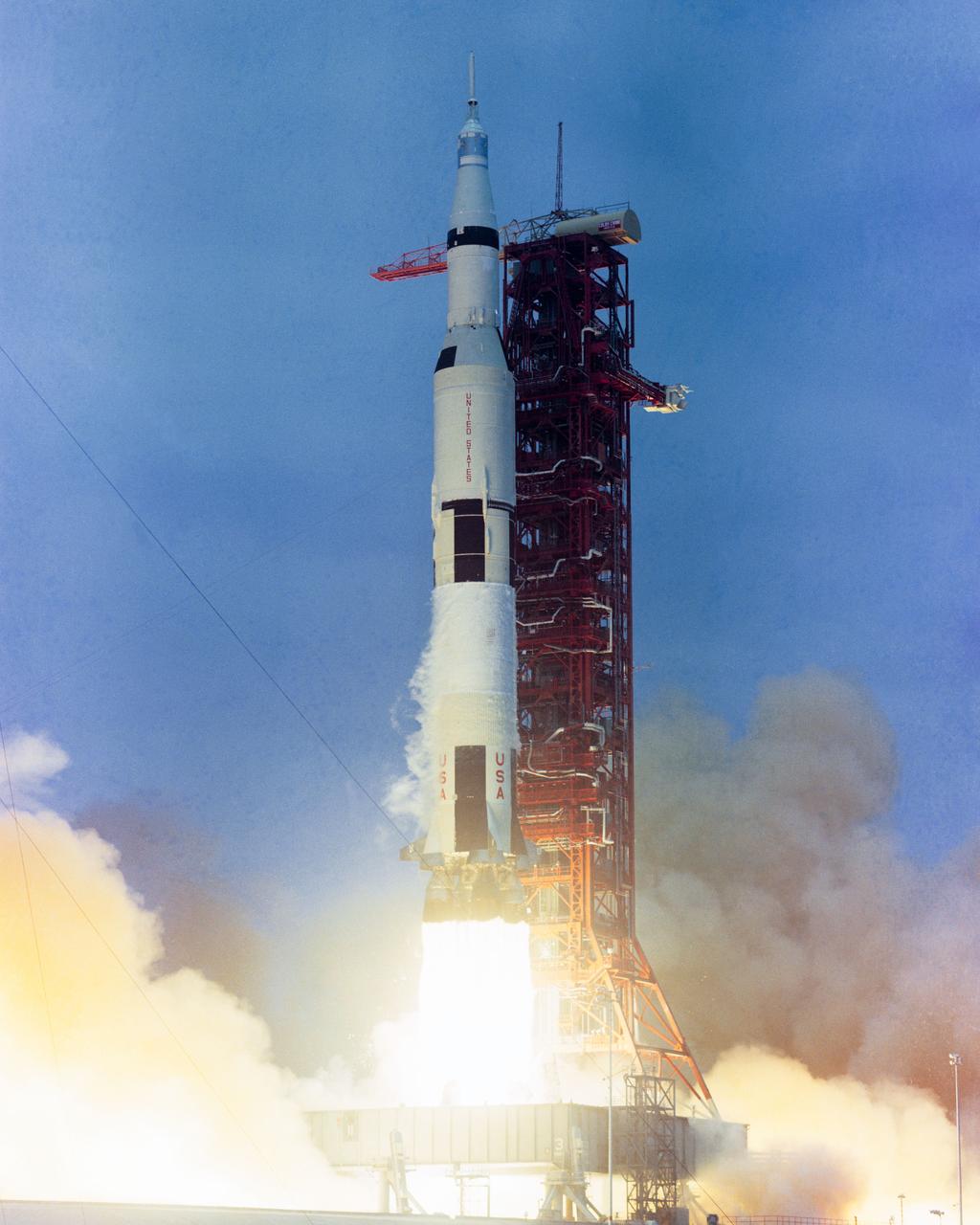
JSC · 1969-05-18 · s69-34144
APOLLO X - LAUNCH - PAD 39B - KSC
S69-34144 (18 May 1969) --- The Apollo 10 (Spacecraft 106/Lunar Module 4/Saturn 505) space vehicle is launched from Pad B, Launch Complex 39, Kennedy Space Center, Florida at…
Inspect NASA record
S69-34144 (18 May 1969) --- The Apollo 10 (Spacecraft 106/Lunar Module 4/Saturn 505) space vehicle is launched from Pad B, Launch Complex 39, Kennedy Space Center, Florida at 12:49 p.m., May 18, 1969. Aboard the spacecraft are astronauts Thomas P. Stafford, commander; John W. Young, command module pilot; and Eugene A. Cernan, lunar module pilot. The eight-day, lunar orbit mission will mark the first time the complete Apollo spacecraft has operated around the moon and the second manned flight for the Lunar Module (LM). Two Apollo 10 astronauts, Stafford and Cernan, are scheduled to descend to within eight nautical miles of the moon's surface in the LM.
- Record ID
- s69-34144
- NASA center
- JSC
- Date
- 1969-05-18