
Update Site (from NASA)
Explore NASA’s Image and Video Library.
Suggest one object per day for the Interstellar Minds collection. We review each suggestion before adding it.
Sign in to suggest a Marvel.
Find a NASA image ID. Open a NASA record and copy its ID from the end of the details URL.
NASA image records

HQ · 2018-07-25 · NHQ201807250012
Hearing on James Webb Space Telescope
NASA Administrator Jim Bridenstine testifies before the House Committee on Science, Space, and Technology during a hearing on the James Webb Space Telescope, Wednesday, July 25, 2018 at…
Inspect NASA record
NASA Administrator Jim Bridenstine testifies before the House Committee on Science, Space, and Technology during a hearing on the James Webb Space Telescope, Wednesday, July 25, 2018 at the Rayburn House Office Building in Washington. Photo Credit: (NASA/Bill Ingalls)
- Record ID
- NHQ201807250012
- NASA center
- HQ
- Date
- 2018-07-25
- Credit
- NASA/Bill Ingalls
- Keywords
- Committee on Science Space and Technology, DC, House Hearing, Jim Bridenstine, NASA Administrator, Rayburn House Office Building, Washington

HQ · 2018-07-25 · NHQ201807250008
Hearing on James Webb Space Telescope
Tom Young, chairman, JWST Independent Review Board, testifies before the House Committee on Science, Space, and Technology during a hearing on the James Webb Space Telescope, Wednesday, July…
Inspect NASA record
Tom Young, chairman, JWST Independent Review Board, testifies before the House Committee on Science, Space, and Technology during a hearing on the James Webb Space Telescope, Wednesday, July 25, 2018 at the Rayburn House Office Building in Washington. Photo Credit: (NASA/Bill Ingalls)
- Record ID
- NHQ201807250008
- NASA center
- HQ
- Date
- 2018-07-25
- Credit
- NASA/Bill Ingalls
- Keywords
- Committee on Science Space and Technology, DC, House Hearing, Rayburn House Office Building, Tom Young, Washington
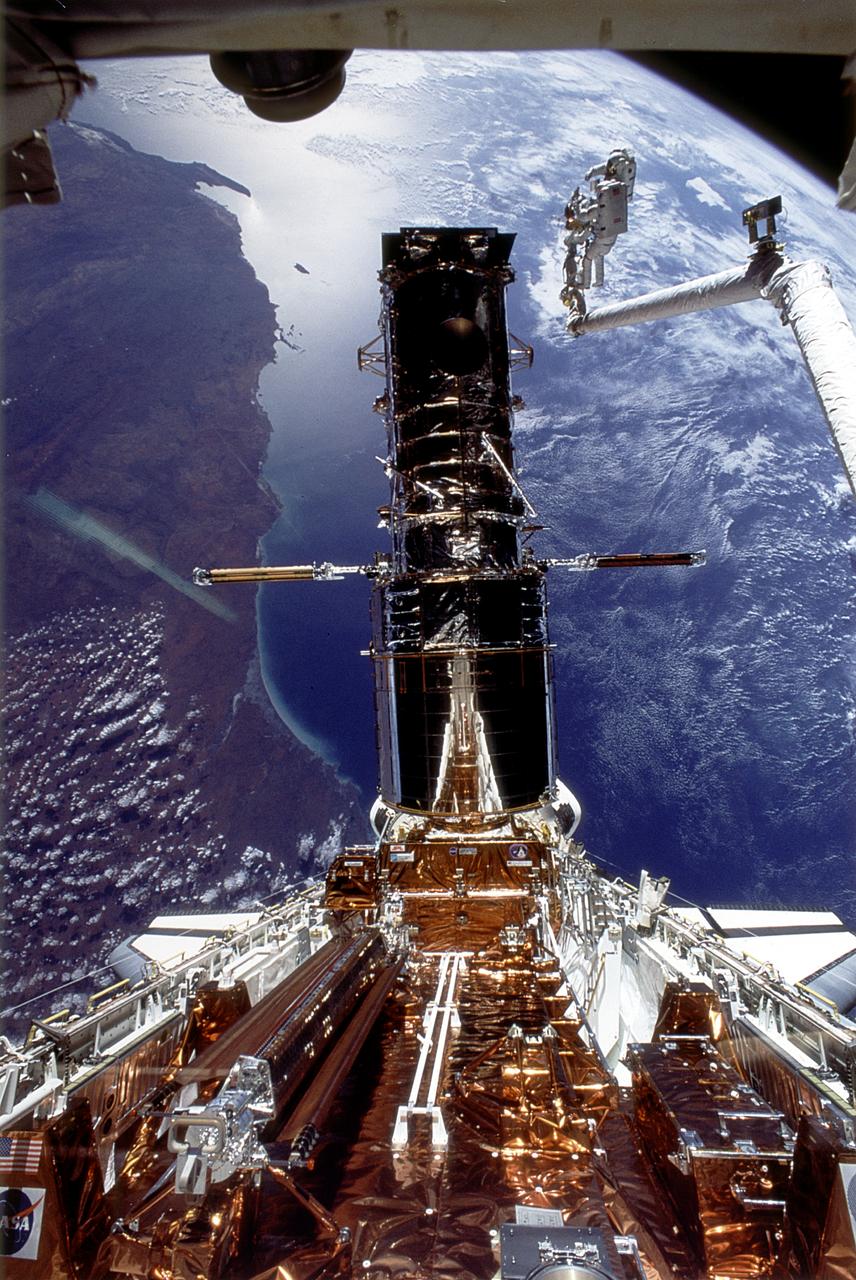
MSFC · 1993-12-09 · 9400251
History of Hubble Space Telescope (HST)
Repair of the Hubble Space Telescope (HST) - orbiting earth at an altitude of 325 nautical miles. Perched atop a foot restraint on shuttle Endeavour's remote manipulator system…
Inspect NASA record
Repair of the Hubble Space Telescope (HST) - orbiting earth at an altitude of 325 nautical miles. Perched atop a foot restraint on shuttle Endeavour's remote manipulator system arm, astronauts Story Musgrave and Jeffrey Hoffman wrap up the final of five space walks.
- Record ID
- 9400251
- NASA center
- MSFC
- Date
- 1993-12-09
- Keywords
- Around Marshall, STS Missions, STS-61 onboard EVA

HQ · 2018-07-25 · NHQ201807250015
Hearing on James Webb Space Telescope
Tom Young, chairman, JWST Independent Review Board, testifies before the House Committee on Science, Space, and Technology during a hearing on the James Webb Space Telescope, Wednesday, July…
Inspect NASA record
Tom Young, chairman, JWST Independent Review Board, testifies before the House Committee on Science, Space, and Technology during a hearing on the James Webb Space Telescope, Wednesday, July 25, 2018 at the Rayburn House Office Building in Washington. Photo Credit: (NASA/Bill Ingalls)
- Record ID
- NHQ201807250015
- NASA center
- HQ
- Date
- 2018-07-25
- Credit
- NASA/Bill Ingalls
- Keywords
- Committee on Science Space and Technology, DC, House Hearing, Rayburn House Office Building, Tom Young, Washington
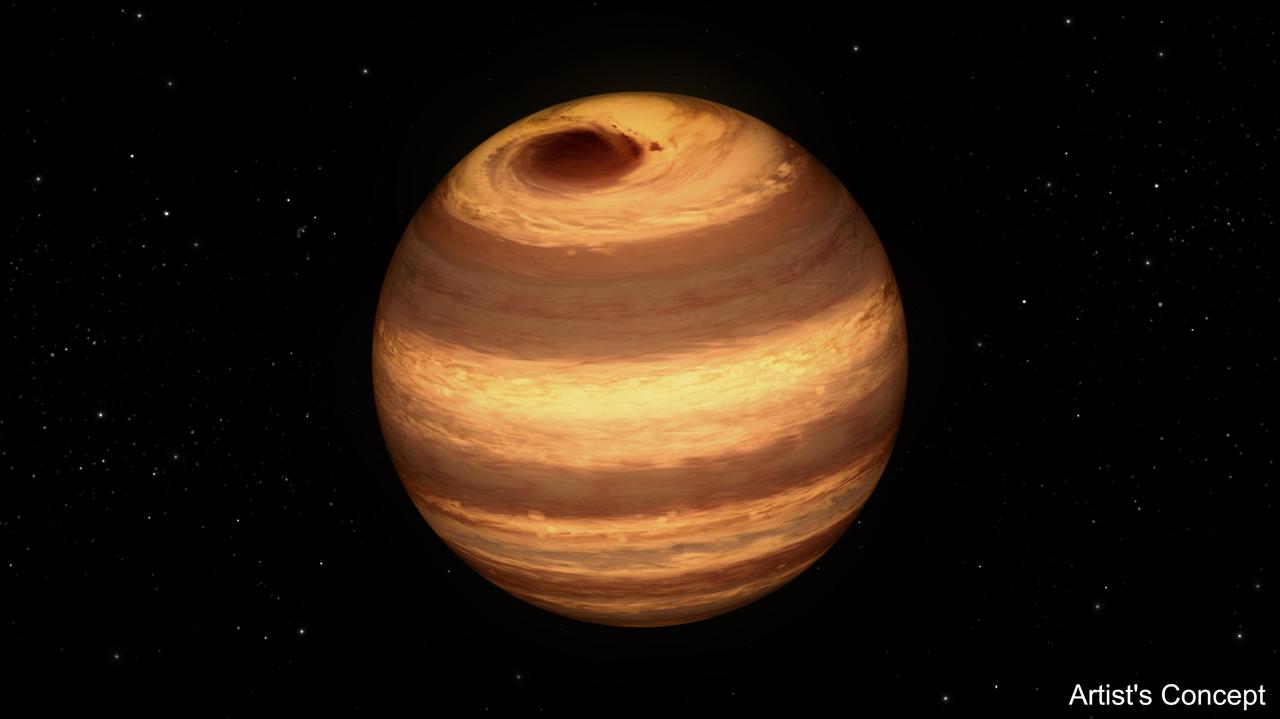
JPL · 2015-12-10 · PIA20055
Cool Star Marked by Long-Lived Storm Artist Concept
This illustration shows a cool star, called W1906+40, marked by a raging storm near one of its poles. The storm is thought to be similar to the Great…
Inspect NASA record
This illustration shows a cool star, called W1906+40, marked by a raging storm near one of its poles. The storm is thought to be similar to the Great Red Spot on Jupiter. Scientists discovered it using NASA's Kepler and Spitzer space telescopes. The location of the storm is estimated to be near the north pole of the star based on computer models of the data. The telescopes cannot see the storm itself, but learned of its presence after observing how the star's light changes over time. The storm travels around with the star, making a full lap about every 9 hours. When it passes into a telescope's field of view, it causes light of particular infrared and visible wavelengths to dip in brightness. The storm has persisted for at least two years. Astronomers aren't sure why it has lasted so long. While planets are known to have cloudy storms, this is the best evidence yet for a star with the same type of storm. The star, W1906+40, belongs to a thermally cool class of objects called L-dwarfs. Some L-dwarfs are considered stars because they fuse atoms and generate light, as our sun does, while others, called brown dwarfs, are known as "failed stars" for their lack of atomic fusion. The L-dwarf W1906+40 is thought to be a star based on estimates of its age (the older the L-dwarf, the more likely it is a star). Its temperature is about 2,200 Kelvin (3,500 degrees Fahrenheit). That may sound scorching hot, but as far as stars go, it is relatively cool. Cool enough, in fact, for clouds to form in its atmosphere. W1906+40 is located 53 light-years away in the constellation Lyra. http://photojournal.jpl.nasa.gov/catalog/PIA20055
- Record ID
- PIA20055
- NASA center
- JPL
- Date
- 2015-12-10
- Credit
- NASA/JPL-Caltech
- Keywords
- Kepler,Spitzer Space Telescope
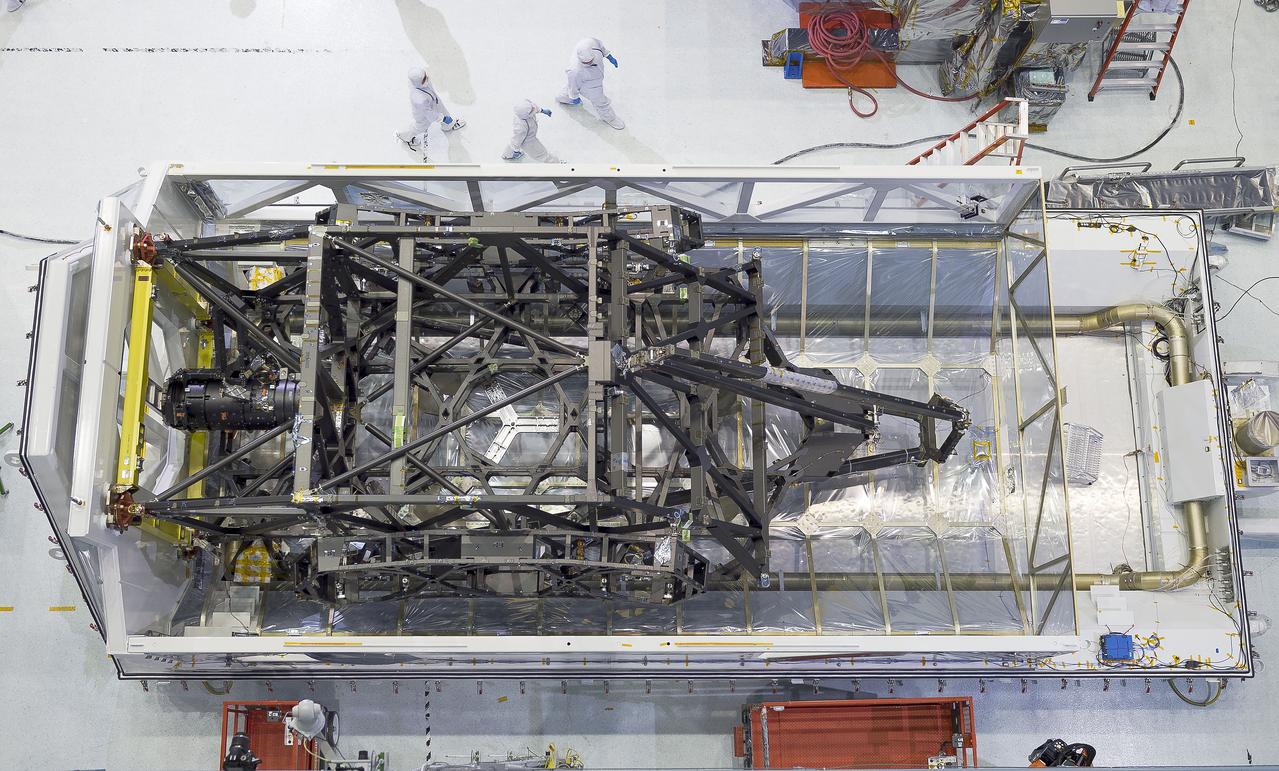
GSFC · 2017-12-08 · GSFC_20171208_Archive_e000639
James Webb Space Telescope Backplane Arrives at NASA Goddard for Mirror Assembly
The James Webb Space Telescope's "spine" or backplane arrived on Aug. 25 at NASA's Goddard Space Flight Center in Greenbelt, Maryland from Northrop Grumman. Credits: NASA Goddard/Chris Gunn…
Inspect NASA record
The James Webb Space Telescope's "spine" or backplane arrived on Aug. 25 at NASA's Goddard Space Flight Center in Greenbelt, Maryland from Northrop Grumman. Credits: NASA Goddard/Chris Gunn Read more: go.nasa.gov/1K2v8J2 NASA image use policy. NASA Goddard Space Flight Center enables NASA’s mission through four scientific endeavors: Earth Science, Heliophysics, Solar System Exploration, and Astrophysics. Goddard plays a leading role in NASA’s accomplishments by contributing compelling scientific knowledge to advance the Agency’s mission. Follow us on Twitter Like us on Facebook Find us on Instagram
- Record ID
- GSFC_20171208_Archive_e000639
- NASA center
- GSFC
- Date
- 2017-12-08
- Keywords
- James Webb Space Telescope Backplane Arrives at NASA Goddard for Mirror Assembly, mirror, nasa, assembly, backplane, jameswebbspacetelescope, nasagoddard

JPL · 2017-02-22 · PIA21429
Transit Illustration of TRAPPIST-1
This illustration shows the seven TRAPPIST-1 planets as they might look as viewed from Earth using a fictional, incredibly powerful telescope. The sizes and relative positions are correctly…
Inspect NASA record
This illustration shows the seven TRAPPIST-1 planets as they might look as viewed from Earth using a fictional, incredibly powerful telescope. The sizes and relative positions are correctly to scale: This is such a tiny planetary system that its sun, TRAPPIST-1, is not much bigger than our planet Jupiter, and all the planets are very close to the size of Earth. Their orbits all fall well within what, in our solar system, would be the orbital distance of our innermost planet, Mercury. With such small orbits, the TRAPPIST-1 planets complete a "year" in a matter of a few Earth days: 1.5 for the innermost planet, TRAPPIST-1b, and 20 for the outermost, TRAPPIST-1h. This particular arrangement of planets with a double-transit reflect an actual configuration of the system during the 21 days of observations made by NASA's Spitzer Space Telescope in late 2016. The system has been revealed through observations from NASA's Spitzer Space Telescope and the ground-based TRAPPIST (TRAnsiting Planets and PlanetesImals Small Telescope) telescope, as well as other ground-based observatories. The system was named for the TRAPPIST telescope. http://photojournal.jpl.nasa.gov/catalog/PIA21429
- Record ID
- PIA21429
- NASA center
- JPL
- Date
- 2017-02-22
- Credit
- NASA/JPL-Caltech
- Keywords
- Spitzer Space Telescope, Trappist-1
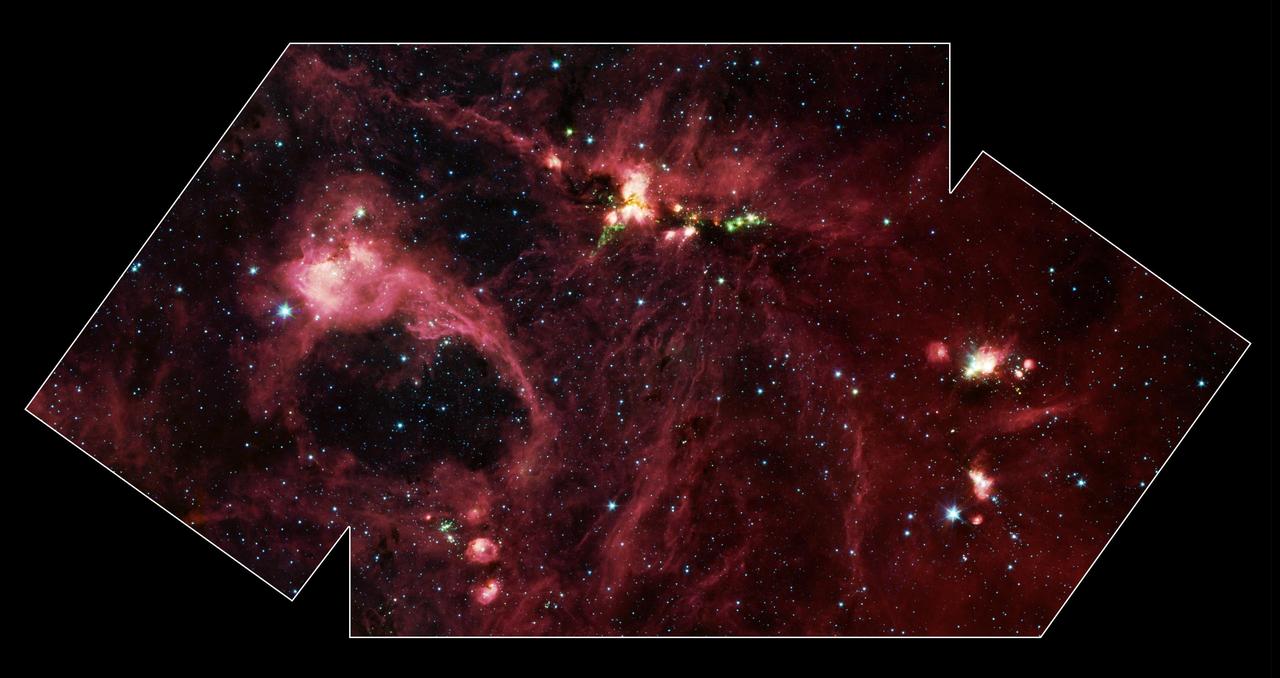
JPL · 2004-04-13 · PIA05732
Nursery of Giants
Hidden behind a shroud of dust in the constellation Cygnus is a stellar nursery called DR21, which is giving birth to some of the most massive stars in…
Inspect NASA record
Hidden behind a shroud of dust in the constellation Cygnus is a stellar nursery called DR21, which is giving birth to some of the most massive stars in our galaxy. Visible light images reveal no trace of this interstellar cauldron because of heavy dust obscuration. In fact, visible light is attenuated in DR21 by a factor of more than 10,000,000,000,000,000,000,000,000,000,000,000,000,000 (ten thousand trillion heptillion). New images from NASA's Spitzer Space Telescope allow us to peek behind the cosmic veil and pinpoint one of the most massive natal stars yet seen in our Milky Way galaxy. The never-before-seen star is 100,000 times as bright as the Sun. Also revealed for the first time is a powerful outflow of hot gas emanating from this star and bursting through a giant molecular cloud. This image is a large-scale mosaic assembled from individual photographs obtained with the InfraRed Array Camera (IRAC) aboard Spitzer. The image covers an area about two times that of a full moon. The mosaic is a composite of images obtained at mid-infrared wavelengths of 3.6 microns (blue), 4.5 microns (green), 5.8 microns (orange) and 8 microns (red). The brightest infrared cloud near the top center corresponds to DR21, which presumably contains a cluster of newly forming stars at a distance of 10,000 light-years. Protruding out from DR21 toward the bottom left of the image is a gaseous outflow (green), containing both carbon monoxide and molecular hydrogen. Data from the Spitzer spectrograph, which breaks light into its constituent individual wavelengths, indicate the presence of hot steam formed as the outflow heats the surrounding molecular gas. Outflows are physical signatures of processes that create supersonic beams, or jets, of gas. They are usually accompanied by discs of material around the new star, which likely contain the materials from which future planetary systems are formed. Additional newborn stars, depicted in green, can be seen surrounding the DR21 region. The red filaments stretching across this image denote the presence of polycyclic aromatic hydrocarbons. These organic molecules, comprised of carbon and hydrogen, are excited by surrounding interstellar radiation and become luminescent at wavelengths near 8.0 microns. The complex pattern of filaments is caused by an intricate combination of radiation pressure, gravity and magnetic fields. The result is a tapestry in which winds, outflows and turbulence move and shape the interstellar medium. To the lower left of the mosaic is a large bubble of gas and dust, which may represent the remnants of a past generation of stars. http://photojournal.jpl.nasa.gov/catalog/PIA05732
- Record ID
- PIA05732
- NASA center
- JPL
- Date
- 2004-04-13
- Credit
- NASA/JPL-Caltech
- Keywords
- Spitzer Space Telescope, Cygnus
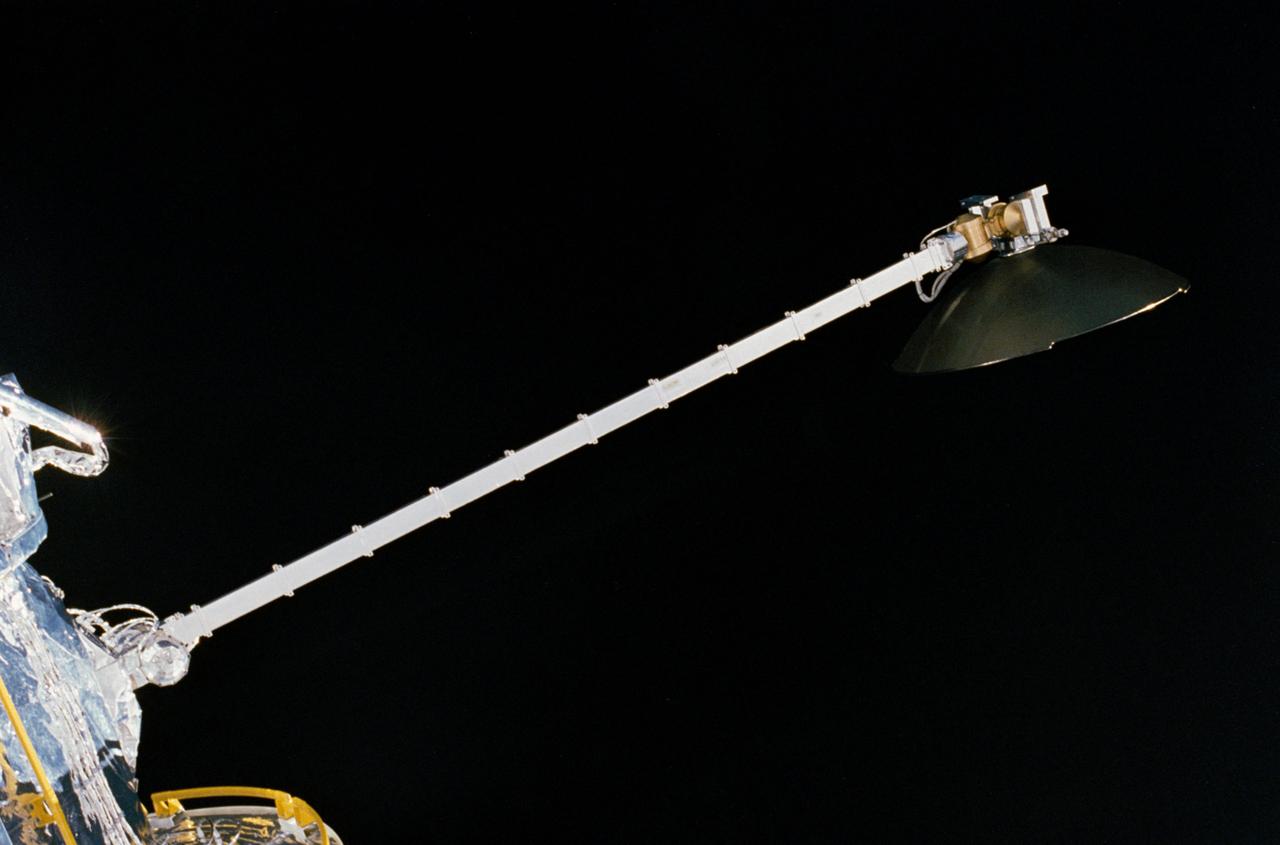
JSC · 1990-04-25 · s31-03-002
Hubble Space Telescope (HST) high gain antenna (HGA) deployment during STS-31
Held in appendage deploy position, the Hubble Space Telescope's (HST's) high gain antenna (HGA) has been released from its stowed position along the Support System Module (SSM) forward…
Inspect NASA record
Held in appendage deploy position, the Hubble Space Telescope's (HST's) high gain antenna (HGA) has been released from its stowed position along the Support System Module (SSM) forward shell. The STS-31 crew aboard Discovery, Orbiter Vehicle (OV) oversees the automatic HGA deployment prior to releasing HST. HST HGA is backdropped against the blackness of space.
- Record ID
- s31-03-002
- NASA center
- JSC
- Date
- 1990-04-25
- Keywords
- ANTENNAS, DISCOVERY (ORBITER), HIGH GAIN, HUBBLE SPACE TELESCOPE, STS-31, SPACECRAFT ANTENNAS
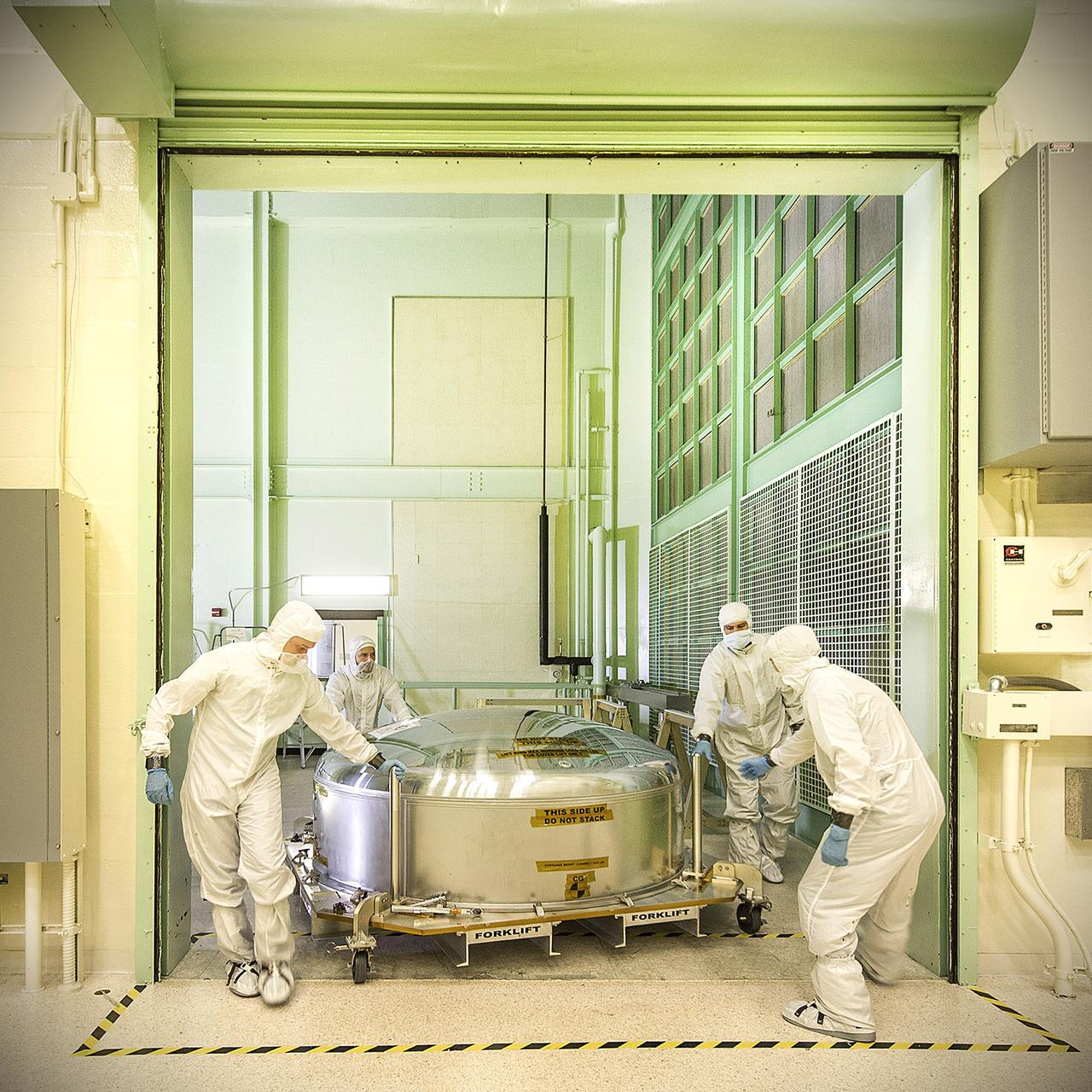
GSFC · 2017-12-08 · GSFC_20171208_Archive_e001286
A James Webb Space Telescope Mirror Takes a Short Trip
This is the James Webb Space Telescope ETU (engineering test unit) primary mirror segment returning to the cleanroom at NASA Goddard after undergoing some tests at our new…
Inspect NASA record
This is the James Webb Space Telescope ETU (engineering test unit) primary mirror segment returning to the cleanroom at NASA Goddard after undergoing some tests at our new Calibration, Integration, and Alignment Facility (CIAF). Credit: NASA/Goddard/Chris Gunn NASA image use policy. NASA Goddard Space Flight Center enables NASA’s mission through four scientific endeavors: Earth Science, Heliophysics, Solar System Exploration, and Astrophysics. Goddard plays a leading role in NASA’s accomplishments by contributing compelling scientific knowledge to advance the Agency’s mission. Follow us on Twitter Like us on Facebook Find us on Instagram
- Record ID
- GSFC_20171208_Archive_e001286
- NASA center
- GSFC
- Date
- 2017-12-08
- Keywords
- A James Webb Space Telescope Mirror Takes a Short Trip, mirror, nasa, goddard, jwst, webbtelescope
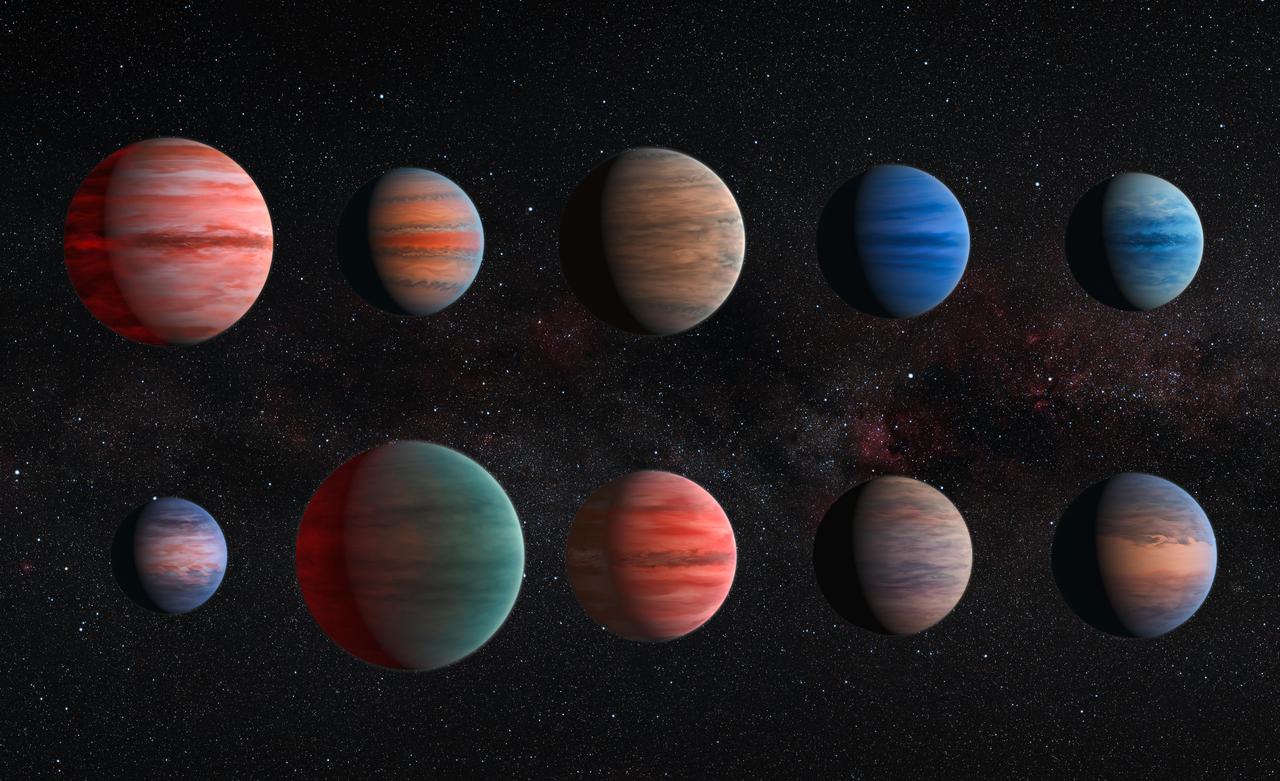
JPL · 2015-12-14 · PIA20056
Artist Impression of Hot
This image shows an artist's impression of the 10 hot Jupiter exoplanets studied using the Hubble and Spitzer space telescopes. From top left to lower left, these planets…
Inspect NASA record
This image shows an artist's impression of the 10 hot Jupiter exoplanets studied using the Hubble and Spitzer space telescopes. From top left to lower left, these planets are WASP-12b, WASP-6b, WASP-31b, WASP-39b, HD 189733b, HAT-P-12b, WASP-17b, WASP-19b, HAT-P-1b and HD 209458b. The colors of the planets are for illustration purposes only. There is little scientific data on color with the exception of HD 189733b, which became known as the "blue planet." The planets are also depicted with a variety of different cloud properties. The wind patterns shown on these 10 planets, which resemble the visible structures on Jupiter, are based on theoretical models. The illustrations are to scale with each other. HAT-P-12b, the smallest of these planets, is approximately the size of Jupiter, while WASP-17b, the largest one in the sample, is almost twice the size. The hottest planets within the sample are portrayed with a glowing night side. This effect is strongest on WASP-12b, the hottest exoplanet in the sample, but also visible on WASP-19b and WASP-17b. It is also known that several of the planets exhibit strong Rayleigh scattering. This effect causes the blue hue of the daytime sky and the reddening of the sun at sunset on Earth. It is also visible as a blue edge on the planets WASP-6b, HD 189733b, HAT-P-12b and HD 209458b. http://photojournal.jpl.nasa.gov/catalog/PIA20056
- Record ID
- PIA20056
- NASA center
- JPL
- Date
- 2015-12-14
- Credit
- NASA/ESA
- Keywords
- Hubble Space Telescope,Spitzer Space Telescope

GSFC · 2017-12-08 · GSFC_20171208_Archive_e001500
NASA's Hubble Space Telescope Finds Dead Stars 'Polluted with Planet Debris'
This is an artist’s impression of a white dwarf (burned-out) star accreting rocky debris left behind by the star’s surviving planetary system. It was observed by Hubble in…
Inspect NASA record
This is an artist’s impression of a white dwarf (burned-out) star accreting rocky debris left behind by the star’s surviving planetary system. It was observed by Hubble in the Hyades star cluster. At lower right, an asteroid can be seen falling toward a Saturn-like disk of dust that is encircling the dead star. Infalling asteroids pollute the white dwarf’s atmosphere with silicon. Credit: NASA, ESA, and G. Bacon (STScI) --- NASA's Hubble Space Telescope has found the building blocks for Earth-sized planets in an unlikely place-- the atmospheres of a pair of burned-out stars called white dwarfs. These dead stars are located 150 light-years from Earth in a relatively young star cluster, Hyades, in the constellation Taurus. The star cluster is only 625 million years old. The white dwarfs are being polluted by asteroid-like debris falling onto them. NASA image use policy. NASA Goddard Space Flight Center enables NASA’s mission through four scientific endeavors: Earth Science, Heliophysics, Solar System Exploration, and Astrophysics. Goddard plays a leading role in NASA’s accomplishments by contributing compelling scientific knowledge to advance the Agency’s mission. Follow us on Twitter Like us on Facebook Find us on Instagram
- Record ID
- GSFC_20171208_Archive_e001500
- NASA center
- GSFC
- Date
- 2017-12-08
- Keywords
- NASA's Hubble Space Telescope Finds Dead Stars 'Polluted with Planet Debris', star, space, nasa, goddard, hubble, whitedwaft