
Update Site (from NASA)
Explore NASA’s Image and Video Library.
Suggest one object per day for the Interstellar Minds collection. We review each suggestion before adding it.
Sign in to suggest a Marvel.
Find a NASA image ID. Open a NASA record and copy its ID from the end of the details URL.
NASA image records

JPL · 2017-02-22 · PIA21421
Abstract Concept of TRAPPIST-1 System
This artist's concept appeared on the Feb. 23, 2017 cover of the journal Nature announcing that the TRAPPIST-1 star, an ultra-cool dwarf, has seven Earth-size planets orbiting it.…
Inspect NASA record
This artist's concept appeared on the Feb. 23, 2017 cover of the journal Nature announcing that the TRAPPIST-1 star, an ultra-cool dwarf, has seven Earth-size planets orbiting it. Any of these planets could have liquid water on them. Planets that are farther from the star are more likely to have significant amounts of ice, especially on the side that faces away from the star. The system has been revealed through observations from NASA's Spitzer Space Telescope and the ground-based TRAPPIST (TRAnsiting Planets and PlanetesImals Small Telescope) telescope, as well as other ground-based observatories. The system was named for the TRAPPIST telescope. http://photojournal.jpl.nasa.gov/catalog/PIA21421
- Record ID
- PIA21421
- NASA center
- JPL
- Date
- 2017-02-22
- Credit
- NASA/JPL-Caltech
- Keywords
- Spitzer Space Telescope, Trappist-1

JPL · 2006-10-27 · PIA01318
Where Galactic Snakes Live
This infrared image from NASA's Spitzer Space Telescope shows what astronomers are referring to as a "snake" (upper left) and its surrounding stormy environment. The sinuous object is…
Inspect NASA record
This infrared image from NASA's Spitzer Space Telescope shows what astronomers are referring to as a "snake" (upper left) and its surrounding stormy environment. The sinuous object is actually the core of a thick, sooty cloud large enough to swallow dozens of solar systems. In fact, astronomers say the "snake's belly" may be harboring beastly stars in the process of forming. The galactic creepy crawler to the right of the snake is another thick cloud core, in which additional burgeoning massive stars might be lurking. The colorful regions below the two cloud cores are less dense cloud material, in which dust has been heated by starlight and glows with infrared light. Yellow and orange dots throughout the image are monstrous developing stars; the red star on the "belly" of the snake is 20 to 50 times as massive as our sun. The blue dots are foreground stars. The red ball at the bottom left is a "supernova remnant," the remains of massive star that died in a fiery blast. Astronomers speculate that radiation and winds from the star before it died, in addition to a shock wave created when it exploded, might have played a role in creating the snake. Spitzer was able to spot the two black cloud cores using its heat-seeking infrared vision. The objects are hiding in the dusty plane of our Milky Way galaxy, invisible to optical telescopes. Because their heat, or infrared light, can sneak through the dust, they first showed up in infrared images from past missions. The cloud cores are so thick with dust that if you were to somehow transport yourself into the middle of them, you would see nothing but black, not even a star in the sky. Now, that's spooky! Spitzer's view of the region provides the best look yet at the massive embryonic stars hiding inside the snake. Astronomers say these observations will ultimately help them better understand how massive stars form. By studying the clustering and range of masses of the stellar embryos, they hope to determine if the stars were born in the same way that our low-mass sun was formed - out of a collapsing cloud of gas and dust - or by another mechanism in which the environment plays a larger role. The snake is located about 11,000 light-years away in the constellation Sagittarius. This false-color image is a composite of infrared data taken by Spitzer's infrared array camera and multiband imaging photometer. Blue represents 3.6-micron light; green shows light of 8 microns; and red is 24-micron light. http://photojournal.jpl.nasa.gov/catalog/PIA01318
- Record ID
- PIA01318
- NASA center
- JPL
- Date
- 2006-10-27
- Credit
- NASA/JPL-Caltech
- Keywords
- Spitzer Space Telescope, Sagittarius

JPL · 2005-01-12 · PIA07225
New Views of a Familiar Beauty
This image composite compares the well-known visible-light picture of the glowing Trifid Nebula (left panel) with infrared views from NASA's Spitzer Space Telescope (remaining three panels). The Trifid…
Inspect NASA record
This image composite compares the well-known visible-light picture of the glowing Trifid Nebula (left panel) with infrared views from NASA's Spitzer Space Telescope (remaining three panels). The Trifid Nebula is a giant star-forming cloud of gas and dust located 5,400 light-years away in the constellation Sagittarius. The false-color Spitzer images reveal a different side of the Trifid Nebula. Where dark lanes of dust are visible trisecting the nebula in the visible-light picture, bright regions of star-forming activity are seen in the Spitzer pictures. All together, Spitzer uncovered 30 massive embryonic stars and 120 smaller newborn stars throughout the Trifid Nebula, in both its dark lanes and luminous clouds. These stars are visible in all the Spitzer images, mainly as yellow or red spots. Embryonic stars are developing stars about to burst into existence. Ten of the 30 massive embryos discovered by Spitzer were found in four dark cores, or stellar "incubators," where stars are born. Astronomers using data from the Institute of Radioastronomy millimeter telescope in Spain had previously identified these cores but thought they were not quite ripe for stars. Spitzer's highly sensitive infrared eyes were able to penetrate all four cores to reveal rapidly growing embryos. http://photojournal.jpl.nasa.gov/catalog/PIA07225
- Record ID
- PIA07225
- NASA center
- JPL
- Date
- 2005-01-12
- Credit
- NASA/JPL-Caltech/NOAO
- Keywords
- Trifid Nebula, Spitzer Space Telescope
JPL · 2005-01-11 · PIA07221
At the Heart of Blobs Artist Concept
This artist's concept illustrates one possible answer to the puzzle of the "giant galactic blobs." These blobs (red), first identified about five years ago, are mammoth clouds of…
Inspect NASA record
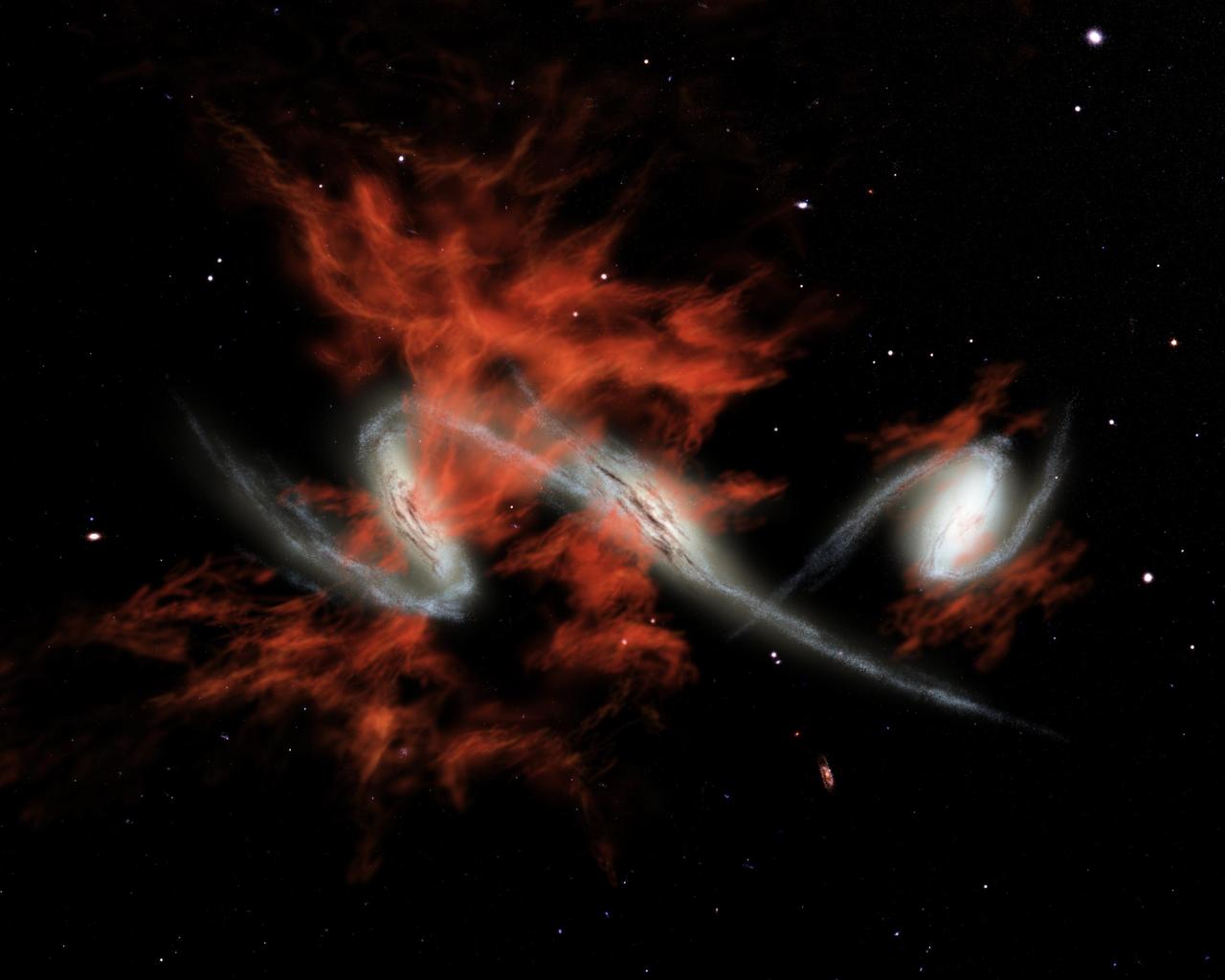
This artist's concept illustrates one possible answer to the puzzle of the "giant galactic blobs." These blobs (red), first identified about five years ago, are mammoth clouds of intensely glowing material that surround distant galaxies (white). Astronomers using visible-light telescopes can see the glow of the blobs, but they didn't know what provides the energy to light them up. NASA's Spitzer Space Telescope set its infrared eyes on one well-known blob located 11 billion light-years away, and discovered three tremendously bright galaxies, each shining with the light of more than one trillion Suns, headed toward each other. Spitzer also observed three other blobs in the same galactic neighborhood and found equally bright galaxies within them. One of these blobs is also known to contain galaxies merging together. The findings suggest that galactic mergers might be the mysterious source of blobs. If so, then one explanation for how mergers produce such large clouds of material is that they trigger intense bursts of star formation. This star formation would lead to exploding massive stars, or supernovae, which would then shoot gases outward in a phenomenon known as superwinds. Blobs produced in this fashion are illustrated in this artist's concept. http://photojournal.jpl.nasa.gov/catalog/PIA07221
- Record ID
- PIA07221
- NASA center
- JPL
- Date
- 2005-01-11
- Credit
- NASA/JPL-Caltech
- Keywords
- Spitzer Space Telescope, artist concept
KSC · 2026-07-08 · KSC-20260708-PH-JMT02_0001
Roman Space Telescope - Flight CGI Test Connector Panel Closeout
During a key integration milestone for NASA’s Nancy Grace Roman Space Telescope, technicians and engineers from the agency's Jet Propulsion Lab in Southern California gather inside the Payload…
Inspect NASA record
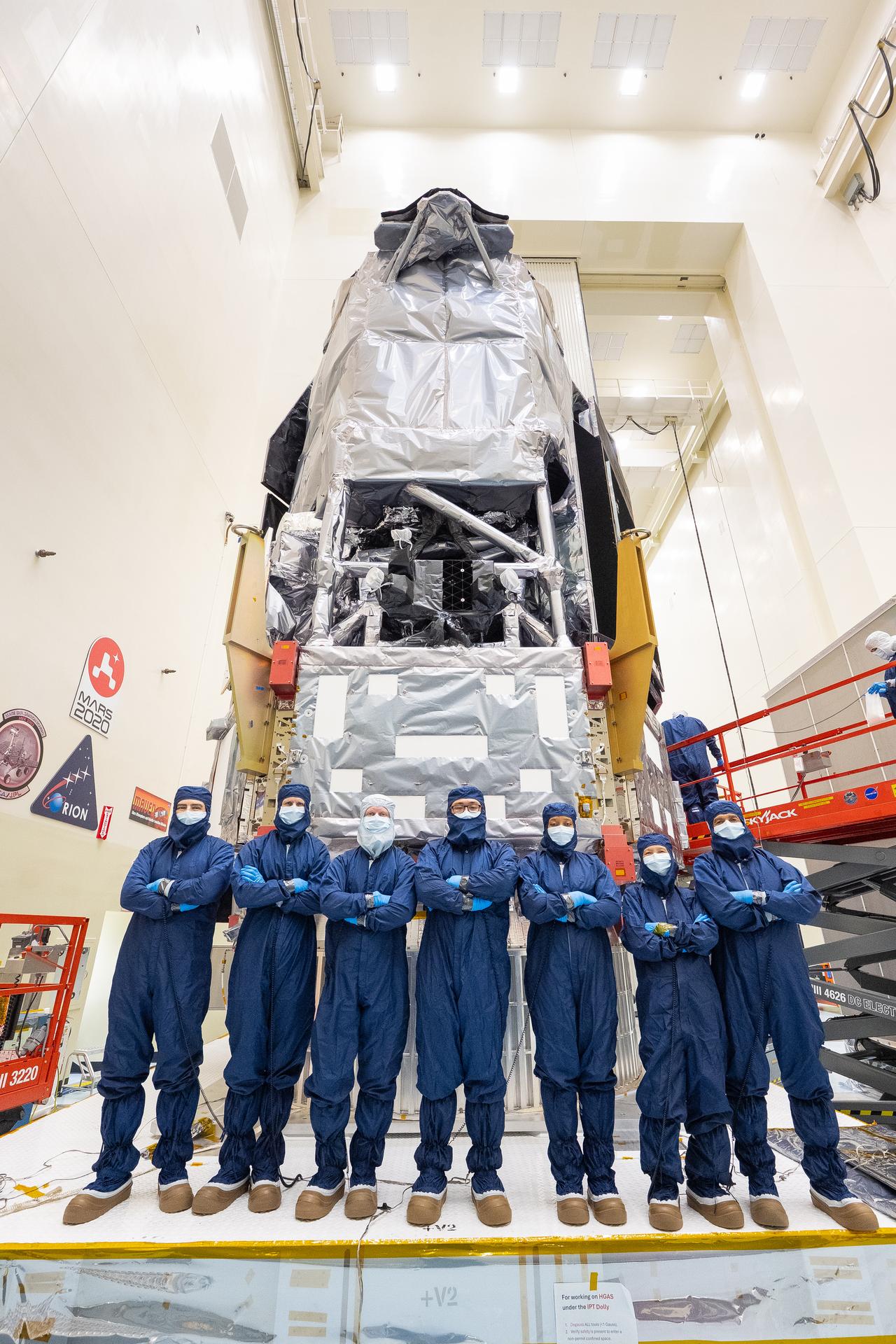
During a key integration milestone for NASA’s Nancy Grace Roman Space Telescope, technicians and engineers from the agency's Jet Propulsion Lab in Southern California gather inside the Payload Hazardous Servicing Facility at NASA’s Kennedy Space Center in Florida on Wednesday, July 8, 2026, following the closeout of the observatory’s Coronagraph Instrument test connector panel. Roman carries one science instrument called the Wide Field Instrument, and one technology demonstration called the Roman Coronagraph Instrument. The coronagraph is a system of masks, prisms, detectors, and even self-flexing mirrors built to block out the glare from distant stars and directly image the planets in orbit around them. The Roman Coronagraph will be the first active coronagraph to fly in space, meaning it contains components that actively respond to variables that would usually cause starlight to scatter, making it harder to see nearby planets.
- Record ID
- KSC-20260708-PH-JMT02_0001
- NASA center
- KSC
- Date
- 2026-07-08
- Credit
- NASA/Jolearra Tshiteya
- Keywords
- Nancy Grace Roman Space Telescope, RST, Payload Hazardous Servicing Facility, PHSF, KSC, Kennedy Space Center, LSP, Launch Services Program, Goddard Space Flight Center, preparations, processing, GSFC

JPL · 2016-11-10 · PIA21077
Brown Dwarf Microlensing Diagram
For the first time, two space-based telescopes have teamed up with ground-based observatories to observe a microlensing event, a magnification of the light of a distant star due…
Inspect NASA record
For the first time, two space-based telescopes have teamed up with ground-based observatories to observe a microlensing event, a magnification of the light of a distant star due to the gravitational effects of an unseen object in the foreground. In this case, the cause of the microlensing event was a brown dwarf, dubbed OGLE-2015-BLG-1319, orbiting a star. In terms of mass, brown dwarfs fall somewhere between the size of the largest planets and the smallest stars. Curiously, scientists have found that, for stars roughly the mass of our sun, less than 1 percent have a brown dwarf orbiting within 3 AU (1 AU is the distance between Earth and the sun). This newly discovered brown dwarf may fall in that distance range. This microlensing event was observed by ground-based telescopes looking for these uncommon events, and subsequently seen by NASA's Spitzer and Swift space telescopes. As the diagram shows, Spitzer and Swift offer additional vantage points for viewing this chance alignment. While Swift orbits close to Earth, and saw (blue diamonds) essentially the same change in light that the ground-based telescopes measured (grey markers), Spitzer's location much farther away from Earth gave it a very different perspective on the event (red circles). In particular, Spitzer's vantage point resulted in a time lag in the microlensing event it observed, compared to what was seen by Swift and the ground-based telescope. This offset allowed astronomers to determine the distance to OGLE-2015-BLG-1319 as well as its mass: around 30-65 times that of Jupiter. http://photojournal.jpl.nasa.gov/catalog/PIA21077
- Record ID
- PIA21077
- NASA center
- JPL
- Date
- 2016-11-10
- Credit
- NASA/JPL-Caltech
- Keywords
- OGLE-2015-BLG-1319, Spitzer Space Telescope,SWIFT, microlensing

JPL · 2018-06-15 · PIA22356
A Tidal Disruption Event in Arp299B
An image of the galaxy Arp299B, which is undergoing a merging process with Arp299A (the galaxy to the left), captured by NASA's Hubble space telescope. The inset features…
Inspect NASA record
An image of the galaxy Arp299B, which is undergoing a merging process with Arp299A (the galaxy to the left), captured by NASA's Hubble space telescope. The inset features an artist's illustration of a tidal disruption event (TDE), which occurs when a star passes fatally close to a supermassive black hole. A TDE was recently observed near the center of Arp299B. https://photojournal.jpl.nasa.gov/catalog/PIA22356
- Record ID
- PIA22356
- NASA center
- JPL
- Date
- 2018-06-15
- Credit
- NRAO/AUI/NSF/NASA/STScI
- Keywords
- Hubble Space Telescope, black hole, TDE, tidal disruption event, ARP299A
KSC · 2026-08-26 · KSC-20260826-PH-SPX01_0002
SpaceX Falcon Heavy Hangar Lift for NASA's Roman Space Telescope
Teams continue launch preparations on the SpaceX Falcon Heavy that will launch NASA's Nancy Grace Roman Space Telescope, inside the SpaceX hangar at Launch Complex 39A at Kennedy…
Inspect NASA record
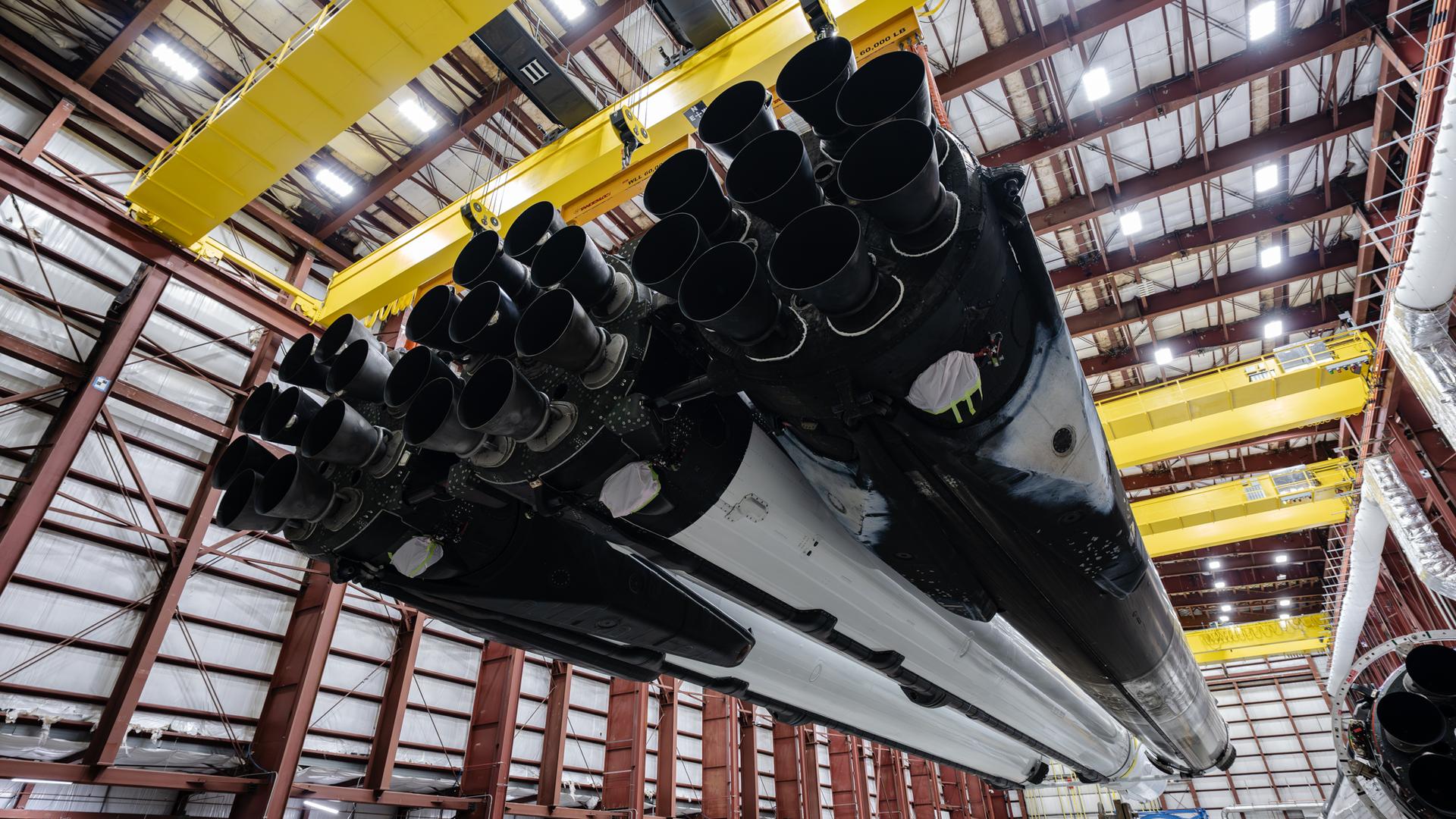
Teams continue launch preparations on the SpaceX Falcon Heavy that will launch NASA's Nancy Grace Roman Space Telescope, inside the SpaceX hangar at Launch Complex 39A at Kennedy Space Center in Florida on Wednesday, Aug. 26, 2026. The rocket has 27 Merlin engines on its first stage and can generate more than five million pounds of thrust at liftoff. NASA and SpaceX are targeting launch no earlier than 7:26 a.m. EDT Sunday, Aug. 30, from Kennedy.
- Record ID
- KSC-20260826-PH-SPX01_0002
- NASA center
- KSC
- Date
- 2026-08-26
- Credit
- SpaceX
- Keywords
- John. F. Kennedy Space Center, Kennedy, Kennedy Space Center, KSC, Spaceport, Cape Canaveral, CCSFS, NASA, Nancy Grace Roman Space Telescope, RST, SpaceX Falcon Heavy, Launch Complex 39A
KSC · 2026-08-26 · KSC-20260826-PH-SPX01_0003
SpaceX Falcon Heavy Hangar Lift for NASA's Roman Space Telescope
Teams continue launch preparations on the SpaceX Falcon Heavy that will launch NASA's Nancy Grace Roman Space Telescope, inside the SpaceX hangar at Launch Complex 39A at Kennedy…
Inspect NASA record
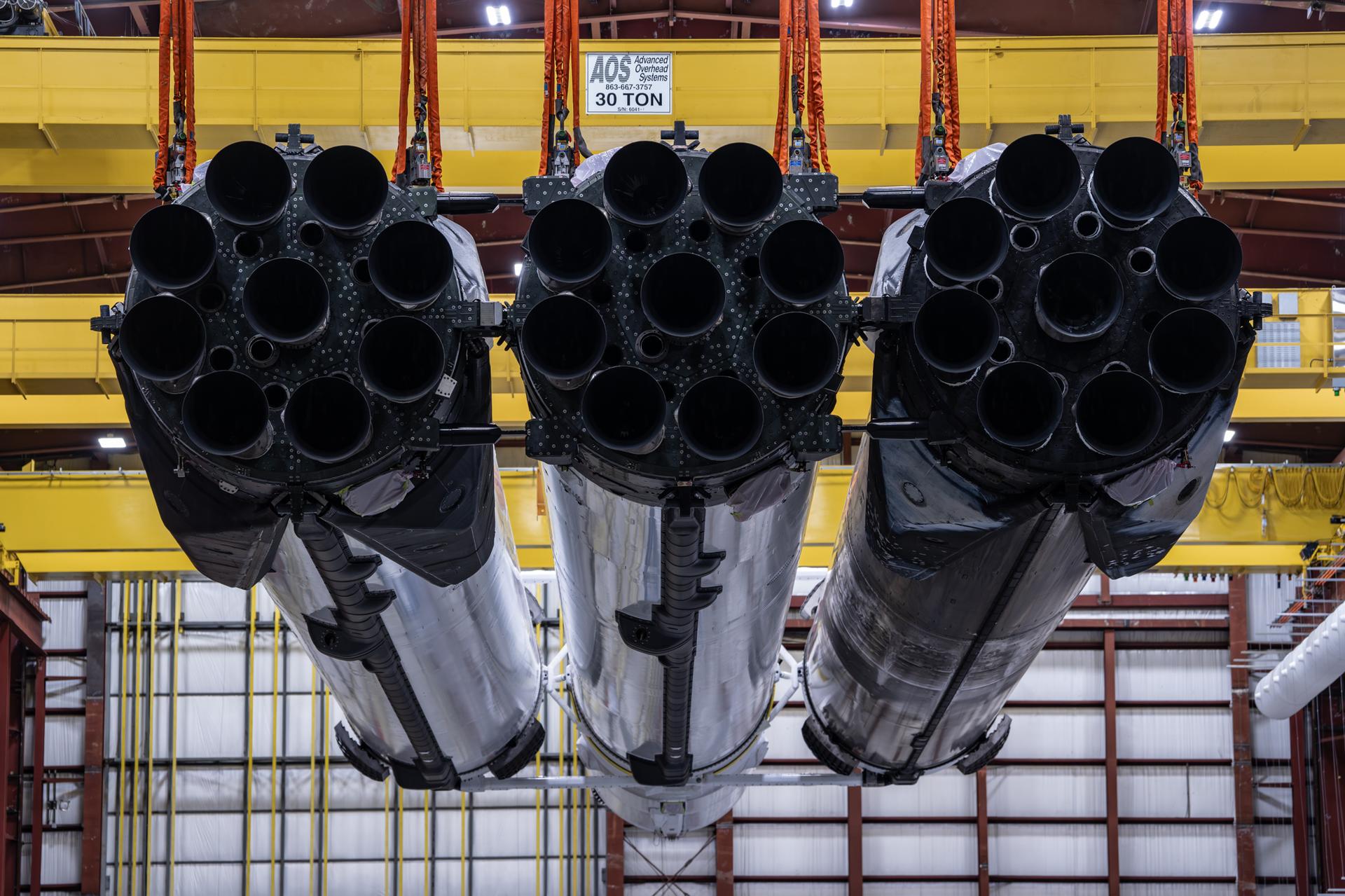
Teams continue launch preparations on the SpaceX Falcon Heavy that will launch NASA's Nancy Grace Roman Space Telescope, inside the SpaceX hangar at Launch Complex 39A at Kennedy Space Center in Florida on Wednesday, Aug. 26, 2026. The rocket has 27 Merlin engines on its first stage and can generate more than five million pounds of thrust at liftoff. NASA and SpaceX are targeting launch no earlier than 7:26 a.m. EDT Sunday, Aug. 30, from Kennedy.
- Record ID
- KSC-20260826-PH-SPX01_0003
- NASA center
- KSC
- Date
- 2026-08-26
- Credit
- SpaceX
- Keywords
- John. F. Kennedy Space Center, Kennedy, Kennedy Space Center, KSC, Spaceport, Cape Canaveral, CCSFS, NASA, Nancy Grace Roman Space Telescope, RST, SpaceX Falcon Heavy, Launch Complex 39A
KSC · 2026-08-26 · KSC-20260826-PH-SPX01_0001
SpaceX Falcon Heavy Hangar Lift for NASA's Roman Space Telescope
Teams continue launch preparations on the SpaceX Falcon Heavy that will launch NASA's Nancy Grace Roman Space Telescope, inside the SpaceX hangar at Launch Complex 39A at Kennedy…
Inspect NASA record
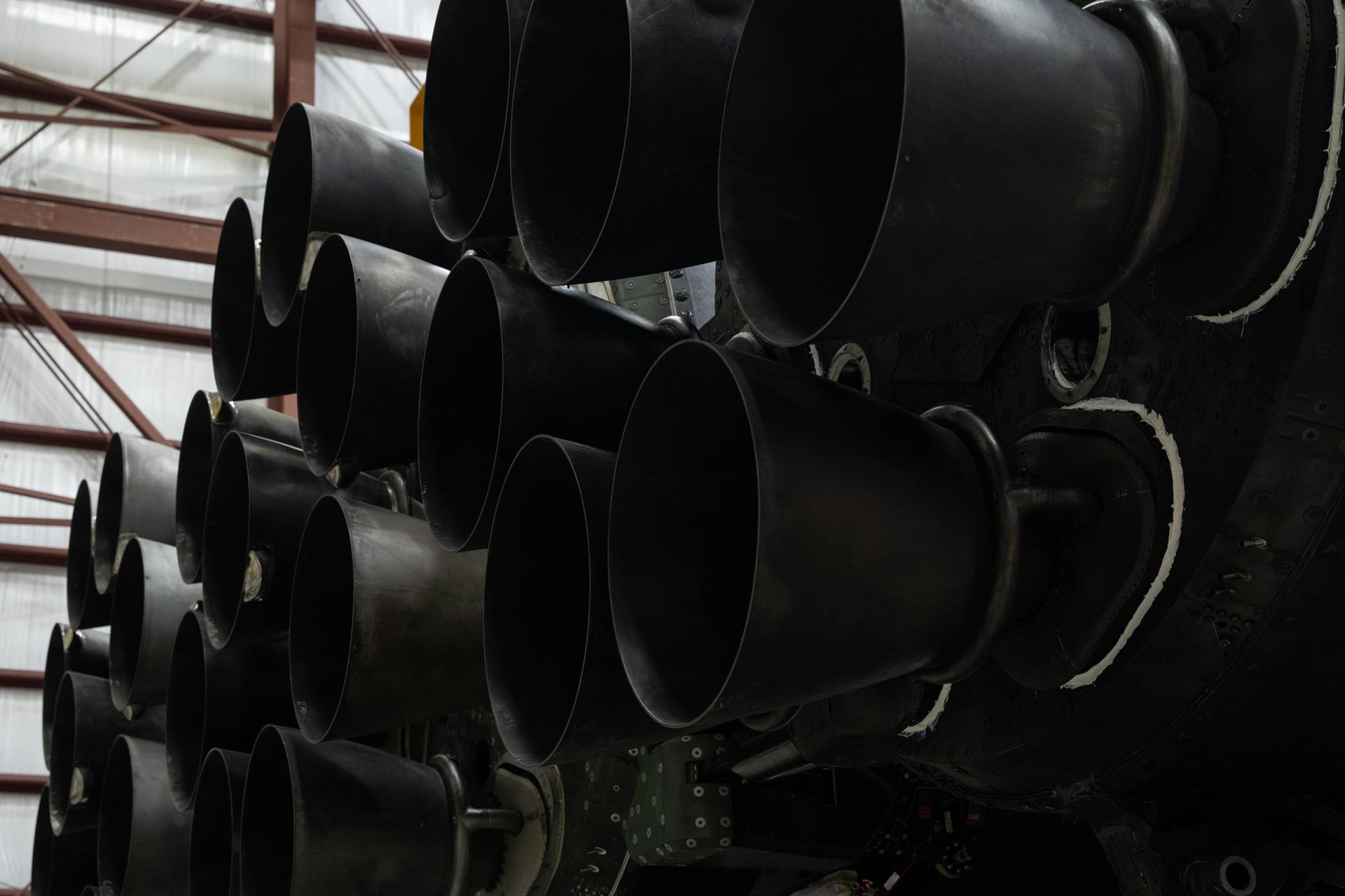
Teams continue launch preparations on the SpaceX Falcon Heavy that will launch NASA's Nancy Grace Roman Space Telescope, inside the SpaceX hangar at Launch Complex 39A at Kennedy Space Center in Florida on Wednesday, Aug. 26, 2026. The rocket has 27 Merlin engines on its first stage and can generate more than five million pounds of thrust at liftoff. NASA and SpaceX are targeting launch no earlier than 7:26 a.m. EDT Sunday, Aug. 30, from Kennedy.
- Record ID
- KSC-20260826-PH-SPX01_0001
- NASA center
- KSC
- Date
- 2026-08-26
- Credit
- SpaceX
- Keywords
- John. F. Kennedy Space Center, Kennedy, Kennedy Space Center, KSC, Spaceport, Cape Canaveral, CCSFS, NASA, Nancy Grace Roman Space Telescope, RST, SpaceX Falcon Heavy, Launch Complex 39A
JPL · 2016-06-14 · PIA20689
Dimming of FU Orionis (Artist Concept)
This artist's concept illustrates how the brightness of outbursting star FU Orionis has been slowly fading since its initial flare-up in 1936. The star is pictured with the…
Inspect NASA record
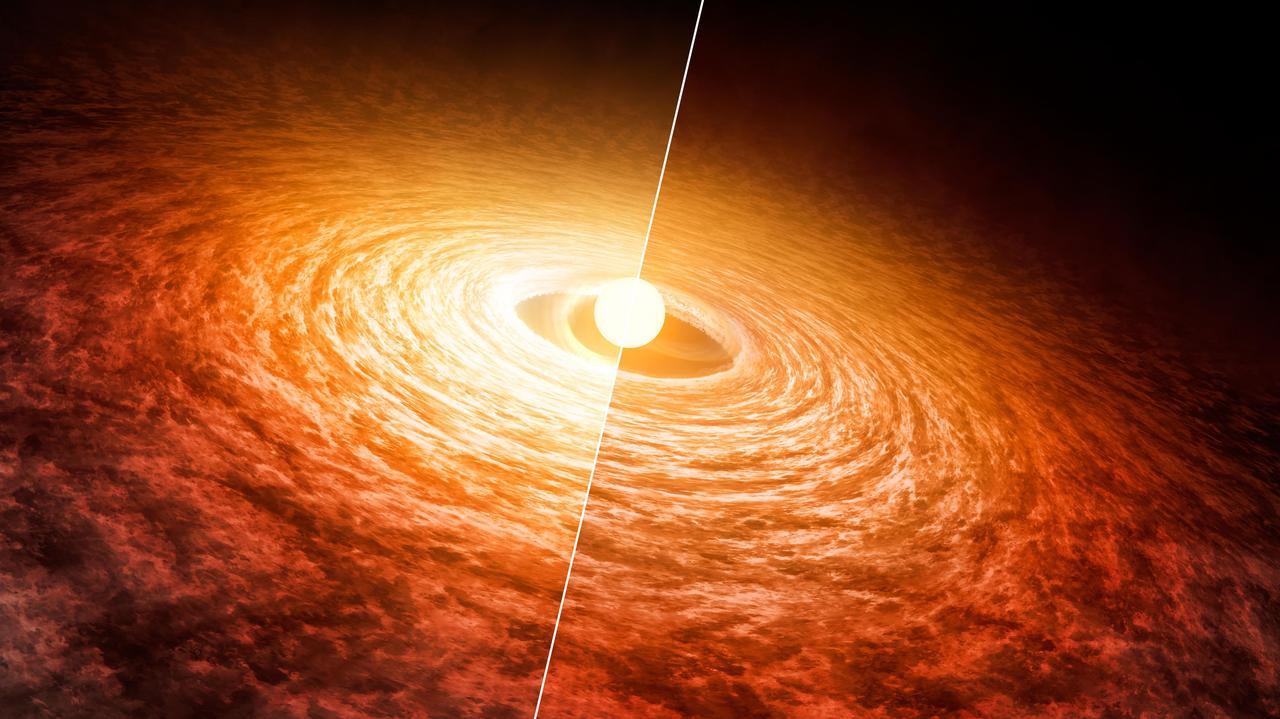
This artist's concept illustrates how the brightness of outbursting star FU Orionis has been slowly fading since its initial flare-up in 1936. The star is pictured with the disk of material that surrounds it. Researchers found that it has dimmed by about 13 percent at short infrared wavelengths from 2004 (left) to 2016 (right). The 2004 data were collected with NASA's Spitzer Space Telescope, and the 2016 data were collected with the Stratospheric Observatory for Infrared Astronomy (SOFIA). FU Orionis is a few hundred thousand years old. It is possible that when our sun was younger, it also went through a period of intense brightening followed by dimming. These results were presented at the American Astronomical Society meeting in June 2016 in San Diego. http://photojournal.jpl.nasa.gov/catalog/PIA20689
- Record ID
- PIA20689
- NASA center
- JPL
- Date
- 2016-06-14
- Credit
- NASA/JPL-Caltech
- Keywords
- Spitzer Space Telescope
JPL · 2005-01-11 · PIA07220
Mysterious Blob Galaxies Revealed
This image composite shows a giant galactic blob (red) and the three merging galaxies NASA's Spitzer Space Telescope discovered within it (yellow). Blobs are intensely glowing clouds of…
Inspect NASA record
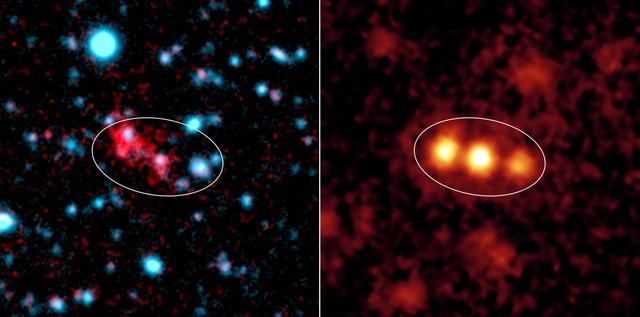
This image composite shows a giant galactic blob (red) and the three merging galaxies NASA's Spitzer Space Telescope discovered within it (yellow). Blobs are intensely glowing clouds of hot hydrogen gas that envelop faraway galaxies. They are about 10 times as large as the galaxies they surround. Visible-light images reveal the vast extent of blobs, but don't provide much information about their host galaxies. Using its heat-seeking infrared eyes, Spitzer was able to see the dusty galaxies tucked inside one well-known blob located 11 billion light-years away. The findings reveal three monstrously bright galaxies, trillions of times brighter than the Sun, in the process of merging together. Spitzer also observed three other blobs located in the same cosmic neighborhood, all of which were found to be glaringly bright. One of these blobs is also known to be a galactic merger, only between two galaxies instead of three. It remains to be seen whether the final two blobs studied also contain mergers. The Spitzer data were acquired by its multiband imaging photometer. The visible-light image was taken by the Blanco Telescope at the Cerro Tololo Inter-American Observatory, Chile. http://photojournal.jpl.nasa.gov/catalog/PIA07220
- Record ID
- PIA07220
- NASA center
- JPL
- Date
- 2005-01-11
- Credit
- NASA/JPL-Caltech
- Keywords
- Spitzer Space Telescope, galaxy