
Update Site (from NASA)
Explore NASA’s Image and Video Library.
Suggest one object per day for the Interstellar Minds collection. We review each suggestion before adding it.
Sign in to suggest a Marvel.
Find a NASA image ID. Open a NASA record and copy its ID from the end of the details URL.
NASA image records
KSC · 2009-02-13 · KSC-2009-1636
KSC-2009-1636
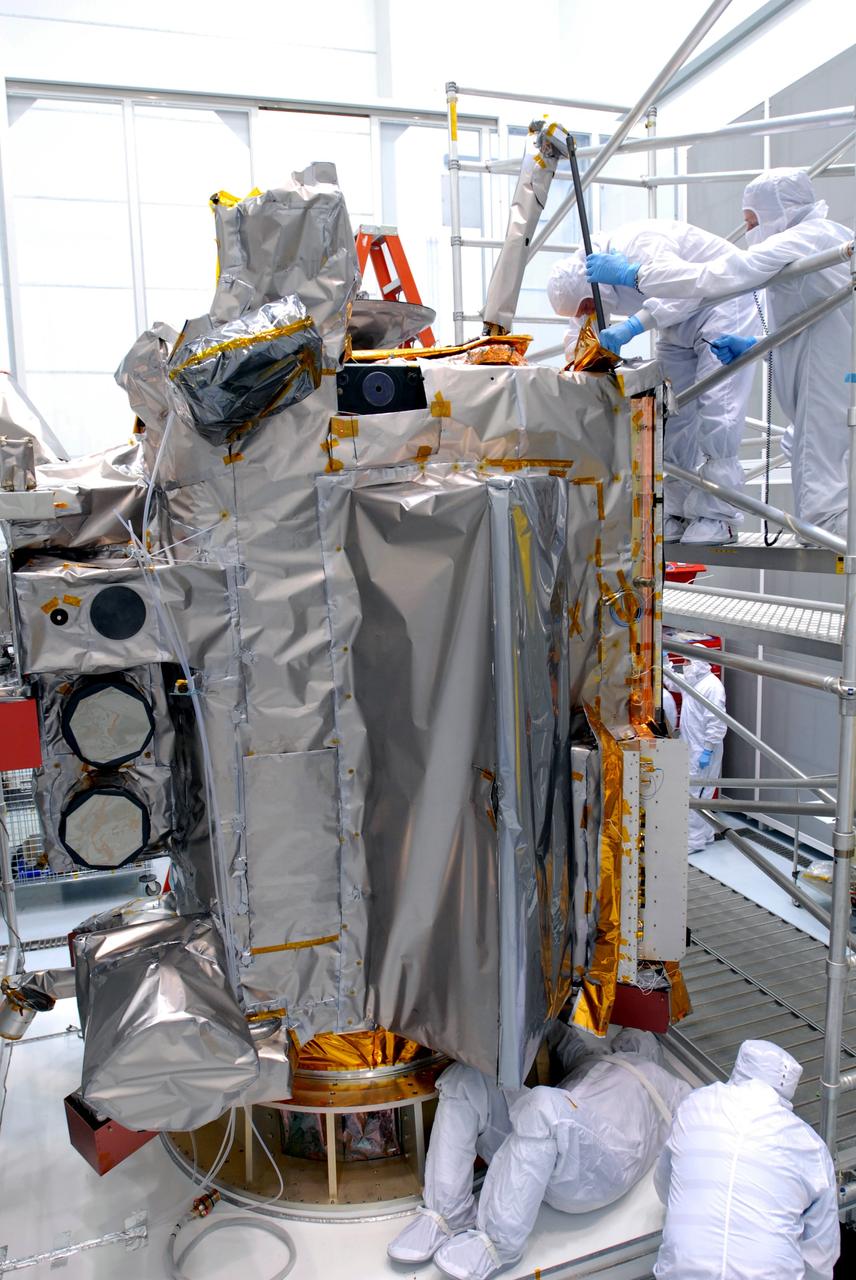
CAPE CANAVERAL, Fla. – Technicians begin checkout and processing of NASA's Lunar Reconnaissance Orbiter, or LRO, in the high bay at the Astrotech processing facility in Titusville, Fla.…
Inspect NASA record
CAPE CANAVERAL, Fla. – Technicians begin checkout and processing of NASA's Lunar Reconnaissance Orbiter, or LRO, in the high bay at the Astrotech processing facility in Titusville, Fla. The spacecraft was built by engineers at Goddard Space Flight Center, where it recently completed two months of tests in a thermal vacuum chamber. The orbiter will carry seven instruments to provide scientists with detailed maps of the lunar surface and enhance our understanding of the moon's topography, lighting conditions, mineralogical composition and natural resources. Information gleaned from LRO will be used to select safe landing sites, determine locations for future lunar outposts and help mitigate radiation dangers to astronauts. The polar regions of the moon are the main focus of the mission because continuous access to sunlight may be possible and water ice may exist in permanently shadowed areas of the poles. Accompanying LRO on its journey to the moon will be the Lunar Crater Observation and Sensing Satellite, or LCROSS, a mission that will impact the lunar surface in its search for water ice. Launch of LRO/LCROSS is targeted for April 24. Photo credit: NASA/Jim Grossmann
- Record ID
- KSC-2009-1636
- NASA center
- KSC
- Date
- 2009-02-13
- Keywords
- moon
KSC · 2009-02-13 · KSC-2009-1599
KSC-2009-1599
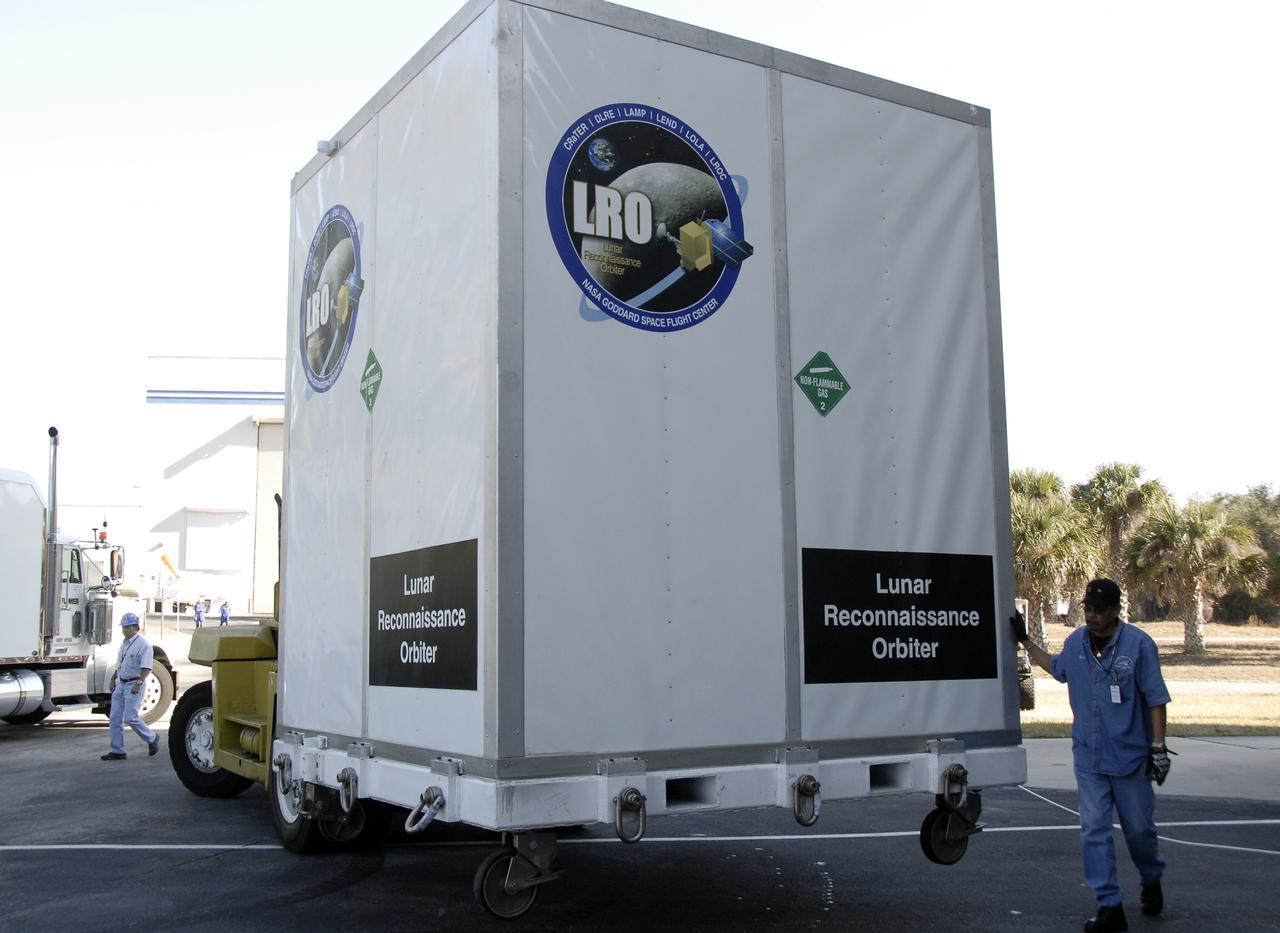
CAPE CANAVERAL, Fla. – NASA's Lunar Reconnaissance Orbiter, or LRO, spacecraft is moved away from the truck after offloading at Astrotech Space Operations in Titusville, Fla. The spacecraft…
Inspect NASA record
CAPE CANAVERAL, Fla. – NASA's Lunar Reconnaissance Orbiter, or LRO, spacecraft is moved away from the truck after offloading at Astrotech Space Operations in Titusville, Fla. The spacecraft was built by engineers at Goddard Space Flight Center, where it recently completed two months of tests in a thermal vacuum chamber. The orbiter will carry seven instruments to provide scientists with detailed maps of the lunar surface and enhance our understanding of the moon's topography, lighting conditions, mineralogical composition and natural resources. Information gleaned from LRO will be used to select safe landing sites, determine locations for future lunar outposts and help mitigate radiation dangers to astronauts. The polar regions of the moon are the main focus of the mission because continuous access to sunlight may be possible and water ice may exist in permanently shadowed areas of the poles. Accompanying LRO on its journey to the moon will be the Lunar Crater Observation and Sensing Satellite, or LCROSS, a mission that will impact the lunar surface in its search for water ice. Launch of LRO is targeted for April 24. Photo credit: NASA/Kim Shiflett
- Record ID
- KSC-2009-1599
- NASA center
- KSC
- Date
- 2009-02-13
- Keywords
- LRO, LCROSS, KSC

JSC · 1972-12-07 · as17-148-22727
View of the Earth seen by the Apollo 17 crew traveling toward the moon
AS17-148-22727 (7 Dec. 1972) --- This view of Earth was seen by the Apollo 17 crew as they traveled toward the moon on their NASA lunar landing mission.…
Inspect NASA record
AS17-148-22727 (7 Dec. 1972) --- This view of Earth was seen by the Apollo 17 crew as they traveled toward the moon on their NASA lunar landing mission. This outstanding trans-lunar coast photograph extends from the Mediterranean Sea area to the Antarctica south polar ice cap. This is the first time the Apollo trajectory made it possible to photograph the south polar ice cap. Note the heavy cloud cover in the Southern Hemisphere. Almost the entire coastline of Africa is clearly visible. The Arabian Peninsula can be seen at the northeastern edge of Africa. The large island off the coast of Africa is the Malagasy Republic. The Asian mainland is on the horizon toward the northeast. The Apollo 17 crew consisted of astronauts Eugene A. Cernan, mission commander; Ronald E. Evans, command module pilot; and Harrison H. Schmitt, lunar module pilot. While astronauts Cernan and Schmitt descended in the Lunar Module (LM) to explore the moon, astronaut Evans remained with the Command and Service Modules (CSM) in lunar orbit.
- Record ID
- as17-148-22727
- NASA center
- JSC
- Date
- 1972-12-07
- Keywords
- APOLLO 17 FLIGHT, APOLLO PROJECT, EARTH (PLANET), ONBOARD ACTIVITIES, EARTH OBSERVATIONS (FROM SPACE), PHOTOGRAPHY
KSC · 2009-02-15 · KSC-2009-1644
KSC-2009-1644
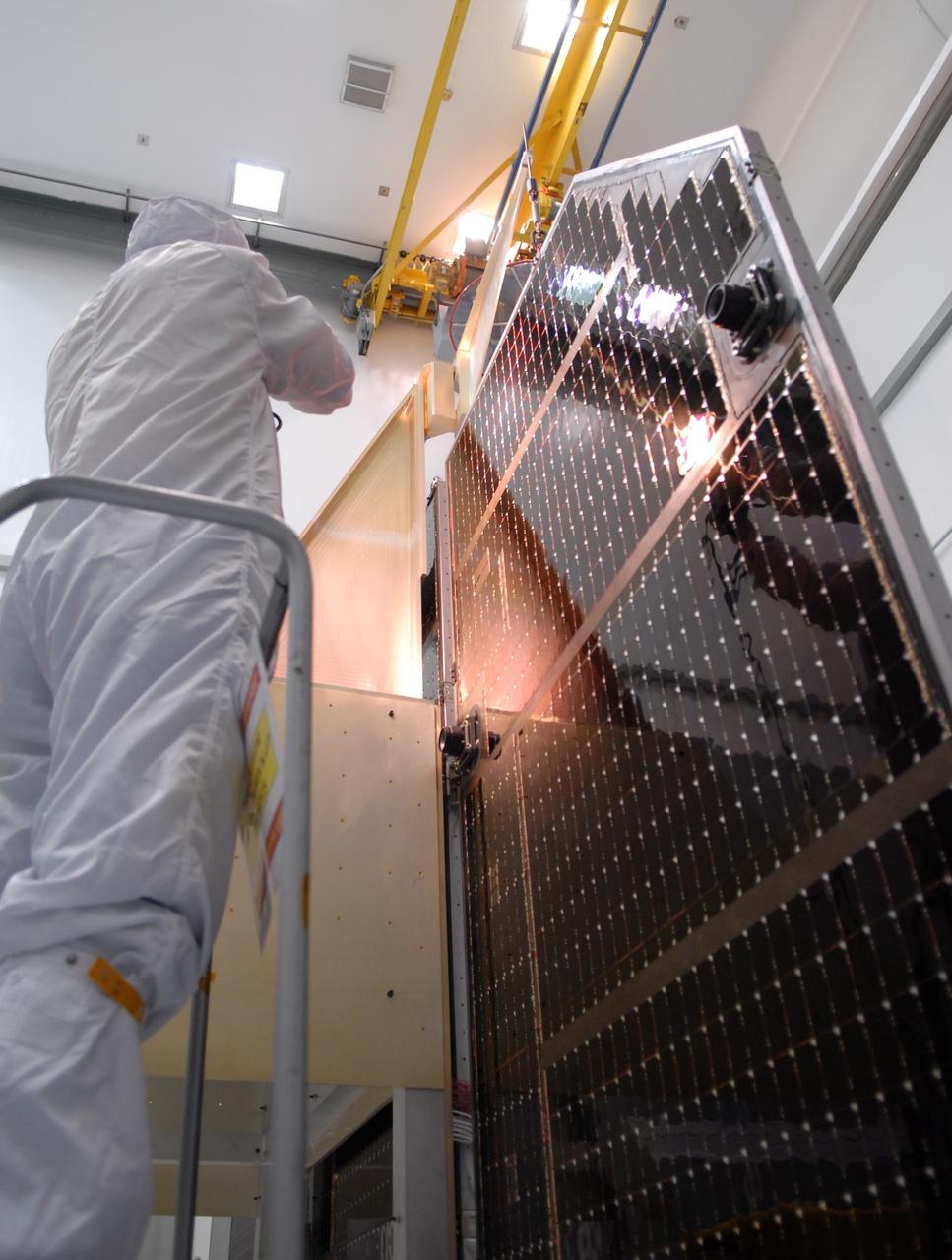
CAPE CANAVERAL, Fla. – A technician inspects the solar arrays for NASA's Lunar Reconnaissance Orbiter, or LRO, at the Astrotech processing facility in Titusville, Fla. The spacecraft was…
Inspect NASA record
CAPE CANAVERAL, Fla. – A technician inspects the solar arrays for NASA's Lunar Reconnaissance Orbiter, or LRO, at the Astrotech processing facility in Titusville, Fla. The spacecraft was built by engineers at Goddard Space Flight Center, where it recently completed two months of tests in a thermal vacuum chamber. The orbiter will carry seven instruments to provide scientists with detailed maps of the lunar surface and enhance our understanding of the moon's topography, lighting conditions, mineralogical composition and natural resources. Information gleaned from LRO will be used to select safe landing sites, determine locations for future lunar outposts and help mitigate radiation dangers to astronauts. The polar regions of the moon are the main focus of the mission because continuous access to sunlight may be possible and water ice may exist in permanently shadowed areas of the poles. Accompanying LRO on its journey to the moon will be the Lunar Crater Observation and Sensing Satellite, or LCROSS, a mission that will impact the lunar surface in its search for water ice. Launch of LRO/LCROSS is targeted for April 24. Photo credit: NASA/Jack Pfaller
- Record ID
- KSC-2009-1644
- NASA center
- KSC
- Date
- 2009-02-15
- Keywords
- moon
KSC · 2009-02-13 · KSC-2009-1630
KSC-2009-1630
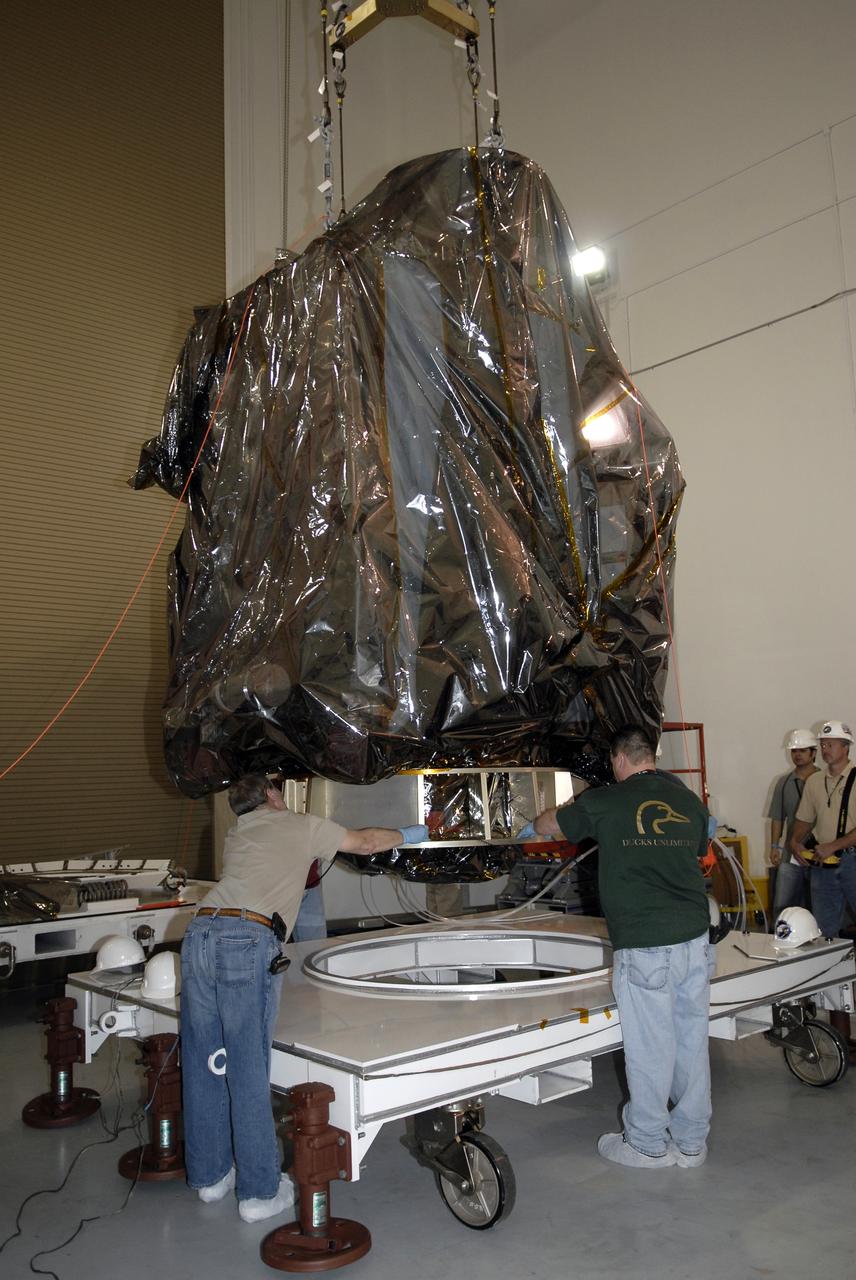
CAPE CANAVERAL, Fla. – Technicians guide NASA's Lunar Reconnaissance Orbiter, or LRO, onto a work stand in the high bay at the Astrotech processing facility in Titusville, Fla.…
Inspect NASA record
CAPE CANAVERAL, Fla. – Technicians guide NASA's Lunar Reconnaissance Orbiter, or LRO, onto a work stand in the high bay at the Astrotech processing facility in Titusville, Fla. The spacecraft was built by engineers at Goddard Space Flight Center, where it recently completed two months of tests in a thermal vacuum chamber. The orbiter will carry seven instruments to provide scientists with detailed maps of the lunar surface and enhance our understanding of the moon's topography, lighting conditions, mineralogical composition and natural resources. Information gleaned from LRO will be used to select safe landing sites, determine locations for future lunar outposts and help mitigate radiation dangers to astronauts. The polar regions of the moon are the main focus of the mission because continuous access to sunlight may be possible and water ice may exist in permanently shadowed areas of the poles. Accompanying LRO on its journey to the moon will be the Lunar Crater Observation and Sensing Satellite, or LCROSS, a mission that will impact the lunar surface in its search for water ice. Launch of LRO/LCROSS is targeted for April 24. Photo credit: NASA/Kim Shiflett
- Record ID
- KSC-2009-1630
- NASA center
- KSC
- Date
- 2009-02-13
- Keywords
- moon
KSC · 2009-02-13 · KSC-2009-1596
KSC-2009-1596
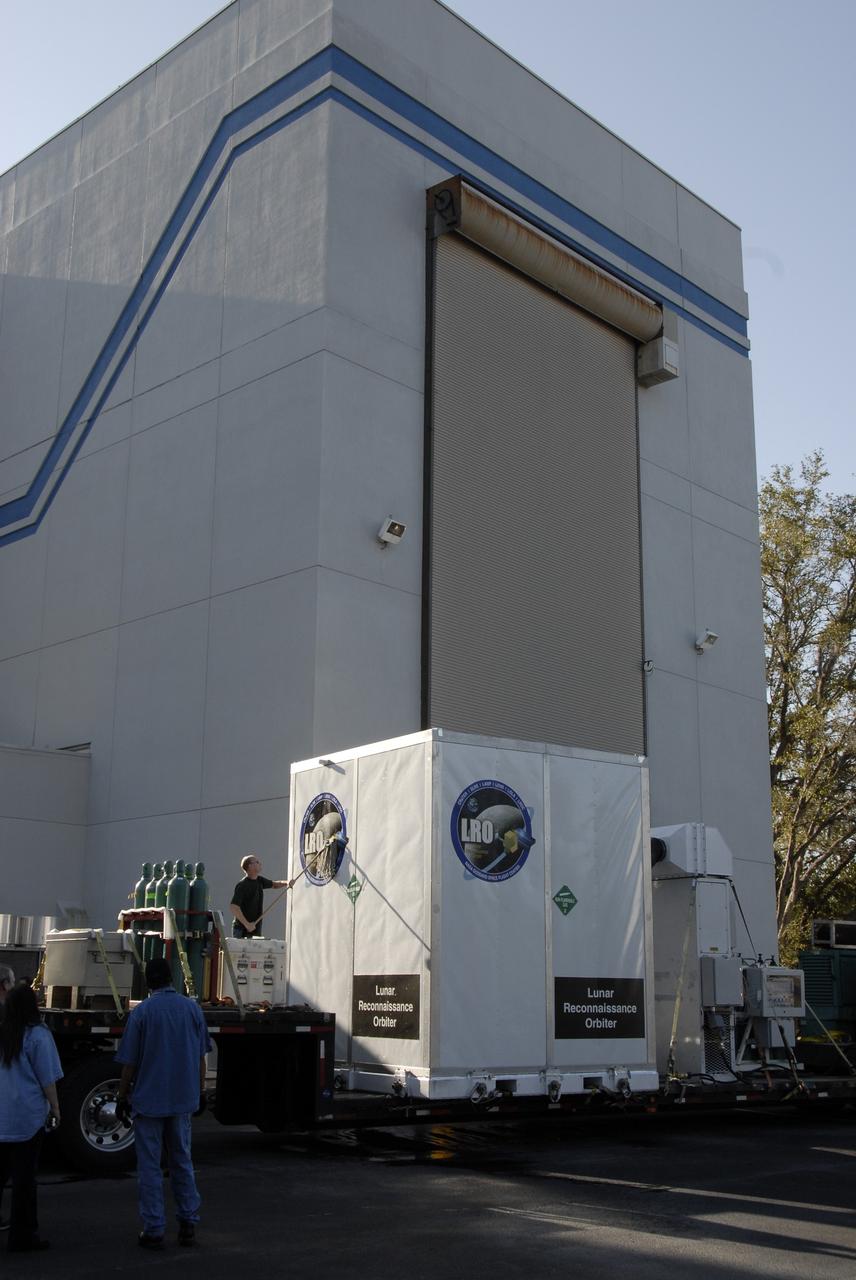
CAPE CANAVERAL, Fla. – NASA's Lunar Reconnaissance Orbiter, or LRO, spacecraft completes its journey to NASA's Kennedy Space Center in Florida. The spacecraft was built by engineers at…
Inspect NASA record
CAPE CANAVERAL, Fla. – NASA's Lunar Reconnaissance Orbiter, or LRO, spacecraft completes its journey to NASA's Kennedy Space Center in Florida. The spacecraft was built by engineers at Goddard Space Flight Center, where it recently completed two months of tests in a thermal vacuum chamber. The orbiter will carry seven instruments to provide scientists with detailed maps of the lunar surface and enhance our understanding of the moon's topography, lighting conditions, mineralogical composition and natural resources. Information gleaned from LRO will be used to select safe landing sites, determine locations for future lunar outposts and help mitigate radiation dangers to astronauts. The polar regions of the moon are the main focus of the mission because continuous access to sunlight may be possible and water ice may exist in permanently shadowed areas of the poles. Accompanying LRO on its journey to the moon will be the Lunar Crater Observation and Sensing Satellite, or LCROSS, a mission that will impact the lunar surface in its search for water ice. Launch of LRO is targeted for April 24. Photo credit: NASA/Kim Shiflett
- Record ID
- KSC-2009-1596
- NASA center
- KSC
- Date
- 2009-02-13
- Keywords
- LRO, LCROSS, KSC
KSC · 2009-02-15 · KSC-2009-1637
KSC-2009-1637
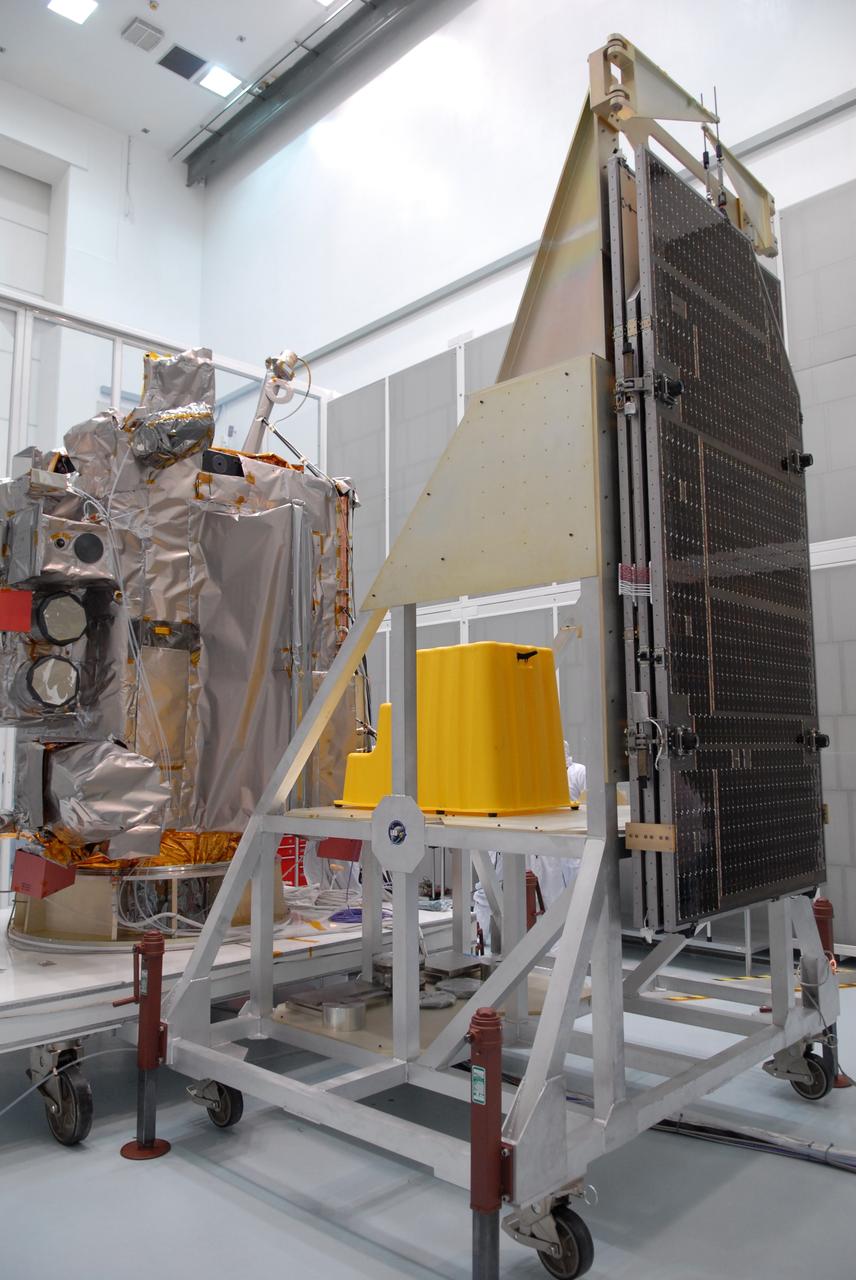
CAPE CANAVERAL, Fla. – Inspection begins of the solar arrays for NASA's Lunar Reconnaissance Orbiter, or LRO, at the Astrotech processing facility in Titusville, Fla. The spacecraft was…
Inspect NASA record
CAPE CANAVERAL, Fla. – Inspection begins of the solar arrays for NASA's Lunar Reconnaissance Orbiter, or LRO, at the Astrotech processing facility in Titusville, Fla. The spacecraft was built by engineers at Goddard Space Flight Center, where it recently completed two months of tests in a thermal vacuum chamber. The orbiter will carry seven instruments to provide scientists with detailed maps of the lunar surface and enhance our understanding of the moon's topography, lighting conditions, mineralogical composition and natural resources. Information gleaned from LRO will be used to select safe landing sites, determine locations for future lunar outposts and help mitigate radiation dangers to astronauts. The polar regions of the moon are the main focus of the mission because continuous access to sunlight may be possible and water ice may exist in permanently shadowed areas of the poles. Accompanying LRO on its journey to the moon will be the Lunar Crater Observation and Sensing Satellite, or LCROSS, a mission that will impact the lunar surface in its search for water ice. Launch of LRO/LCROSS is targeted for April 24. Photo credit: NASA/Jack Pfaller
- Record ID
- KSC-2009-1637
- NASA center
- KSC
- Date
- 2009-02-15
- Keywords
- moon
KSC · 2009-03-07 · KSC-2009-2008
KSC-2009-2008
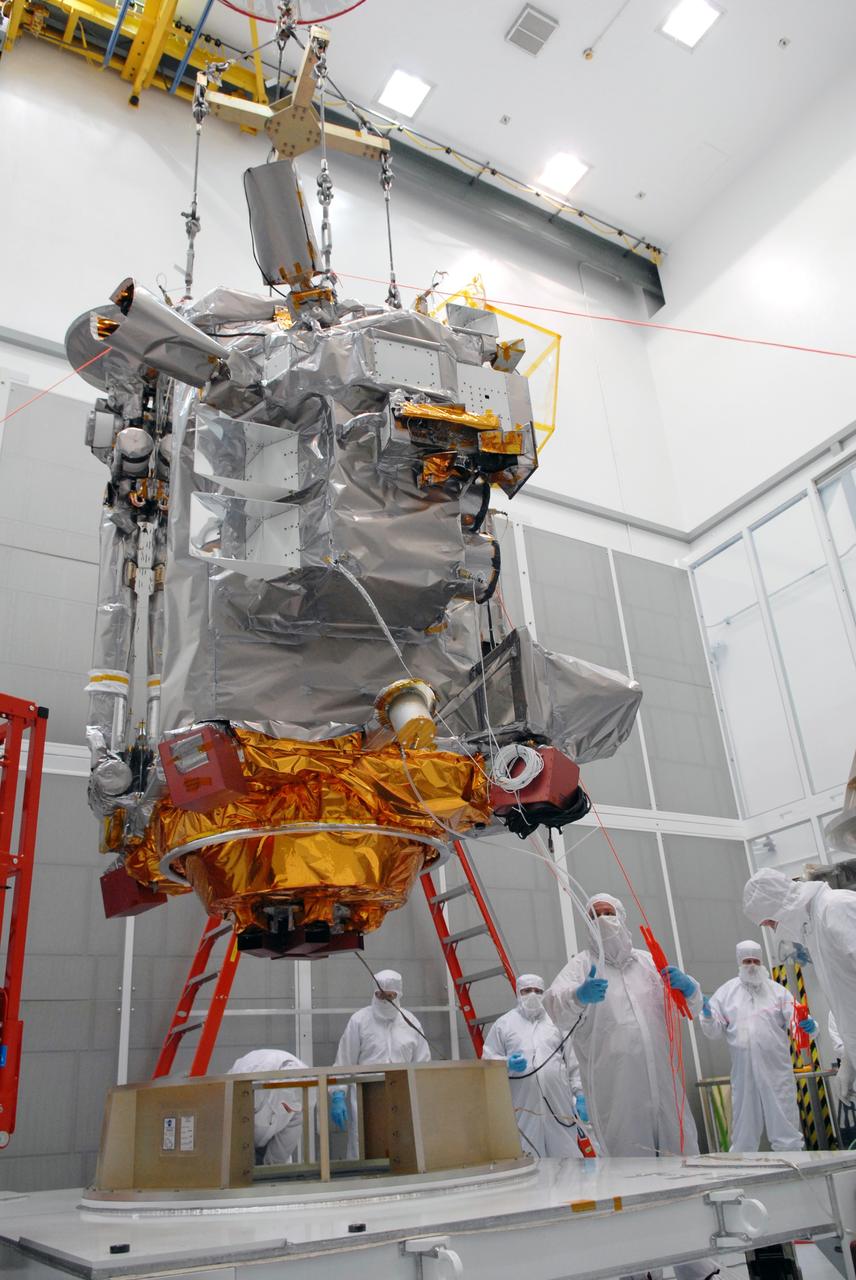
CAPE CANAVERAL, Fla. – At Astrotech in Titusville, Fla., an overhead crane lifts NASA's Lunar Reconnaissance Orbiter, or LRO, from its stand. The orbiter will be moved to…
Inspect NASA record
CAPE CANAVERAL, Fla. – At Astrotech in Titusville, Fla., an overhead crane lifts NASA's Lunar Reconnaissance Orbiter, or LRO, from its stand. The orbiter will be moved to an Aronson table nearby for rotation to provide proper access for processing. The orbiter will carry seven instruments to provide scientists with detailed maps of the lunar surface and enhance our understanding of the moon's topography, lighting conditions, mineralogical composition and natural resources. Information gleaned from LRO will be used to select safe landing sites, determine locations for future lunar outposts and help mitigate radiation dangers to astronauts. The polar regions of the moon are the main focus of the mission because continuous access to sunlight may be possible and water ice may exist in permanently shadowed areas of the poles. Accompanying LRO on its journey to the moon will be the Lunar CRater Observation and Sensing Satellite, or LCROSS, a mission that will impact the lunar surface in its search for water ice. Launch of LRO is targeted for May 20. Photo credit: NASA/Jack Pfaller
- Record ID
- KSC-2009-2008
- NASA center
- KSC
- Date
- 2009-03-07
- Keywords
- LRO, lunar, orbiter, Aronson, rotation
MSFC · 1969-07-24 · 6901208
Saturn Apollo Program
The Apollo 11 mission, the first manned lunar mission, launched from the Kennedy Space Center, Florida via a Saturn V launch vehicle on July 16, 1969 and safely…
Inspect NASA record
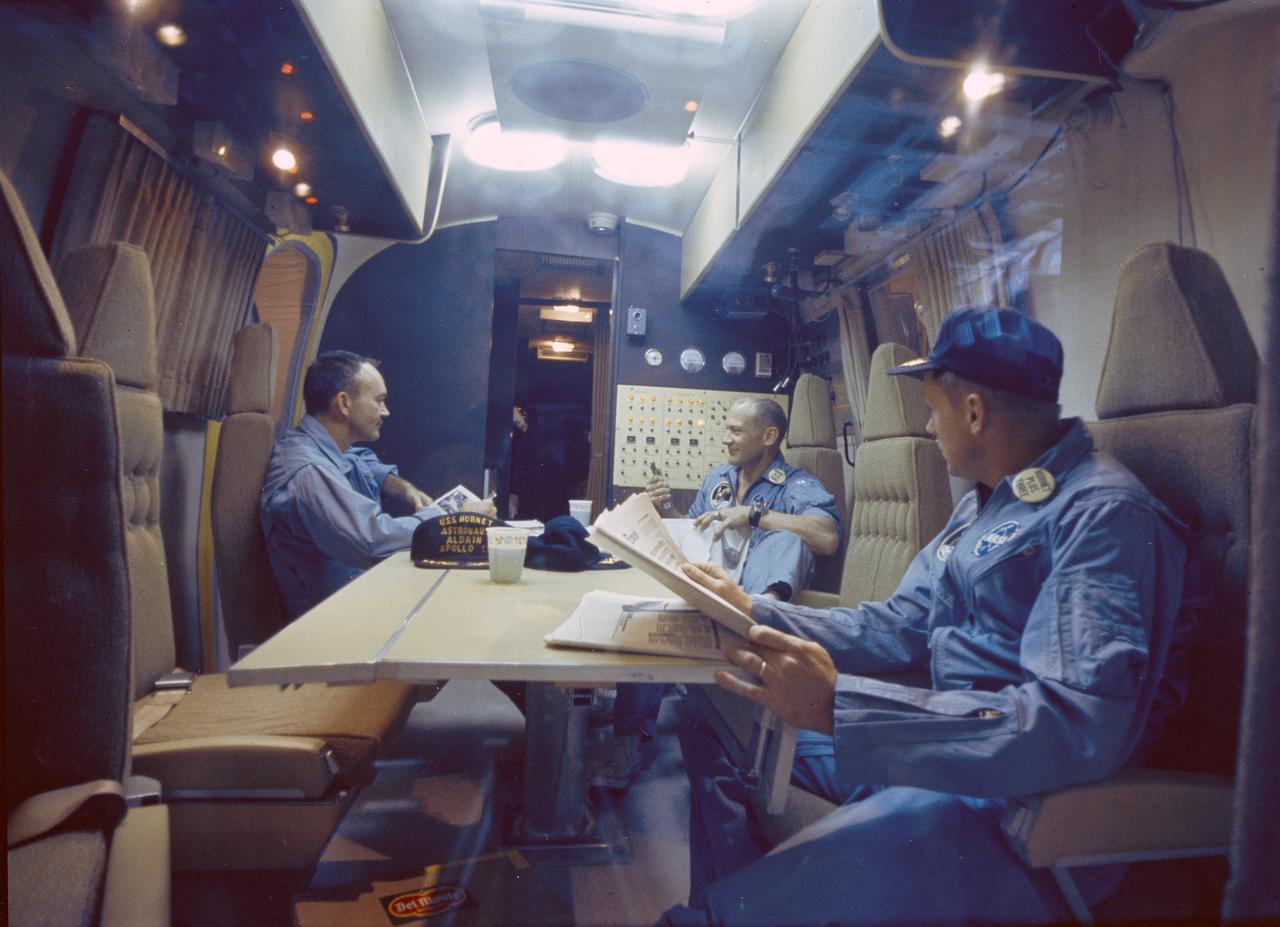
The Apollo 11 mission, the first manned lunar mission, launched from the Kennedy Space Center, Florida via a Saturn V launch vehicle on July 16, 1969 and safely returned to Earth on July 24, 1969. The Saturn V vehicle was developed by the Marshall Space Flight Center (MSFC) under the direction of Dr. Wernher von Braun. Aboard were Neil A. Armstrong, commander; Michael Collins, Command Module pilot; and Edwin E. Aldrin Jr., Lunar Module pilot. The Command Module (CM), piloted by Michael Collins remained in a parking orbit around the Moon while the Lunar Module (LM), named “Eagle’’, carrying astronauts Neil Armstrong and Edwin Aldrin, landed on the Moon. Armstrong was the first human to ever stand on the lunar surface, followed by Edwin (Buzz) Aldrin. The surface exploration was concluded in 2½ hours, in which the crew collected 47 pounds of lunar surface material for analysis back on Earth. Upon splash down in the Pacific Ocean, Navy para-rescue men recovered the capsule housing the 3-man Apollo 11 crew. The crew was taken to safety aboard the USS Hornet, where they were quartered in a mobile quarantine facility. Shown here is the Apollo 11 crew inside the quarantine facility. With the success of Apollo 11, the national objective to land men on the Moon and return them safely to Earth had been accomplished.
- Record ID
- 6901208
- NASA center
- MSFC
- Date
- 1969-07-24
- Keywords
- Apollo 11, Moon, Recovery, Quarantine
KSC · 2009-03-17 · KSC-2009-2155
KSC-2009-2155
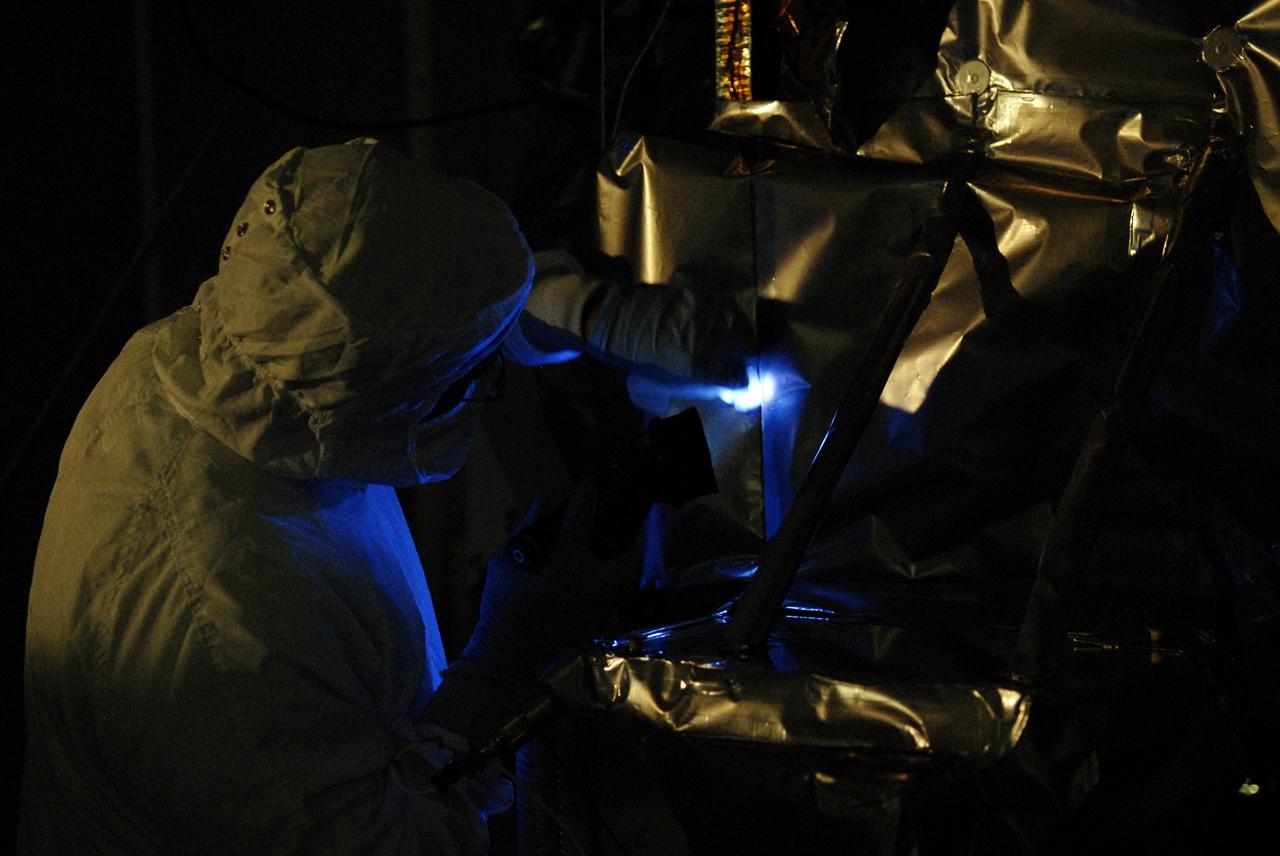
CAPE CANAVERAL, Fla. – At the Astrotech facility in Titusville, Fla., technicians perform backlight inspection and cleaning on NASA's Lunar Reconnaissance Orbiter, or LRO. Black light inspection uses…
Inspect NASA record
CAPE CANAVERAL, Fla. – At the Astrotech facility in Titusville, Fla., technicians perform backlight inspection and cleaning on NASA's Lunar Reconnaissance Orbiter, or LRO. Black light inspection uses UVA fluorescence to detect possible particulate microcontamination, minute cracks or fluid leaks. The orbiter will carry seven instruments to provide scientists with detailed maps of the lunar surface and enhance our understanding of the moon's topography, lighting conditions, mineralogical composition and natural resources. Information gleaned from LRO will be used to select safe landing sites, determine locations for future lunar outposts and help mitigate radiation dangers to astronauts. The polar regions of the moon are the main focus of the mission because continuous access to sunlight may be possible and water ice may exist in permanently shadowed areas of the poles. Accompanying LRO on its journey to the moon will be the Lunar CRater Observation and Sensing Satellite, or LCROSS, a mission that will impact the lunar surface in its search for water ice. Launch of LRO is targeted for May 20. Photo credit: NASA/Kim Shiflett
- Record ID
- KSC-2009-2155
- NASA center
- KSC
- Date
- 2009-03-17
- Keywords
- LRO, LCROSS, lunar, black light, UVA
KSC · 2009-02-13 · KSC-2009-1601
KSC-2009-1601
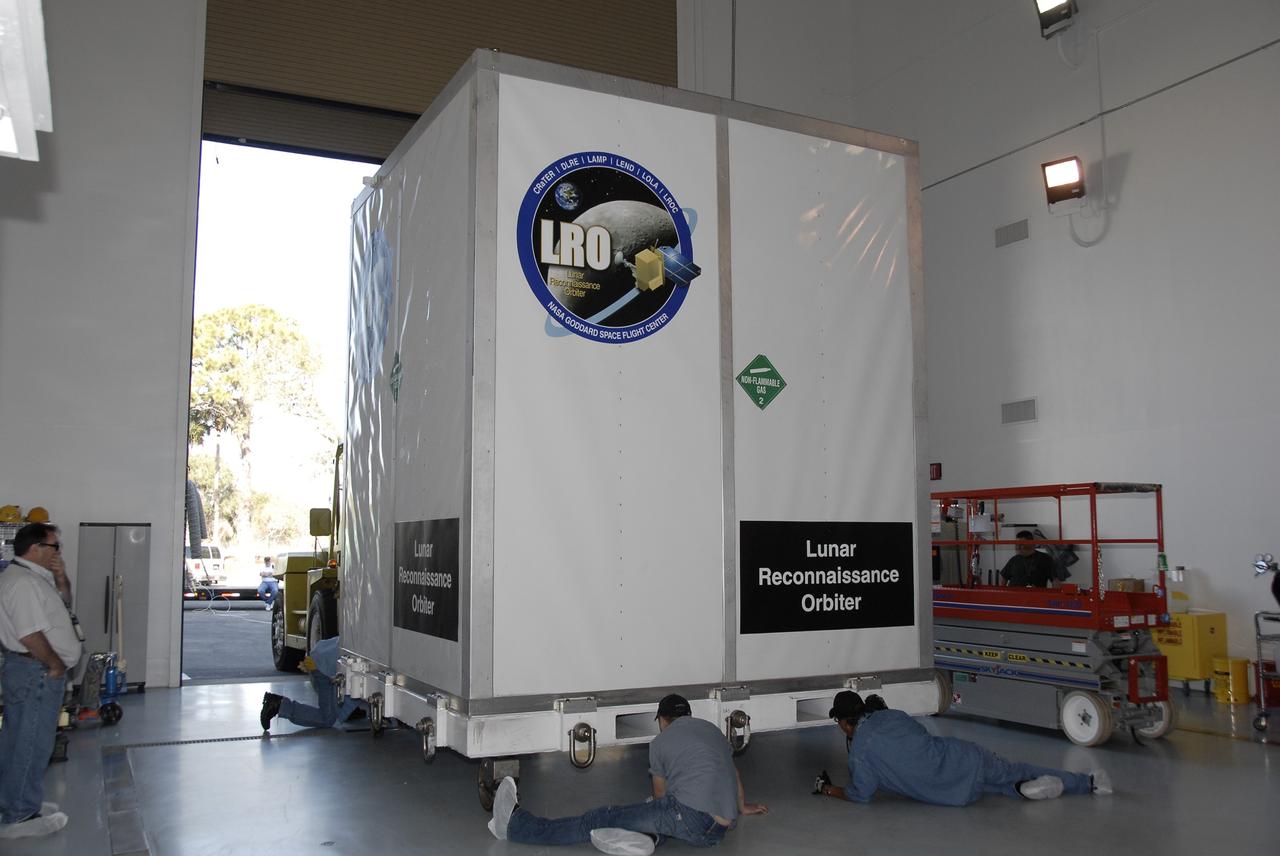
CAPE CANAVERAL, Fla. – NASA's Lunar Reconnaissance Orbiter, or LRO, spacecraft is moved into Astrotech in Titusville, Fla. The spacecraft was built by engineers at Goddard Space Flight…
Inspect NASA record
CAPE CANAVERAL, Fla. – NASA's Lunar Reconnaissance Orbiter, or LRO, spacecraft is moved into Astrotech in Titusville, Fla. The spacecraft was built by engineers at Goddard Space Flight Center, where it recently completed two months of tests in a thermal vacuum chamber. The orbiter will carry seven instruments to provide scientists with detailed maps of the lunar surface and enhance our understanding of the moon's topography, lighting conditions, mineralogical composition and natural resources. Information gleaned from LRO will be used to select safe landing sites, determine locations for future lunar outposts and help mitigate radiation dangers to astronauts. The polar regions of the moon are the main focus of the mission because continuous access to sunlight may be possible and water ice may exist in permanently shadowed areas of the poles. Accompanying LRO on its journey to the moon will be the Lunar Crater Observation and Sensing Satellite, or LCROSS, a mission that will impact the lunar surface in its search for water ice. Launch of LRO is targeted for April 24. Photo credit: NASA/Kim Shiflett
- Record ID
- KSC-2009-1601
- NASA center
- KSC
- Date
- 2009-02-13
- Keywords
- LRO, LCROSS, KSC
KSC · 2009-02-13 · KSC-2009-1632
KSC-2009-1632
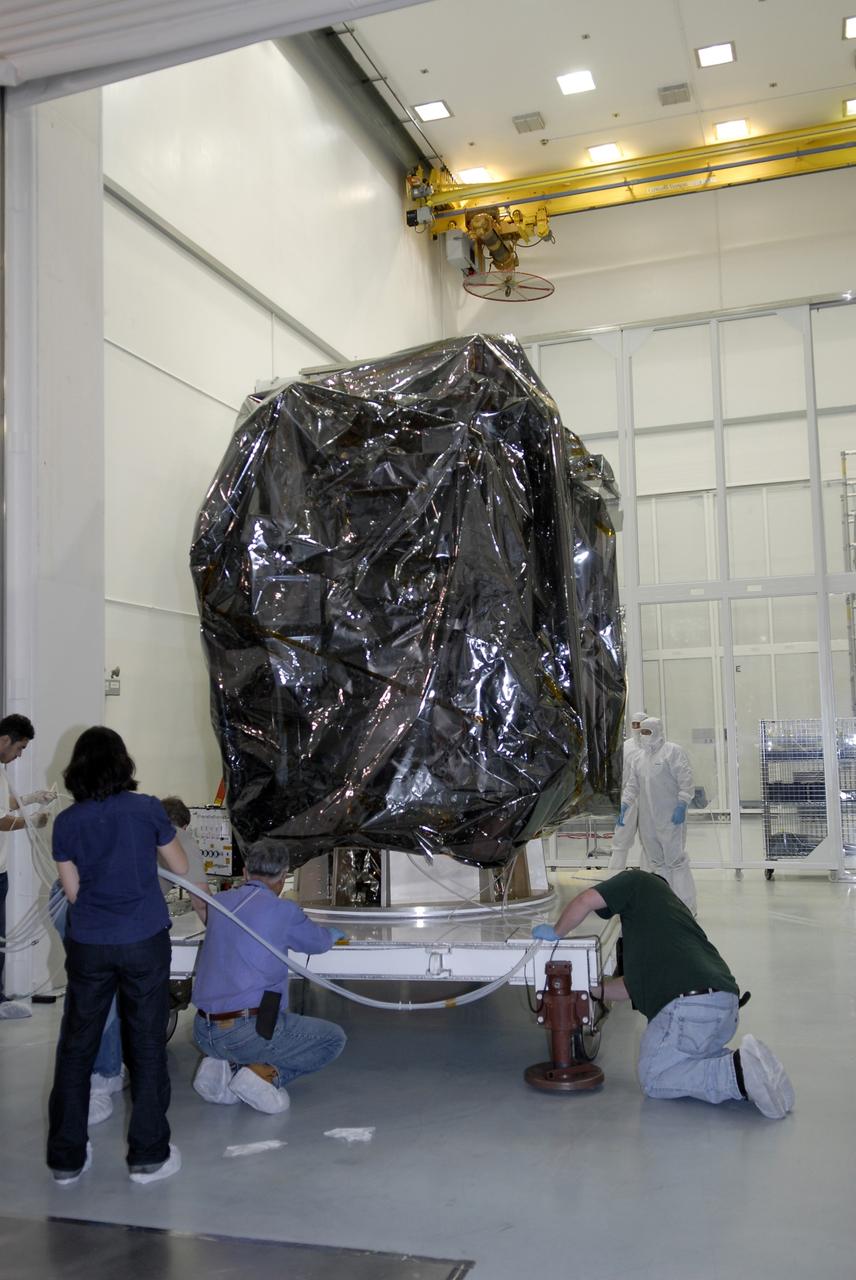
CAPE CANAVERAL, Fla. – Technicians secure a work stand supporting NASA's Lunar Reconnaissance Orbiter, or LRO, in the high bay at the Astrotech processing facility in Titusville, Fla.…
Inspect NASA record
CAPE CANAVERAL, Fla. – Technicians secure a work stand supporting NASA's Lunar Reconnaissance Orbiter, or LRO, in the high bay at the Astrotech processing facility in Titusville, Fla. The spacecraft was built by engineers at Goddard Space Flight Center, where it recently completed two months of tests in a thermal vacuum chamber. The orbiter will carry seven instruments to provide scientists with detailed maps of the lunar surface and enhance our understanding of the moon's topography, lighting conditions, mineralogical composition and natural resources. Information gleaned from LRO will be used to select safe landing sites, determine locations for future lunar outposts and help mitigate radiation dangers to astronauts. The polar regions of the moon are the main focus of the mission because continuous access to sunlight may be possible and water ice may exist in permanently shadowed areas of the poles. Accompanying LRO on its journey to the moon will be the Lunar Crater Observation and Sensing Satellite, or LCROSS, a mission that will impact the lunar surface in its search for water ice. Launch of LRO/LCROSS is targeted for April 24. Photo credit: NASA/Kim Shiflett
- Record ID
- KSC-2009-1632
- NASA center
- KSC
- Date
- 2009-02-13
- Keywords
- moon