
Update Site (from NASA)
Explore NASA’s Image and Video Library.
Suggest one object per day for the Interstellar Minds collection. We review each suggestion before adding it.
Sign in to suggest a Marvel.
Find a NASA image ID. Open a NASA record and copy its ID from the end of the details URL.
NASA image records
GSFC · 2017-12-08 · GSFC_20171208_Archive_e000964
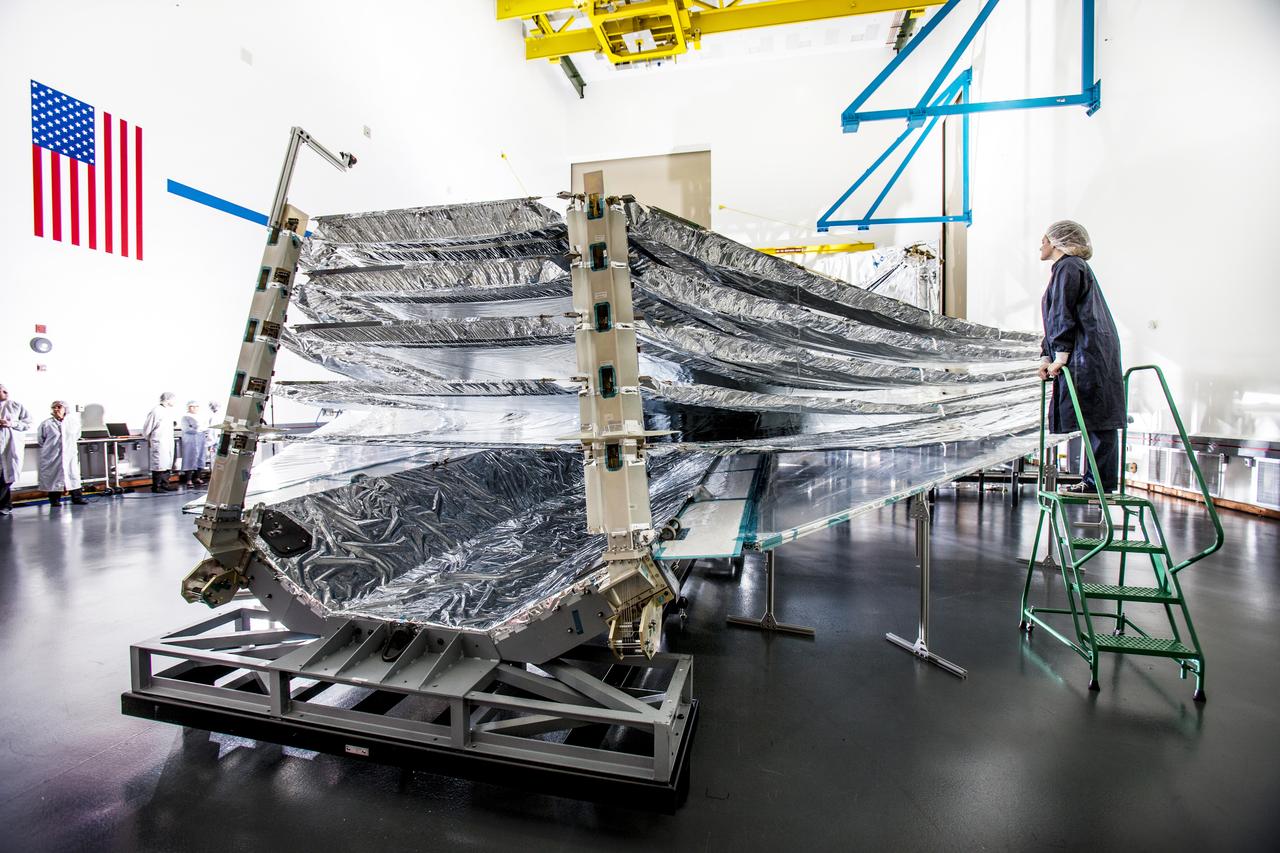
James Webb Space Telescope Sunshield Test Unfolds Seamlessly
A major test of the sunshield for NASA’s James Webb Space Telescope was conducted recently by Northrop Grumman in Redondo Beach, California. For the first time, the five…
Inspect NASA record
A major test of the sunshield for NASA’s James Webb Space Telescope was conducted recently by Northrop Grumman in Redondo Beach, California. For the first time, the five sunshield test layers were unfolded and separated; unveiling important insights for the engineers and technicians as to how the deployment will take place when the telescope launches into space. “These tests are critical and allow us to see how our modeling works and learn about any modifications we may need to make in our design as we move into sunshield flight production,” said Jim Flynn, Webb sunshield manager. The three-day test took place in July, taking seven engineers and six technicians about 20 hours to complete. On orbit, the sunshield will take several days to unfold. Read more here: 1.usa.gov/1vykZbk Credit: Northrop Grumman/Alex Evers NASA image use policy. NASA Goddard Space Flight Center enables NASA’s mission through four scientific endeavors: Earth Science, Heliophysics, Solar System Exploration, and Astrophysics. Goddard plays a leading role in NASA’s accomplishments by contributing compelling scientific knowledge to advance the Agency’s mission. Follow us on Twitter Like us on Facebook Find us on Instagram
- Record ID
- GSFC_20171208_Archive_e000964
- NASA center
- GSFC
- Date
- 2017-12-08
- Keywords
- James Webb Space Telescope Sunshield Test Unfolds Seamlessly, nasa, jwst, sunshield, jameswebbspacetelescope, nasagoddard
JPL · 2013-01-08 · PIA16611
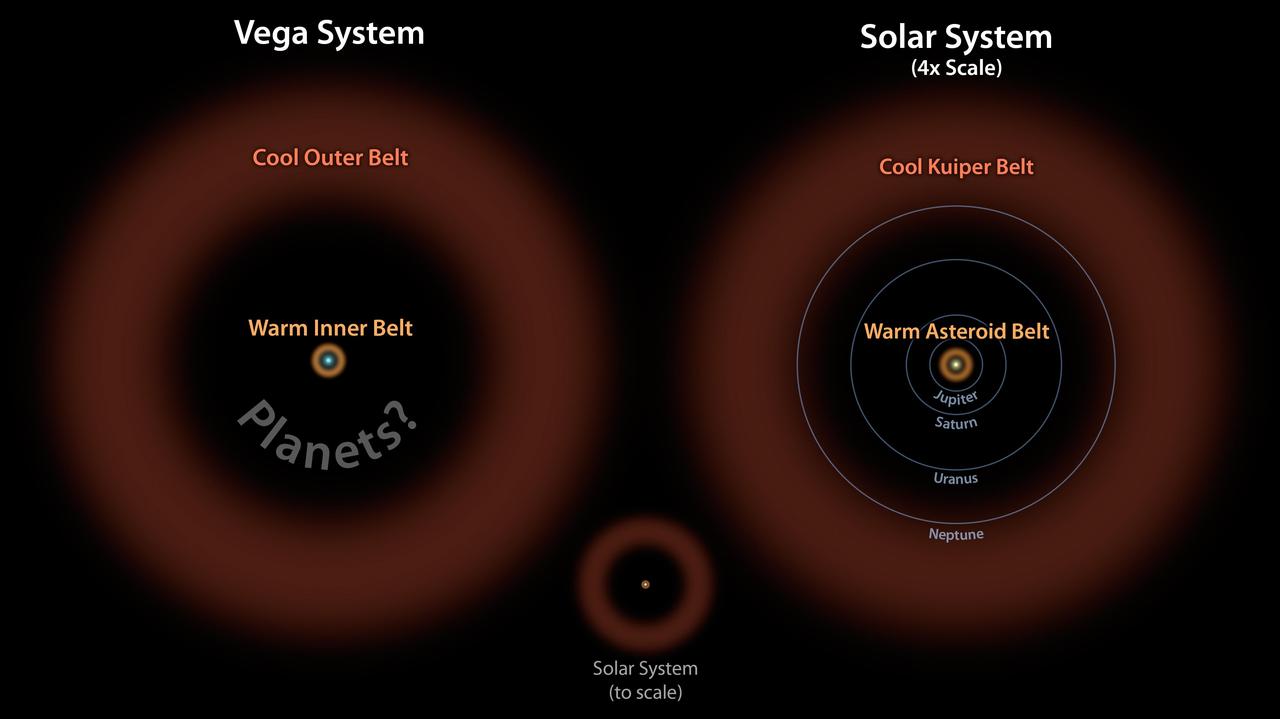
Vega: Two Belts and the Possibility of Planets
In this diagram, the Vega system, which was already known to have a cooler outer belt of comets orange, is compared to our solar system with its asteroid…
Inspect NASA record
In this diagram, the Vega system, which was already known to have a cooler outer belt of comets orange, is compared to our solar system with its asteroid and Kuiper belts. The ring of warm, rocky debris was detected using NASA Spitzer Space Telescope,
- Record ID
- PIA16611
- NASA center
- JPL
- Date
- 2013-01-08
- Credit
- NASA/JPL-Caltech
- Keywords
- Herschel Space Observatory,Spitzer Space Telescope
JPL · 2018-08-02 · PIA22564
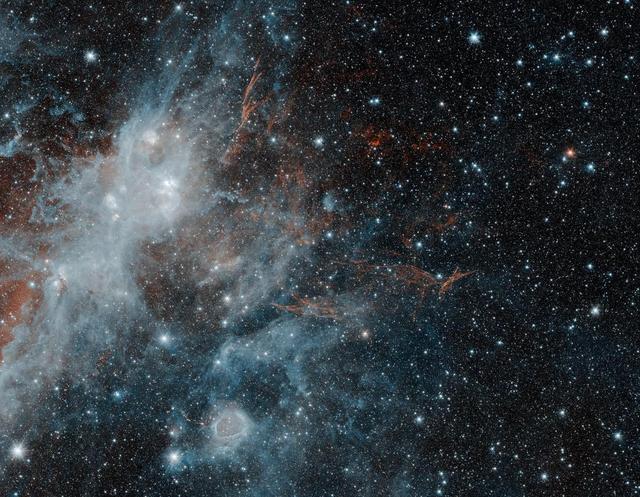
Spitzer Spies Supernova Remnant HBH 3
Thin, red veins of energized gas mark the location of the supernova remnant HBH 3 in this image from NASA's Spitzer Space Telescope. The puffy, white feature in…
Inspect NASA record
Thin, red veins of energized gas mark the location of the supernova remnant HBH 3 in this image from NASA's Spitzer Space Telescope. The puffy, white feature in the image is a portion of the star forming regions W3, W4 and W5. Infrared wavelengths of 3.6 microns have been mapped to blue, and 4.5 microns to red. The white color of the star-forming region is a combination of both wavelengths, while the HBH 3 filaments radiate only at the longer 4.5 micron wavelength. https://photojournal.jpl.nasa.gov/catalog/PIA22564
- Record ID
- PIA22564
- NASA center
- JPL
- Date
- 2018-08-02
- Credit
- NASA/JPL-Caltech/IPAC
- Keywords
- Spitzer Space Telescope, IRAC, HBH 3
JPL · 2017-06-06 · PIA21475
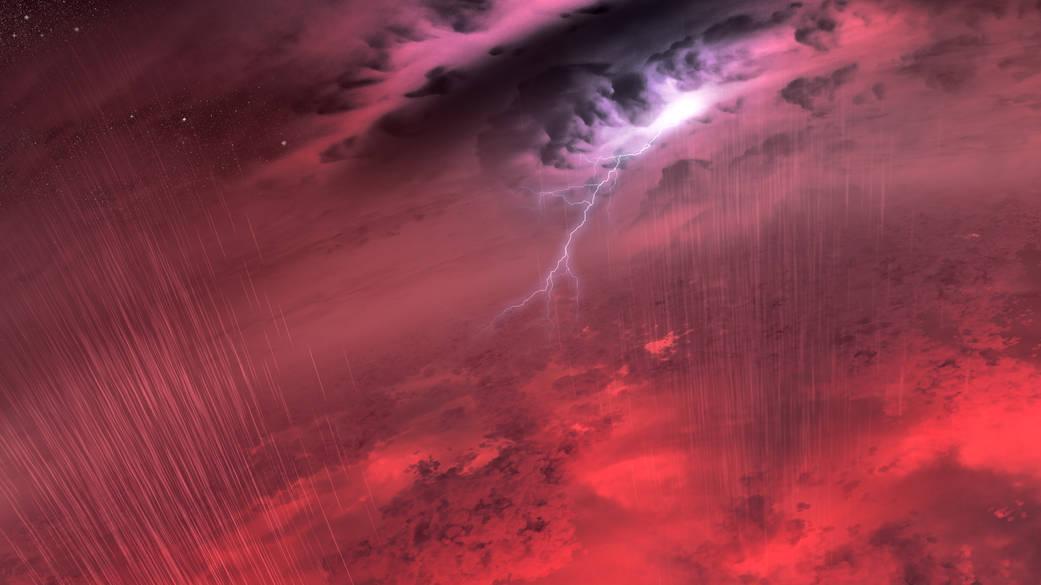
Brown Dwarf Weather (Artist's Concept)
This artist's concept shows what the weather might look like on cool star-like bodies known as brown dwarfs. These giant balls of gas start out life like stars,…
Inspect NASA record
This artist's concept shows what the weather might look like on cool star-like bodies known as brown dwarfs. These giant balls of gas start out life like stars, but lack the mass to sustain nuclear fusion at their cores, and instead, fade and cool with time. Observations from NASA's Spitzer Space Telescope suggest that most brown dwarfs are roiling with one or more planet-size storms akin to Jupiter's "Great Red Spot." https://photojournal.jpl.nasa.gov/catalog/PIA21475
- Record ID
- PIA21475
- NASA center
- JPL
- Date
- 2017-06-06
- Credit
- NASA/JPL-Caltech/University of Western Ontario/Stony Brook University/Tim Pyle
- Keywords
- Spitzer Space Telescope, brown dwarf, artist's concept
MSFC · 1993-12-06 · 9400260
History of Hubble Space Telescope (HST)
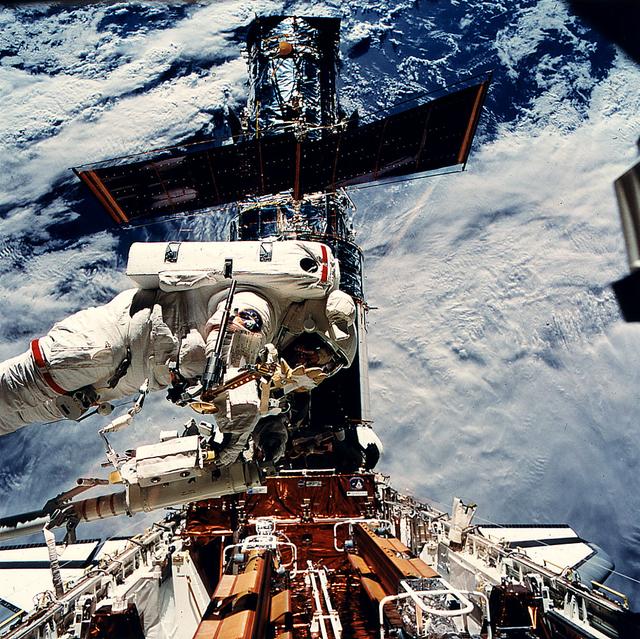
Extra vehicular activity - Astronaut Kathy Thornton on the end of orbiter Endeavour's remote manipulator system arm, hovers over equipment associated with servicing chores on the Hubble Space…
Inspect NASA record
Extra vehicular activity - Astronaut Kathy Thornton on the end of orbiter Endeavour's remote manipulator system arm, hovers over equipment associated with servicing chores on the Hubble Space Telescope (HST).
- Record ID
- 9400260
- NASA center
- MSFC
- Date
- 1993-12-06
- Keywords
- Around Marshall, STS Missions, STS-61 HST repair
MSFC · 1993-12-09 · 9400257
History of Hubble Space Telescope (HST)
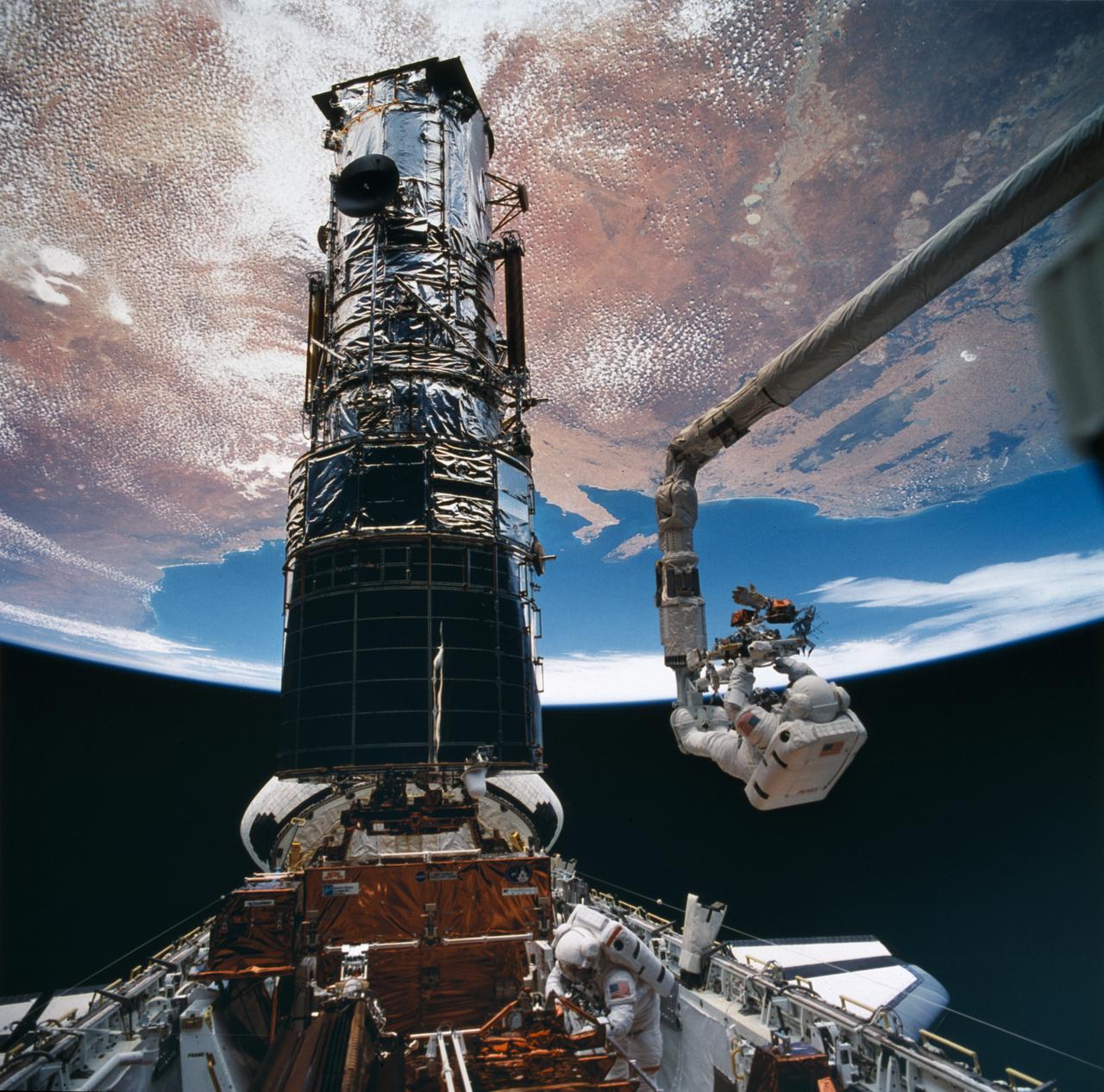
Astronaut Story Musgrave, anchored to the end of the remote manipulator arm, prepares to be elevated to the top of the towering Hubble Space Telescope (HST) to install…
Inspect NASA record
Astronaut Story Musgrave, anchored to the end of the remote manipulator arm, prepares to be elevated to the top of the towering Hubble Space Telescope (HST) to install protective covers on magnetometers. Astornaut Jeffrey Hoffman assisted Musgrave with the final servicing tasks.
- Record ID
- 9400257
- NASA center
- MSFC
- Date
- 1993-12-09
- Keywords
- Around Marshall, STS Missions, STS-61 HST repair
KSC · 2026-08-30 · KSC-20260830-PH-CSH01-0038
Nancy Grace Roman Space Telescope Post Launch Press Conference
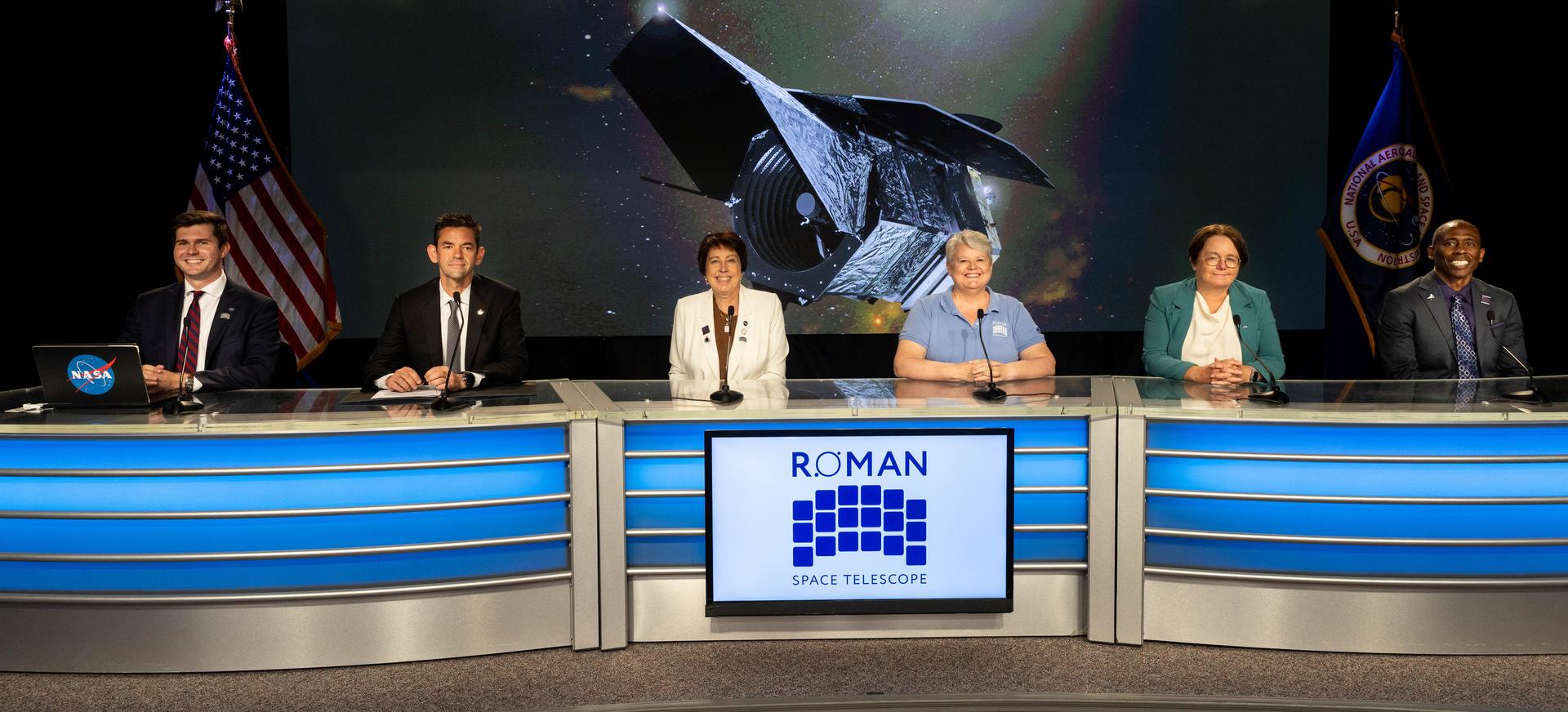
From left, George Alderman, NASA Deputy Press Secretary; NASA Administrator Jared Isaacman; Nicky Fox, associate administrator, Science Mission Directorate, NASA Headquarters in Washington; Jackie Townsend, Roman telescope project…
Inspect NASA record
From left, George Alderman, NASA Deputy Press Secretary; NASA Administrator Jared Isaacman; Nicky Fox, associate administrator, Science Mission Directorate, NASA Headquarters in Washington; Jackie Townsend, Roman telescope project manager, NASA’s Goddard Space Flight Center in Greenbelt, Maryland; Julie McEnery, Roman telescope senior project scientist, NASA Goddard; and Denton Gibson, launch director, NASA’s Launch Services Program, Kennedy Space Center in Florida, participate in a postlaunch news conference for NASA’s Nancy Grace Roman Space Telescope inside the NASA News Center’s John Holliman Auditorium at Kennedy Space Center in Florida, on Sunday, Aug. 30, 2026. Roman will investigate dark energy and dark matter, conduct a statistical census of planetary systems, and enable a broad range of additional astrophysics research. Liftoff of Roman atop a SpaceX Falcon Heavy rocket occurred at 7:26 a.m. EDT Sunday, Aug. 30, from Kennedy’s Launch Complex 39A.
- Record ID
- KSC-20260830-PH-CSH01-0038
- NASA center
- KSC
- Date
- 2026-08-30
- Credit
- NASA/Cory S Huston
- Keywords
- Nancy Grace Roman Space Telescope, Roman, RST, Payload Hazardous Servicing Facility, PHSF, KSC, Kennedy Space Center, LSP, Launch Services Program, astrophysics, science, launch
JPL · 2018-12-04 · PIA22913
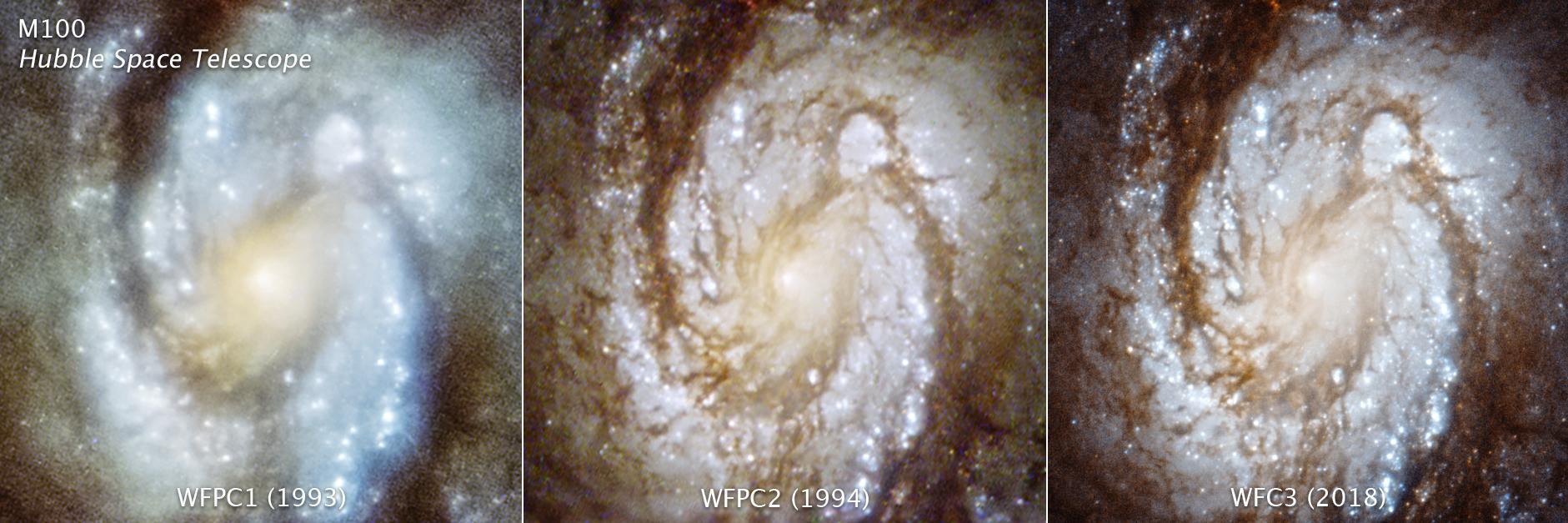
M100 Through 3 Cameras
These three images are of the central region of the spiral galaxy M100, taken with three generations of cameras that were sequentially swapped out aboard the Hubble Space…
Inspect NASA record
These three images are of the central region of the spiral galaxy M100, taken with three generations of cameras that were sequentially swapped out aboard the Hubble Space Telescope, and document the consistently improving capability of the observatory. The image on the left was taken with the Wide Field and Planetary Camera 1 in 1993. The photo is blurry due to a flaw (called spherical aberration) in Hubble's primary mirror. Celestial images could not be brought into a single focus. The middle image was taken in late 1993 with Wide Field and Planetary Camera 2 that was installed during the December 2 - 13 space shuttle servicing mission (SM1, STS-61). The camera contained corrective optics to compensate for the mirror flaw, and so the galaxy snapped into sharp focus when photographed. The image on the right was taken with a newer instrument, Wide Field Camera 3, that was installed on Hubble during the space shuttle servicing mission 4 (SM4) in May, 2009. https://photojournal.jpl.nasa.gov/catalog/PIA22913
- Record ID
- PIA22913
- NASA center
- JPL
- Date
- 2018-12-04
- Credit
- NASA, ESA, STScI and Judy Schmidt
- Keywords
- Hubble Space Telescope
JPL · 2005-01-10 · PIA07218
Tiny Particles, So Far Away
NASA's Spitzer Space Telescope recently captured these images of the star Vega, located 25 light years away in the constellation Lyra. Spitzer was able to detect the heat…
Inspect NASA record
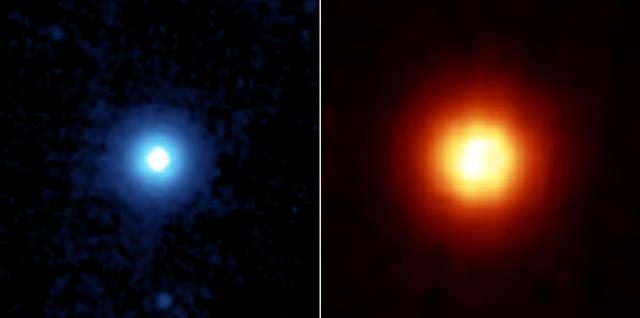
NASA's Spitzer Space Telescope recently captured these images of the star Vega, located 25 light years away in the constellation Lyra. Spitzer was able to detect the heat radiation from the cloud of dust around the star and found that the debris disc is much larger than previously thought. This side by side comparison, taken by Spitzer's multiband imaging photometer, shows the warm infrared glows from dust particles orbiting the star at wavelengths of 24 microns (figure 2 in blue) and 70 microns (figure 3 in red). Both images show a very large, circular and smooth debris disc. The disc radius extends to at least 815 astronomical units. (One astronomical unit is the distance from Earth to the Sun, which is 150-million kilometers or 93-million miles). Scientists compared the surface brightness of the disc in the infrared wavelengths to determine the temperature distribution of the disc and then infer the corresponding particle size in the disc. Most of the particles in the disc are only a few microns in size, or 100 times smaller than a grain of Earth sand. These fine dust particles originate from collisions of embryonic planets near the star at a radius of approximately 90 astronomical units, and are then blown away by Vega's intense radiation. The mass and short lifetime of these small particles indicate that the disc detected by Spitzer is the aftermath of a large and relatively recent collision, involving bodies perhaps as big as the planet Pluto. The images are 3 arcminutes on each side. North is oriented upward and east is to the left. http://photojournal.jpl.nasa.gov/catalog/PIA07218
- Record ID
- PIA07218
- NASA center
- JPL
- Date
- 2005-01-10
- Credit
- NASA/JPL-Caltech/University of Arizona
- Keywords
- Vega, Spitzer Space Telescope

STScI (Hubble) · 1996-01-15 · PIA12110
Hubble Deep Field Image Unveils Myriad Galaxies Back to the Beginning of Time
Several hundred never before seen galaxies are visible in this deepest-ever view of the universe, called the Hubble Deep Field, made with NASA Hubble Space Telescope.
Inspect NASA record
Several hundred never before seen galaxies are visible in this deepest-ever view of the universe, called the Hubble Deep Field, made with NASA Hubble Space Telescope.
- Record ID
- PIA12110
- NASA center
- STScI (Hubble)
- Date
- 1996-01-15
- Credit
- NASA/JPL/STScI Hubble Deep Field Team
- Keywords
- Hubble Space Telescope
JPL · 2018-10-23 · PIA22568
Cat's Paw Image 1
The Cat's Paw Nebula, imaged here by NASA's Spitzer Space Telescope, lies inside the Milky Way Galaxy and is located in the constellation Scorpius. Its distance from Earth…
Inspect NASA record
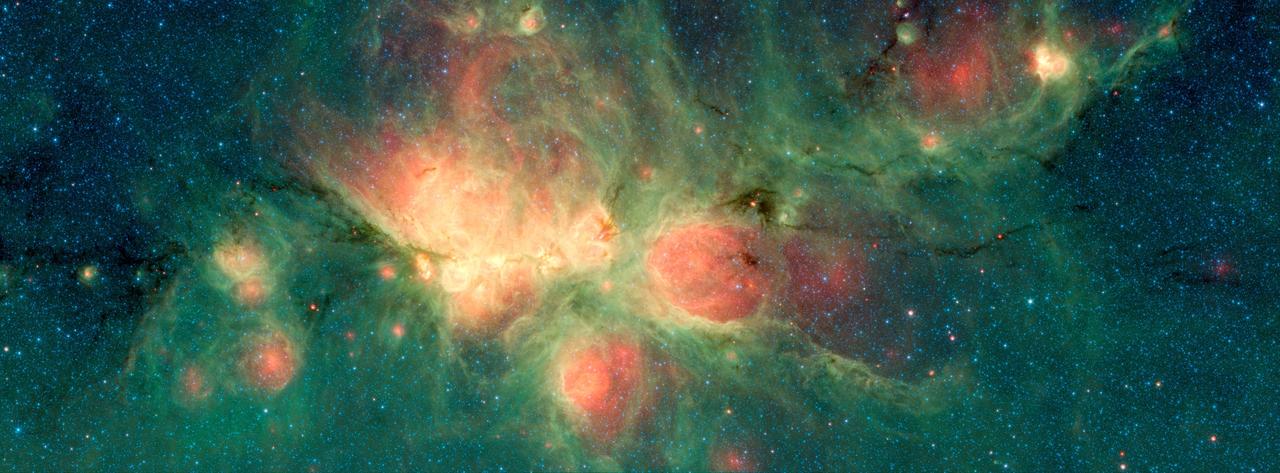
The Cat's Paw Nebula, imaged here by NASA's Spitzer Space Telescope, lies inside the Milky Way Galaxy and is located in the constellation Scorpius. Its distance from Earth is estimated to be between 1.3 kiloparsecs (about 4,200 light years) to 1.7 kiloparsecs (about 5,500 light years). The bright, cloudlike band running left to right across the image shows the presence of gas and dust that can collapse to form new stars. The black filaments running through the nebula are particularly dense regions of gas and dust. The entire star-forming region is thought to be between 24 and 27 parsecs (80-90 light years) across. The stars that form inside the nebula heat up the pressurized gas surrounding them, such that the gas may expand and form "bubbles", which appear red in this image. Asymmetric bubbles may "burst," creating U-shaped features. The green areas show regions where radiation from hot stars collided with large molecules and small dust grains called "polycyclic aromatic hydocarbons" (PAHs), causing them to fluoresce. This image was compiled using data from two Spitzer instruments, the Infrared Array Camera (IRAC) and the Multiband Imaging Photometer (MIPS). The colors correspond with wavelengths of 3.6 microns (blue), 4.5 microns (cyan), 8 microns (green) and 24 microns (red). https://photojournal.jpl.nasa.gov/catalog/PIA22568
- Record ID
- PIA22568
- NASA center
- JPL
- Date
- 2018-10-23
- Credit
- NASA/JPL-Caltech
- Keywords
- Spitzer Space Telescope
JPL · 2018-10-23 · PIA22567
Cat's Paw Image 2
The Cat's Paw Nebula, imaged here by NASA's Spitzer Space Telescope, is a star-forming region inside the Milky Way Galaxy and is located in the constellation Scorpius. Its…
Inspect NASA record
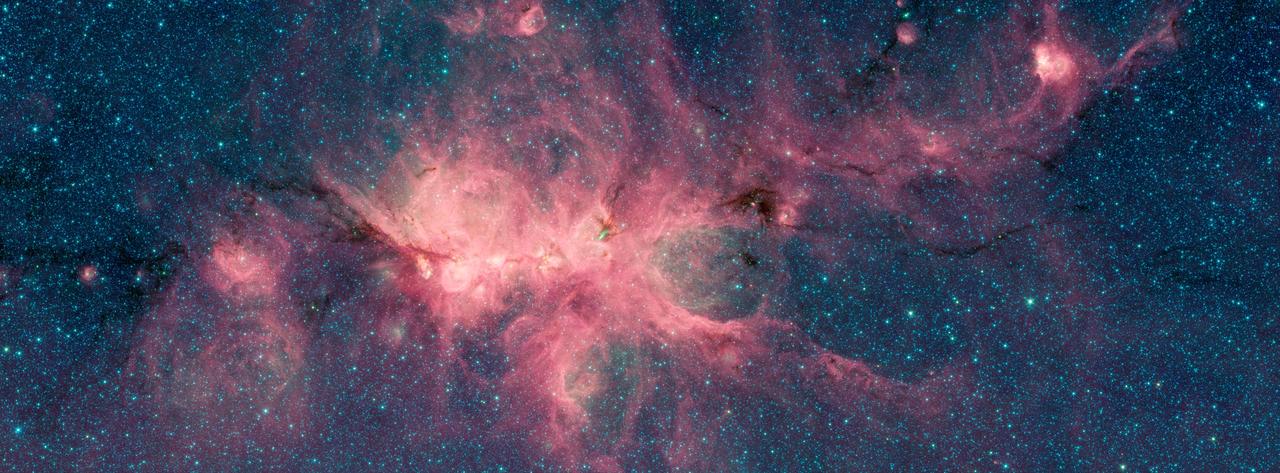
The Cat's Paw Nebula, imaged here by NASA's Spitzer Space Telescope, is a star-forming region inside the Milky Way Galaxy and is located in the constellation Scorpius. Its distance from Earth is estimated to be between 1.3 kiloparsecs (about 4,200 light years) to 1.7 kiloparsecs (about 5,500 light years). The image was taken as part of the Galactic Legacy Infrared Midplane Survey Extraordinaire (GLIMPSE), a survey of the Milky Way Galaxy. It was taken using Spitzer's Infrared Array Camera (IRAC). The colors correspond with wavelengths of 3.6 microns (blue), 4.5 microns (green), and 8 microns (red). The bright, cloudlike band running left to right across the image shows the presence of gas and dust that can collapse to form new stars. The black filaments running through the nebula are particularly dense regions of gas and dust. The entire star-forming region is thought to be between 24 and 27 parsecs (80-90 light years) across. New stars may heat up the pressurized gas surrounding them causing the gas to expand and form "bubbles." https://photojournal.jpl.nasa.gov/catalog/PIA22567
- Record ID
- PIA22567
- NASA center
- JPL
- Date
- 2018-10-23
- Credit
- NASA/JPL-Caltech
- Keywords
- Spitzer Space Telescope