
Update Site (from NASA)
Explore NASA’s Image and Video Library.
Suggest one object per day for the Interstellar Minds collection. We review each suggestion before adding it.
Sign in to suggest a Marvel.
Find a NASA image ID. Open a NASA record and copy its ID from the end of the details URL.
NASA image records
KSC · 2009-06-18 · KSC-2009-3782
KSC-2009-3782
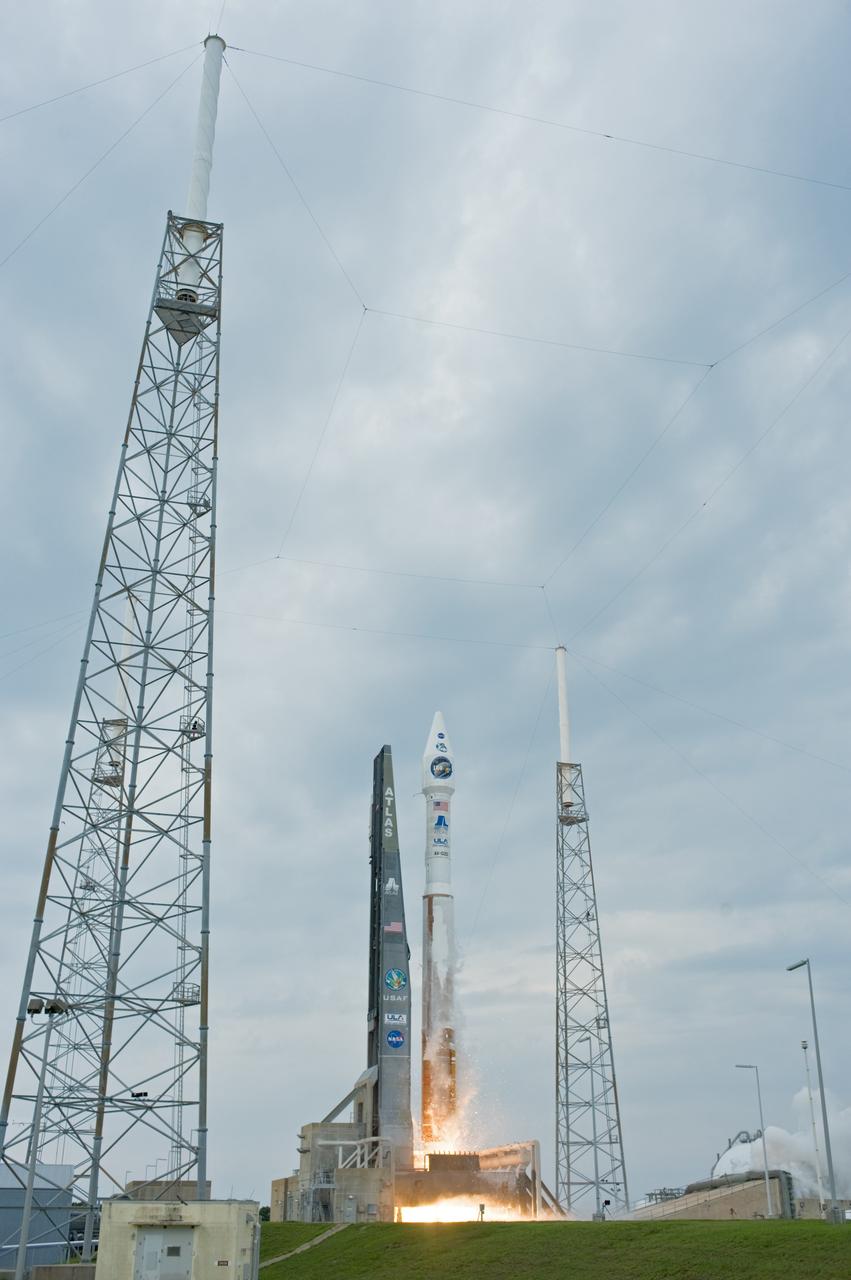
CAPE CANAVERAL, Fla. – NASA's Lunar Reconnaissance Orbiter, or LRO, and NASA's Lunar Crater Observation and Sensing Satellite, known as LCROSS, lifts off from Launch Pad 41 at…
Inspect NASA record
CAPE CANAVERAL, Fla. – NASA's Lunar Reconnaissance Orbiter, or LRO, and NASA's Lunar Crater Observation and Sensing Satellite, known as LCROSS, lifts off from Launch Pad 41 at Cape Canaveral Air Force Station in Florida atop an Atlas V/Centaur rocket. LRO and LCROSS are the first missions in NASA's plan to return humans to the moon and begin establishing a lunar outpost by 2020. The LRO also includes seven instruments that will help NASA characterize the moon's surface: DIVINER, LAMP, LEND, LOLA , CRATER, Mini-RF and LROC. Launch was on-time at 5:32 p.m. EDT. Photo credit: NASA/Tom Farrar, Kevin O'Connell
- Record ID
- KSC-2009-3782
- NASA center
- KSC
- Date
- 2009-06-18
- Keywords
- LRO, LCROSS, ELV

KSC · 2009-03-03 · KSC-2009-1923
KSC-2009-1923
CAPE CANAVERAL, Fla. – On Cape Canaveral Air Force Station's skid strip in Florida, the shrouded Atlas V first stage booster is being moved out of the Russian…
Inspect NASA record
CAPE CANAVERAL, Fla. – On Cape Canaveral Air Force Station's skid strip in Florida, the shrouded Atlas V first stage booster is being moved out of the Russian AH-124-100 aircraft onto a transporter. The Atlas V is the launch vehicle for NASA's Lunar Reconnaissance Orbiter, or LRO, and NASA's Lunar CRater Observation and Sensing Satellite, known as LCROSS. The booster will be taken to the Atlas Space Operations Center on CCAFS. Launch is scheduled no earlier than May 20. LCROSS and LRO are the first missions in NASA's plan to return humans to the moon and begin establishing a lunar outpost by 2020. Photo credit: NASA/Jim Grossmann
- Record ID
- KSC-2009-1923
- NASA center
- KSC
- Date
- 2009-03-03
- Keywords
- LRO, LCRPSS. Atlas V, booster, CCAFS

JSC · 2025-08-06 · jsc2025e067512
Artemis II Science Officers -- jsc2025e067512
jsc2025e067512 --- Artemis II science officers Kelsey Young, left, and Angela Garcia sit at the SCIENCE console during a training simulation in the White Flight Control Room of…
Inspect NASA record
jsc2025e067512 --- Artemis II science officers Kelsey Young, left, and Angela Garcia sit at the SCIENCE console during a training simulation in the White Flight Control Room of the Mission Control Center at NASA's Johnson Space Center in Houston. Artemis II will test mission science operations and integration into flight control. Lessons learned during Artemis II science operations will pave the way for lunar science operations for future Artemis missions. A team of experts will staff the Science Evaluation Room (SER) at Johnson, providing lunar scientific expertise, data analysis, and strategic guidance in real-time to the science officer and the rest of Mission Control.
- Record ID
- jsc2025e067512
- NASA center
- JSC
- Date
- 2025-08-06
JSC · 1973-12-13 · S73-38346
APOLLO 17 - POSTFLIGHT - JSC
S73-38346 (11 Dec. 1973) --- Two of the three Apollo 17 crewmen join in commemoration of their historical lunar landing mission of one year ago by presenting to…
Inspect NASA record
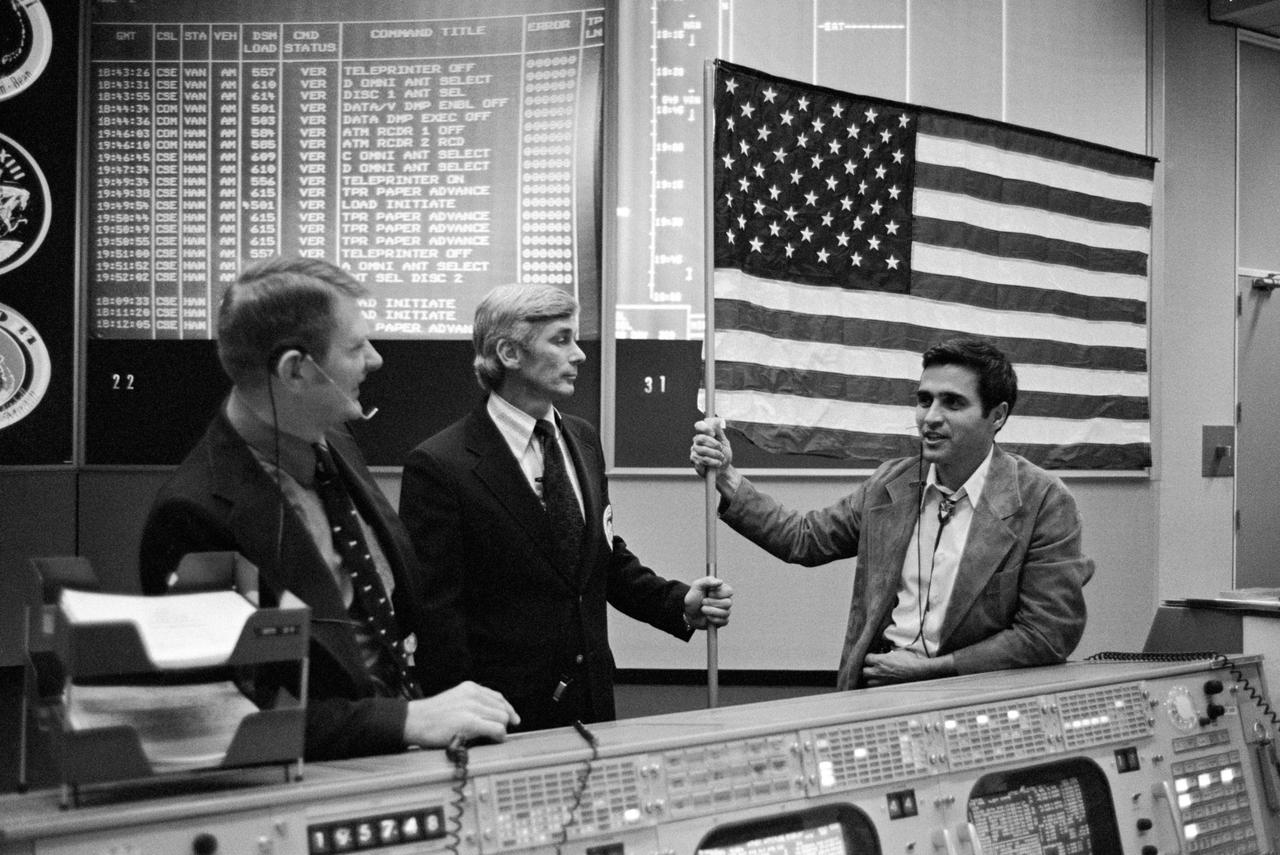
S73-38346 (11 Dec. 1973) --- Two of the three Apollo 17 crewmen join in commemoration of their historical lunar landing mission of one year ago by presenting to flight controllers in Mission Control Center (MCC) the U.S. flag which flew with them to the moon. Astronauts Eugene A. Cernan, center, Apollo 17 commander, and Harrison H. Schmitt, right, lunar module pilot, are shown with Eugene F. Kranz, who accepted the flag on behalf of all the flight controllers during special ceremonies in the Mission Operations Control Room (MOCR) of MCC during the third manned Skylab mission. Kranz is chief of the Flight Control Division of the Flight Operations Directorate at JSC.
- Record ID
- S73-38346
- NASA center
- JSC
- Date
- 1973-12-13

JSC · 1973-12-13 · S73-38345
APOLLO 17 Postflight
S73-38345 (11 Dec. 1973) --- Two of the three Apollo 17 crewmen join in commemoration of their historical lunar landing mission of one year ago by presenting to…
Inspect NASA record
S73-38345 (11 Dec. 1973) --- Two of the three Apollo 17 crewmen join in commemoration of their historical lunar landing mission of one year ago by presenting to flight controllers in Mission Control Center (MCC) the U.S. flag which flew with them to the moon. Astronauts Eugene A. Cernan, center, Apollo 17 commander, and Harrison H. Schmitt, right, lunar module pilot, are shown with Eugene F. Kranz, who accepted the flag on behalf of all the flight controllers during special ceremonies in the Mission Operations Control Room (MOCR) of MCC during the third manned Skylab mission. Kranz is chief of the Flight Control Division of the Flight Operations Directorate at JSC.
- Record ID
- S73-38345
- NASA center
- JSC
- Date
- 1973-12-13

KSC · 2009-02-13 · KSC-2009-1628
KSC-2009-1628
CAPE CANAVERAL, Fla. – The shipping container is removed from around NASA's Lunar Reconnaissance Orbiter, or LRO, at the Astrotech processing facility in Titusville, Fla. The spacecraft was…
Inspect NASA record
CAPE CANAVERAL, Fla. – The shipping container is removed from around NASA's Lunar Reconnaissance Orbiter, or LRO, at the Astrotech processing facility in Titusville, Fla. The spacecraft was built by engineers at Goddard Space Flight Center, where it recently completed two months of tests in a thermal vacuum chamber. The orbiter will carry seven instruments to provide scientists with detailed maps of the lunar surface and enhance our understanding of the moon's topography, lighting conditions, mineralogical composition and natural resources. Information gleaned from LRO will be used to select safe landing sites, determine locations for future lunar outposts and help mitigate radiation dangers to astronauts. The polar regions of the moon are the main focus of the mission because continuous access to sunlight may be possible and water ice may exist in permanently shadowed areas of the poles. Accompanying LRO on its journey to the moon will be the Lunar Crater Observation and Sensing Satellite, or LCROSS, a mission that will impact the lunar surface in its search for water ice. Launch of LRO/LCROSS is targeted for April 24. Photo credit: NASA/Kim Shiflett
- Record ID
- KSC-2009-1628
- NASA center
- KSC
- Date
- 2009-02-13
- Keywords
- moon
KSC · 2009-02-13 · KSC-2009-1597
KSC-2009-1597
CAPE CANAVERAL, Fla. – NASA's Lunar Reconnaissance Orbiter, or LRO, spacecraft arrives at Astrotech Space Operations in Titusville, Fla. The spacecraft was built by engineers at Goddard Space…
Inspect NASA record
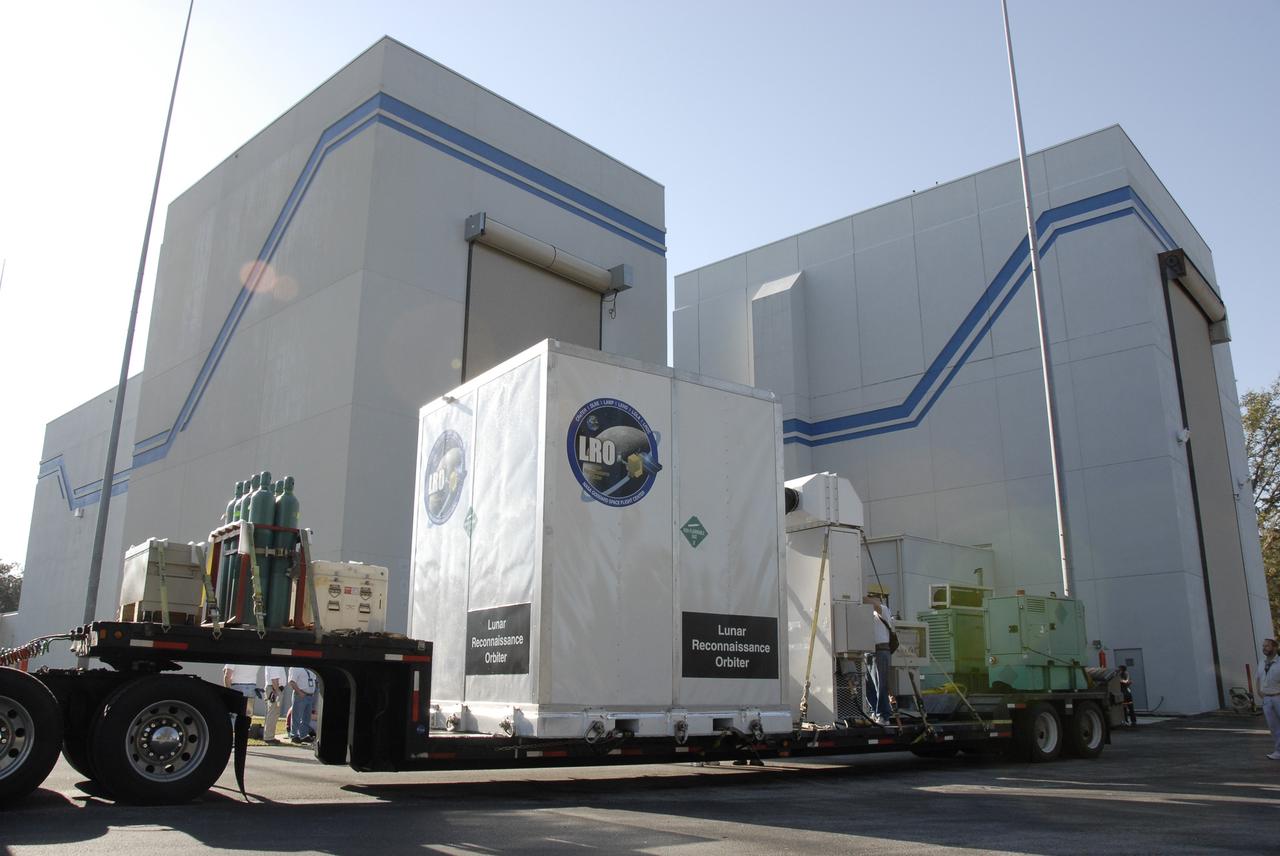
CAPE CANAVERAL, Fla. – NASA's Lunar Reconnaissance Orbiter, or LRO, spacecraft arrives at Astrotech Space Operations in Titusville, Fla. The spacecraft was built by engineers at Goddard Space Flight Center, where it recently completed two months of tests in a thermal vacuum chamber. The orbiter will carry seven instruments to provide scientists with detailed maps of the lunar surface and enhance our understanding of the moon's topography, lighting conditions, mineralogical composition and natural resources. Information gleaned from LRO will be used to select safe landing sites, determine locations for future lunar outposts and help mitigate radiation dangers to astronauts. The polar regions of the moon are the main focus of the mission because continuous access to sunlight may be possible and water ice may exist in permanently shadowed areas of the poles. Accompanying LRO on its journey to the moon will be the Lunar Crater Observation and Sensing Satellite, or LCROSS, a mission that will impact the lunar surface in its search for water ice. Launch of LRO is targeted for April 24. Photo credit: NASA/Kim Shiflett
- Record ID
- KSC-2009-1597
- NASA center
- KSC
- Date
- 2009-02-13
- Keywords
- LRO, LCROSS, KSC
KSC · 2009-02-13 · KSC-2009-1600
KSC-2009-1600
CAPE CANAVERAL, Fla. – NASA's Lunar Reconnaissance Orbiter, or LRO, spacecraft is moved into Astrotech in Titusville, Fla. The spacecraft was built by engineers at Goddard Space Flight…
Inspect NASA record
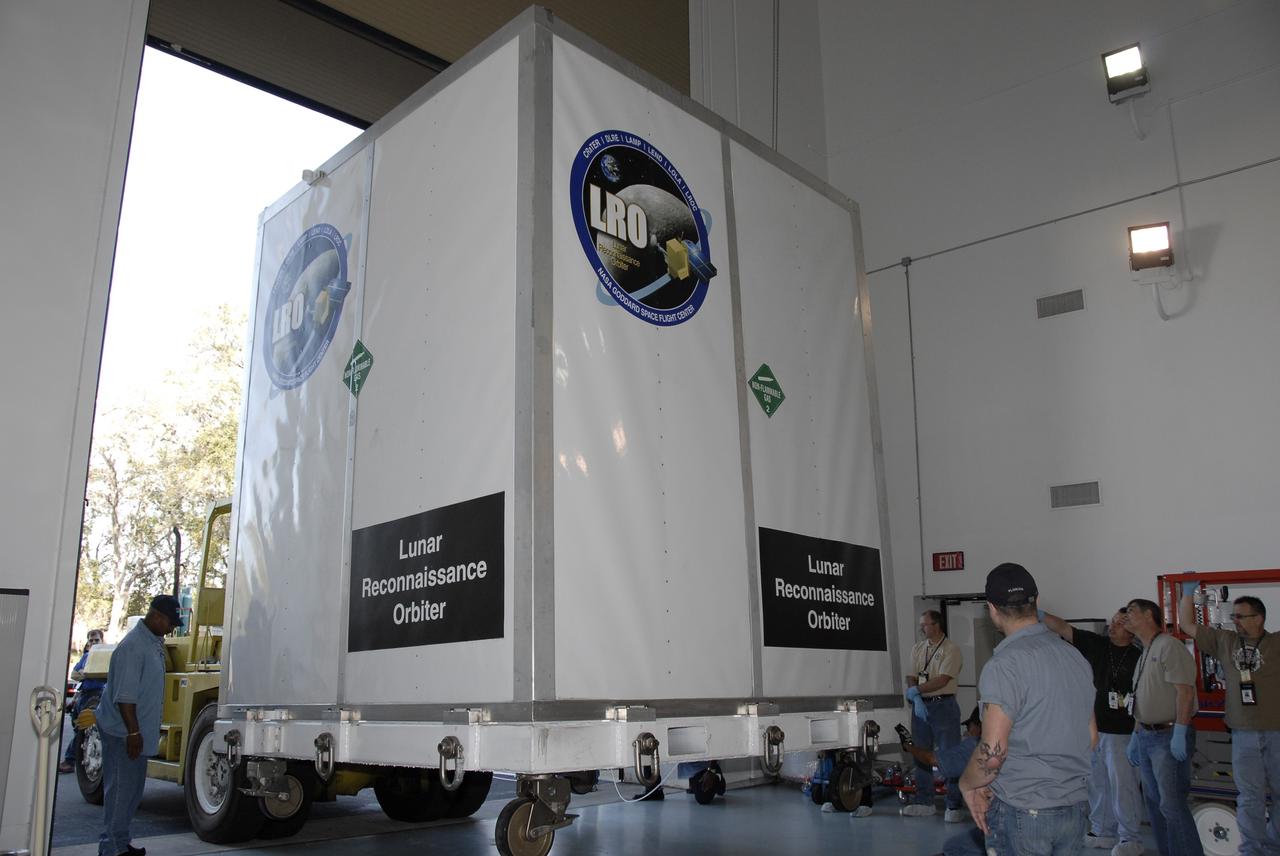
CAPE CANAVERAL, Fla. – NASA's Lunar Reconnaissance Orbiter, or LRO, spacecraft is moved into Astrotech in Titusville, Fla. The spacecraft was built by engineers at Goddard Space Flight Center, where it recently completed two months of tests in a thermal vacuum chamber. The orbiter will carry seven instruments to provide scientists with detailed maps of the lunar surface and enhance our understanding of the moon's topography, lighting conditions, mineralogical composition and natural resources. Information gleaned from LRO will be used to select safe landing sites, determine locations for future lunar outposts and help mitigate radiation dangers to astronauts. The polar regions of the moon are the main focus of the mission because continuous access to sunlight may be possible and water ice may exist in permanently shadowed areas of the poles. Accompanying LRO on its journey to the moon will be the Lunar Crater Observation and Sensing Satellite, or LCROSS, a mission that will impact the lunar surface in its search for water ice. Launch of LRO is targeted for April 24. Photo credit: NASA/Kim Shiflett
- Record ID
- KSC-2009-1600
- NASA center
- KSC
- Date
- 2009-02-13
- Keywords
- LRO, LCROSS, KSC
KSC · 2009-02-13 · KSC-2009-1634
KSC-2009-1634
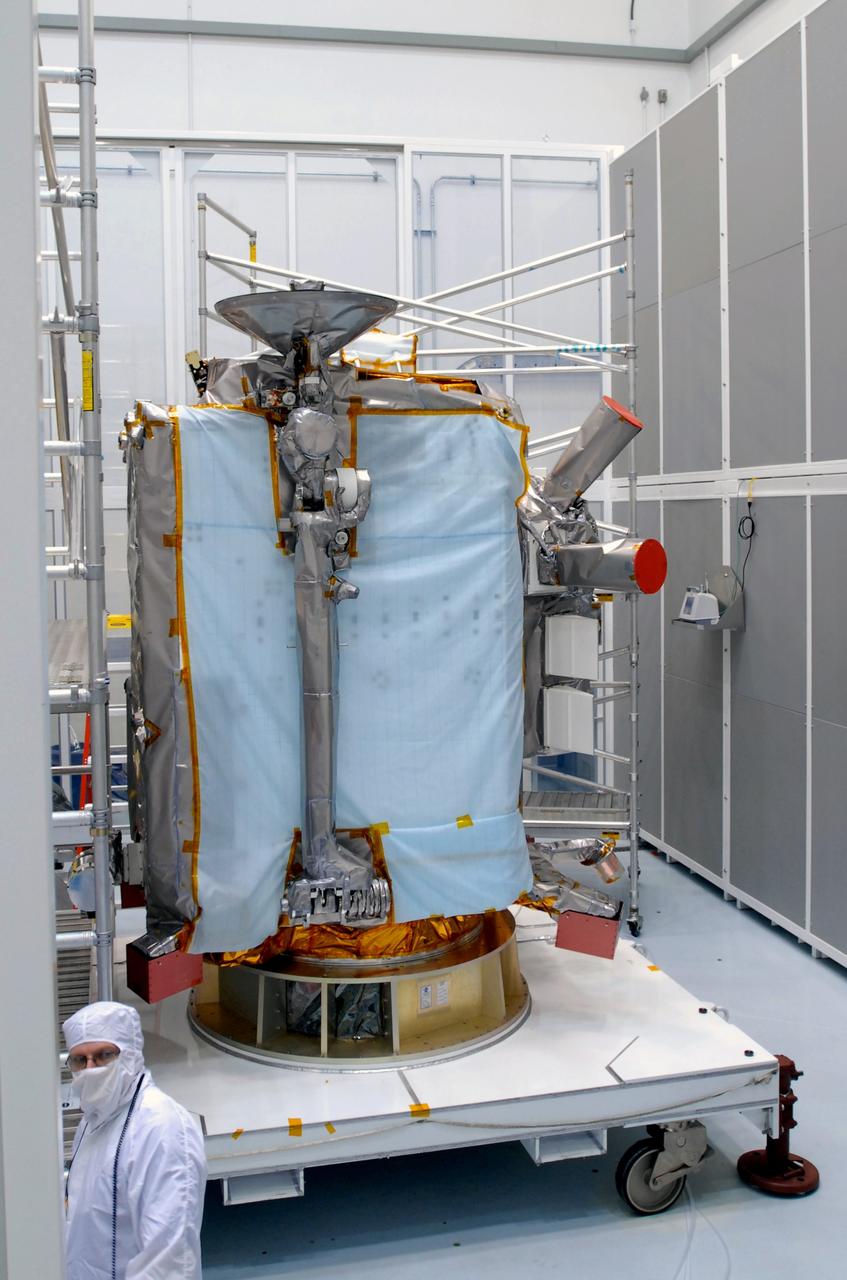
CAPE CANAVERAL, Fla. – NASA's Lunar Reconnaissance Orbiter, or LRO, is ready for final checkout and processing in the high bay at the Astrotech processing facility in Titusville,…
Inspect NASA record
CAPE CANAVERAL, Fla. – NASA's Lunar Reconnaissance Orbiter, or LRO, is ready for final checkout and processing in the high bay at the Astrotech processing facility in Titusville, Fla. The spacecraft was built by engineers at Goddard Space Flight Center, where it recently completed two months of tests in a thermal vacuum chamber. The orbiter will carry seven instruments to provide scientists with detailed maps of the lunar surface and enhance our understanding of the moon's topography, lighting conditions, mineralogical composition and natural resources. Information gleaned from LRO will be used to select safe landing sites, determine locations for future lunar outposts and help mitigate radiation dangers to astronauts. The polar regions of the moon are the main focus of the mission because continuous access to sunlight may be possible and water ice may exist in permanently shadowed areas of the poles. Accompanying LRO on its journey to the moon will be the Lunar Crater Observation and Sensing Satellite, or LCROSS, a mission that will impact the lunar surface in its search for water ice. Launch of LRO/LCROSS is targeted for April 24. Photo credit: NASA/Jim Grossmann
- Record ID
- KSC-2009-1634
- NASA center
- KSC
- Date
- 2009-02-13
- Keywords
- moon
KSC · 2009-03-17 · KSC-2009-2156
KSC-2009-2156
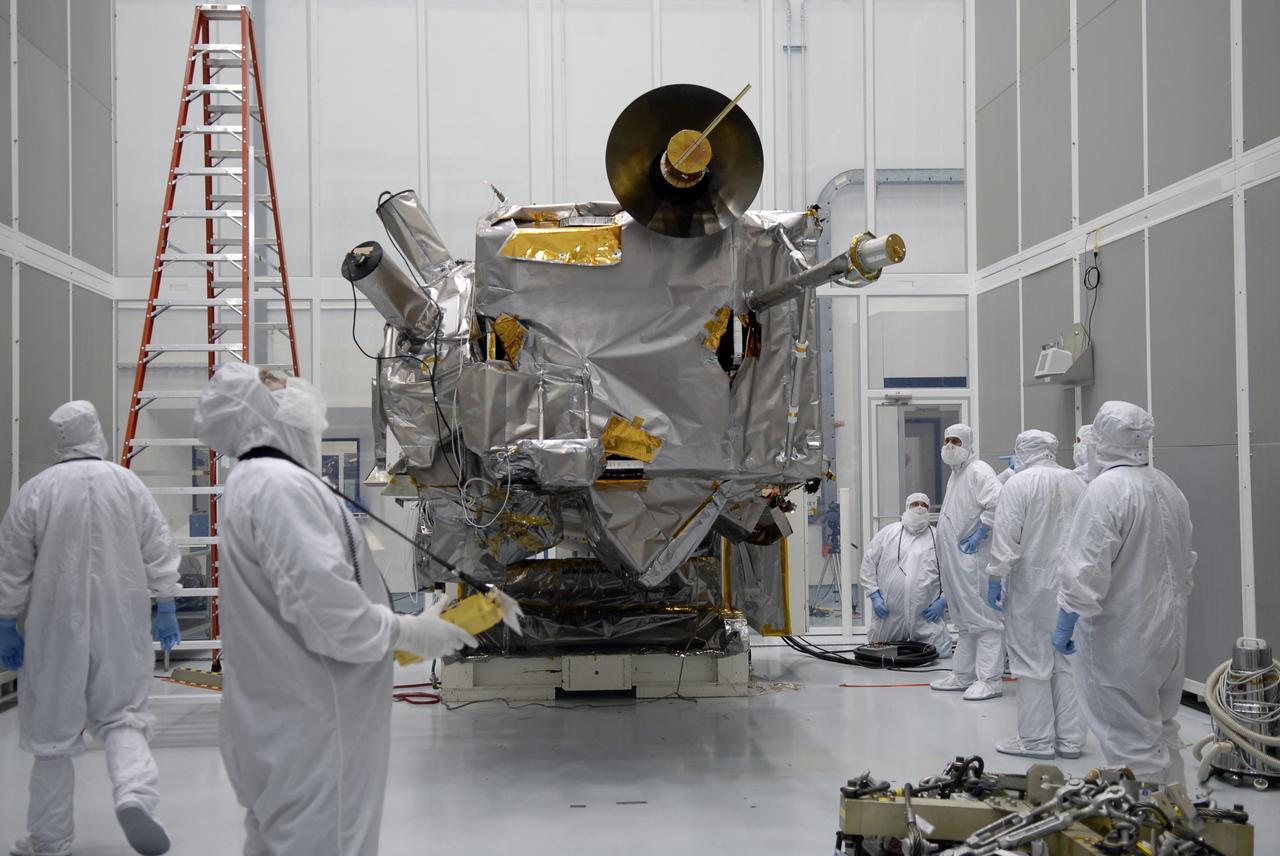
CAPE CANAVERAL, Fla. – At the Astrotech facility in Titusville, Fla., technicians wait for the rotation of NASA's Lunar Reconnaissance Orbiter, or LRO, (center) on the Aronson stand.…
Inspect NASA record
CAPE CANAVERAL, Fla. – At the Astrotech facility in Titusville, Fla., technicians wait for the rotation of NASA's Lunar Reconnaissance Orbiter, or LRO, (center) on the Aronson stand. When vertical, a crane will be attached to move the LRO to another stand. The orbiter will carry seven instruments to provide scientists with detailed maps of the lunar surface and enhance our understanding of the moon's topography, lighting conditions, mineralogical composition and natural resources. Information gleaned from LRO will be used to select safe landing sites, determine locations for future lunar outposts and help mitigate radiation dangers to astronauts. The polar regions of the moon are the main focus of the mission because continuous access to sunlight may be possible and water ice may exist in permanently shadowed areas of the poles. Accompanying LRO on its journey to the moon will be the Lunar CRater Observation and Sensing Satellite, or LCROSS, a mission that will impact the lunar surface in its search for water ice. Launch of LRO is targeted for May 20. Photo credit: NASA/Kim Shiflett
- Record ID
- KSC-2009-2156
- NASA center
- KSC
- Date
- 2009-03-17
- Keywords
- LRO, LCROSS, lunar, black light, UVA
KSC · 2009-02-15 · KSC-2009-1643
KSC-2009-1643
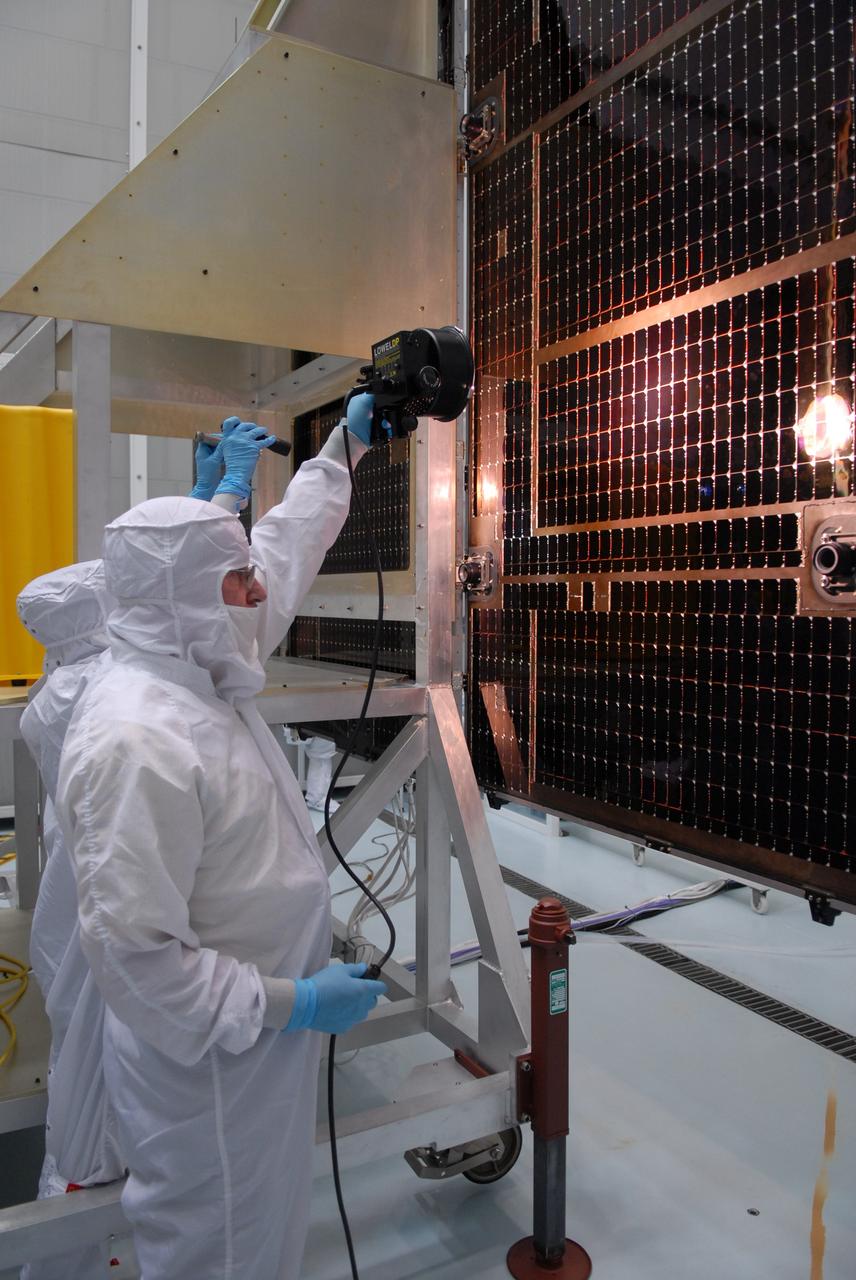
CAPE CANAVERAL, Fla. – Technicians check out the solar arrays for NASA's Lunar Reconnaissance Orbiter, or LRO, at the Astrotech processing facility in Titusville, Fla. The spacecraft was…
Inspect NASA record
CAPE CANAVERAL, Fla. – Technicians check out the solar arrays for NASA's Lunar Reconnaissance Orbiter, or LRO, at the Astrotech processing facility in Titusville, Fla. The spacecraft was built by engineers at Goddard Space Flight Center, where it recently completed two months of tests in a thermal vacuum chamber. The orbiter will carry seven instruments to provide scientists with detailed maps of the lunar surface and enhance our understanding of the moon's topography, lighting conditions, mineralogical composition and natural resources. Information gleaned from LRO will be used to select safe landing sites, determine locations for future lunar outposts and help mitigate radiation dangers to astronauts. The polar regions of the moon are the main focus of the mission because continuous access to sunlight may be possible and water ice may exist in permanently shadowed areas of the poles. Accompanying LRO on its journey to the moon will be the Lunar Crater Observation and Sensing Satellite, or LCROSS, a mission that will impact the lunar surface in its search for water ice. Launch of LRO/LCROSS is targeted for April 24. Photo credit: NASA/Jack Pfaller
- Record ID
- KSC-2009-1643
- NASA center
- KSC
- Date
- 2009-02-15
- Keywords
- moon
KSC · 2009-02-15 · KSC-2009-1641
KSC-2009-1641
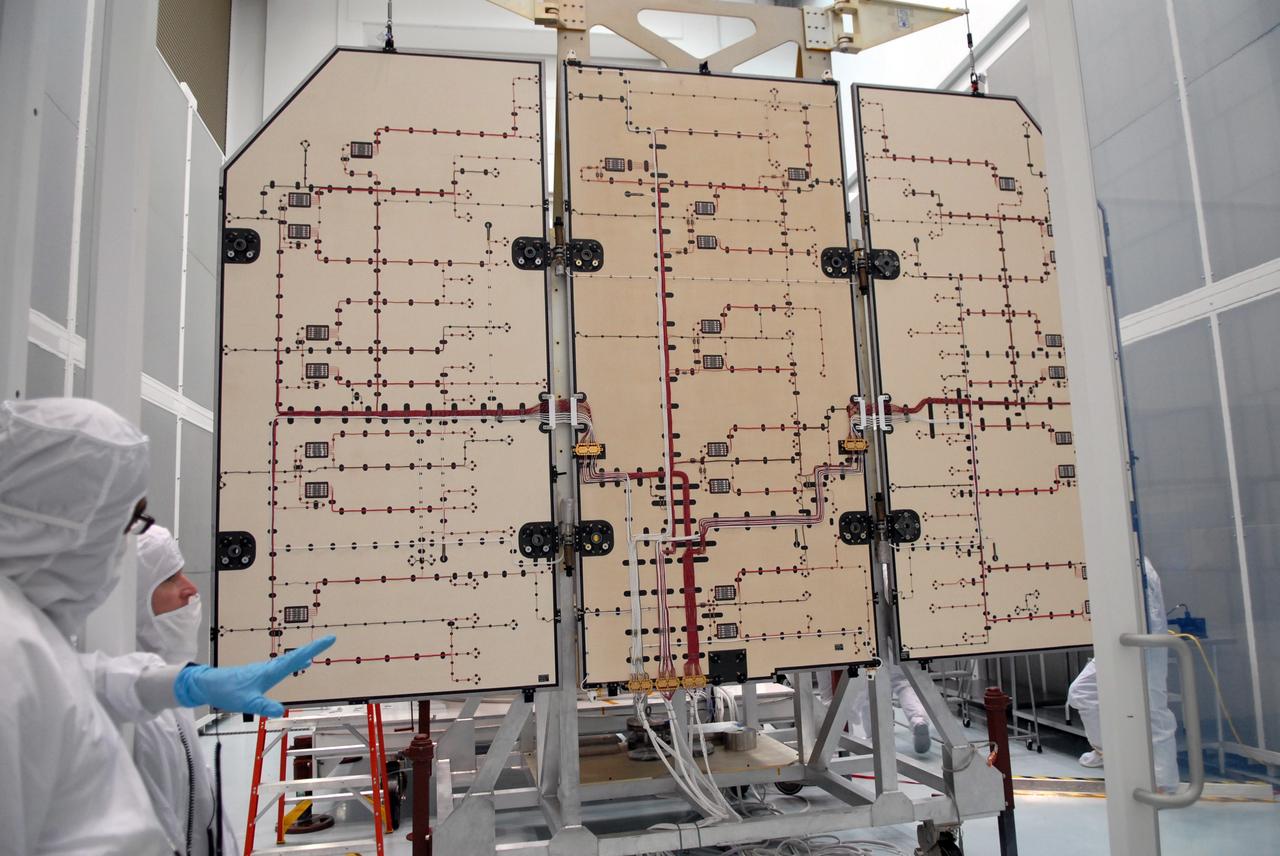
CAPE CANAVERAL, Fla. – Technicians inspect the solar arrays for NASA's Lunar Reconnaissance Orbiter, or LRO, at the Astrotech processing facility in Titusville, Fla. The spacecraft was built…
Inspect NASA record
CAPE CANAVERAL, Fla. – Technicians inspect the solar arrays for NASA's Lunar Reconnaissance Orbiter, or LRO, at the Astrotech processing facility in Titusville, Fla. The spacecraft was built by engineers at Goddard Space Flight Center, where it recently completed two months of tests in a thermal vacuum chamber. The orbiter will carry seven instruments to provide scientists with detailed maps of the lunar surface and enhance our understanding of the moon's topography, lighting conditions, mineralogical composition and natural resources. Information gleaned from LRO will be used to select safe landing sites, determine locations for future lunar outposts and help mitigate radiation dangers to astronauts. The polar regions of the moon are the main focus of the mission because continuous access to sunlight may be possible and water ice may exist in permanently shadowed areas of the poles. Accompanying LRO on its journey to the moon will be the Lunar Crater Observation and Sensing Satellite, or LCROSS, a mission that will impact the lunar surface in its search for water ice. Launch of LRO/LCROSS is targeted for April 24. Photo credit: NASA/Jack Pfaller
- Record ID
- KSC-2009-1641
- NASA center
- KSC
- Date
- 2009-02-15
- Keywords
- moon