
Update Site (from NASA)
Explore NASA’s Image and Video Library.
Suggest one object per day for the Interstellar Minds collection. We review each suggestion before adding it.
Sign in to suggest a Marvel.
Find a NASA image ID. Open a NASA record and copy its ID from the end of the details URL.
NASA image records
JPL · 2019-10-30 · PIA23403
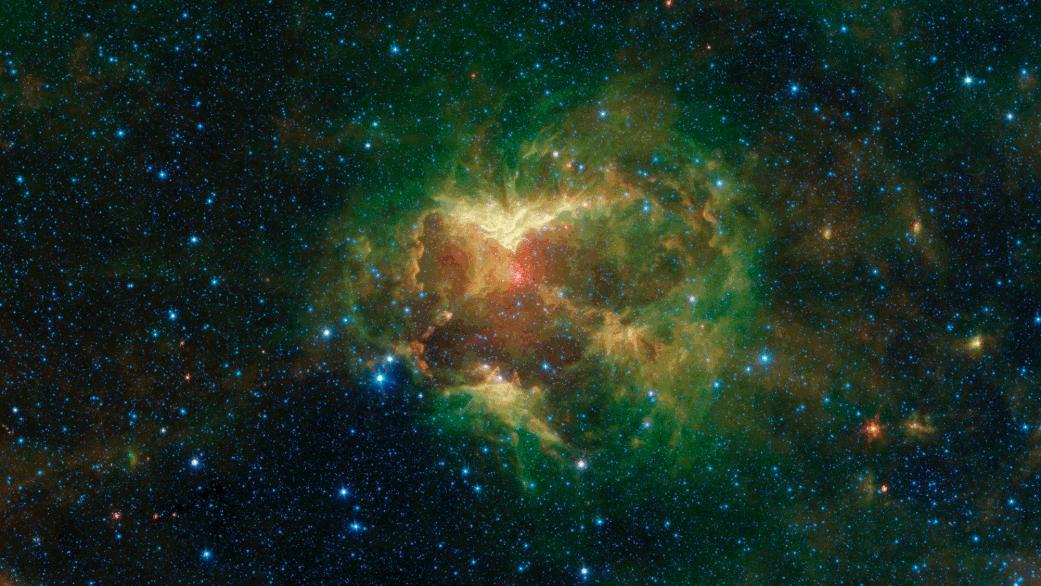
The "Jack-o'-Lantern Nebula"
This carved-out cloud of gas and dust has been nicknamed the "Jack-o'-lantern Nebula" because it looks like a cosmic hollowed-out pumpkin. Powerful outflows of radiation and particles from…
Inspect NASA record
This carved-out cloud of gas and dust has been nicknamed the "Jack-o'-lantern Nebula" because it looks like a cosmic hollowed-out pumpkin. Powerful outflows of radiation and particles from a massive star — known as an O-type star and about 15 to 20 times heavier than the Sun — has likely swept the surrounding dust and gas outward, creating deep gouges in the cloud. The image shows infrared light (which is invisible to the human eye) captured by NASA's Spitzer Space Telescope. https://photojournal.jpl.nasa.gov/catalog/PIA23403
- Record ID
- PIA23403
- NASA center
- JPL
- Date
- 2019-10-30
- Credit
- NASA/JPL-Caltech
- Keywords
- Spitzer Space Telescope
JPL · 2019-03-05 · PIA23010
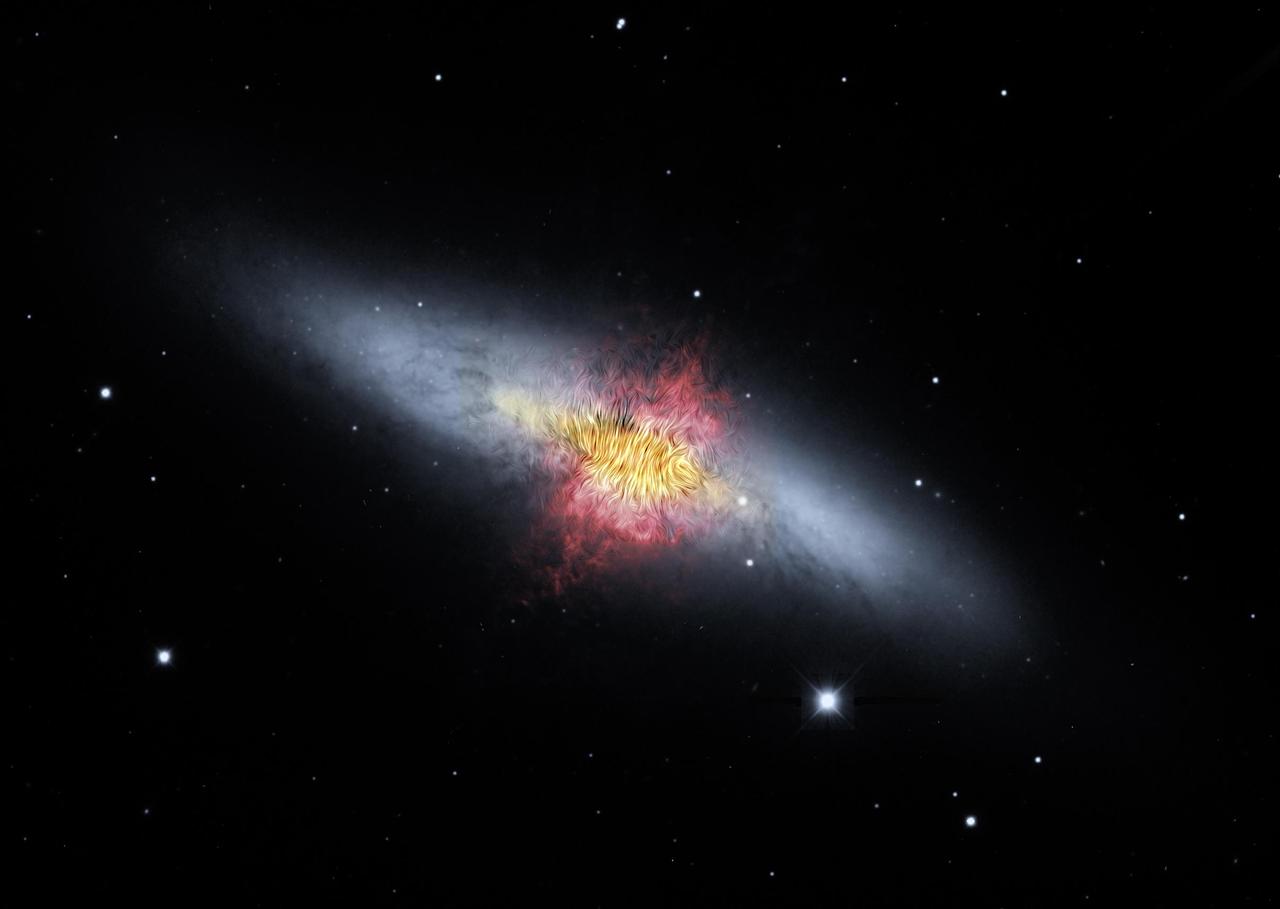
The Cigar Galaxy's Magnetic Field
A composite image of the Cigar Galaxy (also called M82), a starburst galaxy about 12 million light-years away in the constellation Ursa Major. The magnetic field detected by…
Inspect NASA record
A composite image of the Cigar Galaxy (also called M82), a starburst galaxy about 12 million light-years away in the constellation Ursa Major. The magnetic field detected by the High-resolution Airborne Wideband Camera-Plus instrument (known as HAWC+) on SOFIA (the Stratospheric Observatory for Infrared Astronomy), shown as streamlines, appears to follow the bipolar outflows (red) generated by the intense nuclear starburst. The image combines visible starlight (gray) and a tracing of hydrogen gas (red) observed from the Kitt Peak Observatory, with near-infrared and mid-infrared starlight and dust (yellow) observed by SOFIA and the Spitzer Space Telescope. https://photojournal.jpl.nasa.gov/catalog/PIA23010
- Record ID
- PIA23010
- NASA center
- JPL
- Date
- 2019-03-05
- Credit
- NASA/SOFIA/E. Lopez-Rodiguez; NASA/Spitzer/J. Moustakas et al.
- Keywords
- Spitzer Space Telescope
1998-05-02 · PIA01264
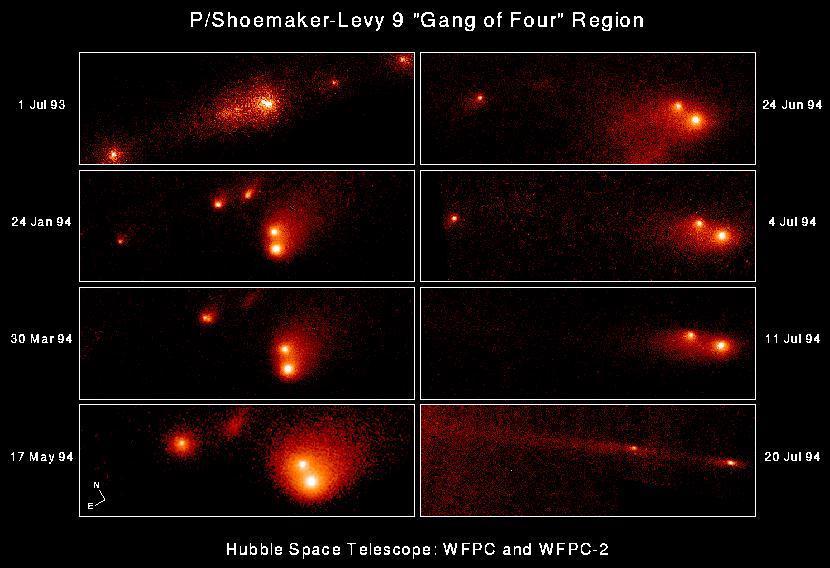
Evolution of the P/Shoemaker-Levy 9 Gang
This series of eight NASA Hubble Space Telescope "snapshots" shows the evolution of the P-Q complex, also called the "gang of four" region, of comet P/Shoemaker-Levy 9. The…
Inspect NASA record
This series of eight NASA Hubble Space Telescope "snapshots" shows the evolution of the P-Q complex, also called the "gang of four" region, of comet P/Shoemaker-Levy 9. The eight individual frames chronicle changes in the comet during the 12 months before colliding with Jupiter. The sequence shows that the relative separations of the various cometary fragments, thought to range in size from about 500 meters to almost 4 km (2.5 miles) across, changed dramatically over this period. The apparent separation of Q1 and Q2 was only about 1100 kilometers (680 miles) on 1 July 1993 and increased to 28,000 kilometers (17,400 miles) by 20 July 1994. http://photojournal.jpl.nasa.gov/catalog/PIA01264
- Record ID
- PIA01264
- Date
- 1998-05-02
- Credit
- JPL/NASA/STScI
- Keywords
- Jupiter, Hubble Space Telescope
KSC · 2026-08-29 · KSC-20260829-PH-RCR01_0101
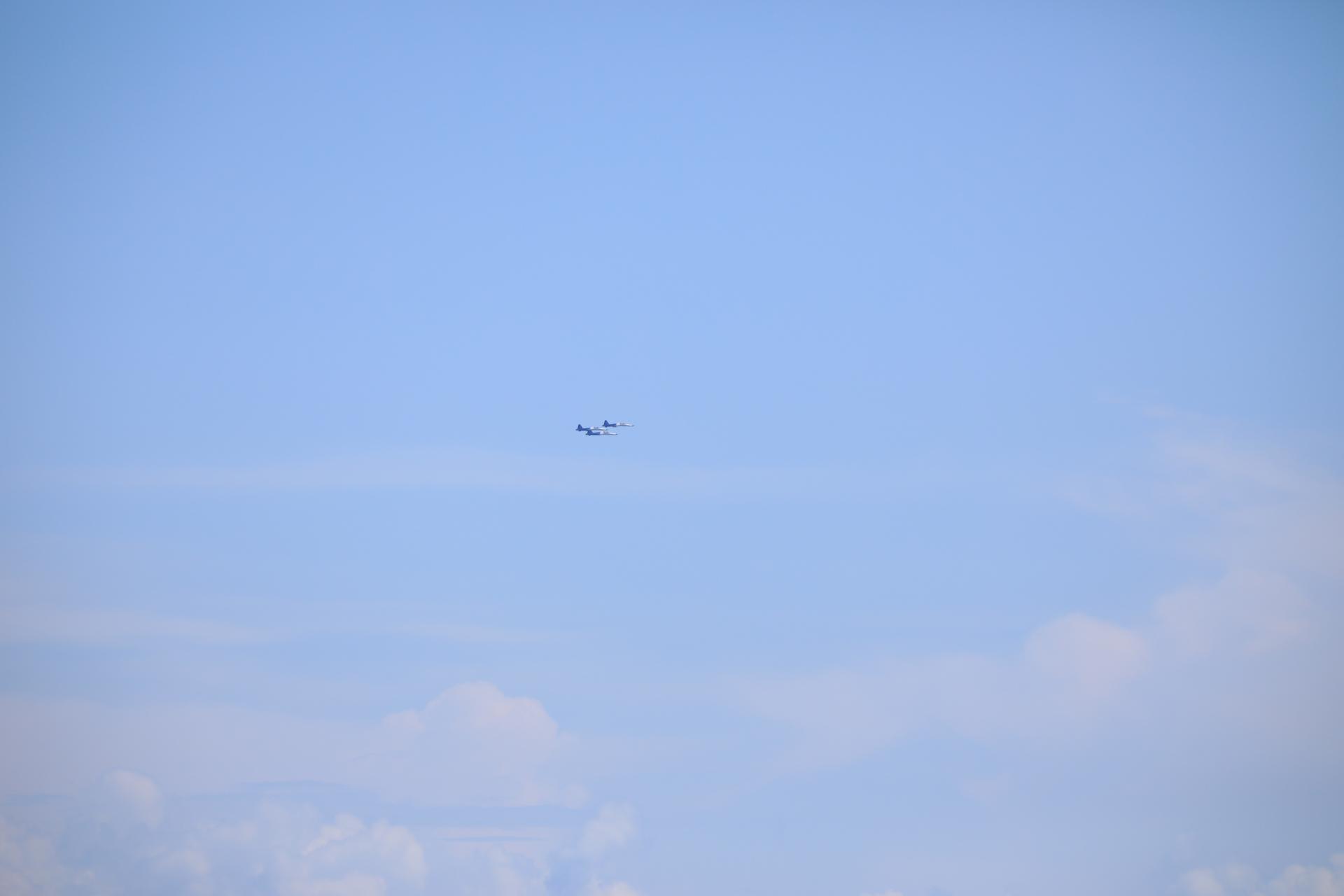
Roman Space Telescope Broadcast Isaacman Fly by 39A
NASA Administrator Jared Isaacman leads a flight of his personally owned F-5 Tiger II aircraft on a flyby of Launch Complex 39A where a SpaceX Falcon Heavy rocket…
Inspect NASA record
NASA Administrator Jared Isaacman leads a flight of his personally owned F-5 Tiger II aircraft on a flyby of Launch Complex 39A where a SpaceX Falcon Heavy rocket with the agency's Nancy Grace Roman Space Telescope, encapsulated in a protective payload fairing, is undergoing final launch preparations, Saturday, Aug. 29, 2026, at NASA's Kennedy Space Center in Florida. Roman will investigate dark energy and dark matter, conduct a statistical census of planetary systems, and enable a broad range of additional astrophysics research. Liftoff from Kennedy is targeted for no earlier than 7:26 a.m. EDT Sunday, Aug. 30.
- Record ID
- KSC-20260829-PH-RCR01_0101
- NASA center
- KSC
- Date
- 2026-08-29
- Credit
- NASA/Clayton Rougelot
- Keywords
- John. F. Kennedy Space Center, Kennedy, Kennedy Space Center, KSC, Spaceport, Cape Canaveral, NASA, rocket ranch, Florida, multi-user spaceport, premier spaceport, space coast
KSC · 2026-08-29 · KSC-20260829-PH-RCR01_0065
Roman Space Telescope Broadcast Isaacman Fly by 39A
NASA Administrator Jared Isaacman leads a flight of his personally owned F-5 Tiger II aircraft on a flyby of Launch Complex 39A where a SpaceX Falcon Heavy rocket…
Inspect NASA record
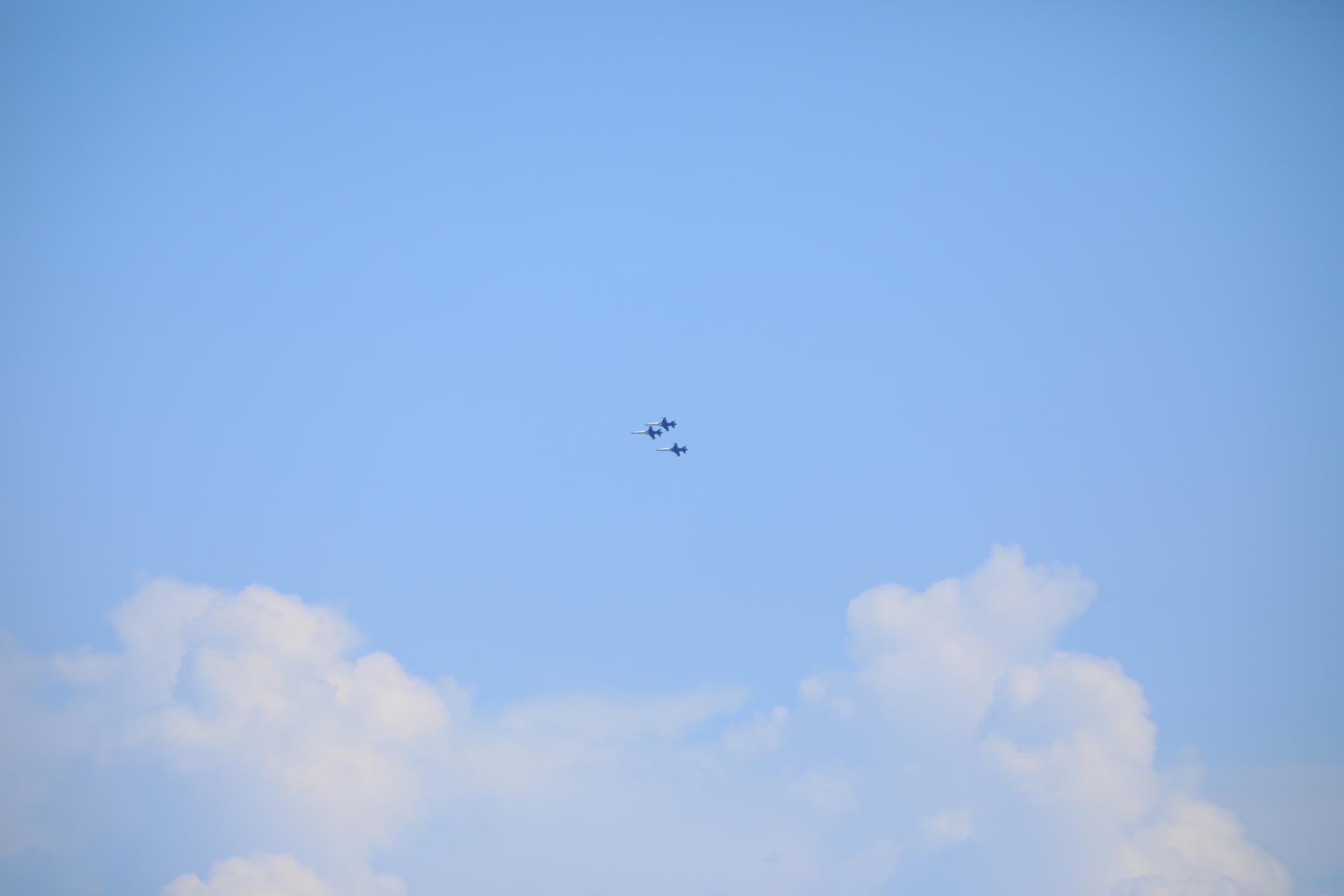
NASA Administrator Jared Isaacman leads a flight of his personally owned F-5 Tiger II aircraft on a flyby of Launch Complex 39A where a SpaceX Falcon Heavy rocket with the agency's Nancy Grace Roman Space Telescope, encapsulated in a protective payload fairing, is undergoing final launch preparations, Saturday, Aug. 29, 2026, at NASA's Kennedy Space Center in Florida. Roman will investigate dark energy and dark matter, conduct a statistical census of planetary systems, and enable a broad range of additional astrophysics research. Liftoff from Kennedy is targeted for no earlier than 7:26 a.m. EDT Sunday, Aug. 30.
- Record ID
- KSC-20260829-PH-RCR01_0065
- NASA center
- KSC
- Date
- 2026-08-29
- Credit
- NASA/Clayton Rougelot
- Keywords
- John. F. Kennedy Space Center, Kennedy, Kennedy Space Center, KSC, Spaceport, Cape Canaveral, NASA, rocket ranch, Florida, multi-user spaceport, premier spaceport, space coast
KSC · 2026-08-29 · KSC-20260829-PH-RCR01_0093
Roman Space Telescope Broadcast Isaacman Fly by 39A
NASA Administrator Jared Isaacman leads a flight of his personally owned F-5 Tiger II aircraft on a flyby of Launch Complex 39A where a SpaceX Falcon Heavy rocket…
Inspect NASA record
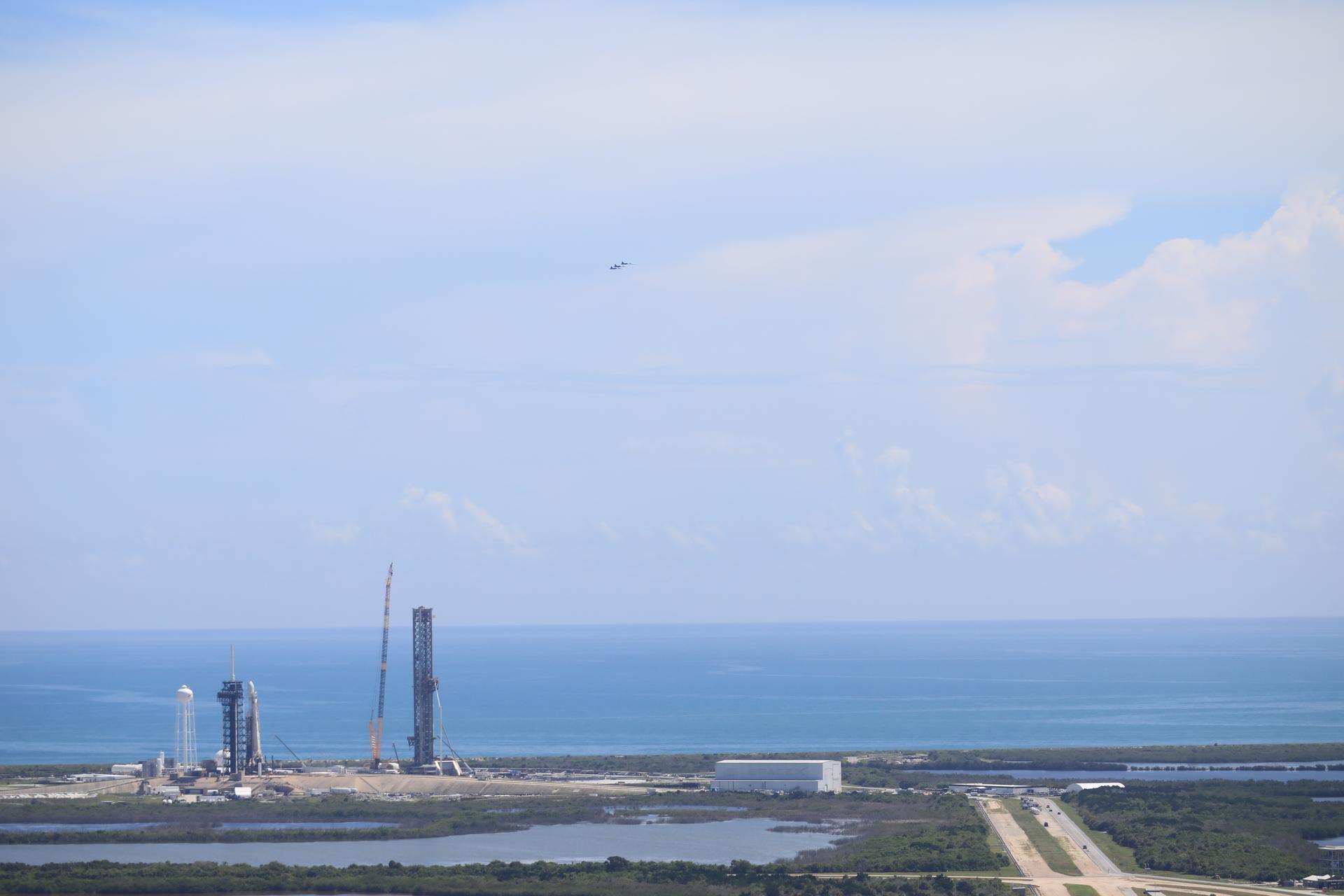
NASA Administrator Jared Isaacman leads a flight of his personally owned F-5 Tiger II aircraft on a flyby of Launch Complex 39A where a SpaceX Falcon Heavy rocket with the agency's Nancy Grace Roman Space Telescope, encapsulated in a protective payload fairing, is undergoing final launch preparations, Saturday, Aug. 29, 2026, at NASA's Kennedy Space Center in Florida. Roman will investigate dark energy and dark matter, conduct a statistical census of planetary systems, and enable a broad range of additional astrophysics research. Liftoff from Kennedy is targeted for no earlier than 7:26 a.m. EDT Sunday, Aug. 30.
- Record ID
- KSC-20260829-PH-RCR01_0093
- NASA center
- KSC
- Date
- 2026-08-29
- Credit
- NASA/Clayton Rougelot
- Keywords
- John. F. Kennedy Space Center, Kennedy, Kennedy Space Center, KSC, Spaceport, Cape Canaveral, NASA, rocket ranch, Florida, multi-user spaceport, premier spaceport, space coast
KSC · 2026-08-29 · KSC-20260829-PH-RCR01_0054
Roman Space Telescope Broadcast Isaacman Fly by 39A
NASA Administrator Jared Isaacman leads a flight of his personally owned F-5 Tiger II aircraft on a flyby of Launch Complex 39A where a SpaceX Falcon Heavy rocket…
Inspect NASA record
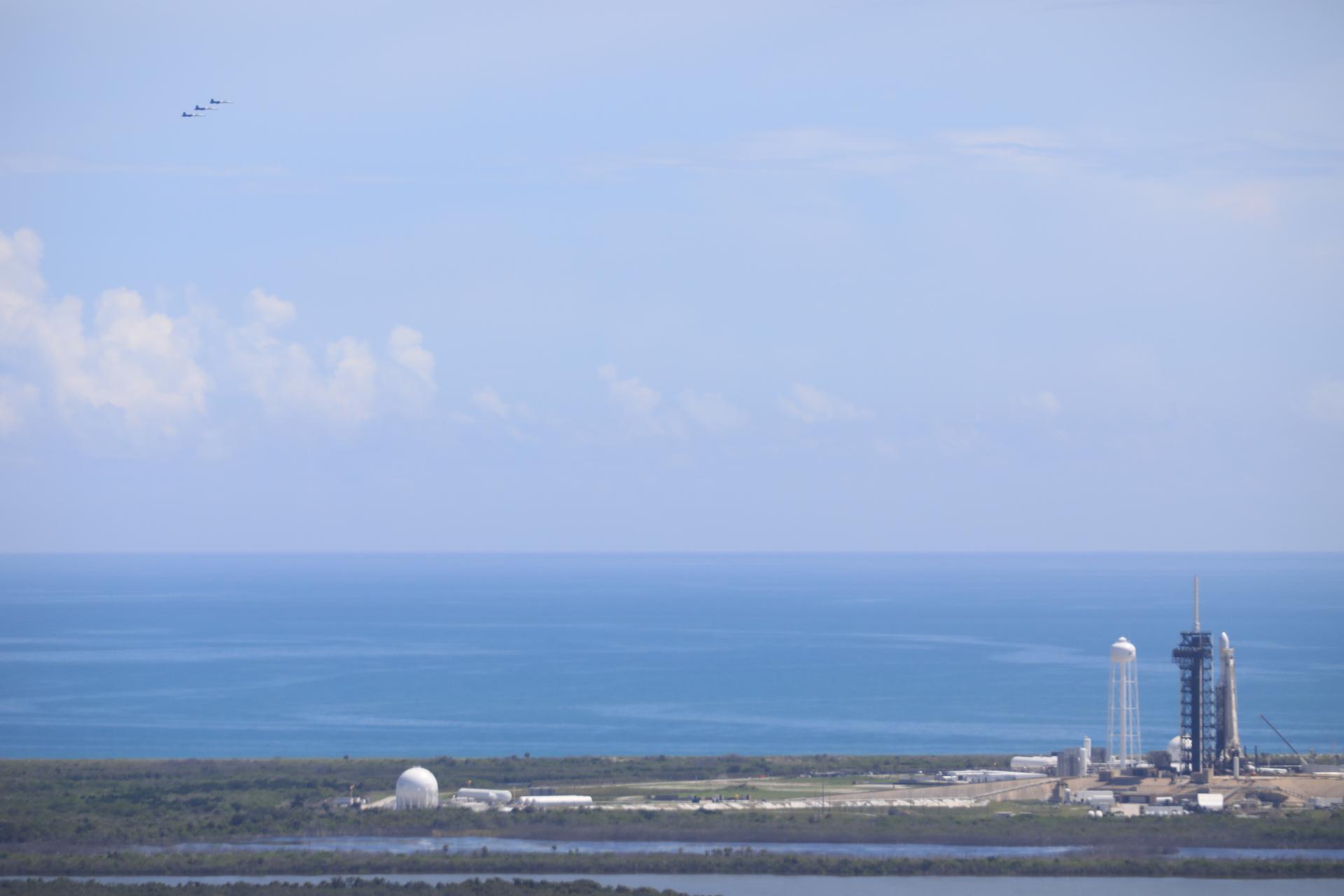
NASA Administrator Jared Isaacman leads a flight of his personally owned F-5 Tiger II aircraft on a flyby of Launch Complex 39A where a SpaceX Falcon Heavy rocket with the agency's Nancy Grace Roman Space Telescope, encapsulated in a protective payload fairing, is undergoing final launch preparations, Saturday, Aug. 29, 2026, at NASA's Kennedy Space Center in Florida. Roman will investigate dark energy and dark matter, conduct a statistical census of planetary systems, and enable a broad range of additional astrophysics research. Liftoff from Kennedy is targeted for no earlier than 7:26 a.m. EDT Sunday, Aug. 30.
- Record ID
- KSC-20260829-PH-RCR01_0054
- NASA center
- KSC
- Date
- 2026-08-29
- Credit
- NASA/Clayton Rougelot
- Keywords
- John. F. Kennedy Space Center, Kennedy, Kennedy Space Center, KSC, Spaceport, Cape Canaveral, NASA, rocket ranch, Florida, multi-user spaceport, premier spaceport, space coast
KSC · 2026-08-29 · KSC-20260829-PH-RCR01_0025
Roman Space Telescope Broadcast Isaacman Fly by 39A
NASA Administrator Jared Isaacman leads a flight of his personally owned F-5 Tiger II aircraft on a flyby of Launch Complex 39A where a SpaceX Falcon Heavy rocket…
Inspect NASA record
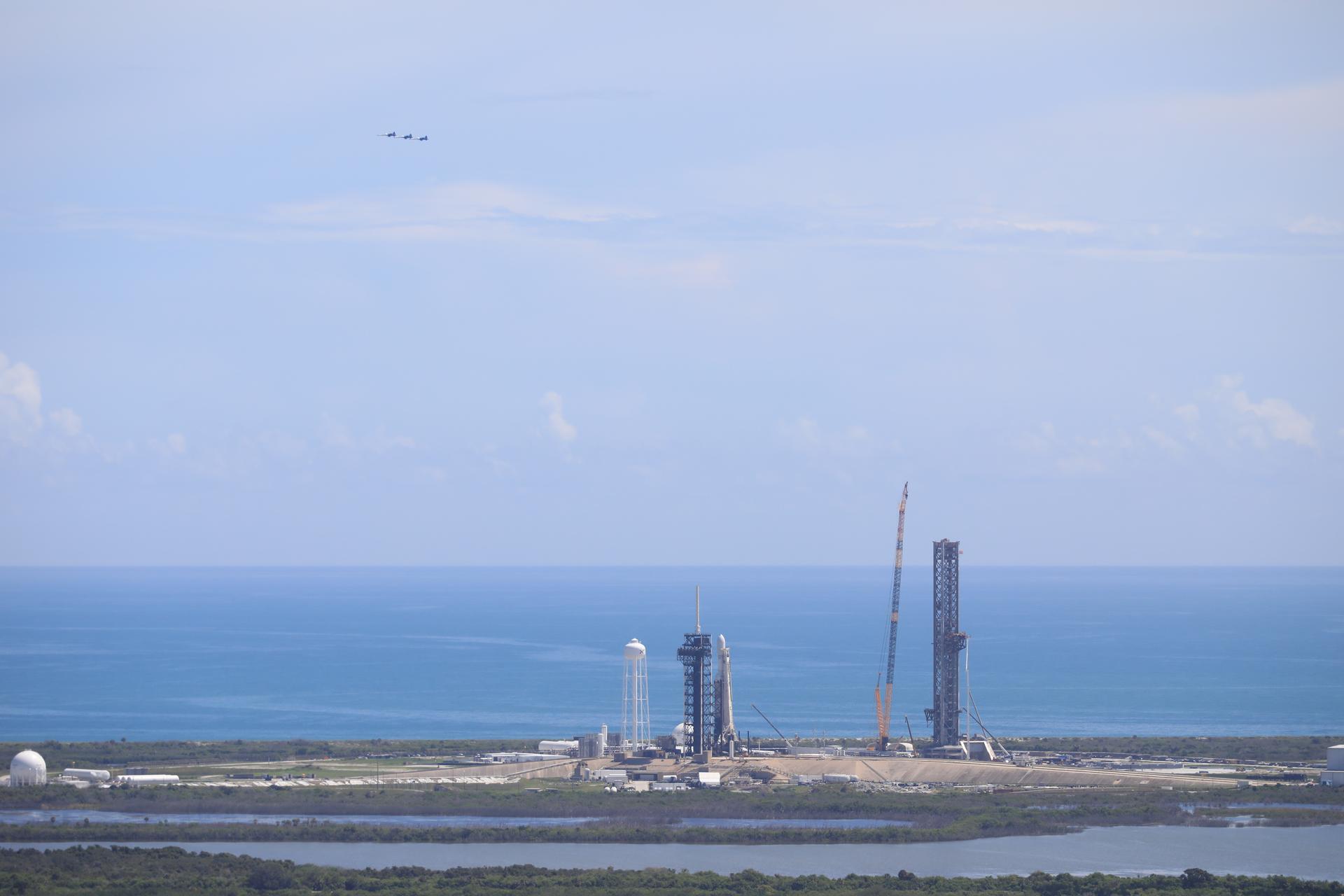
NASA Administrator Jared Isaacman leads a flight of his personally owned F-5 Tiger II aircraft on a flyby of Launch Complex 39A where a SpaceX Falcon Heavy rocket with the agency's Nancy Grace Roman Space Telescope, encapsulated in a protective payload fairing, is undergoing final launch preparations, Saturday, Aug. 29, 2026, at NASA's Kennedy Space Center in Florida. Roman will investigate dark energy and dark matter, conduct a statistical census of planetary systems, and enable a broad range of additional astrophysics research. Liftoff from Kennedy is targeted for no earlier than 7:26 a.m. EDT Sunday, Aug. 30.
- Record ID
- KSC-20260829-PH-RCR01_0025
- NASA center
- KSC
- Date
- 2026-08-29
- Credit
- NASA/Clayton Rougelot
- Keywords
- John. F. Kennedy Space Center, Kennedy, Kennedy Space Center, KSC, Spaceport, Cape Canaveral, NASA, rocket ranch, Florida, multi-user spaceport, premier spaceport, space coast
JPL · 2019-04-25 · PIA23122
Spitzer Captures Messier 87
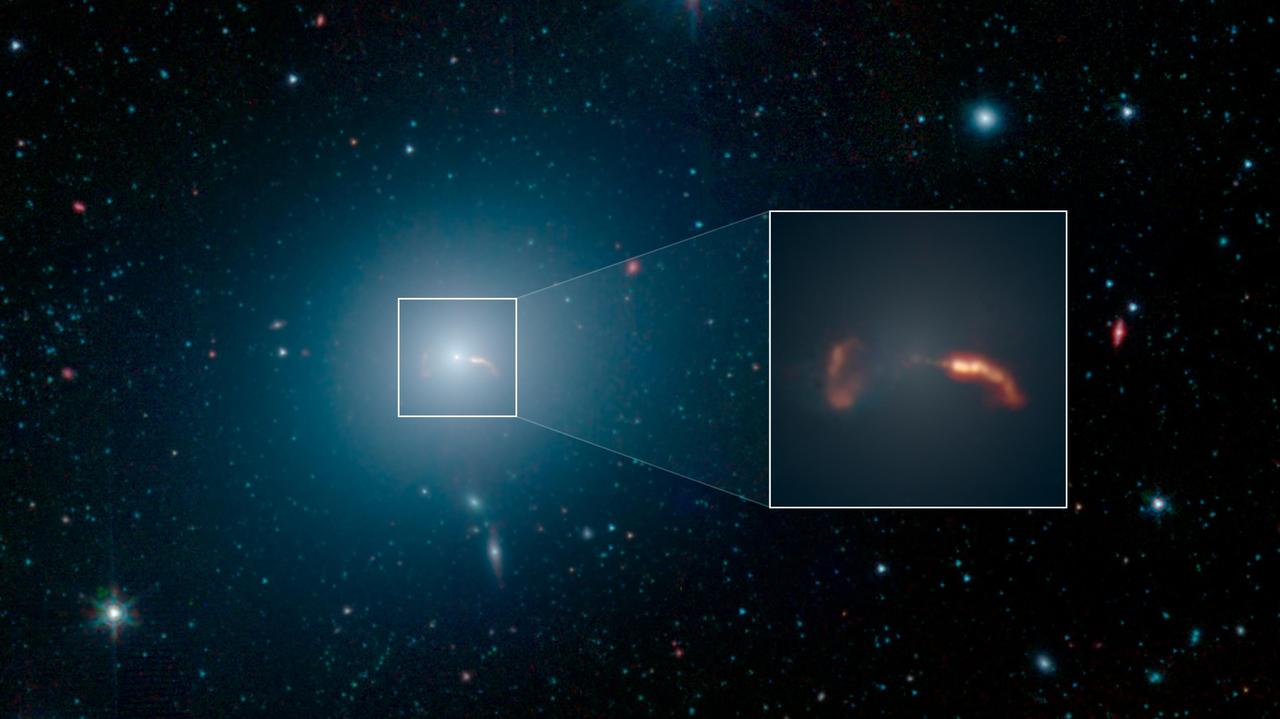
This image from NASA's Spitzer Space Telescope shows the elliptical galaxy Messier 87 (M87), the home galaxy of the supermassive black hole recently imaged by the Event Horizon…
Inspect NASA record
This image from NASA's Spitzer Space Telescope shows the elliptical galaxy Messier 87 (M87), the home galaxy of the supermassive black hole recently imaged by the Event Horizon Telescope (EHT). Spitzer's infrared view shows a faint trace of a jet of material spewing to the right of the galaxy - a feature that was previously one key indicator that a supermassive black hole lived at the galaxy's center. More prominent in the image is the shockwave created by that jet. The inset in the image below shows a close-up view of the shockwave on the right side of the galaxy, as well as the shockwave from a second jet traveling to the left of the galaxy. Located about 55 million light-years from Earth, M87 has been a subject of astronomical study for more than 100 years and has been imaged by many NASA observatories, including the Hubble Space Telescope, the Chandra X-ray Observatory and NuSTAR. In 1918, astronomer Heber Curtis first noticed "a curious straight ray" extending from the galaxy's center. This bright jet (which appears to extend to the right of the galaxy) is visible in multiple wavelengths of light, from radio waves through X-rays. The jet is produced by a disk of material spinning rapidly around the black hole, and spewing in opposite directions away from the galaxy. When the particles in the jet impact the interstellar medium (the sparse material filling the space between stars in M87), they create a shockwave that radiates in infrared and radio wavelengths of light, but not visible light. The jet on the right is traveling almost directly toward Earth, and its brightness is amplified due to its high speed in our direction. But the jet's trajectory is just slightly offset from our line of sight with the galaxy, so we can still see some of the length of the jet. The shockwave begins around the point where the jet appears to curve down, highlighting the regions where the fast-moving particles are colliding with gas in the galaxy and slowing down. There is also a second jet on the left that is moving so rapidly away from us it is rendered invisible at all wavelengths. But the shockwave it creates in the interstellar medium can still be seen here. In the Spitzer image, the shockwave is on the left side of the galaxy and looks like an inverted letter "C." Scientists are still striving for a solid theoretical understanding of how inflowing gas around black holes creates outflowing jets. Infrared light at wavelengths of 3.6 and 4.5 microns are rendered in blue and green, showing the distribution of stars, while dust features that glow brightly at 8.0 microns are shown in red. The image was taken during Spitzer's initial "cold" mission. https://photojournal.jpl.nasa.gov/catalog/PIA23122
- Record ID
- PIA23122
- NASA center
- JPL
- Date
- 2019-04-25
- Credit
- NASA/JPL-Caltech/IPAC/Event Horizon Telescope Collaboration
- Keywords
- Spitzer Space Telescope, Messier 87
JSC · 2002-03-09 · sts109-331-010
Deployed view of the Hubble Space Telescope
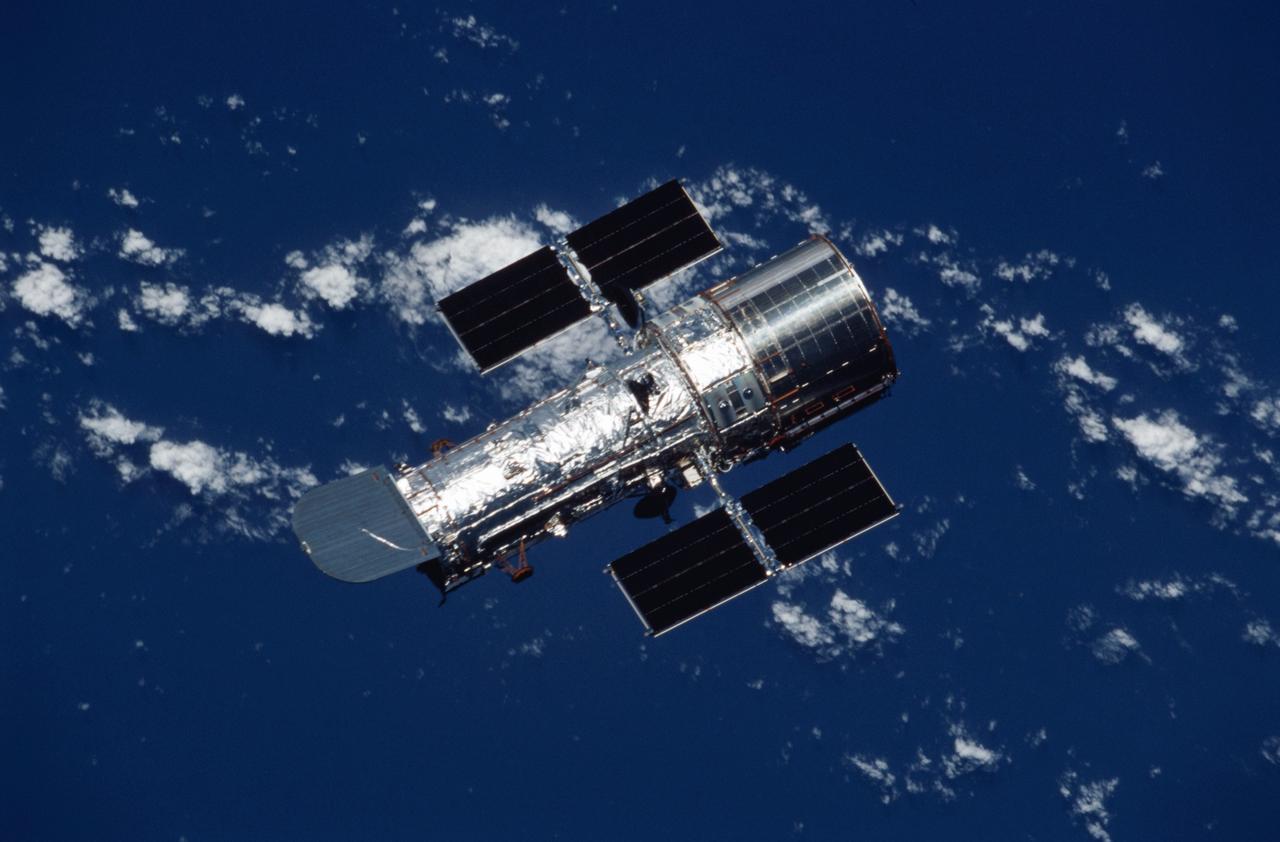
STS109-331-010 (9 March 2002) --- The Hubble Space Telescope (HST) heads back toward its normal routine, after a week of servicing and upgrading by the STS-109 astronaut crew…
Inspect NASA record
STS109-331-010 (9 March 2002) --- The Hubble Space Telescope (HST) heads back toward its normal routine, after a week of servicing and upgrading by the STS-109 astronaut crew on board the Space Shuttle Columbia.
- Record ID
- sts109-331-010
- NASA center
- JSC
- Date
- 2002-03-09
JSC · 2002-03-09 · sts109-331-005
Deployed view of the Hubble Space Telescope
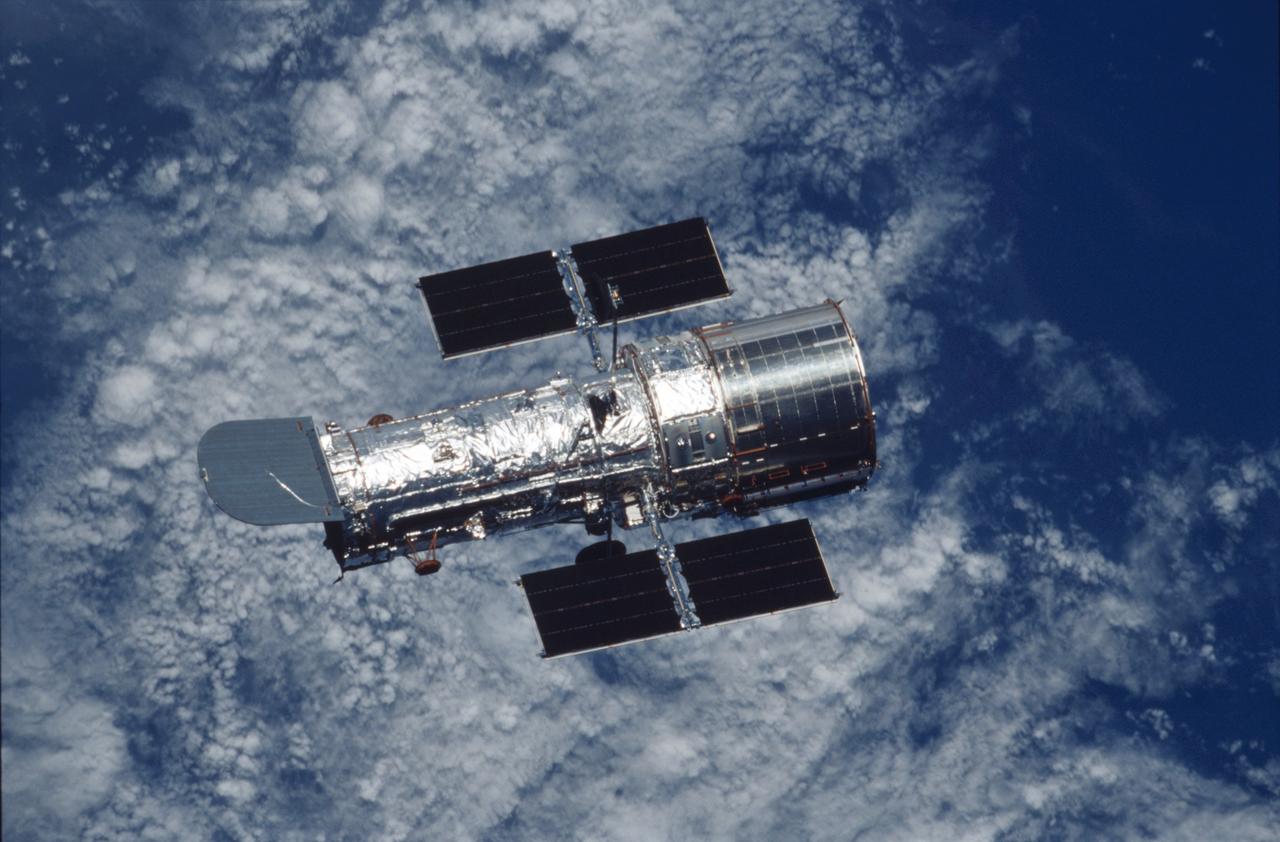
STS109-331-005 (9 March 2002) --- The Hubble Space Telescope (HST) heads back toward its normal routine, after a week of servicing and upgrading by the STS-109 astronaut crew…
Inspect NASA record
STS109-331-005 (9 March 2002) --- The Hubble Space Telescope (HST) heads back toward its normal routine, after a week of servicing and upgrading by the STS-109 astronaut crew on board the Space Shuttle Columbia.
- Record ID
- sts109-331-005
- NASA center
- JSC
- Date
- 2002-03-09
JPL · 2013-09-27 · PIA17466
Comparing Vesta Topography
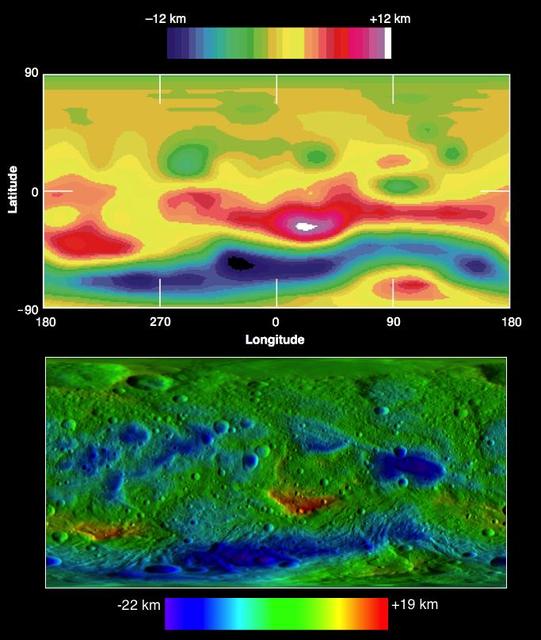
These two images compare topographic maps of the giant asteroid Vesta as discerned by NASA Hubble Space Telescope top and as seen by NASA Dawn spacecraft bottom. Hubble…
Inspect NASA record
These two images compare topographic maps of the giant asteroid Vesta as discerned by NASA Hubble Space Telescope top and as seen by NASA Dawn spacecraft bottom. Hubble has been in an orbit around Earth, while Dawn orbited Vesta from 2011 to 2012.
- Record ID
- PIA17466
- NASA center
- JPL
- Date
- 2013-09-27
- Credit
- NASA/ESA/Cornell and NASA/JPL-Caltech/UCLA/MPS/DLR/IDA
- Keywords
- Vesta, Dawn,Hubble Space Telescope