
Update Site (from NASA)
Explore NASA’s Image and Video Library.
Suggest one object per day for the Interstellar Minds collection. We review each suggestion before adding it.
Sign in to suggest a Marvel.
Find a NASA image ID. Open a NASA record and copy its ID from the end of the details URL.
NASA image records

HQ · 2026-08-30 · NHQ202608300058
Nancy Grace Roman Space Telescope Launch
Theresa Trzupek, a mission assurance engineer at NASA’s Kennedy Space Center, left, confers with Bobby Hughes, a safety and mission assurance engineer and NASA’s Kennedy Space Center, center,…
Inspect NASA record
Theresa Trzupek, a mission assurance engineer at NASA’s Kennedy Space Center, left, confers with Bobby Hughes, a safety and mission assurance engineer and NASA’s Kennedy Space Center, center, and Casey Quinn, a safety and mission assurance engineer at NASA’s Kennedy Space Center, right, as they monitor the countdown inside Hangar AE at Cape Canaveral Space Force Station for the launch of a SpaceX Falcon Heavy rocket with NASA’S Nancy Grace Roman Space Telescope from Launch Complex 39A at NASA’s Kennedy Space Center, Sunday, Aug. 30, 2026, in Florida. Roman will investigate dark energy and dark matter, conduct a statistical census of planetary systems, and enable a broad range of additional astrophysics research. Launch occurred at 7:26 a.m. EDT. Photo Credit (NASA/Joel Kowsky)
- Record ID
- NHQ202608300058
- NASA center
- HQ
- Date
- 2026-08-30
- Credit
- NASA/Joel Kowsky
- Keywords
- Bobby Hughes, Cape Canaveral Space Force Station (CCSFS), Casey Quinn, Falcon Heavy, Florida, Hangar AE, Kennedy Space Center, Launch Complex 39A, Nancy Grace Roman Space Telescope, SpaceX, Theresa Trzupek
MSFC · 1993-12-04 · 9400254
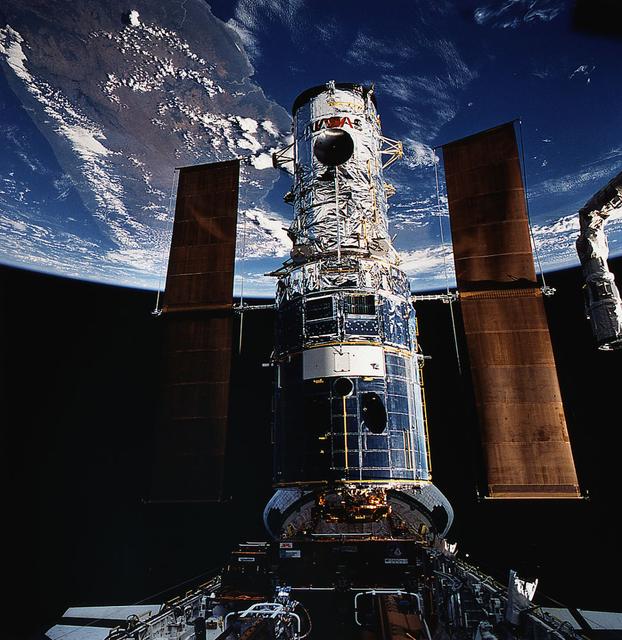
History of Hubble Space Telescope (HST)
The Hubble Space Telescope (HST), backdropped over Madagascar, is berthed in Endeavour's cargo bay following its capture for repair by the STS-61 astronauts.
Inspect NASA record
The Hubble Space Telescope (HST), backdropped over Madagascar, is berthed in Endeavour's cargo bay following its capture for repair by the STS-61 astronauts.
- Record ID
- 9400254
- NASA center
- MSFC
- Date
- 1993-12-04
- Keywords
- Around Marshall, STS Missions, STS-61 HST in cargo bay
JPL · 2026-01-26 · PIA26703
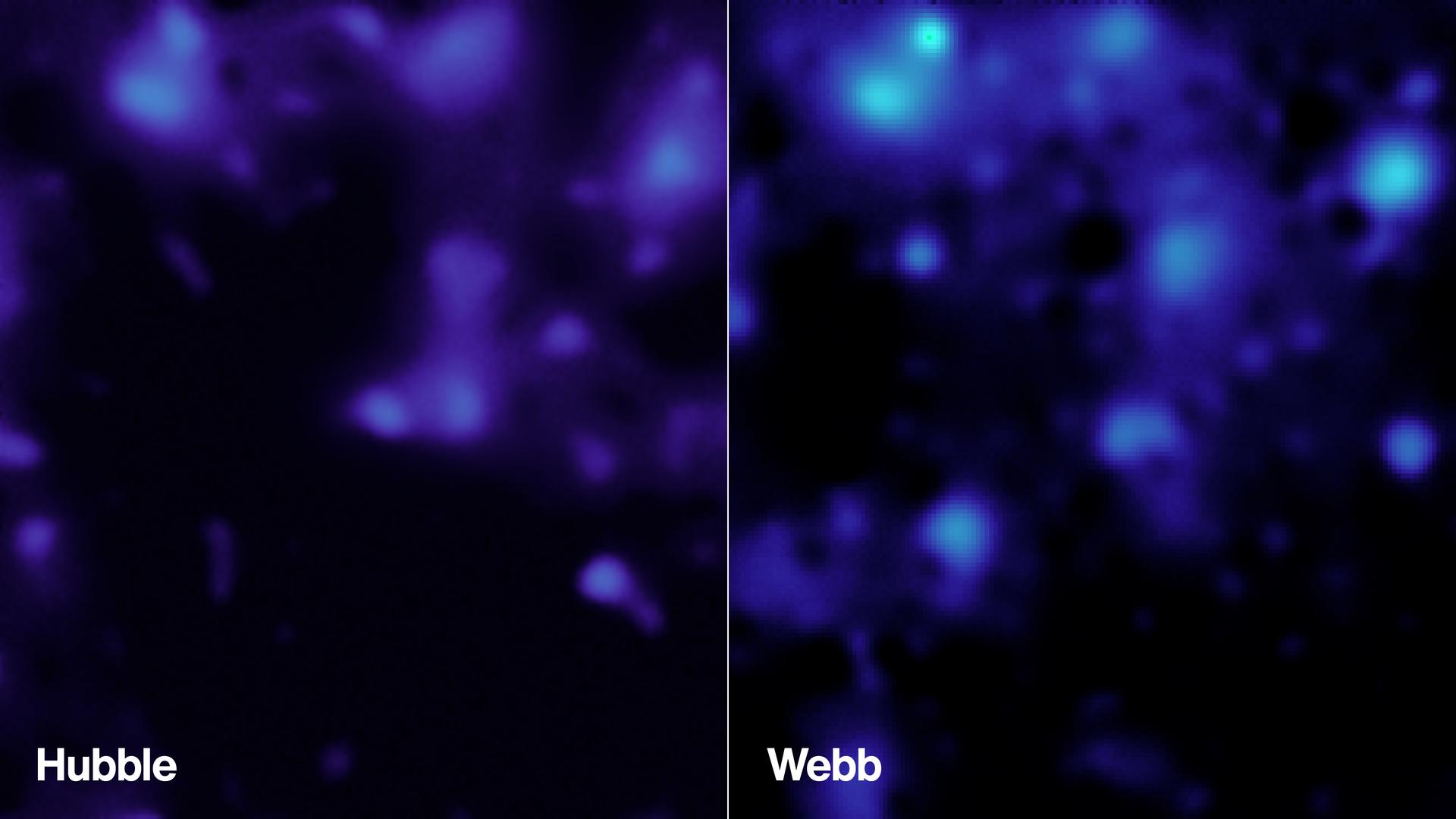
Dark Matter Revealed in Webb, Hubble Observations
These images show the presence of dark matter in the same region of sky, created using data from NASA’s Webb telescope in 2026 (right) and from the Hubble…
Inspect NASA record
These images show the presence of dark matter in the same region of sky, created using data from NASA’s Webb telescope in 2026 (right) and from the Hubble Space Telescope in 2007 (left). Webb’s higher resolution is providing new insights into how this invisible component influences the distribution of ordinary matter in the universe. The James Webb Space Telescope is solving mysteries in our solar system, looking beyond to distant worlds around other stars, and probing the mysterious structures and origins of our universe and our place in it. Webb is an international program led by NASA with its partners, ESA (European Space Agency) and CSA (Canadian Space Agency). Webb’s MIRI was developed through a 50-50 partnership between NASA and ESA. A division of Caltech in Pasadena, California, JPL led the U.S. contribution to MIRI. JPL also led development of MIRI’s cryocooler, done in collaboration with Northrop Grumman in Redondo Beach, California, and NASA’s Goddard Space Flight Center in Greenbelt, Maryland. To learn more about Webb, visit: https://science.nasa.gov/webb
- Record ID
- PIA26703
- NASA center
- JPL
- Date
- 2026-01-26
- Credit
- NASA/STScI/A. Pagan
- Keywords
- Webb, Dark Matter, James Webb Space Telescope
JSC · 2002-03-03 · s109e5141
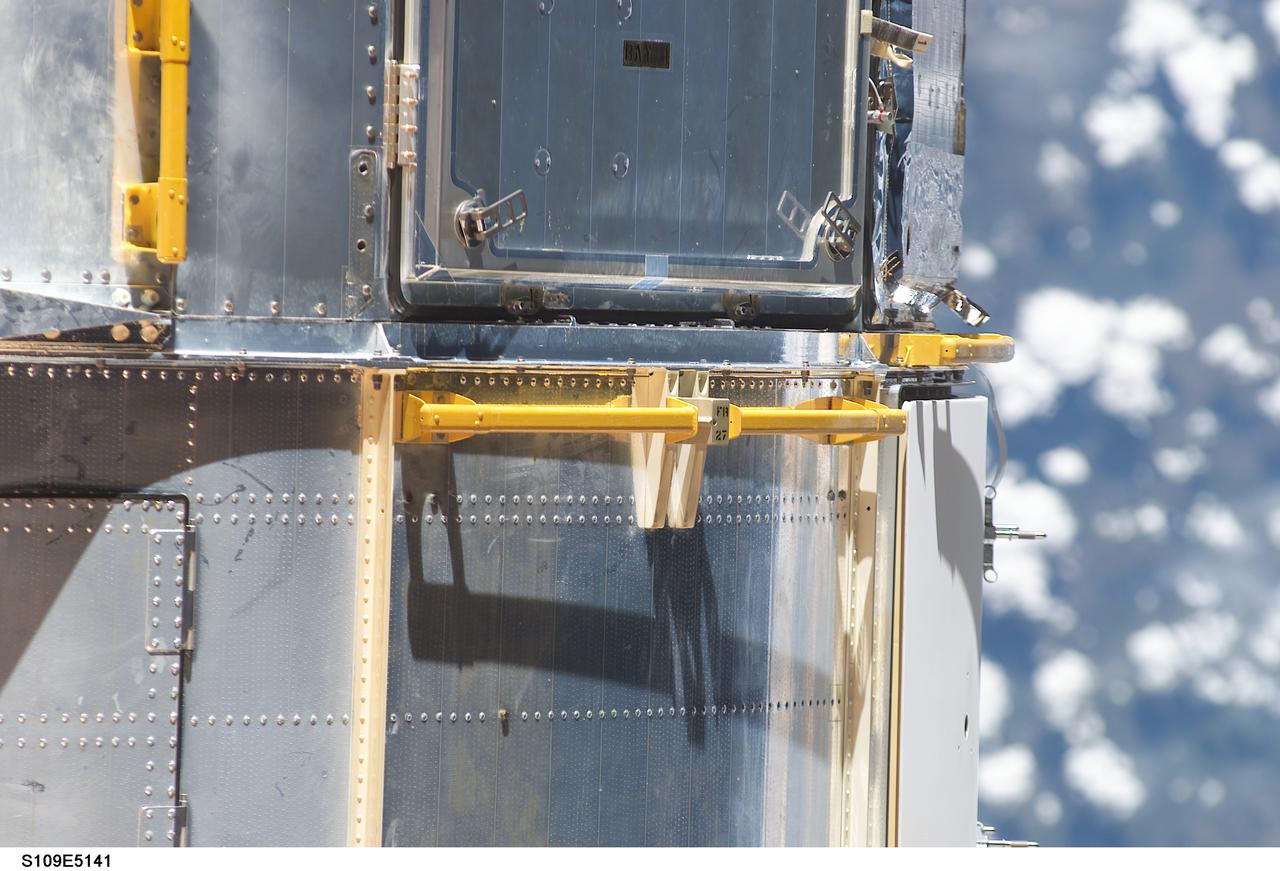
-V2 plane of the Hubble Space Telescope
STS109-E-5141 (3 March 2002) --- Astronauts will find these handrails on the Hubble Space Telescope very helpful during a series of scheduled space walks throughout the coming week.…
Inspect NASA record
STS109-E-5141 (3 March 2002) --- Astronauts will find these handrails on the Hubble Space Telescope very helpful during a series of scheduled space walks throughout the coming week. STS-109 crew members used a digital still camera, as well as other cameras, to survey and document various areas on the giant telescope. This mission marks the fourth shuttle visit to the Hubble since its deployment in April of 1990.
- Record ID
- s109e5141
- NASA center
- JSC
- Date
- 2002-03-03

JSC · 2002-03-03 · s109e5048
-V3 view of Hubble Space Telescope
STS109-E-5048 (3 March 2002) --- The top portion of the Hubble Space Telescope is photographed some 350 miles above the Pacific Ocean Southwest of Mexico, as the Space…
Inspect NASA record
STS109-E-5048 (3 March 2002) --- The top portion of the Hubble Space Telescope is photographed some 350 miles above the Pacific Ocean Southwest of Mexico, as the Space Shuttle Columbia is about to use its 50-foot-long robotic arm to lower the telescope into its cargo bay. The image was one of a series recorded with a digital still camera.
- Record ID
- s109e5048
- NASA center
- JSC
- Date
- 2002-03-03

JPL · 2014-04-04 · PIA18164
Iridescent Glory of Nearby Helix Nebula
This composite picture is a seamless blend of ultra-sharp NASA Hubble Space Telescope (HST) images combined with the wide view of the Mosaic Camera on the National Science…
Inspect NASA record
This composite picture is a seamless blend of ultra-sharp NASA Hubble Space Telescope (HST) images combined with the wide view of the Mosaic Camera on the National Science Foundation's 0.9-meter telescope at Kitt Peak National Observatory, part of the National Optical Astronomy Observatory, near Tucson, Ariz. Astronomers at the Space Telescope Science Institute assembled these images into a mosaic. The mosaic was then blended with a wider photograph taken by the Mosaic Camera. The image shows a fine web of filamentary "bicycle-spoke" features embedded in the colorful red and blue gas ring, which is one of the nearest planetary nebulae to Earth. Because the nebula is nearby, it appears as nearly one-half the diameter of the full Moon. This required HST astronomers to take several exposures with the Advanced Camera for Surveys to capture most of the Helix. HST views were then blended with a wider photo taken by the Mosaic Camera. The portrait offers a dizzying look down what is actually a trillion-mile-long tunnel of glowing gases. The fluorescing tube is pointed nearly directly at Earth, so it looks more like a bubble than a cylinder. A forest of thousands of comet-like filaments, embedded along the inner rim of the nebula, points back toward the central star, which is a small, super-hot white dwarf. The tentacles formed when a hot "stellar wind" of gas plowed into colder shells of dust and gas ejected previously by the doomed star. Ground-based telescopes have seen these comet-like filaments for decades, but never before in such detail. The filaments may actually lie in a disk encircling the hot star, like a collar. The radiant tie-die colors correspond to glowing oxygen (blue) and hydrogen and nitrogen (red). Valuable Hubble observing time became available during the November 2002 Leonid meteor storm. To protect the spacecraft, including HST's precise mirror, controllers turned the aft end into the direction of the meteor stream for about half a day. Fortunately, the Helix Nebula was almost exactly in the opposite direction of the meteor stream, so Hubble used nine orbits to photograph the nebula while it waited out the storm. To capture the sprawling nebula, Hubble had to take nine separate snapshots. Planetary nebulae like the Helix are sculpted late in a Sun-like star's life by a torrential gush of gases escaping from the dying star. They have nothing to do with planet formation, but got their name because they look like planetary disks when viewed through a small telescope. With higher magnification, the classic "donut-hole" in the middle of a planetary nebula can be resolved. Based on the nebula's distance of 650 light-years, its angular size corresponds to a huge ring with a diameter of nearly 3 light-years. That's approximately three-quarters of the distance between our Sun and the nearest star. The Helix Nebula is a popular target of amateur astronomers and can be seen with binoculars as a ghostly, greenish cloud in the constellation Aquarius. Larger amateur telescopes can resolve the ring-shaped nebula, but only the largest ground-based telescopes can resolve the radial streaks. After careful analysis, astronomers concluded the nebula really isn't a bubble, but is a cylinder that happens to be pointed toward Earth. http://photojournal.jpl.nasa.gov/catalog/PIA18164
- Record ID
- PIA18164
- NASA center
- JPL
- Date
- 2014-04-04
- Credit
- NASA/STScI
- Keywords
- Helix Hebula, Hubble Space Telescope

GSFC · 2017-12-08 · GSFC_20171208_Archive_e001899
NASA's Next Generation Space Telescope Marks Key Milestone
NASA image release April 14, 2011 NASA engineer Ernie Wright looks on as the first six flight ready James Webb Space Telescope's primary mirror segments are prepped to…
Inspect NASA record
NASA image release April 14, 2011 NASA engineer Ernie Wright looks on as the first six flight ready James Webb Space Telescope's primary mirror segments are prepped to begin final cryogenic testing at NASA's Marshall Space Flight Center in Huntsville, Ala. Credit: NASA/MSFC/David Higginbotham To read more go to: www.nasa.gov/centers/marshall/news/jwst/11-111.html NASA Goddard Space Flight Center enables NASA’s mission through four scientific endeavors: Earth Science, Heliophysics, Solar System Exploration, and Astrophysics. Goddard plays a leading role in NASA’s accomplishments by contributing compelling scientific knowledge to advance the Agency’s mission. Follow us on Twitter Join us on Facebook
- Record ID
- GSFC_20171208_Archive_e001899
- NASA center
- GSFC
- Date
- 2017-12-08
- Keywords
- NASA's Next Generation Space Telescope Marks Key Milestone, space, nasa, jwst, spacetelescope, goddardspaceflightcenter, webbtelescope
JPL · 2004-12-09 · PIA07098
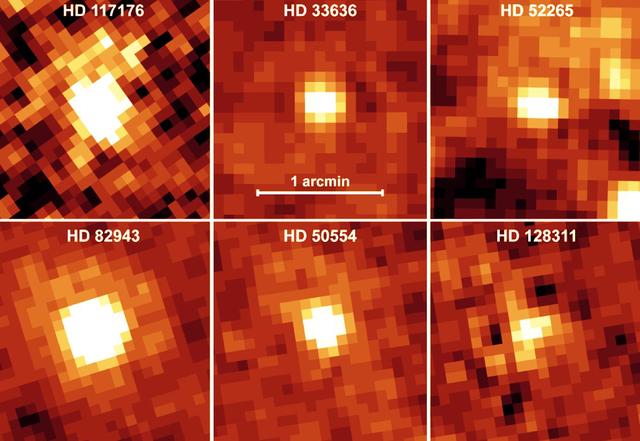
Is There Anybody Home?
NASA's Spitzer Space Telescope recently captured these infrared images of six older stars with known planets. The yellow, fuzzy blobs are stars circled by disks of dust, or…
Inspect NASA record
NASA's Spitzer Space Telescope recently captured these infrared images of six older stars with known planets. The yellow, fuzzy blobs are stars circled by disks of dust, or "debris disks," like the one that surrounds our own Sun. Though astronomers had predicted that stars with planets would harbor debris disks, they could not detect such disks until now. Spitzer was able to sense these dusty disks via their warm infrared glows. Specifically, the presence of the disks was inferred from an excess amount of infrared emission relative to what is emitted from the parent star alone. The stars themselves are similar in age and temperature to our Sun. In astronomical terms, they are stellar main sequence stars, with spectral types of F, G, or K. These planet-bearing stars have a median age of four billion years. For reference, our Sun is classified as a G star, with an age of approximately five billion years. The disks surrounding these planetary systems are comprised of cool material, with temperatures less than 100 Kelvin (-173 degrees Celsius). They are10 times farther away from their parent stars than Earth is from the Sun, and are thought to be analogues of the comet-filled Kuiper Belt in our solar system. The contrast scale is the same for each image. The images are approximately 2 arcminutes on each side. North is oriented upward and east is to the left. The pictures were taken with the 70-micron filter of Spitzer's multiband imaging photometer. The telescope resolution at 70 microns is 17 arcseconds and there is no evidence for any emission extended beyond the telescope resolution. http://photojournal.jpl.nasa.gov/catalog/PIA07098
- Record ID
- PIA07098
- NASA center
- JPL
- Date
- 2004-12-09
- Credit
- NASA/JPL-Caltech
- Keywords
- Spitzer Space Telescope

KSC · 2026-08-29 · KSC-20260829-PH-KLS02_0082
Roman Space Telescope Prelaunch News Conference
Justin McReynolds, launch weather officer, 45th Weather Squadron, U.S. Space Force, participates in a prelaunch news conference for the agency’s Nancy Grace Roman Space Telescope inside the NASA…
Inspect NASA record
Justin McReynolds, launch weather officer, 45th Weather Squadron, U.S. Space Force, participates in a prelaunch news conference for the agency’s Nancy Grace Roman Space Telescope inside the NASA News Center’s John Holliman Auditorium at Kennedy Space Center in Florida, on Saturday, Aug. 29, 2026. Roman will investigate dark energy and dark matter, conduct a statistical census of planetary systems, and enable a broad range of additional astrophysics research. Liftoff from Launch Complex 39A at Kennedy is targeted for no earlier than Sunday, Aug. 30, 2026.
- Record ID
- KSC-20260829-PH-KLS02_0082
- NASA center
- KSC
- Date
- 2026-08-29
- Credit
- NASA/Kim Shiflett
- Keywords
- John. F. Kennedy Space Center, Kennedy, Kennedy Space Center, KSC, Spaceport, Cape Canaveral, NASA, rocket ranch, Florida, multi-user spaceport, premier spaceport, space coast

KSC · 2026-08-29 · KSC-20260829-PH-KLS02_0050
Roman Space Telescope Prelaunch News Conference
From left, Denton Gibson, launch director, NASA’s Launch Services Program, Kennedy Space Center in Florida, and Julianna Scheiman, director, NASA Science and Dragon Programs, SpaceX, participate in a…
Inspect NASA record
From left, Denton Gibson, launch director, NASA’s Launch Services Program, Kennedy Space Center in Florida, and Julianna Scheiman, director, NASA Science and Dragon Programs, SpaceX, participate in a prelaunch news conference for NASA’s Nancy Grace Roman Space Telescope inside the NASA News Center’s John Holliman Auditorium at Kennedy Space Center in Florida, on Saturday, Aug. 29, 2026. Roman will investigate dark energy and dark matter, conduct a statistical census of planetary systems, and enable a broad range of additional astrophysics research. Liftoff from Launch Complex 39A at Kennedy is targeted for no earlier than Sunday, Aug. 30, 2026.
- Record ID
- KSC-20260829-PH-KLS02_0050
- NASA center
- KSC
- Date
- 2026-08-29
- Credit
- NASA/Kim Shiflett
- Keywords
- John. F. Kennedy Space Center, Kennedy, Kennedy Space Center, KSC, Spaceport, Cape Canaveral, NASA, rocket ranch, Florida, multi-user spaceport, premier spaceport, space coast
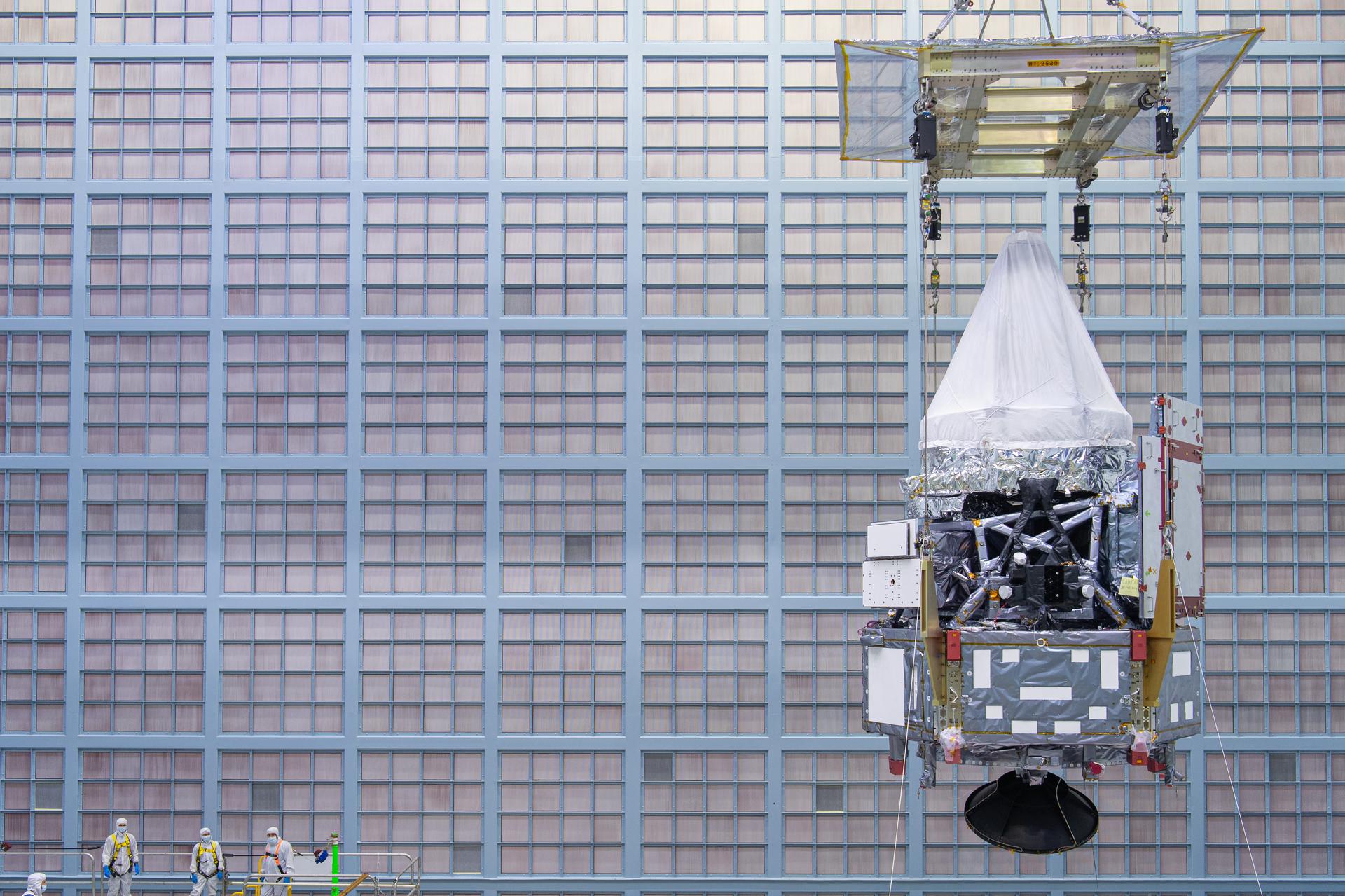
GSFC · 2025-06-12 · GSFC_20250612_RST_034435
GSFC_20250612_RST_034435
The Roman Space Telescope's Spacecraft Bus and Integrated Payload Assembly is crane lifted inside the cleanroom at Goddard Space Flight Center, Greenbelt Md., June 12, 2025. This photo…
Inspect NASA record
The Roman Space Telescope's Spacecraft Bus and Integrated Payload Assembly is crane lifted inside the cleanroom at Goddard Space Flight Center, Greenbelt Md., June 12, 2025. This photo has been approved for public release. NASA/Mike Guinto
- Record ID
- GSFC_20250612_RST_034435
- NASA center
- GSFC
- Date
- 2025-06-12
- Credit
- Michael Guinto
- Keywords
- roman space telescope, filter wall, crane lift, rst

JPL · 2019-06-26 · PIA23128
A Whirlpool 'Warhol' Shows Galaxy in Different Light
These four panels show the Whirlpool galaxy — which is actually a pair of galaxies also known as Messier 51 and NGC 5194/5195 — and how different wavelengths…
Inspect NASA record
These four panels show the Whirlpool galaxy — which is actually a pair of galaxies also known as Messier 51 and NGC 5194/5195 — and how different wavelengths of light can reveal different features of a cosmic object. Located approximately 23 million light-years away, it resides in the constellation Canes Venatici. The left image (a) shows the galaxy in visible light, from the Kitt Peak National Observatory 2.1-meter (6.8-foot) telescope and shows light at 0.4 microns (blue) and 0.7 microns (green). The next image (b) combines two visible-light wavelengths (in blue and green) and infrared light (in red). The infrared was captured by NASA's Spitzer Space Telescope and emphasizes how the dark dust veins that block our view in visible light begin to light up at these longer, infrared wavelengths. The right two panels are composed entirely of Spitzer data. In the middle-right panel (c), we see three wavelengths of infrared light: 3.6 microns (shown in blue), 4.5 microns (green) and 8 microns (red). The blended light from the billions of stars in the Whirlpool is brightest at the shorter infrared wavelengths and appear as as a blue haze. The individual blue dots across the image are mostly nearby stars and a few distant galaxies. Red features (at 8 microns) show us dust composed mostly of carbon that is illuminated by the stars in the galaxy. The far-right panel (d) expands our infrared view to include light at a wavelength of 24 microns (in red), which is particularly good for highlighting areas where the dust is especially hot. The bright reddish-white spots trace regions where new stars are forming and, in the process, heating their surroundings. All of the data shown here were released as part of the Spitzer Infrared Nearby Galaxies Survey (SINGS) project, captured during Spitzer's cryogenic and warm missions. https://photojournal.jpl.nasa.gov/catalog/PIA23128
- Record ID
- PIA23128
- NASA center
- JPL
- Date
- 2019-06-26
- Credit
- NASA/JPL-Caltech
- Keywords
- Spitzer Space Telescope