
Update Site (from NASA)
Explore NASA’s Image and Video Library.
Suggest one object per day for the Interstellar Minds collection. We review each suggestion before adding it.
Sign in to suggest a Marvel.
Find a NASA image ID. Open a NASA record and copy its ID from the end of the details URL.
NASA image records

JPL · 2007-05-30 · PIA09562
Depth Perception in Space Artist Concept
This artist concept shows how astronomers use the unique orbit of NASA Spitzer Space Telescope and a depth-perceiving trick called parallax to determine the distance of dark planets,…
Inspect NASA record
This artist concept shows how astronomers use the unique orbit of NASA Spitzer Space Telescope and a depth-perceiving trick called parallax to determine the distance of dark planets, black holes and failed stars that lurk invisibly among us.
- Record ID
- PIA09562
- NASA center
- JPL
- Date
- 2007-05-30
- Credit
- NASA/JPL-Caltech
- Keywords
- Spitzer Space Telescope
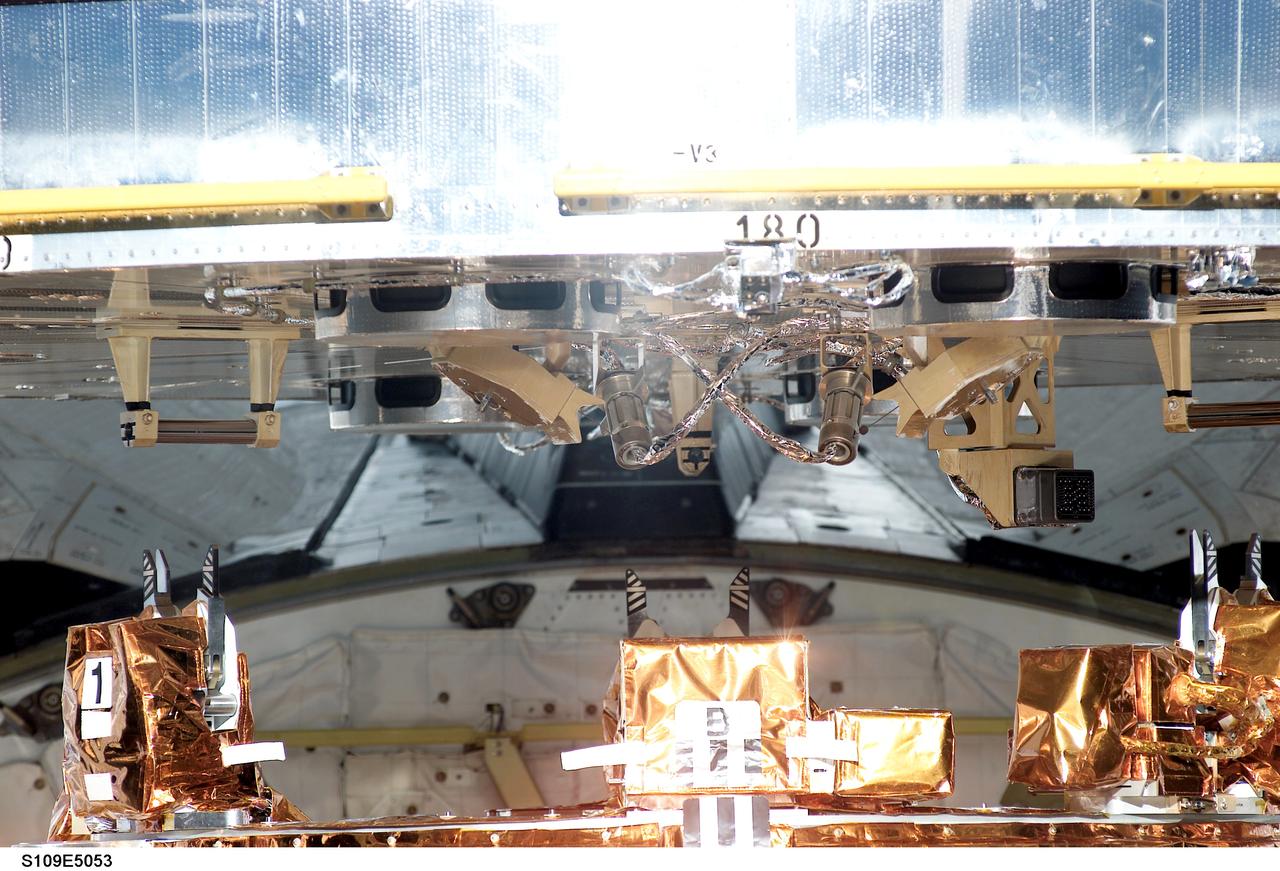
JSC · 2002-03-03 · s109e5053
-V3 plane of the Hubble Space Telescope
STS109-E-5053 (3 March 2002) --- The base of the Hubble Space Telescope is latched down on a special support structure in the cargo bay of the Space Shuttle…
Inspect NASA record
STS109-E-5053 (3 March 2002) --- The base of the Hubble Space Telescope is latched down on a special support structure in the cargo bay of the Space Shuttle Columbia. The bay's Flight Support System, as the structure (partially visible at bottom frame) is called, will hold the telescope for the next week, turning and tilting it as needed for the spacewalking work. Astronaut Nancy J. Currie, mission specialist, was in control of the Shuttle's remote manipulator system (RMS) robotic arm and astronaut Scott D. Altman, mission commander, was at the controls of the shuttle. The crew used a digital still camera to record a series of images documenting the fourth docking of a shuttle to the giant telescope during its tenure in space.
- Record ID
- s109e5053
- NASA center
- JSC
- Date
- 2002-03-03

JPL · 2006-10-27 · PIA01320
Dead Star Creates Celestial Havoc
A star's spectacular death in the constellation Taurus was observed on Earth as the supernova of 1054 A.D. Now, almost a thousand years later, a superdense neutron star…
Inspect NASA record
A star's spectacular death in the constellation Taurus was observed on Earth as the supernova of 1054 A.D. Now, almost a thousand years later, a superdense neutron star left behind by the stellar death is spewing out a blizzard of extremely high-energy particles into the expanding debris field known as the Crab Nebula. This composite image uses data from three of NASA's Great Observatories. The Chandra X-ray image is shown in light blue, the Hubble Space Telescope optical images are in green and dark blue, and the Spitzer Space Telescope's infrared image is in red. The size of the X-ray image is smaller than the others because ultrahigh-energy X-ray emitting electrons radiate away their energy more quickly than the lower-energy electrons emitting optical and infrared light. The neutron star, which has the mass equivalent to the sun crammed into a rapidly spinning ball of neutrons twelve miles across, is the bright white dot in the center of the image. http://photojournal.jpl.nasa.gov/catalog/PIA01320
- Record ID
- PIA01320
- NASA center
- JPL
- Date
- 2006-10-27
- Credit
- NASA/JPL-Caltech/ESA/CXC/Univ. of Ariz./Univ. of Szeged
- Keywords
- Spitzer Space Telescope, Crab Nebula

GSFC · 2016-11-02 · GSFC_20161102_2016-21507_067
James Webb Space Telescope (JWST) Town Hall - Panel question and
James Webb Space Telescope (JWST) Town Hall - Panel question and answer - Bill Ochs; Dr. John Mather; Dr. Eric Smith; Thomas Zurbuchen; Center Director Chris Scolese; NASA…
Inspect NASA record
James Webb Space Telescope (JWST) Town Hall - Panel question and answer - Bill Ochs; Dr. John Mather; Dr. Eric Smith; Thomas Zurbuchen; Center Director Chris Scolese; NASA Administrator Charlie Bolden.
- Record ID
- GSFC_20161102_2016-21507_067
- NASA center
- GSFC
- Date
- 2016-11-02
- Credit
- NASA/GSFC/Bill Hrybyk
- Keywords
- Center Director Chris Scolese, Dr. Eric Smith, Dr. John Mather, James Webb Space Telescope (JWST) Town Hall - Panel question and, NASA Administrator Charlie Bolden., Thomas Zurbuchen

GSFC · 2016-11-02 · GSFC_20161102_2016-21507_065
James Webb Space Telescope (JWST) Town Hall - Panel question and
James Webb Space Telescope (JWST) Town Hall - Panel question and answer - Bill Ochs; Dr. John Mather; Dr. Eric Smith; Thomas Zurbuchen; Center Director Chris Scolese; NASA…
Inspect NASA record
James Webb Space Telescope (JWST) Town Hall - Panel question and answer - Bill Ochs; Dr. John Mather; Dr. Eric Smith; Thomas Zurbuchen; Center Director Chris Scolese; NASA Administrator Charlie Bolden.
- Record ID
- GSFC_20161102_2016-21507_065
- NASA center
- GSFC
- Date
- 2016-11-02
- Credit
- NASA/GSFC/Bill Hrybyk
- Keywords
- Center Director Chris Scolese, Dr. Eric Smith, Dr. John Mather, James Webb Space Telescope (JWST) Town Hall - Panel question and, NASA Administrator Charlie Bolden., Thomas Zurbuchen
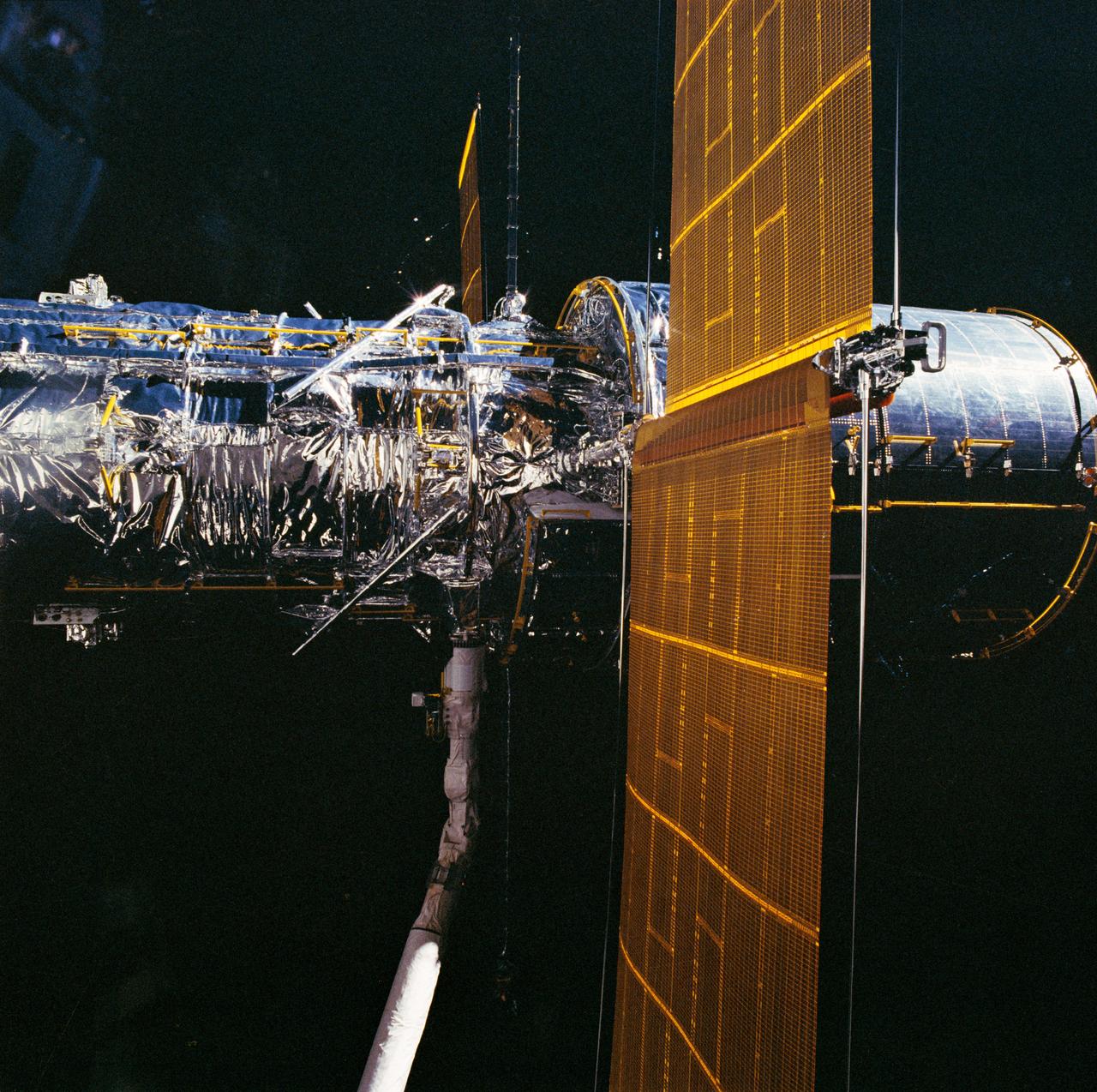
JSC · 1990-04-24 · s31-76-034
STS-31 Hubble Space Telescope (HST) is grappled by OV-103 RMS
During STS-31, the Hubble Space Telescope (HST), grappled by the remote manipulator system (RMS) end effector, is held against the blackness of space. The two solar array (SA)…
Inspect NASA record
During STS-31, the Hubble Space Telescope (HST), grappled by the remote manipulator system (RMS) end effector, is held against the blackness of space. The two solar array (SA) wings (large gold panels) are fully extended with bistem cassette and secondary deployment mechanism (SDM) handle clearly visible. The two deployed high gain antennae (HGA) masts are parallel to the SA panels. RMS end effector is positioned on the starboard fixture during the predeployment checkout operations above Discovery's, Orbiter Vehicle (OV) 103's, payload bay (PLB).
- Record ID
- s31-76-034
- NASA center
- JSC
- Date
- 1990-04-24
- Keywords
- DISCOVERY (ORBITER), END EFFECTORS, HUBBLE SPACE TELESCOPE, SOLAR ARRAYS, REMOTE MANIPULATOR SYSTEM, STS-31

KSC · 2026-08-30 · KSC-20260830-PH-CSH01-0031
Nancy Grace Roman Space Telescope Post Launch Press Conference
From left, George Alderman, NASA Deputy Press Secretary; NASA Administrator Jared Isaacman; Nicky Fox, associate administrator, Science Mission Directorate, NASA Headquarters in Washington; Jackie Townsend, Roman telescope project…
Inspect NASA record
From left, George Alderman, NASA Deputy Press Secretary; NASA Administrator Jared Isaacman; Nicky Fox, associate administrator, Science Mission Directorate, NASA Headquarters in Washington; Jackie Townsend, Roman telescope project manager, NASA’s Goddard Space Flight Center in Greenbelt, Maryland; and Julie McEnery, Roman telescope senior project scientist, NASA Goddard participate in a postlaunch news conference for NASA’s Nancy Grace Roman Space Telescope inside the NASA News Center’s John Holliman Auditorium at Kennedy Space Center in Florida, on Sunday, Aug. 30, 2026. Roman will investigate dark energy and dark matter, conduct a statistical census of planetary systems, and enable a broad range of additional astrophysics research. Liftoff of Roman atop a SpaceX Falcon Heavy rocket occurred at 7:26 a.m. EDT Sunday, Aug. 30, from Kennedy’s Launch Complex 39A.
- Record ID
- KSC-20260830-PH-CSH01-0031
- NASA center
- KSC
- Date
- 2026-08-30
- Credit
- NASA/Cory S Huston
- Keywords
- Nancy Grace Roman Space Telescope, Roman, RST, Payload Hazardous Servicing Facility, PHSF, KSC, Kennedy Space Center, LSP, Launch Services Program, astrophysics, science, launch
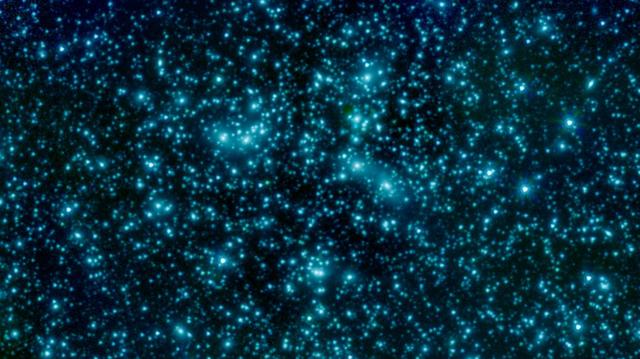
JPL · 2016-09-28 · PIA20920
Pandora Cluster Seen by Spitzer
This image of galaxy cluster Abell 2744, also called Pandora's Cluster, was taken by the Spitzer Space Telescope. The gravity of this galaxy cluster is strong enough that…
Inspect NASA record
This image of galaxy cluster Abell 2744, also called Pandora's Cluster, was taken by the Spitzer Space Telescope. The gravity of this galaxy cluster is strong enough that it acts as a lens to magnify images of more distant background galaxies. This technique is called gravitational lensing. The fuzzy blobs in this Spitzer image are the massive galaxies at the core of this cluster, but astronomers will be poring over the images in search of the faint streaks of light created where the cluster magnifies a distant background galaxy. The cluster is also being studied by NASA's Hubble Space Telescope and Chandra X-Ray Observatory in a collaboration called the Frontier Fields project. In this image, light from Spitzer's infrared channels is colored blue at 3.6 microns and green at 4.5 microns. http://photojournal.jpl.nasa.gov/catalog/PIA20920
- Record ID
- PIA20920
- NASA center
- JPL
- Date
- 2016-09-28
- Credit
- NASA/JPL-Caltech
- Keywords
- Abell 2744, Spitzer Space Telescope

JPL · 2004-10-06 · PIA06909
Kepler Supernova Remnant: A View from Hubble Space Telescope
This image represents a view of NASA Kepler supernova remnant taken in X-rays, visible light, and infrared radiation, indicating that the bubble of gas that makes up the…
Inspect NASA record
This image represents a view of NASA Kepler supernova remnant taken in X-rays, visible light, and infrared radiation, indicating that the bubble of gas that makes up the supernova remnant appears different in various types of light. http://photojournal.jpl.nasa.gov/catalog/PIA06909
- Record ID
- PIA06909
- NASA center
- JPL
- Date
- 2004-10-06
- Credit
- NASA/ESA/Johns Hopkins University
- Keywords
- Hubble Space Telescope, supernova

JPL · 1998-08-02 · PIA01287
Hubble Space Telescope Wide Field Planetary Camera 2 Observations of Neptune
This image was returned by NASA's Voyager 2 spacecraft on July 3, 1989. The planet and its largest satellite, Triton, are captured in view; Triton appears in the…
Inspect NASA record
This image was returned by NASA's Voyager 2 spacecraft on July 3, 1989. The planet and its largest satellite, Triton, are captured in view; Triton appears in the lower right corner at about 5 oclock relative to Neptune. http://photojournal.jpl.nasa.gov/catalog/PIA01287
- Record ID
- PIA01287
- NASA center
- JPL
- Date
- 1998-08-02
- Credit
- NASA/JPL/STScI
- Keywords
- Neptune, Hubble Space Telescope
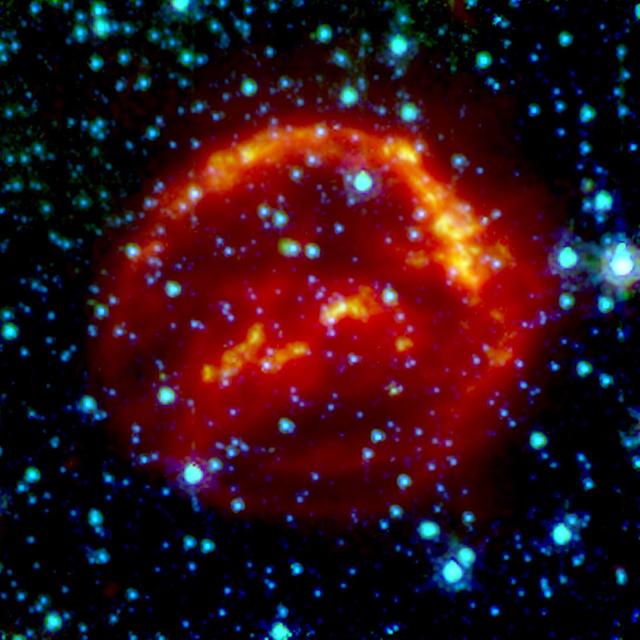
JPL · 2004-10-06 · PIA06910
Kepler Supernova Remnant: A View from Spitzer Space Telescope
This Spitzer false-color image is a composite of data from the 24 micron channel of Spitzer's multiband imaging photometer (red), and three channels of its infrared array camera:…
Inspect NASA record
This Spitzer false-color image is a composite of data from the 24 micron channel of Spitzer's multiband imaging photometer (red), and three channels of its infrared array camera: 8 micron (yellow), 5.6 micron (blue), and 4.8 micron (green). Stars are most prominent in the two shorter wavelengths, causing them to show up as turquoise. The supernova remnant is most prominent at 24 microns, arising from dust that has been heated by the supernova shock wave, and re-radiated in the infrared. The 8 micron data shows infrared emission from regions closely associated with the optically emitting regions. These are the densest regions being encountered by the shock wave, and probably arose from condensations in the surrounding material that was lost by the supernova star before it exploded. The composite above (PIA06908, PIA06909, and PIA06910) represent views of Kepler's supernova remnant taken in X-rays, visible light, and infrared radiation. Each top panel in the composite above shows the entire remnant. Each color in the composite represents a different region of the electromagnetic spectrum, from X-rays to infrared light. The X-ray and infrared data cannot be seen with the human eye. Astronomers have color-coded those data so they can be seen in these images. http://photojournal.jpl.nasa.gov/catalog/PIA06910
- Record ID
- PIA06910
- NASA center
- JPL
- Date
- 2004-10-06
- Credit
- NASA/JPL-Caltech
- Keywords
- Spitzer Space Telescope, supernova
JPL · 2020-04-17 · PIA23650
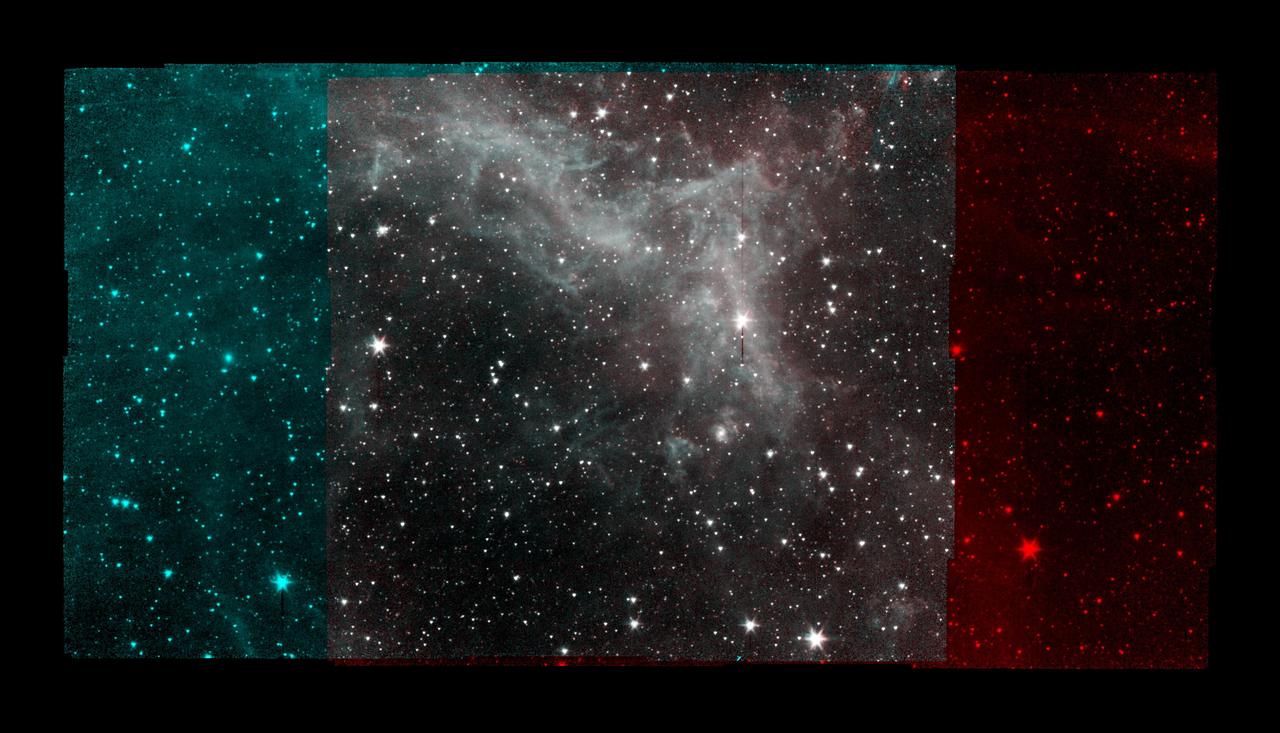
Spitzer California Nebula Mosaic
This series of image taken by NASA's Spitzer Space Telescope on Jan. 25, 2020, shows part of the California Nebula, which is located about 1,000 light-years from Earth.…
Inspect NASA record
This series of image taken by NASA's Spitzer Space Telescope on Jan. 25, 2020, shows part of the California Nebula, which is located about 1,000 light-years from Earth. This is the final mosaic taken by the mission before it was decommissioned on Jan. 30, 2020. Spitzer's infrared detectors reveal the presence of warm dust, similar to soot, mixed in with the gas. The dust absorbs visible and ultraviolet light from nearby stars and then re-emits the absorbed energy as infrared light. The image displays Spitzer's observations much the way that research astronomers would view them: From 2009 to 2020, Spitzer operated two detectors simultaneously that imaged adjacent areas of the sky. The detectors captured different wavelengths of infrared light (referred to by their physical wavelength): 3.6 micrometers (shown in cyan) and 4.5 micrometers (shown in red). Different wavelengths of light can reveal different objects or features. Spitzer would scan the sky, taking multiple pictures in a grid pattern, so that both detectors would image the region at the center of the grid. By combining those images into a mosaic, it was possible to see what a given region looked like in multiple wavelengths, such as in the gray-hued part of the image above. https://photojournal.jpl.nasa.gov/catalog/PIA23650
- Record ID
- PIA23650
- NASA center
- JPL
- Date
- 2020-04-17
- Credit
- NASA/JPL-Caltech/Palomar Digitized Sky Survey
- Keywords
- Spitzer Space Telescope