
Update Site (from NASA)
Explore NASA’s Image and Video Library.
Suggest one object per day for the Interstellar Minds collection. We review each suggestion before adding it.
Sign in to suggest a Marvel.
Find a NASA image ID. Open a NASA record and copy its ID from the end of the details URL.
NASA image records

JPL · 2020-01-27 · PIA23646
Tarantula Nebula Spitzer 2-Color Image
This image from NASA's Spitzer Space Telescope shows the Tarantula Nebula in two wavelengths of infrared light, each represented by a different color. The red color at the…
Inspect NASA record
This image from NASA's Spitzer Space Telescope shows the Tarantula Nebula in two wavelengths of infrared light, each represented by a different color. The red color at the heart of the nebula shows the presence of particularly hot gas emitting infrared light at a wavelength of 4.5 micrometers. The blue regions are dust composed of molecules called polycyclic aromatic hydrocarbons (PAHs), which are also found in ash from coal, wood and oil fires on Earth. Regions emitting both wavelengths appear white. https://photojournal.jpl.nasa.gov/catalog/PIA23646
- Record ID
- PIA23646
- NASA center
- JPL
- Date
- 2020-01-27
- Credit
- NASA/JPL-Caltech
- Keywords
- Spitzer Space Telescope

JPL · 2005-01-12 · PIA07226
Stellar Incubators Seen Cooking up Stars
This image composite compares visible-light and infrared views from NASA's Spitzer Space Telescope of the glowing Trifid Nebula, a giant star-forming cloud of gas and dust located 5,400…
Inspect NASA record
This image composite compares visible-light and infrared views from NASA's Spitzer Space Telescope of the glowing Trifid Nebula, a giant star-forming cloud of gas and dust located 5,400 light-years away in the constellation Sagittarius. Visible-light images of the Trifid taken with NASA's Hubble Space Telescope, Baltimore, Md. (inside left, figure 1) and the National Optical Astronomy Observatory, Tucson, Ariz., (outside left, figure 1) show a murky cloud lined with dark trails of dust. Data of this same region from the Institute for Radioastronomy millimeter telescope in Spain revealed four dense knots, or cores, of dust (outlined by yellow circles), which are "incubators" for embryonic stars. Astronomers thought these cores were not yet ripe for stars, until Spitzer spotted the warmth of rapidly growing massive embryos tucked inside. http://photojournal.jpl.nasa.gov/catalog/PIA07226
- Record ID
- PIA07226
- NASA center
- JPL
- Date
- 2005-01-12
- Credit
- NASA/JPL-Caltech/NOAO/STScI
- Keywords
- Spitzer Space Telescope, Trifid Nebula
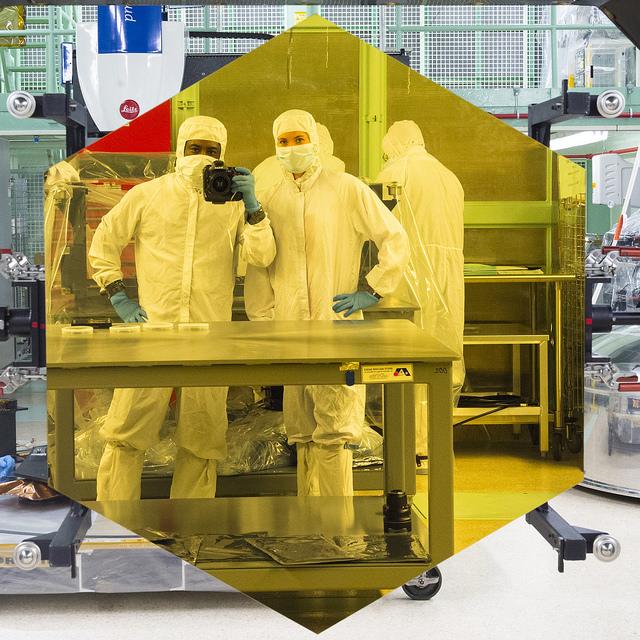
GSFC · 2017-12-08 · GSFC_20171208_Archive_e000194
NASA Invites Artists to Visit James Webb Space Telescope
Witness History: Be inspired by giant, golden, fully-assembled James Webb Space Telescope mirror on display at NASA Goddard. Read more: go.nasa.gov/2dUOmSX Are you an artist? If so, we…
Inspect NASA record
Witness History: Be inspired by giant, golden, fully-assembled James Webb Space Telescope mirror on display at NASA Goddard. Read more: go.nasa.gov/2dUOmSX Are you an artist? If so, we have a unique opportunity to view the amazing and aesthetic scientific marvel that is the James Webb Space Telescope. Because of Webb’s visually striking appearance, we are hosting a special viewing event on Wednesday, Nov. 2, 2016, at NASA’s Goddard Space Flight Center in Greenbelt, Maryland. Artists are invited to apply to attend. Credit: NASA/Goddard/Chris Gunn NASA image use policy. NASA Goddard Space Flight Center enables NASA’s mission through four scientific endeavors: Earth Science, Heliophysics, Solar System Exploration, and Astrophysics. Goddard plays a leading role in NASA’s accomplishments by contributing compelling scientific knowledge to advance the Agency’s mission. Follow us on Twitter Like us on Facebook Find us on Instagram
- Record ID
- GSFC_20171208_Archive_e000194
- NASA center
- GSFC
- Date
- 2017-12-08
- Keywords
- NASA Invites Artists to Visit James Webb Space Telescope
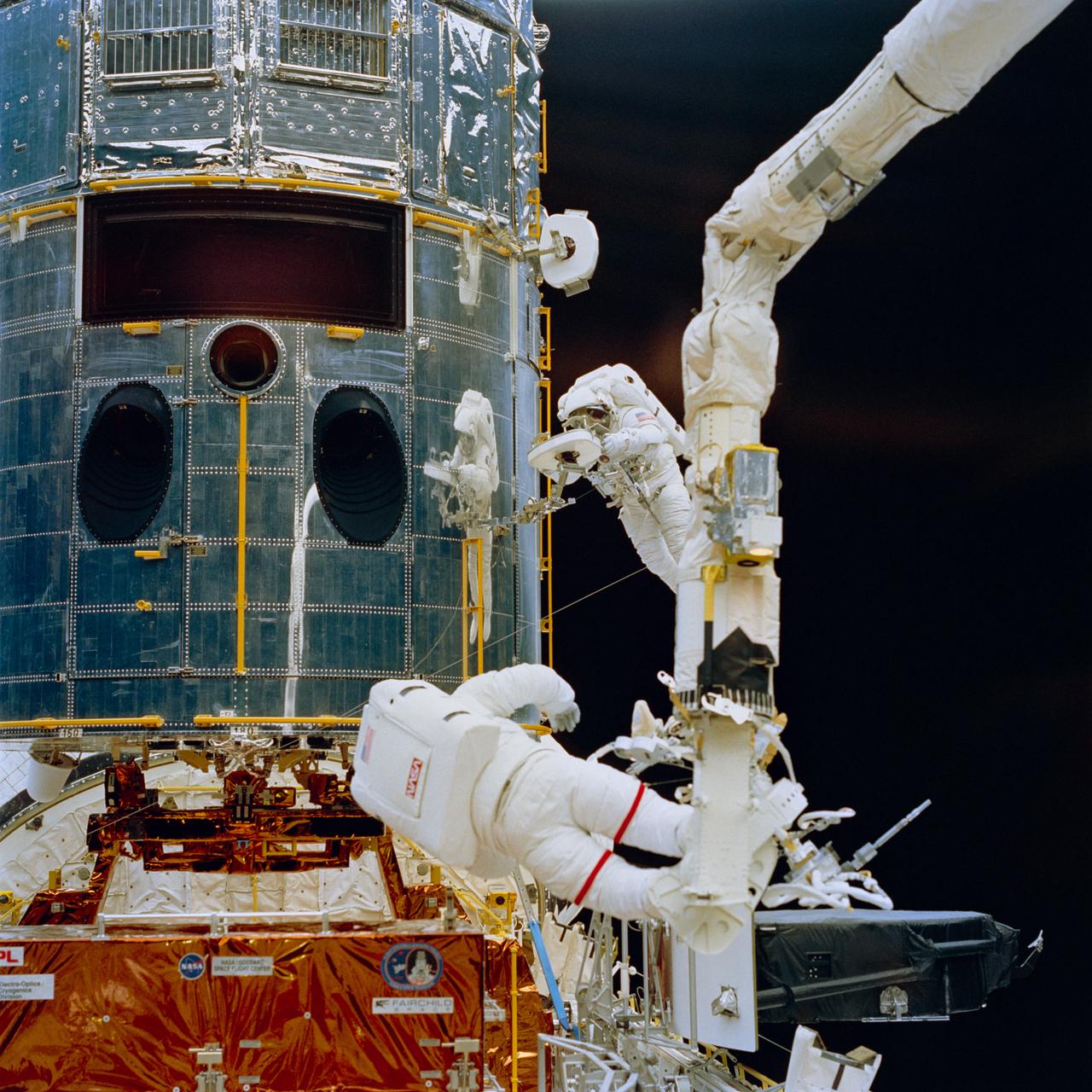
JSC · 1993-12-07 · sts061-74-046
Astronauts Hoffman and Musgrave during EVA to repair Hubble Space Telescope
STS061-74-046 (7 Dec 1993) --- Anchored on the end of the Space Shuttle Endeavour's Remote Manipulator System (RMS) arm, astronaut Jeffrey A. Hoffman (foreground) prepares to install the…
Inspect NASA record
STS061-74-046 (7 Dec 1993) --- Anchored on the end of the Space Shuttle Endeavour's Remote Manipulator System (RMS) arm, astronaut Jeffrey A. Hoffman (foreground) prepares to install the new Wide Field\Planetary Camera (WFPC II) into the empty cavity (top left) on the Hubble Space Telescope (HST). WFPC I is seen temporarily stowed at bottom right. Astronaut F. Story Musgrave works with a Portable Foot Restraint (PFR) at frame center, as his image is reflected in the shiny surface of the telescope. Hoffman and Musgrave shared chores on three of the five extravehicular activity?s (EVA) during the mission.
- Record ID
- sts061-74-046
- NASA center
- JSC
- Date
- 1993-12-07
- Keywords
- STS-61, ASTRONAUTS, EXTRAVEHICULAR ACTIVITY, ENDEAVOUR (ORBITER), REPAIRING, HUBBLE SPACE TELESCOPE, REMOTE MANIPULATOR SYSTEM, CAMERAS PORTABLE FOOT RESTRAINTS
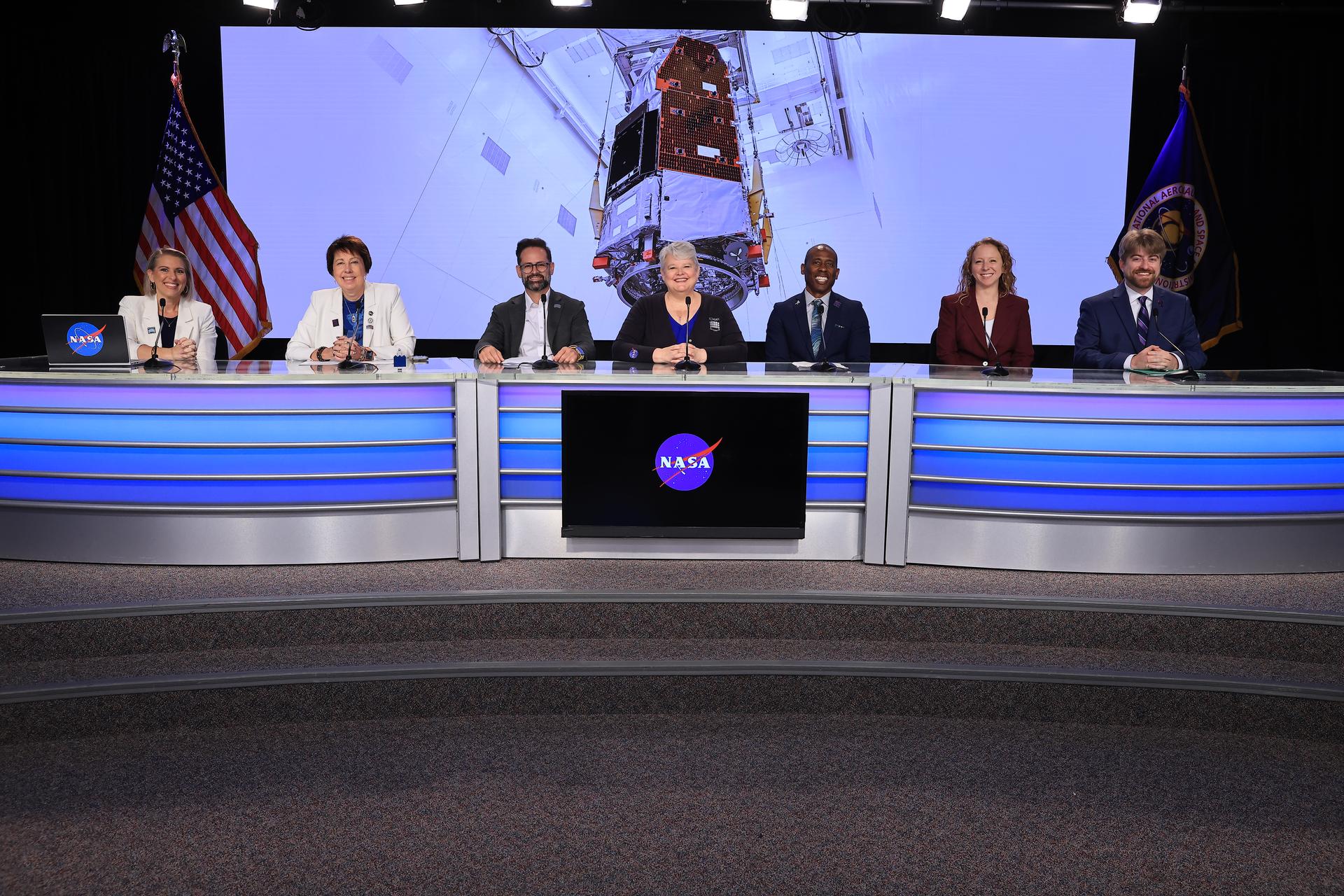
KSC · 2026-08-29 · KSC-20260829-PH-KLS02_0022
Roman Space Telescope Prelaunch News Conference
From left, Leah Martin, NASA Communications; Nicky Fox, associate administrator, Science Mission Directorate, NASA Headquarters in Washington; Lucas Paganini, Roman telescope program executive, NASA Headquarters; Jackie Townsend, Roman…
Inspect NASA record
From left, Leah Martin, NASA Communications; Nicky Fox, associate administrator, Science Mission Directorate, NASA Headquarters in Washington; Lucas Paganini, Roman telescope program executive, NASA Headquarters; Jackie Townsend, Roman telescope project manager, NASA’s Goddard Space Flight Center in Greenbelt, Maryland; Denton Gibson, launch director, NASA’s Launch Services Program, Kennedy Space Center in Florida; Julianna Scheiman, director, NASA Science and Dragon Programs, SpaceX; and Justin McReynolds, launch weather officer, 45th Weather Squadron, U.S. Space Force, participate in a prelaunch news conference for NASA’s Nancy Grace Roman Space Telescope inside the NASA News Center’s John Holliman Auditorium at Kennedy Space Center in Florida, on Saturday, Aug. 29, 2026. Roman will investigate dark energy and dark matter, conduct a statistical census of planetary systems, and enable a broad range of additional astrophysics research. Liftoff from Launch Complex 39A at Kennedy is targeted for no earlier than Sunday, Aug. 30, 2026.
- Record ID
- KSC-20260829-PH-KLS02_0022
- NASA center
- KSC
- Date
- 2026-08-29
- Credit
- NASA/Kim Shiflett
- Keywords
- John. F. Kennedy Space Center, Kennedy, Kennedy Space Center, KSC, Spaceport, Cape Canaveral, NASA, rocket ranch, Florida, multi-user spaceport, premier spaceport, space coast
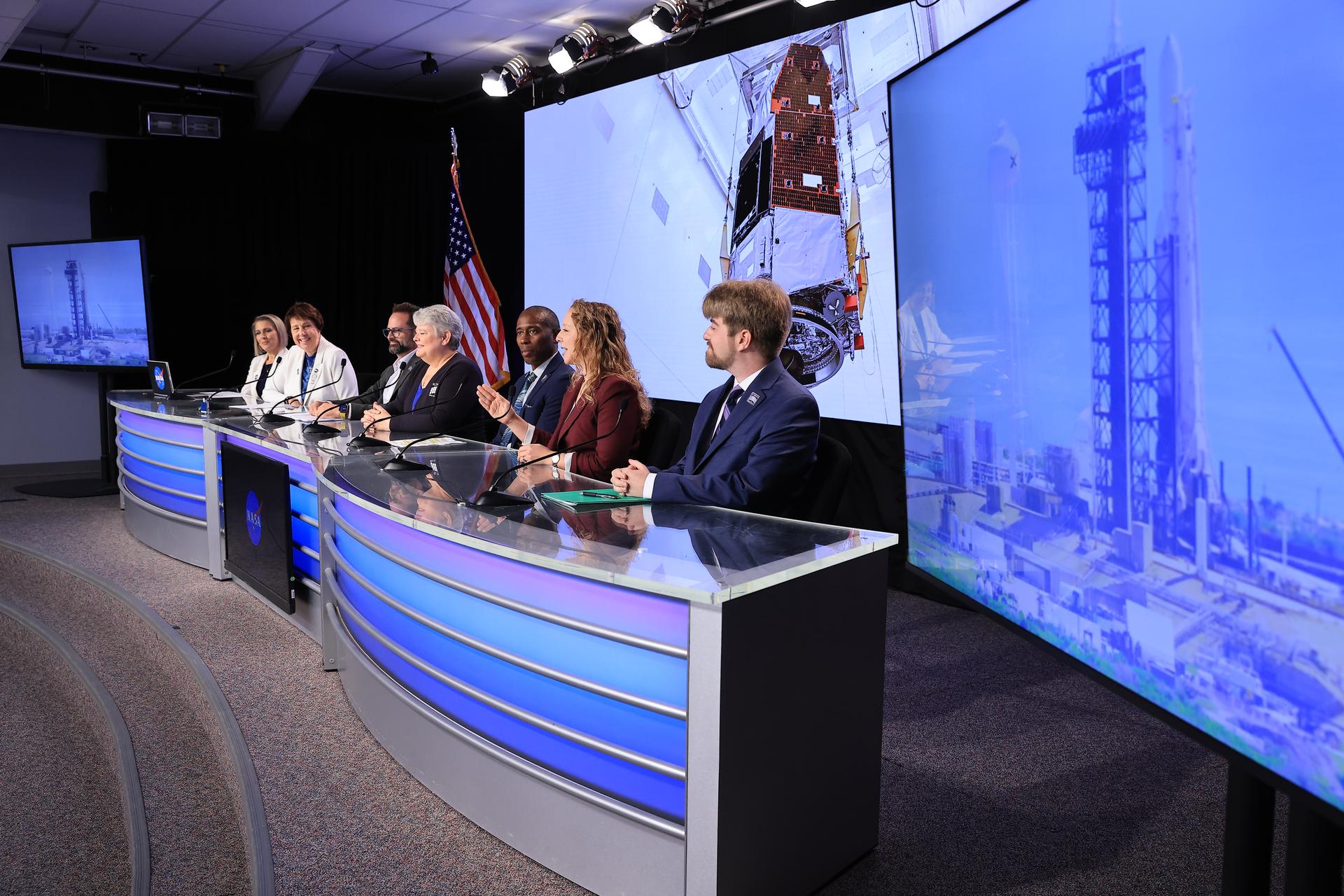
KSC · 2026-08-29 · KSC-20260829-PH-KLS02_0007
Roman Space Telescope Prelaunch News Conference
From left, Leah Martin, NASA Communications; Nicky Fox, associate administrator, Science Mission Directorate, NASA Headquarters in Washington; Lucas Paganini, Roman telescope program executive, NASA Headquarters; Jackie Townsend, Roman…
Inspect NASA record
From left, Leah Martin, NASA Communications; Nicky Fox, associate administrator, Science Mission Directorate, NASA Headquarters in Washington; Lucas Paganini, Roman telescope program executive, NASA Headquarters; Jackie Townsend, Roman telescope project manager, NASA’s Goddard Space Flight Center in Greenbelt, Maryland; Denton Gibson, launch director, NASA’s Launch Services Program, Kennedy Space Center in Florida; Julianna Scheiman, director, NASA Science and Dragon Programs, SpaceX; and Justin McReynolds, launch weather officer, 45th Weather Squadron, U.S. Space Force, participate in a prelaunch news conference for NASA’s Nancy Grace Roman Space Telescope inside the NASA News Center’s John Holliman Auditorium at Kennedy Space Center in Florida, on Saturday, Aug. 29, 2026. Roman will investigate dark energy and dark matter, conduct a statistical census of planetary systems, and enable a broad range of additional astrophysics research. Liftoff from Launch Complex 39A at Kennedy is targeted for no earlier than Sunday, Aug. 30, 2026.
- Record ID
- KSC-20260829-PH-KLS02_0007
- NASA center
- KSC
- Date
- 2026-08-29
- Credit
- NASA/Kim Shiflett
- Keywords
- John. F. Kennedy Space Center, Kennedy, Kennedy Space Center, KSC, Spaceport, Cape Canaveral, NASA, rocket ranch, Florida, multi-user spaceport, premier spaceport, space coast
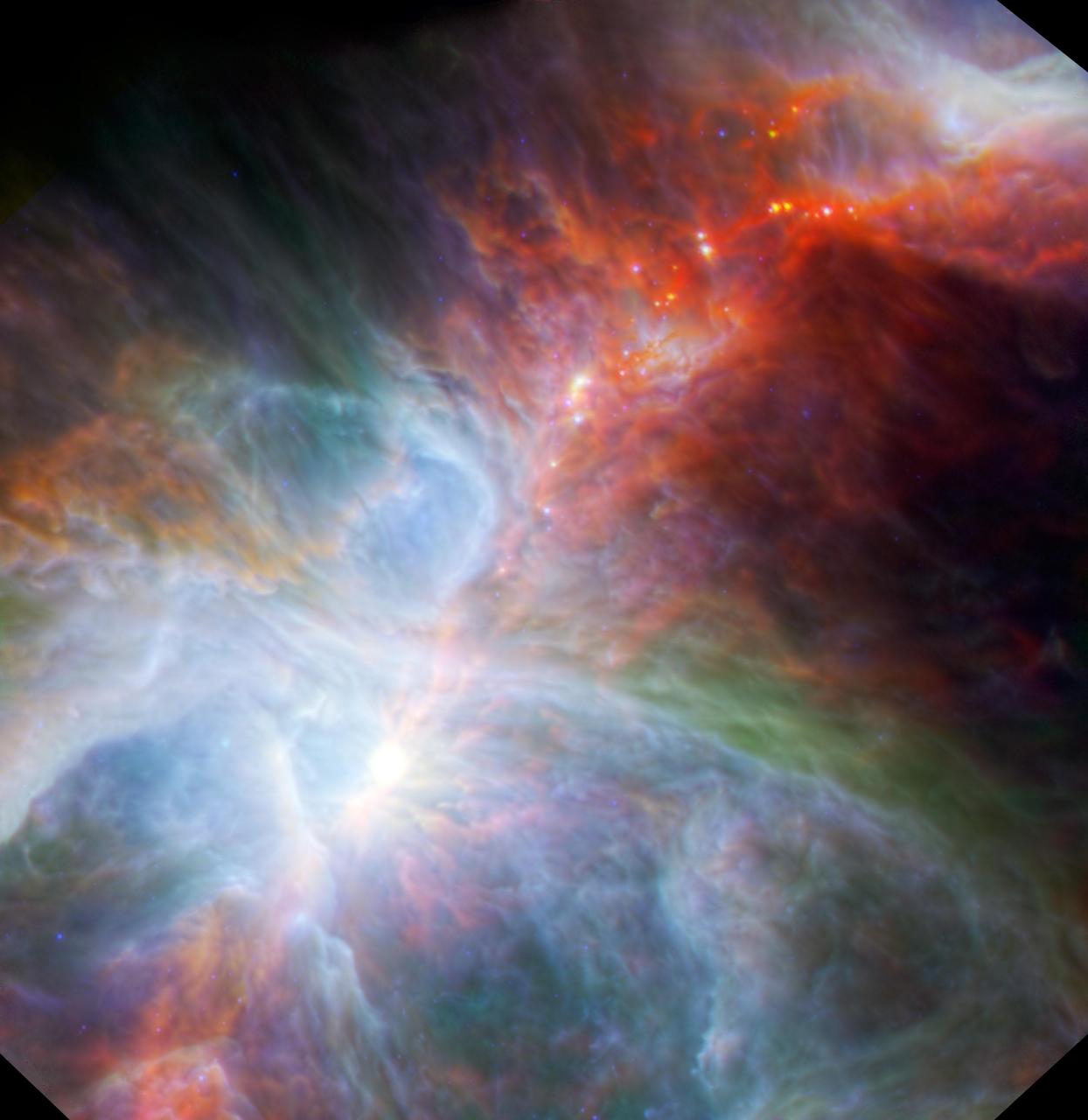
JPL · 2012-02-29 · PIA13959
Orion Rainbow of Infrared Light
NASA Spitzer Space Telescope and ESA Herschel mission combined to show this view of the Orion nebula, found below the three belt stars in the famous constellation of…
Inspect NASA record
NASA Spitzer Space Telescope and ESA Herschel mission combined to show this view of the Orion nebula, found below the three belt stars in the famous constellation of Orion the Hunter, highlights fledgling stars hidden in the gas and clouds.
- Record ID
- PIA13959
- NASA center
- JPL
- Date
- 2012-02-29
- Credit
- NASA/ESA/JPL-Caltech/IRAM
- Keywords
- Herschel Space Observatory,Spitzer Space Telescope, Herschel Space Observatory, Spitzer Space Telescope
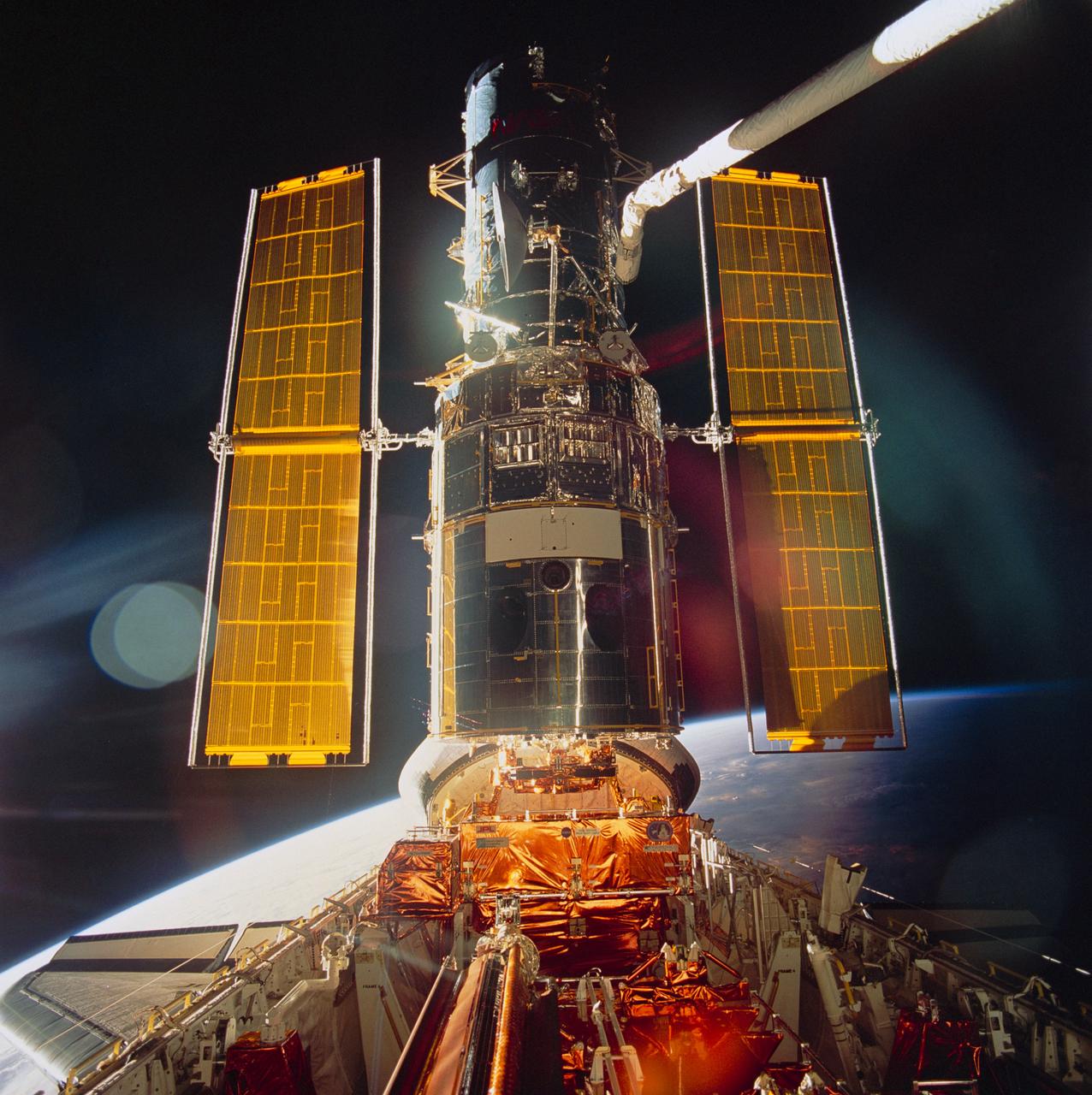
JSC · 1993-12-09 · sts061-99-009
New set of solar arrays deployed on Hubble Space Telescope
STS061-99-009 (9 Dec 1993) --- Sunlight reflects off the Space Shuttle Endeavour's aft windows and the shiny Hubble Space Telescope (HST) prior to its post-servicing deployment near the…
Inspect NASA record
STS061-99-009 (9 Dec 1993) --- Sunlight reflects off the Space Shuttle Endeavour's aft windows and the shiny Hubble Space Telescope (HST) prior to its post-servicing deployment near the end of the eleven-day mission. A handheld Hasselblad camera was used inside Endeavour's cabin to record the image.
- Record ID
- sts061-99-009
- NASA center
- JSC
- Date
- 1993-12-09
- Keywords
- SOLAR ARRAYS, HUBBLE SPACE TELESCOPE, SPACE MAINTENANCE, REPAIRING, STS-61, PAYLOAD BAY, ENDEAVOUR (ORBITER), EARTH OBSERVATIONS (FROM SPACE) ONBOARD ACTIVITIES, REMOTE MANIPULATOR SYSTEM

JPL · 2004-01-13 · PIA05062
The Tarantula Nebula
NASA Spitzer Space Telescope, formerly known as the Space Infrared Telescope Facility, has captured in stunning detail the spidery filaments and newborn stars of theTarantula Nebula, a rich…
Inspect NASA record
NASA Spitzer Space Telescope, formerly known as the Space Infrared Telescope Facility, has captured in stunning detail the spidery filaments and newborn stars of theTarantula Nebula, a rich star-forming region also known as 30 Doradus. This cloud of glowing dust and gas is located in the Large Magellanic Cloud, the nearest galaxy to our own Milky Way, and is visible primarily from the Southern Hemisphere. This image of an interstellar cauldron provides a snapshot of the complex physical processes and chemistry that govern the birth - and death - of stars. At the heart of the nebula is a compact cluster of stars, known as R136, which contains very massive and young stars. The brightest of these blue supergiant stars are up to 100 times more massive than the Sun, and are at least 100,000 times more luminous. These stars will live fast and die young, at least by astronomical standards, exhausting their nuclear fuel in a few million years. The Spitzer Space Telescope image was obtained with an infrared array camera that is sensitive to invisible infrared light at wavelengths that are about ten times longer than visible light. In this four-color composite, emission at 3.6 microns is depicted in blue, 4.5 microns in green, 5.8 microns in orange, and 8.0 microns in red. The image covers a region that is three-quarters the size of the full moon. The Spitzer observations penetrate the dust clouds throughout the Tarantula to reveal previously hidden sites of star formation. Within the luminescent nebula, many holes are also apparent. These voids are produced by highly energetic winds originating from the massive stars in the central star cluster. The structures at the edges of these voids are particularly interesting. Dense pillars of gas and dust, sculpted by the stellar radiation, denote the birthplace of future generations of stars. The Spitzer image provides information about the composition of the material at the edges of the voids. The surface layers closest to the massive stars are subject to the most intense stellar radiation. Here, the atoms are stripped of their electrons, and the green color of these regions is indicative of the radiation from this highly excited, or 'ionized,' material. The ubiquitous red filaments seen throughout the image reveal the presence of molecular material thought to be rich in hydrocarbons. The Tarantula Nebula is the nearest example of a 'starburst' phenomenon, in which intense episodes of star formation occur on massive scales. Most starbursts, however, are associated with dusty and distant galaxies. Spitzer infrared observations of the Tarantula provide astronomers with an unprecedented view of the lifecycle of massive stars and their vital role in regulating the birth of future stellar and planetary systems. http://photojournal.jpl.nasa.gov/catalog/PIA05062
- Record ID
- PIA05062
- NASA center
- JPL
- Date
- 2004-01-13
- Credit
- NASA/JPL-Caltech/Cornell University and University of Leiden
- Keywords
- Tarantula Nebula, Spitzer Space Telescope
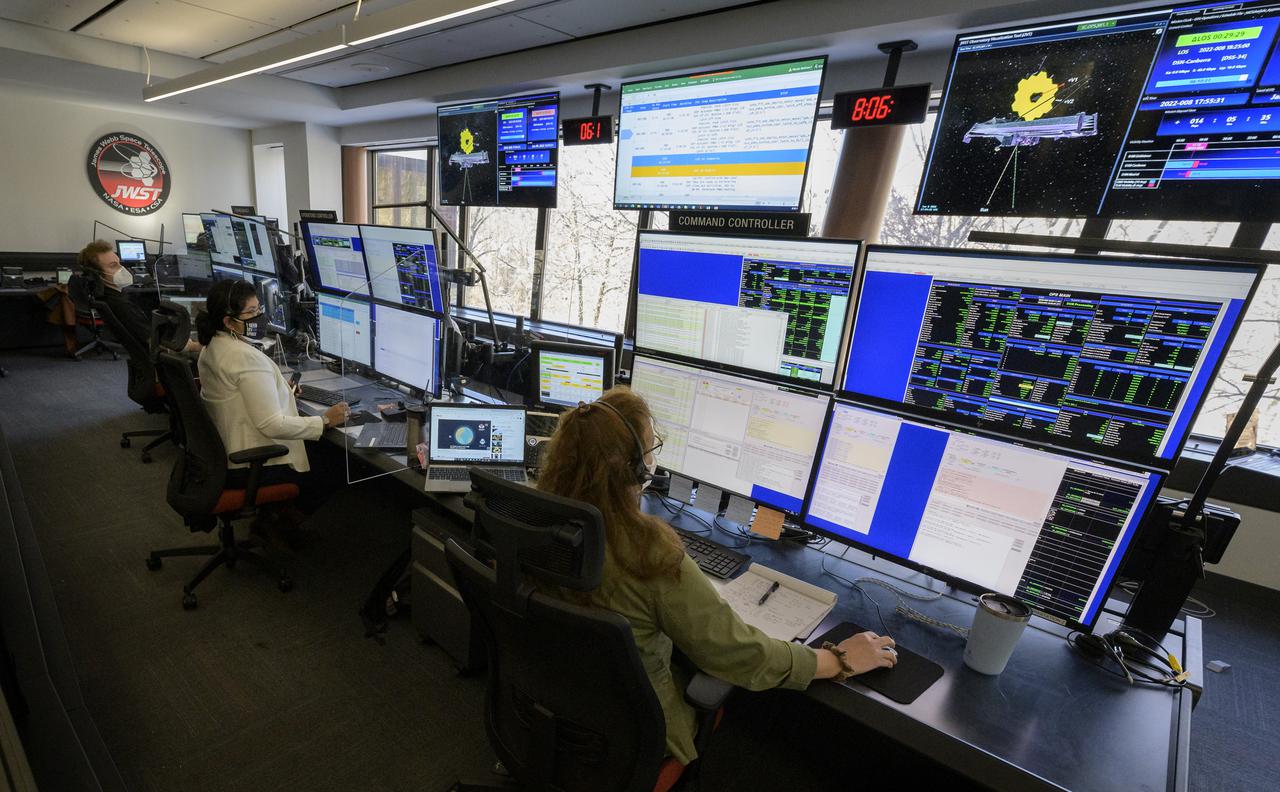
HQ · 2022-01-08 · NHQ202201080027
James Webb Space Telescope Second Primary Mirror Deployment
NASA James Webb Space Telescope Mission team members monitor the progress of Webb’s second primary mirror wing latching, Saturday, Jan. 8, 2022, in Baltimore. When fully latched, the…
Inspect NASA record
NASA James Webb Space Telescope Mission team members monitor the progress of Webb’s second primary mirror wing latching, Saturday, Jan. 8, 2022, in Baltimore. When fully latched, the infrared observatory will have completed its unprecedented process of unfolding in space to prepare for science operations. Webb will study every phase of cosmic history—from within our solar system to the most distant observable galaxies in the early universe. Photo Credit: (NASA/Bill Ingalls)
- Record ID
- NHQ202201080027
- NASA center
- HQ
- Date
- 2022-01-08
- Credit
- NASA/Bill Ingalls
- Keywords
- Baltimore, Canadian Space Agency (CSA), ESA (European Space Agency), Evan Adams, Irma Quispe, James Webb Space Telescope (JWST), Jennifer Whiteleather, Maryland, NASA, Northrop Grumman, Space Telescope Science Institute (STScI)
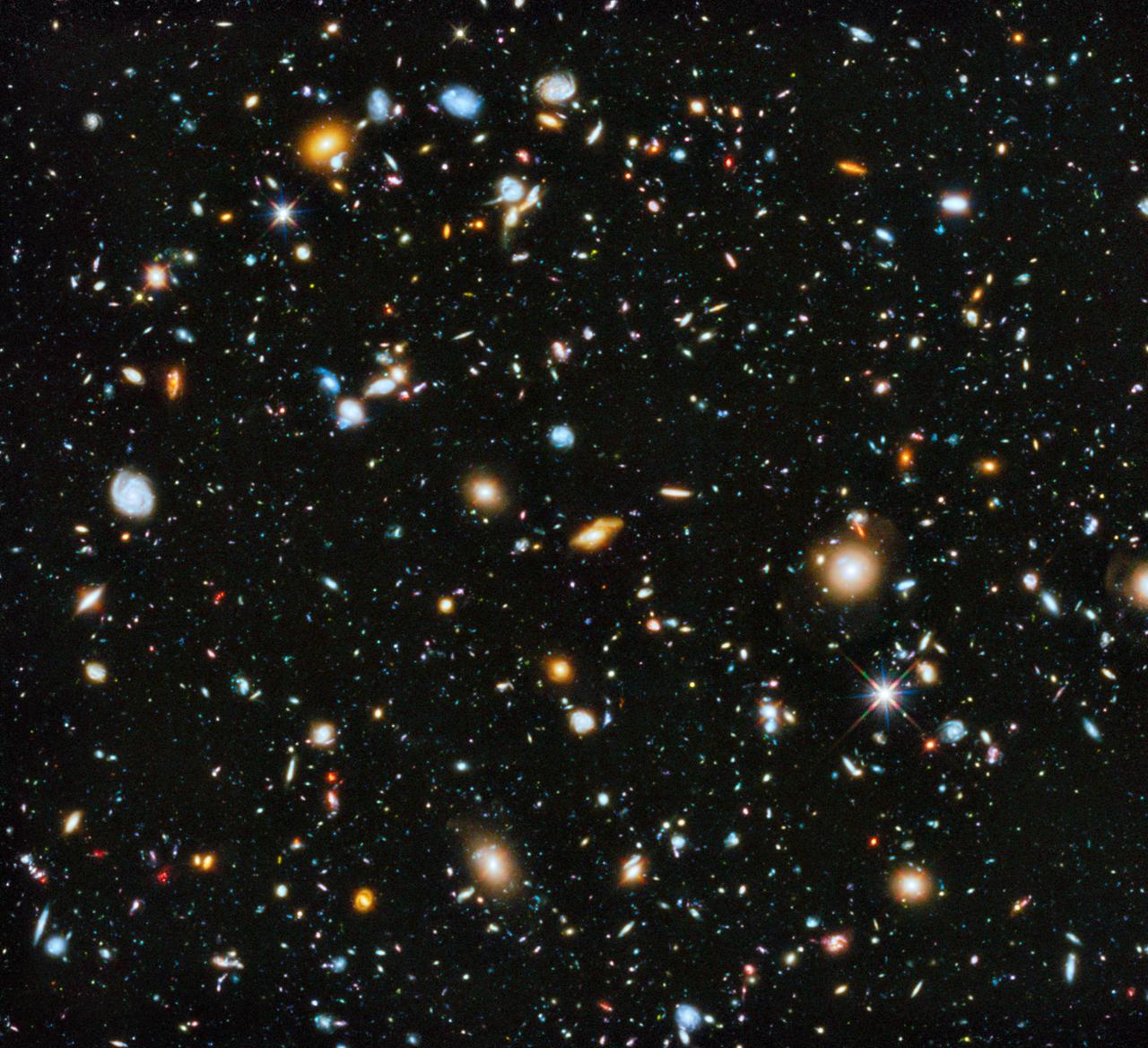
GSFC · 2017-12-08 · GSFC_20171208_Archive_e001061
Hubble Team Unveils Most Colorful View of Universe Captured by Space Telescope
Astronomers using NASA's Hubble Space Telescope have assembled a comprehensive picture of the evolving universe – among the most colorful deep space images ever captured by the 24-year-old…
Inspect NASA record
Astronomers using NASA's Hubble Space Telescope have assembled a comprehensive picture of the evolving universe – among the most colorful deep space images ever captured by the 24-year-old telescope. Researchers say the image, in new study called the Ultraviolet Coverage of the Hubble Ultra Deep Field, provides the missing link in star formation. The Hubble Ultra Deep Field 2014 image is a composite of separate exposures taken in 2003 to 2012 with Hubble's Advanced Camera for Surveys and Wide Field Camera 3. Credit: NASA/ESA Read more: 1.usa.gov/1neD0se NASA image use policy. NASA Goddard Space Flight Center enables NASA’s mission through four scientific endeavors: Earth Science, Heliophysics, Solar System Exploration, and Astrophysics. Goddard plays a leading role in NASA’s accomplishments by contributing compelling scientific knowledge to advance the Agency’s mission. Follow us on Twitter Like us on Facebook Find us on Instagram
- Record ID
- GSFC_20171208_Archive_e001061
- NASA center
- GSFC
- Date
- 2017-12-08
- Keywords
- Hubble Team Unveils Most Colorful View of Universe Captured by Space Telescope
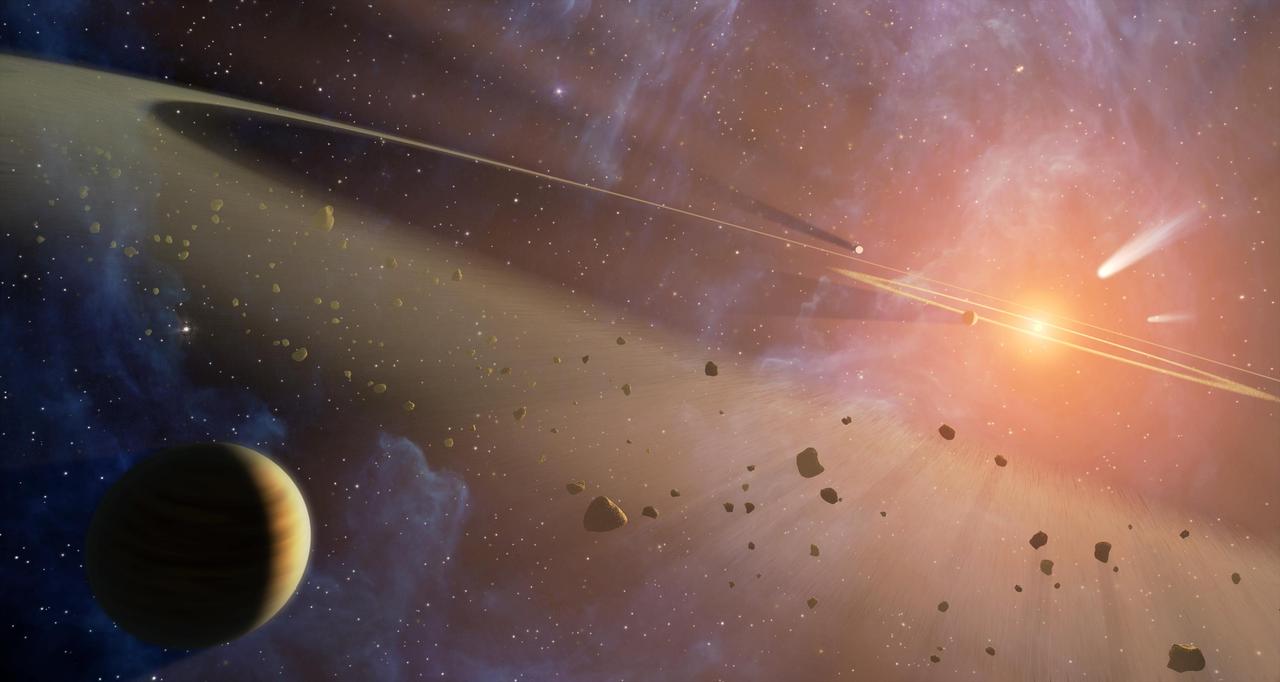
JPL · 2008-10-27 · PIA11375
Double the Rubble Artist Concept
This artist conception shows the closest known planetary system to our own, called Epsilon Eridani. Observations from NASA Spitzer Space Telescope show that the system hosts two asteroid…
Inspect NASA record
This artist conception shows the closest known planetary system to our own, called Epsilon Eridani. Observations from NASA Spitzer Space Telescope show that the system hosts two asteroid belts.
- Record ID
- PIA11375
- NASA center
- JPL
- Date
- 2008-10-27
- Credit
- NASA/JPL-Caltech
- Keywords
- Epsilon Eridani, Spitzer Space Telescope