
Update Site (from NASA)
Explore NASA’s Image and Video Library.
Suggest one object per day for the Interstellar Minds collection. We review each suggestion before adding it.
Sign in to suggest a Marvel.
Find a NASA image ID. Open a NASA record and copy its ID from the end of the details URL.
NASA image records
JPL · 1999-12-01 · PIA04202
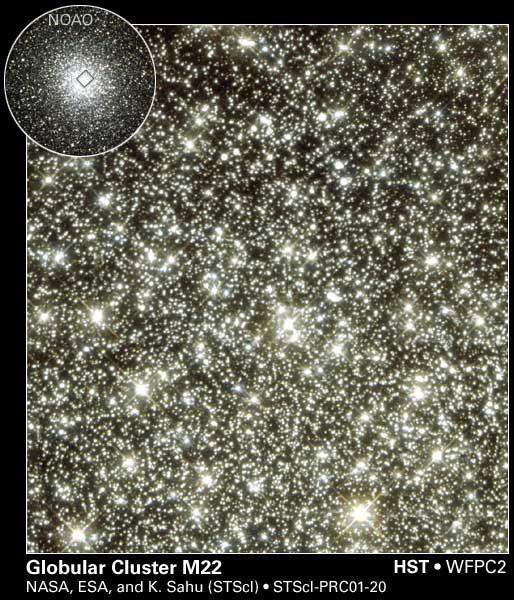
Globular Cluster M22
Scientists are mystified by what may be unexpected, wandering, planet-sized objects. This image taken by NASA Hubble Space Telescope implies the presence of these objects.
Inspect NASA record
Scientists are mystified by what may be unexpected, wandering, planet-sized objects. This image taken by NASA Hubble Space Telescope implies the presence of these objects.
- Record ID
- PIA04202
- NASA center
- JPL
- Date
- 1999-12-01
- Credit
- NASA
- Keywords
- Globular cluster M22, Hubble Space Telescope

JPL · 1999-12-01 · PIA04224
Backwards Spiral Galaxy
Astronomers using NASA Hubble Space Telescope have found a spiral galaxy that may rotate in the opposite direction from what was expected.
Inspect NASA record
Astronomers using NASA Hubble Space Telescope have found a spiral galaxy that may rotate in the opposite direction from what was expected.
- Record ID
- PIA04224
- NASA center
- JPL
- Date
- 1999-12-01
- Credit
- NASA and the Hubble Heritage Team STScI/AURA Acknowledgment: Dr. Ron Buta U. Alabama, Dr. Gene Byrd U. Alabama and Tarsh Freeman Bevill State Comm. College
- Keywords
- Galaxy NGC 4622, Hubble Space Telescope
JPL · 2014-02-11 · PIA17900
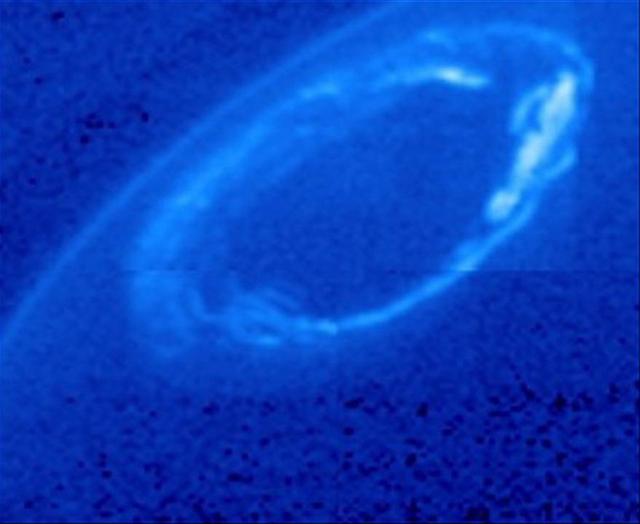
Dance of Saturn Auroras
Ultraviolet and infrared images from NASA Cassini spacecraft and Hubble Space Telescope show active and quiet auroras at Saturn north and south poles.
Inspect NASA record
Ultraviolet and infrared images from NASA Cassini spacecraft and Hubble Space Telescope show active and quiet auroras at Saturn north and south poles.
- Record ID
- PIA17900
- NASA center
- JPL
- Date
- 2014-02-11
- Credit
- NASA/JPL-Caltech/University of Colorado/Central Arizona College and NASA/ESA/University of Leicester and NASA/JPL-Caltech/University of Arizona/Lancaster University
- Keywords
- Saturn, Cassini-Huygens,Hubble Space Telescope

JPL · 1999-12-02 · PIA04228
Rotten Egg Nebula
Violent gas collisions that produced supersonic shock fronts in a dying star are seen in a new, detailed image from NASA Hubble Space Telescope.
Inspect NASA record
Violent gas collisions that produced supersonic shock fronts in a dying star are seen in a new, detailed image from NASA Hubble Space Telescope.
- Record ID
- PIA04228
- NASA center
- JPL
- Date
- 1999-12-02
- Credit
- NASA/ESA & Valentin Bujarrabal Observatorio Astronomico Nacional, Spain
- Keywords
- Rotten Egg Nebula, Hubble Space Telescope
JPL · 2007-01-16 · PIA09106
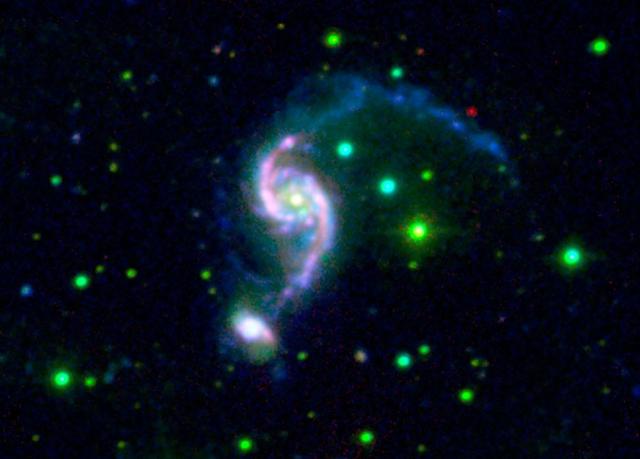
Older Galaxy Pair Has Surprisingly Youthful Glow
NASA Galaxy Evolution Explorer and Spitzer Space Telescope combined to show a pair of interacting galaxies might be experiencing the galactic equivalent of a mid-life crisis.
Inspect NASA record
NASA Galaxy Evolution Explorer and Spitzer Space Telescope combined to show a pair of interacting galaxies might be experiencing the galactic equivalent of a mid-life crisis.
- Record ID
- PIA09106
- NASA center
- JPL
- Date
- 2007-01-16
- Credit
- NASA/JPL-Caltech/ETSU
- Keywords
- Galaxy Evolution Explorer GALEX,Spitzer Space Telescope

JPL · 1999-12-03 · PIA04226
Ghost Head Nebula
Looking like a colorful holiday card, a new image from NASA Hubble Space Telescope reveals a vibrant green and red nebula far from Earth.
Inspect NASA record
Looking like a colorful holiday card, a new image from NASA Hubble Space Telescope reveals a vibrant green and red nebula far from Earth.
- Record ID
- PIA04226
- NASA center
- JPL
- Date
- 1999-12-03
- Credit
- NASA, ESA & Mohammad Heydari-Malayeri Observatoire de Paris, France
- Keywords
- Ghost Head Nebula, Hubble Space Telescope
JPL · 2006-09-28 · PIA08787
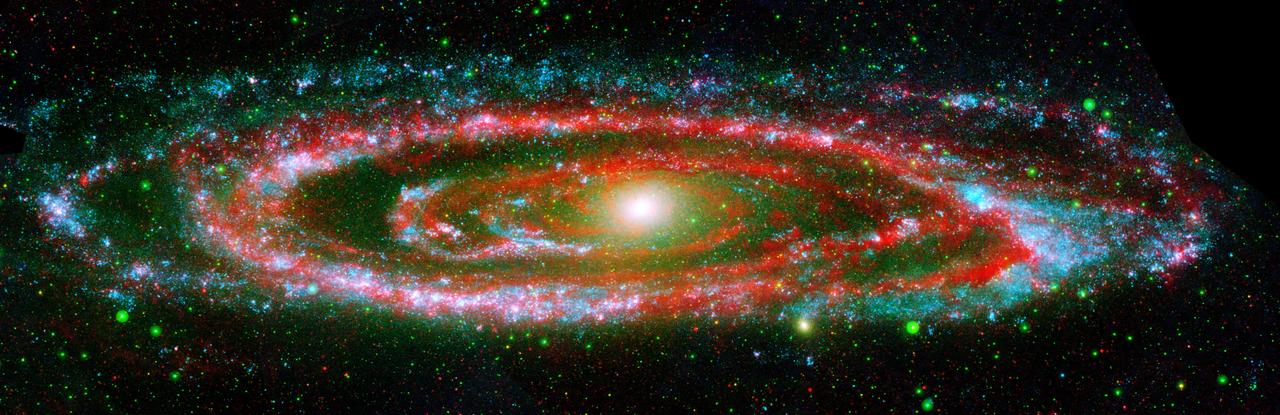
Amazing Andromeda Galaxy
The many personalities of our great galactic neighbor, the Andromeda galaxy, are exposed in this new composite image from NASA Galaxy Evolution Explorer and Spitzer Space Telescope.
Inspect NASA record
The many personalities of our great galactic neighbor, the Andromeda galaxy, are exposed in this new composite image from NASA Galaxy Evolution Explorer and Spitzer Space Telescope.
- Record ID
- PIA08787
- NASA center
- JPL
- Date
- 2006-09-28
- Credit
- NASA/JPL-Caltech
- Keywords
- Galaxy Evolution Explorer GALEX,Spitzer Space Telescope
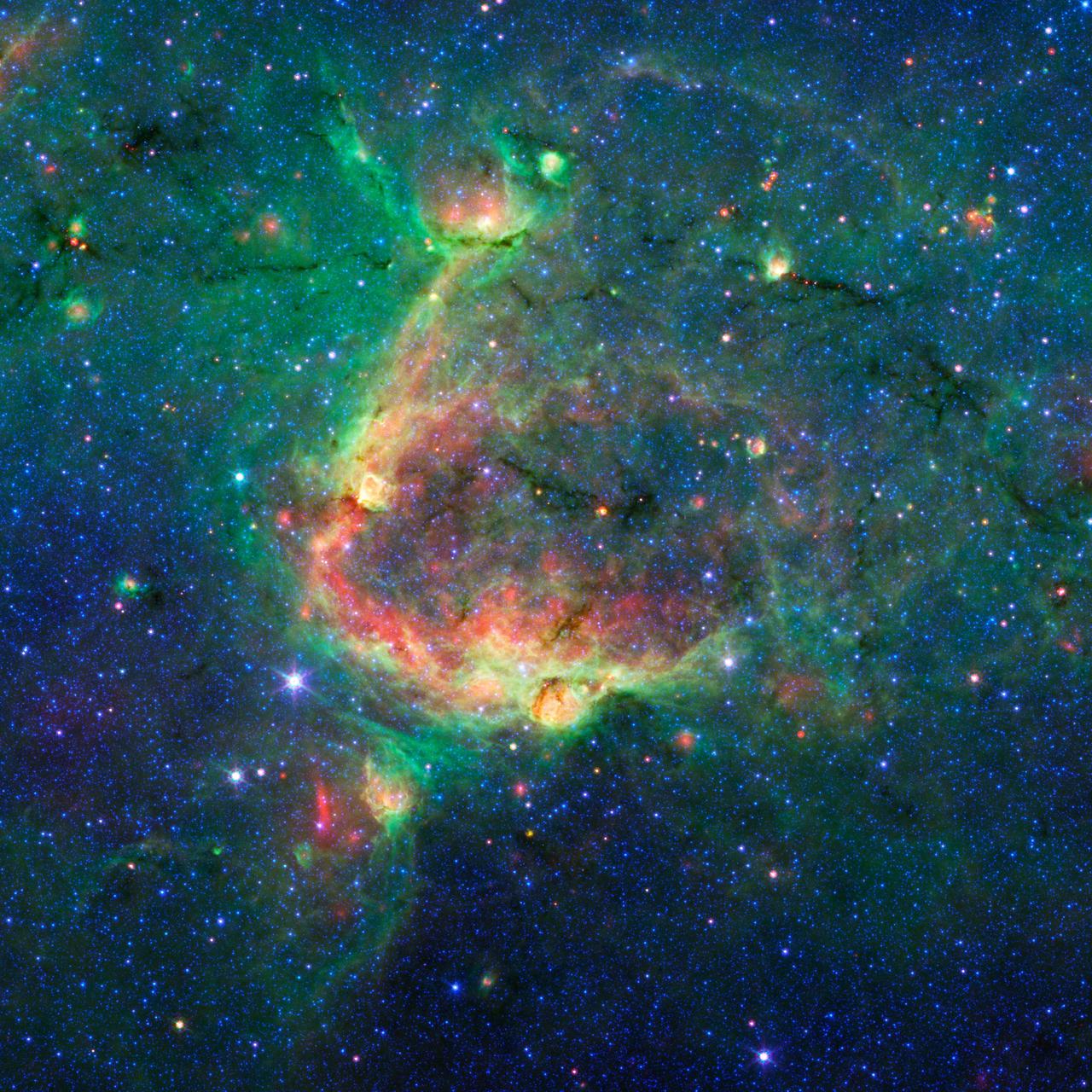
JPL · 2013-06-05 · PIA17017
Bubbles Within Bubbles
This infrared image from NASA Spitzer Space Telescope shows a striking example of what is called a hierarchical bubble structure, in which one giant bubble, carved into the…
Inspect NASA record
This infrared image from NASA Spitzer Space Telescope shows a striking example of what is called a hierarchical bubble structure, in which one giant bubble, carved into the dust of space by massive stars, has triggered the formation of smaller bubbles.
- Record ID
- PIA17017
- NASA center
- JPL
- Date
- 2013-06-05
- Credit
- NASA/JPL-Caltech/University of Wisconsin
- Keywords
- Spitzer Space Telescope
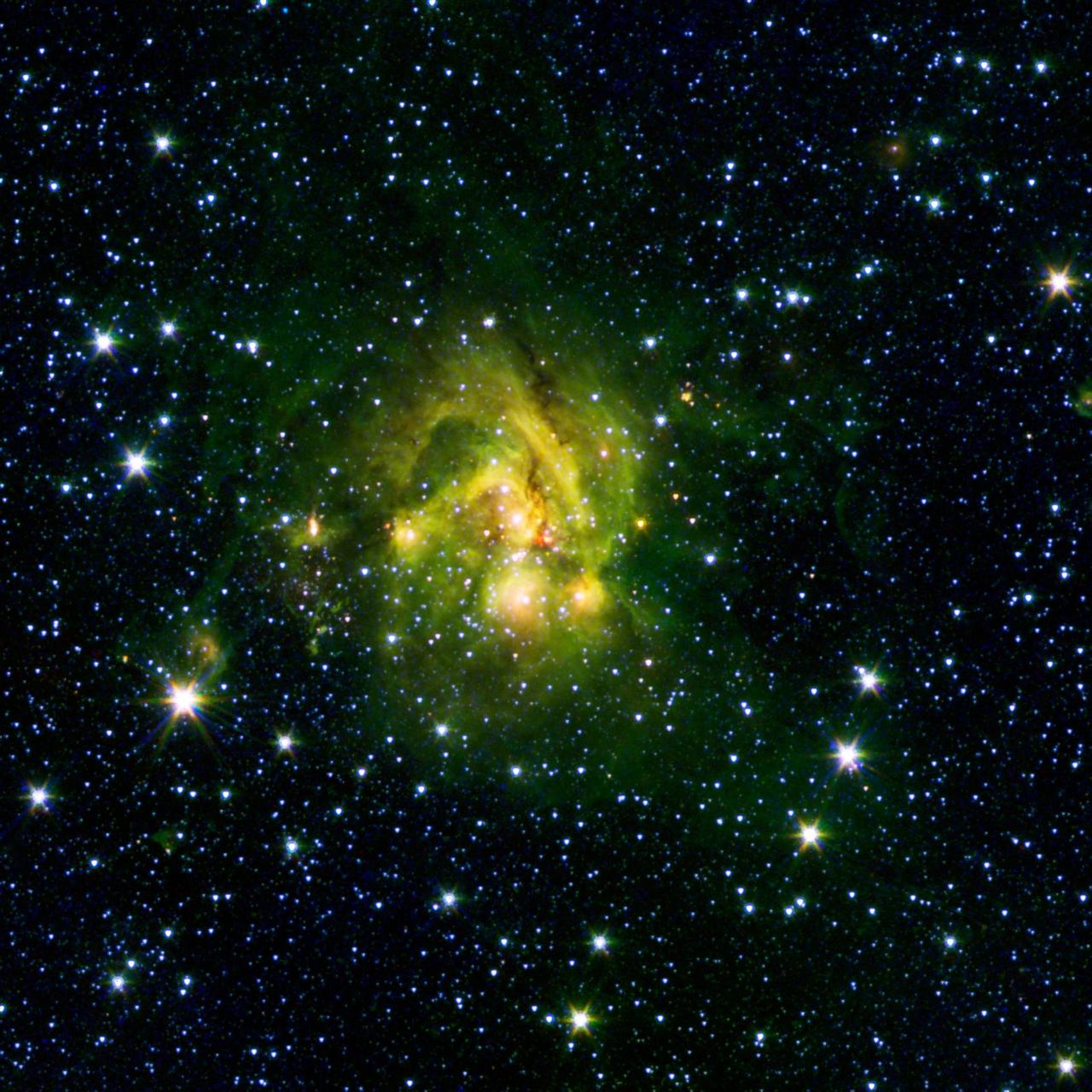
JPL · 2010-07-28 · PIA13302
A Shocking Outflow
This image shows an outflow of gas from a new star as it jets from a space object dubbed IRAS 21078+5211. The reddish blob in its center, as…
Inspect NASA record
This image shows an outflow of gas from a new star as it jets from a space object dubbed IRAS 21078+5211. The reddish blob in its center, as picked up by NASA Spitzer Space Telescope contrasts nicely with the clouds, colored green, that surround it.
- Record ID
- PIA13302
- NASA center
- JPL
- Date
- 2010-07-28
- Credit
- NASA/JPL-Caltech/2MASS/SSI/University of Wisconsin
- Keywords
- Spitzer Space Telescope
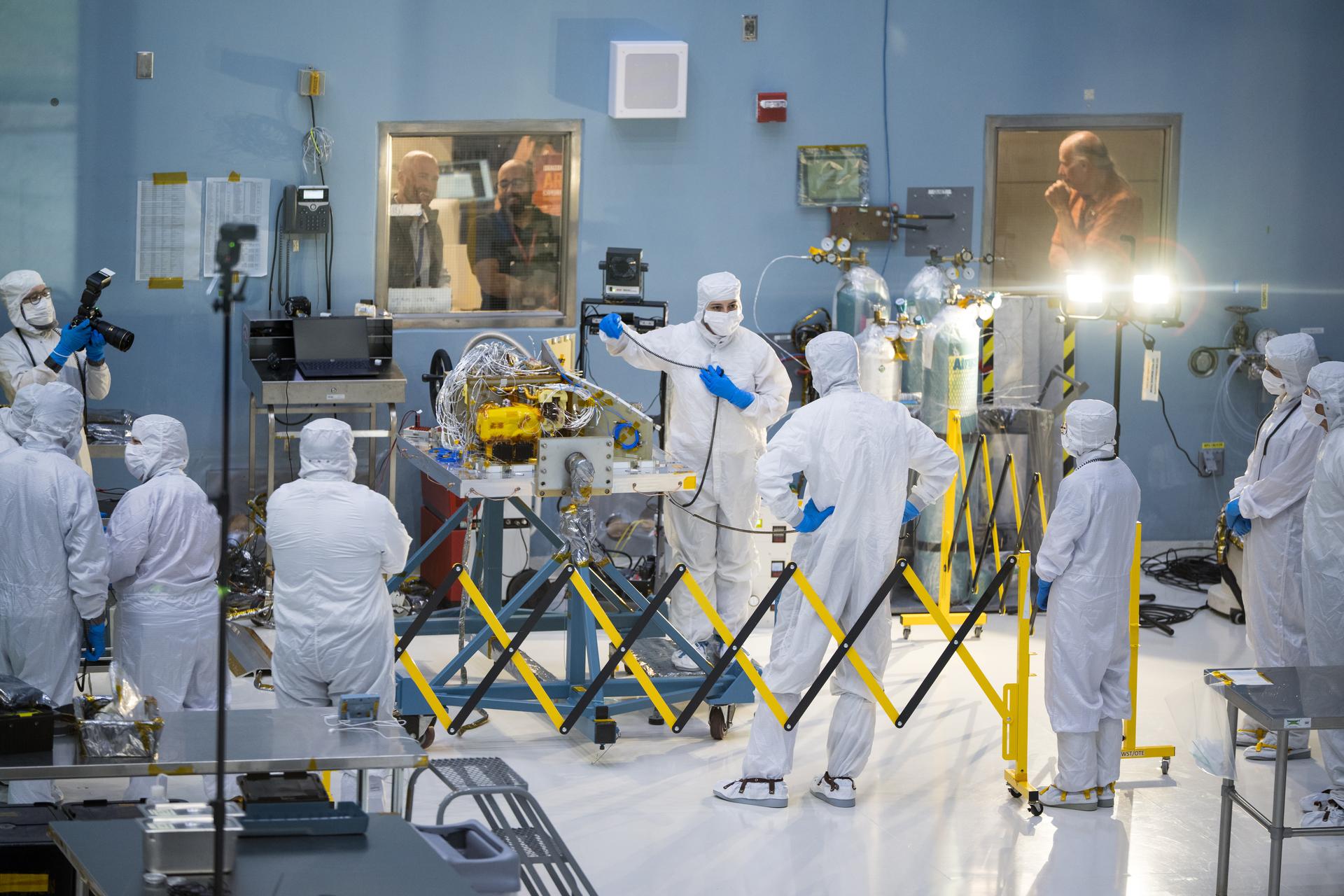
HQ · 2026-09-01 · NHQ202609010027
Nancy Grace Roman Space Telescope Celebration
NASA Administrator Jared Isaacman views the Dragonfly mass spectrometer in the Spacecraft Systems Development and Integration Facility during an event held to celebrate the launch of NASA’s Nancy…
Inspect NASA record
NASA Administrator Jared Isaacman views the Dragonfly mass spectrometer in the Spacecraft Systems Development and Integration Facility during an event held to celebrate the launch of NASA’s Nancy Grace Roman Space Telescope, Tuesday, Sept. 1, 2026, at NASA’s Goddard Space Flight Center in Greenbelt, Maryland. Photo Credit: (NASA/Aubrey Gemignani)
- Record ID
- NHQ202609010027
- NASA center
- HQ
- Date
- 2026-09-01
- Credit
- NASA/Aubrey Gemignani
- Keywords
- Dragonfly, Dragonfly Mass Spectrometer (DraMS), Goddard Space Flight Center (GSFC), Greenbelt, Jamie Dunn, Jared Isaacman, Maryland, NASA Administrator, Nancy Grace Roman Space Telescope, Spacecraft Systems Development and Integration Facility (SSDIF)
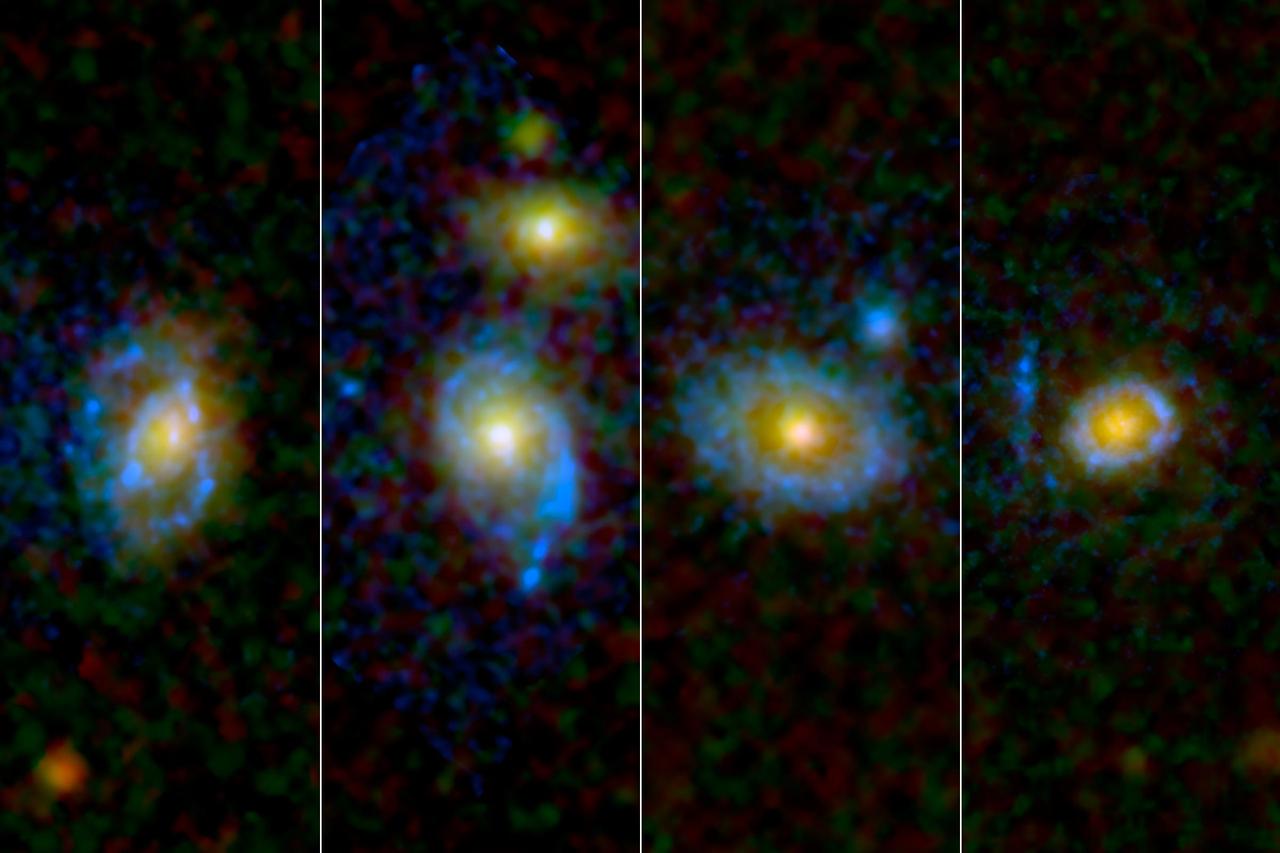
JPL · 2010-08-11 · PIA13318
Ultraviolet Ring Around the Galaxies
Astronomers have found unexpected rings and arcs of ultraviolet light around a selection of galaxies, four of which are shown here as viewed by NASA and the European…
Inspect NASA record
Astronomers have found unexpected rings and arcs of ultraviolet light around a selection of galaxies, four of which are shown here as viewed by NASA and the European Space Agency Hubble Space Telescope.
- Record ID
- PIA13318
- NASA center
- JPL
- Date
- 2010-08-11
- Credit
- NASA/ESA /JPL-Caltech/STScI /UCLA
- Keywords
- Galaxy Evolution Explorer GALEX,Hubble Space Telescope

MSFC · 1996-01-16 · 9605592
History of Hubble Space Telescope (HST)
Taken by the Wide Field Planetary Camera 2 (WFPC2) of the Hubble Space Telescope (HST), this image of MyCn18, a young planetary nebula located about 8,000 light-years away,…
Inspect NASA record
Taken by the Wide Field Planetary Camera 2 (WFPC2) of the Hubble Space Telescope (HST), this image of MyCn18, a young planetary nebula located about 8,000 light-years away, reveals its true shape to be an hourglass with an intricate pattern of "etchings" in its walls. The arc-like etchings could be the remnants of discrete shells ejected from the star when it was younger, flow instabilities, or could result from the action of a narrow beam of matter impinging on the hourglass walls. According to one theory on the formation of planetary nebulae, the hourglass shape is produced by the expansion of a fast stellar wind within a slowly expanding cloud, which is denser near its equator than near its poles. Hubble has also revealed other features in MyCn18 which are completely new and unexpected. For example, there is a pair of intersecting elliptical rings in the central region which appear to be the rims of a smaller hourglass. This picture has been composed from three separate images taken in the light of ionized nitrogen (represented by red), hydrogen (green) and doubly-ionized oxygen (blue). The results are of great interest because they shed new light on the poorly understood ejection of stellar matter which accompanies the slow death of sun-like stars. An unseen companion star and accompanying gravitational effects may well be necessary in order to explain the structure of MyCn18. The Marshall Space Flight Center (MSFC) had responsibility for design, development, and construction of the HST.
- Record ID
- 9605592
- NASA center
- MSFC
- Date
- 1996-01-16
- Keywords
- Hourglass Nebula, MyCn18, Wide Field Planetary Camera 2, WFPC2, Hubble Space Telescope, HST