
Update Site (from NASA)
Explore NASA’s Image and Video Library.
Suggest one object per day for the Interstellar Minds collection. We review each suggestion before adding it.
Sign in to suggest a Marvel.
Find a NASA image ID. Open a NASA record and copy its ID from the end of the details URL.
NASA image records
GSFC · 2017-12-08 · GSFC_20171208_Archive_e001394
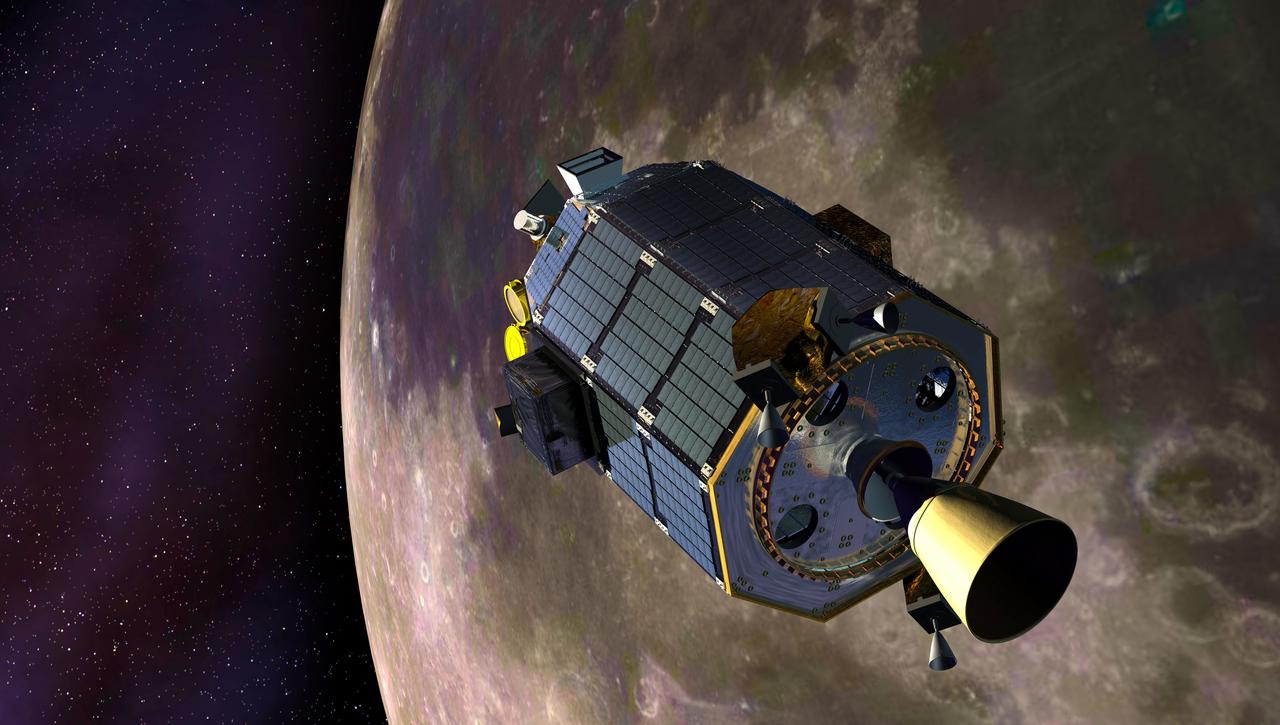
LADEE in Lunar Orbit
An artist's concept showing the Lunar Atmosphere and Dust Environment Explorer (LADEE) spacecraft is seen orbiting the moon as it prepares to fire its maneuvering thrusters to maintain…
Inspect NASA record
An artist's concept showing the Lunar Atmosphere and Dust Environment Explorer (LADEE) spacecraft is seen orbiting the moon as it prepares to fire its maneuvering thrusters to maintain a safe orbital altitude. Credit: NASA Ames / Dana Berry ----- What is LADEE? The Lunar Atmosphere and Dust Environment Explorer (LADEE) is designed to study the Moon's thin exosphere and the lunar dust environment. An "exosphere" is an atmosphere that is so thin and tenuous that molecules don't collide with each other. Studying the Moon's exosphere will help scientists understand other planetary bodies with exospheres too, like Mercury and some of Jupiter's bigger moons. The orbiter will determine the density, composition and temporal and spatial variability of the Moon's exosphere to help us understand where the species in the exosphere come from and the role of the solar wind, lunar surface and interior, and meteoric infall as sources. The mission will also examine the density and temporal and spatial variability of dust particles that may get lofted into the atmosphere. The mission also will test several new technologies, including a modular spacecraft bus that may reduce the cost of future deep space missions and demonstrate two-way high rate laser communication for the first time from the Moon. LADEE now is ready to launch when the window opens on Sept. 6, 2013. Read more: www.nasa.gov/ladee NASA image use policy. NASA Goddard Space Flight Center enables NASA’s mission through four scientific endeavors: Earth Science, Heliophysics, Solar System Exploration, and Astrophysics. Goddard plays a leading role in NASA’s accomplishments by contributing compelling scientific knowledge to advance the Agency’s mission. Follow us on Twitter Like us on Facebook Find us on Instagram
- Record ID
- GSFC_20171208_Archive_e001394
- NASA center
- GSFC
- Date
- 2017-12-08
- Keywords
- LADEE in Lunar Orbit, moon, nasa, rocket, launch, goddard, ladee
GSFC · 2017-12-08 · GSFC_20171208_Archive_e001396
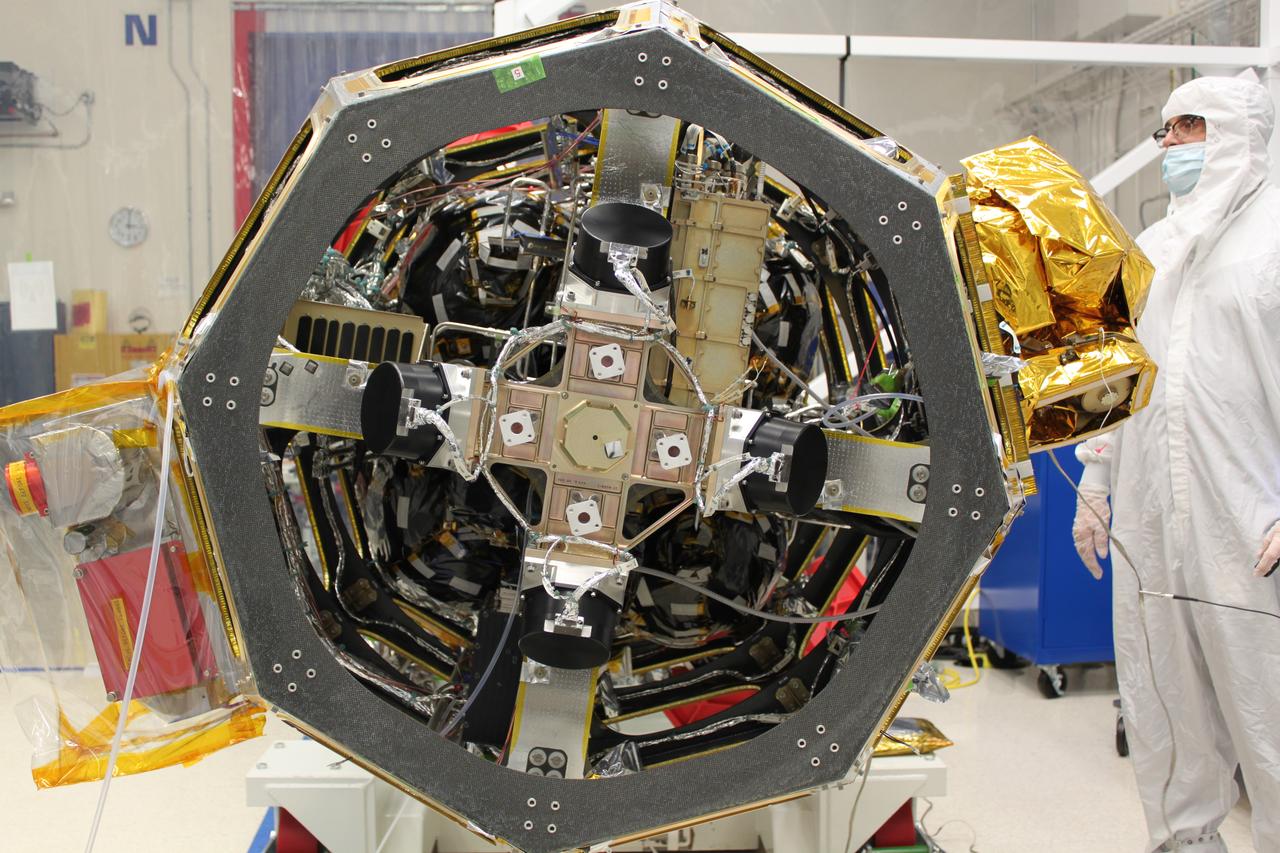
NASA's First Laser Communication System
A new NASA-developed, laser-based space communication system will enable higher rates of satellite communications similar in capability to high-speed fiber optic networks on Earth. The space terminal for…
Inspect NASA record
A new NASA-developed, laser-based space communication system will enable higher rates of satellite communications similar in capability to high-speed fiber optic networks on Earth. The space terminal for the Lunar Laser Communication Demonstration (LLCD), NASA's first high-data-rate laser communication system, was recently integrated onto the Lunar Atmosphere and Dust Environment Explorer (LADEE) spacecraft. LLCD will demonstrate laser communications from lunar orbit to Earth at six times the rate of the best modern-day advanced radio communication systems. Credit: NASA ----- What is LADEE? The Lunar Atmosphere and Dust Environment Explorer (LADEE) is designed to study the Moon's thin exosphere and the lunar dust environment. An "exosphere" is an atmosphere that is so thin and tenuous that molecules don't collide with each other. Studying the Moon's exosphere will help scientists understand other planetary bodies with exospheres too, like Mercury and some of Jupiter's bigger moons. The orbiter will determine the density, composition and temporal and spatial variability of the Moon's exosphere to help us understand where the species in the exosphere come from and the role of the solar wind, lunar surface and interior, and meteoric infall as sources. The mission will also examine the density and temporal and spatial variability of dust particles that may get lofted into the atmosphere. The mission also will test several new technologies, including a modular spacecraft bus that may reduce the cost of future deep space missions and demonstrate two-way high rate laser communication for the first time from the Moon. LADEE now is ready to launch when the window opens on Sept. 6, 2013. Read more: www.nasa.gov/ladee NASA image use policy. NASA Goddard Space Flight Center enables NASA’s mission through four scientific endeavors: Earth Science, Heliophysics, Solar System Exploration, and Astrophysics. Goddard plays a leading role in NASA’s accomplishments by contributing compelling scientific knowledge to advance the Agency’s mission. Follow us on Twitter Like us on Facebook Find us on Instagram
- Record ID
- GSFC_20171208_Archive_e001396
- NASA center
- GSFC
- Date
- 2017-12-08
- Keywords
- NASA's First Laser Communication System, moon, nasa, rocket, launch, goddard, ladee
KSC · 2005-08-12 · KSC-05pp1876
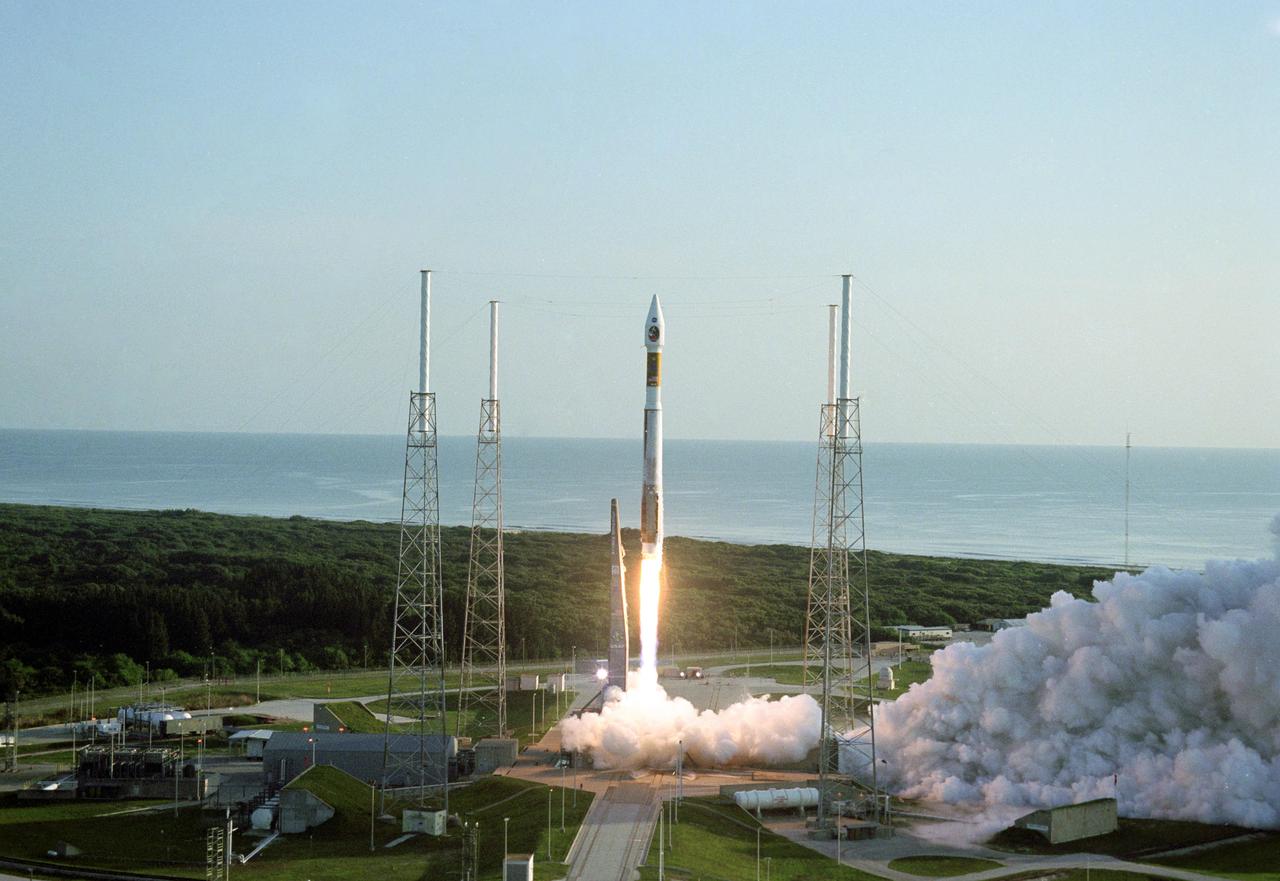
KSC-05pp1876
KENNEDY SPACE CENTER, FLA. - With the Atlantic Ocean as a backdrop, an Atlas V launch vehicle, 19 stories tall, with a two-ton Mars Reconnaissance Orbiter (MRO) on…
Inspect NASA record
KENNEDY SPACE CENTER, FLA. - With the Atlantic Ocean as a backdrop, an Atlas V launch vehicle, 19 stories tall, with a two-ton Mars Reconnaissance Orbiter (MRO) on top, roars away from Launch Complex 41 at Cape Canaveral Air Force Station at 7:43 a.m. EDT. All systems performed nominally for NASA's first launch of an Atlas V on an interplanetary mission. MRO established radio contact with controllers 61 minutes after launch and within four minutes of separation from the upper stage. Initial contact came through an antenna at the Japan Aerospace Exploration Agency's Uchinoura Space Center in southern Japan. Mars is 72 million miles from Earth today, but the spacecraft will travel more than four times that distance on its outbound-arc trajectory to intercept the red planet on March 10, 2006. The orbiter carries six scientific instruments for examining the surface, atmosphere and subsurface of Mars in unprecedented detail from low orbit. NASA expects to get several times more data about Mars from MRO than from all previous Martian missions combined. Researchers will use the instruments to learn more about the history and distribution of Mars' water. That information will improve understanding of planetary climate change and will help guide the quest to answer whether Mars ever supported life. The orbiter will also evaluate potential landing sites for future missions. (Photo Credit: Pat Corkery/Lockheed Martin)
- Record ID
- KSC-05pp1876
- NASA center
- KSC
- Date
- 2005-08-12
- Keywords
- Mars, MRO, Mars Reconnaissance Orbiter, Atlas, CCAFS, LC-41, lau
KSC · 2005-08-12 · KSC-05pp1878
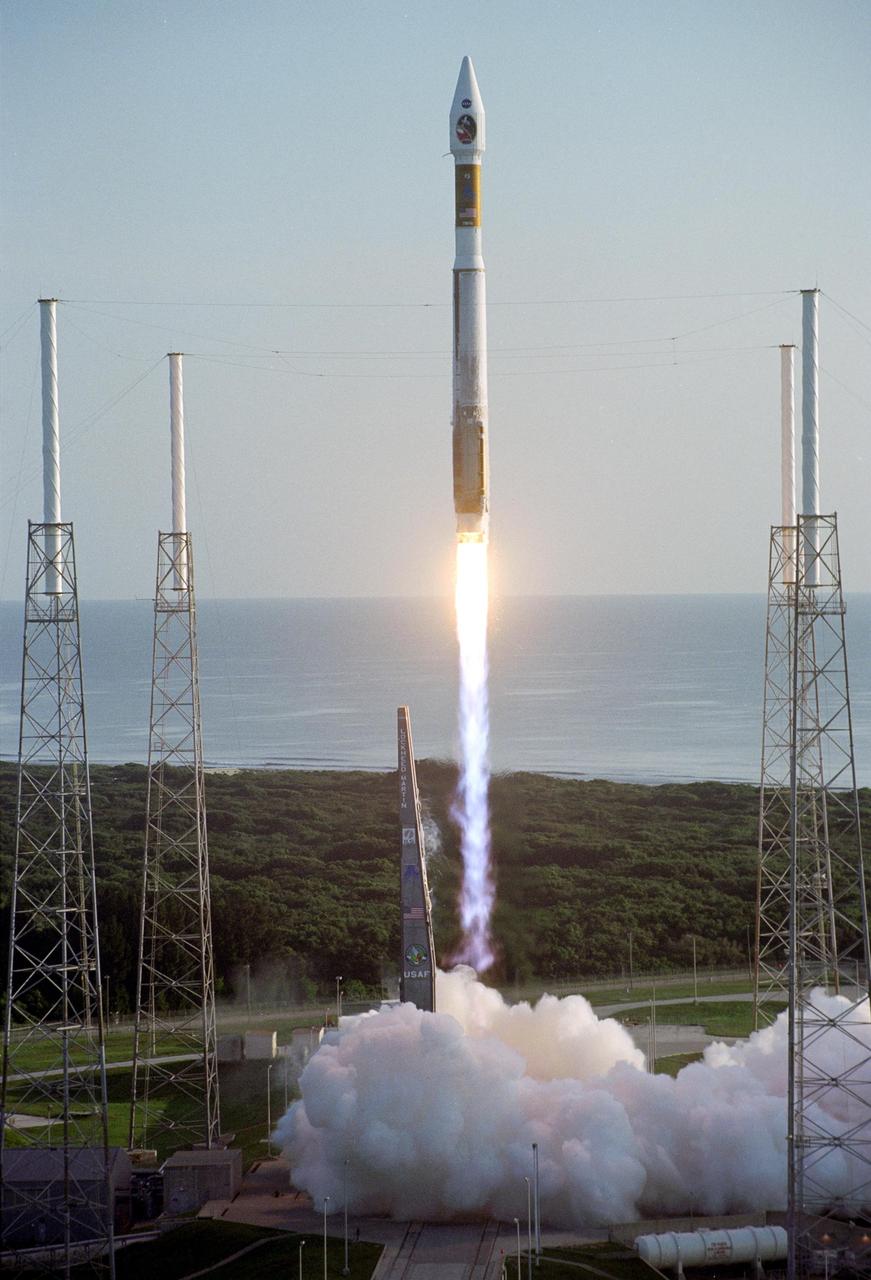
KSC-05pp1878
KENNEDY SPACE CENTER, FLA. - With the Atlantic Ocean as a backdrop, an Atlas V launch vehicle, 19 stories tall, with a two-ton Mars Reconnaissance Orbiter (MRO) on…
Inspect NASA record
KENNEDY SPACE CENTER, FLA. - With the Atlantic Ocean as a backdrop, an Atlas V launch vehicle, 19 stories tall, with a two-ton Mars Reconnaissance Orbiter (MRO) on top, roars away from Launch Complex 41 at Cape Canaveral Air Force Station at 7:43 a.m. EDT. All systems performed nominally for NASA's first launch of an Atlas V on an interplanetary mission. MRO established radio contact with controllers 61 minutes after launch and within four minutes of separation from the upper stage. Initial contact came through an antenna at the Japan Aerospace Exploration Agency's Uchinoura Space Center in southern Japan. Mars is 72 million miles from Earth today, but the spacecraft will travel more than four times that distance on its outbound-arc trajectory to intercept the red planet on March 10, 2006. The orbiter carries six scientific instruments for examining the surface, atmosphere and subsurface of Mars in unprecedented detail from low orbit. NASA expects to get several times more data about Mars from MRO than from all previous Martian missions combined. Researchers will use the instruments to learn more about the history and distribution of Mars' water. That information will improve understanding of planetary climate change and will help guide the quest to answer whether Mars ever supported life. The orbiter will also evaluate potential landing sites for future missions. (Photo Credit: Pat Corkery/Lockheed Martin)
- Record ID
- KSC-05pp1878
- NASA center
- KSC
- Date
- 2005-08-12
- Keywords
- Mars, MRO, Mars Reconnaissance Orbiter, Atlas, CCAFS, LC-41, lau
KSC · 2005-08-12 · 05pd1874
KSC-05PD-1874
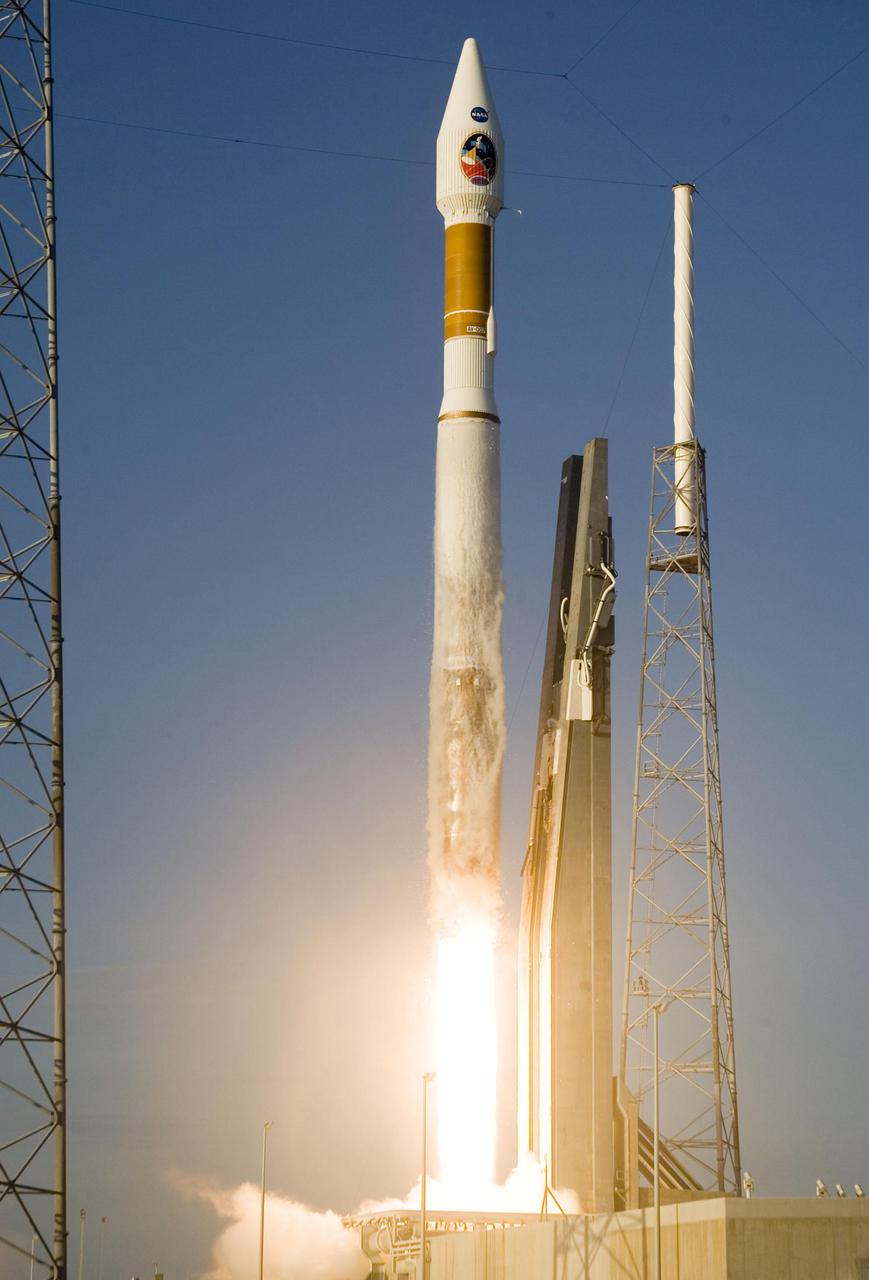
KENNEDY SPACE CENTER, FLA. - Trailing smoke and fire, an Atlas V launch vehicle, 19 stories tall, with a two-ton Mars Reconnaissance Orbiter (MRO) on top, roars away…
Inspect NASA record
KENNEDY SPACE CENTER, FLA. - Trailing smoke and fire, an Atlas V launch vehicle, 19 stories tall, with a two-ton Mars Reconnaissance Orbiter (MRO) on top, roars away from Launch Complex 41 at Cape Canaveral Air Force Station at 7:43 a.m. EDT. All systems performed nominally for NASA's first launch of an Atlas V on an interplanetary mission. MRO established radio contact with controllers 61 minutes after launch and within four minutes of separation from the upper stage. Initial contact came through an antenna at the Japan Aerospace Exploration Agency's Uchinoura Space Center in southern Japan. Mars is 72 million miles from Earth today, but the spacecraft will travel more than four times that distance on its outbound-arc trajectory to intercept the red planet on March 10, 2006. The orbiter carries six scientific instruments for examining the surface, atmosphere and subsurface of Mars in unprecedented detail from low orbit. NASA expects to get several times more data about Mars from MRO than from all previous Martian missions combined. Researchers will use the instruments to learn more about the history and distribution of Mars' water. That information will improve understanding of planetary climate change and will help guide the quest to answer whether Mars ever supported life. The orbiter will also evaluate potential landing sites for future missions. (Photo Credit: Tom Rogers)
- Record ID
- 05pd1874
- NASA center
- KSC
- Date
- 2005-08-12
- Credit
- NASA or National Aeronautics and Space Administration
- Keywords
- Mars, MRO, Mars_Reconnaissance_Orbiter, Atlas, CCAFS, LC-41, launch

GSFC · 2017-12-08 · GSFC_20171208_Archive_e001840
Hubble's Necklace
Image released 11 Aug 2011. The "Necklace Nebula" is located 15,000 light-years away in the constellation Sagitta (the Arrow). In this composite image, taken on July 2, 2011,…
Inspect NASA record
Image released 11 Aug 2011. The "Necklace Nebula" is located 15,000 light-years away in the constellation Sagitta (the Arrow). In this composite image, taken on July 2, 2011, Hubble's Wide Field Camera 3 captured the glow of hydrogen (blue), oxygen (green), and nitrogen (red). The object, aptly named the Necklace Nebula, is a recently discovered planetary nebula, the glowing remains of an ordinary, Sun-like star. The nebula consists of a bright ring, measuring 12 trillion miles wide, dotted with dense, bright knots of gas that resemble diamonds in a necklace. Credit: NASA, ESA, and the Hubble Heritage Team (STScI/AURA) NASA Goddard Space Flight Center enables NASA’s mission through four scientific endeavors: Earth Science, Heliophysics, Solar System Exploration, and Astrophysics. Goddard plays a leading role in NASA’s accomplishments by contributing compelling scientific knowledge to advance the Agency’s mission. Follow us on Twitter Like us on Facebook Find us on Instagram
- Record ID
- GSFC_20171208_Archive_e001840
- NASA center
- GSFC
- Date
- 2017-12-08
- Keywords
- Hubble's Necklace, nasa, goddard, hubble
GSFC · 2023-10-31 · GSFC_20231031_PACE_030767
GSFC_20231031_PACE_030767
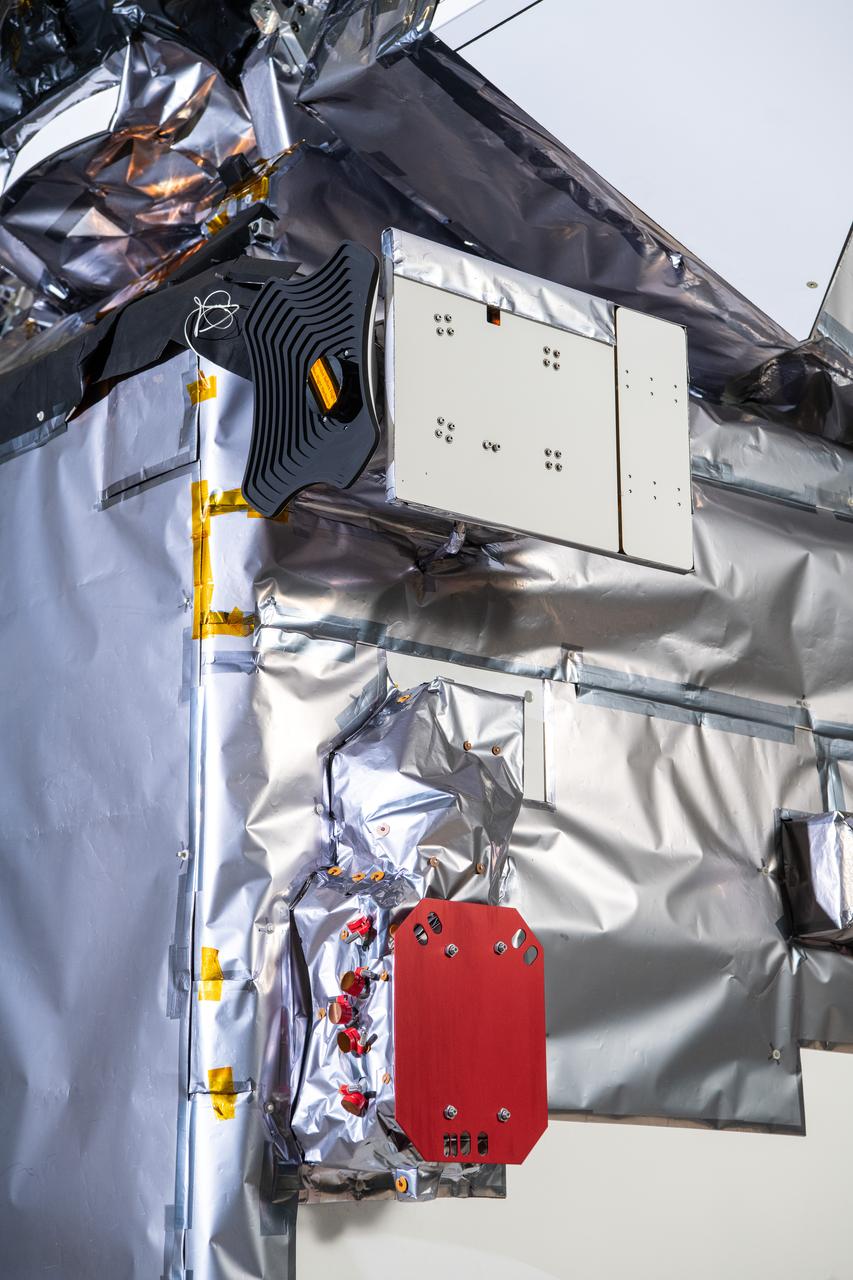
The Hyper-Angular Rainbow Polarimeter #2 (HARP2) instrument (top) and the SPEXone instrument on The Plankton, Aerosol, Cloud, ocean Ecosystem (PACE) in the clean room at NASA's Goddard Space…
Inspect NASA record
The Hyper-Angular Rainbow Polarimeter #2 (HARP2) instrument (top) and the SPEXone instrument on The Plankton, Aerosol, Cloud, ocean Ecosystem (PACE) in the clean room at NASA's Goddard Space Flight Center in Greenbelt, Maryland on October 31st, 2023. HARP2 is one of three instruments on NASA's PACE observatory, it was designed and built by UMBC's Earth and Space Institute. SPEXone has been developed by a Dutch consortium consisting of SRON Netherlands Institute for Space Research and Airbus Defence and Space Netherlands, supported by opto-mechanical expertise from TNO. SRON and Airbus DS NL are responsible for the design, manufacturing and testing of the instrument. The scientific lead is in the hands of SRON. SPEXone is a public-private initiative, funded by the Netherlands Space Office (NSO), the Netherlands Organization of Scientific Research (NWO), SRON and Airbus DS NL. PACE's unprecedented spectral coverage will provide the first-ever global measurements designed to identify phytoplankton community composition. The mission will make global ocean color measurements, using the Ocean Color Instrument (OCI), to provide extended data records on ocean ecology and global biogeochemistry along with polarimetry measurements, using the Spectro-polarimeter for Planetary Exploration (SPEXone) and the Hyper Angular Research Polarimeter (HARP2) to provide extended data records on clouds and aerosols. The Earth-observing satellite mission, built at Goddard Space Flight Center in Greenbelt, MD, will continue and advance observations of global ocean color, biogeochemistry, and ecology, as well as the carbon cycle, aerosols and clouds.
- Record ID
- GSFC_20231031_PACE_030767
- NASA center
- GSFC
- Date
- 2023-10-31
- Credit
- NASA / Denny Henry
KSC · 2005-08-12 · KSC-05pp1883
KSC-05pp1883
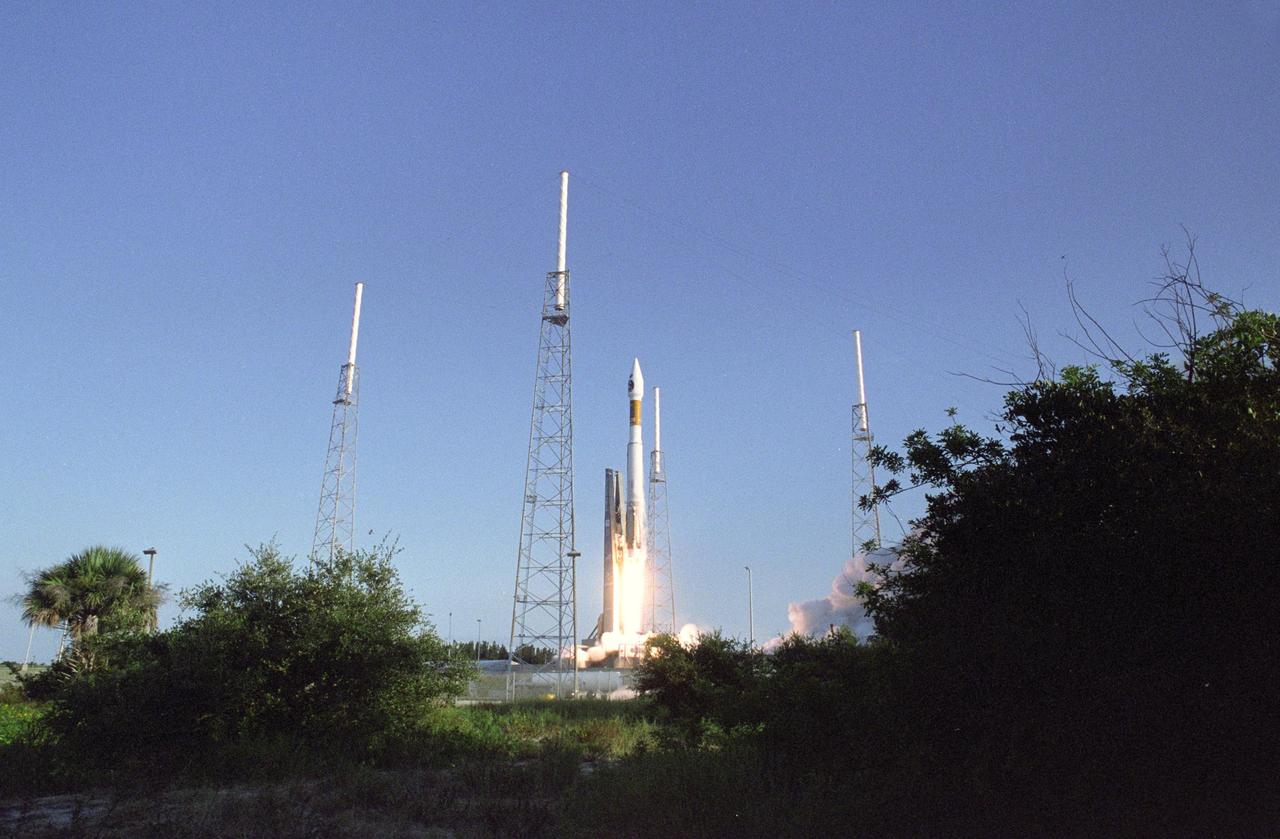
KENNEDY SPACE CENTER, FLA. - Viewed through a break in the greenscape around Launch Complex 41 at Cape Canaveral Air Force Station in Florida, the 19-stories-tall Atlas V…
Inspect NASA record
KENNEDY SPACE CENTER, FLA. - Viewed through a break in the greenscape around Launch Complex 41 at Cape Canaveral Air Force Station in Florida, the 19-stories-tall Atlas V launch vehicle roars off the launch pad, propelling the two-ton Mars Reconnaissance Orbiter (MRO) into a clear blue Florida sky and eventual orbit around Mars. Liftoff was at 7:43 a.m. EDT. All systems performed nominally for NASA's first launch of an Atlas V on an interplanetary mission. MRO established radio contact with controllers 61 minutes after launch and within four minutes of separation from the upper stage. Initial contact came through an antenna at the Japan Aerospace Exploration Agency's Uchinoura Space Center in southern Japan. Mars is 72 million miles from Earth today, but the spacecraft will travel more than four times that distance on its outbound-arc trajectory to intercept the red planet on March 10, 2006. The orbiter carries six scientific instruments for examining the surface, atmosphere and subsurface of Mars in unprecedented detail from low orbit. NASA expects to get several times more data about Mars from MRO than from all previous Martian missions combined. Researchers will use the instruments to learn more about the history and distribution of Mars' water. That information will improve understanding of planetary climate change and will help guide the quest to answer whether Mars ever supported life. The orbiter will also evaluate potential landing sites for future missions.
- Record ID
- KSC-05pp1883
- NASA center
- KSC
- Date
- 2005-08-12
- Keywords
- Mars, MRO, Mars Reconnaissance Orbiter, Atlas, CCAFS, LC-41, lau
KSC · 2005-08-12 · KSC-05pp1882
KSC-05pp1882
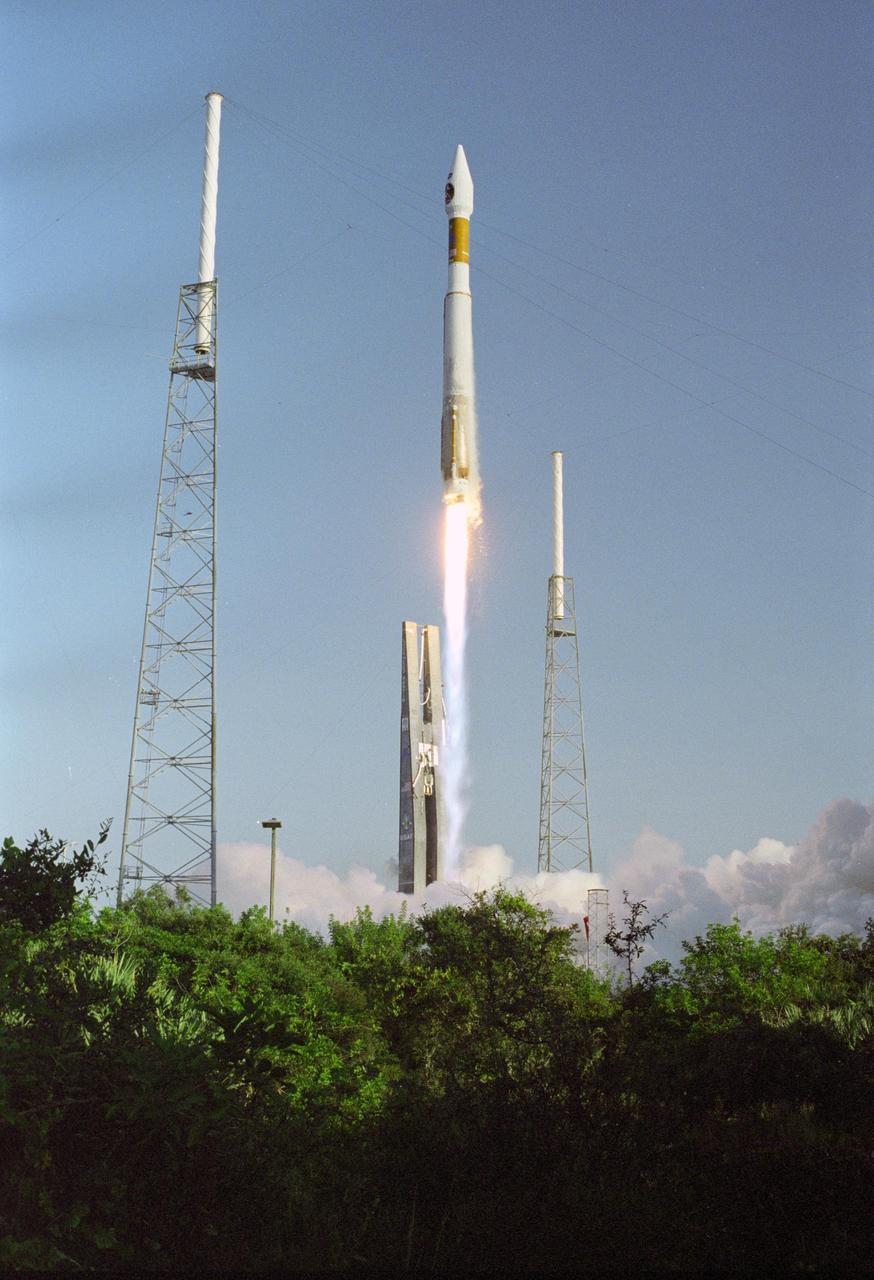
KENNEDY SPACE CENTER, FLA. - The 19-stories-tall Atlas V launch vehicle leaps above the trees near Launch Complex 41 at Cape Canaveral Air Force Station in Florida, propelling…
Inspect NASA record
KENNEDY SPACE CENTER, FLA. - The 19-stories-tall Atlas V launch vehicle leaps above the trees near Launch Complex 41 at Cape Canaveral Air Force Station in Florida, propelling the two-ton Mars Reconnaissance Orbiter (MRO) into a clear blue Florida sky and eventual orbit around Mars. Liftoff was at 7:43 a.m. EDT. All systems performed nominally for NASA's first launch of an Atlas V on an interplanetary mission. MRO established radio contact with controllers 61 minutes after launch and within four minutes of separation from the upper stage. Initial contact came through an antenna at the Japan Aerospace Exploration Agency's Uchinoura Space Center in southern Japan. Mars is 72 million miles from Earth today, but the spacecraft will travel more than four times that distance on its outbound-arc trajectory to intercept the red planet on March 10, 2006. The orbiter carries six scientific instruments for examining the surface, atmosphere and subsurface of Mars in unprecedented detail from low orbit. NASA expects to get several times more data about Mars from MRO than from all previous Martian missions combined. Researchers will use the instruments to learn more about the history and distribution of Mars' water. That information will improve understanding of planetary climate change and will help guide the quest to answer whether Mars ever supported life. The orbiter will also evaluate potential landing sites for future missions.
- Record ID
- KSC-05pp1882
- NASA center
- KSC
- Date
- 2005-08-12
- Keywords
- Mars, MRO, Mars Reconnaissance Orbiter, Atlas, CCAFS, LC-41, lau
GSFC · 2017-12-08 · GSFC_20171208_Archive_e000941
Hubble's View of Comet Siding Spring
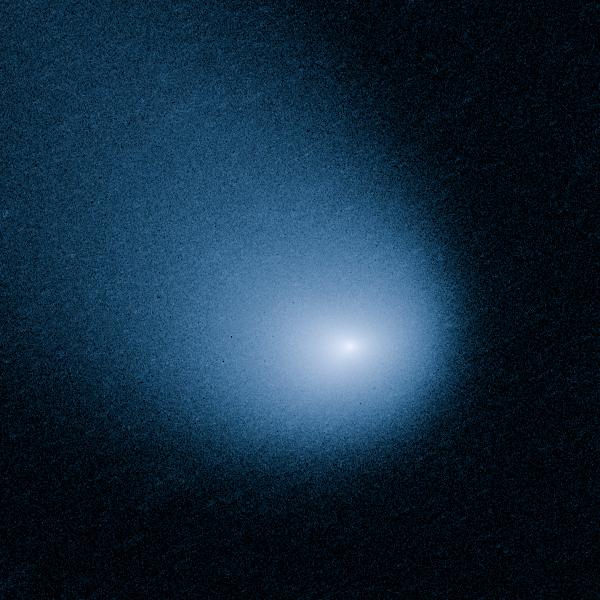
MARCH 27, 2014: Comet Siding Spring is plunging toward the Sun along a roughly 1-million-year orbit. The comet, discovered in 2013, was within the radius of Jupiter's orbit…
Inspect NASA record
MARCH 27, 2014: Comet Siding Spring is plunging toward the Sun along a roughly 1-million-year orbit. The comet, discovered in 2013, was within the radius of Jupiter's orbit when the Hubble Space Telescope photographed it on March 11, 2014. Hubble resolves two jets of dust coming from the solid icy nucleus. These persistent jets were first seen in Hubble pictures taken on Oct. 29, 2013. The feature should allow astronomers to measure the direction of the nucleus's pole, and hence, rotation axis. The comet will make its closest approach to our Sun on Oct. 25, 2014, at a distance of 130 million miles, well outside Earth's orbit. On its inbound leg, Comet Siding Spring will pass within 84,000 miles of Mars on Oct. 19, 2014, which is less than half the Moon's distance from Earth. The comet is not expected to become bright enough to be seen by the naked eye. Credit: NASA, ESA, and J.-Y. Li (Planetary Science Institute) NASA image use policy. NASA Goddard Space Flight Center enables NASA’s mission through four scientific endeavors: Earth Science, Heliophysics, Solar System Exploration, and Astrophysics. Goddard plays a leading role in NASA’s accomplishments by contributing compelling scientific knowledge to advance the Agency’s mission. Follow us on Twitter Like us on Facebook Find us on Instagram
- Record ID
- GSFC_20171208_Archive_e000941
- NASA center
- GSFC
- Date
- 2017-12-08
- Keywords
- Hubble's View of Comet Siding Spring, mars, space, nasa, hubble, nasagoddard, cometsidingspring
KSC · 2005-08-12 · KSC-05pp1875
KSC-05pp1875
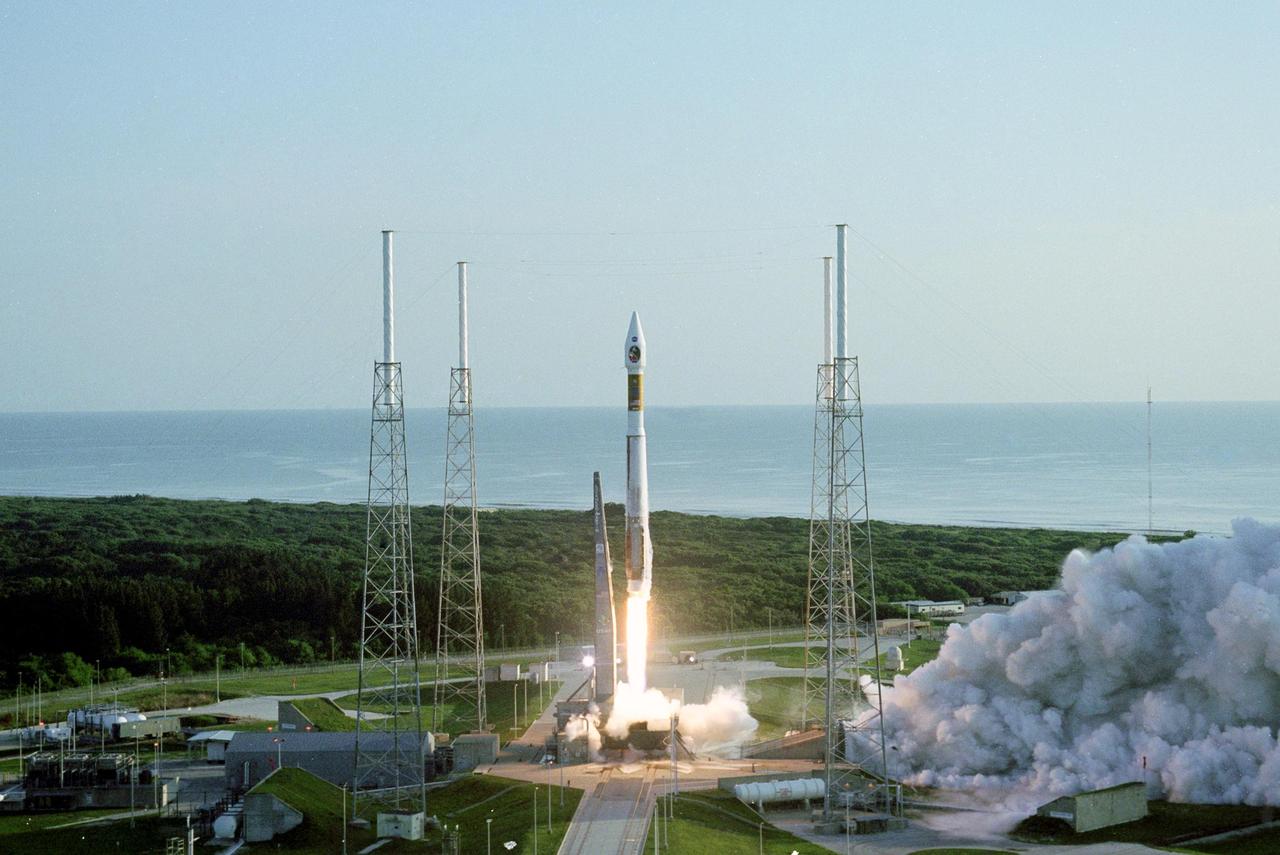
KENNEDY SPACE CENTER, FLA. - With the Atlantic Ocean as a backdrop, an Atlas V launch vehicle, 19 stories tall, with a two-ton Mars Reconnaissance Orbiter (MRO) on…
Inspect NASA record
KENNEDY SPACE CENTER, FLA. - With the Atlantic Ocean as a backdrop, an Atlas V launch vehicle, 19 stories tall, with a two-ton Mars Reconnaissance Orbiter (MRO) on top, roars away from Launch Complex 41 at Cape Canaveral Air Force Station at 7:43 a.m. EDT. All systems performed nominally for NASA's first launch of an Atlas V on an interplanetary mission. MRO established radio contact with controllers 61 minutes after launch and within four minutes of separation from the upper stage. Initial contact came through an antenna at the Japan Aerospace Exploration Agency's Uchinoura Space Center in southern Japan. Mars is 72 million miles from Earth today, but the spacecraft will travel more than four times that distance on its outbound-arc trajectory to intercept the red planet on March 10, 2006. The orbiter carries six scientific instruments for examining the surface, atmosphere and subsurface of Mars in unprecedented detail from low orbit. NASA expects to get several times more data about Mars from MRO than from all previous Martian missions combined. Researchers will use the instruments to learn more about the history and distribution of Mars' water. That information will improve understanding of planetary climate change and will help guide the quest to answer whether Mars ever supported life. The orbiter will also evaluate potential landing sites for future missions. (Photo Credit: Pat Corkery/Lockheed Martin)
- Record ID
- KSC-05pp1875
- NASA center
- KSC
- Date
- 2005-08-12
- Keywords
- Mars, MRO, Mars Reconnaissance Orbiter, Atlas, CCAFS, LC-41, lau
KSC · 2005-08-12 · KSC-05pp1877
KSC-05pp1877
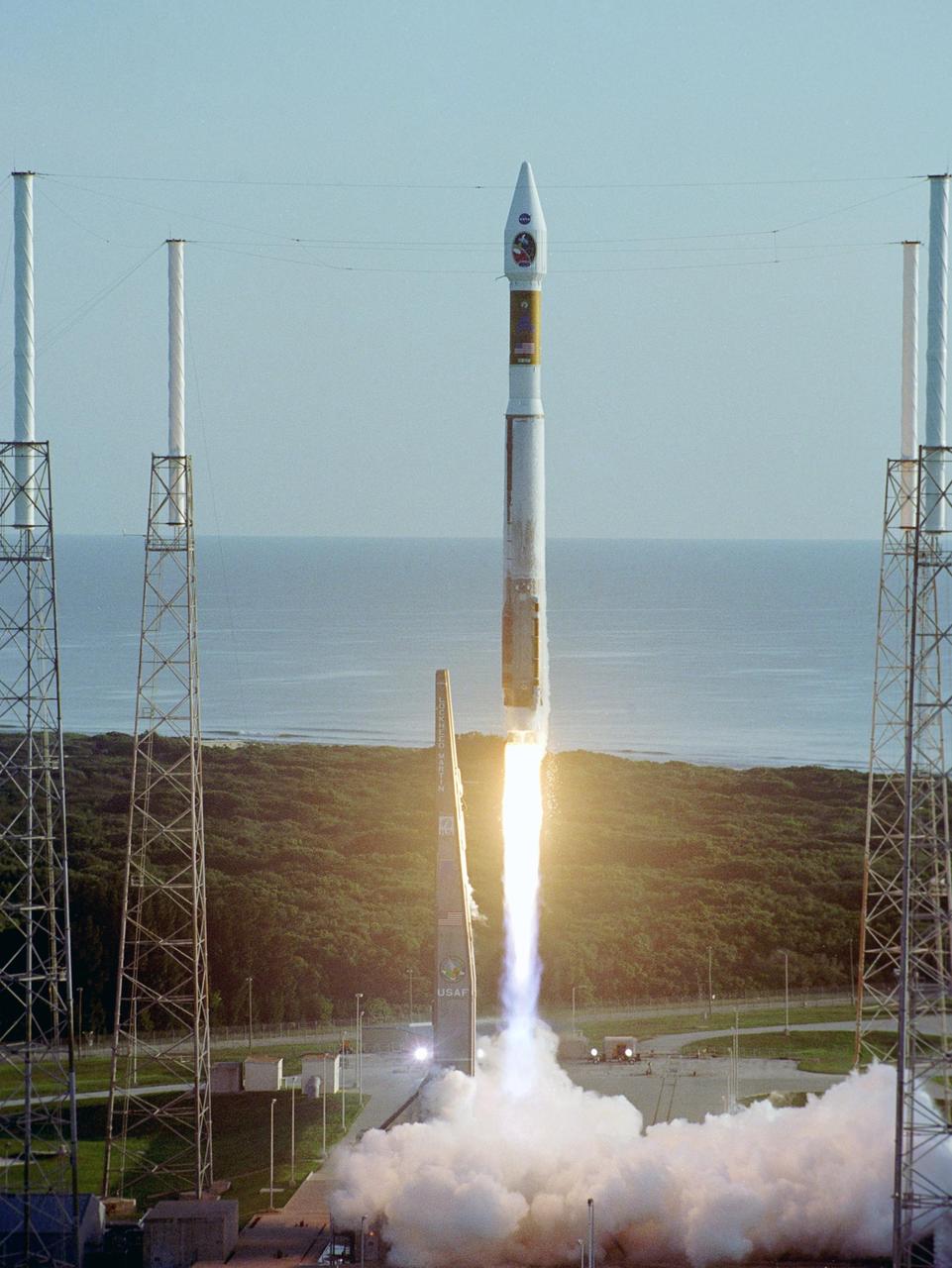
KENNEDY SPACE CENTER, FLA. - With the Atlantic Ocean as a backdrop, an Atlas V launch vehicle, 19 stories tall, with a two-ton Mars Reconnaissance Orbiter (MRO) on…
Inspect NASA record
KENNEDY SPACE CENTER, FLA. - With the Atlantic Ocean as a backdrop, an Atlas V launch vehicle, 19 stories tall, with a two-ton Mars Reconnaissance Orbiter (MRO) on top, roars away from Launch Complex 41 at Cape Canaveral Air Force Station at 7:43 a.m. EDT. All systems performed nominally for NASA's first launch of an Atlas V on an interplanetary mission. MRO established radio contact with controllers 61 minutes after launch and within four minutes of separation from the upper stage. Initial contact came through an antenna at the Japan Aerospace Exploration Agency's Uchinoura Space Center in southern Japan. Mars is 72 million miles from Earth today, but the spacecraft will travel more than four times that distance on its outbound-arc trajectory to intercept the red planet on March 10, 2006. The orbiter carries six scientific instruments for examining the surface, atmosphere and subsurface of Mars in unprecedented detail from low orbit. NASA expects to get several times more data about Mars from MRO than from all previous Martian missions combined. Researchers will use the instruments to learn more about the history and distribution of Mars' water. That information will improve understanding of planetary climate change and will help guide the quest to answer whether Mars ever supported life. The orbiter will also evaluate potential landing sites for future missions. (Photo Credit: Pat Corkery/Lockheed Martin)
- Record ID
- KSC-05pp1877
- NASA center
- KSC
- Date
- 2005-08-12
- Keywords
- Mars, MRO, Mars Reconnaissance Orbiter, Atlas, CCAFS, LC-41, lau