
Update Site (from NASA)
Explore NASA’s Image and Video Library.
Suggest one object per day for the Interstellar Minds collection. We review each suggestion before adding it.
Sign in to suggest a Marvel.
Find a NASA image ID. Open a NASA record and copy its ID from the end of the details URL.
NASA image records
KSC · 2014-03-14 · KSC-2014-1753
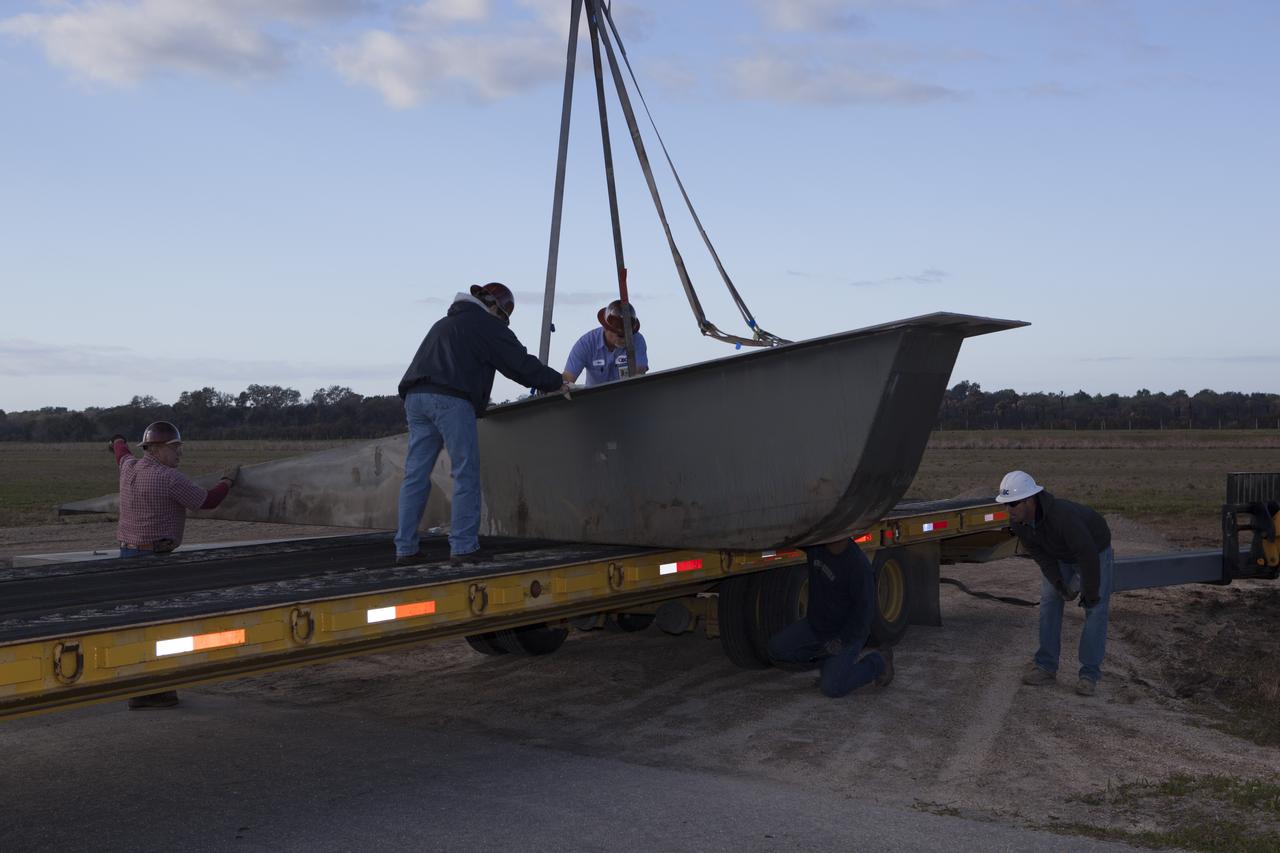
Morpheus Launch Pad Move
CAPE CANAVERAL, Fla. – Construction workers assist as a crane lowers a portion of the launch pad for the Project Morpheus prototype lander onto a transporter at the…
Inspect NASA record
CAPE CANAVERAL, Fla. – Construction workers assist as a crane lowers a portion of the launch pad for the Project Morpheus prototype lander onto a transporter at the north end of the Shuttle Landing Facility at NASA’s Kennedy Space Center in Florida. The launch pad is being moved to a different location at the landing facility to support the next phase of flight testing. Morpheus completed its seventh free flight test on March 11. The 83-second test began at 3:41 p.m. EDT with the Morpheus lander launching from the ground over a flame trench and ascending to 580 feet. Morpheus then flew its fastest downrange trek at 30 mph, travelling farther than before, 837 feet. The lander performed a 42-foot divert to emulate a hazard avoidance maneuver before descending and touching down on Landing Site 2, at the northern landing pad inside the automated landing and hazard avoidance technology ALHAT hazard field. Morpheus landed within one foot of its intended target. Project Morpheus tests NASA’s ALHAT and an engine that runs on liquid oxygen and methane, or green propellants, into a fully-operational lander that could deliver cargo to other planetary surfaces. The landing facility provides the lander with the kind of field necessary for realistic testing, complete with rocks, craters and hazards to avoid. Morpheus’ ALHAT payload allows it to navigate to clear landing sites amidst rocks, craters and other hazards during its descent. Project Morpheus is being managed under the Advanced Exploration Systems, or AES, Division in NASA’s Human Exploration and Operations Mission Directorate. The efforts in AES pioneer new approaches for rapidly developing prototype systems, demonstrating key capabilities and validating operational concepts for future human missions beyond Earth orbit. For more information on Project Morpheus, visit http://morpheuslander.jsc.nasa.gov/. Photo credit: NASA/Dimitri Gerondidakis
- Record ID
- KSC-2014-1753
- NASA center
- KSC
- Date
- 2014-03-14
- Credit
- NASA/KSC - Dimitri Gerondidakis
- Keywords
- KSC-2014-1753, Project Morpheus

KSC · 2014-04-02 · KSC-2014-1927
KSC-2014-1927
CAPE CANAVERAL, Fla. – Engineers and technicians prepare NASA's Project Morpheus prototype lander for a free flight test at a new launch site at the north end of…
Inspect NASA record
CAPE CANAVERAL, Fla. – Engineers and technicians prepare NASA's Project Morpheus prototype lander for a free flight test at a new launch site at the north end of the Shuttle Landing Facility at NASA’s Kennedy Space Center in Florida. The 96-second test began at 4:21 p.m. EDT with the Morpheus lander launching from the ground over the flame trench and ascending more than 800 feet at a peak speed of 36 mph. The vehicle with its recently installed autonomous landing and hazard avoidance technology, or ALHAT, sensors surveyed the hazard field to determine safe landing sites. Morpheus then flew forward and downward covering 1,300 feet while performing a 78-foot divert to simulate a hazard avoidance maneuver. The lander descended and landed on a dedicated pad inside the ALHAT field. Project Morpheus tests NASA’s ALHAT, and an engine that runs on liquid oxygen and methane, or green propellants, into a fully-operational lander that could deliver cargo to other planetary surfaces. The landing facility provides the lander with the kind of field necessary for realistic testing, complete with rocks, craters and hazards to avoid. Morpheus’ ALHAT payload allows it to navigate to clear landing sites amidst rocks, craters and other hazards during its descent. Project Morpheus is being managed under the Advanced Exploration Systems, or AES, Division in NASA’s Human Exploration and Operations Mission Directorate. The efforts in AES pioneer new approaches for rapidly developing prototype systems, demonstrating key capabilities and validating operational concepts for future human missions beyond Earth orbit. For more information on Project Morpheus, visit http://morpheuslander.jsc.nasa.gov/. Photo credit: NASA/Frankie Martin
- Record ID
- KSC-2014-1927
- NASA center
- KSC
- Date
- 2014-04-02
- Keywords
- SLF, ALHAT, launch pad, free flight test
KSC · 2014-04-30 · KSC-2014-2342
KSC-2014-2342
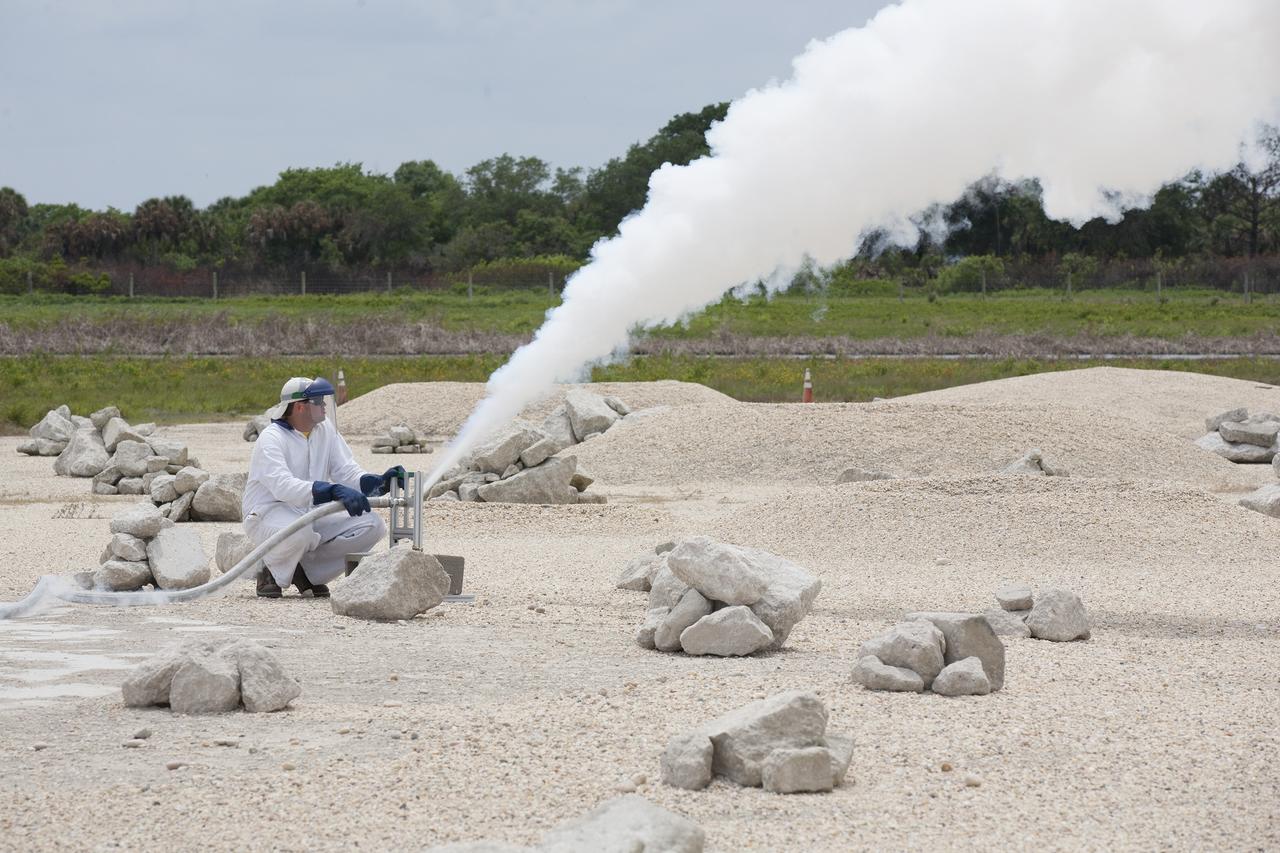
CAPE CANAVERAL, Fla. – A technician vents off the gas from the propellant lines of NASA's Project Morpheus prototype lander after it landed from a free-flight test at…
Inspect NASA record
CAPE CANAVERAL, Fla. – A technician vents off the gas from the propellant lines of NASA's Project Morpheus prototype lander after it landed from a free-flight test at the north end of the Shuttle Landing Facility at NASA's Kennedy Space Center in Florida. The 98-second test began at 1:57 p.m. EDT with the Morpheus lander launching from the ground over a flame trench and ascending more than 800 feet at a peak speed of 36 mph. The vehicle, with its recently installed autonomous landing and hazard avoidance technology, or ALHAT, sensors surveyed the hazard field to determine safe landing sites. Morpheus then flew forward and downward covering approximately 1300 feet while performing a 78-foot divert to simulate a hazard avoidance maneuver. The lander descended and landed on a dedicated pad inside the ALHAT hazard field. Project Morpheus tests NASA’s ALHAT and an engine that runs on liquid oxygen and methane, which are green propellants. These new capabilities could be used in future efforts to deliver cargo to planetary surfaces. The landing facility provides the lander with the kind of field necessary for realistic testing, complete with rocks, craters and hazards to avoid. Morpheus’ ALHAT payload allows it to navigate to clear landing sites amidst rocks, craters and other hazards during its descent. Project Morpheus is being managed under the Advanced Exploration Systems, or AES, Division in NASA’s Human Exploration and Operations Mission Directorate. The efforts in AES pioneer new approaches for rapidly developing prototype systems, demonstrating key capabilities and validating operational concepts for future human missions beyond Earth orbit. For more information on Project Morpheus, visit http://morpheuslander.jsc.nasa.gov/. Photo credit: NASA/Kim Shiflett
- Record ID
- KSC-2014-2342
- NASA center
- KSC
- Date
- 2014-04-30
- Keywords
- SLF, ALHAT, launch pad, free flight test
KSC · 2014-05-28 · KSC-2014-2711
KSC-2014-2711
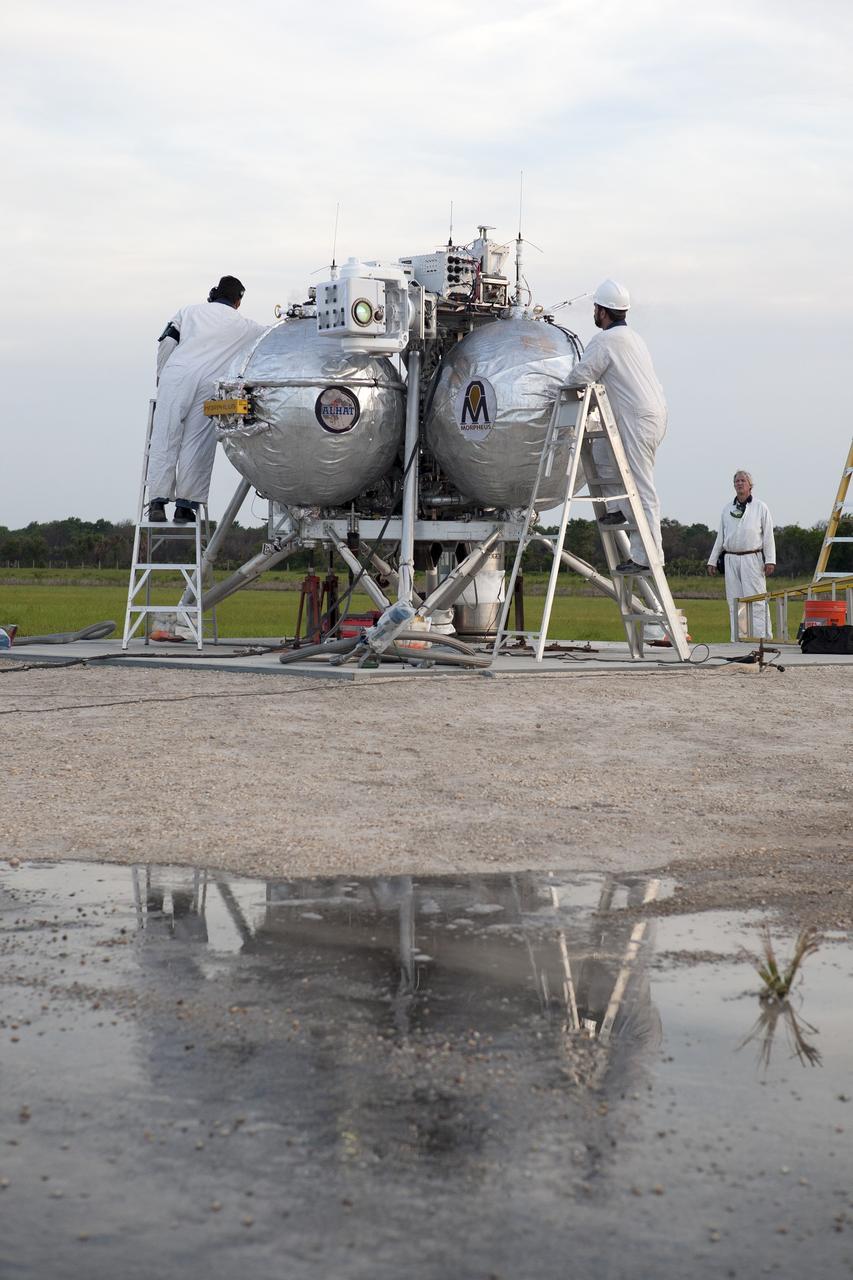
CAPE CANAVERAL, Fla. -- Technicians check the systems on NASA's Project Morpheus prototype lander in preparation for the first free flight test at night from a launch pad…
Inspect NASA record
CAPE CANAVERAL, Fla. -- Technicians check the systems on NASA's Project Morpheus prototype lander in preparation for the first free flight test at night from a launch pad at the north end of the Shuttle Landing Facility at NASA's Kennedy Space Center in Florida. The 98-second test began at 10:02 p.m. EDT with the Morpheus lander launching from the ground over a flame trench and ascending more than 800 feet. The vehicle, with its autonomous landing and hazard avoidance technology, or ALHAT sensors, surveyed the hazard field to determine safe landing sites. Morpheus then flew forward and downward covering approximately 1,300 feet while performing a 78-foot divert to simulate a hazard avoidance maneuver. The lander then descended and landed on a dedicated pad inside the test field. Project Morpheus tests NASA’s ALHAT and an engine that runs on liquid oxygen and methane, which are green propellants. These new capabilities could be used in future efforts to deliver cargo to planetary surfaces. The landing facility provides the lander with the kind of field necessary for realistic testing, complete with rocks, craters and hazards to avoid. Morpheus’ ALHAT payload allows it to navigate to clear landing sites amidst rocks, craters and other hazards during its descent. Project Morpheus is being managed under the Advanced Exploration Systems, or AES, Division in NASA’s Human Exploration and Operations Mission Directorate. The efforts in AES pioneer new approaches for rapidly developing prototype systems, demonstrating key capabilities and validating operational concepts for future human missions beyond Earth orbit. For more information on Project Morpheus, visit http://morpheuslander.jsc.nasa.gov/. Photo credit: NASA/Kim Shiflett
- Record ID
- KSC-2014-2711
- NASA center
- KSC
- Date
- 2014-05-28
- Keywords
- SLF, ALHAT, launch pad, free flight test
KSC · 2013-12-10 · KSC-2013-4324
KSC-2013-4324
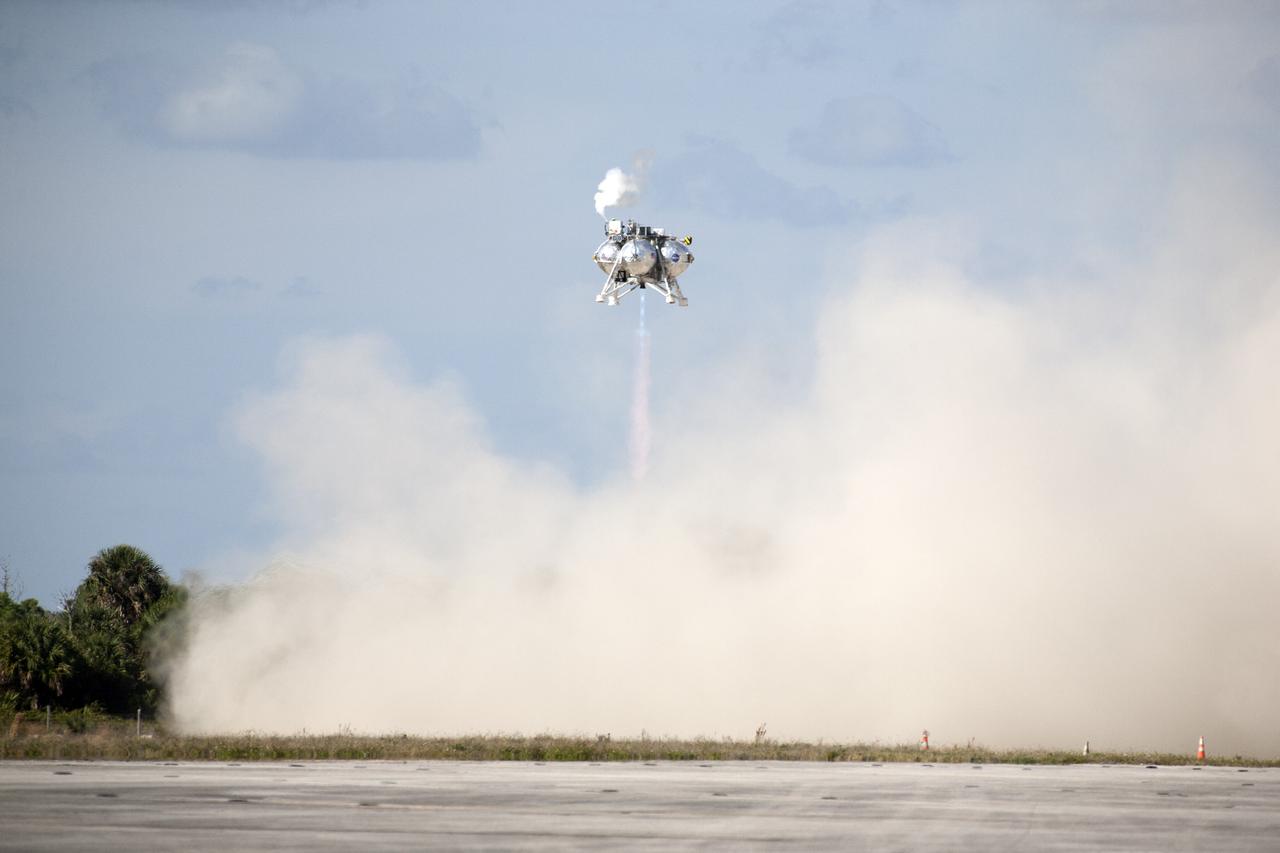
CAPE CANAVERAL, Fla. – The first free flight of the Project Morpheus prototype lander was conducted at the Shuttle Landing Facility at NASA’s Kennedy Space Center in Florida.…
Inspect NASA record
CAPE CANAVERAL, Fla. – The first free flight of the Project Morpheus prototype lander was conducted at the Shuttle Landing Facility at NASA’s Kennedy Space Center in Florida. Smoke fills the air as the engine fires and the Morpheus lander launched from the ground over a flame trench. During the 54-second test, it ascended approximately 50 feet, and hovered for about 15 seconds. The lander then flew forward and landed on its pad about 23 feet from the launch point. Testing of the prototype lander was performed at NASA’s Johnson Space Center in Houston in preparation for tethered and free flight testing at Kennedy. Project Morpheus integrates NASA’s automated landing and hazard avoidance technology, or ALHAT, with an engine that runs on liquid oxygen and methane, or green propellants, into a fully-operational lander that could deliver cargo to asteroids and other planetary surfaces. The landing facility will provide the lander with the kind of field necessary for realistic testing, complete with rocks, craters and hazards to avoid. Morpheus’ ALHAT payload allows it to navigate to clear landing sites amidst rocks, craters and other hazards during its descent. Project Morpheus is being managed under the Advanced Exploration Systems, or AES, Division in NASA’s Human Exploration and Operations Mission Directorate. The efforts in AES pioneer new approaches for rapidly developing prototype systems, demonstrating key capabilities and validating operational concepts for future human missions beyond Earth orbit. For more information on Project Morpheus, visit http://morpheuslander.jsc.nasa.gov. Photo credit: NASA/Kim Shiflett
- Record ID
- KSC-2013-4324
- NASA center
- KSC
- Date
- 2013-12-10
- Keywords
- SLF, ALHAT, free flight test
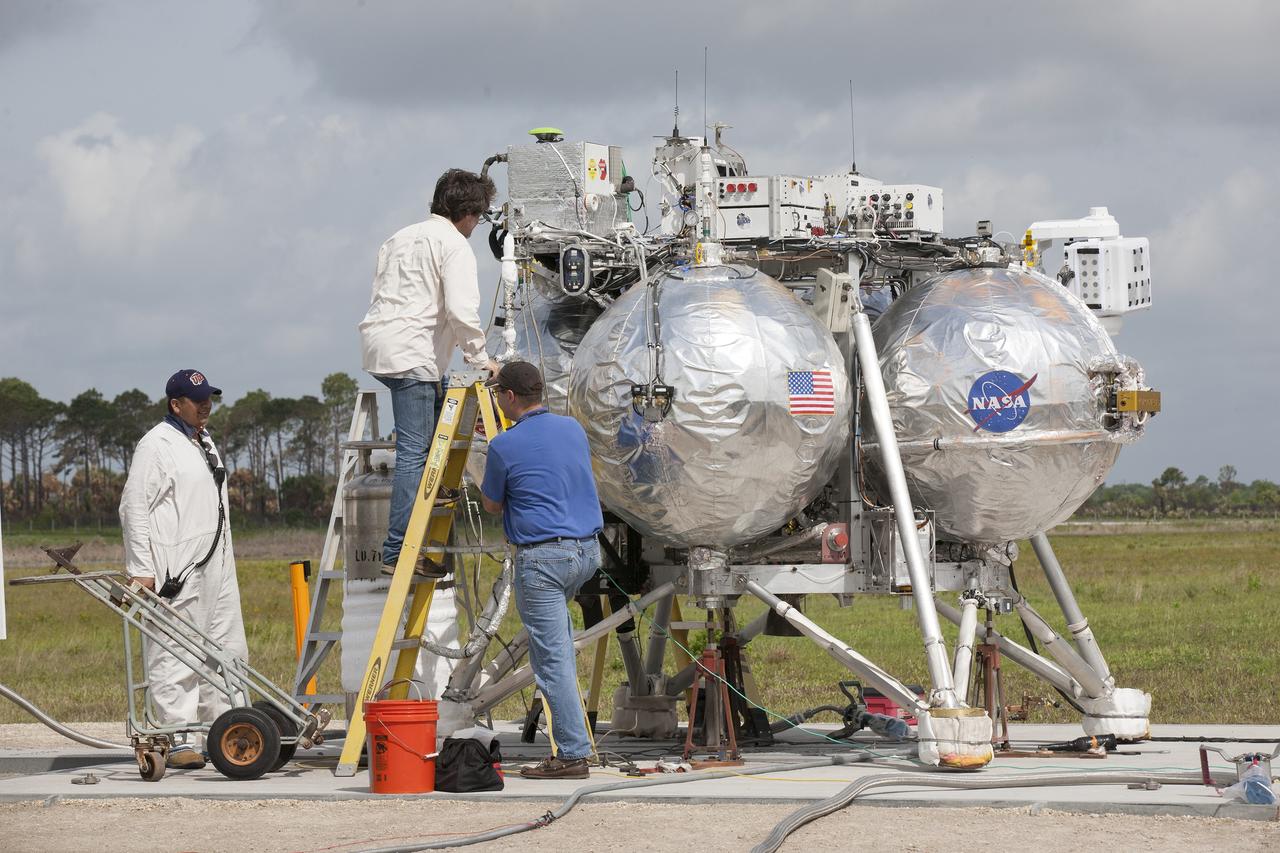
KSC · 2014-04-30 · KSC-2014-2337
KSC-2014-2337
CAPE CANAVERAL, Fla. – Technicians and engineers prepare NASA's Project Morpheus prototype lander for a free-flight test from a new launch pad at the north end of the…
Inspect NASA record
CAPE CANAVERAL, Fla. – Technicians and engineers prepare NASA's Project Morpheus prototype lander for a free-flight test from a new launch pad at the north end of the Shuttle Landing Facility at NASA’s Kennedy Space Center in Florida. The 98-second test began at 1:57 p.m. EDT with the Morpheus lander launching from the ground over a flame trench and ascending more than 800 feet at a peak speed of 36 mph. The vehicle, with its recently installed autonomous landing and hazard avoidance technology, or ALHAT, sensors surveyed the hazard field to determine safe landing sites. Morpheus then flew forward and downward covering approximately 1300 feet while performing a 78-foot divert to simulate a hazard avoidance maneuver. The lander descended and landed on a dedicated pad inside the ALHAT hazard field. Project Morpheus tests NASA’s ALHAT and an engine that runs on liquid oxygen and methane, which are green propellants. These new capabilities could be used in future efforts to deliver cargo to planetary surfaces. The landing facility provides the lander with the kind of field necessary for realistic testing, complete with rocks, craters and hazards to avoid. Morpheus’ ALHAT payload allows it to navigate to clear landing sites amidst rocks, craters and other hazards during its descent. Project Morpheus is being managed under the Advanced Exploration Systems, or AES, Division in NASA’s Human Exploration and Operations Mission Directorate. The efforts in AES pioneer new approaches for rapidly developing prototype systems, demonstrating key capabilities and validating operational concepts for future human missions beyond Earth orbit. For more information on Project Morpheus, visit http://morpheuslander.jsc.nasa.gov/. Photo credit: NASA/Kim Shiflett
- Record ID
- KSC-2014-2337
- NASA center
- KSC
- Date
- 2014-04-30
- Keywords
- SLF, ALHAT, launch pad, free flight test
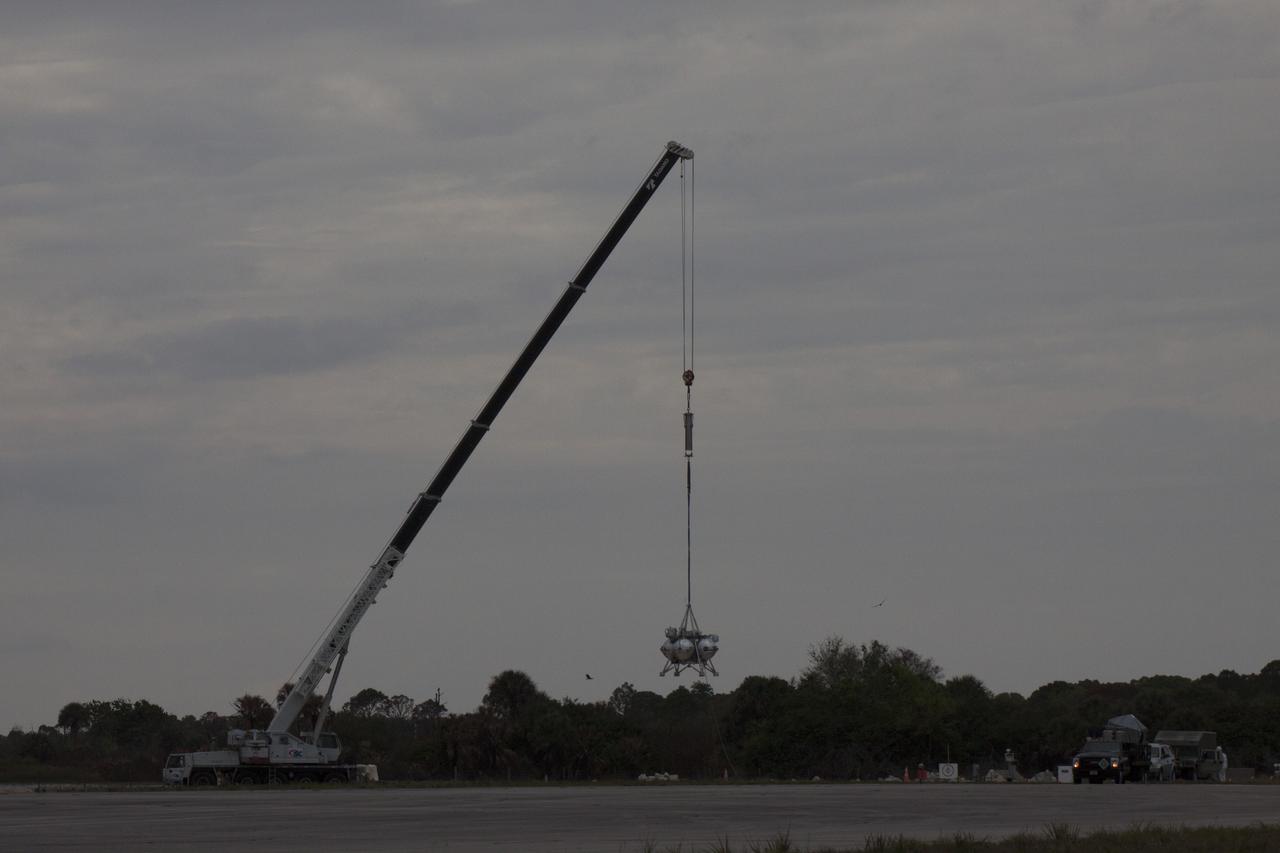
KSC · 2014-03-27 · KSC-2014-1879
Morpheus Campaign 2A Tether Test
CAPE CANAVERAL, Fla. – NASA's Project Morpheus prototype lander is lifted by crane for a tethered test near a new launch site at the north end of the…
Inspect NASA record
CAPE CANAVERAL, Fla. – NASA's Project Morpheus prototype lander is lifted by crane for a tethered test near a new launch site at the north end of the Shuttle Landing Facility at NASA’s Kennedy Space Center in Florida. The launch pad was moved to a different location at the landing facility to support the next phase of flight testing. The test was performed to verify the lander's recently installed autonomous landing and hazard avoidance technology, or ALHAT, sensors and integration systems. During the test, Morpheus was lifted by crane to 20 feet for an engine firing of about 74 seconds and then lowered to the ground. With the successful completion of the test, the Morpheus project team will begin preparing for the first free flight test with ALHAT. Morpheus tests NASA’s ALHAT, and an engine that runs on liquid oxygen and methane, or green propellants, into a fully-operational lander that could deliver cargo to other planetary surfaces. The landing facility provides the lander with the kind of field necessary for realistic testing, complete with rocks, craters and hazards to avoid. Morpheus’ ALHAT payload allows it to navigate to clear landing sites amidst rocks, craters and other hazards during its descent. Project Morpheus is being managed under the Advanced Exploration Systems, or AES, Division in NASA’s Human Exploration and Operations Mission Directorate. The efforts in AES pioneer new approaches for rapidly developing prototype systems, demonstrating key capabilities and validating operational concepts for future human missions beyond Earth orbit. For more information on Project Morpheus, visit http://morpheuslander.jsc.nasa.gov/. Photo credit: NASA/Glenn Benson
- Record ID
- KSC-2014-1879
- NASA center
- KSC
- Date
- 2014-03-27
- Credit
- NASA/KSC - Glenn Benson (IMCS)
- Keywords
- KSC-2014-1879, Project Morpheus, ALHAT
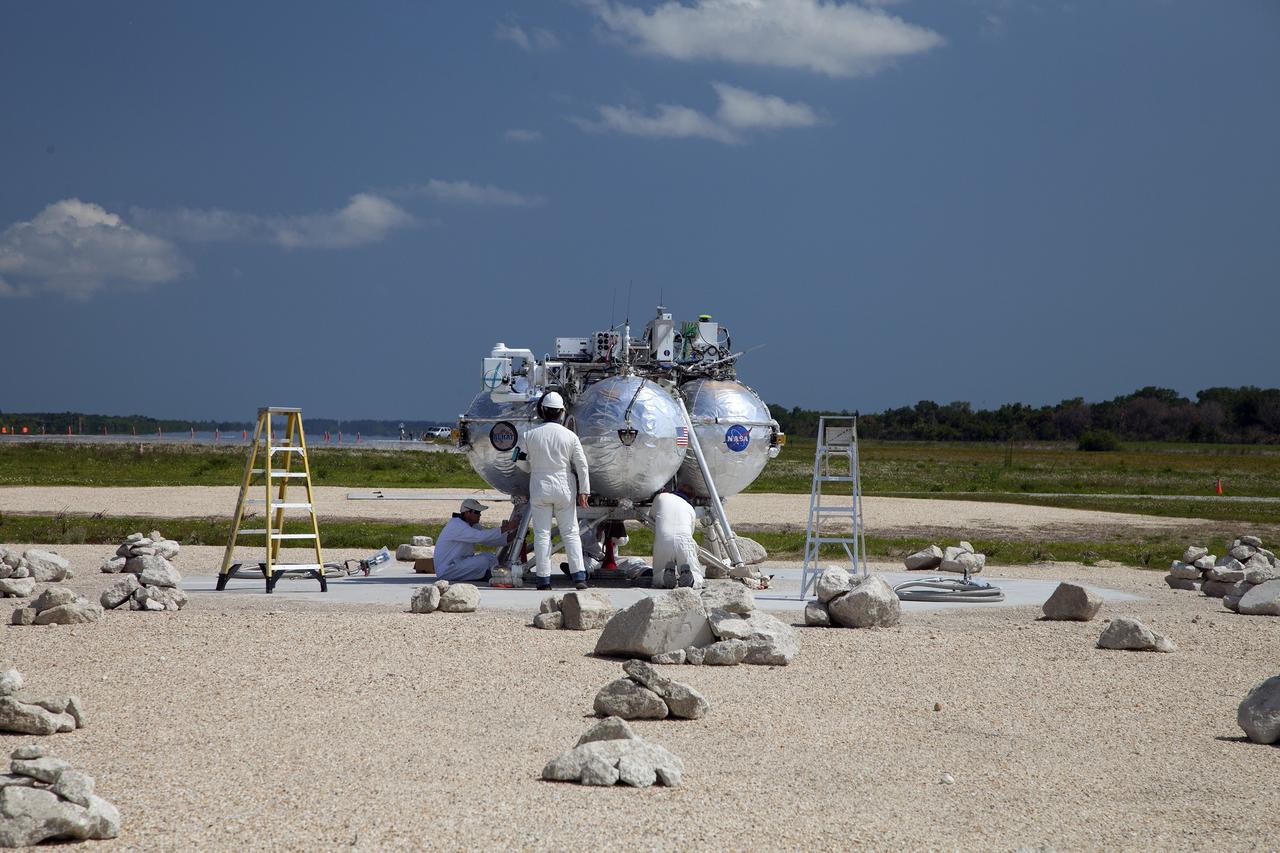
KSC · 2014-04-24 · KSC-2014-2283
KSC-2014-2283
CAPE CANAVERAL, Fla. – Technicians and engineers prepare NASA's Project Morpheus prototype lander for a free flight test from a new launch pad at the north end of…
Inspect NASA record
CAPE CANAVERAL, Fla. – Technicians and engineers prepare NASA's Project Morpheus prototype lander for a free flight test from a new launch pad at the north end of the Shuttle Landing Facility at NASA's Kennedy Space Center in Florida. The 98-second test began at 3:20 p.m. EDT with the Morpheus lander launching from the ground over a flame trench and ascending more than 800 feet at a peak speed of 36 mph. The vehicle, with its recently installed autonomous landing and hazard avoidance technology ALHAT sensors, surveyed the hazard field to determine safe landing sites. Morpheus then flew forward and downward covering approximately 1300 feet while performing a 78-foot divert to simulate a hazard avoidance maneuver. The lander then descended and landed on a dedicated pad inside the autonomous landing and hazard avoidance technology hazard field. Project Morpheus tests NASA’s ALHAT and an engine that runs on liquid oxygen and methane, which are green propellants. These new capabilities could be used in future efforts to deliver cargo to planetary surfaces. The landing facility provides the lander with the kind of field necessary for realistic testing, complete with rocks, craters and hazards to avoid. Morpheus’ ALHAT payload allows it to navigate to clear landing sites amidst rocks, craters and other hazards during its descent. Project Morpheus is being managed under the Advanced Exploration Systems, or AES, Division in NASA’s Human Exploration and Operations Mission Directorate. The efforts in AES pioneer new approaches for rapidly developing prototype systems, demonstrating key capabilities and validating operational concepts for future human missions beyond Earth orbit. For more information on Project Morpheus, visit http://morpheuslander.jsc.nasa.gov/. Photo credit: NASA/Daniel Casper
- Record ID
- KSC-2014-2283
- NASA center
- KSC
- Date
- 2014-04-24
- Keywords
- SLF, ALHAT, launch pad, free flight test
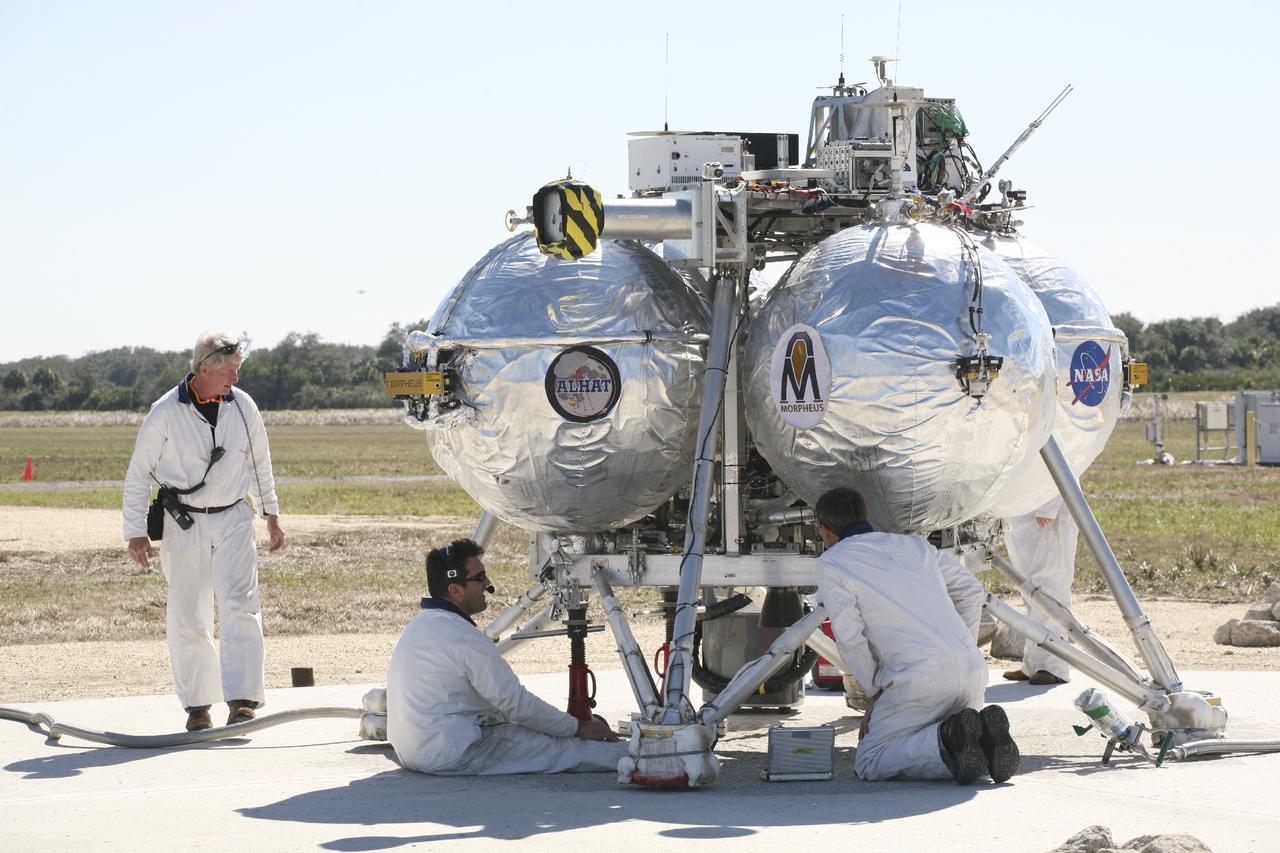
KSC · 2014-02-10 · 2014-1360
KSC-2014-1360
CAPE CANAVERAL, Fla. – Technicians and engineers check the Project Morpheus prototype lander after it lands on a dedicated pad inside the autonomous landing and hazard avoidance technology,…
Inspect NASA record
CAPE CANAVERAL, Fla. – Technicians and engineers check the Project Morpheus prototype lander after it lands on a dedicated pad inside the autonomous landing and hazard avoidance technology, or ALHAT, hazard field at the north end of the Shuttle Landing Facility at NASA’s Kennedy Space Center in Florida. Morpheus launched from the ground over a flame trench on its fifth free flight test at around 1 p.m. EST. It ascended 467 feet, more than 160 feet higher than its last test. Morpheus flew forward, covering 637 feet in 30 seconds before descending on target. Project Morpheus tests NASA’s ALHAT and an engine that runs on liquid oxygen and methane, or green propellants, into a fully-operational lander that could deliver cargo to other planetary surfaces. The landing facility provides the lander with the kind of field necessary for realistic testing, complete with rocks, craters and hazards to avoid. Morpheus’ ALHAT payload will allow it to navigate to clear landing sites amidst rocks, craters and other hazards during its descent. Project Morpheus is being managed under the Advanced Exploration Systems, or AES, Division in NASA’s Human Exploration and Operations Mission Directorate. The efforts in AES pioneer new approaches for rapidly developing prototype systems, demonstrating key capabilities and validating operational concepts for future human missions beyond Earth orbit. For more information, visit http:__morpheuslander.jsc.nasa.gov. Photo credit: NASA_Kim Shiflett
- Record ID
- 2014-1360
- NASA center
- KSC
- Date
- 2014-02-10
- Credit
- NASA_Kim Shiflett
- Keywords
- SLF, ALHAT, free_flight_test
KSC · 2013-12-10 · KSC-2013-4328
KSC-2013-4328
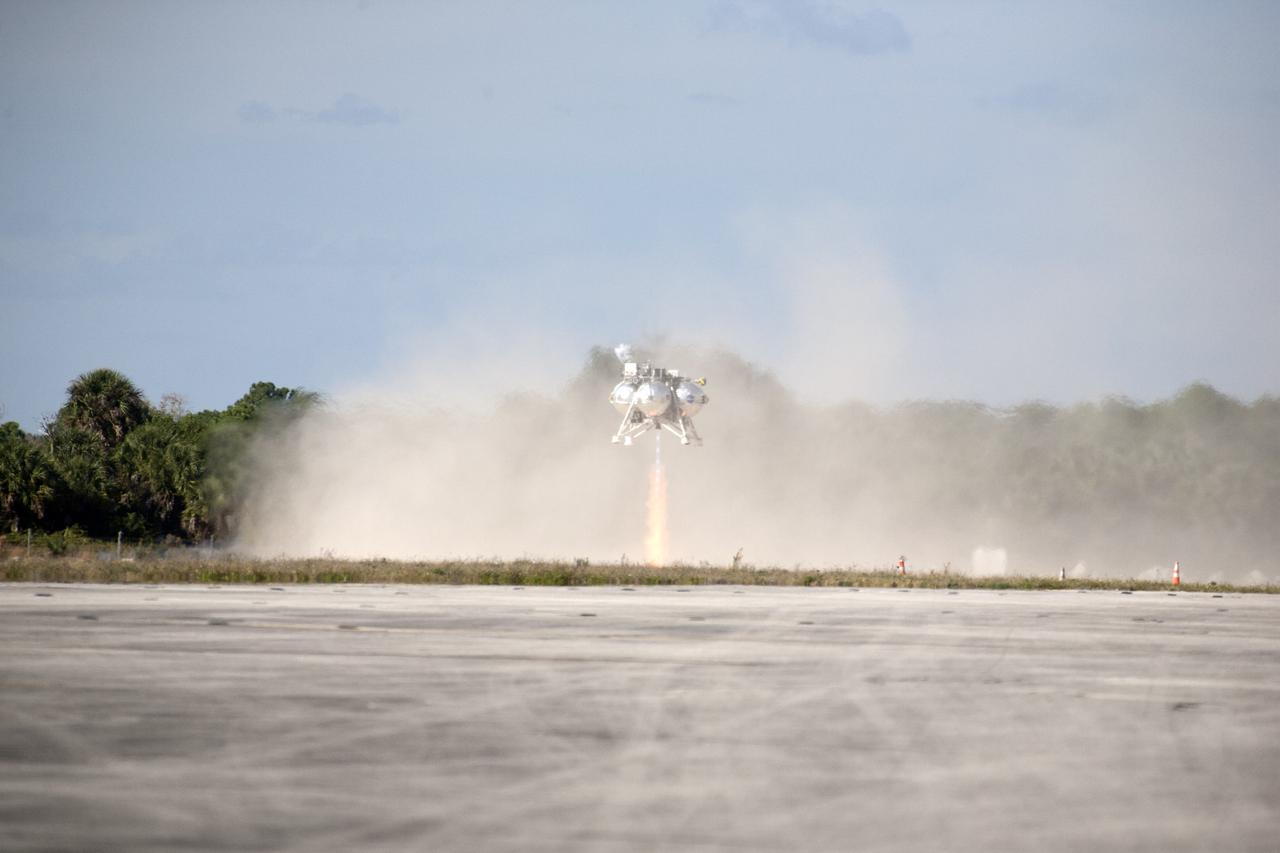
CAPE CANAVERAL, Fla. – The first free flight of the Project Morpheus prototype lander was conducted at the Shuttle Landing Facility at NASA’s Kennedy Space Center in Florida.…
Inspect NASA record
CAPE CANAVERAL, Fla. – The first free flight of the Project Morpheus prototype lander was conducted at the Shuttle Landing Facility at NASA’s Kennedy Space Center in Florida. Smoke filled the air as the engine fired and the Morpheus lander launched from the ground over a flame trench. During the 54-second test, it ascended approximately 50 feet, and hovered for about 15 seconds. The lander then flew forward and landed on its pad about 23 feet from the launch point. Testing of the prototype lander was performed at NASA’s Johnson Space Center in Houston in preparation for tethered and free flight testing at Kennedy. Project Morpheus integrates NASA’s automated landing and hazard avoidance technology, or ALHAT, with an engine that runs on liquid oxygen and methane, or green propellants, into a fully-operational lander that could deliver cargo to asteroids and other planetary surfaces. The landing facility will provide the lander with the kind of field necessary for realistic testing, complete with rocks, craters and hazards to avoid. Morpheus’ ALHAT payload allows it to navigate to clear landing sites amidst rocks, craters and other hazards during its descent. Project Morpheus is being managed under the Advanced Exploration Systems, or AES, Division in NASA’s Human Exploration and Operations Mission Directorate. The efforts in AES pioneer new approaches for rapidly developing prototype systems, demonstrating key capabilities and validating operational concepts for future human missions beyond Earth orbit. For more information on Project Morpheus, visit http://morpheuslander.jsc.nasa.gov. Photo credit: NASA/Kim Shiflett
- Record ID
- KSC-2013-4328
- NASA center
- KSC
- Date
- 2013-12-10
- Keywords
- SLF, ALHAT, free flight test

KSC · 2014-04-30 · KSC-2014-2327
KSC-2014-2327
CAPE CANAVERAL, Fla. – NASA's Project Morpheus prototype lander begins to lift off on a free-flight test from a new launch pad at the north end of the…
Inspect NASA record
CAPE CANAVERAL, Fla. – NASA's Project Morpheus prototype lander begins to lift off on a free-flight test from a new launch pad at the north end of the Shuttle Landing Facility at NASA’s Kennedy Space Center in Florida. The 98-second test began at 1:57 p.m. EDT with the Morpheus lander launching from the ground over a flame trench and ascending more than 800 feet at a peak speed of 36 mph. The vehicle, with its recently installed autonomous landing and hazard avoidance technology, or ALHAT, sensors surveyed the hazard field to determine safe landing sites. Morpheus then flew forward and downward covering approximately 1300 feet while performing a 78-foot divert to simulate a hazard avoidance maneuver. The lander descended and landed on a dedicated pad inside the ALHAT hazard field. Project Morpheus tests NASA’s ALHAT and an engine that runs on liquid oxygen and methane, which are green propellants. These new capabilities could be used in future efforts to deliver cargo to planetary surfaces. The landing facility provides the lander with the kind of field necessary for realistic testing, complete with rocks, craters and hazards to avoid. Morpheus’ ALHAT payload allows it to navigate to clear landing sites amidst rocks, craters and other hazards during its descent. Project Morpheus is being managed under the Advanced Exploration Systems, or AES, Division in NASA’s Human Exploration and Operations Mission Directorate. The efforts in AES pioneer new approaches for rapidly developing prototype systems, demonstrating key capabilities and validating operational concepts for future human missions beyond Earth orbit. For more information on Project Morpheus, visit http://morpheuslander.jsc.nasa.gov/. Photo credit: NASA/Frankie Martin
- Record ID
- KSC-2014-2327
- NASA center
- KSC
- Date
- 2014-04-30
KSC · 2014-03-11 · KSC-2014-1703
Morpheus 1C preps & post launch activities
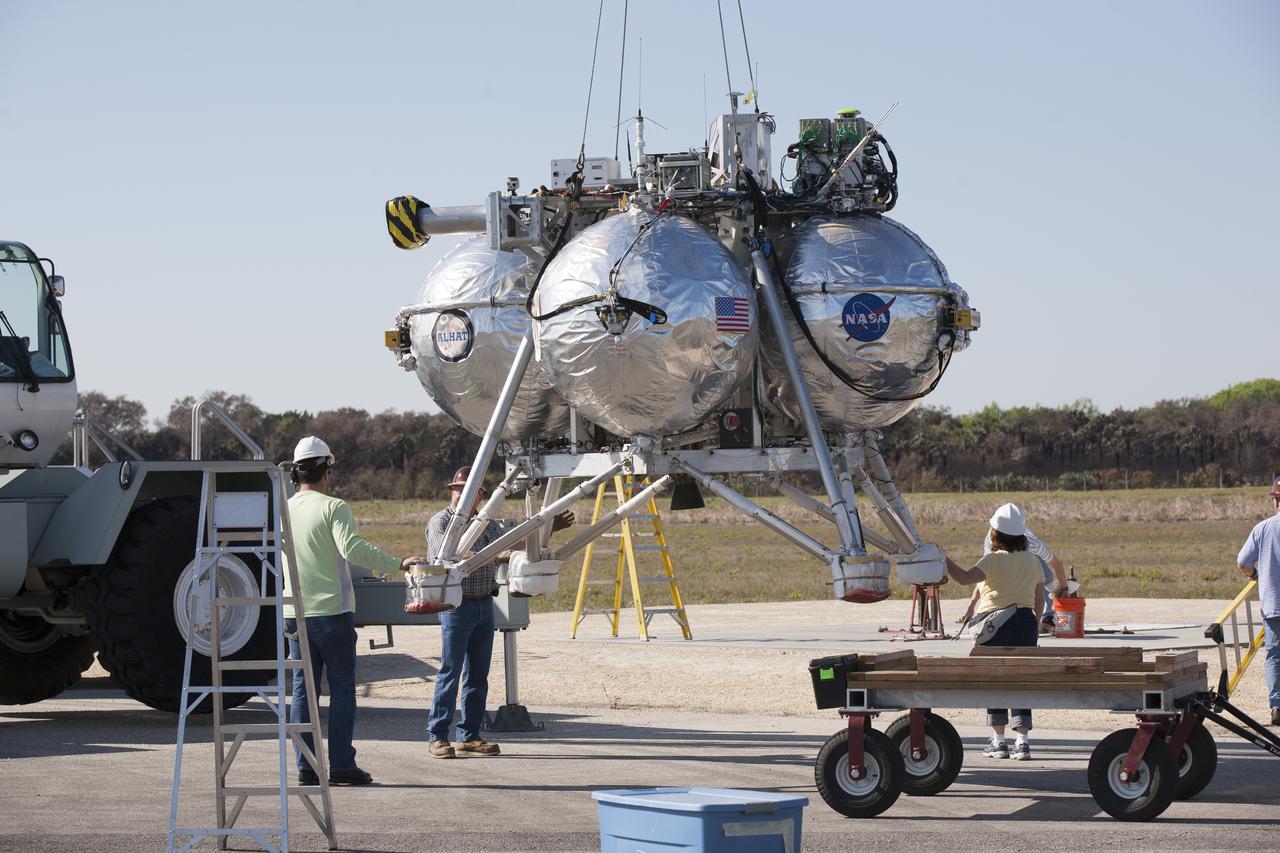
CAPE CANAVERAL, Fla. - Engineers and technicians assist as a crane lowers the Project Morpheus prototype lander in preparation for its seventh free flight test at the north…
Inspect NASA record
CAPE CANAVERAL, Fla. - Engineers and technicians assist as a crane lowers the Project Morpheus prototype lander in preparation for its seventh free flight test at the north end of the Shuttle Landing Facility at NASA’s Kennedy Space Center in Florida. The 83-second test began at 3:41 p.m. EDT with the Morpheus lander launching from the ground over a flame trench and ascending to 580 feet, its highest to date. Morpheus then flew its fastest downrange trek at 30 mph, travelling farther than before, 837 feet. The lander performed a 42-foot divert to emulate a hazard avoidance maneuver before descending and touching down on Landing Site 2, at the northern landing pad inside the automated landing and hazard avoidance technology ALHAT hazard field. Morpheus landed within one foot of its intended target. Project Morpheus tests NASA’s ALHAT and an engine that runs on liquid oxygen and methane, or green propellants, into a fully-operational lander that could deliver cargo to other planetary surfaces. The landing facility provides the lander with the kind of field necessary for realistic testing, complete with rocks, craters and hazards to avoid. Morpheus’ ALHAT payload allows it to navigate to clear landing sites amidst rocks, craters and other hazards during its descent. Project Morpheus is being managed under the Advanced Exploration Systems, or AES, Division in NASA’s Human Exploration and Operations Mission Directorate. The efforts in AES pioneer new approaches for rapidly developing prototype systems, demonstrating key capabilities and validating operational concepts for future human missions beyond Earth orbit. For more information on Project Morpheus, visit http://morpheuslander.jsc.nasa.gov/. Photo credit: NASA/Kim Shiflett
- Record ID
- KSC-2014-1703
- NASA center
- KSC
- Date
- 2014-03-11
- Credit
- NASA/KSC - Kim Shiflett (IMCS)
- Keywords
- KSC-2014-1703, Project Morpheus