
Update Site (from NASA)
Explore NASA’s Image and Video Library.
Suggest one object per day for the Interstellar Minds collection. We review each suggestion before adding it.
Sign in to suggest a Marvel.
Find a NASA image ID. Open a NASA record and copy its ID from the end of the details URL.
NASA image records
KSC · 2014-01-17 · KSC-2014-1088
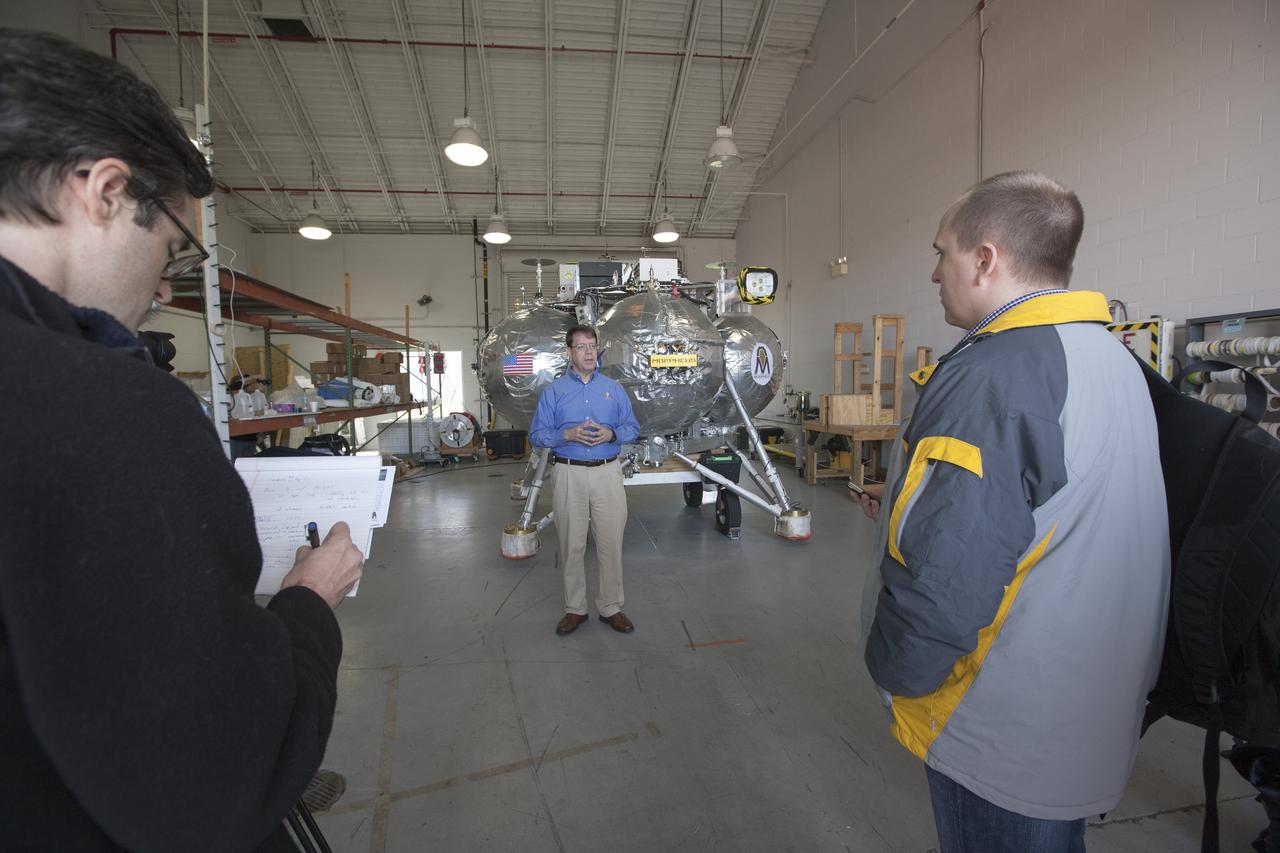
Morpheus Media Press Event
CAPE CANAVERAL, Fla. – Members of the news media view the Project Morpheus prototype lander inside a hangar near the Shuttle Landing Facility at NASA’s Kennedy Space Center…
Inspect NASA record
CAPE CANAVERAL, Fla. – Members of the news media view the Project Morpheus prototype lander inside a hangar near the Shuttle Landing Facility at NASA’s Kennedy Space Center in Florida. Speaking to the media is Greg Gaddis, the Kennedy Morpheus and ALHAT site manager. Morpheus successfully completed its third free flight test Jan. 16. The 57-second test began at 1:15 p.m. EST with the Morpheus lander launching from the ground over a flame trench and ascending about 187 feet, nearly doubling the target ascent velocity from the last test in December 2013. The lander flew forward, covering about 154 feet in 20 seconds before descending and landing within 11 inches of its target on a dedicated pad inside the autonomous landing and hazard avoidance technology, or ALHAT, hazard field. Project Morpheus tests NASA’s ALHAT and an engine that runs on liquid oxygen and methane, or green propellants, into a fully-operational lander that could deliver cargo to other planetary surfaces. The landing facility provides the lander with the kind of field necessary for realistic testing, complete with rocks, craters and hazards to avoid. Morpheus’ ALHAT payload allows it to navigate to clear landing sites amidst rocks, craters and other hazards during its descent. Project Morpheus is being managed under the Advanced Exploration Systems, or AES, Division in NASA’s Human Exploration and Operations Mission Directorate. The efforts in AES pioneer new approaches for rapidly developing prototype systems, demonstrating key capabilities and validating operational concepts for future human missions beyond Earth orbit. For more information on Project Morpheus, visit http://www.nasa.gov/centers/johnson/exploration/morpheus. Photo credit: NASA/Kim Shiflett
- Record ID
- KSC-2014-1088
- NASA center
- KSC
- Date
- 2014-01-17
- Credit
- NASA/KSC - KIM SHIFLETT (IMCS)
- Keywords
- KSC-2014-1088, Greg Gaddis
KSC · 2014-01-16 · KSC-2014-1070
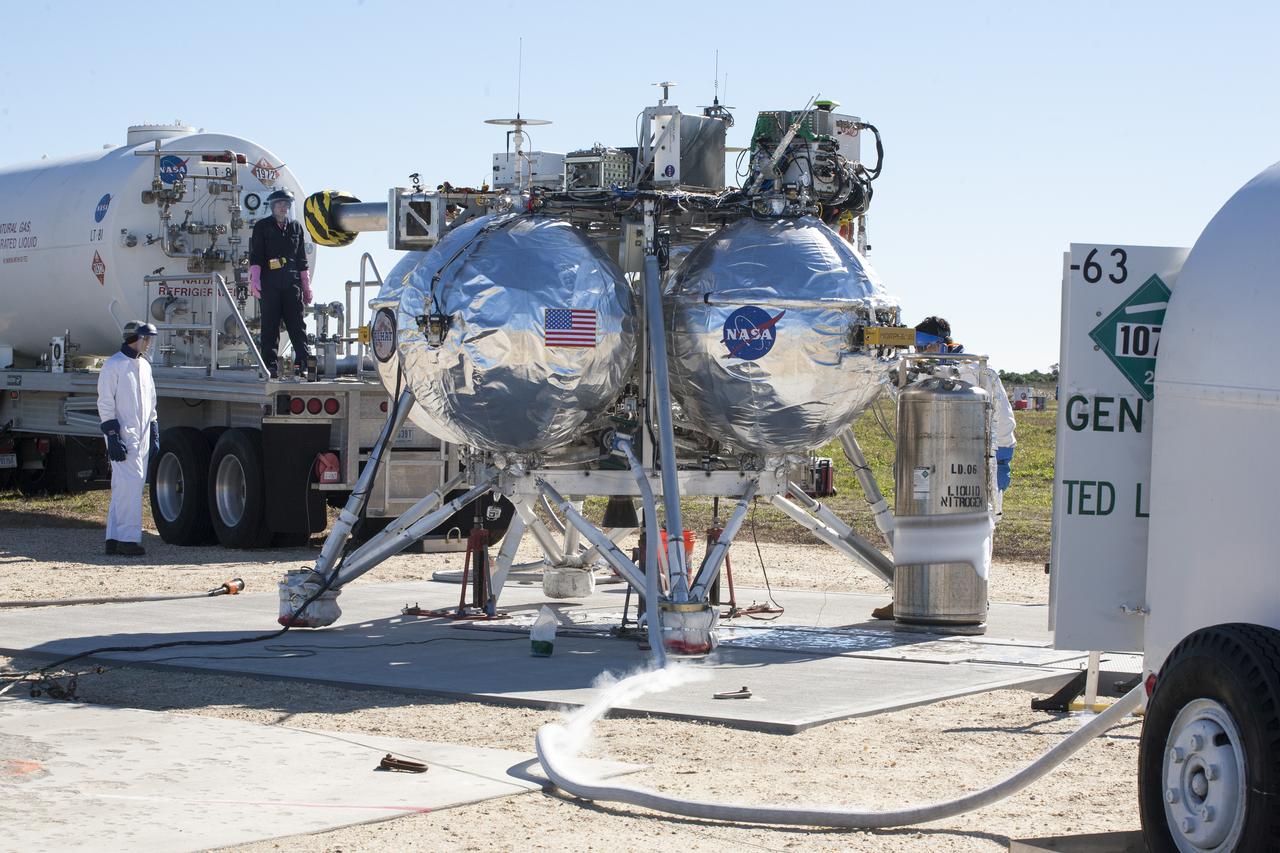
Morpheus Campaign 1A Set-up and Liftoff
CAPE CANAVERAL, Fla. – Engineers and technicians monitor the progress as the Project Morpheus prototype lander is prepared for its third free flight test at the north end…
Inspect NASA record
CAPE CANAVERAL, Fla. – Engineers and technicians monitor the progress as the Project Morpheus prototype lander is prepared for its third free flight test at the north end of the Shuttle Landing Facility at NASA’s Kennedy Space Center in Florida. The 57-second test began at 1:15 p.m. EST with the Morpheus lander launching from the ground over a flame trench and ascending about 187 feet, nearly doubling the target ascent velocity from the last test in December 2013. The lander flew forward, covering about 154 feet in 20 seconds before descending and landing within 11 inches of its target on a dedicated pad inside the autonomous landing and hazard avoidance technology, or ALHAT, hazard field. Project Morpheus tests NASA’s ALHAT and an engine that runs on liquid oxygen and methane, or green propellants, into a fully-operational lander that could deliver cargo to other planetary surfaces. The landing facility provides the lander with the kind of field necessary for realistic testing, complete with rocks, craters and hazards to avoid. Morpheus’ ALHAT payload allows it to navigate to clear landing sites amidst rocks, craters and other hazards during its descent. Project Morpheus is being managed under the Advanced Exploration Systems, or AES, Division in NASA’s Human Exploration and Operations Mission Directorate. The efforts in AES pioneer new approaches for rapidly developing prototype systems, demonstrating key capabilities and validating operational concepts for future human missions beyond Earth orbit. For more information on Project Morpheus, visit http://www.nasa.gov/centers/johnson/exploration/morpheus. Photo credit: NASA/Kim Shiflett
- Record ID
- KSC-2014-1070
- NASA center
- KSC
- Date
- 2014-01-16
- Credit
- NASA/KSC - KIM SHIFLETT (IMCS)
- Keywords
- KSC-2014-1070
KSC · 2014-01-21 · KSC-2014-1125
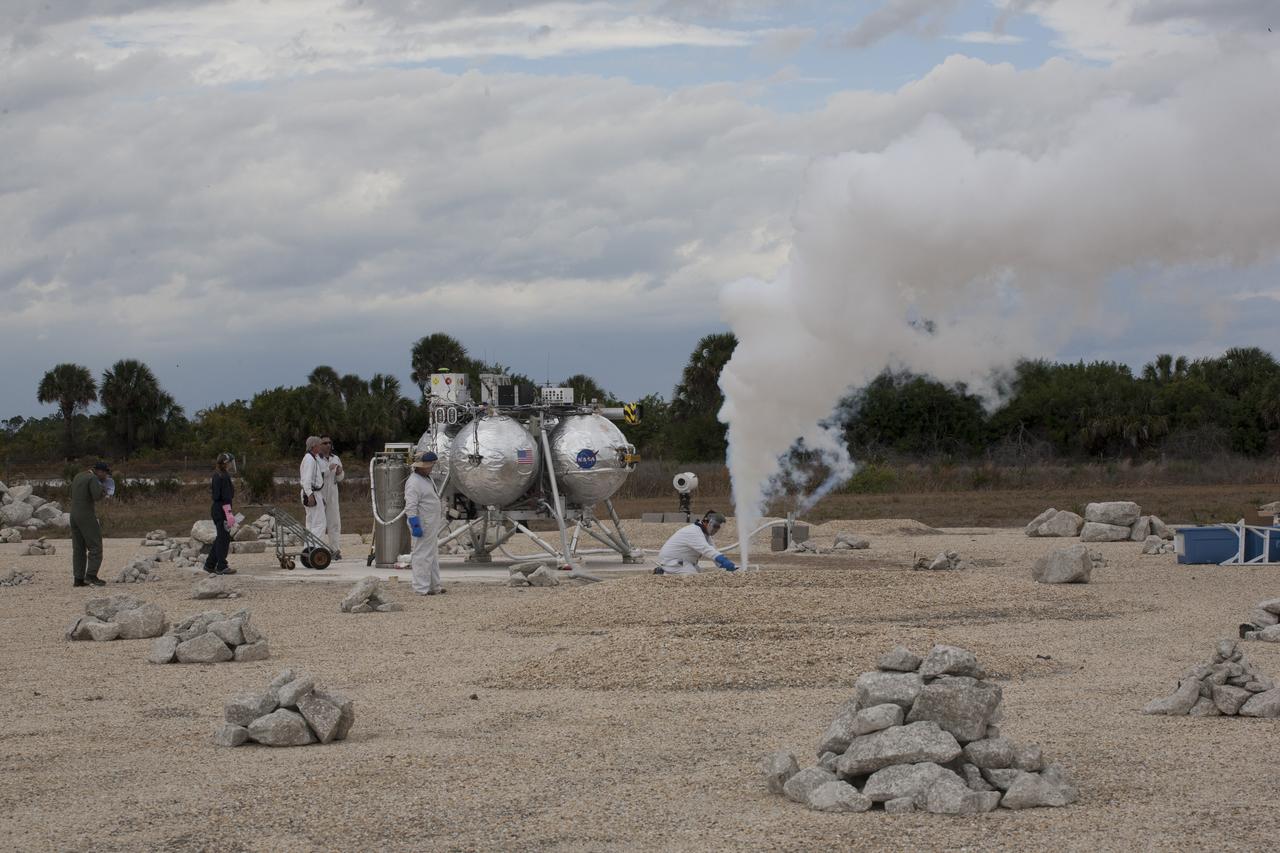
Morpheus Campaign 1A Liftoff
CAPE CANAVERAL, Fla. – Technicians and engineers perform safing procedures on the Project Morpheus prototype lander after it touched down in the autonomous landing and hazard avoidance technology,…
Inspect NASA record
CAPE CANAVERAL, Fla. – Technicians and engineers perform safing procedures on the Project Morpheus prototype lander after it touched down in the autonomous landing and hazard avoidance technology, or ALHAT, hazard field. The lander successfully completed its fourth free flight test at the north end of the Shuttle Landing Facility at NASA’s Kennedy Space Center in Florida. The 64-second test began at 1:15 p.m. EST with the Morpheus lander launching from the ground over a flame trench and ascending about 305 feet, significantly increasing the ascent velocity from the last test. The lander flew forward, covering about 358 feet in 25 seconds before descending and landing within 15 inches of its target on a dedicated pad inside the ALHAT hazard field. Project Morpheus tests NASA’s ALHAT and an engine that runs on liquid oxygen and methane, or green propellants, into a fully-operational lander that could deliver cargo to other planetary surfaces. The landing facility provides the lander with the kind of field necessary for realistic testing, complete with rocks, craters and hazards to avoid. Morpheus’ ALHAT payload allows it to navigate to clear landing sites amidst rocks, craters and other hazards during its descent. Project Morpheus is being managed under the Advanced Exploration Systems, or AES, Division in NASA’s Human Exploration and Operations Mission Directorate. The efforts in AES pioneer new approaches for rapidly developing prototype systems, demonstrating key capabilities and validating operational concepts for future human missions beyond Earth orbit. For more information on Project Morpheus, visit http://www.nasa.gov/centers/johnson/exploration/morpheus. Photo credit: NASA/Kim Shiflett
- Record ID
- KSC-2014-1125
- NASA center
- KSC
- Date
- 2014-01-21
- Credit
- NASA/KSC - KIM SHIFLETT (IMCS)
- Keywords
- KSC-2014-1125
JPL · 2023-12-12 · PIA26204
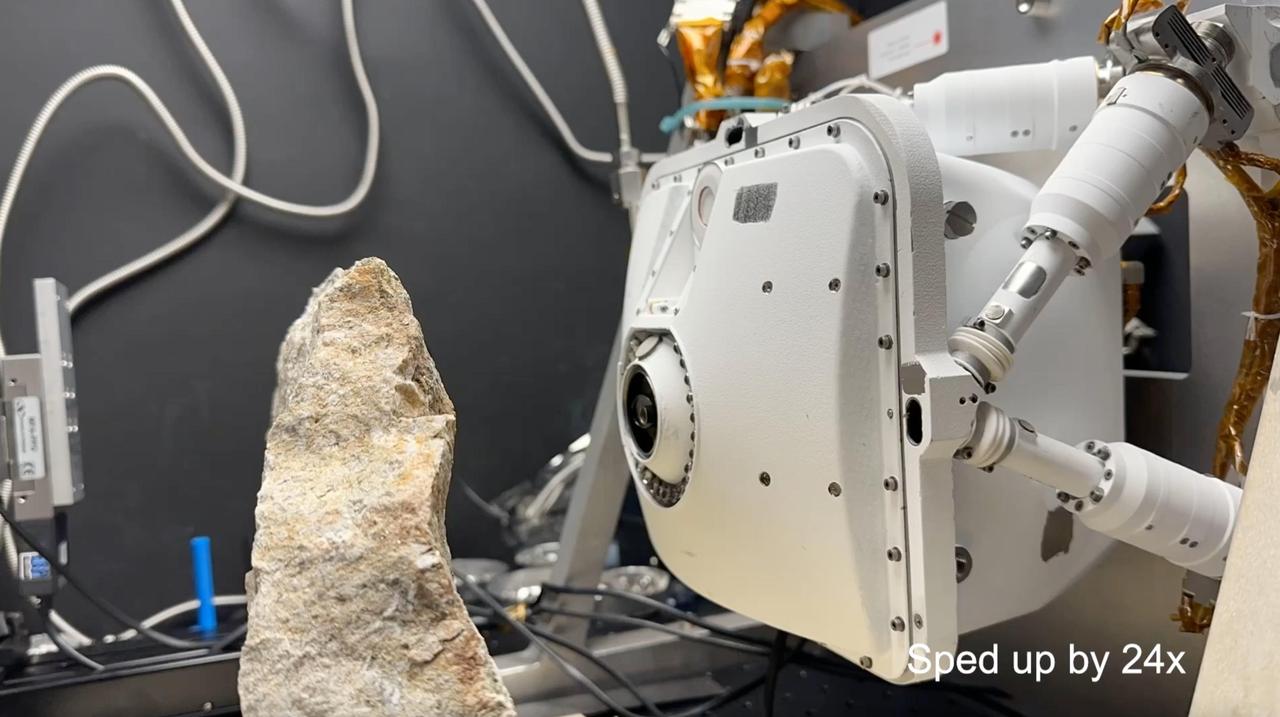
How Perseverance's PIXL Gets Close to a Rock Target
This time-lapse video, which has been sped up by 24 times, uses an engineering model of one of the instruments aboard NASA's Perseverance Mars rover to show how…
Inspect NASA record
This time-lapse video, which has been sped up by 24 times, uses an engineering model of one of the instruments aboard NASA's Perseverance Mars rover to show how the instrument evaluates safe placement against a rock. If it's determined to be safe, the rover places the instrument, called the Planetary Instrument for X-ray Lithochemistry (PIXL), close to the targeted rock for science observations. This test occurred at NASA's Jet Propulsion Laboratory in Southern California on June 8, 2023. Located on the end of Perseverance's robotic arm, PIXL scans postage stamp-size areas on rocks with an X-ray beam the width of a human hair, determining which elements are present. Scientists use this information to infer what minerals and chemicals are in a rock and help decide whether Perseverance should collect a rock core using its drill. The X-ray beam exits the circular opening at the center of PIXL; colored LED lights around that circle can light up a surface, allowing an internal camera to take images. Those images allow PIXL to autonomously place itself – very slowly and precisely – as little as 1 inch (2.5 centimeters) away from a surface to collect its data. A key objective for Perseverance's mission on Mars is astrobiology, including the search for signs of ancient microbial life. The rover will characterize the planet's geology and past climate, pave the way for human exploration of the Red Planet, and be the first mission to collect and cache Martian rock and regolith (broken rock and dust). Subsequent NASA missions, in cooperation with ESA (European Space Agency), would send spacecraft to Mars to collect these sealed samples from the surface and return them to Earth for in-depth analysis. The Mars 2020 Perseverance mission is part of NASA's Moon to Mars exploration approach, which includes Artemis missions to the Moon that will help prepare for human exploration of the Red Planet. Animation available at https://photojournal.jpl.nasa.gov/catalog/PIA26204
- Record ID
- PIA26204
- NASA center
- JPL
- Date
- 2023-12-12
- Credit
- NASA/JPL-Caltech
- Keywords
- Mars 2020, Mars
KSC · 2013-12-17 · KSC-2013-4373
KSC-2013-4373
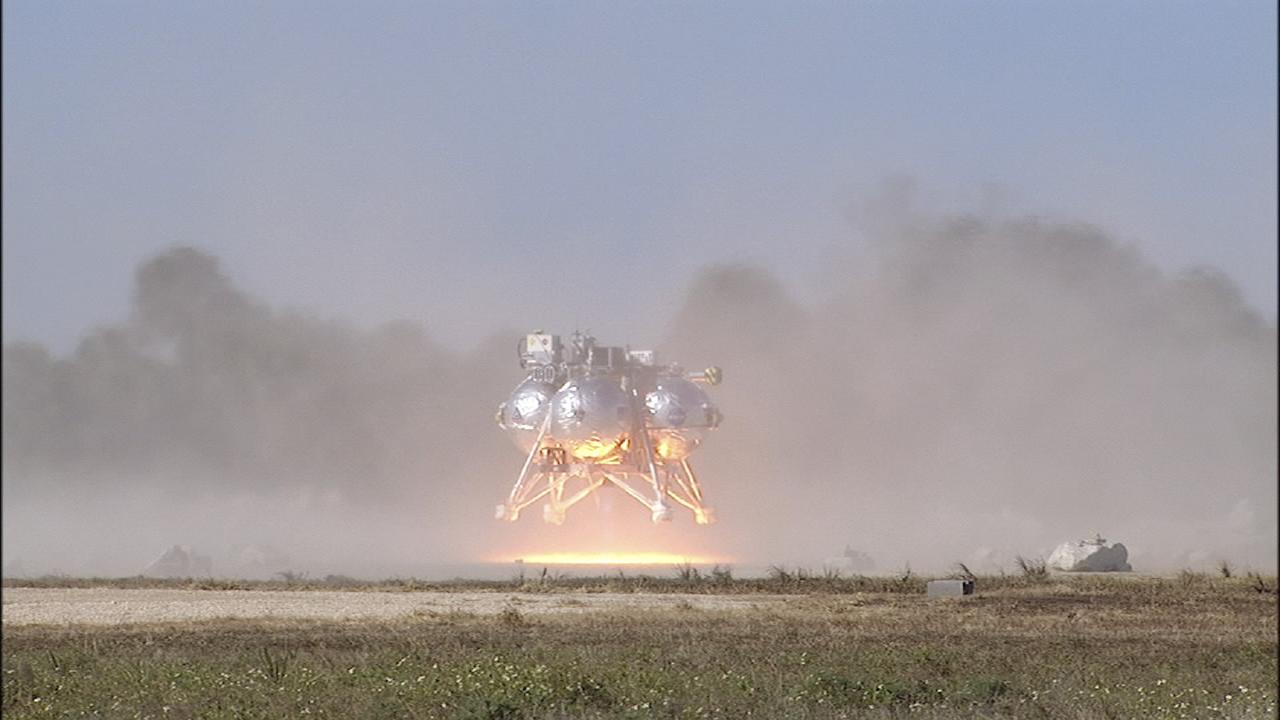
CAPE CANAVERAL, Fla. -- The second free flight of the Project Morpheus prototype lander was conducted at the north end of the Shuttle Landing Facility at NASA’s Kennedy…
Inspect NASA record
CAPE CANAVERAL, Fla. -- The second free flight of the Project Morpheus prototype lander was conducted at the north end of the Shuttle Landing Facility at NASA’s Kennedy Space Center in Florida. The 81-second test began at 1:37 p.m. EST with the Morpheus lander launching from the ground over a flame trench and ascending about 164 feet, pausing briefly at 82 feet. The lander flew forward, covering about 154 feet in 30 seconds before descending and landing on a dedicated landing pad inside the autonomous landing and hazard avoidance technology, or ALHAT, hazard field. Project Morpheus tests NASA’s ALHAT and an engine that runs on liquid oxygen and methane, or green propellants, into a fully-operational lander that could deliver cargo to other planetary surfaces. The landing facility provides the lander with the kind of field necessary for realistic testing, complete with rocks, craters and hazards to avoid. Morpheus’ ALHAT payload allows it to navigate to clear landing sites amidst rocks, craters and other hazards during its descent. Project Morpheus is being managed under the Advanced Exploration Systems, or AES, Division in NASA’s Human Exploration and Operations Mission Directorate. The efforts in AES pioneer new approaches for rapidly developing prototype systems, demonstrating key capabilities and validating operational concepts for future human missions beyond Earth orbit. For more information on Project Morpheus, visit http://www.nasa.gov/centers/johnson/exploration/morpheus. Photo credit: NASA/Chris Chamberland
- Record ID
- KSC-2013-4373
- NASA center
- KSC
- Date
- 2013-12-17
- Keywords
- SLF, ALHAT, free flight
JPL · 2021-09-10 · PIA24835
PIXL Image of Salts in Bellegarde
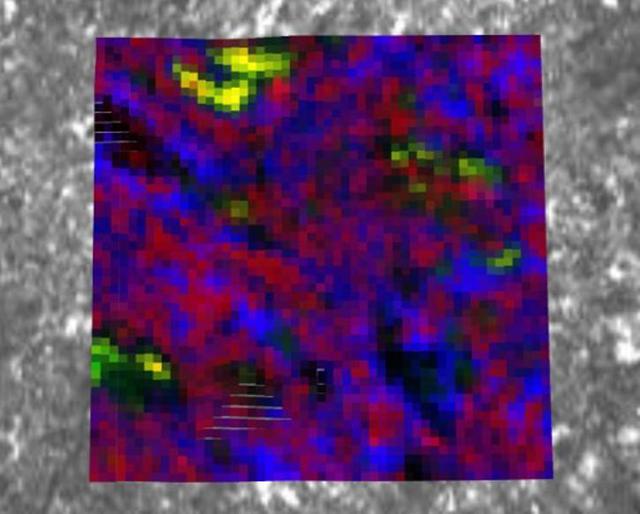
NASA's Perseverance Mars rover used its PIXL (Planetary Instrument for X-ray Lithochemistry) instrument to analyze the "Bellegarde" abrasion target – created when the rover scraped away surface area…
Inspect NASA record
NASA's Perseverance Mars rover used its PIXL (Planetary Instrument for X-ray Lithochemistry) instrument to analyze the "Bellegarde" abrasion target – created when the rover scraped away surface area of the rock named "Rochette" – revealing salt minerals (the yellow color in the image). Salt crystals could have trapped bubbles of ancient water that, after the samples are returned to Earth, scientists could use to learn more about the environment these salts formed in. NASA's Jet Propulsion Laboratory built and manages operations of Perseverance and Ingenuity for the agency. Caltech in Pasadena, California, manages JPL for NASA. WATSON was built by Malin Space Science Systems (MSSS) in San Diego and is operated jointly by MSSS and JPL. A key objective for Perseverance's mission on Mars is astrobiology, including the search for signs of ancient microbial life. The rover will characterize the planet's geology and past climate, pave the way for human exploration of the Red Planet, and be the first mission to collect and cache Martian rock and regolith (broken rock and dust). Subsequent NASA missions, in cooperation with ESA (European Space Agency), would send spacecraft to Mars to collect these sealed samples from the surface and return them to Earth for in-depth analysis. The Mars 2020 Perseverance mission is part of NASA's Moon to Mars exploration approach, which includes Artemis missions to the Moon that will help prepare for human exploration of the Red Planet. https://photojournal.jpl.nasa.gov/catalog/PIA24835
- Record ID
- PIA24835
- NASA center
- JPL
- Date
- 2021-09-10
- Credit
- NASA/JPL/Caltech/DTU/UW/QUT
- Keywords
- Mars 2020, Mars

GSFC · 2017-12-08 · GSFC_20171208_Archive_e000210
Hubble sees the beautiful demises of dying star
This image, taken by the NASA/ESA Hubble Space Telescope, shows the colorful "last hurrah" of a star like our sun. The star is ending its life by casting…
Inspect NASA record
This image, taken by the NASA/ESA Hubble Space Telescope, shows the colorful "last hurrah" of a star like our sun. The star is ending its life by casting off its outer layers of gas, which formed a cocoon around the star's remaining core. Ultraviolet light from the dying star makes the material glow. The burned-out star, called a white dwarf, is the white dot in the center. Our sun will eventually burn out and shroud itself with stellar debris, but not for another 5 billion years. Our Milky Way Galaxy is littered with these stellar relics, called planetary nebulae. The objects have nothing to do with planets. Eighteenth- and nineteenth-century astronomers called them the name because through small telescopes they resembled the disks of the distant planets Uranus and Neptune. The planetary nebula in this image is called NGC 2440. The white dwarf at the center of NGC 2440 is one of the hottest known, with a surface temperature of more than 360,000 degrees Fahrenheit (200,000 degrees Celsius). The nebula's chaotic structure suggests that the star shed its mass episodically. During each outburst, the star expelled material in a different direction. This can be seen in the two bowtie-shaped lobes. The nebula also is rich in clouds of dust, some of which form long, dark streaks pointing away from the star. NGC 2440 lies about 4,000 light-years from Earth in the direction of the constellation Puppis. The material expelled by the star glows with different colors depending on its composition, its density and how close it is to the hot central star. Blue samples helium; blue-green oxygen, and red nitrogen and hydrogen. Credit: NASA, ESA, and K. Noll (STScI), Acknowledgment: The Hubble Heritage Team (STScI/AURA) NASA image use policy. NASA Goddard Space Flight Center enables NASA’s mission through four scientific endeavors: Earth Science, Heliophysics, Solar System Exploration, and Astrophysics. Goddard plays a leading role in NASA’s accomplishments by contributing compelling scientific knowledge to advance the Agency’s mission. Follow us on Twitter Like us on Facebook Find us on Instagram
- Record ID
- GSFC_20171208_Archive_e000210
- NASA center
- GSFC
- Date
- 2017-12-08
- Keywords
- Hubble sees the beautiful demises of dying star, ngc2440
GSFC · 2017-12-08 · GSFC_20171208_Archive_e000537
Hubble’s Planetary Portrait Captures New Changes in Jupiter’s Great Red Spot
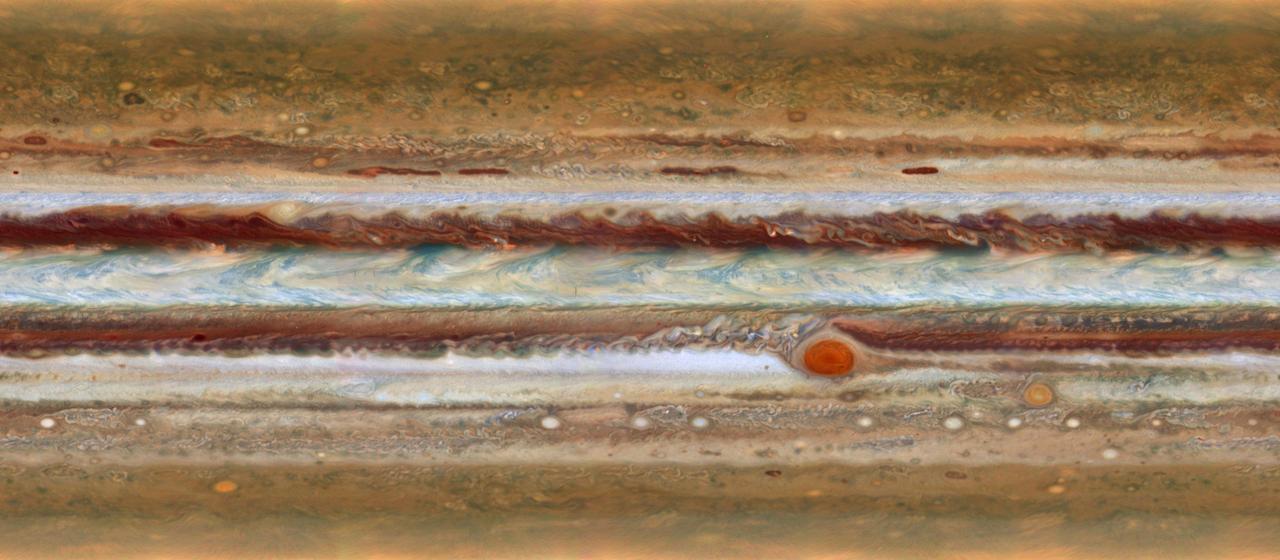
New imagery from the Hubble Space Telescope is revealing details never before seen on Jupiter. Hubble’s new Jupiter maps were used to create this Ultra HD animation. These…
Inspect NASA record
New imagery from the Hubble Space Telescope is revealing details never before seen on Jupiter. Hubble’s new Jupiter maps were used to create this Ultra HD animation. These new maps and spinning globes of Jupiter were made from observations performed with NASA’s Hubble Space Telescope. They are the first products to come from a program to study the solar system’s outer planets – Jupiter, Uranus, Neptune and, later, Saturn – each year using Hubble. The observations are designed to capture a broad range of features, including winds, clouds, storms and atmospheric chemistry. These annual studies will help current and future scientists see how these giant worlds change over time. Scientists at NASA’s Goddard Space Flight Center, the Jet Propulsion Laboratory, and the University of California at Berkeley produced two global maps of Jupiter from the observations, which were made using Hubble’s high-performance Wide Field Camera 3. The two maps represent nearly back-to-back rotations of the planet, making it possible to determine the speeds of Jupiter’s winds. Already, the images have revealed a rare wave just north of the planet’s equator and a unique filament-like feature in the core of the Great Red Spot that had not been seen previously. In addition, the new images confirm that the Great Red Spot continues to shrink and become more circular, as it has been doing for years. The long axis of this characteristic storm is about 150 miles (240 kilometers) shorter now than it was in 2014. Recently, the storm had been shrinking at a faster-than-usual rate, but the latest change is consistent with the long-term trend. Read more: www.nasa.gov/press-release/goddard/hubble-s-planetary-por... Credits: NASA/ESA/Goddard/UCBerkeley/JPL-Caltech/STScI NASA image use policy. NASA Goddard Space Flight Center enables NASA’s mission through four scientific endeavors: Earth Science, Heliophysics, Solar System Exploration, and Astrophysics. Goddard plays a leading role in NASA’s accomplishments by contributing compelling scientific knowledge to advance the Agency’s mission. Follow us on Twitter Like us on Facebook Find us on Instagram
- Record ID
- GSFC_20171208_Archive_e000537
- NASA center
- GSFC
- Date
- 2017-12-08
- Keywords
- Hubble’s Planetary Portrait Captures New Changes in Jupiter’s Great Red Spot, red, space, spot, nasa, jupiter, hubble, nasagoddard, greatredspotjupiter
KSC · 2014-04-30 · KSC-2014-2329
KSC-2014-2329
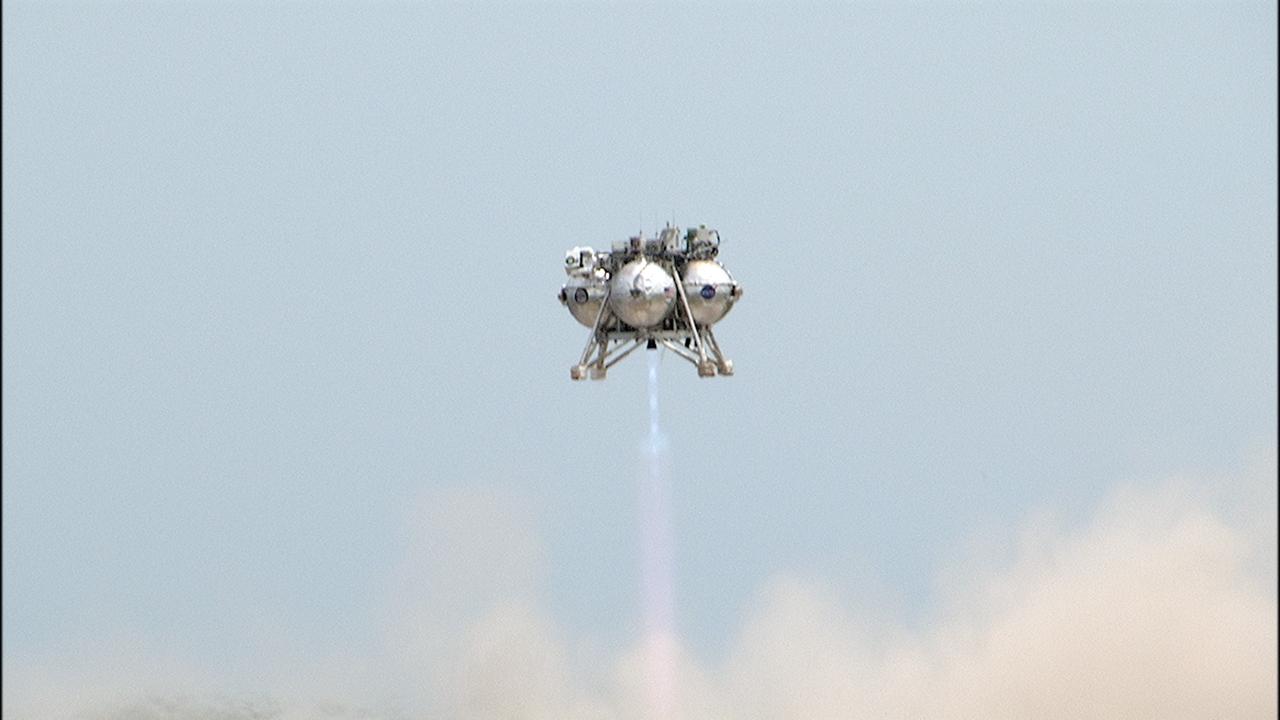
CAPE CANAVERAL, Fla. – NASA's Project Morpheus prototype lander soars high after lifting off on a free-flight test from a new launch pad at the north end of…
Inspect NASA record
CAPE CANAVERAL, Fla. – NASA's Project Morpheus prototype lander soars high after lifting off on a free-flight test from a new launch pad at the north end of the Shuttle Landing Facility at NASA's Kennedy Space Center in Florida. The 98-second test began at 1:57 p.m. EDT with the Morpheus lander launching from the ground over a flame trench and ascending more than 800 feet at a peak speed of 36 mph. The vehicle, with its recently installed autonomous landing and hazard avoidance technology, or ALHAT, sensors surveyed the hazard field to determine safe landing sites. Morpheus then flew forward and downward covering approximately 1300 feet while performing a 78-foot divert to simulate a hazard avoidance maneuver. The lander descended and landed on a dedicated pad inside the ALHAT hazard field. Project Morpheus tests NASA’s ALHAT and an engine that runs on liquid oxygen and methane, which are green propellants. These new capabilities could be used in future efforts to deliver cargo to planetary surfaces. The landing facility provides the lander with the kind of field necessary for realistic testing, complete with rocks, craters and hazards to avoid. Morpheus’ ALHAT payload allows it to navigate to clear landing sites amidst rocks, craters and other hazards during its descent. Project Morpheus is being managed under the Advanced Exploration Systems, or AES, Division in NASA’s Human Exploration and Operations Mission Directorate. The efforts in AES pioneer new approaches for rapidly developing prototype systems, demonstrating key capabilities and validating operational concepts for future human missions beyond Earth orbit. For more information on Project Morpheus, visit http://morpheuslander.jsc.nasa.gov/. Photo credit: NASA/Frankie Martin
- Record ID
- KSC-2014-2329
- NASA center
- KSC
- Date
- 2014-04-30
- Keywords
- SLF, ALHAT, launch pad, free flight test
KSC · 2014-02-10 · 2014-1363
KSC-2014-1363
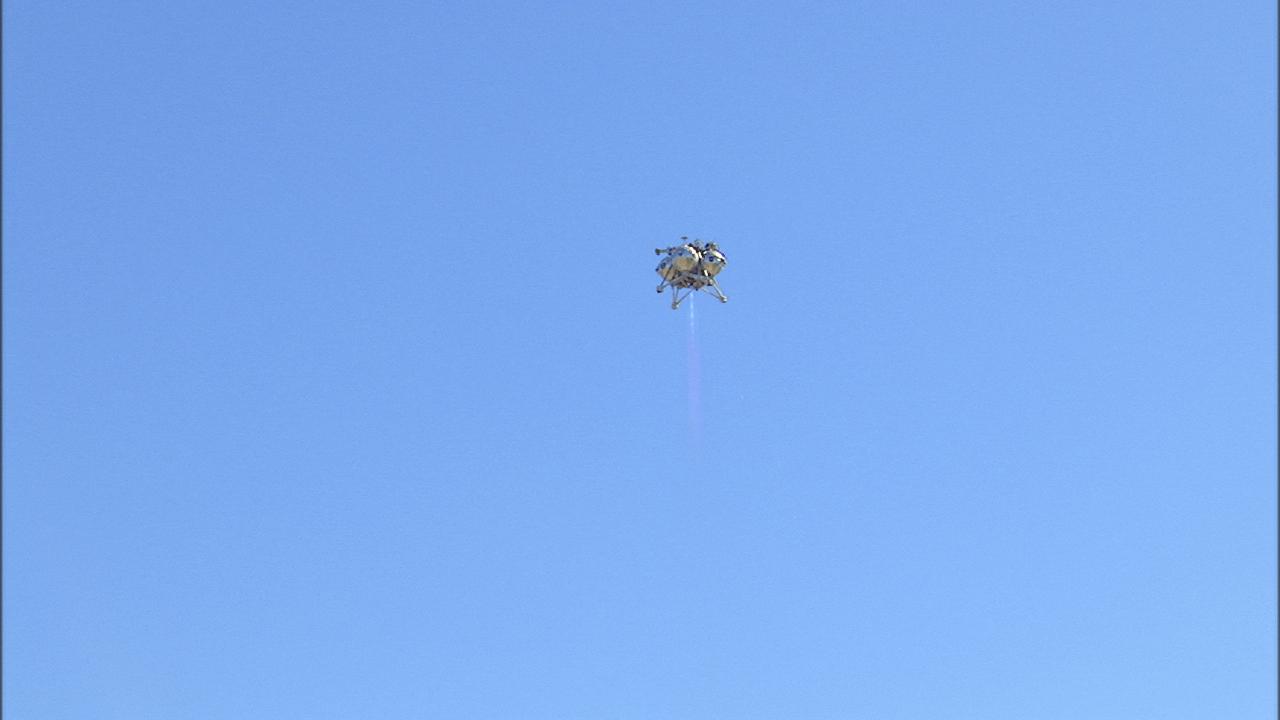
CAPE CANAVERAL, Fla. – The fifth free flight of the Project Morpheus prototype lander was conducted at the north end of the Shuttle Landing Facility at NASA’s Kennedy…
Inspect NASA record
CAPE CANAVERAL, Fla. – The fifth free flight of the Project Morpheus prototype lander was conducted at the north end of the Shuttle Landing Facility at NASA’s Kennedy Space Center in Florida. The 74-second test began at about 1 p.m. EST with the Morpheus lander launching from the ground over a flame trench and ascending about to 476 feet, more than 160 feet higher than its last test. The lander flew forward, covering 637 feet in 30 seconds before descending and landing on target on a dedicated landing pad inside the autonomous landing and hazard avoidance technology, or ALHAT, hazard field. Project Morpheus tests NASA’s ALHAT and an engine that runs on liquid oxygen and methane, or green propellants, into a fully-operational lander that could deliver cargo to other planetary surfaces. The landing facility provides the lander with the kind of field necessary for realistic testing, complete with rocks, craters and hazards to avoid. Morpheus’ ALHAT payload allows it to navigate to clear landing sites amidst rocks, craters and other hazards during its descent. Project Morpheus is being managed under the Advanced Exploration Systems, or AES, Division in NASA’s Human Exploration and Operations Mission Directorate. The efforts in AES pioneer new approaches for rapidly developing prototype systems, demonstrating key capabilities and validating operational concepts for future human missions beyond Earth orbit. For more information on Project Morpheus, visit http:__www.nasa.gov_centers_johnson_exploration_morpheus. Photo credit: NASA_Frankie Martin
- Record ID
- 2014-1363
- NASA center
- KSC
- Date
- 2014-02-10
- Credit
- NASA_Frankie Martin
- Keywords
- SLF, ALHAT, free_flight_test

KSC · 2014-04-02 · KSC-2014-1925
KSC-2014-1925
CAPE CANAVERAL, Fla. – Engineers and technicians prepare NASA's Project Morpheus prototype lander for a free flight test at a new launch site at the north end of…
Inspect NASA record
CAPE CANAVERAL, Fla. – Engineers and technicians prepare NASA's Project Morpheus prototype lander for a free flight test at a new launch site at the north end of the Shuttle Landing Facility at NASA’s Kennedy Space Center in Florida. The 96-second test began at 4:21 p.m. EDT with the Morpheus lander launching from the ground over the flame trench and ascending more than 800 feet at a peak speed of 36 mph. The vehicle with its recently installed autonomous landing and hazard avoidance technology, or ALHAT, sensors surveyed the hazard field to determine safe landing sites. Morpheus then flew forward and downward covering 1,300 feet while performing a 78-foot divert to simulate a hazard avoidance maneuver. The lander descended and landed on a dedicated pad inside the ALHAT field. Project Morpheus tests NASA’s ALHAT, and an engine that runs on liquid oxygen and methane, or green propellants, into a fully-operational lander that could deliver cargo to other planetary surfaces. The landing facility provides the lander with the kind of field necessary for realistic testing, complete with rocks, craters and hazards to avoid. Morpheus’ ALHAT payload allows it to navigate to clear landing sites amidst rocks, craters and other hazards during its descent. Project Morpheus is being managed under the Advanced Exploration Systems, or AES, Division in NASA’s Human Exploration and Operations Mission Directorate. The efforts in AES pioneer new approaches for rapidly developing prototype systems, demonstrating key capabilities and validating operational concepts for future human missions beyond Earth orbit. For more information on Project Morpheus, visit http://morpheuslander.jsc.nasa.gov/. Photo credit: NASA/Frankie Martin
- Record ID
- KSC-2014-1925
- NASA center
- KSC
- Date
- 2014-04-02
- Keywords
- SLF, ALHAT, launch pad, free flight test
KSC · 2014-04-24 · KSC-2014-2285
KSC-2014-2285
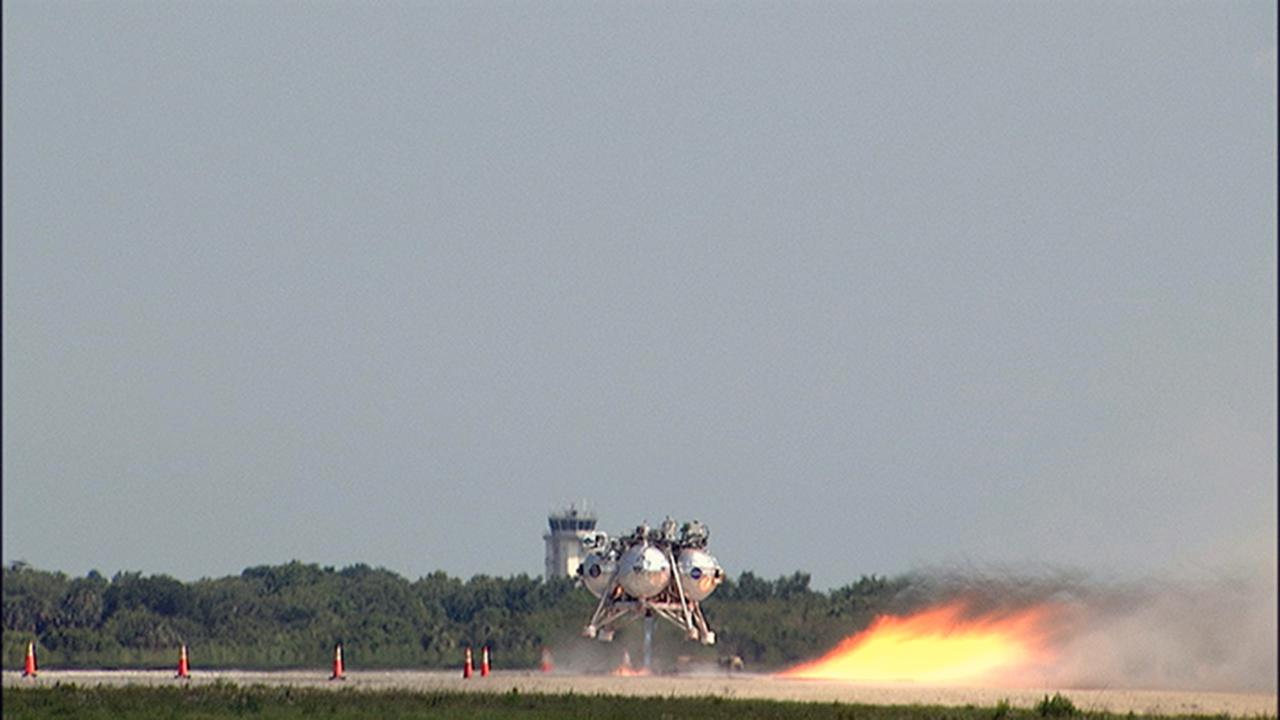
CAPE CANAVERAL, Fla. – NASA's Project Morpheus prototype lander begins to lift off on a free-flight test from a new launch pad at the north end of the…
Inspect NASA record
CAPE CANAVERAL, Fla. – NASA's Project Morpheus prototype lander begins to lift off on a free-flight test from a new launch pad at the north end of the Shuttle Landing Facility at NASA’s Kennedy Space Center in Florida. The 98-second test began at 3:20 p.m. EDT with the Morpheus lander launching from the ground over a flame trench and ascending more than 800 feet at a peak speed of 36 mph. The vehicle, with its recently installed autonomous landing and hazard avoidance technology ALHAT sensors, surveyed the hazard field to determine safe landing sites. Morpheus then flew forward and downward covering approximately 1300 feet while performing a 78-foot divert to simulate a hazard avoidance maneuver. The lander then descended and landed on a dedicated pad inside the autonomous landing and hazard avoidance technology hazard field. Project Morpheus tests NASA’s ALHAT and an engine that runs on liquid oxygen and methane, which are green propellants. These new capabilities could be used in future efforts to deliver cargo to planetary surfaces. The landing facility provides the lander with the kind of field necessary for realistic testing, complete with rocks, craters and hazards to avoid. Morpheus’ ALHAT payload allows it to navigate to clear landing sites amidst rocks, craters and other hazards during its descent. Project Morpheus is being managed under the Advanced Exploration Systems, or AES, Division in NASA’s Human Exploration and Operations Mission Directorate. The efforts in AES pioneer new approaches for rapidly developing prototype systems, demonstrating key capabilities and validating operational concepts for future human missions beyond Earth orbit. For more information on Project Morpheus, visit http://morpheuslander.jsc.nasa.gov/. Photo credit: NASA/Chris Chamberland
- Record ID
- KSC-2014-2285
- NASA center
- KSC
- Date
- 2014-04-24
- Keywords
- SLF, ALHAT, launch pad, free flight test