
Update Site (from NASA)
Explore NASA’s Image and Video Library.
Suggest one object per day for the Interstellar Minds collection. We review each suggestion before adding it.
Sign in to suggest a Marvel.
Find a NASA image ID. Open a NASA record and copy its ID from the end of the details URL.
NASA image records
JPL · 2021-12-16 · PIA25041
PIXL's View of Dourbes
These images show a rock target called "Dourbes" in Mars' Jezero Crater and a map of chemical elements detected within the target by PIXL (Planetary Instrument for X-ray…
Inspect NASA record
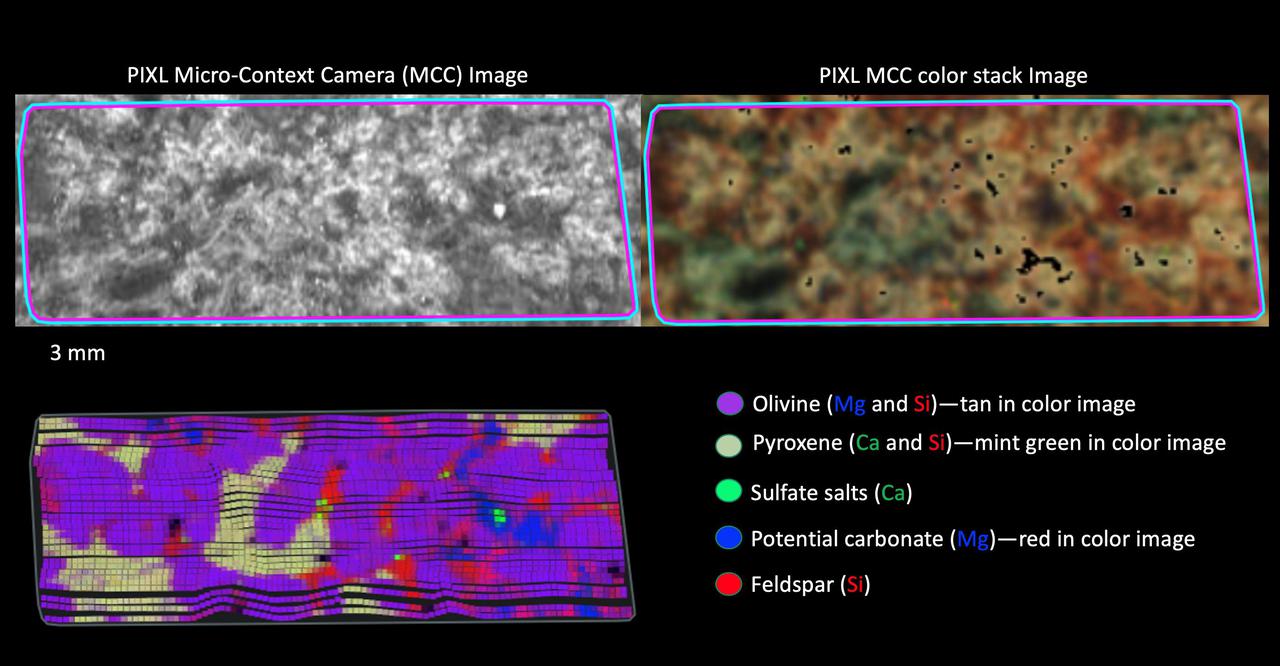
These images show a rock target called "Dourbes" in Mars' Jezero Crater and a map of chemical elements detected within the target by PIXL (Planetary Instrument for X-ray Lithochemistry), one of the instruments on the end of the robotic arm aboard NASA's Perseverance Mars rover. The two images at top show the target in black-and-white and colorized views. PIXL's map of elements is at the bottom, showing magnesium (blue), silicon (red), and calcium (green) – three of the major minerals present in the rock. The map shows olivine and pyroxene forming a cumulate texture characteristic of an igneous rock (solidified from magma or lava). The presence of sulfate salts and potential carbonates reveal that these igneous rocks were altered by water, indicating past watery environments in Jezero Crater. A key objective for Perseverance's mission on Mars is astrobiology, including the search for signs of ancient microbial life. The rover will characterize the planet's geology and past climate, pave the way for human exploration of the Red Planet, and be the first mission to collect and cache Martian rock and regolith (broken rock and dust). Subsequent NASA missions, in cooperation with ESA (European Space Agency), would send spacecraft to Mars to collect these sealed samples from the surface and return them to Earth for in-depth analysis. The Mars 2020 Perseverance mission is part of NASA's Moon to Mars exploration approach, which includes Artemis missions to the Moon that will help prepare for human exploration of the Red Planet. https://photojournal.jpl.nasa.gov/catalog/PIA25041
- Record ID
- PIA25041
- NASA center
- JPL
- Date
- 2021-12-16
- Credit
- NASA/JPL-Caltech
- Keywords
- Mars 2020, Mars
KSC · 2014-01-21 · KSC-2014-1118
Morpheus Campaign 1A Liftoff
CAPE CANAVERAL, Fla. – The Project Morpheus prototype lander descends toward the autonomous landing and hazard avoidance technology, or ALHAT, hazard field after launching on its fourth free…
Inspect NASA record
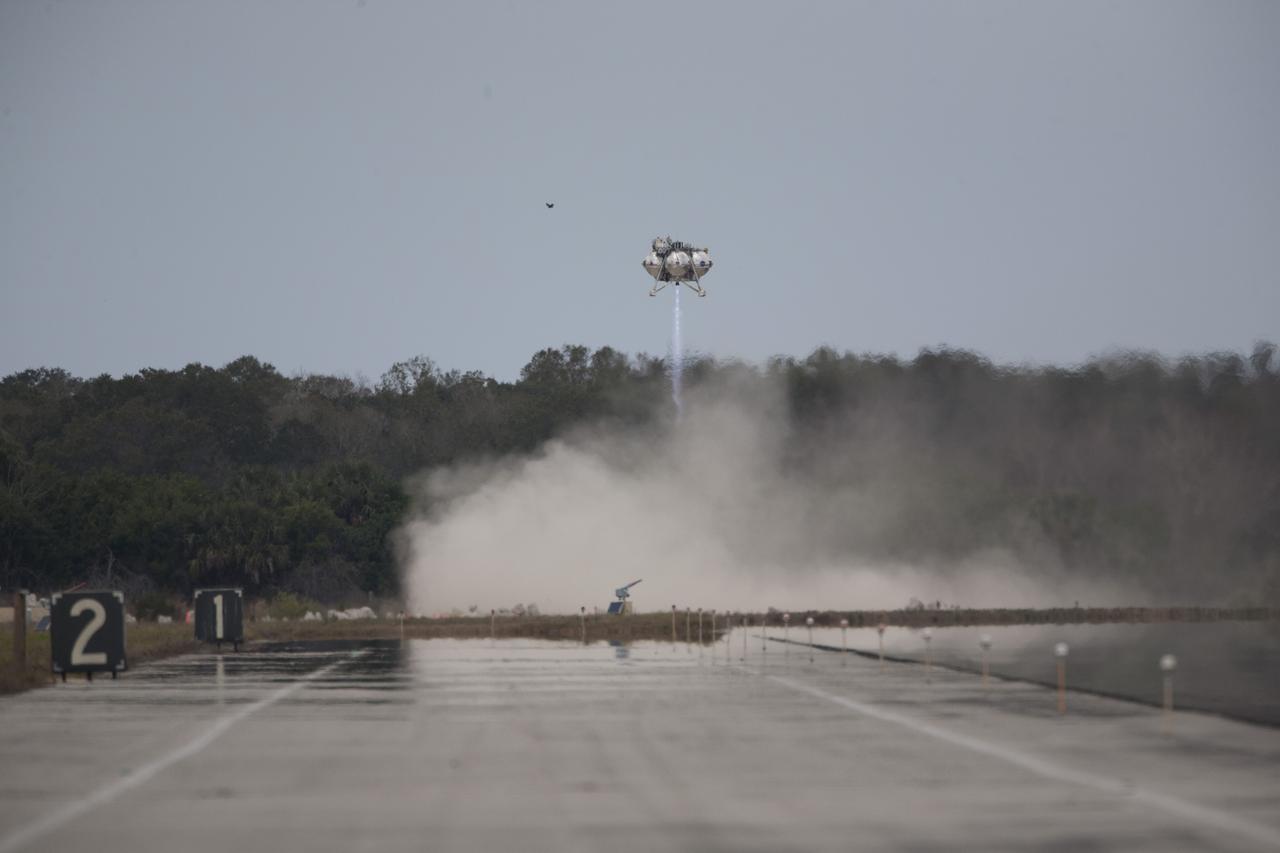
CAPE CANAVERAL, Fla. – The Project Morpheus prototype lander descends toward the autonomous landing and hazard avoidance technology, or ALHAT, hazard field after launching on its fourth free flight test at the north end of the Shuttle Landing Facility at NASA’s Kennedy Space Center in Florida. The 64-second test began at 1:15 p.m. EST with the Morpheus lander launching from the ground over a flame trench and ascending about 305 feet, significantly increasing the ascent velocity from the last test. The lander flew forward, covering about 358 feet in 25 seconds before descending and landing within 15 inches of its target on a dedicated pad inside the ALHAT hazard field. Project Morpheus tests NASA’s ALHAT and an engine that runs on liquid oxygen and methane, or green propellants, into a fully-operational lander that could deliver cargo to other planetary surfaces. The landing facility provides the lander with the kind of field necessary for realistic testing, complete with rocks, craters and hazards to avoid. Morpheus’ ALHAT payload allows it to navigate to clear landing sites amidst rocks, craters and other hazards during its descent. Project Morpheus is being managed under the Advanced Exploration Systems, or AES, Division in NASA’s Human Exploration and Operations Mission Directorate. The efforts in AES pioneer new approaches for rapidly developing prototype systems, demonstrating key capabilities and validating operational concepts for future human missions beyond Earth orbit. For more information on Project Morpheus, visit http://www.nasa.gov/centers/johnson/exploration/morpheus. Photo credit: NASA/Kim Shiflett
- Record ID
- KSC-2014-1118
- NASA center
- KSC
- Date
- 2014-01-21
- Credit
- NASA/KSC - KIM SHIFLETT (IMCS)
- Keywords
- KSC-2014-1118
KSC · 2014-01-21 · KSC-2014-1110
Morpheus Campaign 1A Liftoff
CAPE CANAVERAL, Fla. – The Project Morpheus prototype lander is positioned on a launch pad as engineers and technicians prepare it for the fourth free flight test at…
Inspect NASA record
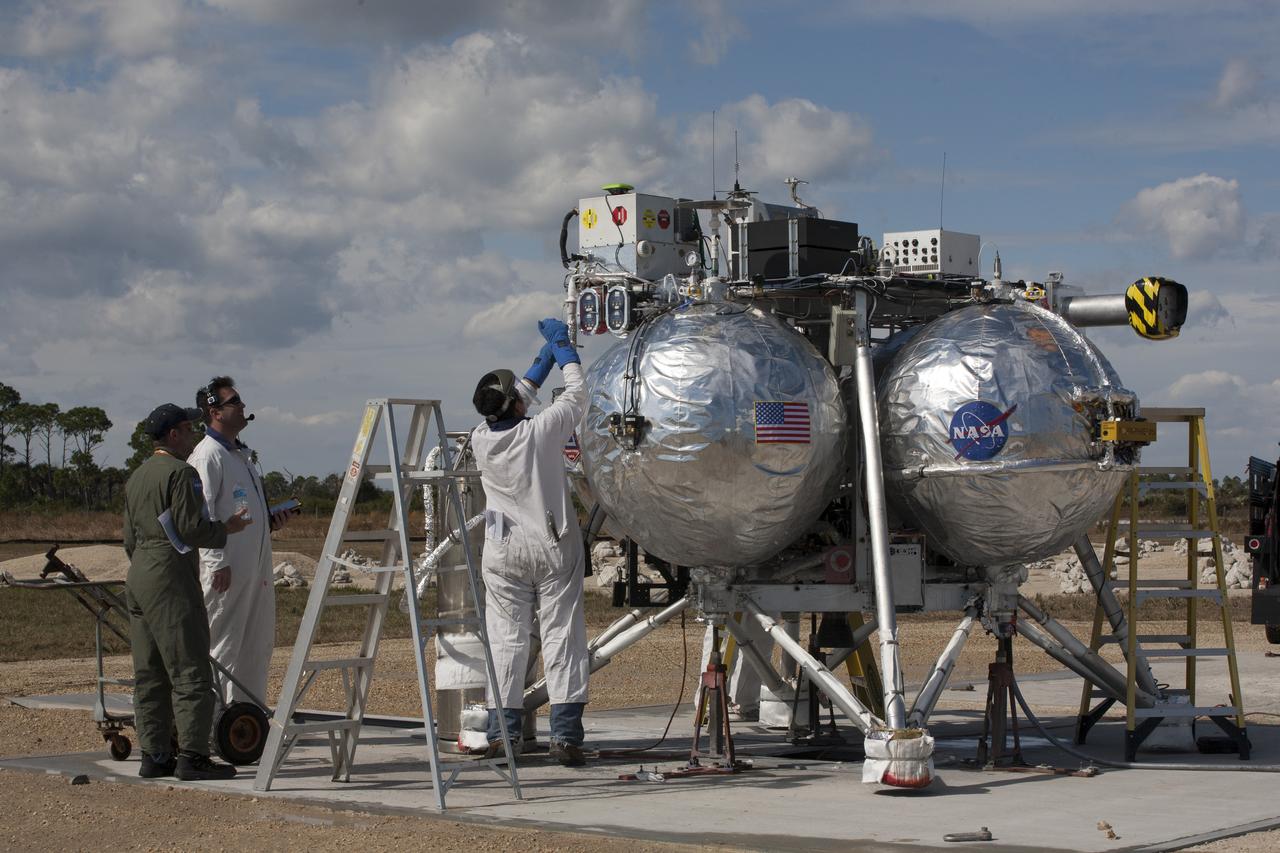
CAPE CANAVERAL, Fla. – The Project Morpheus prototype lander is positioned on a launch pad as engineers and technicians prepare it for the fourth free flight test at the north end of the Shuttle Landing Facility at NASA’s Kennedy Space Center in Florida. The 64-second test began at 1:15 p.m. EST with the Morpheus lander launching from the ground over a flame trench and ascending about 305 feet, significantly increasing the ascent velocity from the last test. The lander flew forward, covering about 358 feet in 25 seconds before descending and landing within 15 inches of its target on a dedicated pad inside the autonomous landing and hazard avoidance technology, or ALHAT, hazard field. Project Morpheus tests NASA’s ALHAT and an engine that runs on liquid oxygen and methane, or green propellants, into a fully-operational lander that could deliver cargo to other planetary surfaces. The landing facility provides the lander with the kind of field necessary for realistic testing, complete with rocks, craters and hazards to avoid. Morpheus’ ALHAT payload allows it to navigate to clear landing sites amidst rocks, craters and other hazards during its descent. Project Morpheus is being managed under the Advanced Exploration Systems, or AES, Division in NASA’s Human Exploration and Operations Mission Directorate. The efforts in AES pioneer new approaches for rapidly developing prototype systems, demonstrating key capabilities and validating operational concepts for future human missions beyond Earth orbit. For more information on Project Morpheus, visit http://www.nasa.gov/centers/johnson/exploration/morpheus. Photo credit: NASA/Kim Shiflett
- Record ID
- KSC-2014-1110
- NASA center
- KSC
- Date
- 2014-01-21
- Credit
- NASA/KSC - KIM SHIFLETT (IMCS)
- Keywords
- KSC-2014-1110
KSC · 2014-01-16 · KSC-2014-1080
Morpheus Campaign 1A Liftoff
CAPE CANAVERAL, Fla. – The Project Morpheus prototype lander begins its ascent from a launch pad during the third free flight test at the north end of the…
Inspect NASA record
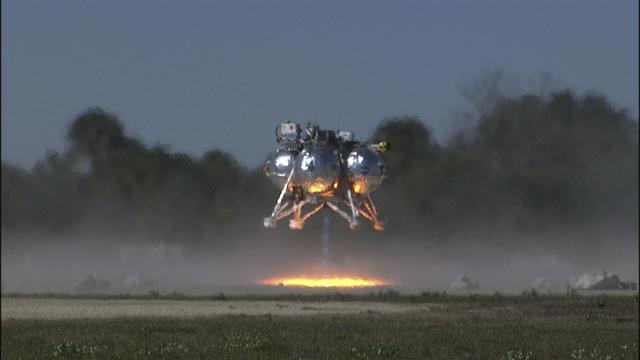
CAPE CANAVERAL, Fla. – The Project Morpheus prototype lander begins its ascent from a launch pad during the third free flight test at the north end of the Shuttle Landing Facility at NASA’s Kennedy Space Center in Florida. The 57-second test began at 1:15 p.m. EST with the Morpheus lander launching from the ground over a flame trench and ascending about 187 feet, nearly doubling the target ascent velocity from the last test in December 2013. The lander flew forward, covering about 154 feet in 20 seconds before descending and landing within 11 inches of its target on a dedicated pad inside the autonomous landing and hazard avoidance technology, or ALHAT, hazard field. Project Morpheus tests NASA’s ALHAT and an engine that runs on liquid oxygen and methane, or green propellants, into a fully-operational lander that could deliver cargo to other planetary surfaces. The landing facility provides the lander with the kind of field necessary for realistic testing, complete with rocks, craters and hazards to avoid. Morpheus’ ALHAT payload allows it to navigate to clear landing sites amidst rocks, craters and other hazards during its descent. Project Morpheus is being managed under the Advanced Exploration Systems, or AES, Division in NASA’s Human Exploration and Operations Mission Directorate. The efforts in AES pioneer new approaches for rapidly developing prototype systems, demonstrating key capabilities and validating operational concepts for future human missions beyond Earth orbit. For more information on Project Morpheus, visit http://www.nasa.gov/centers/johnson/exploration/morpheus. Photo credit: NASA/Frankie Martin
- Record ID
- KSC-2014-1080
- NASA center
- KSC
- Date
- 2014-01-16
- Credit
- NASA/KSC - FRANKIE MARTIN (IMCS)
- Keywords
- KSC-2014-1080
KSC · 2014-01-21 · KSC-2014-1114
Morpheus Campaign 1A Liftoff
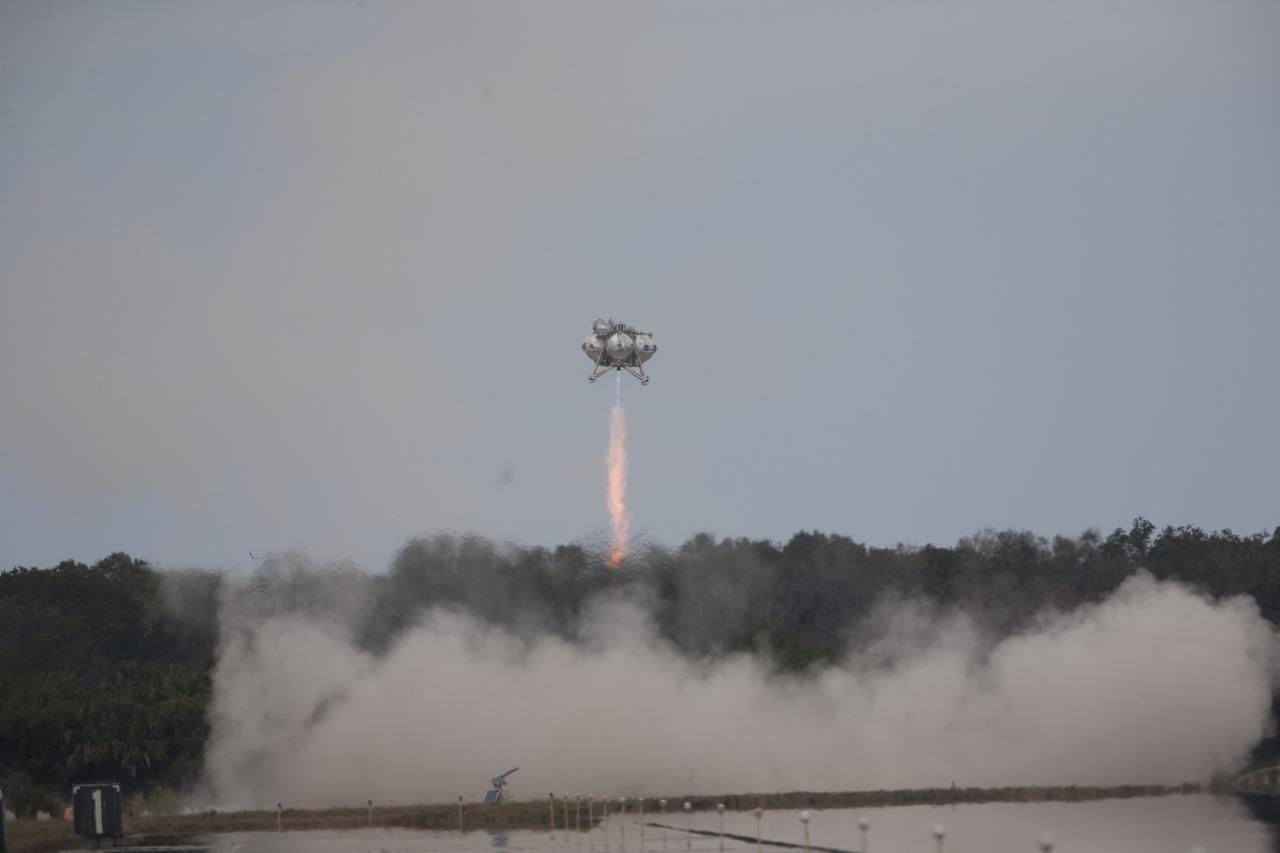
CAPE CANAVERAL, Fla. – The Project Morpheus prototype continues to ascend after launching on its fourth free flight test at the north end of the Shuttle Landing Facility…
Inspect NASA record
CAPE CANAVERAL, Fla. – The Project Morpheus prototype continues to ascend after launching on its fourth free flight test at the north end of the Shuttle Landing Facility at NASA’s Kennedy Space Center in Florida. The 64-second test began at 1:15 p.m. EST with the Morpheus lander launching from the ground over a flame trench and ascending about 305 feet, significantly increasing the ascent velocity from the last test. The lander flew forward, covering about 358 feet in 25 seconds before descending and landing within 15 inches of its target on a dedicated pad inside the autonomous landing and hazard avoidance technology, or ALHAT, hazard field. Project Morpheus tests NASA’s ALHAT and an engine that runs on liquid oxygen and methane, or green propellants, into a fully-operational lander that could deliver cargo to other planetary surfaces. The landing facility provides the lander with the kind of field necessary for realistic testing, complete with rocks, craters and hazards to avoid. Morpheus’ ALHAT payload allows it to navigate to clear landing sites amidst rocks, craters and other hazards during its descent. Project Morpheus is being managed under the Advanced Exploration Systems, or AES, Division in NASA’s Human Exploration and Operations Mission Directorate. The efforts in AES pioneer new approaches for rapidly developing prototype systems, demonstrating key capabilities and validating operational concepts for future human missions beyond Earth orbit. For more information on Project Morpheus, visit http://www.nasa.gov/centers/johnson/exploration/morpheus. Photo credit: NASA/Kim Shiflett
- Record ID
- KSC-2014-1114
- NASA center
- KSC
- Date
- 2014-01-21
- Credit
- NASA/KSC - KIM SHIFLETT (IMCS)
- Keywords
- KSC-2014-1114
JPL · 2023-12-12 · PIA26205
PIXL Instrument on NASA's Perseverance Studies 'Bills Bay'
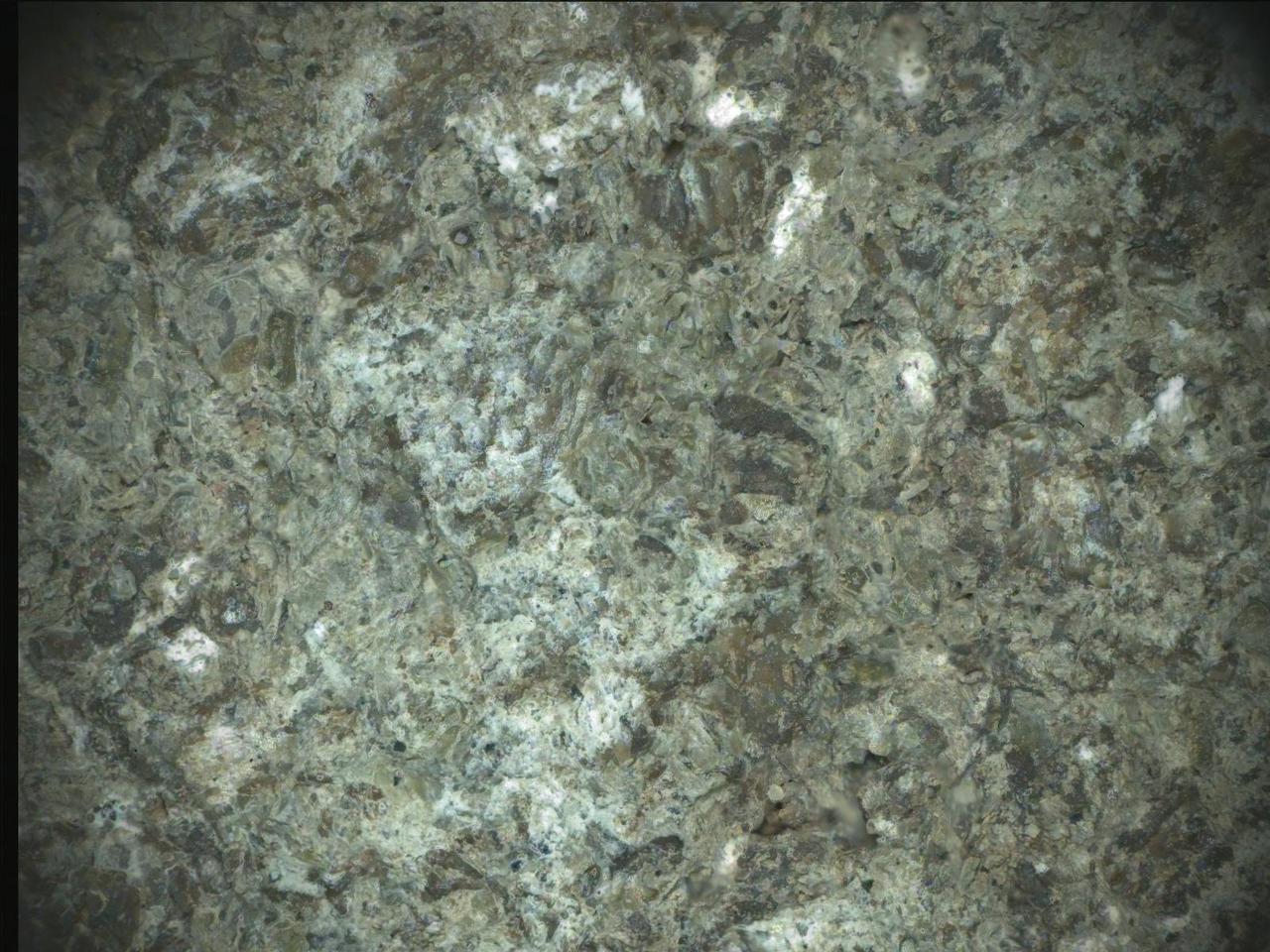
Before collecting a rock sample at a spot nicknamed "Lefroy Bay," NASA's Perseverance Mars rover employed an abrasion tool to wear down the rock surface and then used…
Inspect NASA record
Before collecting a rock sample at a spot nicknamed "Lefroy Bay," NASA's Perseverance Mars rover employed an abrasion tool to wear down the rock surface and then used the Planetary Instrument for X-ray Lithochemistry, or PIXL, to study the rock's internal chemistry. This image is composed of multiple shots of the abrasion patch, dubbed "Bills Bay," that were taken on Oct. 7 and Oct. 11, 2023, the 935th and 939th Martian days, or sols, of the mission. The image was taken by PIXL's camera, the Autofocus and Context Imager, or ACI. Color was added by overlaying data from WATSON (Wide Angle Topographic Sensor for Operations and eNgineering), a pair of cameras that are part of an instrument called Scanning Habitable Environments with Raman & Luminescence for Organics & Chemicals, or SHERLOC. On Earth, both silica and carbonates are good at preserving materials left behind by ancient life. Sand grains made of iron-rich carbonate are also mostly found in places on Earth that are good at protecting carbon-based materials known as organics. Organics can be made from both geological and biological sources; the Lefroy Bay sample does not necessarily show signs of ancient microbial life. Samples like Lefroy Bay would have to be brought back to Earth and studied with complex instruments in laboratories for scientists to confirm signs of ancient life, if indeed they are present. A key objective for Perseverance's mission on Mars is astrobiology, including the search for signs of ancient microbial life. The rover will characterize the planet's geology and past climate, pave the way for human exploration of the Red Planet, and be the first mission to collect and cache Martian rock and regolith (broken rock and dust). Subsequent NASA missions, in cooperation with ESA (European Space Agency), would send spacecraft to Mars to collect these sealed samples from the surface and return them to Earth for in-depth analysis. The Mars 2020 Perseverance mission is part of NASA's Moon to Mars exploration approach, which includes Artemis missions to the Moon that will help prepare for human exploration of the Red Planet. https://photojournal.jpl.nasa.gov/catalog/PIA26205
- Record ID
- PIA26205
- NASA center
- JPL
- Date
- 2023-12-12
- Credit
- NASA/JPL-Caltech/MSSS
- Keywords
- Mars 2020, Mars
KSC · 2014-01-21 · KSC-2014-1119
Morpheus Campaign 1A Liftoff
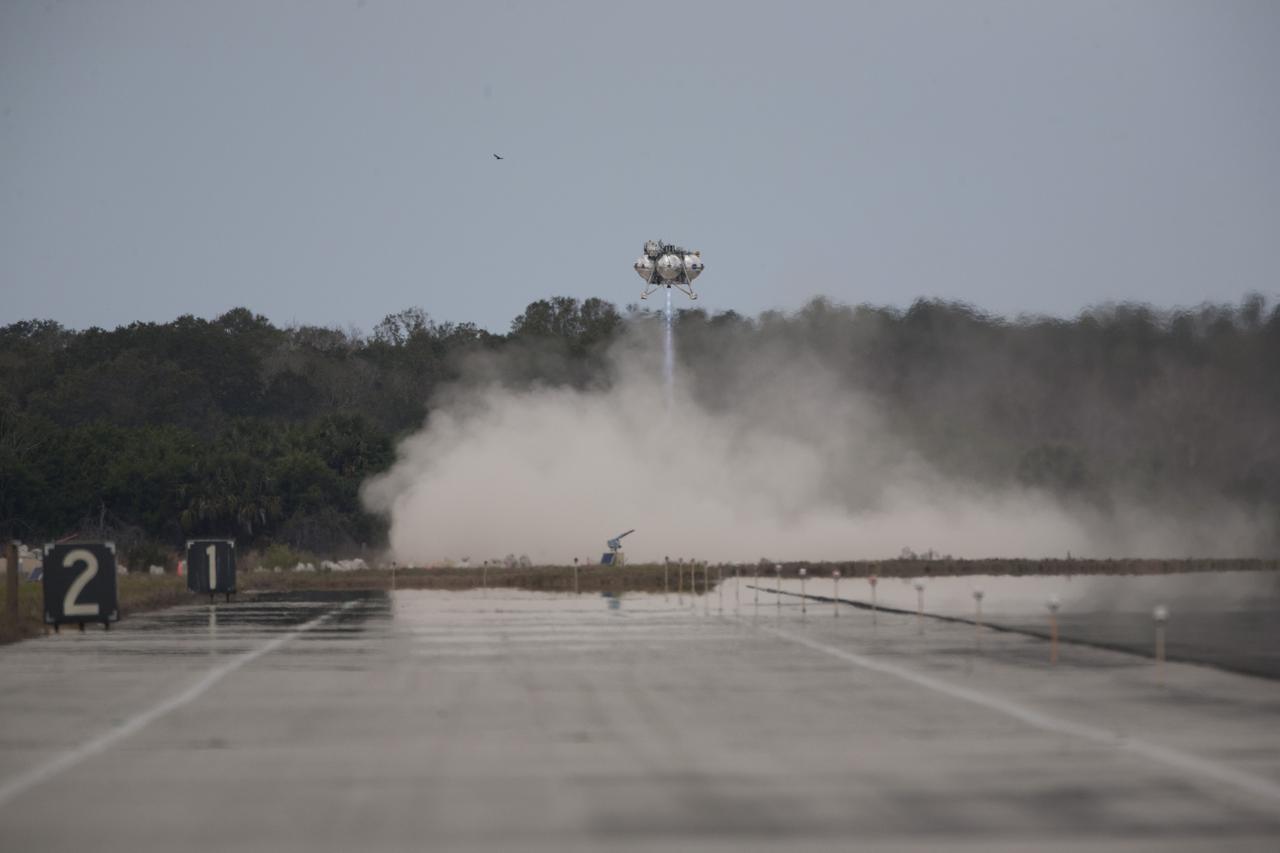
CAPE CANAVERAL, Fla. – The Project Morpheus prototype lander descends toward the autonomous landing and hazard avoidance technology, or ALHAT, hazard field after launching on its fourth free…
Inspect NASA record
CAPE CANAVERAL, Fla. – The Project Morpheus prototype lander descends toward the autonomous landing and hazard avoidance technology, or ALHAT, hazard field after launching on its fourth free flight test at the north end of the Shuttle Landing Facility at NASA’s Kennedy Space Center in Florida. The 64-second test began at 1:15 p.m. EST with the Morpheus lander launching from the ground over a flame trench and ascending about 305 feet, significantly increasing the ascent velocity from the last test. The lander flew forward, covering about 358 feet in 25 seconds before descending and landing within 15 inches of its target on a dedicated pad inside the ALHAT hazard field. Project Morpheus tests NASA’s ALHAT and an engine that runs on liquid oxygen and methane, or green propellants, into a fully-operational lander that could deliver cargo to other planetary surfaces. The landing facility provides the lander with the kind of field necessary for realistic testing, complete with rocks, craters and hazards to avoid. Morpheus’ ALHAT payload allows it to navigate to clear landing sites amidst rocks, craters and other hazards during its descent. Project Morpheus is being managed under the Advanced Exploration Systems, or AES, Division in NASA’s Human Exploration and Operations Mission Directorate. The efforts in AES pioneer new approaches for rapidly developing prototype systems, demonstrating key capabilities and validating operational concepts for future human missions beyond Earth orbit. For more information on Project Morpheus, visit http://www.nasa.gov/centers/johnson/exploration/morpheus. Photo credit: NASA/Kim Shiflett
- Record ID
- KSC-2014-1119
- NASA center
- KSC
- Date
- 2014-01-21
- Credit
- NASA/KSC - KIM SHIFLETT (IMCS)
- Keywords
- KSC-2014-1119
KSC · 2014-01-17 · KSC-2014-1089
Morpheus Media Press Event
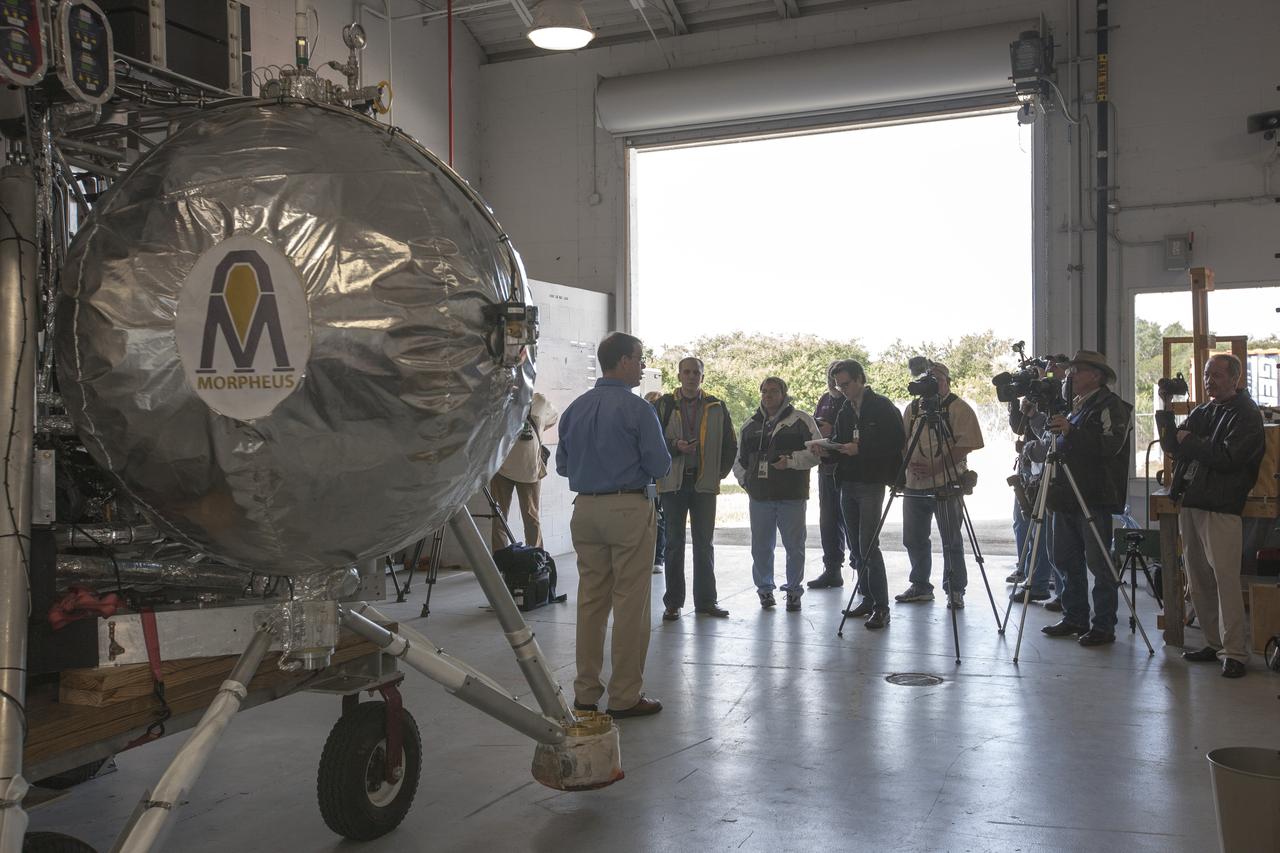
CAPE CANAVERAL, Fla. – Members of the news media view the Project Morpheus prototype lander inside a hangar near the Shuttle Landing Facility at NASA’s Kennedy Space Center…
Inspect NASA record
CAPE CANAVERAL, Fla. – Members of the news media view the Project Morpheus prototype lander inside a hangar near the Shuttle Landing Facility at NASA’s Kennedy Space Center in Florida. Speaking to the media is Greg Gaddis, the Kennedy Morpheus and ALHAT site manager. Morpheus successfully completed its third free flight test Jan. 16. The 57-second test began at 1:15 p.m. EST with the Morpheus lander launching from the ground over a flame trench and ascending about 187 feet, nearly doubling the target ascent velocity from the last test in December 2013. The lander flew forward, covering about 154 feet in 20 seconds before descending and landing within 11 inches of its target on a dedicated pad inside the autonomous landing and hazard avoidance technology, or ALHAT, hazard field. Project Morpheus tests NASA’s ALHAT and an engine that runs on liquid oxygen and methane, or green propellants, into a fully-operational lander that could deliver cargo to other planetary surfaces. The landing facility provides the lander with the kind of field necessary for realistic testing, complete with rocks, craters and hazards to avoid. Morpheus’ ALHAT payload allows it to navigate to clear landing sites amidst rocks, craters and other hazards during its descent. Project Morpheus is being managed under the Advanced Exploration Systems, or AES, Division in NASA’s Human Exploration and Operations Mission Directorate. The efforts in AES pioneer new approaches for rapidly developing prototype systems, demonstrating key capabilities and validating operational concepts for future human missions beyond Earth orbit. For more information on Project Morpheus, visit http://www.nasa.gov/centers/johnson/exploration/morpheus. Photo credit: NASA/Kim Shiflett
- Record ID
- KSC-2014-1089
- NASA center
- KSC
- Date
- 2014-01-17
- Credit
- NASA/KSC - KIM SHIFLETT (IMCS)
- Keywords
- KSC-2014-1089, Greg Gaddis
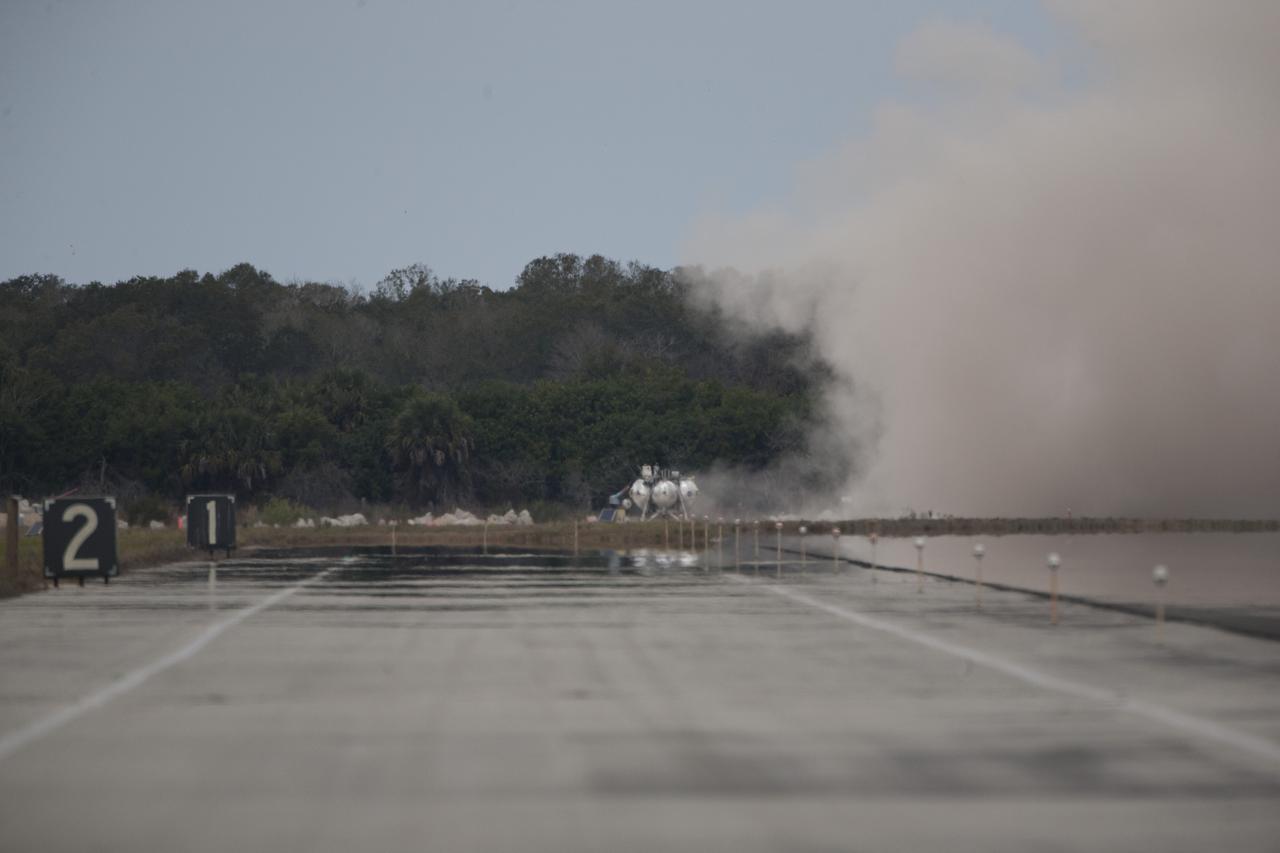
KSC · 2014-01-21 · KSC-2014-1122
Morpheus Campaign 1A Liftoff
CAPE CANAVERAL, Fla. – The Project Morpheus prototype lander touches down in the autonomous landing and hazard avoidance technology, or ALHAT, hazard field after launching on its fourth…
Inspect NASA record
CAPE CANAVERAL, Fla. – The Project Morpheus prototype lander touches down in the autonomous landing and hazard avoidance technology, or ALHAT, hazard field after launching on its fourth free flight test at the north end of the Shuttle Landing Facility at NASA’s Kennedy Space Center in Florida. The 64-second test began at 1:15 p.m. EST with the Morpheus lander launching from the ground over a flame trench and ascending about 305 feet, significantly increasing the ascent velocity from the last test. The lander flew forward, covering about 358 feet in 25 seconds before descending and landing within 15 inches of its target on a dedicated pad inside the ALHAT hazard field. Project Morpheus tests NASA’s ALHAT and an engine that runs on liquid oxygen and methane, or green propellants, into a fully-operational lander that could deliver cargo to other planetary surfaces. The landing facility provides the lander with the kind of field necessary for realistic testing, complete with rocks, craters and hazards to avoid. Morpheus’ ALHAT payload allows it to navigate to clear landing sites amidst rocks, craters and other hazards during its descent. Project Morpheus is being managed under the Advanced Exploration Systems, or AES, Division in NASA’s Human Exploration and Operations Mission Directorate. The efforts in AES pioneer new approaches for rapidly developing prototype systems, demonstrating key capabilities and validating operational concepts for future human missions beyond Earth orbit. For more information on Project Morpheus, visit http://www.nasa.gov/centers/johnson/exploration/morpheus. Photo credit: NASA/Kim Shiflett
- Record ID
- KSC-2014-1122
- NASA center
- KSC
- Date
- 2014-01-21
- Credit
- NASA/KSC - KIM SHIFLETT (IMCS)
- Keywords
- KSC-2014-1122
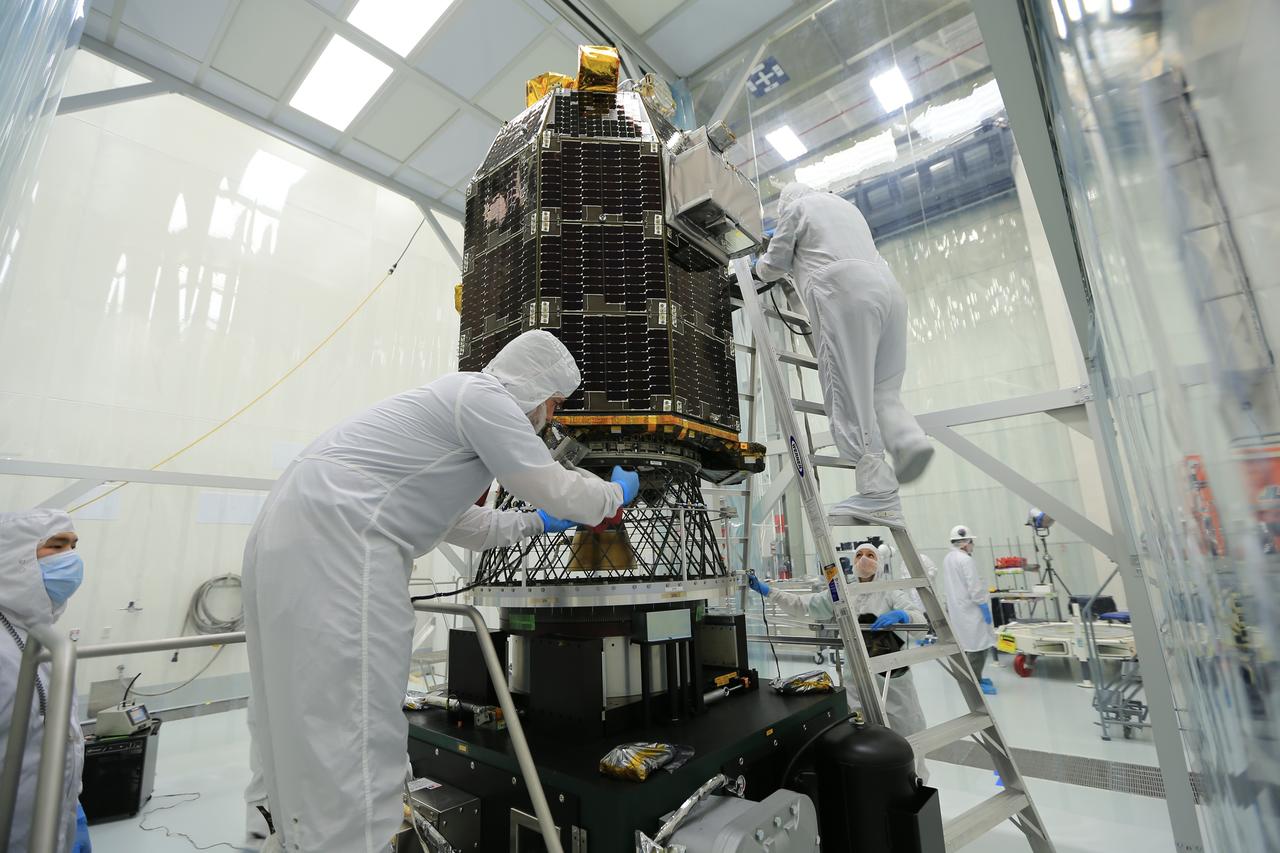
GSFC · 2017-12-08 · GSFC_20171208_Archive_e001395
LADEE Preparations
NASA's Lunar Atmosphere and Dust Environment Explorer (LADEE) spacecraft being prepared in the clean room at Wallops Flight Facility. Credit: NASA ----- What is LADEE? The Lunar Atmosphere…
Inspect NASA record
NASA's Lunar Atmosphere and Dust Environment Explorer (LADEE) spacecraft being prepared in the clean room at Wallops Flight Facility. Credit: NASA ----- What is LADEE? The Lunar Atmosphere and Dust Environment Explorer (LADEE) is designed to study the Moon's thin exosphere and the lunar dust environment. An "exosphere" is an atmosphere that is so thin and tenuous that molecules don't collide with each other. Studying the Moon's exosphere will help scientists understand other planetary bodies with exospheres too, like Mercury and some of Jupiter's bigger moons. The orbiter will determine the density, composition and temporal and spatial variability of the Moon's exosphere to help us understand where the species in the exosphere come from and the role of the solar wind, lunar surface and interior, and meteoric infall as sources. The mission will also examine the density and temporal and spatial variability of dust particles that may get lofted into the atmosphere. The mission also will test several new technologies, including a modular spacecraft bus that may reduce the cost of future deep space missions and demonstrate two-way high rate laser communication for the first time from the Moon. LADEE now is ready to launch when the window opens on Sept. 6, 2013. Read more: www.nasa.gov/ladee NASA image use policy. NASA Goddard Space Flight Center enables NASA’s mission through four scientific endeavors: Earth Science, Heliophysics, Solar System Exploration, and Astrophysics. Goddard plays a leading role in NASA’s accomplishments by contributing compelling scientific knowledge to advance the Agency’s mission. Follow us on Twitter Like us on Facebook Find us on Instagram
- Record ID
- GSFC_20171208_Archive_e001395
- NASA center
- GSFC
- Date
- 2017-12-08
- Keywords
- LADEE Preparations, moon, nasa, rocket, launch, goddard, ladee
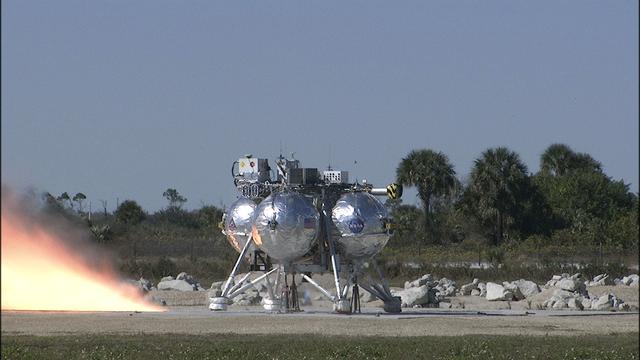
KSC · 2014-01-16 · KSC-2014-1079
Morpheus Campaign 1A Liftoff
CAPE CANAVERAL, Fla. – The Project Morpheus prototype lander third free flight test begins at the north end of the Shuttle Landing Facility at NASA’s Kennedy Space Center…
Inspect NASA record
CAPE CANAVERAL, Fla. – The Project Morpheus prototype lander third free flight test begins at the north end of the Shuttle Landing Facility at NASA’s Kennedy Space Center in Florida. The 57-second test began at 1:15 p.m. EST with the Morpheus lander launching from the ground over a flame trench and ascending about 187 feet, nearly doubling the target ascent velocity from the last test in December 2013. The lander flew forward, covering about 154 feet in 20 seconds before descending and landing within 11 inches of its target on a dedicated pad inside the autonomous landing and hazard avoidance technology, or ALHAT, hazard field. Project Morpheus tests NASA’s ALHAT and an engine that runs on liquid oxygen and methane, or green propellants, into a fully-operational lander that could deliver cargo to other planetary surfaces. The landing facility provides the lander with the kind of field necessary for realistic testing, complete with rocks, craters and hazards to avoid. Morpheus’ ALHAT payload allows it to navigate to clear landing sites amidst rocks, craters and other hazards during its descent. Project Morpheus is being managed under the Advanced Exploration Systems, or AES, Division in NASA’s Human Exploration and Operations Mission Directorate. The efforts in AES pioneer new approaches for rapidly developing prototype systems, demonstrating key capabilities and validating operational concepts for future human missions beyond Earth orbit. For more information on Project Morpheus, visit http://www.nasa.gov/centers/johnson/exploration/morpheus. Photo credit: NASA/Frankie Martin
- Record ID
- KSC-2014-1079
- NASA center
- KSC
- Date
- 2014-01-16
- Credit
- NASA/KSC - FRANKIE MARTIN (IMCS)
- Keywords
- KSC-2014-1079
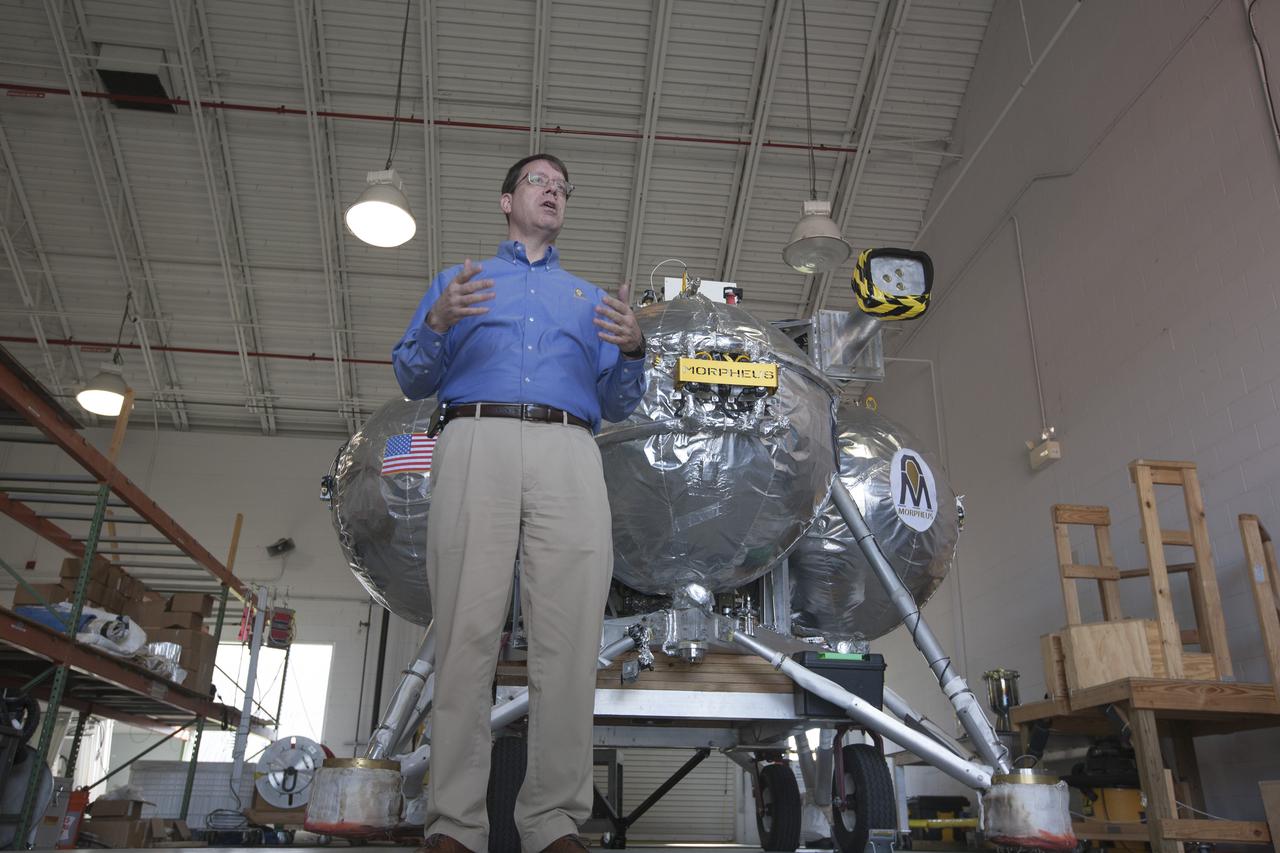
KSC · 2014-01-17 · KSC-2014-1087
Morpheus Media Press Event
CAPE CANAVERAL, Fla. – Members of the news media view the Project Morpheus prototype lander inside a hangar near the Shuttle Landing Facility at NASA’s Kennedy Space Center…
Inspect NASA record
CAPE CANAVERAL, Fla. – Members of the news media view the Project Morpheus prototype lander inside a hangar near the Shuttle Landing Facility at NASA’s Kennedy Space Center in Florida. Speaking to the media is Greg Gaddis, the Kennedy Morpheus and ALHAT site manager. Morpheus successfully completed its third free flight test Jan. 16. The 57-second test began at 1:15 p.m. EST with the Morpheus lander launching from the ground over a flame trench and ascending about 187 feet, nearly doubling the target ascent velocity from the last test in December 2013. The lander flew forward, covering about 154 feet in 20 seconds before descending and landing within 11 inches of its target on a dedicated pad inside the autonomous landing and hazard avoidance technology, or ALHAT, hazard field. Project Morpheus tests NASA’s ALHAT and an engine that runs on liquid oxygen and methane, or green propellants, into a fully-operational lander that could deliver cargo to other planetary surfaces. The landing facility provides the lander with the kind of field necessary for realistic testing, complete with rocks, craters and hazards to avoid. Morpheus’ ALHAT payload allows it to navigate to clear landing sites amidst rocks, craters and other hazards during its descent. Project Morpheus is being managed under the Advanced Exploration Systems, or AES, Division in NASA’s Human Exploration and Operations Mission Directorate. The efforts in AES pioneer new approaches for rapidly developing prototype systems, demonstrating key capabilities and validating operational concepts for future human missions beyond Earth orbit. For more information on Project Morpheus, visit http://www.nasa.gov/centers/johnson/exploration/morpheus. Photo credit: NASA/Kim Shiflett
- Record ID
- KSC-2014-1087
- NASA center
- KSC
- Date
- 2014-01-17
- Credit
- NASA/KSC - KIM SHIFLETT (IMCS)
- Keywords
- KSC-2014-1087, Greg Gaddis