
Update Site (from NASA)
Explore NASA’s Image and Video Library.
Suggest one object per day for the Interstellar Minds collection. We review each suggestion before adding it.
Sign in to suggest a Marvel.
Find a NASA image ID. Open a NASA record and copy its ID from the end of the details URL.
NASA image records

KSC · 2011-04-09 · KSC-2011-2827
KSC-2011-2827
CAPE CANAVERAL, Fla. -- The container holding NASA's Juno spacecraft is being removed by an overhead crane as technicians monitor the progress. The spacecraft will then moved into…
Inspect NASA record
CAPE CANAVERAL, Fla. -- The container holding NASA's Juno spacecraft is being removed by an overhead crane as technicians monitor the progress. The spacecraft will then moved into an airlock at Astrotech's payload processing facility in Titusville, Fla. to begin final testing and preparations for launch. The solar-powered spacecraft will orbit Jupiter's poles 33 times to find out more about the gas giant's origins, structure, atmosphere and magnetosphere and investigate the existence of a solid planetary core. Juno is scheduled to launch aboard an Atlas V rocket from Cape Canaveral, Fla. Aug. 5. For more information visit, www.nasa.gov/juno. Photo credit: NASA/Jack Pfaller It will splash down into the Atlantic Ocean where the ship and its crew will recover it and tow it back through Port Canaveral for refurbishing for another launch. The STS-124 mission is the second of three flights launching components to complete the Japan Aerospace Exploration Agency's Kibo laboratory. The shuttle crew will install Kibo's large Japanese Pressurized Module and its remote manipulator system, or RMS. Photo credit: USA/Jeff Suter
- Record ID
- KSC-2011-2827
- NASA center
- KSC
- Date
- 2011-04-09
- Keywords
- juno, atlas v, elv

JPL · 2023-11-09 · PIA25784
SPHEREx Outer Photon Shield
Sara Susca, deputy payload manager and payload systems engineer for the NASA's SPHEREx mission, looks up at one of the spacecraft's photon shields at the agency's Jet Propulsion…
Inspect NASA record
Sara Susca, deputy payload manager and payload systems engineer for the NASA's SPHEREx mission, looks up at one of the spacecraft's photon shields at the agency's Jet Propulsion Laboratory in Southern California in October 2023. Short for Specto-Photometer for the History of the Universe, Epoch of Reionization and Ices Explorer, SPHEREx will create a map of the cosmos like no other, imaging the entire sky and gathering information about millions of galaxies. With this map, scientists will study what happened in the first fraction of a second after the big bang, the history of galaxy evolution, and the origins of water in planetary systems in our galaxy. Three concentric photon shields will surround the SPHEREx telescope to protect it from nearby light sources that could overwhelm its detectors. The shields will primarily block light from the Sun and the Earth. They also block heat; SPHEREx needs to be kept cold – below minus 350 degrees Fahrenheit (about minus 210 degrees Celsius). That's because SPHEREx detects infrared light, which is sometimes called heat radiation because it's emitted by anything warm. The heat from SPHEREx's own detectors could overwhelm their ability to image faint cosmic objects, so the spacecraft needs a way to cool the detectors down. The spacecraft stands almost 8.5 feet tall (2.6 meters) and stretches nearly 10.5 feet (3.2 meters) wide. https://photojournal.jpl.nasa.gov/catalog/PIA25784
- Record ID
- PIA25784
- NASA center
- JPL
- Date
- 2023-11-09
- Credit
- NASA/JPL-Caltech
- Keywords
- SPHEREx

KSC · 2011-04-09 · KSC-2011-2831
KSC-2011-2831
CAPE CANAVERAL, Fla. -- Lockheed-Martin technicians at Astrotech's payload processing facility in Titusville, Fla. have removed the protective wrapping from NASA's Juno spacecraft and begin an inspection prior…
Inspect NASA record
CAPE CANAVERAL, Fla. -- Lockheed-Martin technicians at Astrotech's payload processing facility in Titusville, Fla. have removed the protective wrapping from NASA's Juno spacecraft and begin an inspection prior to final testing and preparations for launch. The solar-powered spacecraft will orbit Jupiter's poles 33 times to find out more about the gas giant's origins, structure, atmosphere and magnetosphere and investigate the existence of a solid planetary core. Juno is scheduled to launch aboard an Atlas V rocket from Cape Canaveral, Fla. Aug. 5. For more information visit, www.nasa.gov/juno. Photo credit: NASA/Jack Pfaller It will splash down into the Atlantic Ocean where the ship and its crew will recover it and tow it back through Port Canaveral for refurbishing for another launch. The STS-124 mission is the second of three flights launching components to complete the Japan Aerospace Exploration Agency's Kibo laboratory. The shuttle crew will install Kibo's large Japanese Pressurized Module and its remote manipulator system, or RMS. Photo credit: USA/Jeff Suter
- Record ID
- KSC-2011-2831
- NASA center
- KSC
- Date
- 2011-04-09
- Keywords
- juno, atlas v, elv

JPL · 2023-11-09 · PIA25785
SPHEREx Photon Shields Assembled
Part of one of the protective photon shields for NASA's SPHEREx telescope are shown here being assembled at Applied Aerospace Structures in Stockton, California, in July 2023. Short…
Inspect NASA record
Part of one of the protective photon shields for NASA's SPHEREx telescope are shown here being assembled at Applied Aerospace Structures in Stockton, California, in July 2023. Short for Specto-Photometer for the History of the Universe, Epoch of Reionization and Ices Explorer, SPHEREx will create a map of the cosmos like no other, imaging the entire sky and gathering information about millions of galaxies. With this map, scientists will study what happened in the first fraction of a second after the big bang, the history of galaxy evolution, and the origins of water in planetary systems in our galaxy. The three concentric photon shields will surround the SPHEREx telescope to protect it from nearby light sources that could overwhelm its detectors. The shields will primarily block light from the Sun and the Earth. They also block heat, because SPHEREx needs to be kept cold – below minus 350 degrees Fahrenheit (about minus 210 degrees Celsius). That's because SPHEREx detects infrared light, which is sometimes called heat radiation because it's emitted by anything warm. The heat from SPHEREx's own detectors could overwhelm their ability to detect faint cosmic objects if they aren't cooled down. https://photojournal.jpl.nasa.gov/catalog/PIA25785
- Record ID
- PIA25785
- NASA center
- JPL
- Date
- 2023-11-09
- Credit
- AACS
KSC · 2005-12-07 · KSC-05pd2648
KSC-05pd2648
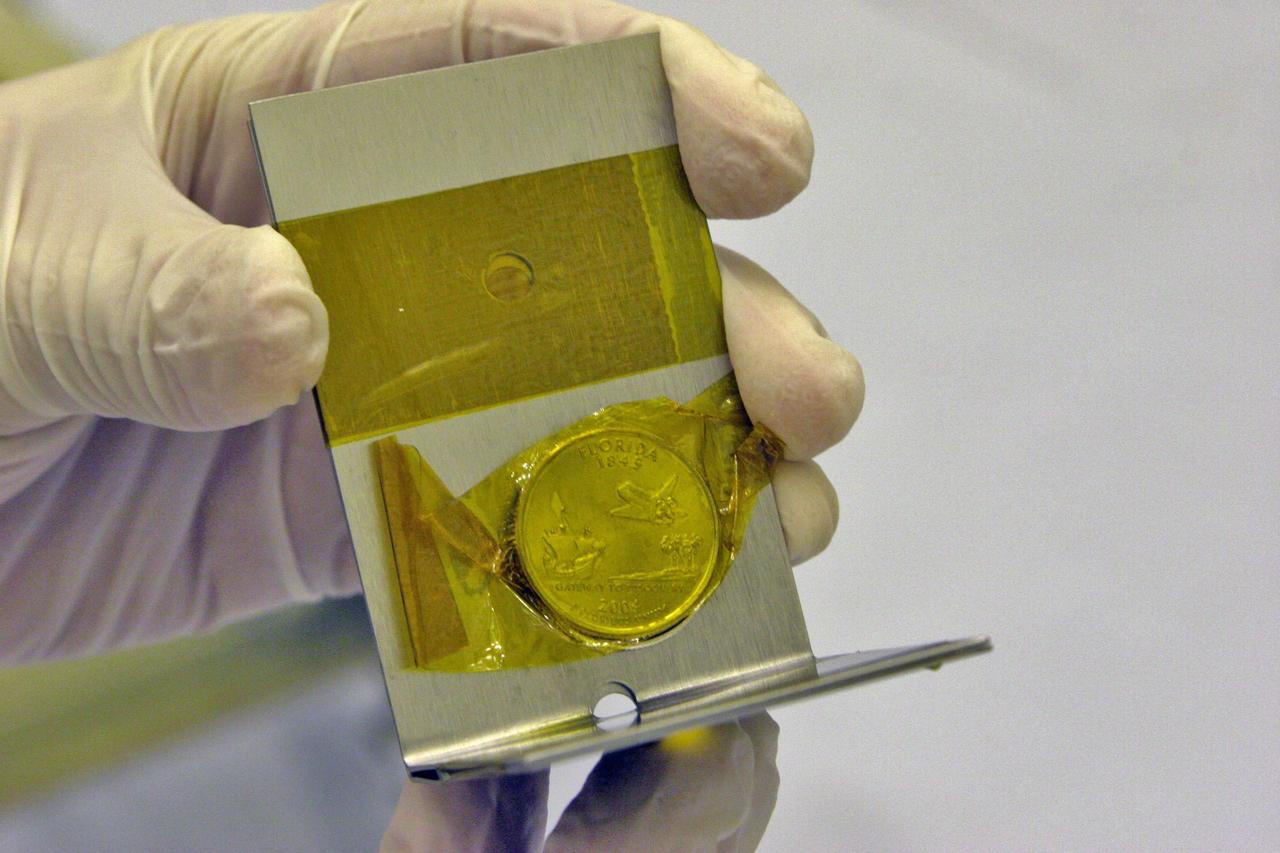
KENNEDY SPACE CENTER, FLA. - A Florida quarter is prepared for installation on the New Horizons spacecraft in Kennedy Space Center's Payload Hazardous Servicing Facility. The new quarter,…
Inspect NASA record
KENNEDY SPACE CENTER, FLA. - A Florida quarter is prepared for installation on the New Horizons spacecraft in Kennedy Space Center's Payload Hazardous Servicing Facility. The new quarter, engraved with the "Gateway to Discovery" design, will accompany New Horizons on its 3-billion-mile journey to the planet Pluto and its moon, Charon. Although appropriate for the mission to carry the coin from the state that symbolizes space exploration, it will also serve a practical purpose: scientists are using the quarter as a spin-balance weight. New Horizons comprises seven scientific instruments that will characterize the global geology and geomorphology of Pluto and its moon Charon, map their surface compositions and temperatures, and examine Pluto's complex atmosphere. After that, flybys of Kuiper Belt objects from even farther in the solar system may be undertaken in an extended mission. New Horizons is the first mission in NASA's New Frontiers program of medium-class planetary missions. The spacecraft, designed for NASA by the Johns Hopkins University Applied Physics Laboratory in Laurel, Md., will launch aboard a Lockheed Martin Atlas V rocket and fly by Pluto and Charon as early as summer 2015. Photo Credit: Applied Physics Laboratory/George W. Rogers III
- Record ID
- KSC-05pd2648
- NASA center
- KSC
- Date
- 2005-12-07
- Keywords
- New Horizons, coin, money, quarter
GSFC · 2022-10-25 · GSFC_20221025_PACE_076169
GSFC_20221025_PACE_076169
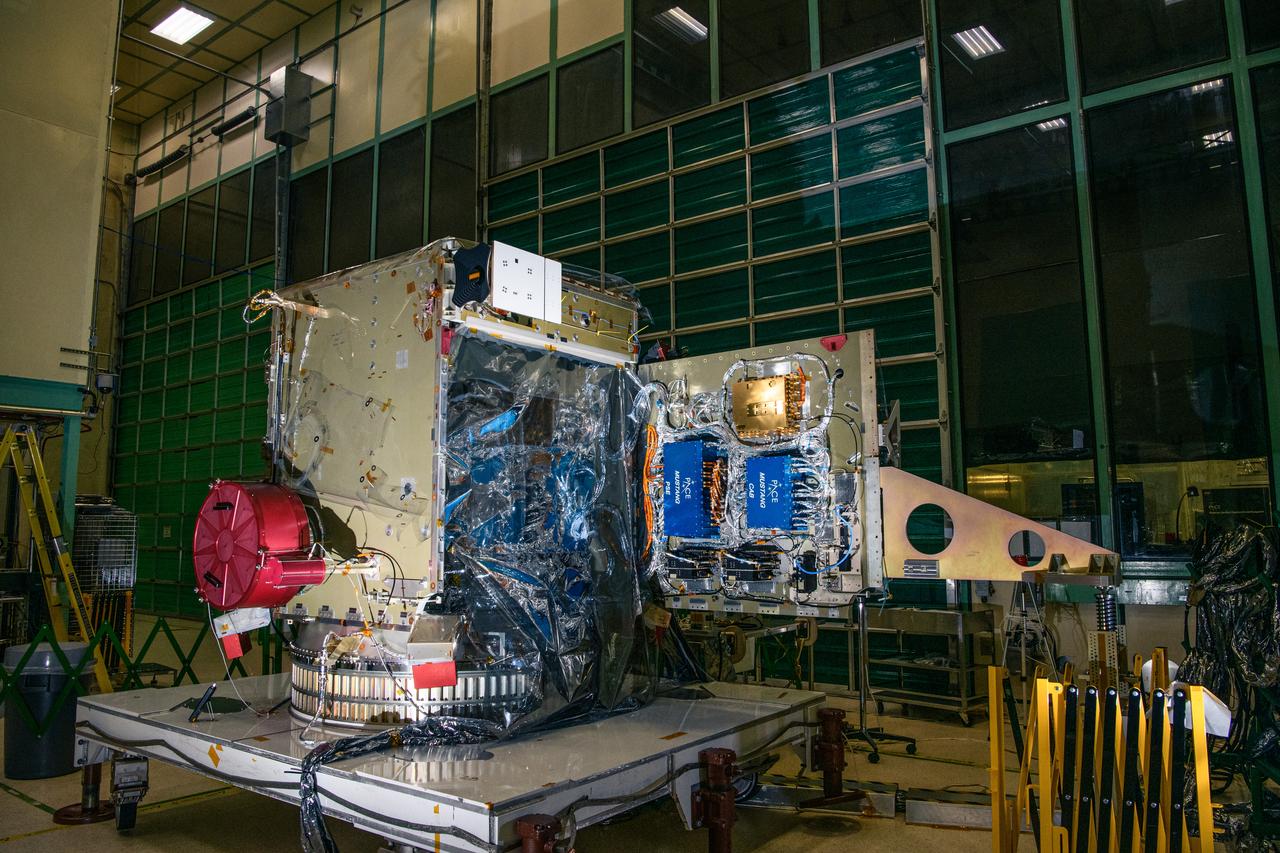
The Plankton, Aerosol, Cloud, ocean Ecosystem (PACE) spacecraft bus after integration of The Hyper-Angular Rainbow Polarimeter #2 (HARP2) instrument at NASA's Goddard Space Flight Center in Greenbelt, Maryland…
Inspect NASA record
The Plankton, Aerosol, Cloud, ocean Ecosystem (PACE) spacecraft bus after integration of The Hyper-Angular Rainbow Polarimeter #2 (HARP2) instrument at NASA's Goddard Space Flight Center in Greenbelt, Maryland on October 25th, 2022. HARP2 is one of three instruments on NASA's PACE observatory, it was designed and built by UMBC's Earth and Space Institute. PACE's unprecedented spectral coverage will provide the first-ever global measurements designed to identify phytoplankton community composition. The mission will make global ocean color measurements, using the Ocean Color Instrument (OCI), to provide extended data records on ocean ecology and global biogeochemistry along with polarimetry measurements, using the Spectro-polarimeter for Planetary Exploration (SPEXone) and the Hyper Angular Research Polarimeter (HARP2) to provide extended data records on clouds and aerosols. The Earth-observing satellite mission, built at Goddard Space Flight Center in Greenbelt, MD, will continue and advance observations of global ocean color, biogeochemistry, and ecology, as well as the carbon cycle, aerosols and clouds.
- Record ID
- GSFC_20221025_PACE_076169
- NASA center
- GSFC
- Date
- 2022-10-25
- Credit
- NASA / Denny Henry

KSC · 2011-04-09 · KSC-2011-2832
KSC-2011-2832
CAPE CANAVERAL, Fla. -- Lockheed-Martin technicians at Astrotech's payload processing facility in Titusville, Fla. have removed the protective wrapping from NASA's Juno spacecraft and begin an inspection prior…
Inspect NASA record
CAPE CANAVERAL, Fla. -- Lockheed-Martin technicians at Astrotech's payload processing facility in Titusville, Fla. have removed the protective wrapping from NASA's Juno spacecraft and begin an inspection prior to final testing and preparations for launch. The solar-powered spacecraft will orbit Jupiter's poles 33 times to find out more about the gas giant's origins, structure, atmosphere and magnetosphere and investigate the existence of a solid planetary core. Juno is scheduled to launch aboard an Atlas V rocket from Cape Canaveral, Fla. Aug. 5. For more information visit, www.nasa.gov/juno. Photo credit: NASA/Jack Pfaller It will splash down into the Atlantic Ocean where the ship and its crew will recover it and tow it back through Port Canaveral for refurbishing for another launch. The STS-124 mission is the second of three flights launching components to complete the Japan Aerospace Exploration Agency's Kibo laboratory. The shuttle crew will install Kibo's large Japanese Pressurized Module and its remote manipulator system, or RMS. Photo credit: USA/Jeff Suter
- Record ID
- KSC-2011-2832
- NASA center
- KSC
- Date
- 2011-04-09
- Keywords
- juno, atlas v, elv
HQ · 2018-10-31 · NHQ201810310014
InSight Media Briefing
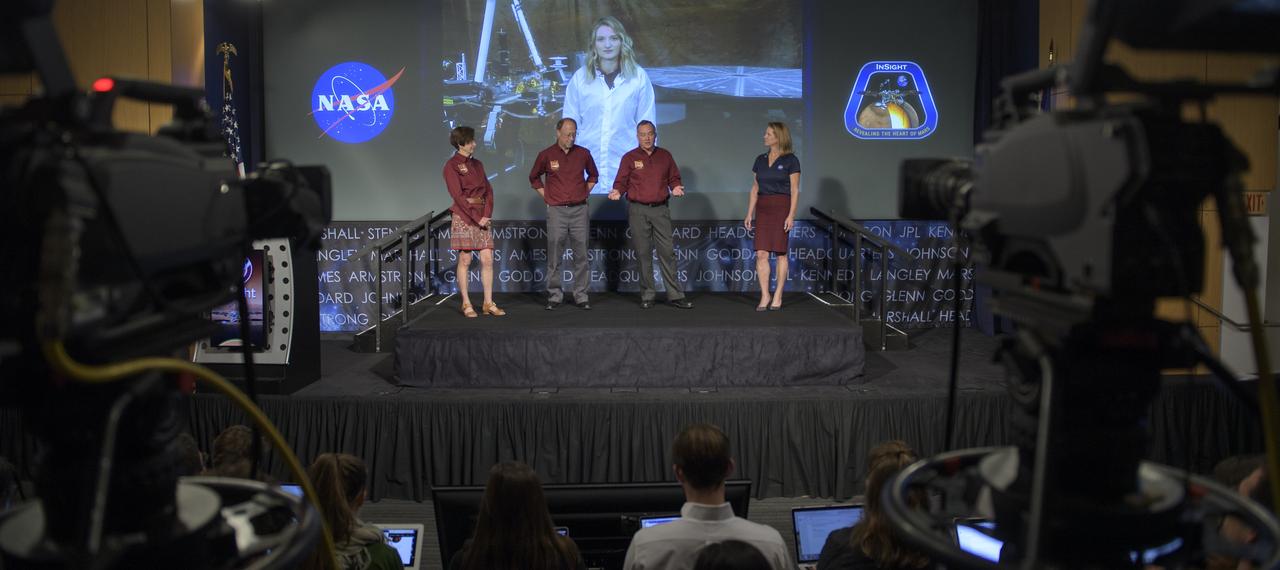
NASA's Jet Propulsion Laboratory InSight instrument deployment lead Jaime Singer, on screen, NASA's Jet Propulsion Laboratory InSight deputy principal investigator Sue Smrekar, left, NASA's Jet Propulsion Laboratory InSight…
Inspect NASA record
NASA's Jet Propulsion Laboratory InSight instrument deployment lead Jaime Singer, on screen, NASA's Jet Propulsion Laboratory InSight deputy principal investigator Sue Smrekar, left, NASA's Jet Propulsion Laboratory InSight principal investigator Bruce Banerdt, NASA's Jet Propulsion Laboratory InSight project manager Tom Hoffman, and NASA Headquarters acting director of the Planetary Science Division Lori Glaze, right, discuss the NASA InSight Mars Lander (Interior Exploration using Seismic Investigations, Geodesy and Heat Transport) during media briefing, Wednesday, Oct. 31, 2018 at NASA Headquarters in Washington. InSIght will land on the Red Planet at approximately 3 p.m. EST (noon PST) Monday, Nov. 26. InSight will study the deep interior of Mars to learn how all celestial bodies with rocky surfaces, including Earth and the Moon, formed. The lander’s instruments include a seismometer to detect marsquakes and a probe to monitor the flow of heat in the planet's subsurface. Photo Credit: (NASA/Bill Ingalls)
- Record ID
- NHQ201810310014
- NASA center
- HQ
- Date
- 2018-10-31
- Credit
- NASA/Bill Ingalls
- Keywords
- Bruce Banerdt, DC, Jaime Singer, Lori Glaze, Mars Interior Exploration using Seismic Investigations Geodesy a, NASA Headquarters, Sue Smrekar, Tom Hoffman, Washington
JPL · 1997-10-14 · PIA00975
Mars Rotational and Orbital Dynamics
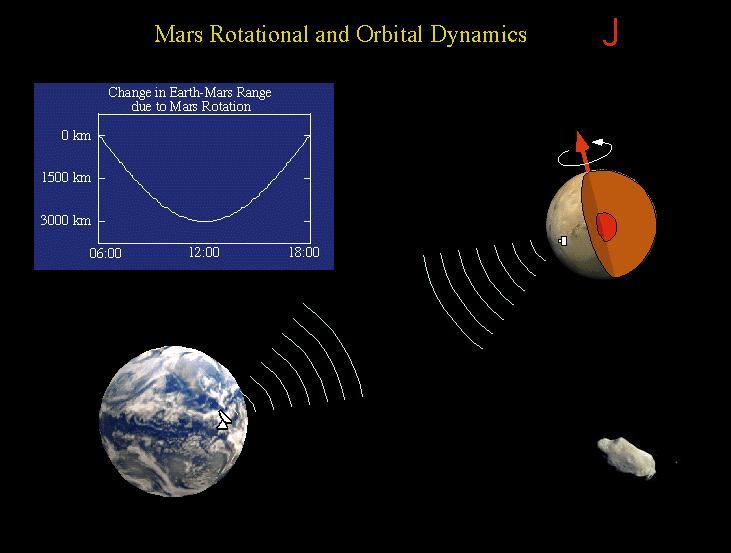
The Rotation and Orbit Dynamics experiment is based on measuring the Doppler range to Pathfinder using the radio link. Mars rotation about it's pole causes a signature in…
Inspect NASA record
The Rotation and Orbit Dynamics experiment is based on measuring the Doppler range to Pathfinder using the radio link. Mars rotation about it's pole causes a signature in the data with a daily minimum when the lander is closest to the Earth. Changes in the daily signature reveal information about the planetary interior, through its effect on Mars' precession and nutation. The signature also is sensitive to variations in Mars' rotation rate as the mass of the atmosphere increases and decreases as the polar caps are formed in winter and evaporate in spring. Long term signatures in the range to the lander are caused by asteroids perturbing Mars' orbit. Analysis of these perturbations allows the determination of the masses of asteroids. Sojourner spent 83 days of a planned seven-day mission exploring the Martian terrain, acquiring images, and taking chemical, atmospheric and other measurements. The final data transmission received from Pathfinder was at 10:23 UTC on September 27, 1997. Although mission managers tried to restore full communications during the following five months, the successful mission was terminated on March 10, 1998. http://photojournal.jpl.nasa.gov/catalog/PIA00975
- Record ID
- PIA00975
- NASA center
- JPL
- Date
- 1997-10-14
- Credit
- NASA/JPL
- Keywords
- Mars, Mars Pathfinder MPF

KSC · 2011-04-09 · KSC-2011-2830
KSC-2011-2830
CAPE CANAVERAL, Fla. -- Lockheed-Martin technicians at Astrotech's payload processing facility in Titusville, Fla. have removed the protective wrapping from NASA's Juno spacecraft and begin an inspection prior…
Inspect NASA record
CAPE CANAVERAL, Fla. -- Lockheed-Martin technicians at Astrotech's payload processing facility in Titusville, Fla. have removed the protective wrapping from NASA's Juno spacecraft and begin an inspection prior to final testing and preparations for launch. The solar-powered spacecraft will orbit Jupiter's poles 33 times to find out more about the gas giant's origins, structure, atmosphere and magnetosphere and investigate the existence of a solid planetary core. Juno is scheduled to launch aboard an Atlas V rocket from Cape Canaveral, Fla. Aug. 5. For more information visit, www.nasa.gov/juno. Photo credit: NASA/Jack Pfaller It will splash down into the Atlantic Ocean where the ship and its crew will recover it and tow it back through Port Canaveral for refurbishing for another launch. The STS-124 mission is the second of three flights launching components to complete the Japan Aerospace Exploration Agency's Kibo laboratory. The shuttle crew will install Kibo's large Japanese Pressurized Module and its remote manipulator system, or RMS. Photo credit: USA/Jeff Suter
- Record ID
- KSC-2011-2830
- NASA center
- KSC
- Date
- 2011-04-09
- Keywords
- juno, atlas v, elv

KSC · 2011-04-09 · KSC-2011-2823
KSC-2011-2823
CAPE CANAVERAL, Fla. -- Workers in Astrotech's payload processing facility in Titusville, Fla. inspect the container that holds NASA's Juno spacecraft after its arrival. The shipping container will…
Inspect NASA record
CAPE CANAVERAL, Fla. -- Workers in Astrotech's payload processing facility in Titusville, Fla. inspect the container that holds NASA's Juno spacecraft after its arrival. The shipping container will then be lifted off the spacecraft to begin final testing and preparations for launch. The solar-powered spacecraft will orbit Jupiter's poles 33 times to find out more about the gas giant's origins, structure, atmosphere and magnetosphere and investigate the existence of a solid planetary core. Juno is scheduled to launch aboard an Atlas V rocket from Cape Canaveral, Fla. Aug. 5. For more information visit, www.nasa.gov/juno. Photo credit: NASA/Jack Pfaller It will splash down into the Atlantic Ocean where the ship and its crew will recover it and tow it back through Port Canaveral for refurbishing for another launch. The STS-124 mission is the second of three flights launching components to complete the Japan Aerospace Exploration Agency's Kibo laboratory. The shuttle crew will install Kibo's large Japanese Pressurized Module and its remote manipulator system, or RMS. Photo credit: USA/Jeff Suter
- Record ID
- KSC-2011-2823
- NASA center
- KSC
- Date
- 2011-04-09
- Keywords
- juno, atlas v, elv
JPL · 2024-07-31 · PIA26345
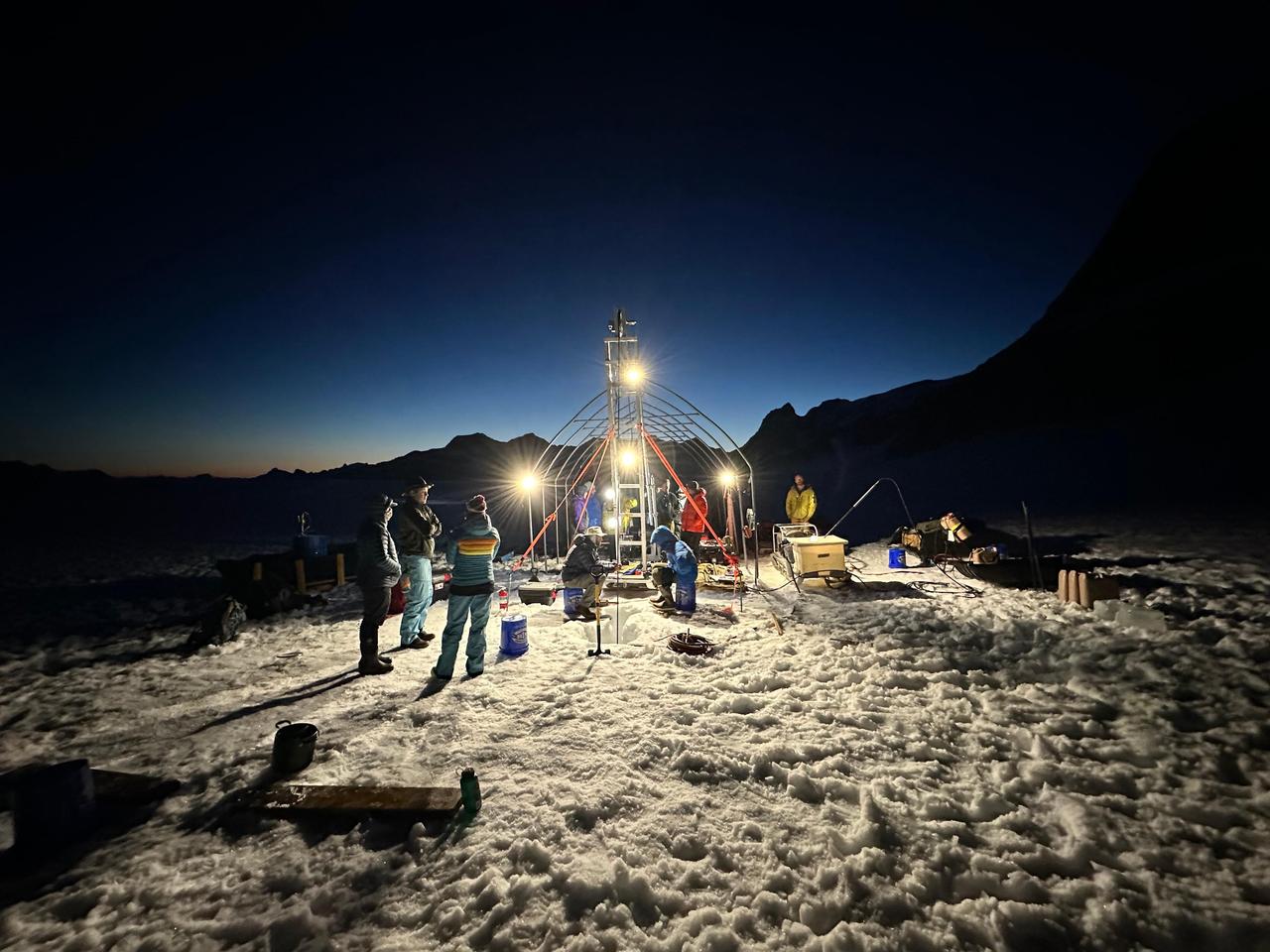
NASA JPL'S ORCAA Field Work in Alaska
A group of researchers from NASA's Jet Propulsion Laboratory and other institutions spent two weeks on a glacier in Alaska in July 2023 for a project called ORCAA…
Inspect NASA record
A group of researchers from NASA's Jet Propulsion Laboratory and other institutions spent two weeks on a glacier in Alaska in July 2023 for a project called ORCAA (Ocean Worlds Reconnaissance and Characterization of Astrobiological Analogs). Known as an analog mission, the project is working to answer science questions and test technology in preparation for a potential future mission to explore the surface or subsurface of icy moons like Jupiter's Europa and Saturn's Enceladus. Working at the Juneau Icefield, in coordination with the Juneau Icefield Research Project, the team used a hot-water drill to make a narrow hole in the glacier, melting its way progressively deeper. After three days, the drill reached bedrock, 890 feet (272 meters) below the surface. Science instruments were then sent down the borehole to take a variety of measurements and characterize the water environment. In 2025, the ORCAA team will return to the icefield and target a subglacial lake (a body of water inside the glacier) that has similarities to a reservoir scientists believe exists a few kilometers beneath the icy surface of Europa. ORCAA is funded by NASA's Planetary Science and Technology from Analog Research (PSTAR) program. https://photojournal.jpl.nasa.gov/catalog/PIA26345
- Record ID
- PIA26345
- NASA center
- JPL
- Date
- 2024-07-31
- Credit
- NASA/JPL-Caltech
- Keywords
- ORCAA