
Update Site (from NASA)
Explore NASA’s Image and Video Library.
Suggest one object per day for the Interstellar Minds collection. We review each suggestion before adding it.
Sign in to suggest a Marvel.
Find a NASA image ID. Open a NASA record and copy its ID from the end of the details URL.
NASA image records

KSC · 2011-04-09 · KSC-2011-2829
KSC-2011-2829
CAPE CANAVERAL, Fla. -- Lockheed-Martin technicians at Astrotech's payload processing facility in Titusville, Fla. remove the protective wrapping from NASA's Juno spacecraft to begin final testing and preparations…
Inspect NASA record
CAPE CANAVERAL, Fla. -- Lockheed-Martin technicians at Astrotech's payload processing facility in Titusville, Fla. remove the protective wrapping from NASA's Juno spacecraft to begin final testing and preparations for launch. The solar-powered spacecraft will orbit Jupiter's poles 33 times to find out more about the gas giant's origins, structure, atmosphere and magnetosphere and investigate the existence of a solid planetary core. Juno is scheduled to launch aboard an Atlas V rocket from Cape Canaveral, Fla. Aug. 5. For more information visit, www.nasa.gov/juno. Photo credit: NASA/Jack Pfaller It will splash down into the Atlantic Ocean where the ship and its crew will recover it and tow it back through Port Canaveral for refurbishing for another launch. The STS-124 mission is the second of three flights launching components to complete the Japan Aerospace Exploration Agency's Kibo laboratory. The shuttle crew will install Kibo's large Japanese Pressurized Module and its remote manipulator system, or RMS. Photo credit: USA/Jeff Suter
- Record ID
- KSC-2011-2829
- NASA center
- KSC
- Date
- 2011-04-09
- Keywords
- juno, atlas v, elv
KSC · 2011-04-09 · KSC-2011-2822
KSC-2011-2822
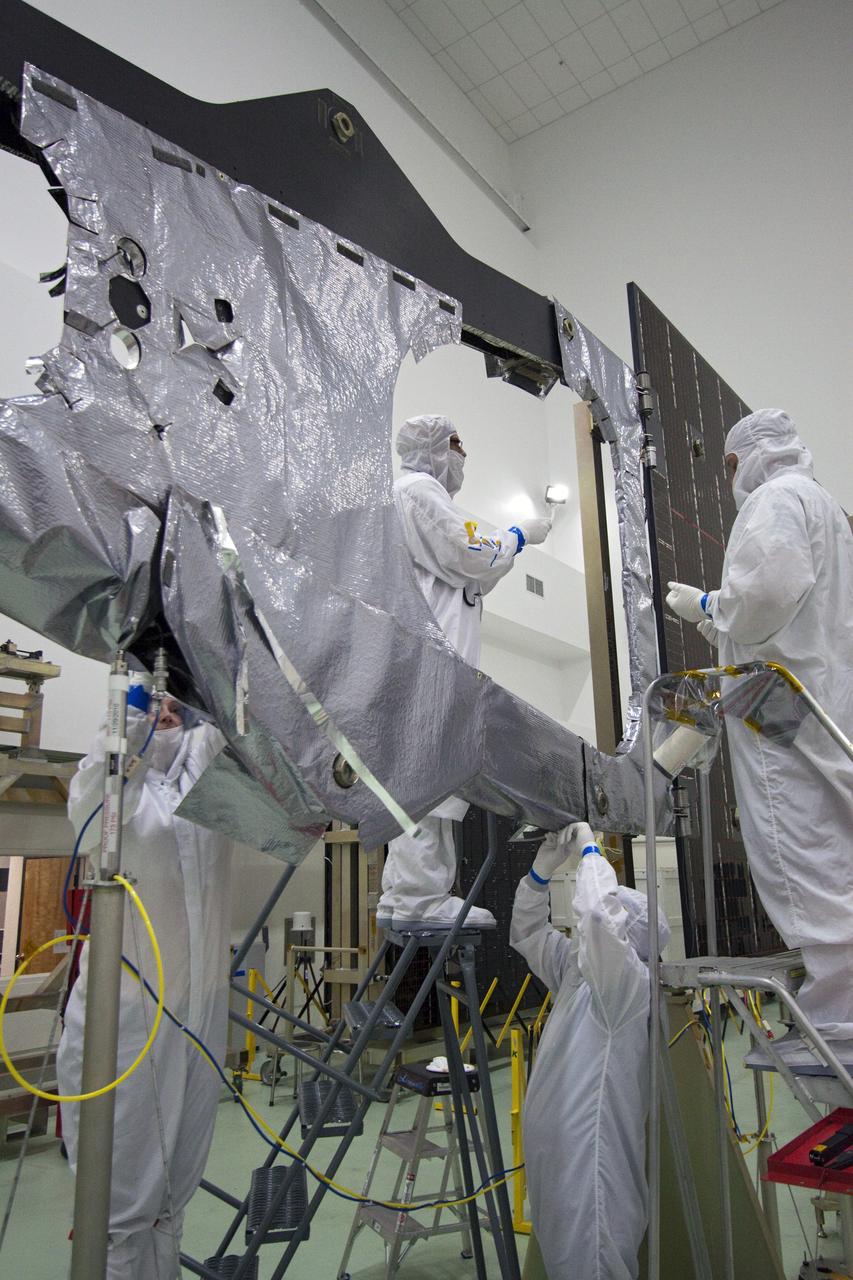
CAPE CANAVERAL, Fla. -- Technicians in the Astrotech payload processing facility in Titusville, Fla. install thermal insulation on NASA's Juno magnetometer boom. The boom structure is attached to…
Inspect NASA record
CAPE CANAVERAL, Fla. -- Technicians in the Astrotech payload processing facility in Titusville, Fla. install thermal insulation on NASA's Juno magnetometer boom. The boom structure is attached to Juno's solar array #1 that will help power the NASA spacecraft on its mission to Jupiter. The solar-powered spacecraft will orbit Jupiter's poles 33 times to find out more about the gas giant's origins, structure, atmosphere and magnetosphere and investigate the existence of a solid planetary core. Juno is scheduled to launch aboard an Atlas V rocket from Cape Canaveral, Fla. Aug. 5. For more information visit, www.nasa.gov/juno. Photo credit: NASA/Jack Pfaller It will splash down into the Atlantic Ocean where the ship and its crew will recover it and tow it back through Port Canaveral for refurbishing for another launch. The STS-124 mission is the second of three flights launching components to complete the Japan Aerospace Exploration Agency's Kibo laboratory. The shuttle crew will install Kibo's large Japanese Pressurized Module and its remote manipulator system, or RMS. Photo credit: USA/Jeff Suter
- Record ID
- KSC-2011-2822
- NASA center
- KSC
- Date
- 2011-04-09
- Keywords
- juno, atlas v, elv
HQ · 2017-09-13 · NHQ201709130115
Cassini End of Mission Preview
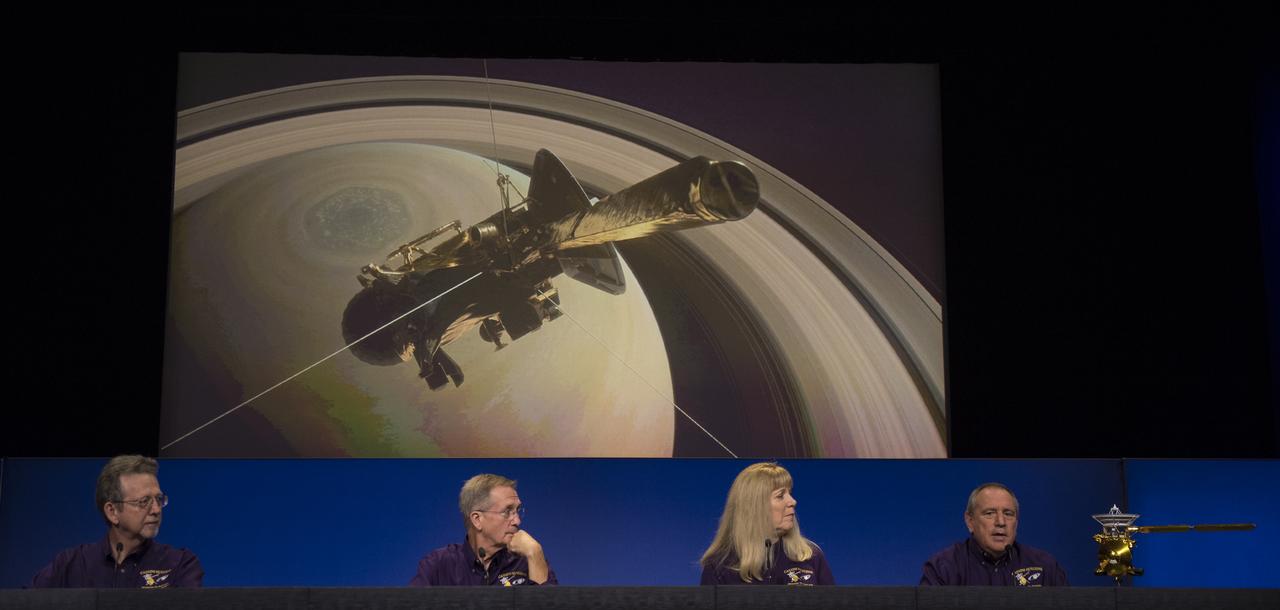
Principle investigator for the Neutral Mass Spectrometer (INMS) at the Southwest Research Institute, Hunter Waite, right, speaks during a press conference previewing Cassini's End of Mission as director…
Inspect NASA record
Principle investigator for the Neutral Mass Spectrometer (INMS) at the Southwest Research Institute, Hunter Waite, right, speaks during a press conference previewing Cassini's End of Mission as director of NASA's Planetary Science Division, Jim Green, left, Cassini program manager at JPL, Earl Maize, second from left, and Cassini project scientist at JPL, Linda Spilker, second from right, look on, Wednesday, Sept. 13, 2017 at NASA's Jet Propulsion Laboratory in Pasadena, California. Since its arrival in 2004, the Cassini-Huygens mission has been a discovery machine, revolutionizing our knowledge of the Saturn system and captivating us with data and images never before obtained with such detail and clarity. On Sept. 15, 2017, operators will deliberately plunge the spacecraft into Saturn, as Cassini gathered science until the end. The “plunge” ensures Saturn’s moons will remain pristine for future exploration. During Cassini’s final days, mission team members from all around the world gathered at NASA’s Jet Propulsion Laboratory, Pasadena, California, to celebrate the achievements of this historic mission. Photo Credit: (NASA/Joel Kowsky)
- Record ID
- NHQ201709130115
- NASA center
- HQ
- Date
- 2017-09-13
- Credit
- NASA/Joel Kowsky
- Keywords
- Cassini, Cassini Grand Finale, Earl Maize, Hunter Waite, Jet Propulsion Laboratory (JPL), Jim Green, Linda Spilker

JPL · 2019-05-24 · PIA23265
NASA's Mars 2020 Mission Drops in on Death Valley
On a test flight in Death Valley, California, an Airbus helicopter carried an engineering model of the Lander Vision System (LVS) that will help guide NASA's next Mars…
Inspect NASA record
On a test flight in Death Valley, California, an Airbus helicopter carried an engineering model of the Lander Vision System (LVS) that will help guide NASA's next Mars mission to a safe touchdown on the Red Planet. During the flight — one in a series — the helicopter (which is not part of the mission and was used just for testing) and its two-person crew flew a pre-planned sequence of maneuvers while LVS collected and analyzed imagery of the barren, mountainous terrain below. LVS is an integral part of a guidance system called Terrain-Relative Navigation (TRN) that will steer NASA's Mars 2020 rover away from hazardous areas during its final descent to Jezero Crater on Feb. 18, 2021. Mars 2020 will be the first spacecraft in the history of planetary exploration with the ability to accurately retarget its point of touchdown during the landing sequence. Also among the firsts of the mission, the 2020 rover carries a sample-caching system that will collect samples of Martian rock and soil and store them on the surface of the planet for retrieval and return to Earth by subsequent missions. Mars 2020 will launch from Cape Canaveral Air Force Station in Florida in July of 2020. https://photojournal.jpl.nasa.gov/catalog/PIA23265
- Record ID
- PIA23265
- NASA center
- JPL
- Date
- 2019-05-24
- Credit
- NASA/JPL-Caltech
- Keywords
- Mars 2020 Rover
GSFC · 2022-10-25 · GSFC_20221025_PACE_076157
GSFC_20221025_PACE_076157
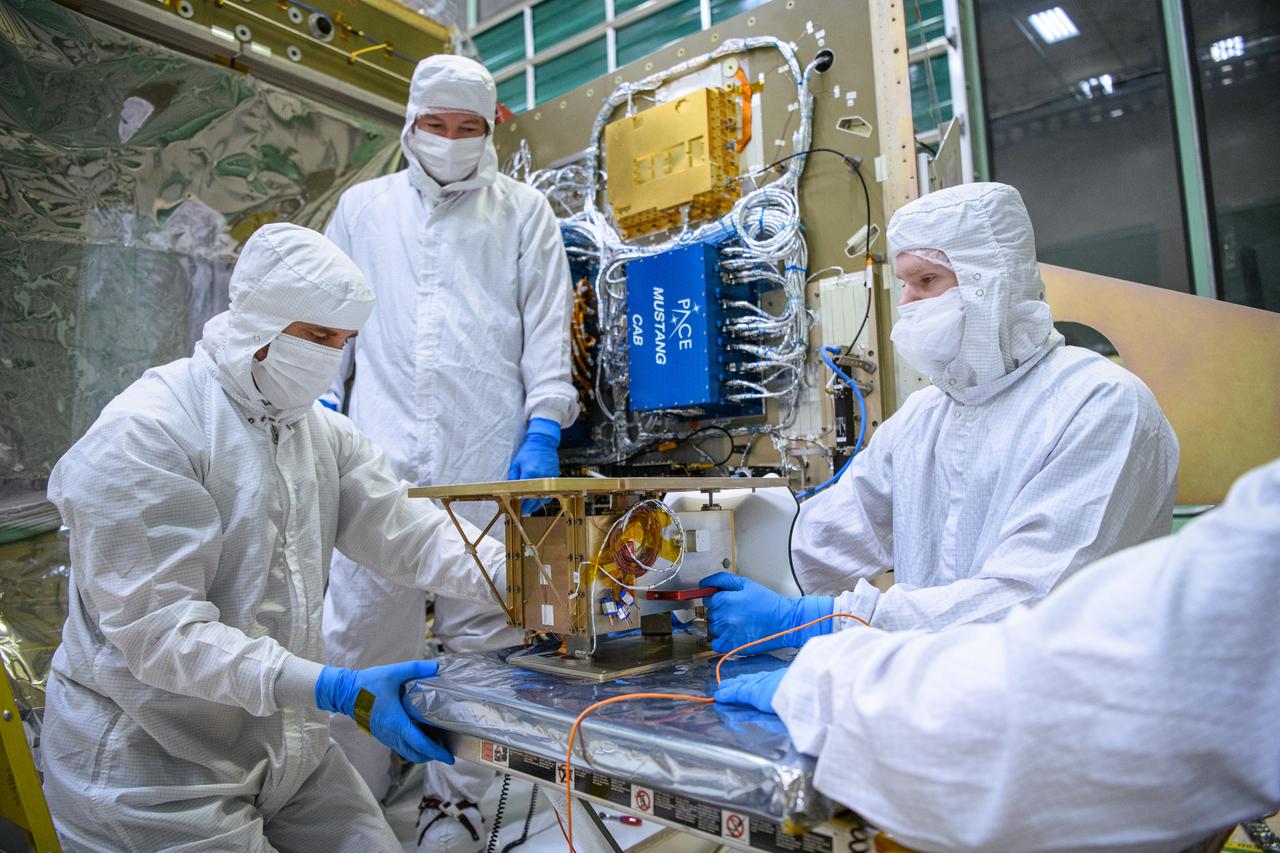
Technicians prepare to integrate the Hyper-Angular Rainbow Polarimeter #2 (HARP2) instrument to the Plankton, Aerosol, Cloud, ocean Ecosystem (PACE) spacecraft bus at NASA's Goddard Space Flight Center in…
Inspect NASA record
Technicians prepare to integrate the Hyper-Angular Rainbow Polarimeter #2 (HARP2) instrument to the Plankton, Aerosol, Cloud, ocean Ecosystem (PACE) spacecraft bus at NASA's Goddard Space Flight Center in Greenbelt, Maryland on October 25th, 2022. HARP2 is one of three instruments on NASA's PACE observatory, it was designed and built by UMBC's Earth and Space Institute. PACE's unprecedented spectral coverage will provide the first-ever global measurements designed to identify phytoplankton community composition. The mission will make global ocean color measurements, using the Ocean Color Instrument (OCI), to provide extended data records on ocean ecology and global biogeochemistry along with polarimetry measurements, using the Spectro-polarimeter for Planetary Exploration (SPEXone) and the Hyper Angular Research Polarimeter (HARP2) to provide extended data records on clouds and aerosols. The Earth-observing satellite mission, built at Goddard Space Flight Center in Greenbelt, MD, will continue and advance observations of global ocean color, biogeochemistry, and ecology, as well as the carbon cycle, aerosols and clouds.
- Record ID
- GSFC_20221025_PACE_076157
- NASA center
- GSFC
- Date
- 2022-10-25
- Credit
- NASA / Denny Henry
HQ · 2017-09-13 · NHQ201709130118
Cassini End of Mission Preview
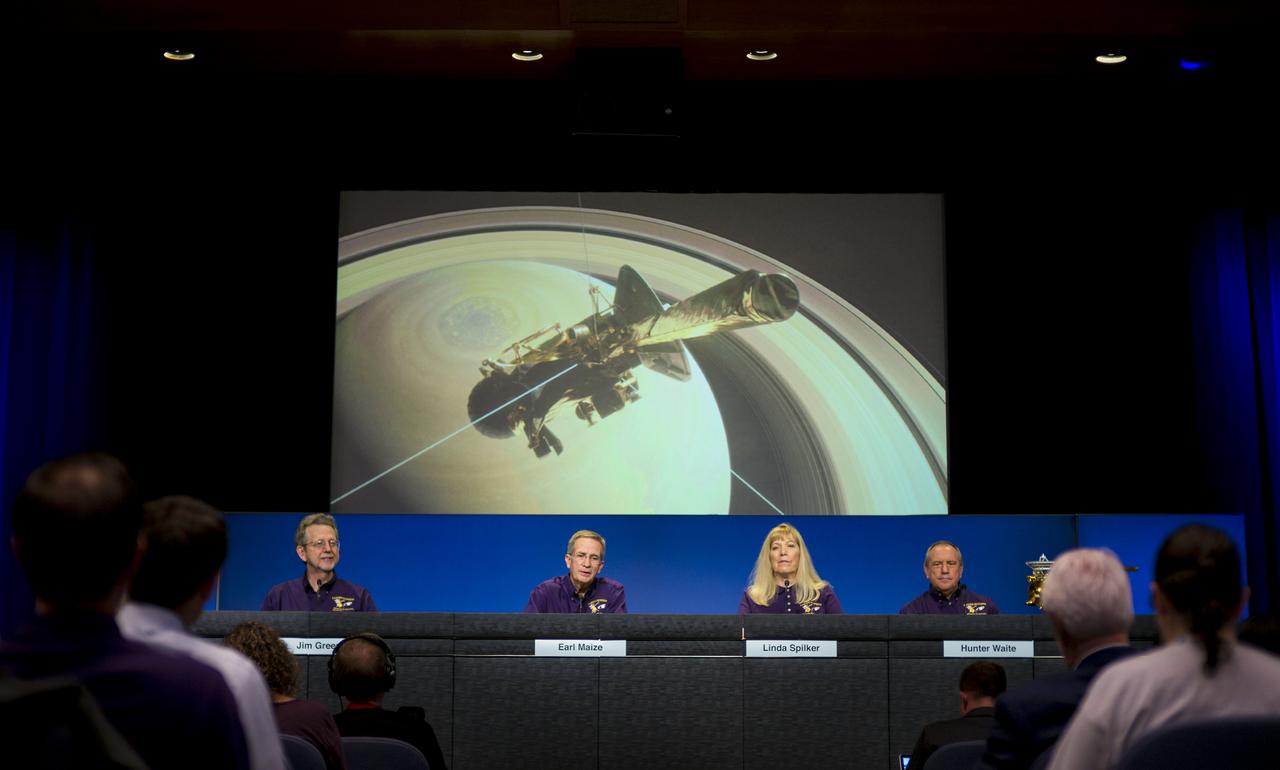
Director of NASA's Planetary Science Division, Jim Green, left, Cassini program manager at JPL, Earl Maize, second from right, Cassini project scientist at JPL, Linda Spilker, second from…
Inspect NASA record
Director of NASA's Planetary Science Division, Jim Green, left, Cassini program manager at JPL, Earl Maize, second from right, Cassini project scientist at JPL, Linda Spilker, second from right, and principle investigator for the Neutral Mass Spectrometer (INMS) at the Southwest Research Institute, Hunter Waite, right, are seen during a press conference previewing Cassini's End of Mission, Wednesday, Sept. 13, 2017 at NASA's Jet Propulsion Laboratory in Pasadena, California. Since its arrival in 2004, the Cassini-Huygens mission has been a discovery machine, revolutionizing our knowledge of the Saturn system and captivating us with data and images never before obtained with such detail and clarity. On Sept. 15, 2017, operators will deliberately plunge the spacecraft into Saturn, as Cassini gathered science until the end. The “plunge” ensures Saturn’s moons will remain pristine for future exploration. During Cassini’s final days, mission team members from all around the world gathered at NASA’s Jet Propulsion Laboratory, Pasadena, California, to celebrate the achievements of this historic mission. Photo Credit: (NASA/Joel Kowsky)
- Record ID
- NHQ201709130118
- NASA center
- HQ
- Date
- 2017-09-13
- Credit
- NASA/Joel Kowsky
- Keywords
- Cassini, Cassini Grand Finale, Earl Maize, Hunter Waite, Jet Propulsion Laboratory (JPL), Jim Green, Linda Spilker
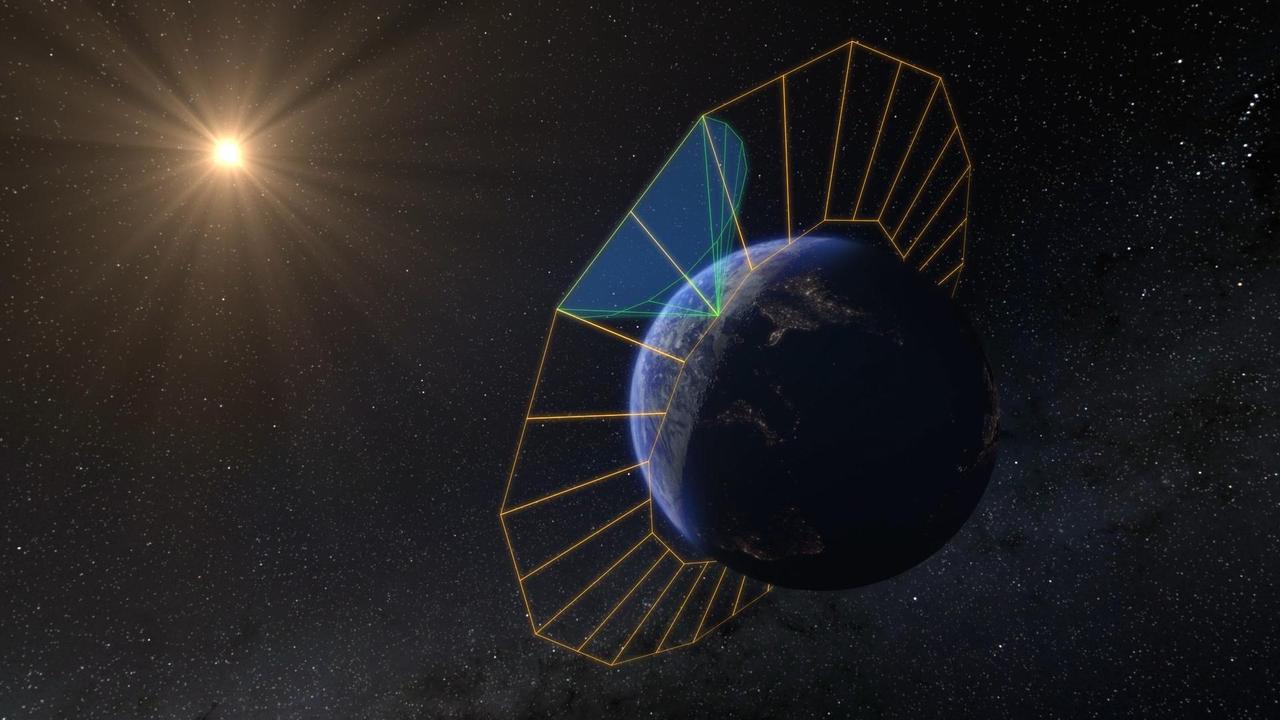
JPL · 2025-01-23 · PIA26532
SPHEREx's Perspective From Orbit (Artist's Concept)
NASA's SPHEREx mission will create the first all-sky spectroscopic survey in the near-infrared, detecting hundreds of millions of stars and galaxies. To do this, the SPHEREx space telescope…
Inspect NASA record
NASA's SPHEREx mission will create the first all-sky spectroscopic survey in the near-infrared, detecting hundreds of millions of stars and galaxies. To do this, the SPHEREx space telescope will look outward from low-Earth orbit, circling the planet along its day-night (or terminator) line. This artist's concept depicts the spacecraft's orbital plane in orange, and its field of view in green. Each of the telescope's orbits allows it to image a 360-degree strip of the celestial sky. As Earth's orbit around the Sun progresses, that strip slowly advances, enabling SPHEREx to complete four all-sky maps in two years. Short for Spectro-Photometer for the History of the Universe, Epoch of Reionization and Ices Explorer, SPHEREx will create a map of the cosmos like no other. Using a technique called spectroscopy to image the entire sky in 102 wavelengths of infrared light, SPHEREx will gather information about the composition of and distance to millions of galaxies and stars. With this map, scientists will study what happened in the first fraction of a second after the big bang, how galaxies formed and evolved, and the origins of water in planetary systems in our galaxy. https://photojournal.jpl.nasa.gov/catalog/PIA26532
- Record ID
- PIA26532
- NASA center
- JPL
- Date
- 2025-01-23
- Credit
- NASA/JPL-Caltech
- Keywords
- SPHEREx, Sky
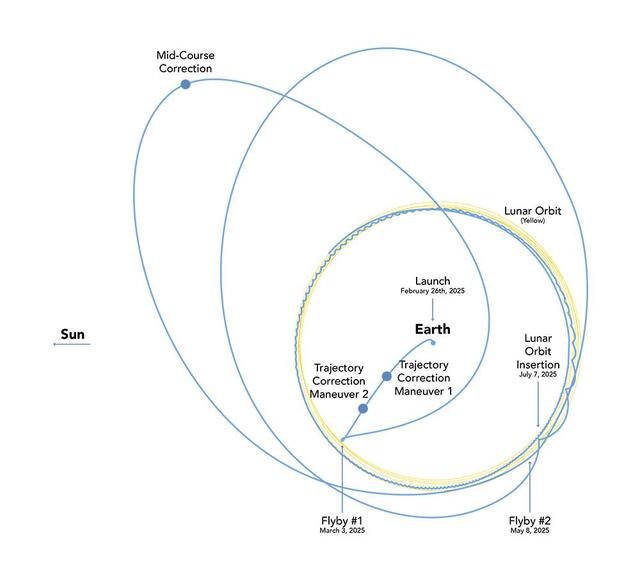
JPL · 2025-02-13 · PIA26459
Lunar Trailblazer's Looping Lunar Voyage
Lunar Trailblazer's voyage to the Moon will take between four and seven months, depending on the day it launches. This orbital diagram shows the low-energy transfer trajectory of…
Inspect NASA record
Lunar Trailblazer's voyage to the Moon will take between four and seven months, depending on the day it launches. This orbital diagram shows the low-energy transfer trajectory of the NASA mission should it launch on Feb. 26, the earliest date in a four-day launch period. If it launches that date, the spacecraft is expected to arrive in lunar orbit about four months later. Shown in this diagram are key dates of trajectory correction maneuvers, when the spacecraft will use its thrusters to shape its orbit, and lunar flybys. Lunar Trailblazer was a selection of NASA's SIMPLEx (Small Innovative Missions for Planetary Exploration), which provides opportunities for low-cost science spacecraft to ride-share with selected primary missions. To maintain the lower overall cost, SIMPLEx missions have a higher risk posture and lighter requirements for oversight and management. This higher risk acceptance allows NASA to test pioneering technologies, and the definition of success for these missions includes the lessons learned from more experimental endeavors. https://photojournal.jpl.nasa.gov/catalog/PIA26459
- Record ID
- PIA26459
- NASA center
- JPL
- Date
- 2025-02-13
- Credit
- Lockheed Martin Space
- Keywords
- Lunar Trailblazer
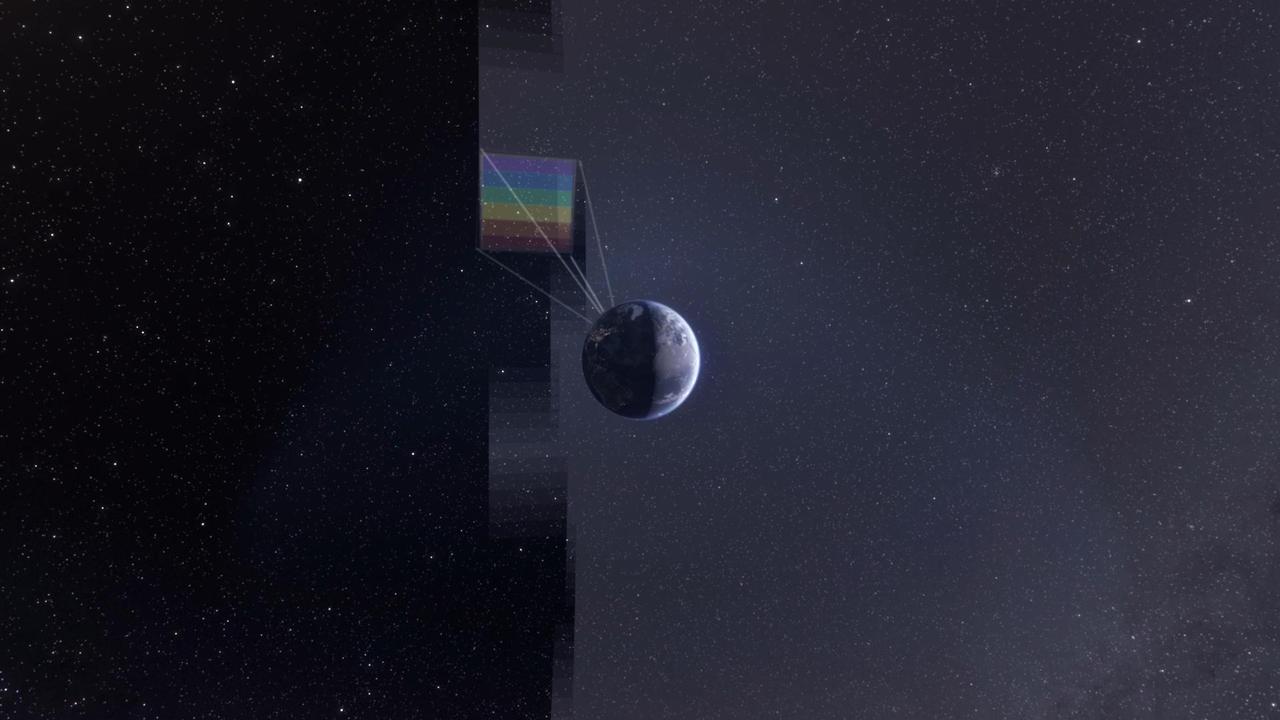
JPL · 2025-01-23 · PIA26533
Building an All-Sky Map With SPHEREx (Artist's Concept)
NASA's SPHEREx observatory will map the entire sky to help scientists answer big-picture questions about the origins of our universe, galaxies, and key ingredients for life in our…
Inspect NASA record
NASA's SPHEREx observatory will map the entire sky to help scientists answer big-picture questions about the origins of our universe, galaxies, and key ingredients for life in our galaxy, such as water. Operating from low Earth orbit, the telescope will sweep across the sky, taking about 600 exposures each day. Using a technique called spectroscopy, the observatory will image every section of the sky 102 times, each time using a different color filter that blocks all wavelengths except one. By combining those images, the mission will produce a map containing information about the composition of and distance to millions of stars and other objects in our galaxy and hundreds of millions of galaxies beyond. (See an animation of this process, depicted in a still artist's concept above, at spherex.caltech.edu/video/all-sky-survey.) Short for Spectro-Photometer for the History of the Universe, Epoch of Reionization and Ices Explorer, SPHEREx will help scientists study what happened in the first fraction of a second after the big bang, how galaxies formed and evolved, and the origins of water in planetary systems in our galaxy. https://photojournal.jpl.nasa.gov/catalog/PIA26533
- Record ID
- PIA26533
- NASA center
- JPL
- Date
- 2025-01-23
- Credit
- NASA/JPL-Caltech
- Keywords
- SPHEREx, Sky
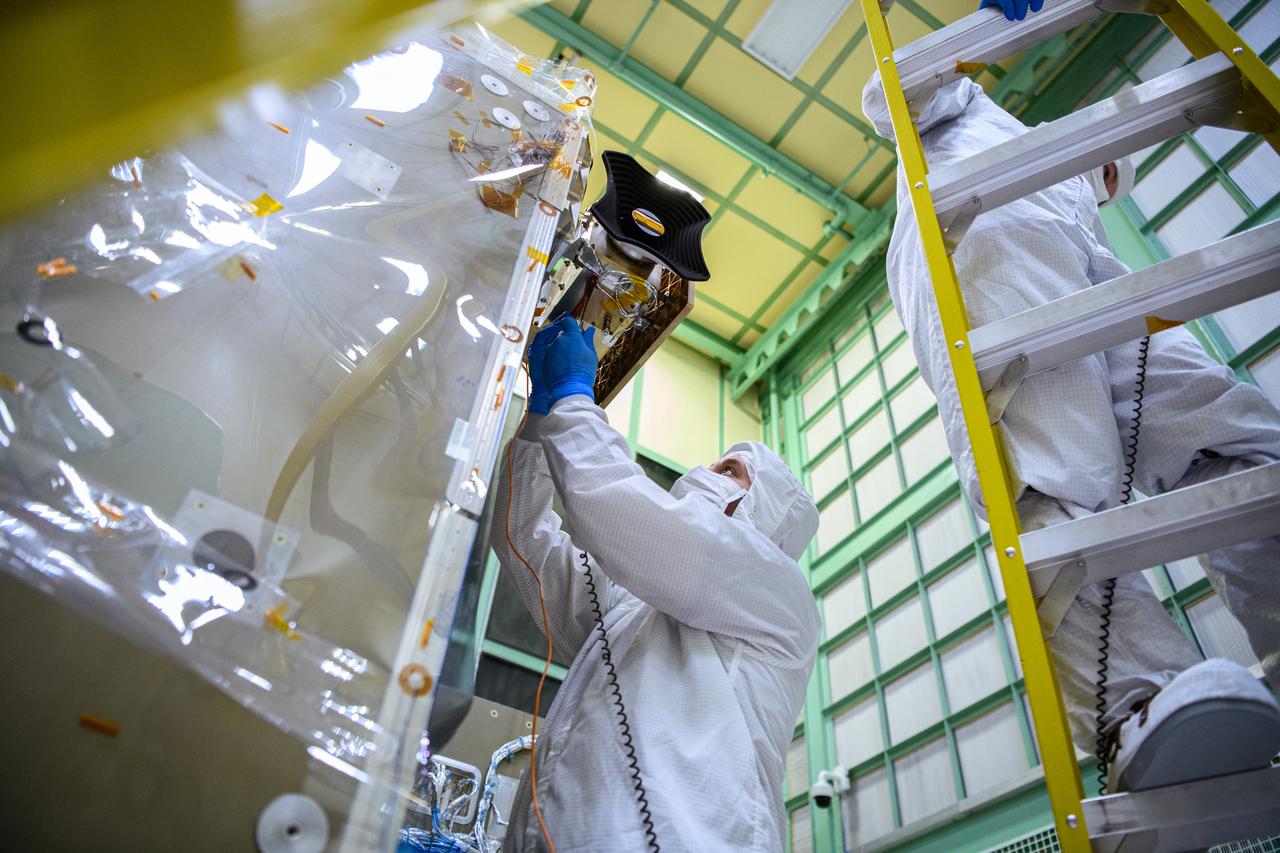
GSFC · 2022-10-25 · GSFC_20221025_PACE_076161
GSFC_20221025_PACE_076161
Technicians integrate the Hyper-Angular Rainbow Polarimeter #2 (HARP2) instrument to the Plankton, Aerosol, Cloud, ocean Ecosystem (PACE) spacecraft bus at NASA's Goddard Space Flight Center in Greenbelt, Maryland…
Inspect NASA record
Technicians integrate the Hyper-Angular Rainbow Polarimeter #2 (HARP2) instrument to the Plankton, Aerosol, Cloud, ocean Ecosystem (PACE) spacecraft bus at NASA's Goddard Space Flight Center in Greenbelt, Maryland on October 25th, 2022. HARP2 is one of three instruments on NASA's PACE observatory, it was designed and built by UMBC's Earth and Space Institute. PACE's unprecedented spectral coverage will provide the first-ever global measurements designed to identify phytoplankton community composition. The mission will make global ocean color measurements, using the Ocean Color Instrument (OCI), to provide extended data records on ocean ecology and global biogeochemistry along with polarimetry measurements, using the Spectro-polarimeter for Planetary Exploration (SPEXone) and the Hyper Angular Research Polarimeter (HARP2) to provide extended data records on clouds and aerosols. The Earth-observing satellite mission, built at Goddard Space Flight Center in Greenbelt, MD, will continue and advance observations of global ocean color, biogeochemistry, and ecology, as well as the carbon cycle, aerosols and clouds.
- Record ID
- GSFC_20221025_PACE_076161
- NASA center
- GSFC
- Date
- 2022-10-25
- Credit
- NASA / Denny Henry
KSC · 2011-05-04 · KSC-2011-3299
KSC-2011-3299
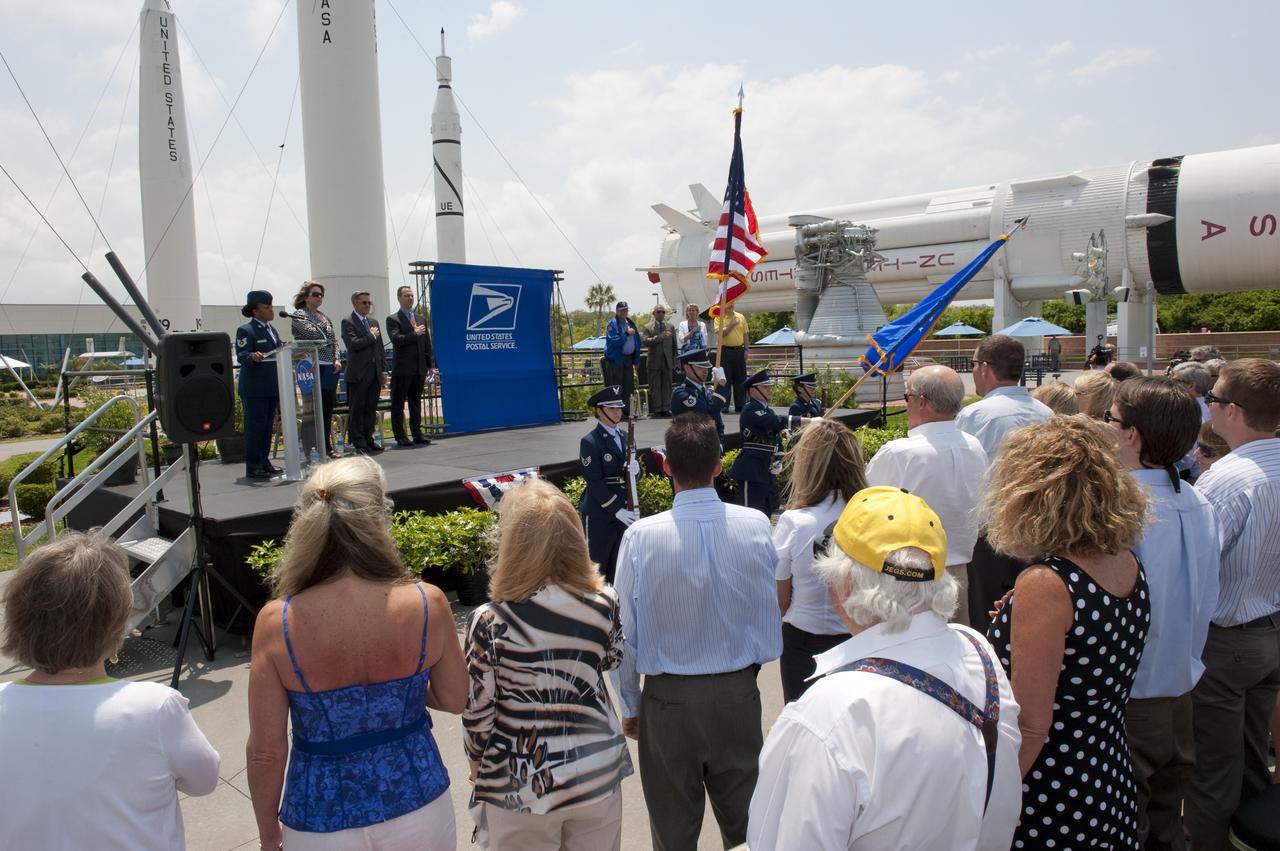
CAPE CANAVERAL, Fla. -- In the Rocket Garden at NASA's Kennedy Space Center Visitor Complex in Florida, the audience and speakers stand for the Pledge of Allegiance and…
Inspect NASA record
CAPE CANAVERAL, Fla. -- In the Rocket Garden at NASA's Kennedy Space Center Visitor Complex in Florida, the audience and speakers stand for the Pledge of Allegiance and the singing of the National Anthem by a member of the 45th Space Wing Honor Guard from Patrick Air Force Base in Florida. Also on stage are, from left, Director of Education and External Relations for Kennedy Cheryl Hurst, Center Director Bob Cabana and United States Postal Service official Steve Massey, Mercury Astronaut Scott Carpenter, NASA Administrator, Charlie Bolden, Julie Jenkins and NASA's Deputy Director for Planetary Science, Jim Adams, all in attendance for the United States Postal Service unveiling of two new stamps to commemorate the 50th anniversary of human spaceflight. One stamp commemorates NASA's Project Mercury and Alan Shepard's historic launch on May 5, 1961, aboard the spacecraft Freedom 7. The second stamp honors NASA's MESSENGER, which reached Mercury in March to become the first spacecraft to orbit the planet. The two missions frame a remarkable 50-year period in which America advanced space exploration through more than 1,500 crewed and uncrewed flights. Photo credit: NASA/Kim Shiflett
- Record ID
- KSC-2011-3299
- NASA center
- KSC
- Date
- 2011-05-04
- Keywords
- stamps, visitor complex
HQ · 2017-09-15 · NHQ201709150034
Cassini End of Mission
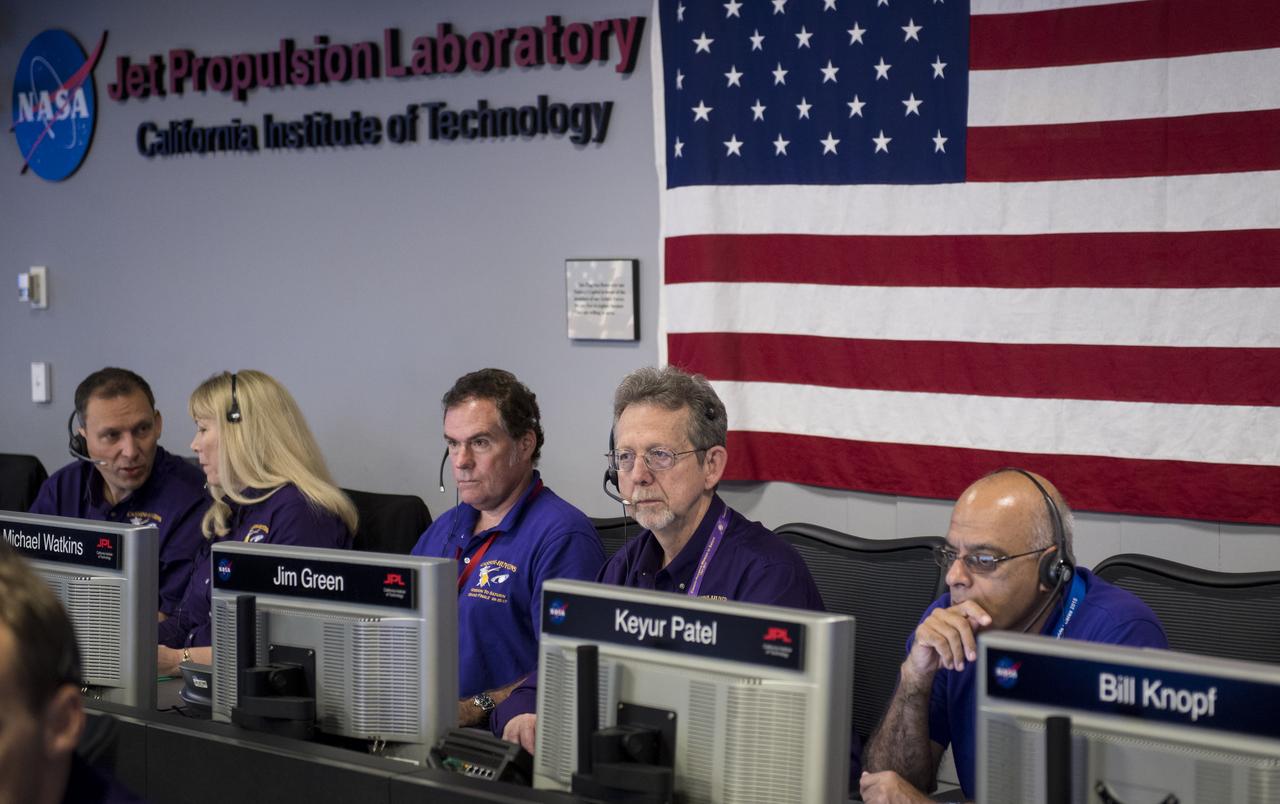
Associate administrator for NASA's Science Mission Directorate Thomas Zurbuchen, left, Cassini project scientist at JPL, Linda Spilker, second from left, director of NASA's Jet Propulsion Laboratory, Michael Watkins,…
Inspect NASA record
Associate administrator for NASA's Science Mission Directorate Thomas Zurbuchen, left, Cassini project scientist at JPL, Linda Spilker, second from left, director of NASA's Jet Propulsion Laboratory, Michael Watkins, center, director of NASA's Planetary Science Division, Jim Green, second from right, and director of the interplanetary network directorate at NASA's Jet Propulsion Laboratory, Keyur Patel, left, are seen in mission control, Friday, Sept. 15, 2017 at NASA's Jet Propulsion Laboratory in Pasadena, California. Since its arrival in 2004, the Cassini-Huygens mission has been a discovery machine, revolutionizing our knowledge of the Saturn system and captivating us with data and images never before obtained with such detail and clarity. On Sept. 15, 2017, operators deliberately plunged the spacecraft into Saturn, as Cassini gathered science until the end. Loss of contact with the Cassini spacecraft occurred at 7:55 a.m. EDT (4:55 a.m. PDT). The “plunge” ensures Saturn’s moons will remain pristine for future exploration. During Cassini’s final days, mission team members from all around the world gathered at NASA’s Jet Propulsion Laboratory, Pasadena, California, to celebrate the achievements of this historic mission. Photo Credit: (NASA/Joel Kowsky)
- Record ID
- NHQ201709150034
- NASA center
- HQ
- Date
- 2017-09-15
- Credit
- NASA/Joel Kowsky
- Keywords
- Cassini, Cassini Grand Finale, Jet Propulsion Laboratory (JPL), Jim Green, Keyur Patel, Linda Spilker, Michael Watkins, Thomas Zurbuchen