
Update Site (from NASA)
Explore NASA’s Image and Video Library.
Suggest one object per day for the Interstellar Minds collection. We review each suggestion before adding it.
Sign in to suggest a Marvel.
Find a NASA image ID. Open a NASA record and copy its ID from the end of the details URL.
NASA image records
KSC · 2024-08-22 · KSC-20240822-PH-KLS01_0007
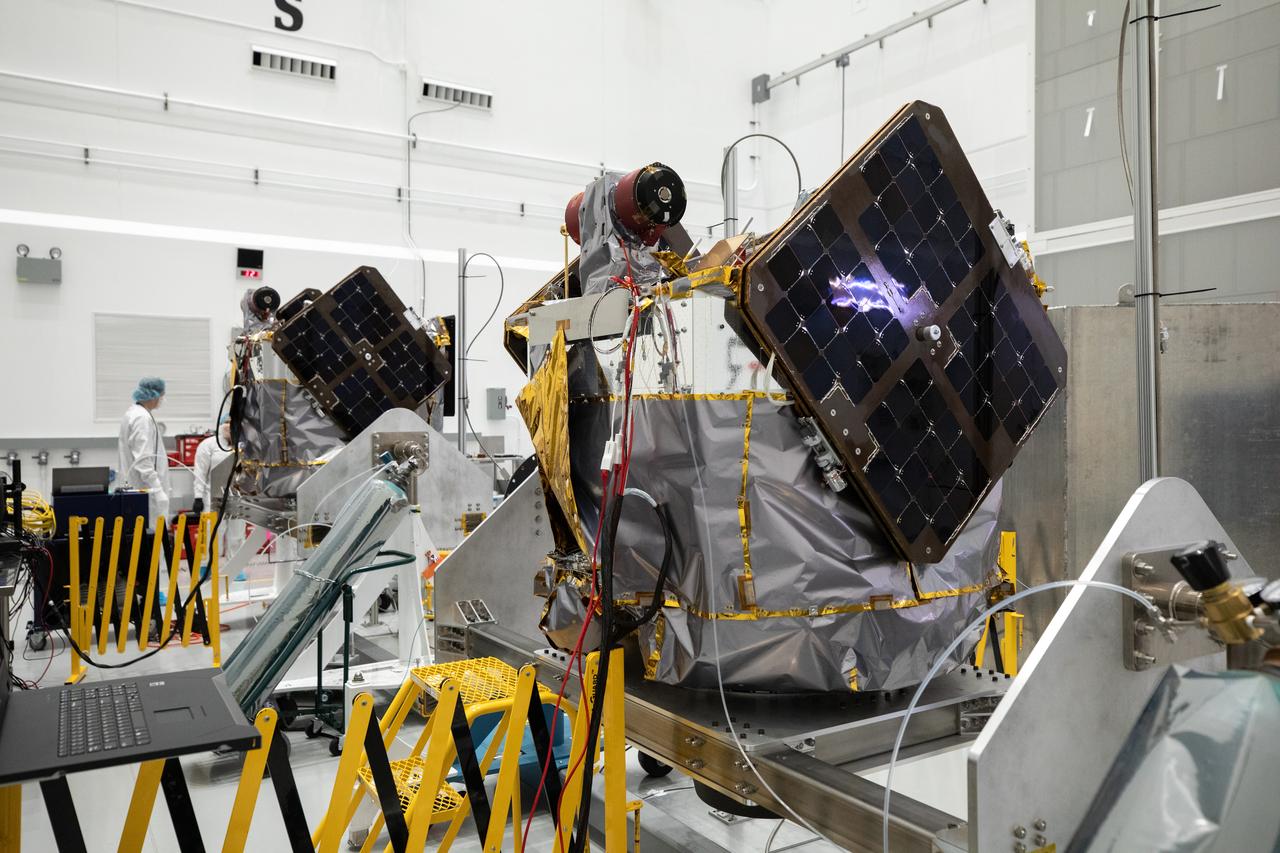
ESCAPADE Unboxed at Astrotech
NASA’s ESCAPADE (Escape and Plasma Acceleration and Dynamics Explorers) identical dual spacecraft are inspected and processed on dollies in a high bay of the Astrotech Space Operations Facility…
Inspect NASA record
NASA’s ESCAPADE (Escape and Plasma Acceleration and Dynamics Explorers) identical dual spacecraft are inspected and processed on dollies in a high bay of the Astrotech Space Operations Facility near the agency’s Kennedy Space Center in Florida on Thursday, Aug. 22, 2024. As the first multi-spacecraft orbital science mission to Mars, ESCAPADE’s twin orbiters will take simultaneous observations from different locations around the planet and reveal the real-time response to space weather and how the Martian magnetosphere changes over time.
- Record ID
- KSC-20240822-PH-KLS01_0007
- NASA center
- KSC
- Date
- 2024-08-22
- Credit
- NASA/Kim Shiflett
- Keywords
- Blue Origin, ESCAPADE, Escape and Plasma Acceleration and Dynamics Explorers, LSP, Launch Services Program, Mars, New Glenn, Rocket Lab, Small Innovative Missions for Planetary Exploration (SIMPLEx), U.C. Berkeley, magnetosphere, satellites
KSC · 2024-08-22 · KSC-20240822-PH-KLS01_0030
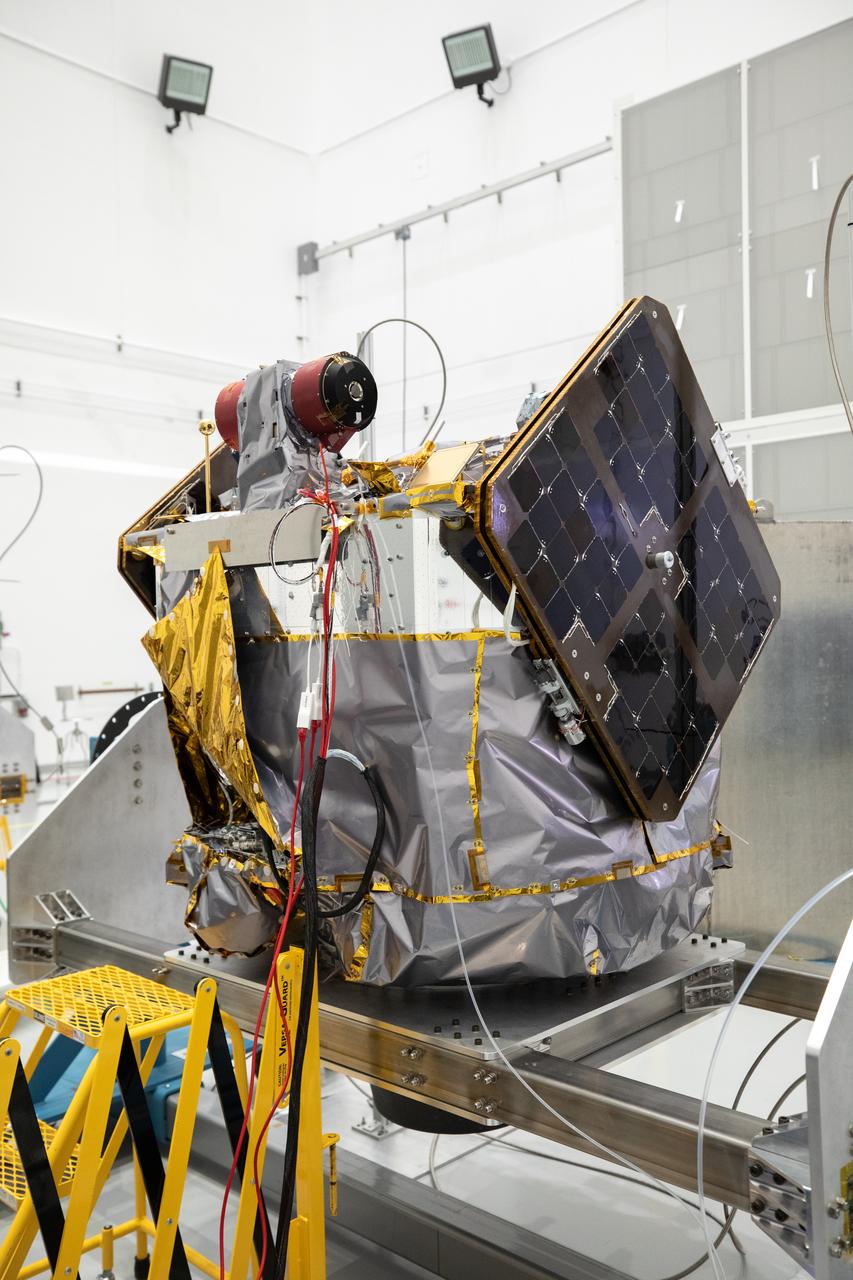
ESCAPADE Unboxed at Astrotech
NASA’s ESCAPADE (Escape and Plasma Acceleration and Dynamics Explorers) identical dual spacecraft are inspected and processed on dollies in a high bay of the Astrotech Space Operations Facility…
Inspect NASA record
NASA’s ESCAPADE (Escape and Plasma Acceleration and Dynamics Explorers) identical dual spacecraft are inspected and processed on dollies in a high bay of the Astrotech Space Operations Facility near the agency’s Kennedy Space Center in Florida on Thursday, Aug. 22, 2024. As the first multi-spacecraft orbital science mission to Mars, ESCAPADE’s twin orbiters will take simultaneous observations from different locations around the planet and reveal the real-time response to space weather and how the Martian magnetosphere changes over time.
- Record ID
- KSC-20240822-PH-KLS01_0030
- NASA center
- KSC
- Date
- 2024-08-22
- Credit
- NASA/Kim Shiflett
- Keywords
- Blue Origin, ESCAPADE, Escape and Plasma Acceleration and Dynamics Explorers, LSP, Launch Services Program, Mars, New Glenn, Rocket Lab, Small Innovative Missions for Planetary Exploration (SIMPLEx), U.C. Berkeley, magnetosphere, satellites

KSC · 2024-08-22 · KSC-20240822-PH-KLS01_0018
ESCAPADE Unboxed at Astrotech
NASA’s ESCAPADE (Escape and Plasma Acceleration and Dynamics Explorers) identical dual spacecraft are inspected and processed on dollies in a high bay of the Astrotech Space Operations Facility…
Inspect NASA record
NASA’s ESCAPADE (Escape and Plasma Acceleration and Dynamics Explorers) identical dual spacecraft are inspected and processed on dollies in a high bay of the Astrotech Space Operations Facility near the agency’s Kennedy Space Center in Florida on Thursday, Aug. 22, 2024. As the first multi-spacecraft orbital science mission to Mars, ESCAPADE’s twin orbiters will take simultaneous observations from different locations around the planet and reveal the real-time response to space weather and how the Martian magnetosphere changes over time.
- Record ID
- KSC-20240822-PH-KLS01_0018
- NASA center
- KSC
- Date
- 2024-08-22
- Credit
- NASA/Kim Shiflett
- Keywords
- Blue Origin, ESCAPADE, Escape and Plasma Acceleration and Dynamics Explorers, LSP, Launch Services Program, Mars, New Glenn, Rocket Lab, Small Innovative Missions for Planetary Exploration (SIMPLEx), U.C. Berkeley, magnetosphere, satellites

KSC · 2024-08-18 · KSC-20240818-PH-NLP01_0001
ESCAPADE Unloading
Two small spacecrafts satellites that make up NASA’s ESCAPADE (Escape and Plasma Acceleration and Dynamics Explorers) mission to Mars arrived at Astrotech Space Operations in Titusville, near NASA’s…
Inspect NASA record
Two small spacecrafts satellites that make up NASA’s ESCAPADE (Escape and Plasma Acceleration and Dynamics Explorers) mission to Mars arrived at Astrotech Space Operations in Titusville, near NASA’s Kennedy Space Center in Florida on Sunday, Aug. 19, 2024. Set to launch from Blue Origin’s New Glenn rocket, the Rocket Lab spacecraft will study the solar wind and how the solar wind interacts with Mars’ magnetic environment and how this interaction drives the planet’s atmospheric escape.
- Record ID
- KSC-20240818-PH-NLP01_0001
- NASA center
- KSC
- Date
- 2024-08-18
- Credit
- NASA/Norman Phelps
- Keywords
- ESCAPADE, Mars, Launch Services Program, LSP, U.C. Berkeley, Rocket Lab, Blue Origin, New Glenn, Escape and Plasma Acceleration and Dynamics Explorers, magnetosphere, solar wind, Small Innovative Missions for Planetary Exploration (SIMPLEx)
HQ · 2017-09-13 · NHQ201709130119
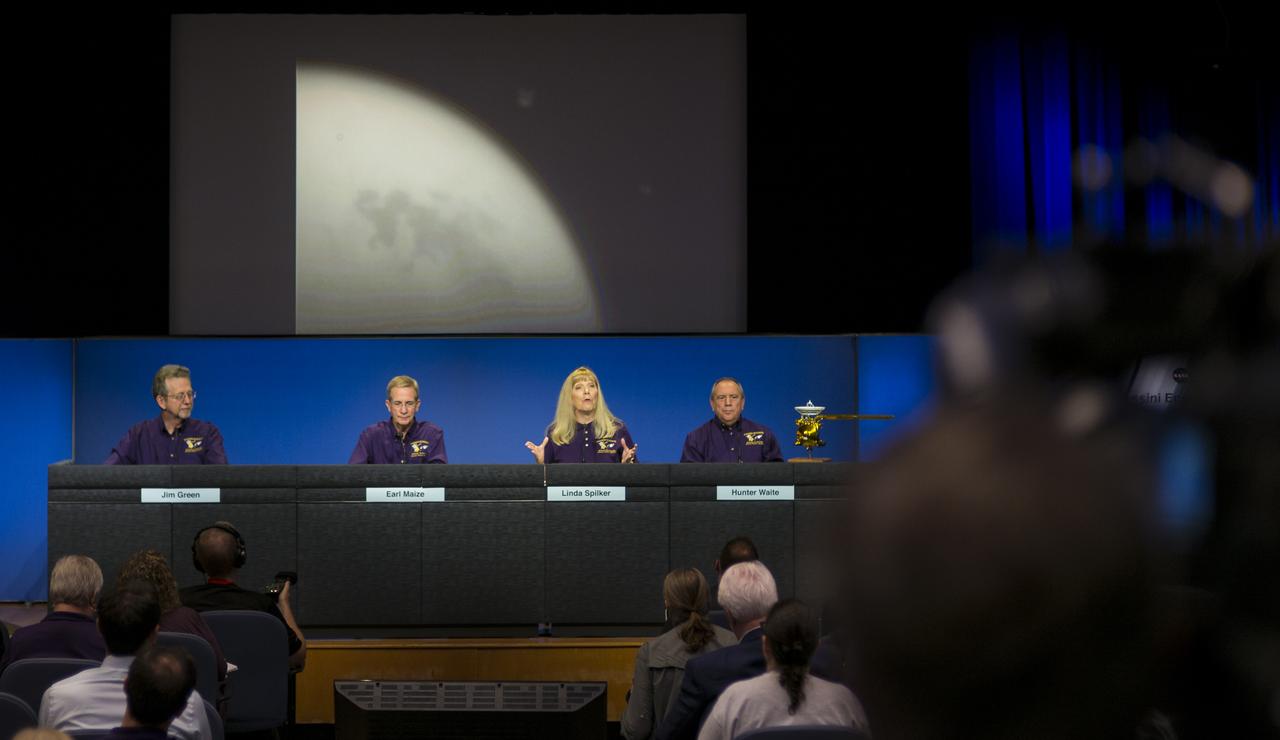
Cassini End of Mission Preview
One of the final images of Saturn's moon Titan, that was taken by the Cassini spacecraft on Sept. 11, is seen as Cassini project scientist at JPL, Linda…
Inspect NASA record
One of the final images of Saturn's moon Titan, that was taken by the Cassini spacecraft on Sept. 11, is seen as Cassini project scientist at JPL, Linda Spilker, second from right, speaks during a press conference previewing Cassini's End of Mission, Wednesday, Sept. 13, 2017 at NASA's Jet Propulsion Laboratory in Pasadena, California. Also participating in the press conference were director of NASA's Planetary Science Division, Jim Green, left, Cassini program manager at JPL, Earl Maize, second from left, and principle investigator for the Neutral Mass Spectrometer (INMS) at the Southwest Research Institute, Hunter Waite, left. Since its arrival in 2004, the Cassini-Huygens mission has been a discovery machine, revolutionizing our knowledge of the Saturn system and captivating us with data and images never before obtained with such detail and clarity. On Sept. 15, 2017, operators will deliberately plunge the spacecraft into Saturn, as Cassini gathered science until the end. The “plunge” ensures Saturn’s moons will remain pristine for future exploration. During Cassini’s final days, mission team members from all around the world gathered at NASA’s Jet Propulsion Laboratory, Pasadena, California, to celebrate the achievements of this historic mission. Photo Credit: (NASA/Joel Kowsky)
- Record ID
- NHQ201709130119
- NASA center
- HQ
- Date
- 2017-09-13
- Credit
- NASA/Joel Kowsky
- Keywords
- Cassini, Cassini Grand Finale, Earl Maize, Hunter Waite, Jet Propulsion Laboratory (JPL), Jim Green, Linda Spilker
KSC · 2011-04-09 · KSC-2011-2821
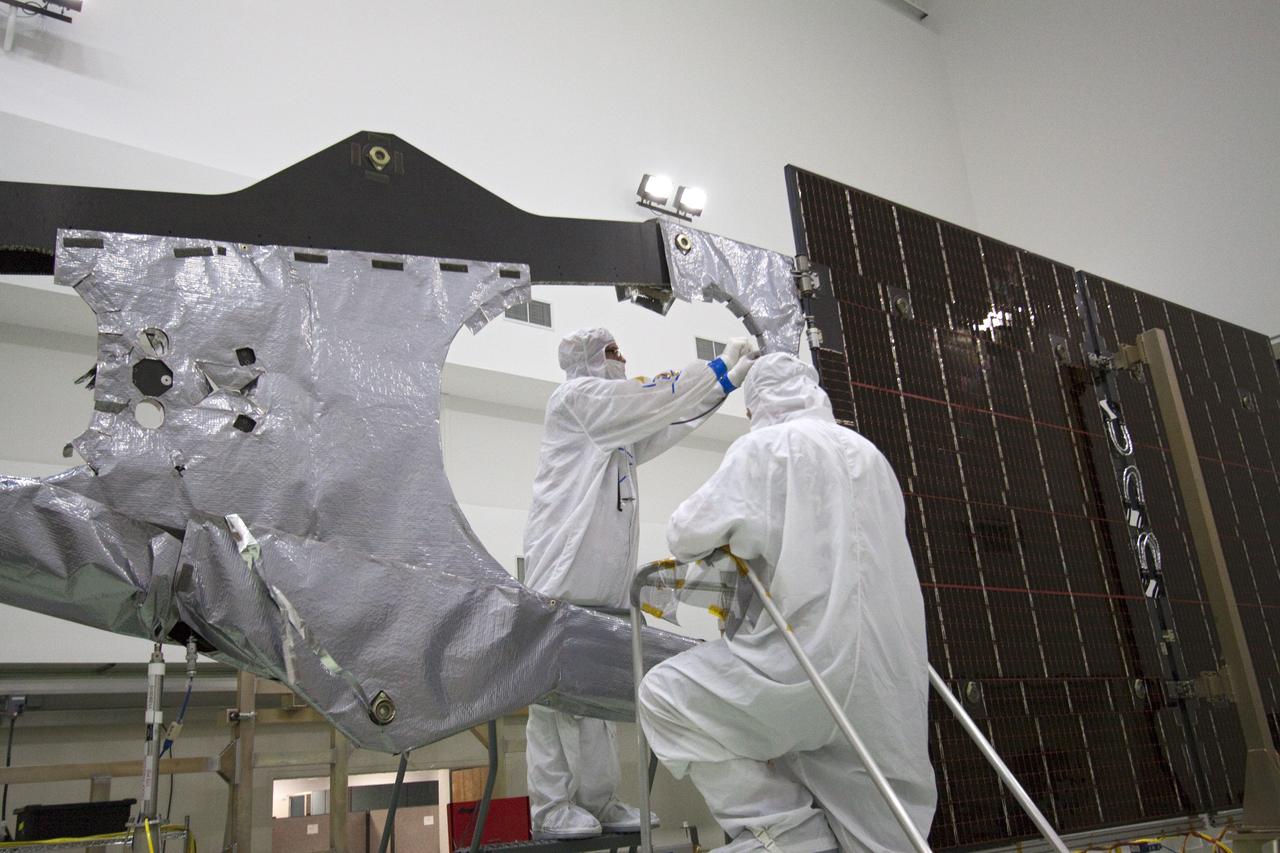
KSC-2011-2821
CAPE CANAVERAL, Fla. -- Technicians in the Astrotech payload processing facility in Titusville, Fla. install thermal insulation on NASA's Juno magnetometer boom. The boom structure is attached to…
Inspect NASA record
CAPE CANAVERAL, Fla. -- Technicians in the Astrotech payload processing facility in Titusville, Fla. install thermal insulation on NASA's Juno magnetometer boom. The boom structure is attached to Juno's solar array #1 that will help power the NASA spacecraft on its mission to Jupiter. The solar-powered spacecraft will orbit Jupiter's poles 33 times to find out more about the gas giant's origins, structure, atmosphere and magnetosphere and investigate the existence of a solid planetary core. Juno is scheduled to launch aboard an Atlas V rocket from Cape Canaveral, Fla. Aug. 5. For more information visit, www.nasa.gov/juno. Photo credit: NASA/Jack Pfaller It will splash down into the Atlantic Ocean where the ship and its crew will recover it and tow it back through Port Canaveral for refurbishing for another launch. The STS-124 mission is the second of three flights launching components to complete the Japan Aerospace Exploration Agency's Kibo laboratory. The shuttle crew will install Kibo's large Japanese Pressurized Module and its remote manipulator system, or RMS. Photo credit: USA/Jeff Suter
- Record ID
- KSC-2011-2821
- NASA center
- KSC
- Date
- 2011-04-09
- Keywords
- juno, atlas v, elv

KSC · 2011-04-09 · KSC-2011-2828
KSC-2011-2828
CAPE CANAVERAL, Fla. -- Technicians at Astrotech's payload processing facility in Titusville, Fla. move NASA's Juno spacecraft into an airlock to begin final testing and preparations for launch.…
Inspect NASA record
CAPE CANAVERAL, Fla. -- Technicians at Astrotech's payload processing facility in Titusville, Fla. move NASA's Juno spacecraft into an airlock to begin final testing and preparations for launch. The solar-powered spacecraft will orbit Jupiter's poles 33 times to find out more about the gas giant's origins, structure, atmosphere and magnetosphere and investigate the existence of a solid planetary core. Juno is scheduled to launch aboard an Atlas V rocket from Cape Canaveral, Fla. Aug. 5. For more information visit, www.nasa.gov/juno. Photo credit: NASA/Jack Pfaller It will splash down into the Atlantic Ocean where the ship and its crew will recover it and tow it back through Port Canaveral for refurbishing for another launch. The STS-124 mission is the second of three flights launching components to complete the Japan Aerospace Exploration Agency's Kibo laboratory. The shuttle crew will install Kibo's large Japanese Pressurized Module and its remote manipulator system, or RMS. Photo credit: USA/Jeff Suter
- Record ID
- KSC-2011-2828
- NASA center
- KSC
- Date
- 2011-04-09
- Keywords
- juno, atlas v, elv
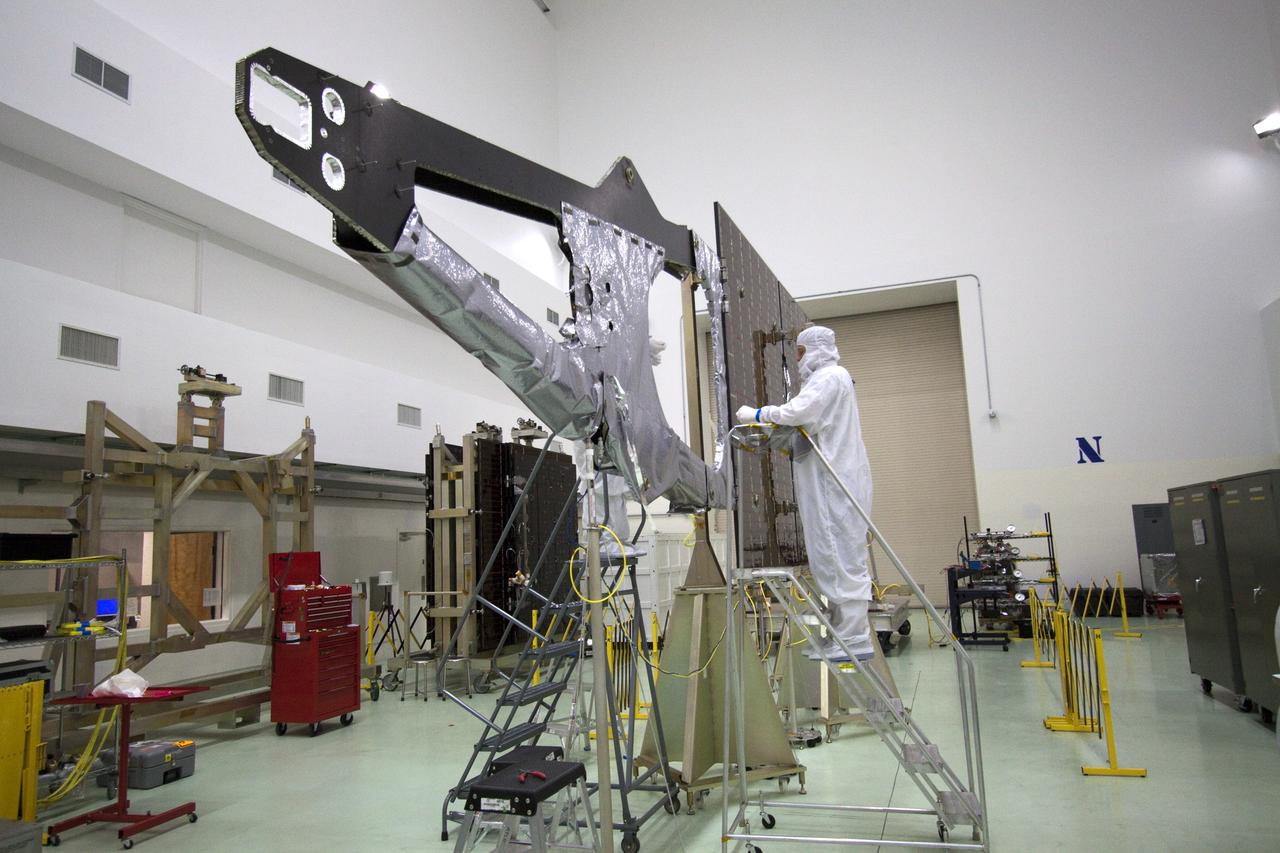
KSC · 2011-04-09 · KSC-2011-2820
KSC-2011-2820
CAPE CANAVERAL, Fla. -- Technicians in the Astrotech payload processing facility in Titusville, Fla. install thermal insulation on NASA's Juno magnetometer boom. The boom structure is attached to…
Inspect NASA record
CAPE CANAVERAL, Fla. -- Technicians in the Astrotech payload processing facility in Titusville, Fla. install thermal insulation on NASA's Juno magnetometer boom. The boom structure is attached to Juno's solar array #1 that will help power the NASA spacecraft on its mission to Jupiter. The solar-powered spacecraft will orbit Jupiter's poles 33 times to find out more about the gas giant's origins, structure, atmosphere and magnetosphere and investigate the existence of a solid planetary core. Juno is scheduled to launch aboard an Atlas V rocket from Cape Canaveral, Fla. Aug. 5. For more information visit, www.nasa.gov/juno. Photo credit: NASA/Jack Pfaller It will splash down into the Atlantic Ocean where the ship and its crew will recover it and tow it back through Port Canaveral for refurbishing for another launch. The STS-124 mission is the second of three flights launching components to complete the Japan Aerospace Exploration Agency's Kibo laboratory. The shuttle crew will install Kibo's large Japanese Pressurized Module and its remote manipulator system, or RMS. Photo credit: USA/Jeff Suter
- Record ID
- KSC-2011-2820
- NASA center
- KSC
- Date
- 2011-04-09
- Keywords
- juno, atlas v, elv
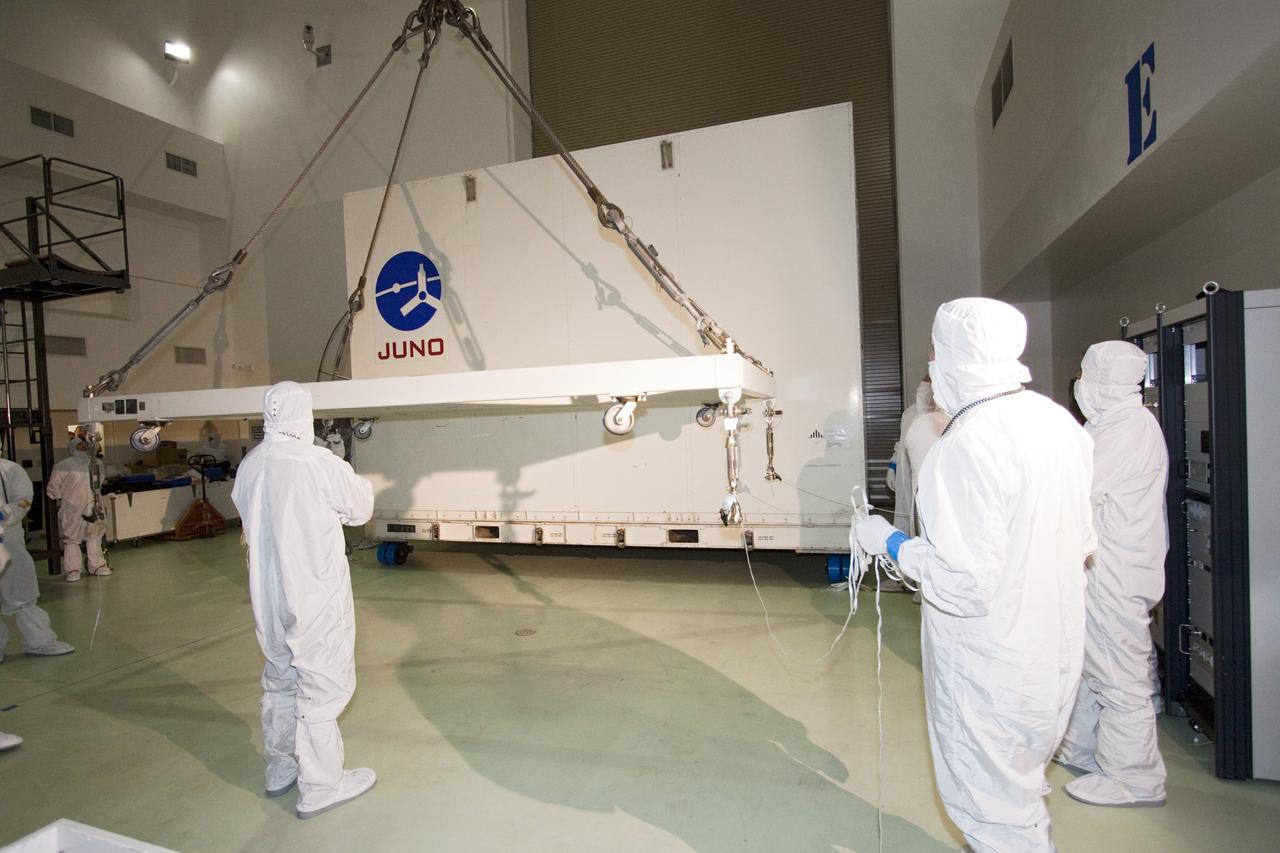
KSC · 2011-04-09 · KSC-2011-2825
KSC-2011-2825
CAPE CANAVERAL, Fla. -- Technicians guide an overhead crane toward the container holding NASA's Juno spacecraft. The container will be lifted away from the spacecraft, moved into an…
Inspect NASA record
CAPE CANAVERAL, Fla. -- Technicians guide an overhead crane toward the container holding NASA's Juno spacecraft. The container will be lifted away from the spacecraft, moved into an airlock at Astrotech's payload processing facility in Titusville, Fla. to begin final testing and preparations for launch. The solar-powered spacecraft will orbit Jupiter's poles 33 times to find out more about the gas giant's origins, structure, atmosphere and magnetosphere and investigate the existence of a solid planetary core. Juno is scheduled to launch aboard an Atlas V rocket from Cape Canaveral, Fla. Aug. 5. For more information visit, www.nasa.gov/juno. Photo credit: NASA/Jack Pfaller It will splash down into the Atlantic Ocean where the ship and its crew will recover it and tow it back through Port Canaveral for refurbishing for another launch. The STS-124 mission is the second of three flights launching components to complete the Japan Aerospace Exploration Agency's Kibo laboratory. The shuttle crew will install Kibo's large Japanese Pressurized Module and its remote manipulator system, or RMS. Photo credit: USA/Jeff Suter
- Record ID
- KSC-2011-2825
- NASA center
- KSC
- Date
- 2011-04-09
- Keywords
- juno, atlas v, elv

JPL · 2022-06-15 · PIA25323
Ingenuity Team With Collier Trophy
Members of NASA's Ingenuity Mars Helicopter team stand next to the Collier Trophy during the Robert J. Collier Dinner in Washington on June 9, 2022. The team was…
Inspect NASA record
Members of NASA's Ingenuity Mars Helicopter team stand next to the Collier Trophy during the Robert J. Collier Dinner in Washington on June 9, 2022. The team was awarded the 2021 Collier Trophy "for the first powered, controlled flight of an aircraft on another planet, thereby opening the skies of Mars and other worlds for future scientific discovery and exploration," the award citation states. From left to right: Teddy Tzanetos, Ingenuity team lead at NASA's Jet Propulsion Laboratory; Bob Balaram, Ingenuity emeritus chief engineer at JPL; MiMi Aung, former Ingenuity project manager at JPL; Bobby Braun, former director for Planetary Science at JPL; Larry James, deputy director at JPL; Håvard Grip, Ingenuity chief pilot at JPL. This historic trophy – which is on permanent display at the Smithsonian Air and Space Museum in Washington – is awarded annually by the National Aeronautic Association "for the greatest achievement in aeronautics or astronautics in America, with respect to improving the performance, efficiency, and safety of air or space vehicles, the value of which has been thoroughly demonstrated by actual use during the preceding year." https://photojournal.jpl.nasa.gov/catalog/PIA25323
- Record ID
- PIA25323
- NASA center
- JPL
- Date
- 2022-06-15
- Credit
- National Aeronautic Association
- Keywords
- Mars Helicopter
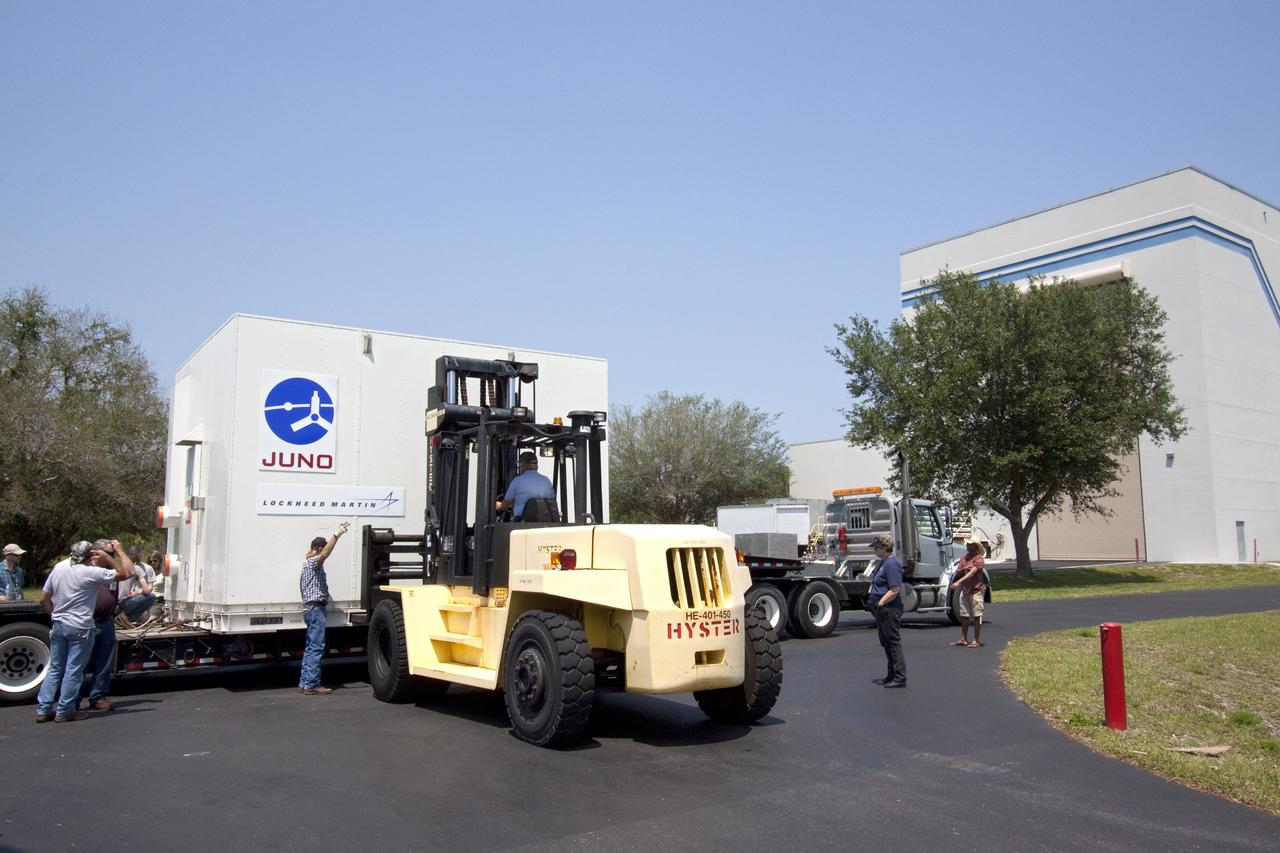
KSC · 2011-04-09 · KSC-2011-2817
KSC-2011-2817
CAPE CANAVERAL, Fla. -- Workers use a Hyster forklift to move NASA's Juno spacecraft from a transport into Astrotech's payload processing facility in Titusville, Fla. to begin final…
Inspect NASA record
CAPE CANAVERAL, Fla. -- Workers use a Hyster forklift to move NASA's Juno spacecraft from a transport into Astrotech's payload processing facility in Titusville, Fla. to begin final testing and preparations for launch. The solar-powered spacecraft will orbit Jupiter's poles 33 times to find out more about the gas giant's origins, structure, atmosphere and magnetosphere and investigate the existence of a solid planetary core. Juno is scheduled to launch aboard an Atlas V rocket from Cape Canaveral, Fla. Aug. 5. For more information visit, www.nasa.gov/juno. Photo credit: NASA/Jack Pfaller It will splash down into the Atlantic Ocean where the ship and its crew will recover it and tow it back through Port Canaveral for refurbishing for another launch. The STS-124 mission is the second of three flights launching components to complete the Japan Aerospace Exploration Agency's Kibo laboratory. The shuttle crew will install Kibo's large Japanese Pressurized Module and its remote manipulator system, or RMS. Photo credit: USA/Jeff Suter
- Record ID
- KSC-2011-2817
- NASA center
- KSC
- Date
- 2011-04-09
- Keywords
- juno, atlas v, elv

KSC · 2011-04-09 · KSC-2011-2824
KSC-2011-2824
CAPE CANAVERAL, Fla. -- Technicians guide an overhead crane toward the container holding NASA's Juno spacecraft. The container will be lifted away from the spacecraft, moved into an…
Inspect NASA record
CAPE CANAVERAL, Fla. -- Technicians guide an overhead crane toward the container holding NASA's Juno spacecraft. The container will be lifted away from the spacecraft, moved into an airlock at Astrotech's payload processing facility in Titusville, Fla. to begin final testing and preparations for launch. The solar-powered spacecraft will orbit Jupiter's poles 33 times to find out more about the gas giant's origins, structure, atmosphere and magnetosphere and investigate the existence of a solid planetary core. Juno is scheduled to launch aboard an Atlas V rocket from Cape Canaveral, Fla. Aug. 5. For more information visit, www.nasa.gov/juno. Photo credit: NASA/Jack Pfaller It will splash down into the Atlantic Ocean where the ship and its crew will recover it and tow it back through Port Canaveral for refurbishing for another launch. The STS-124 mission is the second of three flights launching components to complete the Japan Aerospace Exploration Agency's Kibo laboratory. The shuttle crew will install Kibo's large Japanese Pressurized Module and its remote manipulator system, or RMS. Photo credit: USA/Jeff Suter
- Record ID
- KSC-2011-2824
- NASA center
- KSC
- Date
- 2011-04-09
- Keywords
- juno, atlas v, elv