
Update Site (from NASA)
Explore NASA’s Image and Video Library.
Suggest one object per day for the Interstellar Minds collection. We review each suggestion before adding it.
Sign in to suggest a Marvel.
Find a NASA image ID. Open a NASA record and copy its ID from the end of the details URL.
NASA image records
KSC · 2014-05-22 · KSC-2014-2662
KSC-2014-2662
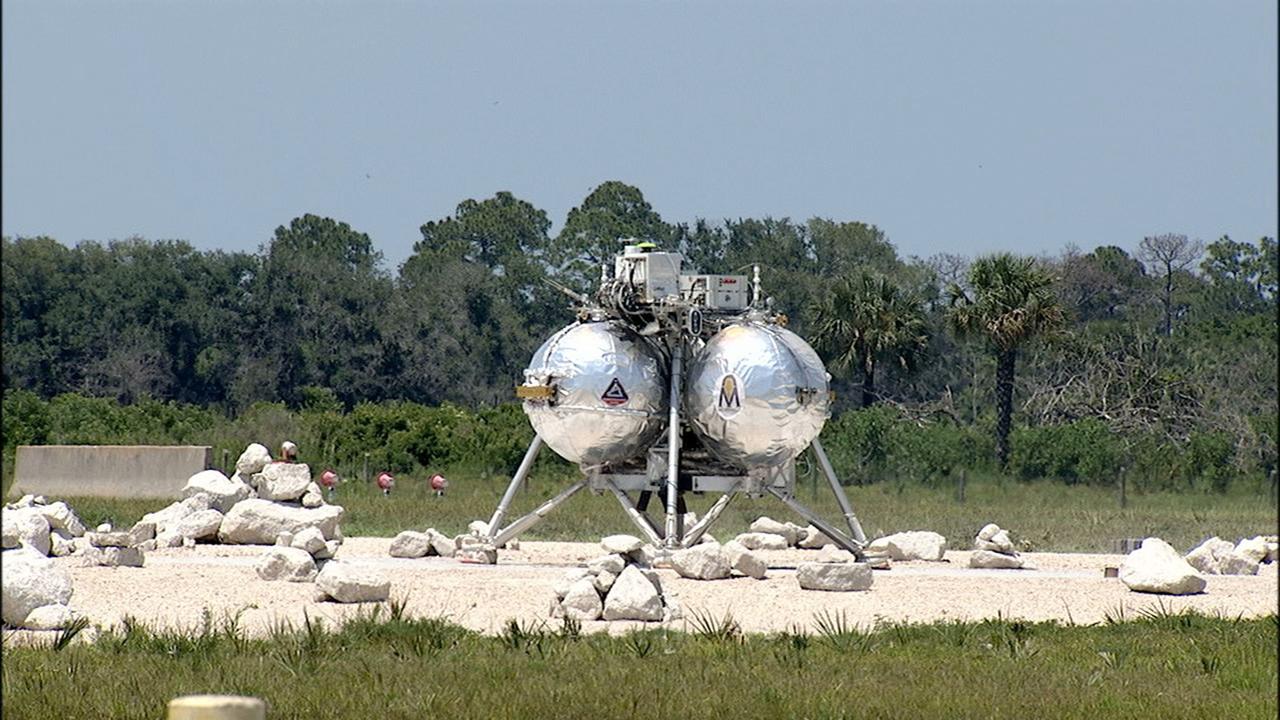
CAPE CANAVERAL, Fla. –At NASA's Kennedy Space Center in Florida, the agency's Project Morpheus prototype lander just touched down on a dedicated pad inside the ALHAT hazard field…
Inspect NASA record
CAPE CANAVERAL, Fla. –At NASA's Kennedy Space Center in Florida, the agency's Project Morpheus prototype lander just touched down on a dedicated pad inside the ALHAT hazard field near the Shuttle Landing Facility. Project Morpheus tests NASA’s ALHAT and an engine that runs on liquid oxygen and methane, which are green propellants. These new capabilities could be used in future efforts to deliver cargo to planetary surfaces. The landing facility provides the lander with the kind of field necessary for realistic testing, complete with rocks, craters and hazards to avoid. Morpheus’ ALHAT payload allows it to navigate to clear landing sites amidst rocks, craters and other hazards during its descent. Project Morpheus is being managed under the Advanced Exploration Systems, or AES, Division in NASA’s Human Exploration and Operations Mission Directorate. The efforts in AES pioneer new approaches for rapidly developing prototype systems, demonstrating key capabilities and validating operational concepts for future human missions beyond Earth orbit. For more information on Project Morpheus, visit http://morpheuslander.jsc.nasa.gov/. Photo credit: NASA/Mike Chambers and Chris Chamberland
- Record ID
- KSC-2014-2662
- NASA center
- KSC
- Date
- 2014-05-22
- Keywords
- SLF, ALHAT, launch pad, free flight test
KSC · 2013-12-10 · KSC-2013-4315
KSC-2013-4315
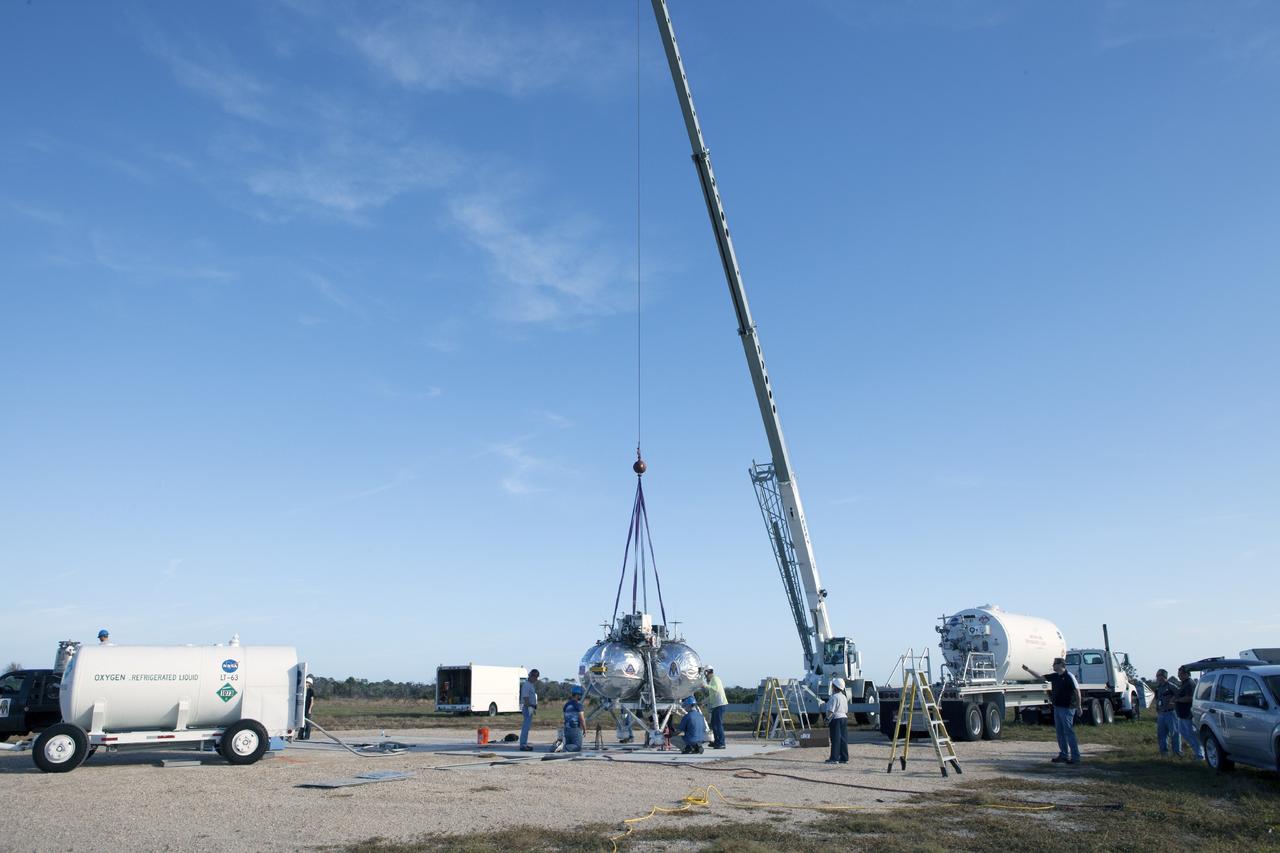
CAPE CANAVERAL, Fla. – Preparations are underway to prepare the Project Morpheus prototype lander for its first free flight test at the north end of the Shuttle Landing…
Inspect NASA record
CAPE CANAVERAL, Fla. – Preparations are underway to prepare the Project Morpheus prototype lander for its first free flight test at the north end of the Shuttle Landing Facility at NASA’s Kennedy Space Center in Florida. Testing of the prototype lander was performed at NASA’s Johnson Space Center in Houston in preparation for tethered and free flight testing at Kennedy. Project Morpheus integrates NASA’s automated landing and hazard avoidance technology, or ALHAT, with an engine that runs on liquid oxygen and methane, or green propellants, into a fully-operational lander that could deliver cargo to asteroids and other planetary surfaces. The landing facility will provide the lander with the kind of field necessary for realistic testing, complete with rocks, craters and hazards to avoid. Morpheus’ ALHAT payload allows it to navigate to clear landing sites amidst rocks, craters and other hazards during its descent. Project Morpheus is being managed under the Advanced Exploration Systems, or AES, Division in NASA’s Human Exploration and Operations Mission Directorate. The efforts in AES pioneer new approaches for rapidly developing prototype systems, demonstrating key capabilities and validating operational concepts for future human missions beyond Earth orbit. For more information on Project Morpheus, visit http://morpheuslander.jsc.nasa.gov. Photo credit: NASA/Kim Shiflett
- Record ID
- KSC-2013-4315
- NASA center
- KSC
- Date
- 2013-12-10
- Keywords
- SLF, ALHAT, free flight test
KSC · 2014-03-27 · KSC-2014-1870
Morpheus Alhat Tether Test Preparations
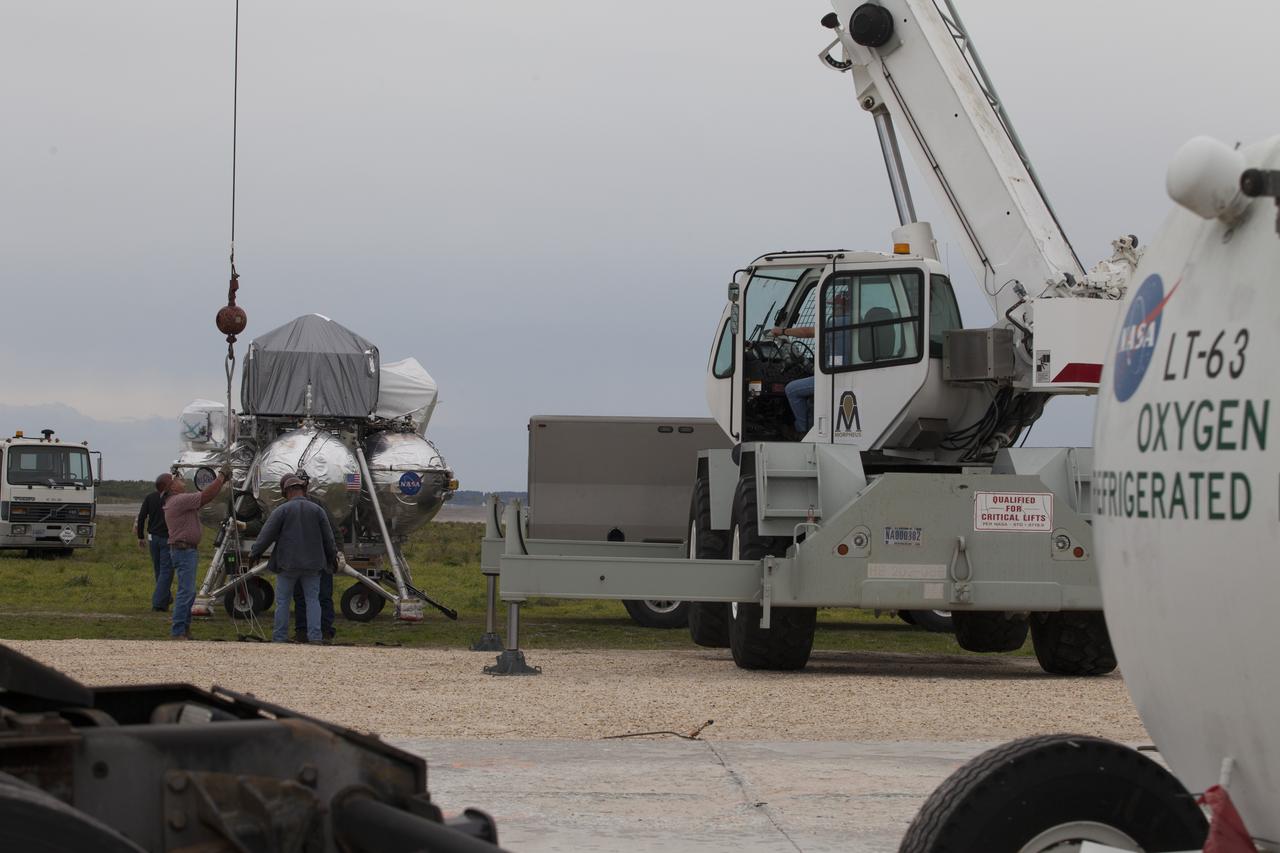
CAPE CANAVERAL, Fla. – Engineers and technicians prepare the Project Morpheus prototype lander for a tether test near a new launch site at the north end of the…
Inspect NASA record
CAPE CANAVERAL, Fla. – Engineers and technicians prepare the Project Morpheus prototype lander for a tether test near a new launch site at the north end of the Shuttle Landing Facility at NASA's Kennedy Space Center in Florida. The launch pad was moved to a different location at the landing facility to support the next phase of flight testing. Project Morpheus tests NASA’s automated landing and hazard avoidance technology, or ALHAT, and an engine that runs on liquid oxygen and methane, or green propellants, into a fully-operational lander that could deliver cargo to other planetary surfaces. The landing facility provides the lander with the kind of field necessary for realistic testing, complete with rocks, craters and hazards to avoid. Morpheus’ ALHAT payload allows it to navigate to clear landing sites amidst rocks, craters and other hazards during its descent. Project Morpheus is being managed under the Advanced Exploration Systems, or AES, Division in NASA’s Human Exploration and Operations Mission Directorate. The efforts in AES pioneer new approaches for rapidly developing prototype systems, demonstrating key capabilities and validating operational concepts for future human missions beyond Earth orbit. For more information on Project Morpheus, visit http://morpheuslander.jsc.nasa.gov/. Photo credit: NASA/Ben Smegelsky
- Record ID
- KSC-2014-1870
- NASA center
- KSC
- Date
- 2014-03-27
- Credit
- NASA/KSC - Ben Smegelsky (IMCS)
- Keywords
- KSC-2014-1870, Project Morpheus, ALHAT
KSC · 2013-12-17 · KSC-2013-4366
KSC-2013-4366
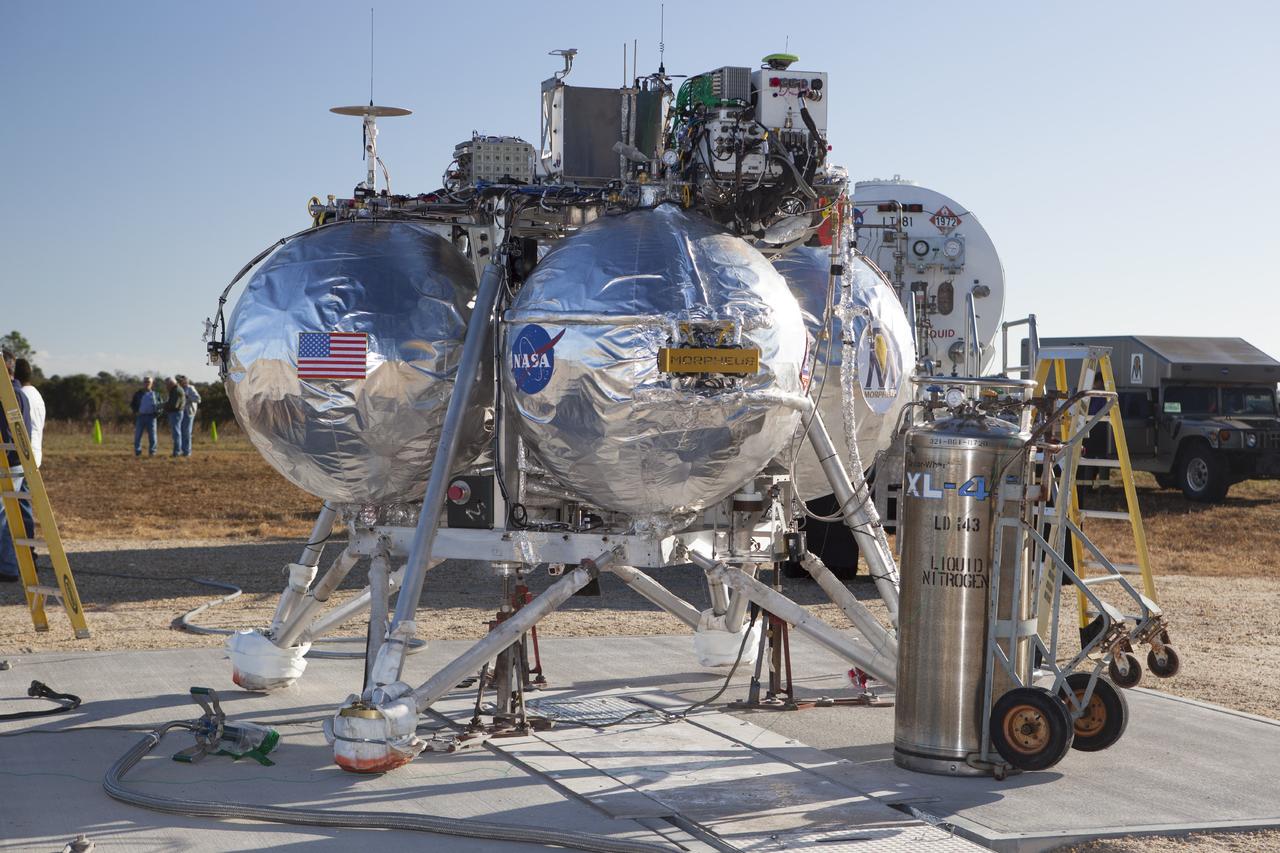
CAPE CANAVERAL, Fla. -- Preparations are underway to prepare the Project Morpheus prototype lander for a second free flight test at the north end of the Shuttle Landing…
Inspect NASA record
CAPE CANAVERAL, Fla. -- Preparations are underway to prepare the Project Morpheus prototype lander for a second free flight test at the north end of the Shuttle Landing Facility at NASA’s Kennedy Space Center in Florida. Testing of the prototype lander was performed at NASA’s Johnson Space Center in Houston in preparation for tethered and free flight testing at Kennedy. Project Morpheus integrates NASA’s automated landing and hazard avoidance technology, or ALHAT, with an engine that runs on liquid oxygen and methane, or green propellants, into a fully-operational lander that could deliver cargo to other planetary surfaces. The landing facility will provide the lander with the kind of field necessary for realistic testing, complete with rocks, craters and hazards to avoid. Morpheus’ ALHAT payload allows it to navigate to clear landing sites amidst rocks, craters and other hazards during its descent. Project Morpheus is being managed under the Advanced Exploration Systems, or AES, Division in NASA’s Human Exploration and Operations Mission Directorate. The efforts in AES pioneer new approaches for rapidly developing prototype systems, demonstrating key capabilities and validating operational concepts for future human missions beyond Earth orbit. For more information on Project Morpheus, visit http://morpheuslander.jsc.nasa.gov. Photo credit: NASA/Dimitri Gerondidakis
- Record ID
- KSC-2013-4366
- NASA center
- KSC
- Date
- 2013-12-17
- Keywords
- SLF, ALHAT, free flight

KSC · 2020-07-30 · KSC-20200730-PH-KLS02_0025
Mars 2020 Post-launch News Conference
A Mars 2020 post-launch news conference is held at NASA’s Kennedy Space Center in Florida on July 30, 2020. Participants, from left, are NASA Administrator Jim Bridenstine; Thomas…
Inspect NASA record
A Mars 2020 post-launch news conference is held at NASA’s Kennedy Space Center in Florida on July 30, 2020. Participants, from left, are NASA Administrator Jim Bridenstine; Thomas Zurbuchen, NASA associate administrator, Science Mission Directorate; Lori Glaze, Planetary Science Division director, NASA Headquarters; Matt Wallace, deputy project manager, NASA’s Jet Propulsion Laboratory; Omar Baez, launch director, NASA’s Launch Services Program; and Tory Bruno, president and CEO of United Launch Alliance. The United Launch Alliance Atlas V 541 rocket lifted off from Space Launch Complex 41 at Cape Canaveral Air Force Station at 7:50 a.m. EDT, carrying the agency’s Mars Perseverance rover and Ingenuity helicopter. The rover is part of NASA’s Mars Exploration Program, a long-term effort of robotic exploration of the Red Planet. The rover will search for habitable conditions in the ancient past and signs of past microbial life on Mars. The Launch Services Program at Kennedy is responsible for launch management.
- Record ID
- KSC-20200730-PH-KLS02_0025
- NASA center
- KSC
- Date
- 2020-07-30
- Credit
- NASA/Kim Shiflett
- Keywords
- Atlas V, Briefing, CCAFS, Cape Canaveral Air Force Station, JPL , Jet Propulsion Laboratory, KSC, Kennedy Space Center, LSP, Launch Services Program, Mars, Mars 2020
KSC · 2014-03-27 · KSC-2014-1876
Morpheus Alhat Tether Test Preparations
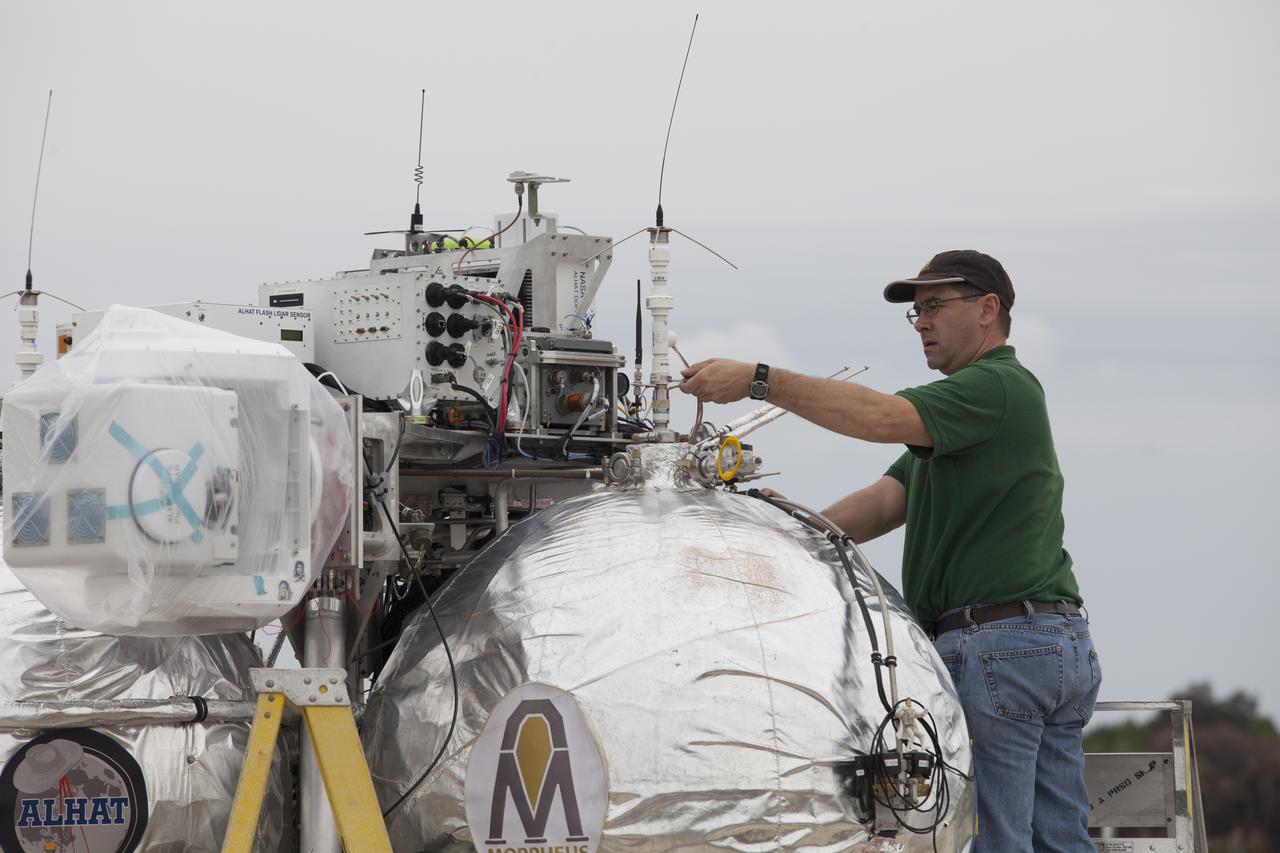
CAPE CANAVERAL, Fla. – A technician prepares the Project Morpheus prototype lander for a tether test near a new launch site at the north end of the Shuttle…
Inspect NASA record
CAPE CANAVERAL, Fla. – A technician prepares the Project Morpheus prototype lander for a tether test near a new launch site at the north end of the Shuttle Landing Facility at NASA's Kennedy Space Center in Florida. The launch pad was moved to a different location at the landing facility to support the next phase of flight testing. Project Morpheus tests NASA’s automated landing and hazard avoidance technology, or ALHAT, and an engine that runs on liquid oxygen and methane, or green propellants, into a fully-operational lander that could deliver cargo to other planetary surfaces. The landing facility provides the lander with the kind of field necessary for realistic testing, complete with rocks, craters and hazards to avoid. Morpheus’ ALHAT payload allows it to navigate to clear landing sites amidst rocks, craters and other hazards during its descent. Project Morpheus is being managed under the Advanced Exploration Systems, or AES, Division in NASA’s Human Exploration and Operations Mission Directorate. The efforts in AES pioneer new approaches for rapidly developing prototype systems, demonstrating key capabilities and validating operational concepts for future human missions beyond Earth orbit. For more information on Project Morpheus, visit http://morpheuslander.jsc.nasa.gov/. Photo credit: NASA/Ben Smegelsky
- Record ID
- KSC-2014-1876
- NASA center
- KSC
- Date
- 2014-03-27
- Credit
- NASA/KSC - Ben Smegelsky (IMCS)
- Keywords
- KSC-2014-1876, Project Morpheus, ALHAT
KSC · 2014-03-27 · KSC-2014-1871
Morpheus Alhat Tether Test Preparations
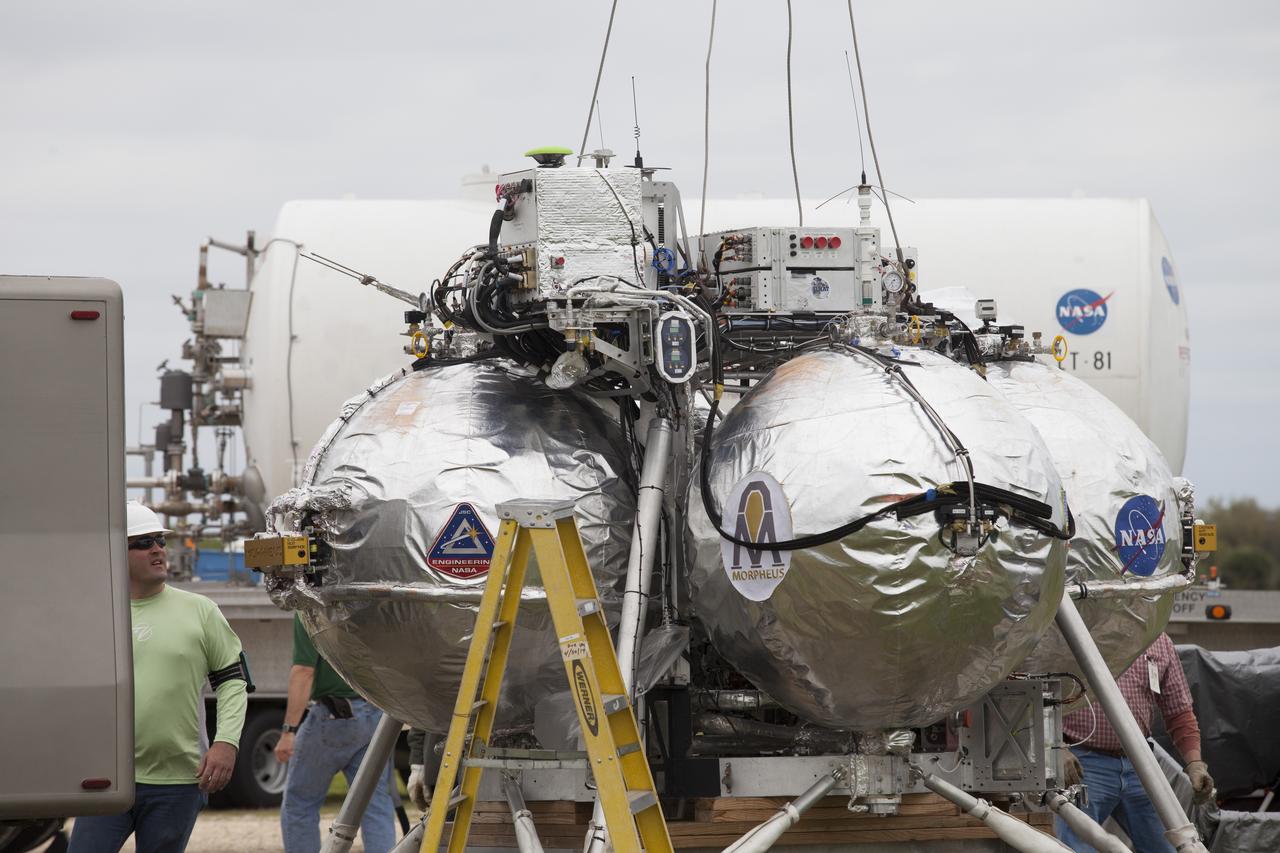
CAPE CANAVERAL, Fla. – Engineers and technicians prepare the Project Morpheus prototype lander for a tether test near a new launch site at the north end of the…
Inspect NASA record
CAPE CANAVERAL, Fla. – Engineers and technicians prepare the Project Morpheus prototype lander for a tether test near a new launch site at the north end of the Shuttle Landing Facility at NASA's Kennedy Space Center in Florida. The launch pad was moved to a different location at the landing facility to support the next phase of flight testing. Project Morpheus tests NASA’s automated landing and hazard avoidance technology, or ALHAT, and an engine that runs on liquid oxygen and methane, or green propellants, into a fully-operational lander that could deliver cargo to other planetary surfaces. The landing facility provides the lander with the kind of field necessary for realistic testing, complete with rocks, craters and hazards to avoid. Morpheus’ ALHAT payload allows it to navigate to clear landing sites amidst rocks, craters and other hazards during its descent. Project Morpheus is being managed under the Advanced Exploration Systems, or AES, Division in NASA’s Human Exploration and Operations Mission Directorate. The efforts in AES pioneer new approaches for rapidly developing prototype systems, demonstrating key capabilities and validating operational concepts for future human missions beyond Earth orbit. For more information on Project Morpheus, visit http://morpheuslander.jsc.nasa.gov/. Photo credit: NASA/Ben Smegelsky
- Record ID
- KSC-2014-1871
- NASA center
- KSC
- Date
- 2014-03-27
- Credit
- NASA/KSC - Ben Smegelsky (IMCS)
- Keywords
- KSC-2014-1871, Project Morpheus, ALHAT
JPL · 2024-09-10 · PIA26439
Europa Clipper: Equipped for Discovery (Artist's Concept)
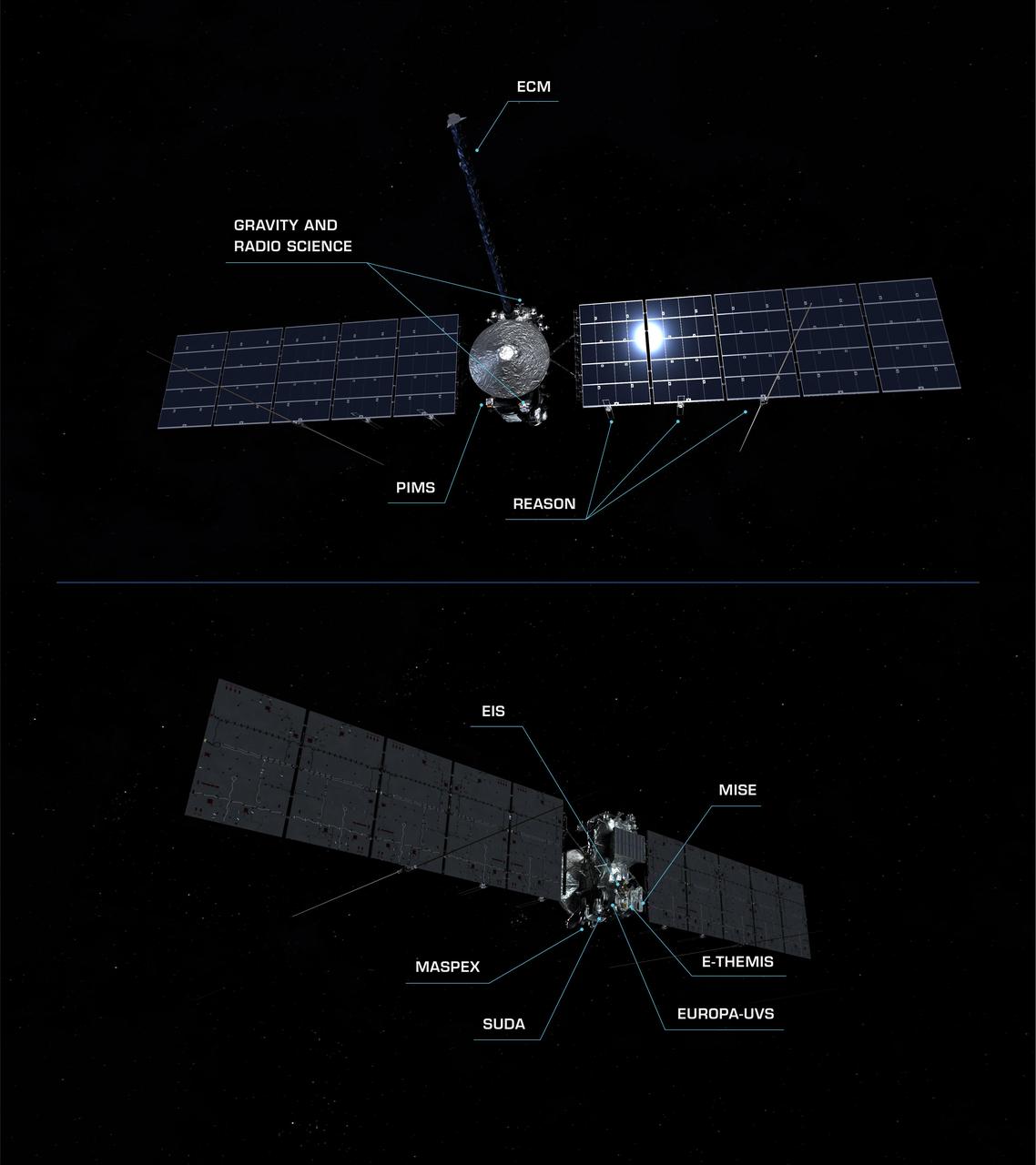
To conduct its detailed investigations of Jupiter's icy moon Europa, NASA's Europa Clipper spacecraft carries a suite of nine science instruments and a gravity experiment that uses its…
Inspect NASA record
To conduct its detailed investigations of Jupiter's icy moon Europa, NASA's Europa Clipper spacecraft carries a suite of nine science instruments and a gravity experiment that uses its telecommunications system. These components are depicted in this pair of artist's concepts showing each side of the spacecraft, and include: Europa Imaging System (EIS) Europa Thermal Emission Imaging System (E-THEMIS) Europa Ultraviolet Spectrograph (Europa-UVS) Mapping Imaging Spectrometer for Europa (MISE) Europa Clipper Magnetometer (ECM) Plasma Instrument for Magnetic Sounding (PIMS) Radar for Europa Assessment and Sounding: Ocean to Near-surface (REASON) MAss Spectrometer for Planetary EXploration/Europa (MASPEX) Surface Dust Analyzer (SUDA) Gravity and Radio Science Experiment (G/RS) Europa Clipper's three main science objectives are to determine the thickness of the moon's icy shell and its interactions with the ocean below, to investigate its composition, and to characterize its geology. The mission's detailed exploration of Europa will help scientists better understand the astrobiological potential for habitable worlds beyond our planet. https://photojournal.jpl.nasa.gov/catalog/PIA26439
- Record ID
- PIA26439
- NASA center
- JPL
- Date
- 2024-09-10
- Credit
- NASA/JPL-Caltech
- Keywords
- Europa Clipper, Europa
JPL · 2024-10-11 · PIA26107
Creation of Europa's Atmosphere (Artist's Concept)
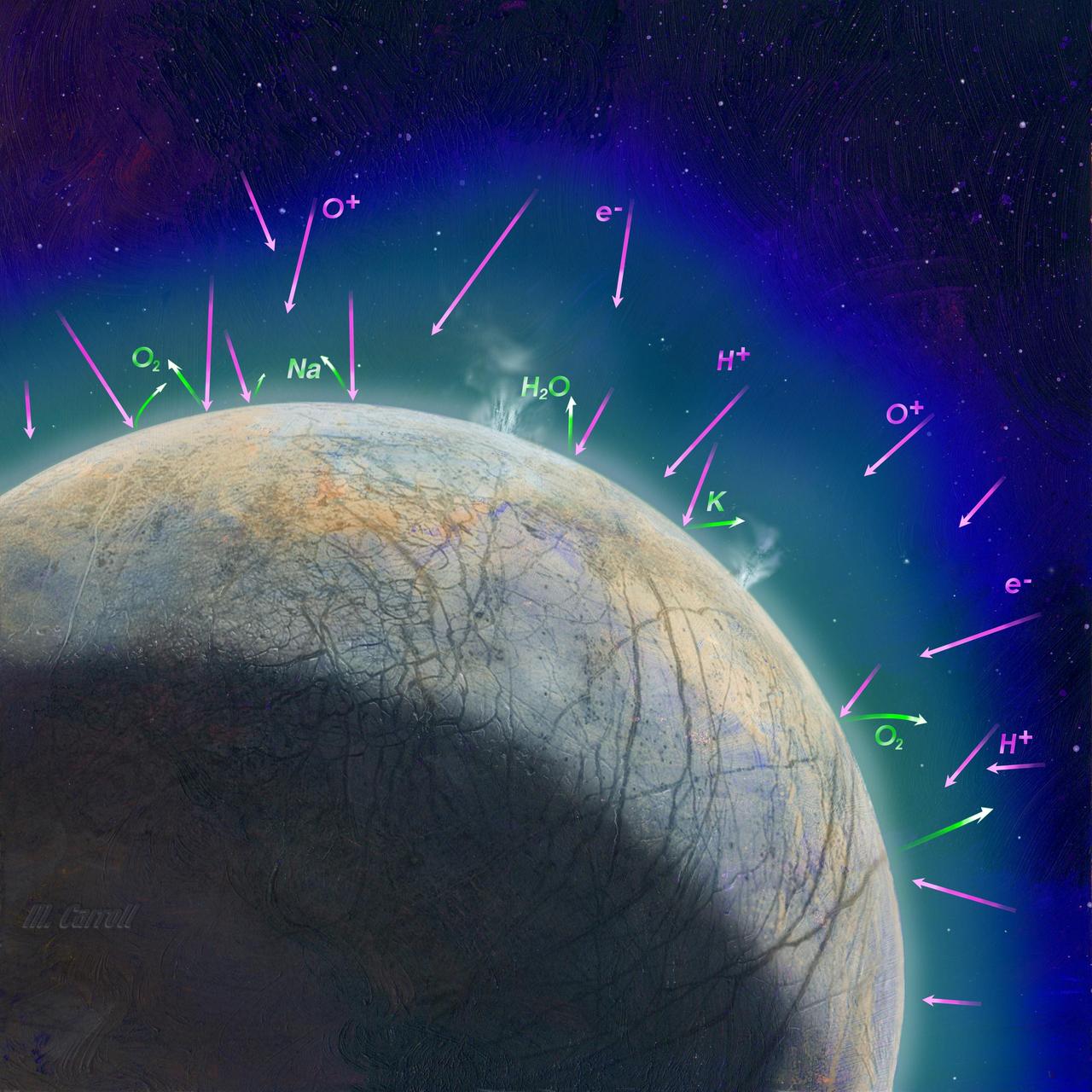
This artist's concept shows how scientists think the thin atmosphere on Jupiter's moon Europa is formed. It illustrates how the impact of high-energy, charged particles can kick up…
Inspect NASA record
This artist's concept shows how scientists think the thin atmosphere on Jupiter's moon Europa is formed. It illustrates how the impact of high-energy, charged particles can kick up material from the surface and how possible plumes might also contribute to the atmosphere. NASA's Europa Clipper mission aims to better understand the moon's atmosphere by measuring its chemical composition with the MAss Spectrometer for Planetary EXploration/Europa (MASPEX) and "sniffing" the dust grains blasted off the surface with the SUrface Dust Analyzer (SUDA). These two instruments will help scientists understand whether Europa harbors the composition and chemistry required to host life. Europa Clipper's three main science objectives are to determine the thickness of the moon's icy shell and its interactions with the ocean below, to investigate its composition, and to characterize its geology. The mission's detailed exploration of Europa will help scientists better understand the astrobiological potential for habitable worlds beyond our planet. https://photojournal.jpl.nasa.gov/catalog/PIA26107
- Record ID
- PIA26107
- NASA center
- JPL
- Date
- 2024-10-11
- Credit
- NASA/JPL-Caltech
- Keywords
- Europa Clipper, Europa
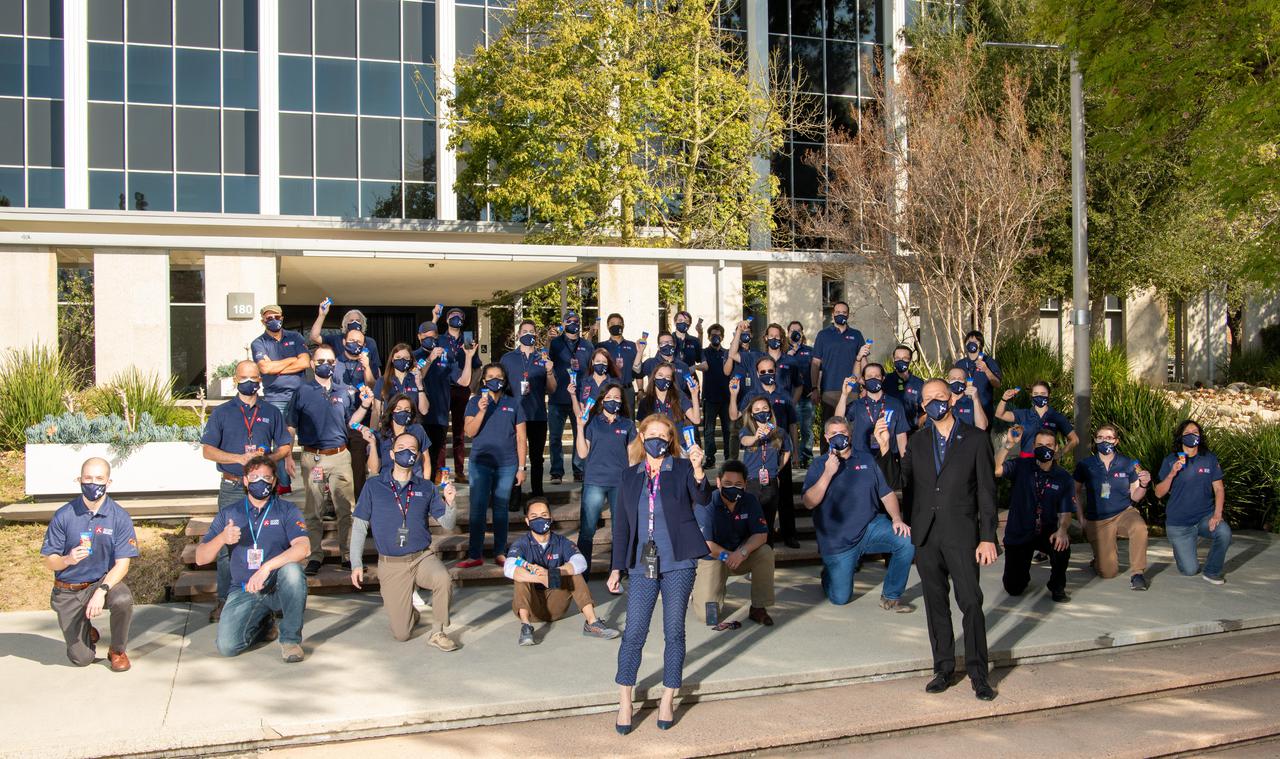
JPL · 2021-02-19 · PIA23724
Mars Perseverance Team, Pre-landing
Before NASA's Mars Perseverance rover landed on Mars on Feb. 18, 2021, the entry, descent, and landing team posed at the agency's Jet Propulsion Laboratory in Southern California…
Inspect NASA record
Before NASA's Mars Perseverance rover landed on Mars on Feb. 18, 2021, the entry, descent, and landing team posed at the agency's Jet Propulsion Laboratory in Southern California with individual bags of traditional "lucky peanuts." Eating peanuts before major mission events is a longstanding tradition at JPL. In the foreground are (left to right) NASA Planetary Science Division Director Lori Glaze and NASA Science Mission Directorate Associate Administrator Thomas Zurbuchen. A key objective for Perseverance's mission on Mars is astrobiology, including the search for signs of ancient microbial life. The rover will characterize the planet's geology and past climate, pave the way for human exploration of the Red Planet, and be the first mission to collect and cache Martian rock and regolith (broken rock and dust). Subsequent NASA missions, in cooperation with ESA (European Space Agency), would send spacecraft to Mars to collect these sealed samples from the surface and return them to Earth for in-depth analysis. The Mars 2020 mission is part of a larger program that includes missions to the Moon as a way to prepare for human exploration of the Red Planet. https://photojournal.jpl.nasa.gov/catalog/PIA23724
- Record ID
- PIA23724
- NASA center
- JPL
- Date
- 2021-02-19
- Credit
- NASA/JPL-Caltech
- Keywords
- Mars 2020, Mars
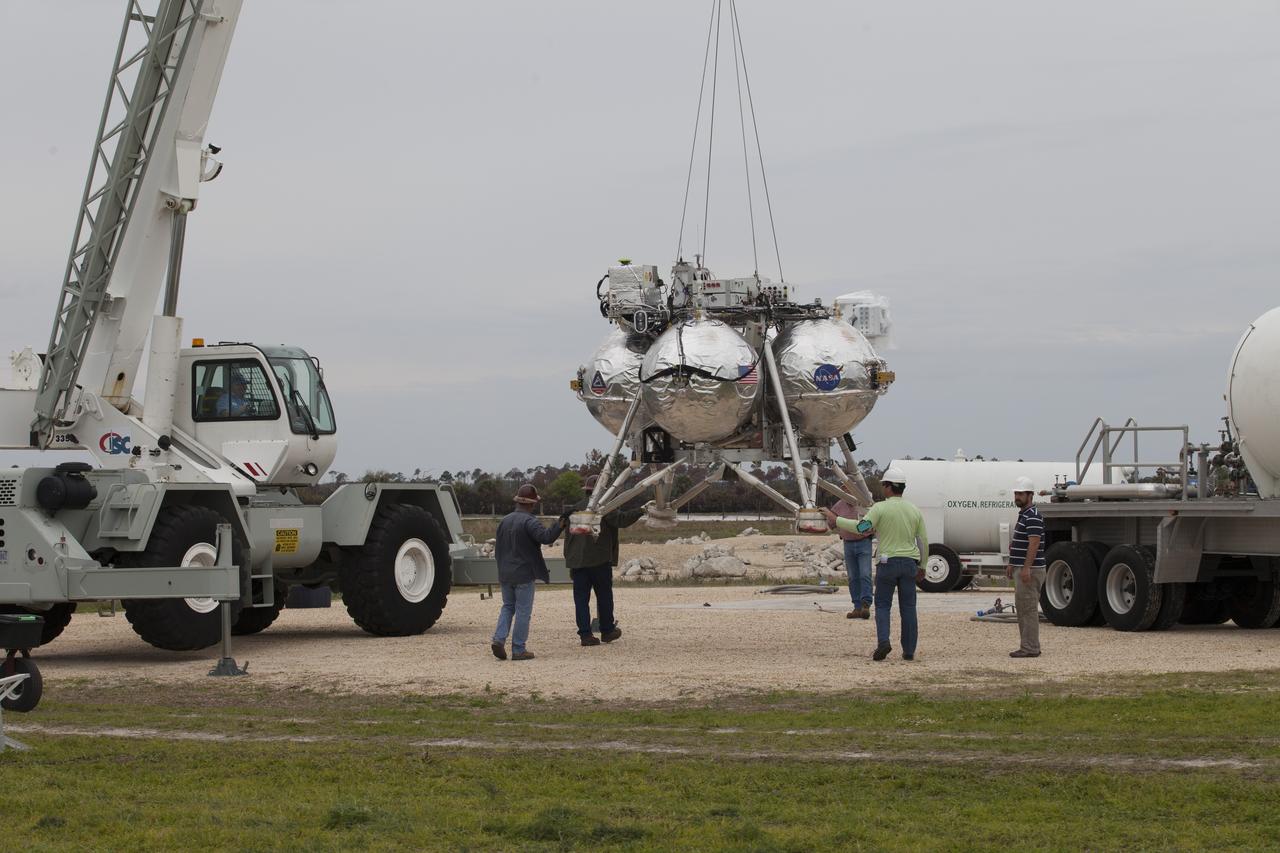
KSC · 2014-03-27 · KSC-2014-1872
Morpheus Alhat Tether Test Preparations
CAPE CANAVERAL, Fla. – Engineers and technicians monitor the progress as a crane lifts the Project Morpheus prototype lander off the ground for a tether test near a…
Inspect NASA record
CAPE CANAVERAL, Fla. – Engineers and technicians monitor the progress as a crane lifts the Project Morpheus prototype lander off the ground for a tether test near a new launch site at the north end of the Shuttle Landing Facility at NASA's Kennedy Space Center in Florida. The launch pad was moved to a different location at the landing facility to support the next phase of flight testing. Project Morpheus tests NASA’s automated landing and hazard avoidance technology, or ALHAT, and an engine that runs on liquid oxygen and methane, or green propellants, into a fully-operational lander that could deliver cargo to other planetary surfaces. The landing facility provides the lander with the kind of field necessary for realistic testing, complete with rocks, craters and hazards to avoid. Morpheus’ ALHAT payload allows it to navigate to clear landing sites amidst rocks, craters and other hazards during its descent. Project Morpheus is being managed under the Advanced Exploration Systems, or AES, Division in NASA’s Human Exploration and Operations Mission Directorate. The efforts in AES pioneer new approaches for rapidly developing prototype systems, demonstrating key capabilities and validating operational concepts for future human missions beyond Earth orbit. For more information on Project Morpheus, visit http://morpheuslander.jsc.nasa.gov/. Photo credit: NASA/Ben Smegelsky
- Record ID
- KSC-2014-1872
- NASA center
- KSC
- Date
- 2014-03-27
- Credit
- NASA/KSC - Ben Smegelsky (IMCS)
- Keywords
- KSC-2014-1872, Project Morpheus, ALHAT
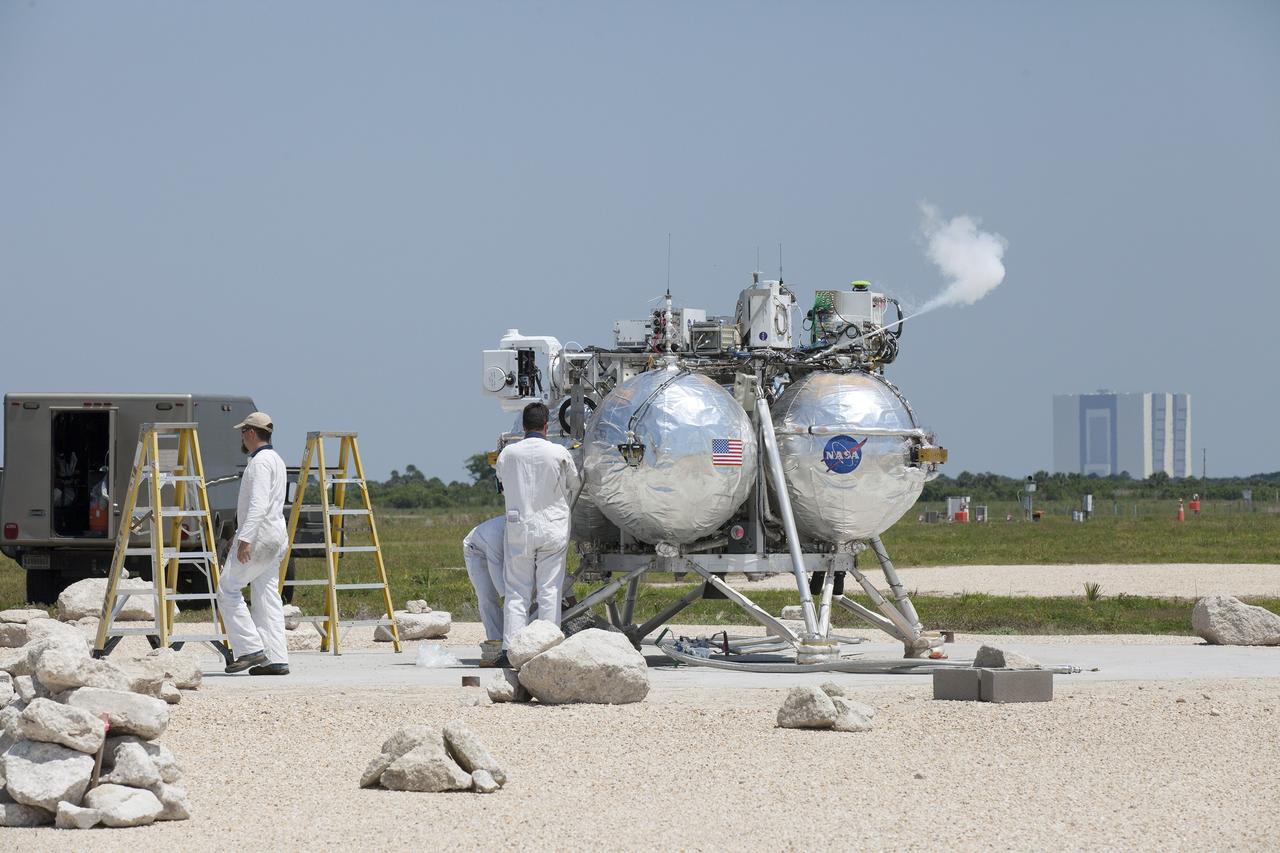
KSC · 2014-05-22 · KSC-2014-2667
KSC-2014-2667
CAPE CANAVERAL, Fla. – At NASA's Kennedy Space Center in Florida, technicians check out the agency's Project Morpheus prototype lander which just touched down on a dedicated pad…
Inspect NASA record
CAPE CANAVERAL, Fla. – At NASA's Kennedy Space Center in Florida, technicians check out the agency's Project Morpheus prototype lander which just touched down on a dedicated pad inside the ALHAT hazard field near the Shuttle Landing Facility. Project Morpheus tests NASA’s ALHAT and an engine that runs on liquid oxygen and methane, which are green propellants. These new capabilities could be used in future efforts to deliver cargo to planetary surfaces. The landing facility provides the lander with the kind of field necessary for realistic testing, complete with rocks, craters and hazards to avoid. Morpheus’ ALHAT payload allows it to navigate to clear landing sites amidst rocks, craters and other hazards during its descent. Project Morpheus is being managed under the Advanced Exploration Systems, or AES, Division in NASA’s Human Exploration and Operations Mission Directorate. The efforts in AES pioneer new approaches for rapidly developing prototype systems, demonstrating key capabilities and validating operational concepts for future human missions beyond Earth orbit. For more information on Project Morpheus, visit http://morpheuslander.jsc.nasa.gov/. Photo credit: NASA/Kim Shiflett
- Record ID
- KSC-2014-2667
- NASA center
- KSC
- Date
- 2014-05-22
- Keywords
- SLF, ALHAT, launch pad, free flight test