
Update Site (from NASA)
Explore NASA’s Image and Video Library.
Suggest one object per day for the Interstellar Minds collection. We review each suggestion before adding it.
Sign in to suggest a Marvel.
Find a NASA image ID. Open a NASA record and copy its ID from the end of the details URL.
NASA image records
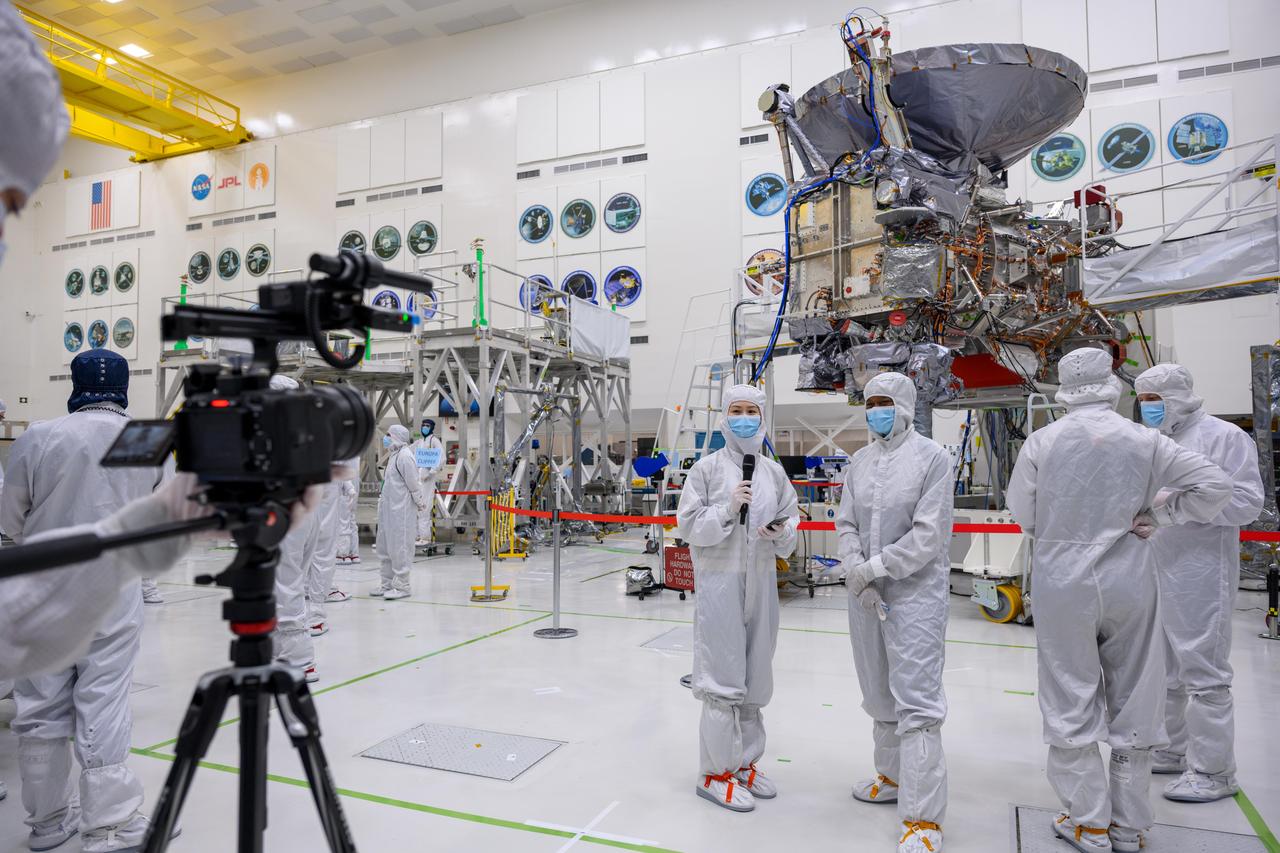
JPL · 2024-04-11 · PIA26291
JPL Shows Off Europa Clipper in the Clean Room
Members of the media viewed NASA's Europa Clipper spacecraft in High Bay 1 in the historic Spacecraft Assembly Facility at the agency's Jet Propulsion Laboratory on April 11,…
Inspect NASA record
Members of the media viewed NASA's Europa Clipper spacecraft in High Bay 1 in the historic Spacecraft Assembly Facility at the agency's Jet Propulsion Laboratory on April 11, 2024. The largest spacecraft NASA has ever built for a planetary mission, Europa Clipper is expected to launch in October 2024 on a six-year journey to the Jupiter system, where it will orbit the gas giant and study the ice-encased moon Europa. Europa Clipper's main science goal is to determine whether there are places below the surface of Jupiter's icy moon, Europa, that could support life. The mission's three main science objectives are to determine the thickness of the moon's icy shell and its surface interactions with the ocean below, to investigate its composition, and to characterize its geology. The mission's detailed exploration of Europa will help scientists better understand the astrobiological potential for habitable worlds beyond our planet. https://photojournal.jpl.nasa.gov/catalog/PIA26291
- Record ID
- PIA26291
- NASA center
- JPL
- Date
- 2024-04-11
- Credit
- NASA/JPL-Caltech
- Keywords
- Europa Clipper, Europa

KSC · 1999-06-12 · KSC-99pp0670
KSC-99pp0670
In Hangar AE, Cape Canaveral Air Station (CCAS), NASA's Far Ultraviolet Spectroscopic Explorer (FUSE) satellite stands ready to be moved to the launch pad. The black rectangle on…
Inspect NASA record
In Hangar AE, Cape Canaveral Air Station (CCAS), NASA's Far Ultraviolet Spectroscopic Explorer (FUSE) satellite stands ready to be moved to the launch pad. The black rectangle on top is the optical port; at the lower edge are the radiators. The total length of the instrument is approximately four meters. FUSE was developed by The Johns Hopkins University under contract to Goddard Space Flight Center, Greenbelt, Md., to investigate the origin and evolution of the lightest elements in the universe hydrogen and deuterium. In addition, the FUSE satellite will examine the forces and process involved in the evolution of the galaxies, stars and planetary systems by investigating light in the far ultraviolet portion of the electromagnetic spectrum. Launch is targeted for June 23 from Launch Pad 17A, CCAS, aboard a Boeing Delta II rocket
- Record ID
- KSC-99pp0670
- NASA center
- KSC
- Date
- 1999-06-12
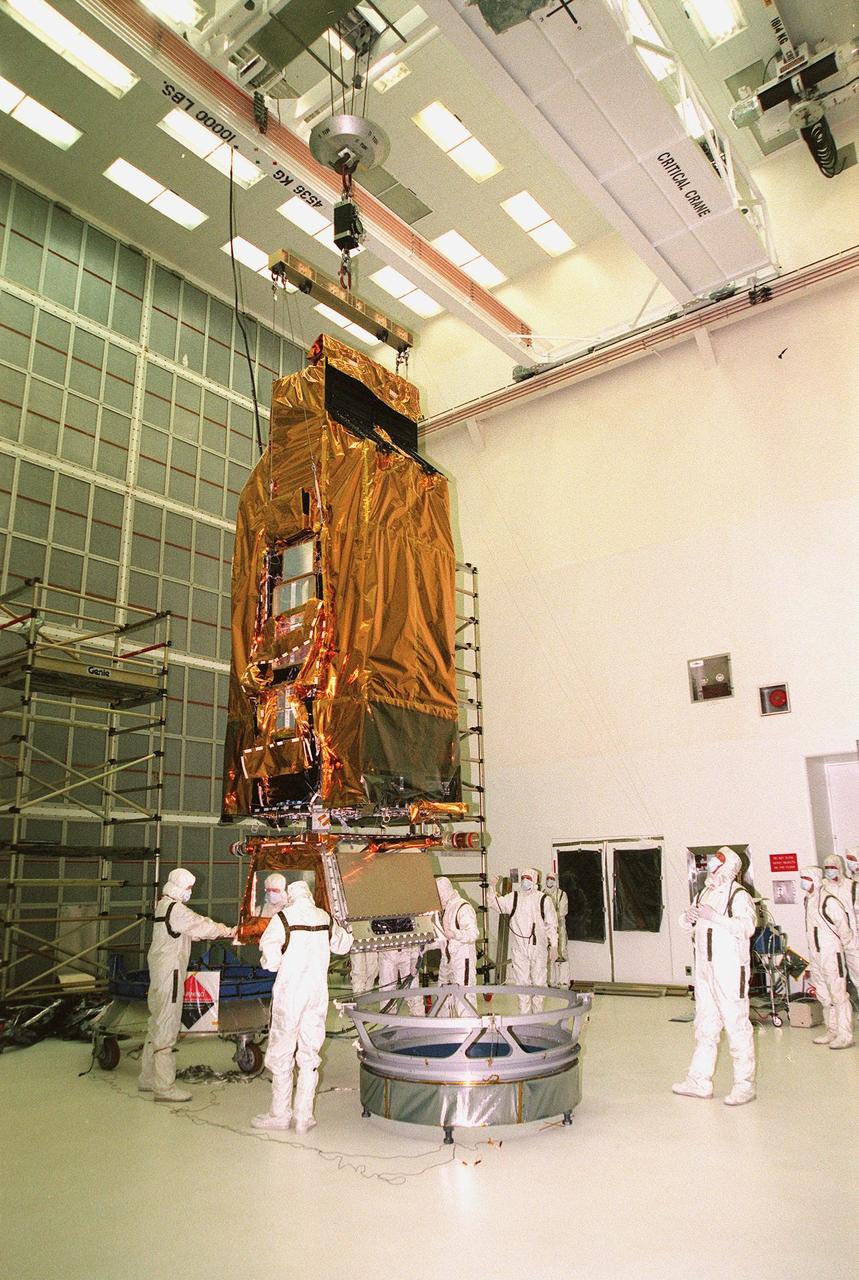
KSC · 1999-05-04 · KSC-99pp0495
KSC-99pp0495
While a crane lifts NASA's Far Ultraviolet Spectroscopic Explorer (FUSE) satellite, workers at Hangar AE, Cape Canaveral Air Station, help guide it toward the circular Payload Attach Fitting…
Inspect NASA record
While a crane lifts NASA's Far Ultraviolet Spectroscopic Explorer (FUSE) satellite, workers at Hangar AE, Cape Canaveral Air Station, help guide it toward the circular Payload Attach Fitting (PAF) in front of it. FUSE is undergoing a functional test of its systems, plus installation of flight batteries and solar arrays. Developed by The Johns Hopkins University under contract to Goddard Space Flight Center, Greenbelt, Md., FUSE will investigate the origin and evolution of the lightest elements in the universe hydrogen and deuterium. In addition, the FUSE satellite will examine the forces and process involved in the evolution of the galaxies, stars and planetary systems by investigating light in the far ultraviolet portion of the electromagnetic spectrum. FUSE is scheduled to be launched May 27 aboard a Boeing Delta II rocket at Launch Complex 17
- Record ID
- KSC-99pp0495
- NASA center
- KSC
- Date
- 1999-05-04
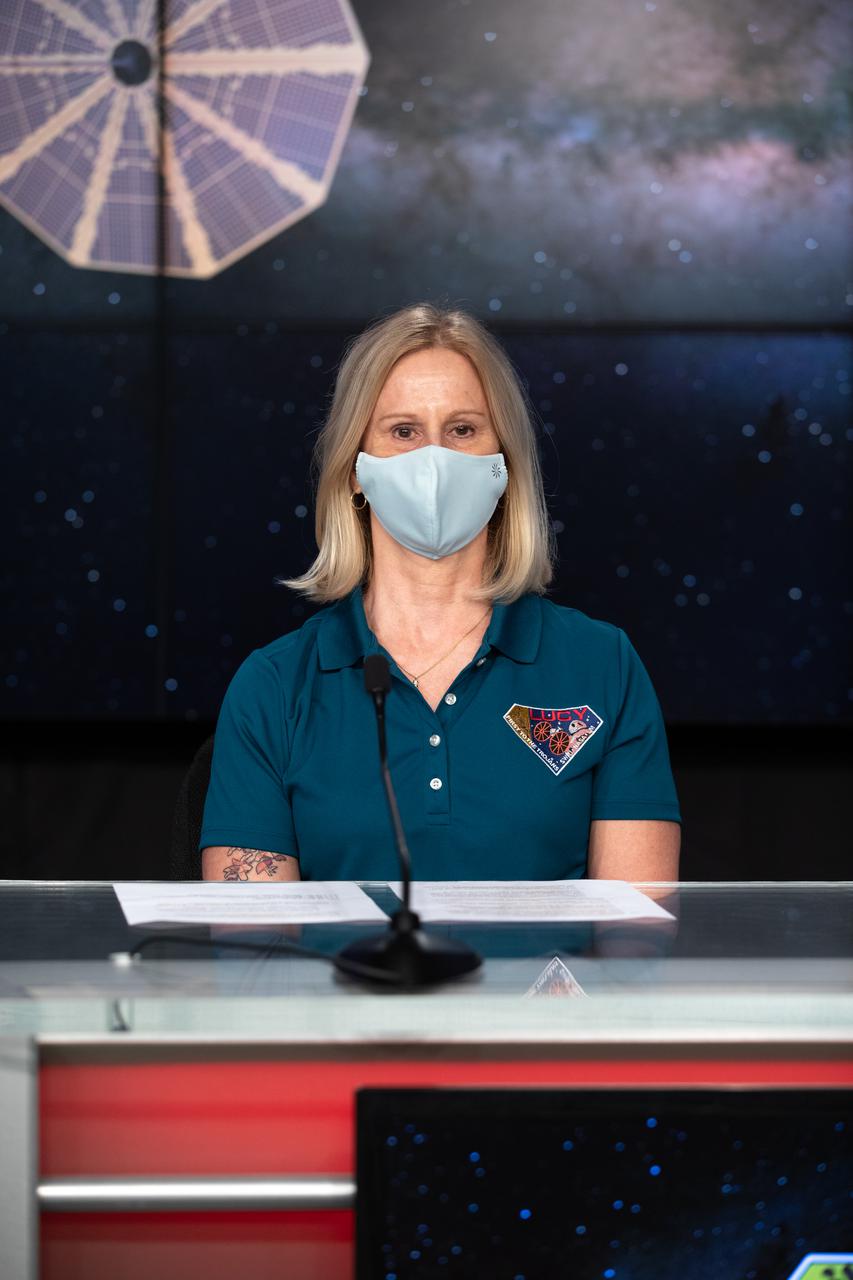
KSC · 2021-10-14 · KSC-20211014-PH-KLS02_0012
Lucy Engineering Briefing
Joan Salute, Planetary Science Division associate director, Flight Programs, NASA HQ, is introduced during an engineering briefing for the Lucy mission held inside the TV Auditorium at NASA’s…
Inspect NASA record
Joan Salute, Planetary Science Division associate director, Flight Programs, NASA HQ, is introduced during an engineering briefing for the Lucy mission held inside the TV Auditorium at NASA’s Kennedy Space Center in Florida on Oct. 14, 2021. The mission is scheduled to launch at 5:34 a.m. EDT Saturday, Oct. 16, on a United Launch Alliance Atlas V 401 rocket from Space Launch Complex 41 at Cape Canaveral Space Force Station. NASA’s Launch Services Program, based at Kennedy, is managing the launch. During its 12-year primary mission, Lucy will explore a record-breaking number of asteroids, flying by one asteroid in the solar system’s main belt and seven Trojan asteroids. Additionally, Lucy’s path will circle back to Earth three times for gravity assists, making it the first spacecraft to return to the vicinity of Earth from the outer solar system.
- Record ID
- KSC-20211014-PH-KLS02_0012
- NASA center
- KSC
- Date
- 2021-10-14
- Credit
- NASA/Kim Shiflett
- Keywords
- CCSFS, Cape Canaveral Space Force Station, Engineering briefing, GSFC, KSC, Kennedy Space Center, KinetX Aerospace, LSP, Launch Services Program, Lockheed Martin Space, Lucy, Lucy Mission
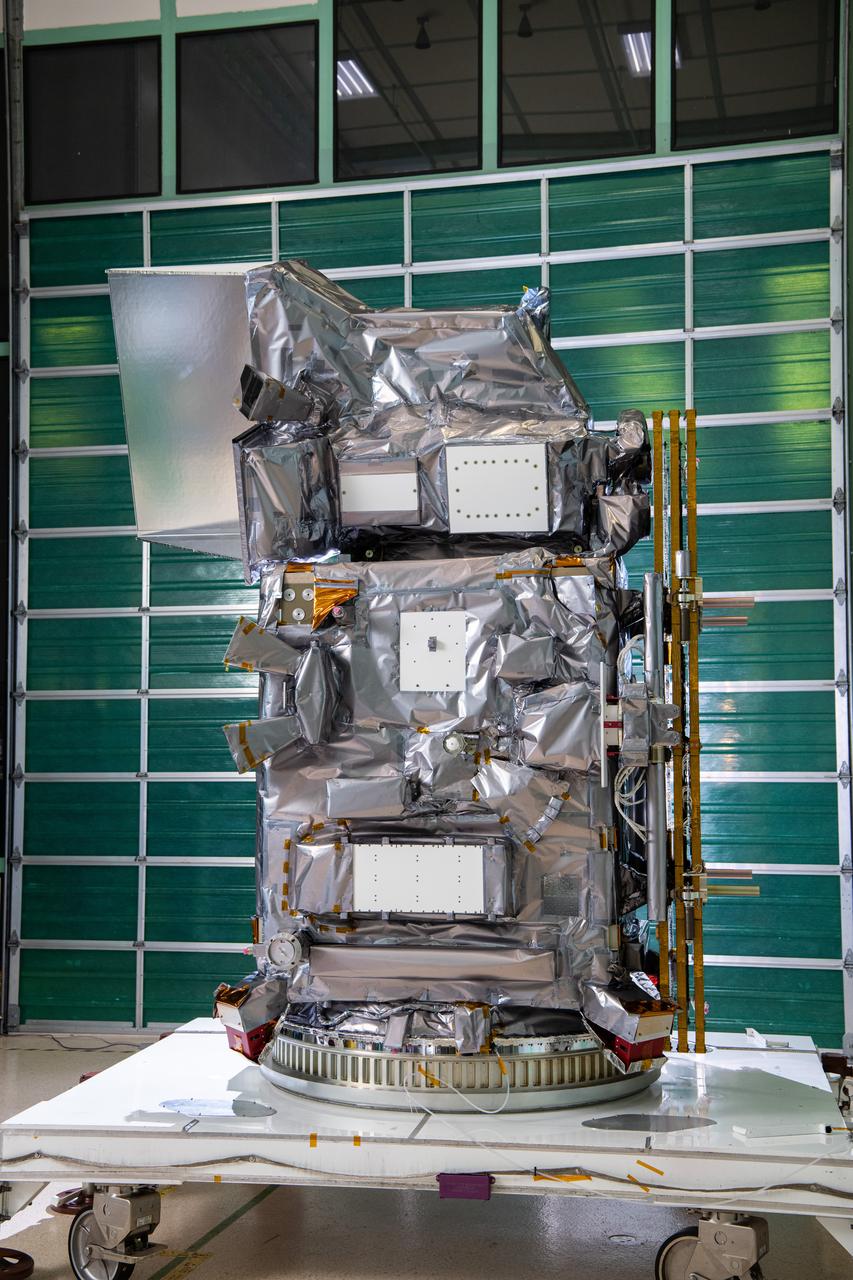
GSFC · 2023-10-31 · GSFC_20231031_PACE_030777
GSFC_20231031_PACE_030777
The Plankton, Aerosol, Cloud, ocean Ecosystem (PACE) in the clean room at NASA's Goddard Space Flight Center in Greenbelt, Maryland on October 31st, 2023. PACE's unprecedented spectral coverage…
Inspect NASA record
The Plankton, Aerosol, Cloud, ocean Ecosystem (PACE) in the clean room at NASA's Goddard Space Flight Center in Greenbelt, Maryland on October 31st, 2023. PACE's unprecedented spectral coverage will provide the first-ever global measurements designed to identify phytoplankton community composition. The mission will make global ocean color measurements, using the Ocean Color Instrument (OCI), to provide extended data records on ocean ecology and global biogeochemistry along with polarimetry measurements, using the Spectro-polarimeter for Planetary Exploration (SPEXone) and the Hyper Angular Research Polarimeter (HARP2) to provide extended data records on clouds and aerosols. The Earth-observing satellite mission, built at Goddard Space Flight Center in Greenbelt, MD, will continue and advance observations of global ocean color, biogeochemistry, and ecology, as well as the carbon cycle, aerosols and clouds.
- Record ID
- GSFC_20231031_PACE_030777
- NASA center
- GSFC
- Date
- 2023-10-31
- Credit
- NASA / Denny Henry
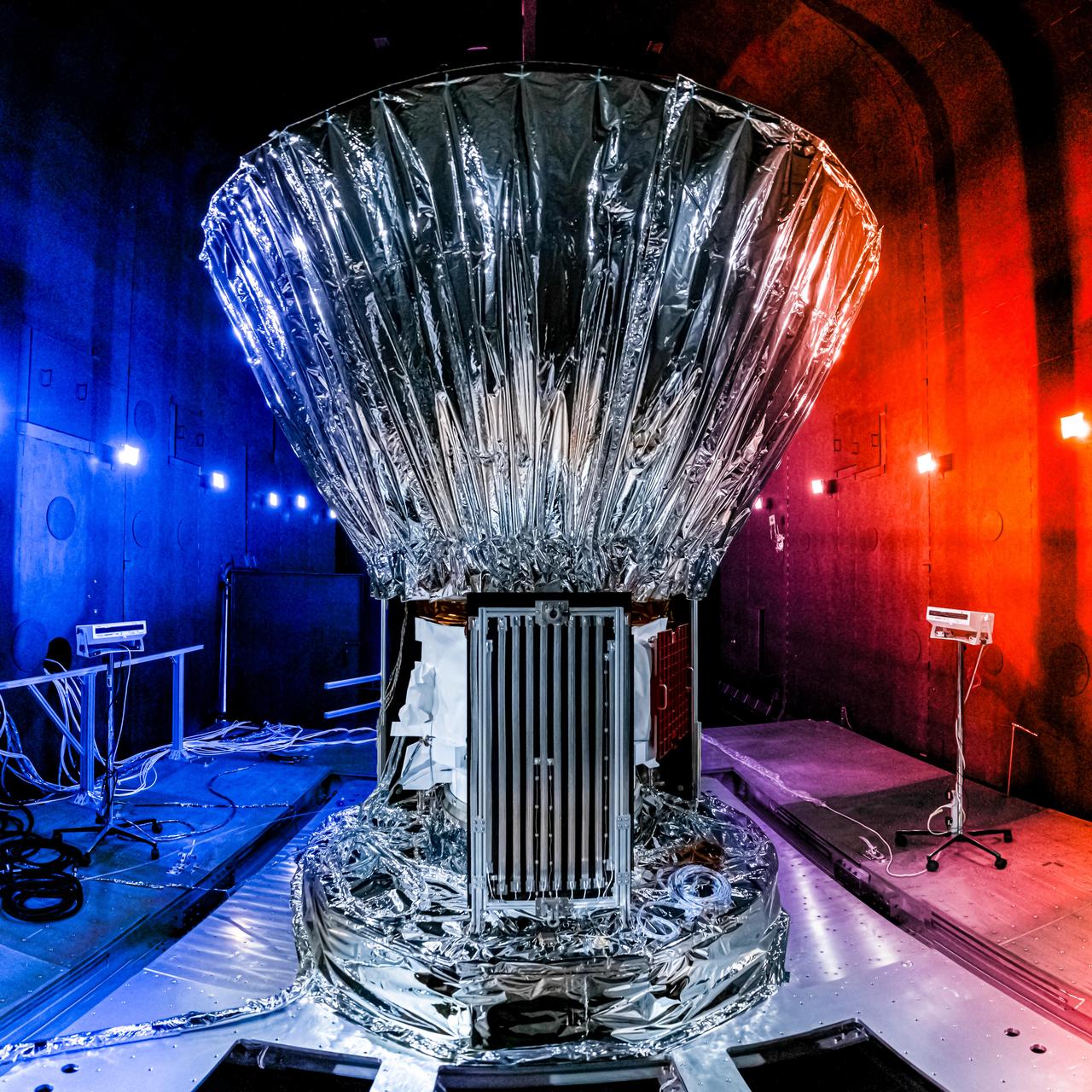
JPL · 2025-01-23 · PIA26541
SPHEREx Prepared for Thermal Vacuum Testing
NASA's SPHEREx observatory is installed in the Titan Thermal Vacuum (TVAC) test Chamber at BAE Systems in Boulder, Colorado, in June 2024. As part of the test setup,…
Inspect NASA record
NASA's SPHEREx observatory is installed in the Titan Thermal Vacuum (TVAC) test Chamber at BAE Systems in Boulder, Colorado, in June 2024. As part of the test setup, the spacecraft and photon shield are covered in multilayer insulation and blankets and surrounded by ground support equipment. Short for Spectro-Photometer for the History of the Universe, Epoch of Reionization and Ices Explorer, SPHEREx will create a map of the cosmos like no other. Using a technique called spectroscopy to image the entire sky in 102 wavelengths of infrared light, SPHEREx will gather information about the composition of and distance to millions of galaxies and stars. With this map, scientists will study what happened in the first fraction of a second after the big bang, how galaxies formed and evolved, and the origins of water in planetary systems in our galaxy. https://photojournal.jpl.nasa.gov/catalog/PIA26541
- Record ID
- PIA26541
- NASA center
- JPL
- Date
- 2025-01-23
- Credit
- NASA/JPL-Caltech/BAE Systems
- Keywords
- SPHEREx, Sky
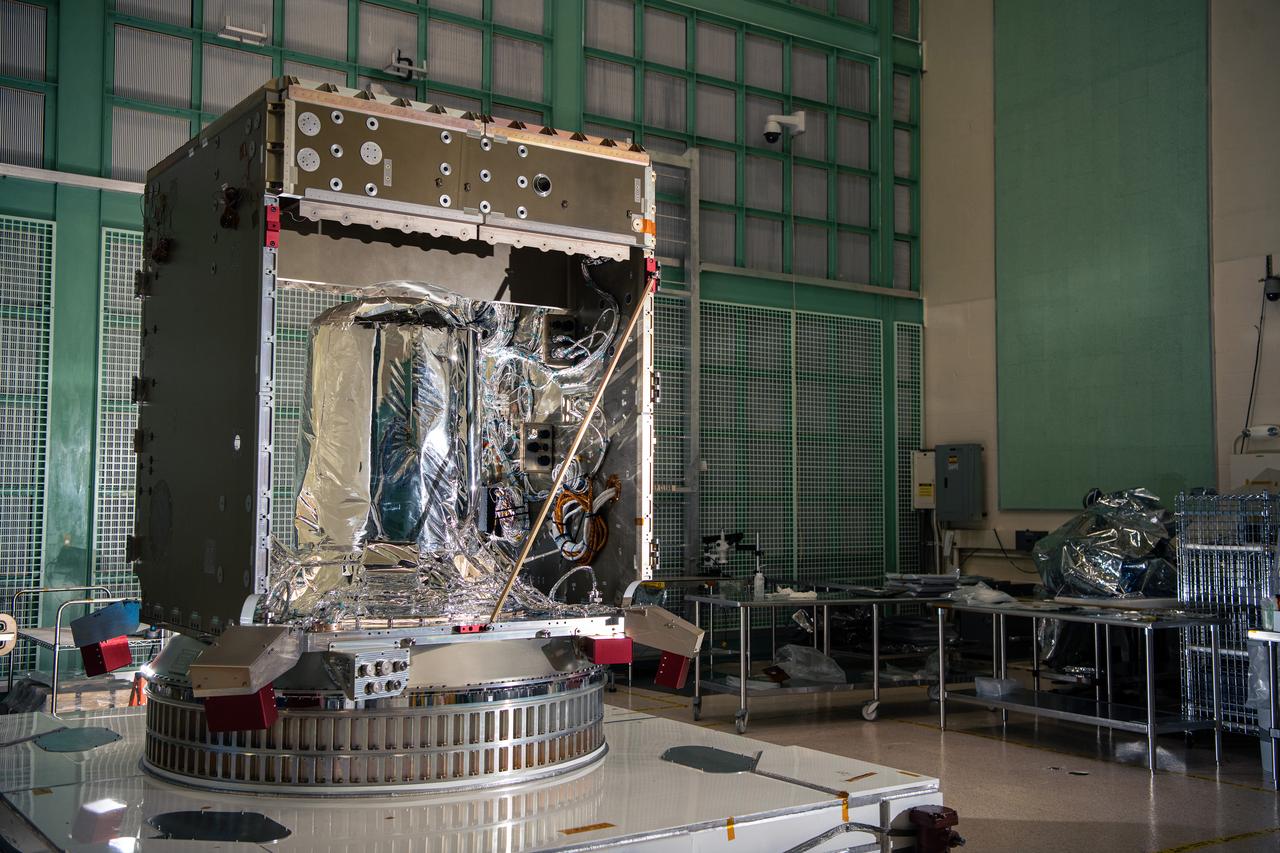
GSFC · 2022-02-24 · GSFC_20220224_PACE_038025
GSFC_20220224_PACE_038025
The flight propellant tank is visible inside the partially assembled Plankton, Aerosol, Cloud, ocean Ecosystem (PACE) Spacecraft structure in the cleanroom at NASA Goddard Space Flight Center in…
Inspect NASA record
The flight propellant tank is visible inside the partially assembled Plankton, Aerosol, Cloud, ocean Ecosystem (PACE) Spacecraft structure in the cleanroom at NASA Goddard Space Flight Center in Greenbelt, Maryland on February 24th, 2022. PACE's unprecedented spectral coverage will provide the first-ever global measurements designed to identify phytoplankton community composition. The mission will make global ocean color measurements, using the Ocean Color Instrument (OCI), to provide extended data records on ocean ecology and global biogeochemistry along with polarimetry measurements, using the Spectro-polarimeter for Planetary Exploration (SPEXone) and the Hyper Angular Research Polarimeter (HARP2) to provide extended data records on clouds and aerosols. The Earth-observing satellite mission, built at Goddard Space Flight Center in Greenbelt, MD, will continue and advance observations of global ocean color, biogeochemistry, and ecology, as well as the carbon cycle, aerosols and clouds.
- Record ID
- GSFC_20220224_PACE_038025
- NASA center
- GSFC
- Date
- 2022-02-24
- Credit
- NASA / Denny Henry
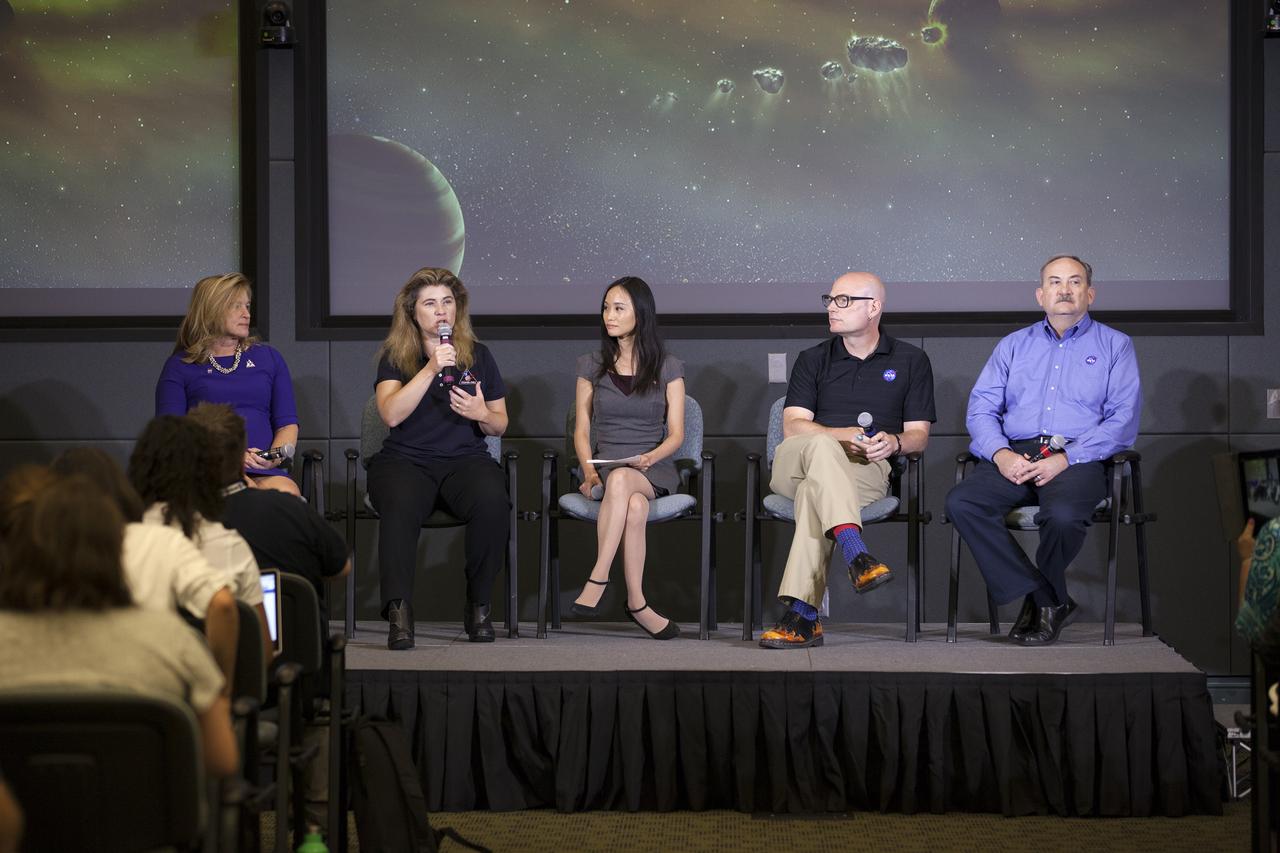
KSC · 2016-09-07 · KSC-20160907-PH_KLS03_0003
OSIRIS-REx "Uncovering the Secrets of Asteroids" Briefing
In a panel discussion in the Kennedy Space Center’s Operations Support Building II, social media followers were briefed by NASA scientists on asteroids, how they relate to the…
Inspect NASA record
In a panel discussion in the Kennedy Space Center’s Operations Support Building II, social media followers were briefed by NASA scientists on asteroids, how they relate to the origins of our solar system and the search for life beyond Earth. The discussion took place before launch of the agency’s Origins, Spectral Interpretation, Resource Identification, Security-Regolith Explorer, or OSIRIS-REx spacecraft. Panelists for this conversation are, from the left, Ellen Stofan, NASA chief scientist; Michelle Thaller, deputy director of science communications for NASA’s Science Mission Directorate; Felicia Chou, NASA Communications; Alex Young, associate director for science in the Heliophysics Science Division at NASA’s Goddard Space Flight Center in Greenbelt, Maryland; and Lindley Johnson, director of the Planetary Defense Coordination Office in NASA’s Science Mission Directorate.
- Record ID
- KSC-20160907-PH_KLS03_0003
- NASA center
- KSC
- Date
- 2016-09-07
- Credit
- NASA/Kim Shiflett
- Keywords
- OSIRIS-REx, ULA, NASA Social, LSP, Asteroid, Bennu
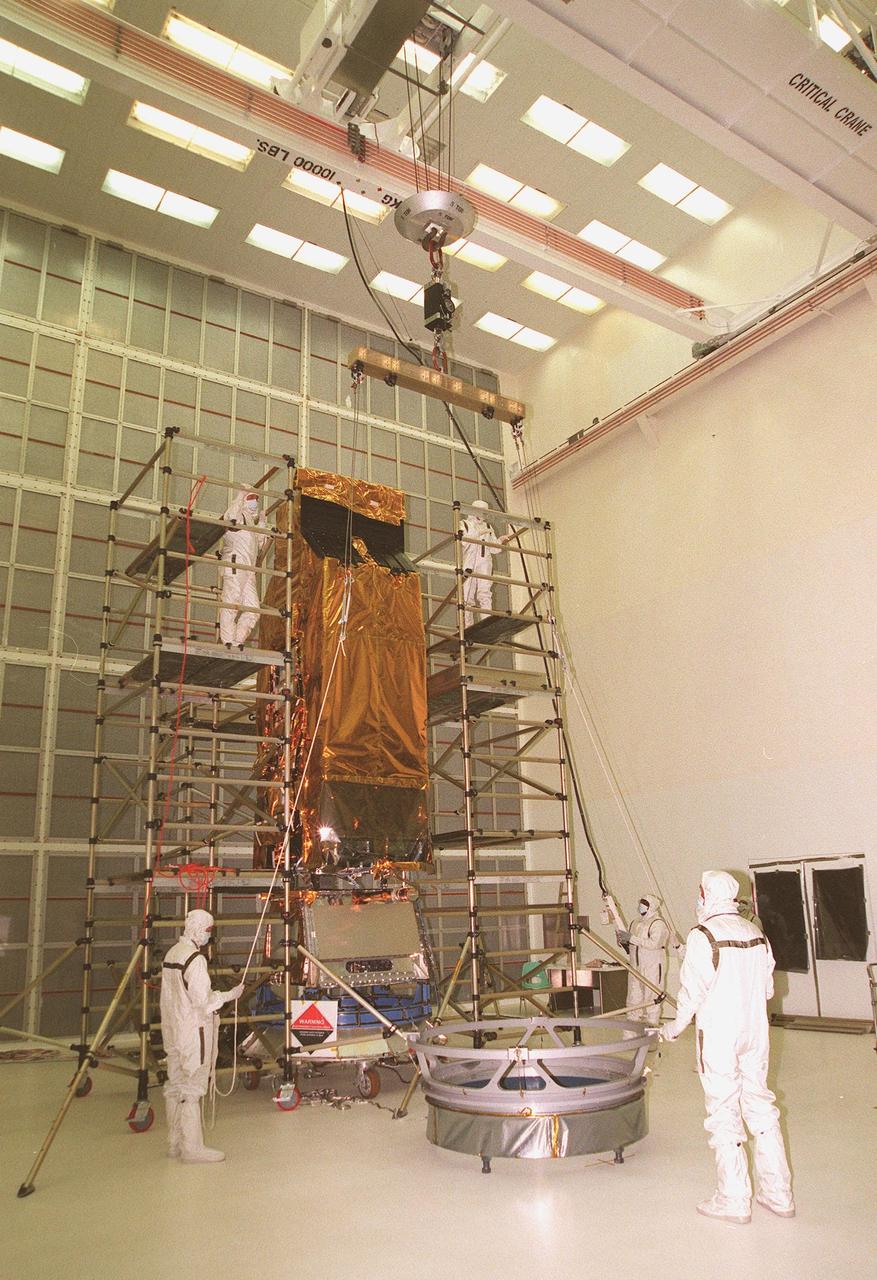
KSC · 1999-05-03 · KSC-99pp0494
KSC-99pp0494
Workers at Hangar AE, Cape Canaveral Air Station, maneuver an overhead crane toward NASA's Far Ultraviolet Spectroscopic Explorer (FUSE) satellite standing between vertical workstands. The crane will lift…
Inspect NASA record
Workers at Hangar AE, Cape Canaveral Air Station, maneuver an overhead crane toward NASA's Far Ultraviolet Spectroscopic Explorer (FUSE) satellite standing between vertical workstands. The crane will lift FUSE to move it onto the Payload Attach Fitting (PAF) in front of it. FUSE is undergoing a functional test of its systems, plus installation of flight batteries and solar arrays. Developed by The Johns Hopkins University under contract to Goddard Space Flight Center, Greenbelt, Md., FUSE will investigate the origin and evolution of the lightest elements in the universe hydrogen and deuterium. In addition, the FUSE satellite will examine the forces and process involved in the evolution of the galaxies, stars and planetary systems by investigating light in the far ultraviolet portion of the electromagnetic spectrum. FUSE is scheduled to be launched May 27 aboard a Boeing Delta II rocket at Launch Complex 17
- Record ID
- KSC-99pp0494
- NASA center
- KSC
- Date
- 1999-05-03
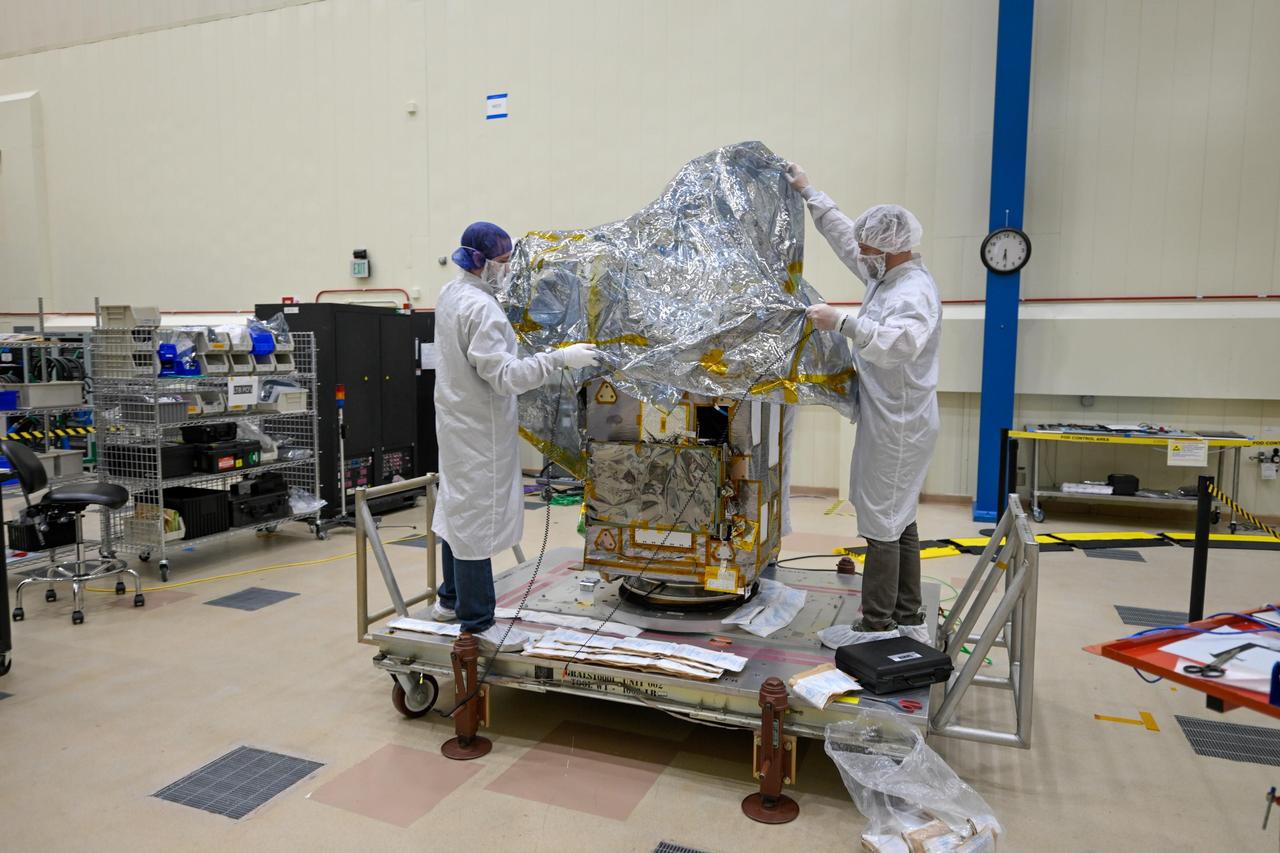
JPL · 2025-02-13 · PIA26458
NASA's Lunar Trailblazer Gets Bagged Up
NASA's Lunar Trailblazer spacecraft gets covered in anti-static wrap before being shipped from Lockheed Martin Space in Littleton, Colorado, to Florida, where it arrived on Jan. 29, 2025.…
Inspect NASA record
NASA's Lunar Trailblazer spacecraft gets covered in anti-static wrap before being shipped from Lockheed Martin Space in Littleton, Colorado, to Florida, where it arrived on Jan. 29, 2025. The spacecraft was built and tested at Lockheed and will launch no earlier than Feb. 26 from Launch Complex 39A at the agency's Kennedy Space Center. Lunar Trailblazer was a selection of NASA's SIMPLEx (Small Innovative Missions for Planetary Exploration), which provides opportunities for low-cost science spacecraft to ride-share with selected primary missions. To maintain the lower overall cost, SIMPLEx missions have a higher risk posture and lighter requirements for oversight and management. This higher risk acceptance allows NASA to test pioneering technologies, and the definition of success for these missions includes the lessons learned from more experimental endeavors. https://photojournal.jpl.nasa.gov/catalog/PIA26458
- Record ID
- PIA26458
- NASA center
- JPL
- Date
- 2025-02-13
- Credit
- Lockheed Martin Space
- Keywords
- Lunar Trailblazer

HQ · 2017-09-14 · NHQ201709140008
Cassini NASA Social
Director of NASA's Planetary Science Division, Jim Green, speaks to NASA Social attendees, Thursday, Sept. 14, 2017 at NASA's Jet Propulsion Laboratory in Pasadena, California. Since its arrival…
Inspect NASA record
Director of NASA's Planetary Science Division, Jim Green, speaks to NASA Social attendees, Thursday, Sept. 14, 2017 at NASA's Jet Propulsion Laboratory in Pasadena, California. Since its arrival in 2004, the Cassini-Huygens mission has been a discovery machine, revolutionizing our knowledge of the Saturn system and captivating us with data and images never before obtained with such detail and clarity. On Sept. 15, 2017, operators will deliberately plunge the spacecraft into Saturn, as Cassini gathered science until the end. The “plunge” ensures Saturn’s moons will remain pristine for future exploration. During Cassini’s final days, mission team members from all around the world gathered at NASA’s Jet Propulsion Laboratory, Pasadena, California, to celebrate the achievements of this historic mission. Photo Credit: (NASA/Joel Kowsky)
- Record ID
- NHQ201709140008
- NASA center
- HQ
- Date
- 2017-09-14
- Credit
- NASA/Joel Kowsky
- Keywords
- Cassini, Cassini Grand Finale, Jet Propulsion Laboratory (JPL), Jim Green, NASA Social
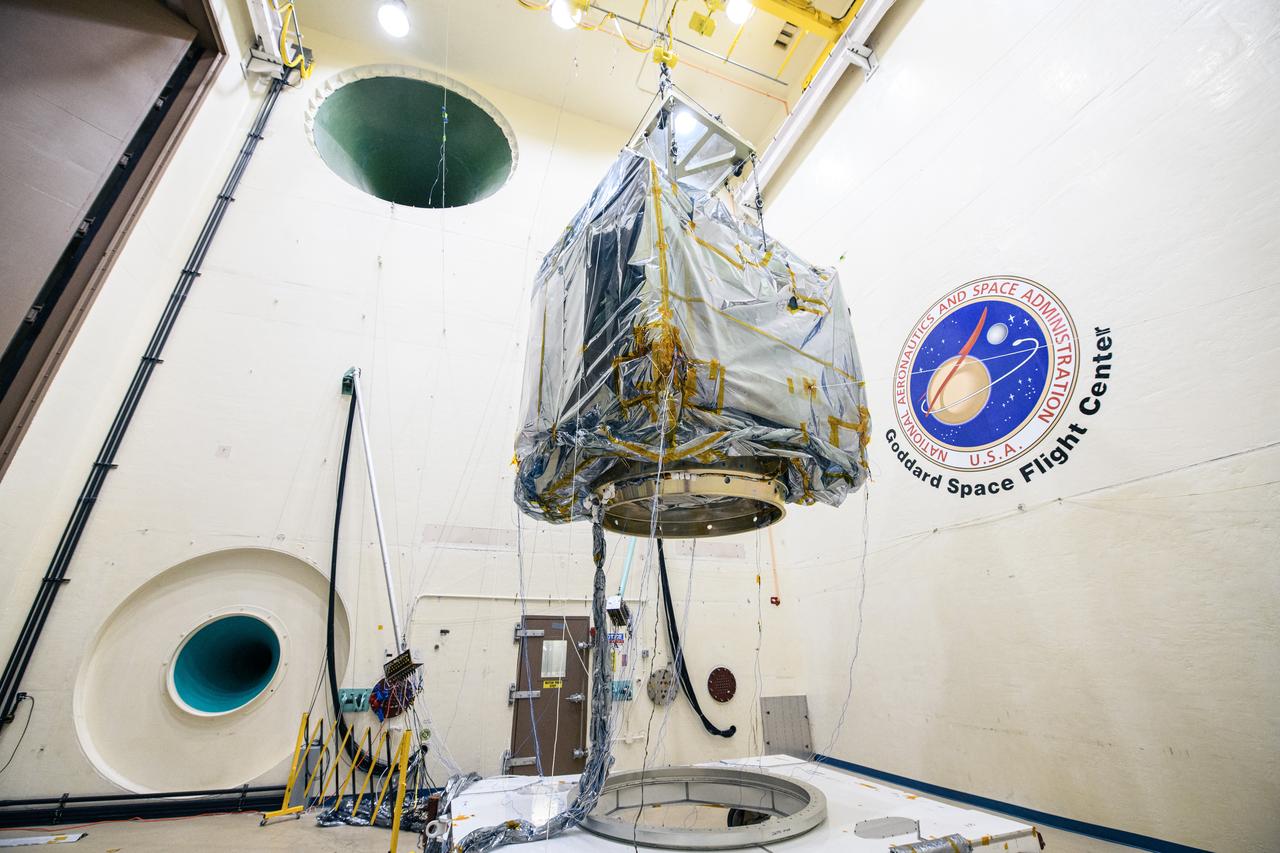
GSFC · 2023-04-17 · GSFC_20230417_PACE_013137
GSFC_20230417_PACE_013137
The Plankton, Aerosol, Cloud, ocean Ecosystem (PACE) observatory suspended for acoustic testing in the acoustic test facility at NASA's Goddard Space Flight Center in Greenbelt, Maryland on April…
Inspect NASA record
The Plankton, Aerosol, Cloud, ocean Ecosystem (PACE) observatory suspended for acoustic testing in the acoustic test facility at NASA's Goddard Space Flight Center in Greenbelt, Maryland on April 17th, 2023. PACE's unprecedented spectral coverage will provide the first-ever global measurements designed to identify phytoplankton community composition. The mission will make global ocean color measurements, using the Ocean Color Instrument (OCI), to provide extended data records on ocean ecology and global biogeochemistry along with polarimetry measurements, using the Spectro-polarimeter for Planetary Exploration (SPEXone) and the Hyper Angular Research Polarimeter (HARP2) to provide extended data records on clouds and aerosols. The Earth-observing satellite mission, built at Goddard Space Flight Center in Greenbelt, MD, will continue and advance observations of global ocean color, biogeochemistry, and ecology, as well as the carbon cycle, aerosols and clouds.
- Record ID
- GSFC_20230417_PACE_013137
- NASA center
- GSFC
- Date
- 2023-04-17
- Credit
- NASA / Denny Henry