
Update Site (from NASA)
Explore NASA’s Image and Video Library.
Suggest one object per day for the Interstellar Minds collection. We review each suggestion before adding it.
Sign in to suggest a Marvel.
Find a NASA image ID. Open a NASA record and copy its ID from the end of the details URL.
NASA image records
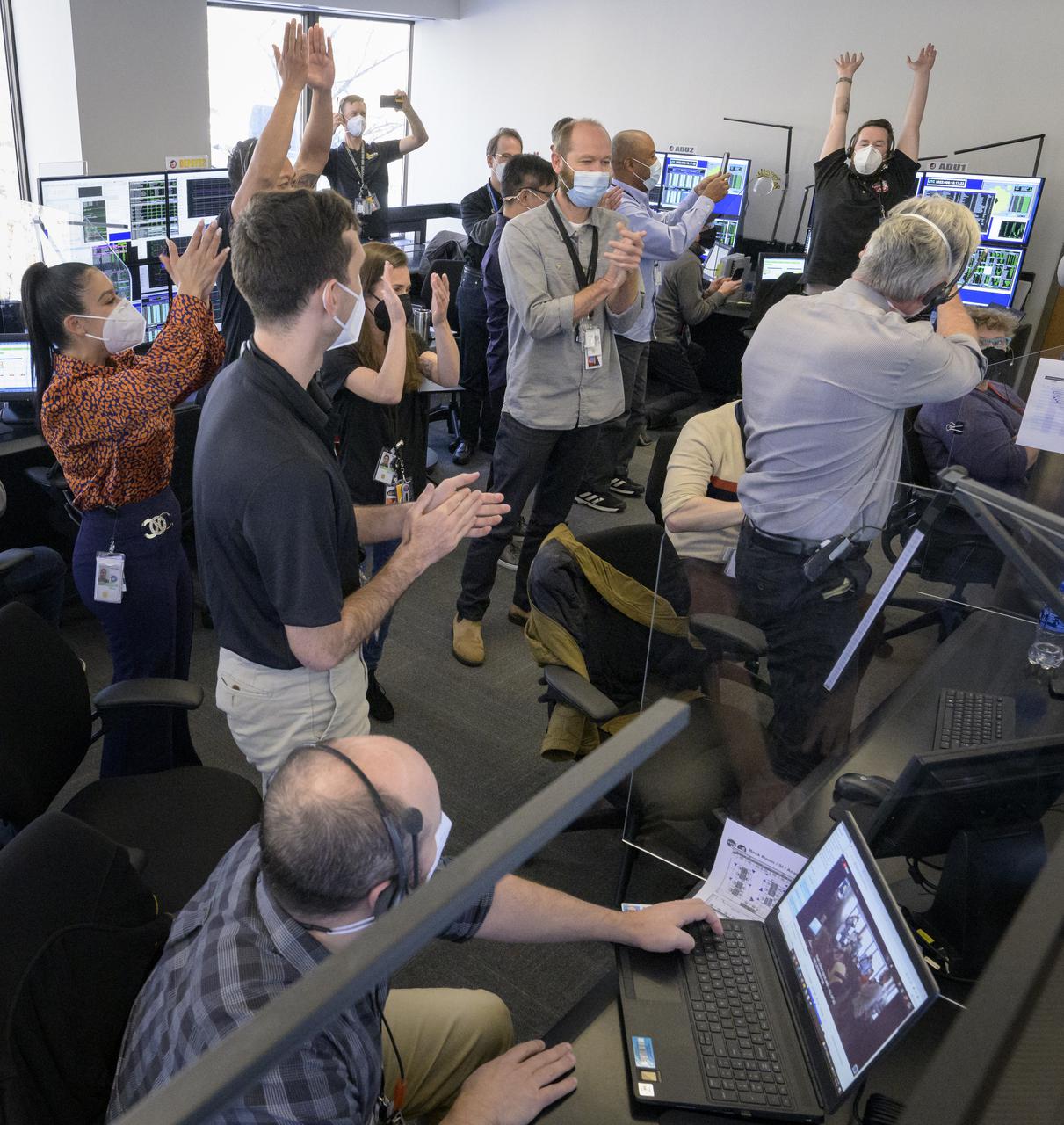
HQ · 2022-01-08 · NHQ202201080013
James Webb Space Telescope Second Primary Mirror Deployment
NASA’s James Webb Space Telescope mission operations team celebrates, Saturday, Jan. 8, 2022, at the Space Telescope Science Institute in Baltimore, after confirming that the observatory’s final primary…
Inspect NASA record
NASA’s James Webb Space Telescope mission operations team celebrates, Saturday, Jan. 8, 2022, at the Space Telescope Science Institute in Baltimore, after confirming that the observatory’s final primary mirror wing successfully extended and locked into place. With Webb’s 21.3-foot (6.5-meter) primary mirror fully deployed, the infrared observatory has completed its unprecedented process of unfolding in space to prepare for science operations. The observatory will study every phase of cosmic history—from within our solar system to the most distant observable galaxies in the early universe. Photo Credit: (NASA/Bill Ingalls)
- Record ID
- NHQ202201080013
- NASA center
- HQ
- Date
- 2022-01-08
- Credit
- NASA/Bill Ingalls
- Keywords
- Baltimore, Canadian Space Agency (CSA), ESA (European Space Agency), James Webb Space Telescope (JWST), Maryland, NASA, Northrop Grumman, Space Telescope Science Institute (STScI)
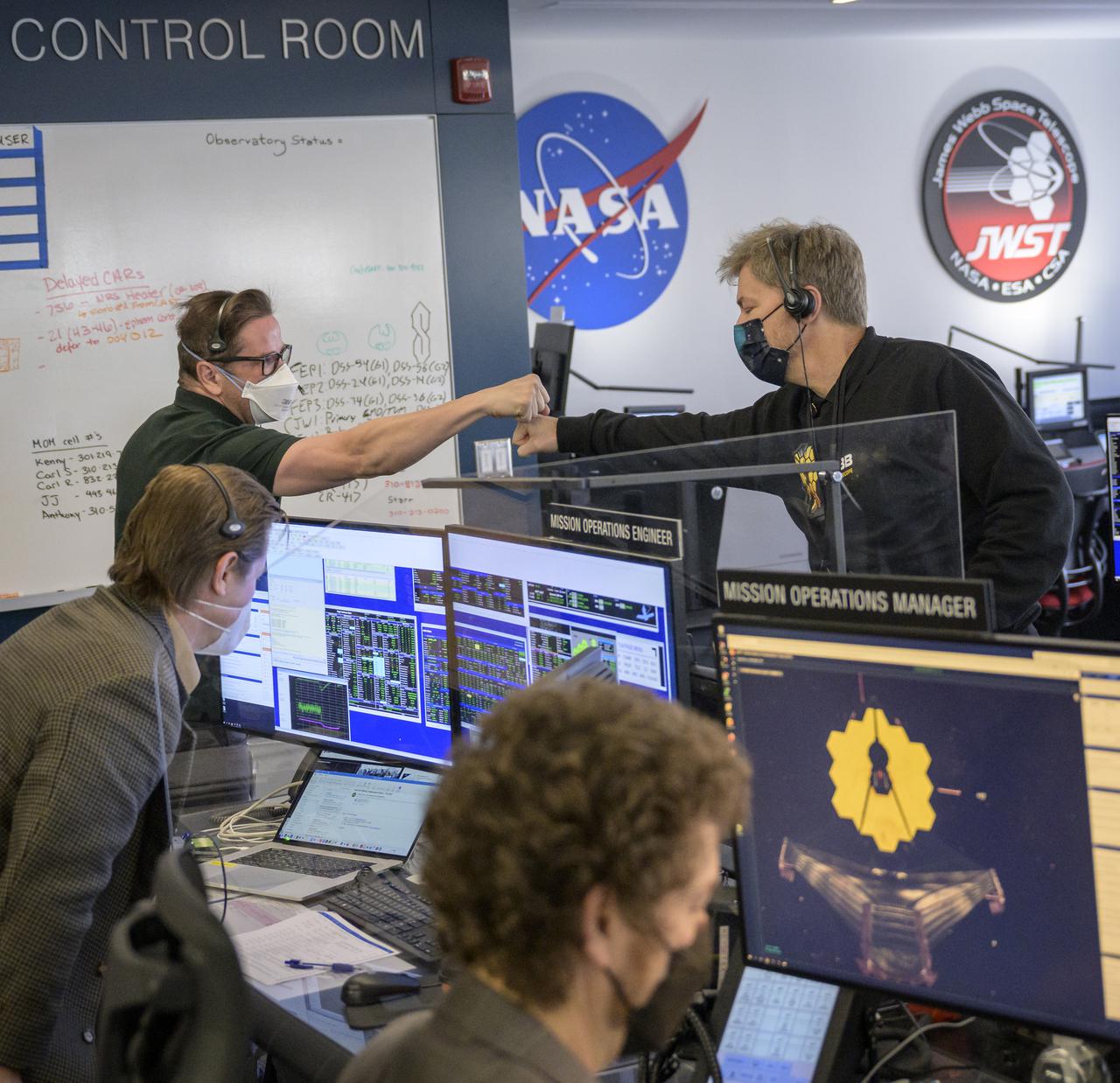
HQ · 2022-01-08 · NHQ202201080006
James Webb Space Telescope Second Primary Mirror Deployment
Engineering teams celebrate at the Space Telescope Science Institute in Baltimore as the second primary mirror wing of NASA’s James Webb Space Telescope unfolds, before beginning the process…
Inspect NASA record
Engineering teams celebrate at the Space Telescope Science Institute in Baltimore as the second primary mirror wing of NASA’s James Webb Space Telescope unfolds, before beginning the process of latching the mirror wing into place, Saturday, Jan. 8, 2022. When fully latched, the infrared observatory will have completed its unprecedented process of unfolding in space to prepare for science operations. Webb will study every phase of cosmic history—from within our solar system to the most distant observable galaxies in the early universe. Photo Credit: (NASA/Bill Ingalls)
- Record ID
- NHQ202201080006
- NASA center
- HQ
- Date
- 2022-01-08
- Credit
- NASA/Bill Ingalls
- Keywords
- Baltimore, Canadian Space Agency (CSA), ESA (European Space Agency), James Webb Space Telescope (JWST), Maryland, NASA, Northrop Grumman, Space Telescope Science Institute (STScI)
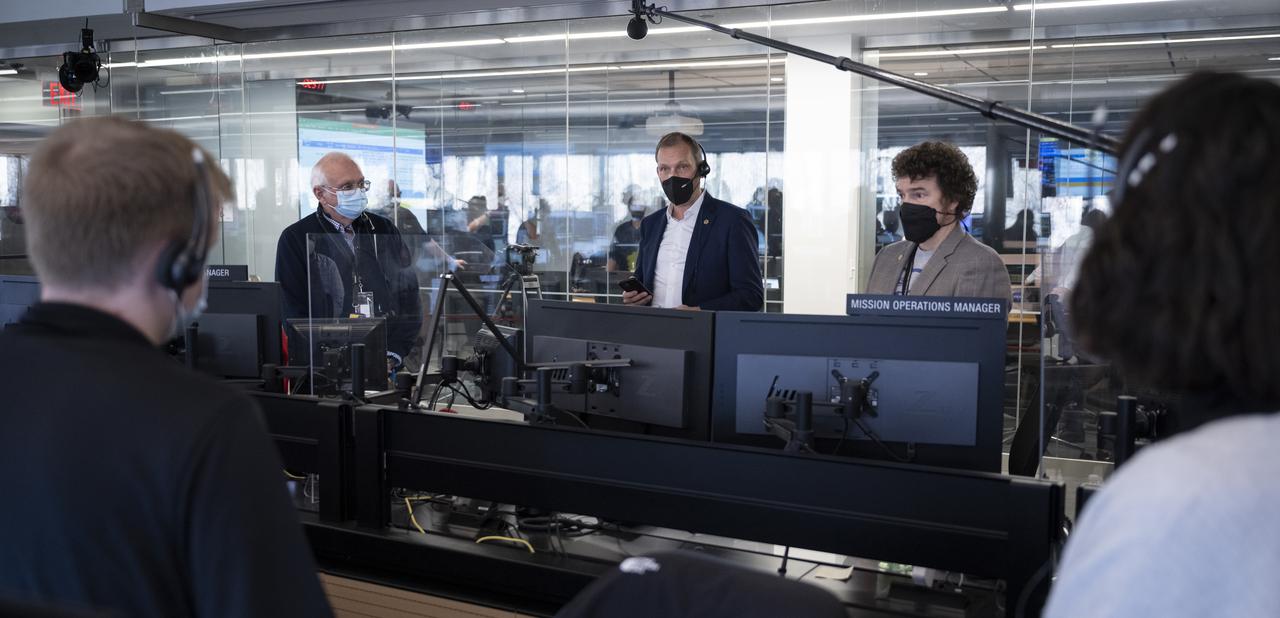
HQ · 2022-01-08 · NHQ202201080037
James Webb Space Telescope Second Primary Mirror Deployment
NASA Associate Administrator for the Science Mission Directorate Thomas Zurbuchen congratulates the NASA James Webb Space Telescope mission operations team after confirming that the observatory’s final primary mirror…
Inspect NASA record
NASA Associate Administrator for the Science Mission Directorate Thomas Zurbuchen congratulates the NASA James Webb Space Telescope mission operations team after confirming that the observatory’s final primary mirror wing successfully extended and locked into place, Saturday, Jan. 8, 2022, at the Space Telescope Science Institute in Baltimore. With Webb’s 21.3-foot (6.5-meter) primary mirror fully deployed, the infrared observatory has completed its unprecedented process of unfolding in space to prepare for science operations. The observatory will study every phase of cosmic history—from within our solar system to the most distant observable galaxies in the early universe. Photo Credit: (NASA/Bill Ingalls)
- Record ID
- NHQ202201080037
- NASA center
- HQ
- Date
- 2022-01-08
- Credit
- NASA/Bill Ingalls
- Keywords
- Baltimore, Canadian Space Agency (CSA), ESA (European Space Agency), James Webb Space Telescope (JWST), Maryland, NASA, Northrop Grumman, Space Telescope Science Institute (STScI), Thomas Zurbuchen

KSC · 2026-08-29 · KSC-20260829-PH-KLS02_0089
Roman Space Telescope Prelaunch News Conference
Denton Gibson, launch director, NASA’s Launch Services Program, Kennedy Space Center in Florida, participates in a prelaunch news conference for the agency’s Nancy Grace Roman Space Telescope inside…
Inspect NASA record
Denton Gibson, launch director, NASA’s Launch Services Program, Kennedy Space Center in Florida, participates in a prelaunch news conference for the agency’s Nancy Grace Roman Space Telescope inside the NASA News Center’s John Holliman Auditorium at Kennedy Space Center in Florida, on Saturday, Aug. 29, 2026. Roman will investigate dark energy and dark matter, conduct a statistical census of planetary systems, and enable a broad range of additional astrophysics research. Liftoff from Launch Complex 39A at Kennedy is targeted for no earlier than Sunday, Aug. 30, 2026.
- Record ID
- KSC-20260829-PH-KLS02_0089
- NASA center
- KSC
- Date
- 2026-08-29
- Credit
- NASA/Kim Shiflett
- Keywords
- John. F. Kennedy Space Center, Kennedy, Kennedy Space Center, KSC, Spaceport, Cape Canaveral, NASA, rocket ranch, Florida, multi-user spaceport, premier spaceport, space coast

GSFC · 2019-01-31 · bedin1
Hubble Accidentally Discovers a New Galaxy in Cosmic Neighborhoo
This is a Hubble Space Telescope image of a concentration of stars within the globular cluster NGC 6752. Hidden among the stars is an image of a background…
Inspect NASA record
This is a Hubble Space Telescope image of a concentration of stars within the globular cluster NGC 6752. Hidden among the stars is an image of a background galaxy that is much farther away. The diminutive galaxy, named by its discoverers as Bedin 1, measures only around 3,000 light-years at its greatest extent — a fraction of the size of the Milky Way. Not only is it tiny, but it is also incredibly faint. These properties led astronomers to classify it as a dwarf spheroidal galaxy that is as old as the universe. More info: https://go.nasa.gov/2tCaxGS Credits: NASA, ESA and L. Bedin (Astronomical Observatory of Padua, Italy)
- Record ID
- bedin1
- NASA center
- GSFC
- Date
- 2019-01-31
- Credit
- Hubble Space Telescope
- Keywords
- Bedin I, Goddard Space Flight Center, Hubble, Hubble Space Telescope, NGC 6752, galaxies, universe

MSFC · 2001-08-24 · 0300724
History of Hubble Space Telescope (HST)
Some 5,000 light years (2,900 trillion miles) from Earth, in the constellation Puppis, is the 1.4 light years (more than 8 trillion miles) long Calabash Nebula, referred to…
Inspect NASA record
Some 5,000 light years (2,900 trillion miles) from Earth, in the constellation Puppis, is the 1.4 light years (more than 8 trillion miles) long Calabash Nebula, referred to as the Rotten Egg Nebula because of its sulfur content which would produce an awful odor if one could smell in space. This image of the nebula captured by NASA's Hubble Space Telescope (HST) depicts violent gas collisions that produced supersonic shock fronts in a dying star. Stars, like our sun, will eventually die and expel most of their material outward into shells of gas and dust These shells eventually form some of the most beautiful objects in the universe, called planetary nebulae. The yellow in the image depicts the material ejected from the central star zooming away at speeds up to one and a half million kilometers per hour (one million miles per hour). Due to the high speeds of the gas, shock-fronts are formed on impact and heat the surrounding gas. Although computer calculations have predicted the existence and structure of such shocks for some time, previous observations have not been able to prove the theory.
- Record ID
- 0300724
- NASA center
- MSFC
- Date
- 2001-08-24
- Keywords
- Hubble Space Telescope, HST, Calabash Nebula, Rotten Egg Nebula

MSFC · 2004-01-01 · 0400392
History of Hubble Space Telescope (HST)
Residing roughly 17 million light years from Earth, in the northern constellation Coma Berenices, is a merged star system known as Messier 64 (M64). First cataloged in the…
Inspect NASA record
Residing roughly 17 million light years from Earth, in the northern constellation Coma Berenices, is a merged star system known as Messier 64 (M64). First cataloged in the 18th century by the French astronomer Messier, M64 is a result of two colliding galaxies and has an unusual appearance as well as bizarre internal motions. It has a spectacular dark band of absorbing dust in front of its bright nucleus, lending to it the nickname of the "Black Eye" or "Evil Eye" galaxy. Fine details of the dark band can be seen in this image of the central portion of M64 obtained by the Wide Field Planetary Camera (WFPC2) of NASA's Hubble Space Telescope (HST). Appearing to be a fairly normal pinwheel-shaped galaxy, the M64 stars are rotating in the same direction, clockwise, as in the majority of galaxies. However, detailed studies in the 1990's led to the remarkable discovery that the interstellar gas in the outer regions of M64 rotates in the opposite direction from the gas and stars in the irner region. Astronomers believe that the oppositely rotating gas arose when M64 absorbed a satellite galaxy that collided with it, perhaps more than one billion years ago. The Marshall Space Flight Center had responsibility for design, development, and construction of the HST.
- Record ID
- 0400392
- NASA center
- MSFC
- Date
- 2004-01-01
- Keywords
- Messier 64, M64, Black Eye, Hubble Space Telescope, HST
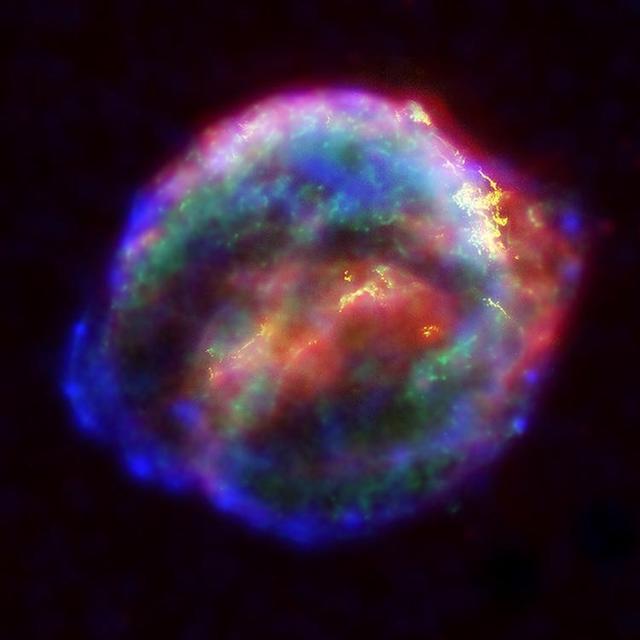
JPL · 2004-10-06 · PIA06907
Three Great Eyes on Kepler Supernova Remnant
NASA's three Great Observatories -- the Hubble Space Telescope, the SpitzerSpace Telescope, and the Chandra X-ray Observatory -- joined forces to probe theexpanding remains of a supernova, called…
Inspect NASA record
NASA's three Great Observatories -- the Hubble Space Telescope, the SpitzerSpace Telescope, and the Chandra X-ray Observatory -- joined forces to probe theexpanding remains of a supernova, called Kepler's supernova remnant, first seen 400 years ago by sky watchers, including astronomer Johannes Kepler. The combined image unveils a bubble-shaped shroud of gas and dust that is 14light-years wide and is expanding at 4 million miles per hour (2,000 kilometersper second). Observations from each telescope highlight distinct features of thesupernova remnant, a fast-moving shell of iron-rich material from the explodedstar, surrounded by an expanding shock wave that is sweeping up interstellar gasand dust. Each color in this image represents a different region of the electromagneticspectrum, from X-rays to infrared light. These diverse colors are shown in thepanel of photographs below the composite image. The X-ray and infrared datacannot be seen with the human eye. By color-coding those data and combining themwith Hubble's visible-light view, astronomers are presenting a more completepicture of the supernova remnant. Visible-light images from the Hubble telescope (colored yellow) reveal where the supernova shock wave is slamming into the densest regions of surrounding gas.The bright glowing knots are dense clumps from instabilities that form behindthe shock wave. The Hubble data also show thin filaments of gas that look likerippled sheets seen edge-on. These filaments reveal where the shock wave isencountering lower-density, more uniform interstellar material. The Spitzer telescope shows microscopic dust particles (colored red) that havebeen heated by the supernova shock wave. The dust re-radiates the shock wave'senergy as infrared light. The Spitzer data are brightest in the regionssurrounding those seen in detail by the Hubble telescope. The Chandra X-ray data show regions of very hot gas, and extremely high-energyparticles. The hottest gas (higher-energy X-rays, colored blue) is locatedprimarily in the regions directly behind the shock front. These regions alsoshow up in the Hubble observations, and also align with the faint rim of glowingmaterial seen in the Spitzer data. The X-rays from the region on the lower left(colored blue) may be dominated by extremely high-energy electrons that wereproduced by the shock wave and are radiating at radio through X-ray wavelengthsas they spiral in the intensified magnetic field behind the shock front. CoolerX-ray gas (lower-energy X-rays, colored green) resides in a thick interior shelland marks the location of heated material expelled from the exploded star. Kepler's supernova, the last such object seen to explode in our Milky Waygalaxy, resides about 13,000 light-years away in the constellation Ophiuchus. The Chandra observations were taken in June 2000, the Hubble in August 2003;and the Spitzer in August 2004. http://photojournal.jpl.nasa.gov/catalog/PIA06907
- Record ID
- PIA06907
- NASA center
- JPL
- Date
- 2004-10-06
- Credit
- NASA/ESA/Johns Hopkins University
- Keywords
- Hubble Space Telescope,Spitzer Space Telescope, supernova

JPL · 2013-12-12 · PIA17563
Crab Nebula, as Seen by Herschel and Hubble
This image shows a composite view of the Crab nebula, an iconic supernova remnant in our Milky Way galaxy, as viewed by the Herschel Space Observatory and the…
Inspect NASA record
This image shows a composite view of the Crab nebula, an iconic supernova remnant in our Milky Way galaxy, as viewed by the Herschel Space Observatory and the Hubble Space Telescope.
- Record ID
- PIA17563
- NASA center
- JPL
- Date
- 2013-12-12
- Credit
- ESA/Herschel/PACS/MESS Key Programme Supernova Remnant Team; NASA, ESA and Allison Loll/Jeff Hester Arizona State University
- Keywords
- Herschel Space Observatory,Hubble Space Telescope
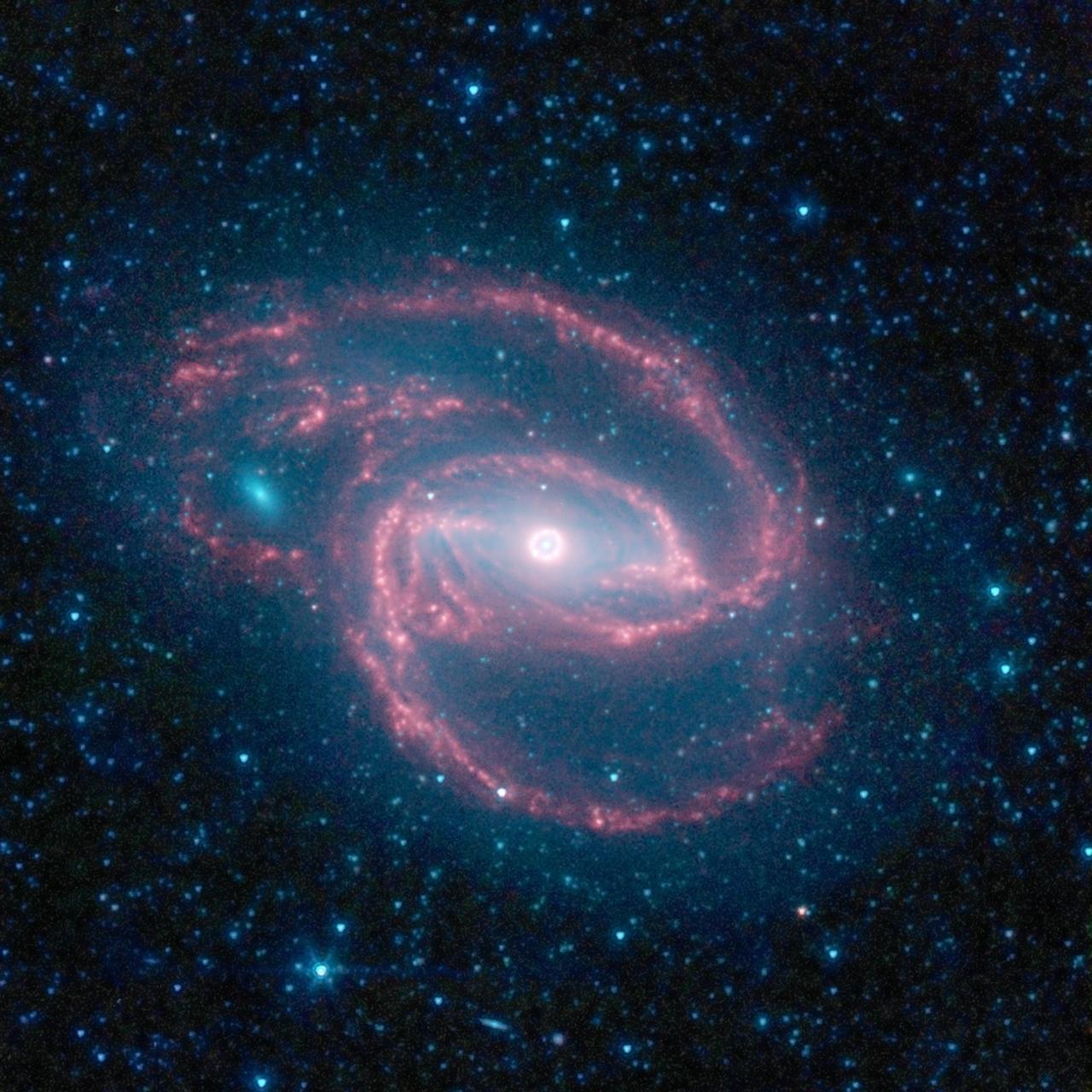
JPL · 2009-07-23 · PIA12151
Coiled Creature of the Night
NASA Spitzer Space Telescope has imaged a wild creature of the dark -- a coiled galaxy with an eye-like object at its center.
Inspect NASA record
NASA Spitzer Space Telescope has imaged a wild creature of the dark -- a coiled galaxy with an eye-like object at its center.
- Record ID
- PIA12151
- NASA center
- JPL
- Date
- 2009-07-23
- Credit
- NASA/JPL-Caltech
- Keywords
- NGC 1097, Spitzer Space Telescope

JPL · 2007-08-24 · PIA09962
Spitzer Celebrates Fourth Anniversary with Celestial Fireworks
A newly expanded image of the Helix nebula lends a festive touch to the fourth anniversary of the launch of NASA Spitzer Space Telescope
Inspect NASA record
A newly expanded image of the Helix nebula lends a festive touch to the fourth anniversary of the launch of NASA Spitzer Space Telescope
- Record ID
- PIA09962
- NASA center
- JPL
- Date
- 2007-08-24
- Credit
- NASA/JPL-Caltech
- Keywords
- Helix Nebula, Spitzer Space Telescope

KSC · 2026-08-29 · KSC-20260829-PH-KLS02_0108
Roman Space Telescope Prelaunch News Conference
Nicky Fox, associate administrator, Science Mission Directorate, NASA Headquarters in Washington, participates in a prelaunch news conference for the agency’s Nancy Grace Roman Space Telescope inside the NASA…
Inspect NASA record
Nicky Fox, associate administrator, Science Mission Directorate, NASA Headquarters in Washington, participates in a prelaunch news conference for the agency’s Nancy Grace Roman Space Telescope inside the NASA News Center’s John Holliman Auditorium at Kennedy Space Center in Florida, on Saturday, Aug. 29, 2026. Roman will investigate dark energy and dark matter, conduct a statistical census of planetary systems, and enable a broad range of additional astrophysics research. Liftoff from Launch Complex 39A at Kennedy is targeted for no earlier than Sunday, Aug. 30, 2026.
- Record ID
- KSC-20260829-PH-KLS02_0108
- NASA center
- KSC
- Date
- 2026-08-29
- Credit
- NASA/Kim Shiflett
- Keywords
- John. F. Kennedy Space Center, Kennedy, Kennedy Space Center, KSC, Spaceport, Cape Canaveral, NASA, rocket ranch, Florida, multi-user spaceport, premier spaceport, space coast