
Update Site (from NASA)
Explore NASA’s Image and Video Library.
Suggest one object per day for the Interstellar Minds collection. We review each suggestion before adding it.
Sign in to suggest a Marvel.
Find a NASA image ID. Open a NASA record and copy its ID from the end of the details URL.
NASA image records
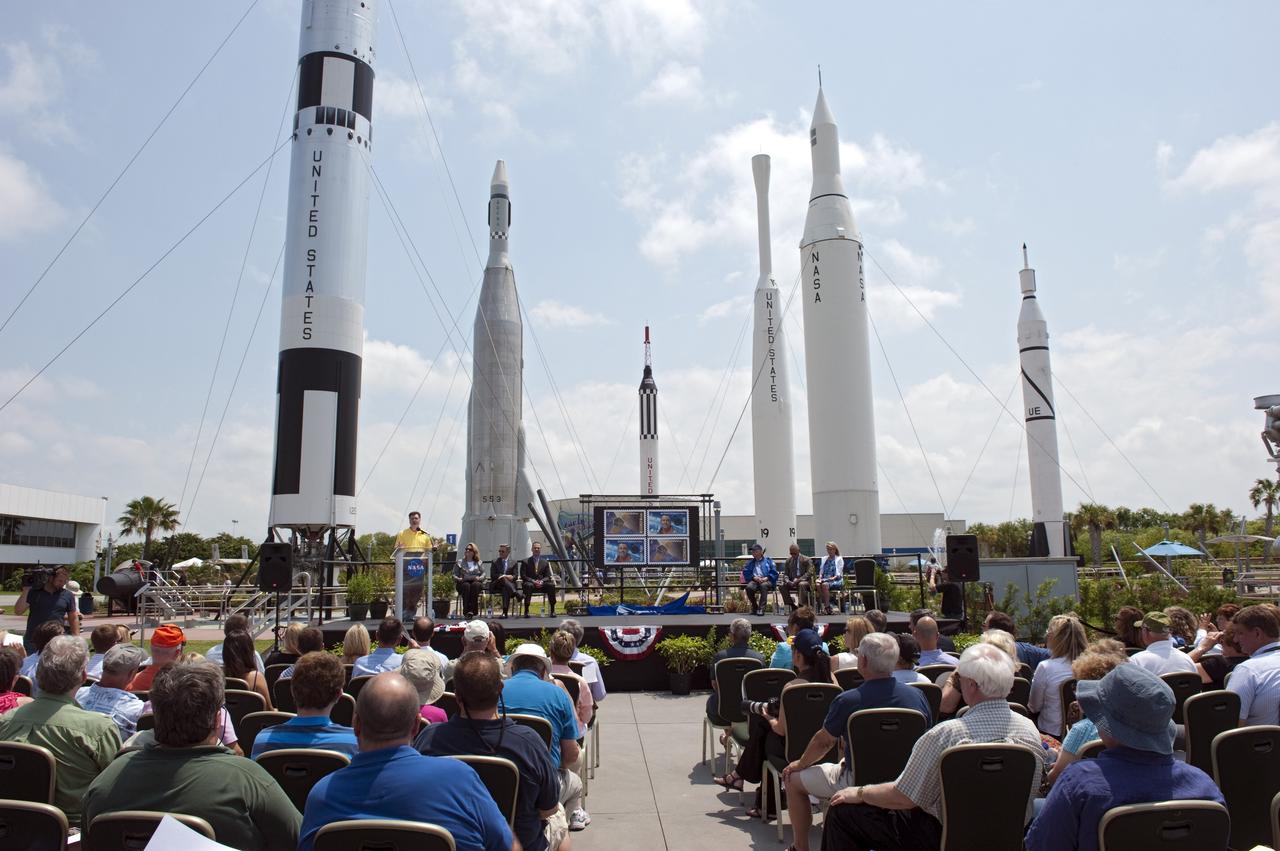
KSC · 2011-05-04 · KSC-2011-3303
KSC-2011-3303
CAPE CANAVERAL, Fla. -- In the Rocket Garden at NASA's Kennedy Space Center Visitor Complex in Florida, NASA's Deputy Director for Planetary Science, Jim Adams speaks to the…
Inspect NASA record
CAPE CANAVERAL, Fla. -- In the Rocket Garden at NASA's Kennedy Space Center Visitor Complex in Florida, NASA's Deputy Director for Planetary Science, Jim Adams speaks to the audience after the unveiling of the two new stamps that commemorate the 50th anniversary of human spaceflight designed by the United States Postal Service. One stamp commemorates NASA's Project Mercury and Alan Shepard's historic launch on May 5, 1961, aboard the spacecraft Freedom 7. The second stamp honors NASA's MESSENGER, which reached Mercury in March to become the first spacecraft to orbit the planet. The two missions frame a remarkable 50-year period in which America advanced space exploration through more than 1,500 crewed and uncrewed flights. Photo credit: NASA/Kim Shiflett
- Record ID
- KSC-2011-3303
- NASA center
- KSC
- Date
- 2011-05-04
- Keywords
- stamps, visitor complex
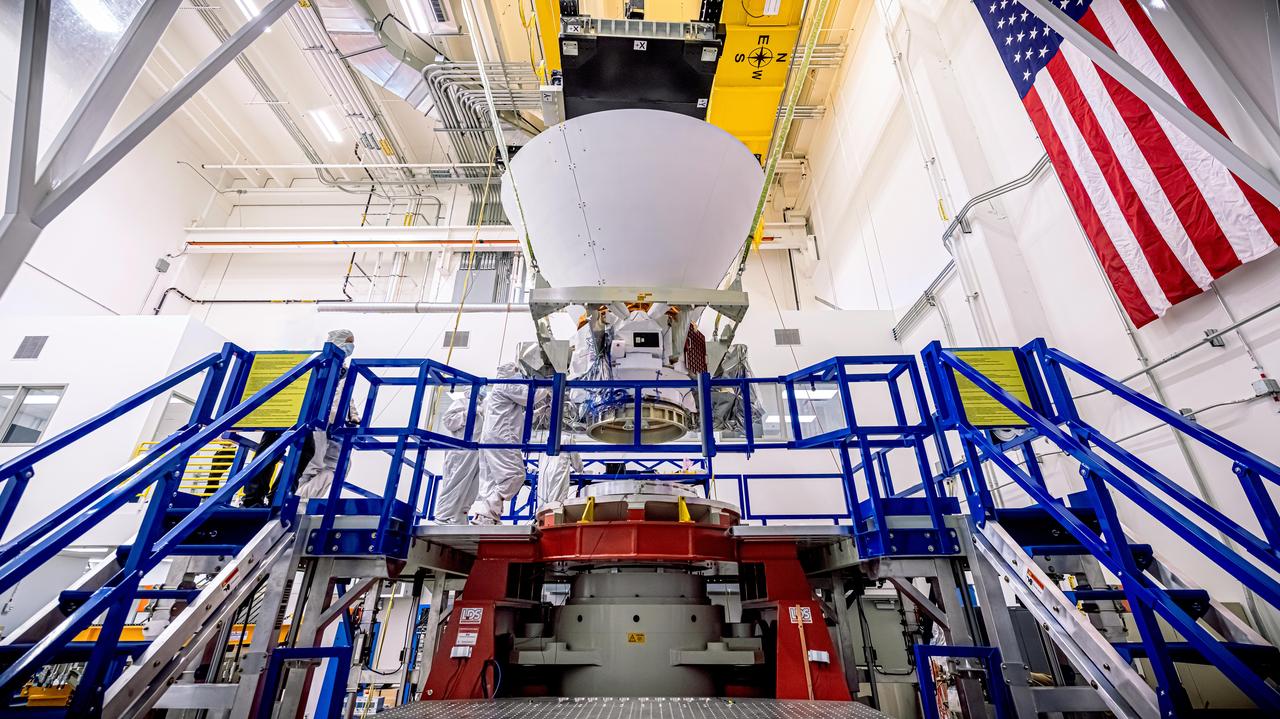
JPL · 2025-01-23 · PIA26539
SPHEREx Prepared for Vibration Testing
NASA's SPHEREx observatory is lifted and installed onto a vibration table in the Z-axis configuration at BAE Systems in Boulder, Colorado, in August 2024. In this test, the…
Inspect NASA record
NASA's SPHEREx observatory is lifted and installed onto a vibration table in the Z-axis configuration at BAE Systems in Boulder, Colorado, in August 2024. In this test, the spacecraft is subjected to vibrations in all three axes separately. The test was successfully completed Aug. 16, 2024. Short for Spectro-Photometer for the History of the Universe, Epoch of Reionization and Ices Explorer, SPHEREx will create a map of the cosmos like no other. Using a technique called spectroscopy to image the entire sky in 102 wavelengths of infrared light, SPHEREx will gather information about the composition of and distance to millions of galaxies and stars. With this map, scientists will study what happened in the first fraction of a second after the big bang, how galaxies formed and evolved, and the origins of water in planetary systems in our galaxy. https://photojournal.jpl.nasa.gov/catalog/PIA26539
- Record ID
- PIA26539
- NASA center
- JPL
- Date
- 2025-01-23
- Credit
- NASA/JPL-Caltech/BAE Systems
- Keywords
- SPHEREx, Sky
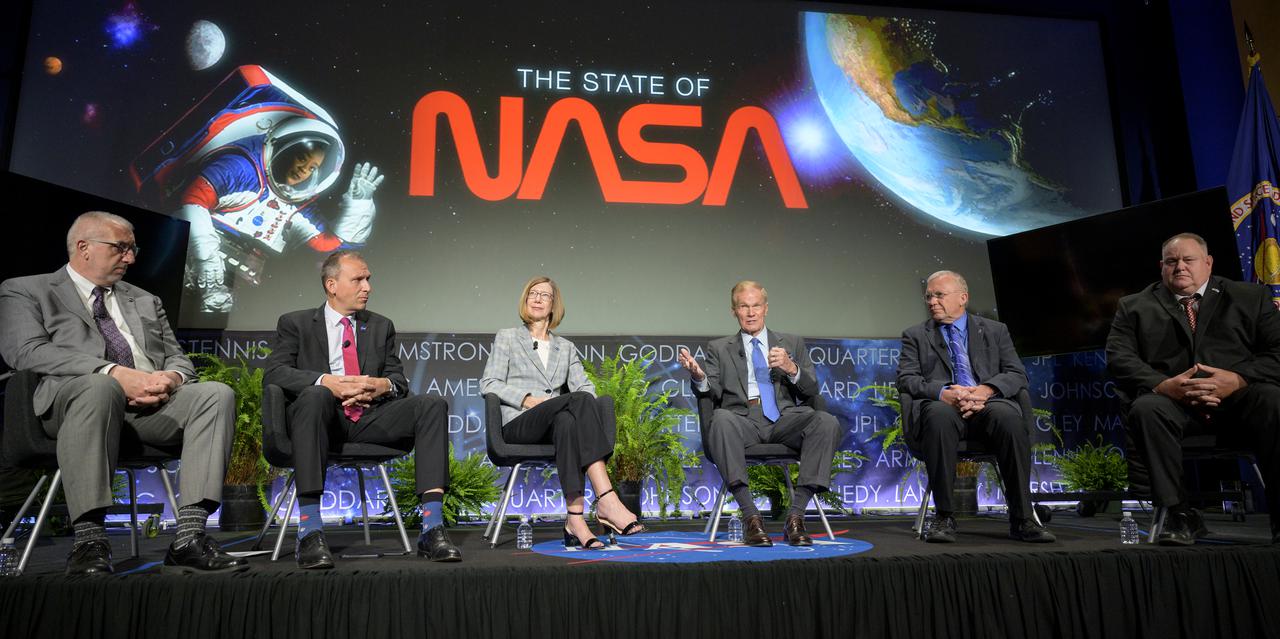
HQ · 2021-06-02 · NHQ202106020024
State of NASA Media Event
NASA Associate Administrator for Aeronautics Research Mission Directorate Bob Pearce, left, NASA Associate Administrator for Science Thomas Zurbuchen, NASA Associate Administrator for Human Exploration and Operations Kathy Lueders,…
Inspect NASA record
NASA Associate Administrator for Aeronautics Research Mission Directorate Bob Pearce, left, NASA Associate Administrator for Science Thomas Zurbuchen, NASA Associate Administrator for Human Exploration and Operations Kathy Lueders, NASA Administrator Bill Nelson, NASA Associate Administrator for the Space Technology Mission Directorate Jim Reuter, and NASA Associate Administrator for the Mission Support Directorate Bob Gibbs, right, participate in a media gaggle, Wednesday, June 2, 2021, at NASA Headquarters Mary W. Jackson Building in Washington. Nelson, and other NASA leadership, answered reporters questions following a State of NASA event where Nelson remarked on his long history with NASA, and among other topics, discussed the agency’s plans for future Earth-focused missions to address climate change and a robotic and human return to the Moon through the Artemis program, as well as announcing two new planetary science missions to Venus – VERITAS and DAVINCI+. Photo Credit: (NASA/Bill Ingalls)
- Record ID
- NHQ202106020024
- NASA center
- HQ
- Date
- 2021-06-02
- Credit
- NASA/Bill Ingalls
- Keywords
- Bill Nelson, Bob Gibbs, Bob Pearce, DC, Jim Reuter, Kathy Lueders, Mary W. Jackson NASA Headquarters, NASA Administrator, Thomas Zurbuchen, U.S. Senator, Washington
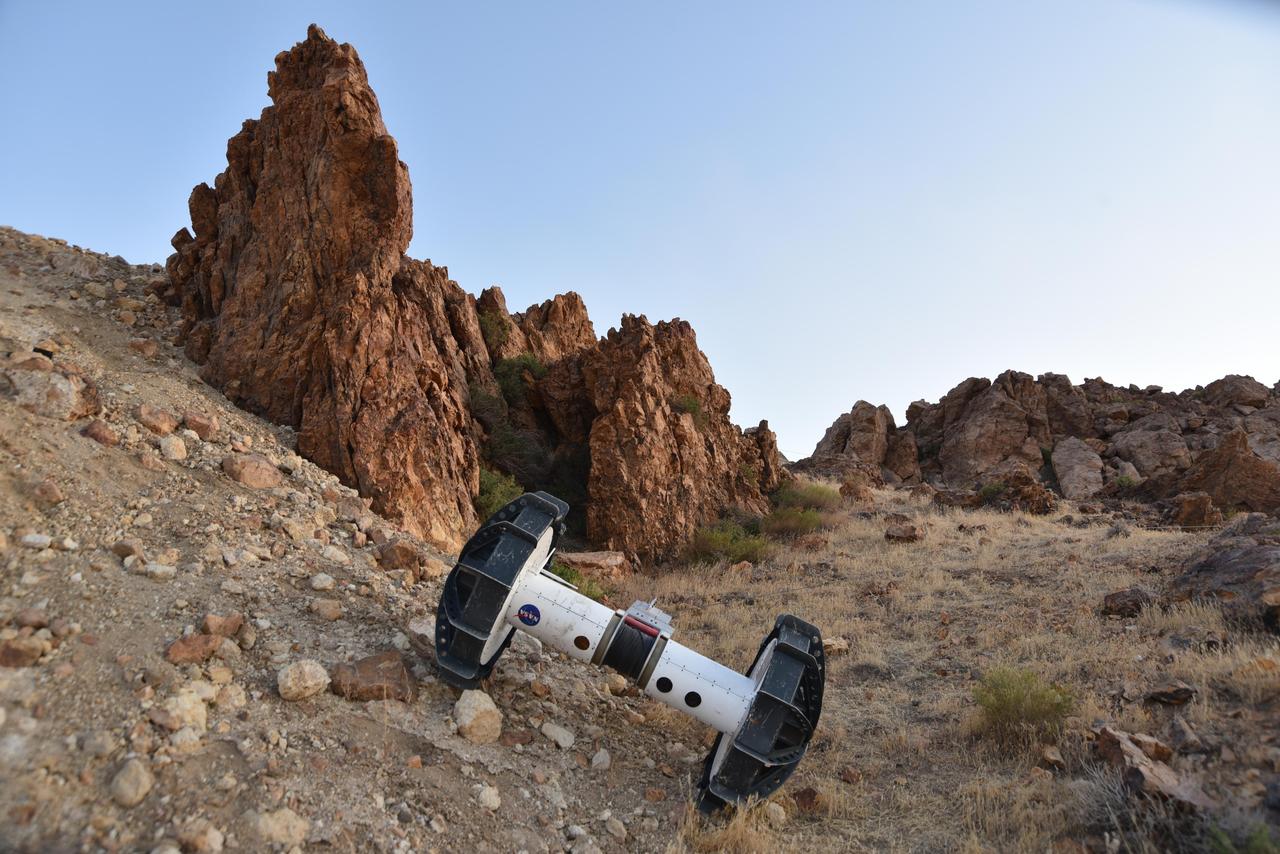
JPL · 2020-10-13 · PIA24110
The Tethered Axel Autonomously Descends a Rocky Slope
In this photograph, a tethered Axel robot — part of the four-wheeled DuAxel rover — navigates a steep slope during a field test in the Mojave Desert. The…
Inspect NASA record
In this photograph, a tethered Axel robot — part of the four-wheeled DuAxel rover — navigates a steep slope during a field test in the Mojave Desert. The tether, which connects to the rover's other half, serves as a climbing rope of sorts while also providing power and a means of communication. This flexibility was built with crater walls, pits, scarps, vents, and other extreme terrain in mind. That's because on Earth, some of the best locations to study geology can be found in rocky outcrops and cliff faces, where many layers of the past are neatly exposed. They're hard enough to reach here, let alone on the Moon, Mars, and other celestial bodies. The DuAxel project is a technology demonstration being developed by roboticists at NASA's Jet Propulsion Laboratory in Southern California to see how this unconventional rover might fill a niche in planetary exploration. https://photojournal.jpl.nasa.gov/catalog/PIA24110
- Record ID
- PIA24110
- NASA center
- JPL
- Date
- 2020-10-13
- Credit
- NASA/JPL-Caltech/J.D. Gammell
- Keywords
- DuAxel Project
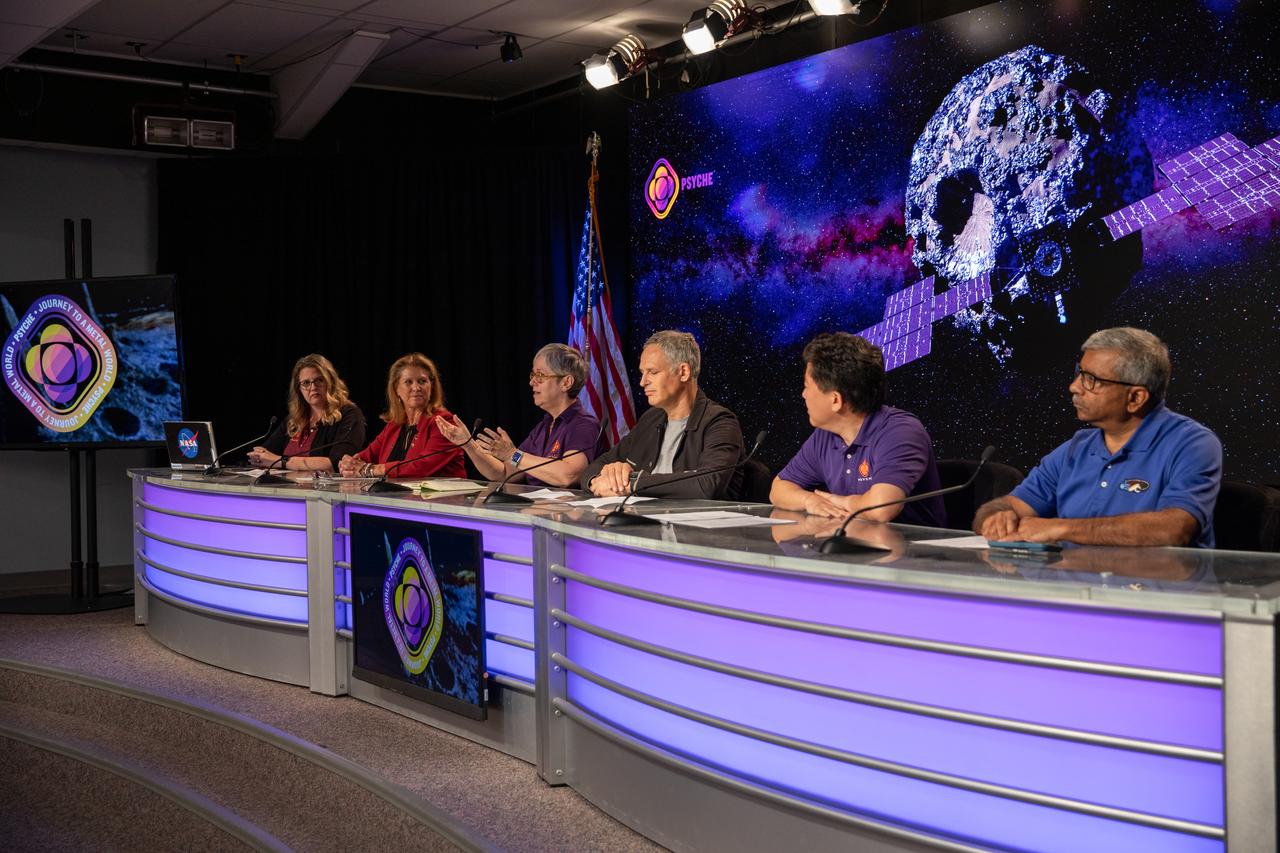
KSC · 2023-10-10 · KSC-20231010-PH-KLS01_0115
Psyche Mission and Science Briefing
A Psyche mission and science briefing takes place at NASA’s Kennedy Space Center in Florida on Tuesday, Oct. 10, 2023. Participants, from left, are: Alana Johnson, NASA Communications;…
Inspect NASA record
A Psyche mission and science briefing takes place at NASA’s Kennedy Space Center in Florida on Tuesday, Oct. 10, 2023. Participants, from left, are: Alana Johnson, NASA Communications; Lori Glaze, Planetary Science division director, NASA Headquarters; Lindy Elkins-Tanton, Psyche principal investigator, Arizona State University; Ben Weiss, Psyche deputy principal investigator and magnetometer lead, Massachusetts Institute of Technology; David Oh, Psyche chief engineer for operations, NASA’s Jet Propulsion Laboratory (JPL); and Abi Biswas, Deep Space Optical Communications project technologist, JPL. Psyche is the first mission to explore an asteroid with a surface that likely contains substantial amounts of metal rather than rock or ice. Liftoff of NASA’s Psyche spacecraft, atop a SpaceX Falcon Heavy rocket, is targeted for 10:16 a.m. EDT Thursday, Oct. 12, from Kennedy’s Launch Complex 39A.
- Record ID
- KSC-20231010-PH-KLS01_0115
- NASA center
- KSC
- Date
- 2023-10-10
- Credit
- NASA/Kim Shiflett
- Keywords
- Arizona State University, DSOC, Deep Space Optical Communications, Falcon Heavy, JPL, Jet Propulsion Lab, KSC, Kennedy Space Center, LC39A, LSP, Launch Services Program, NASA
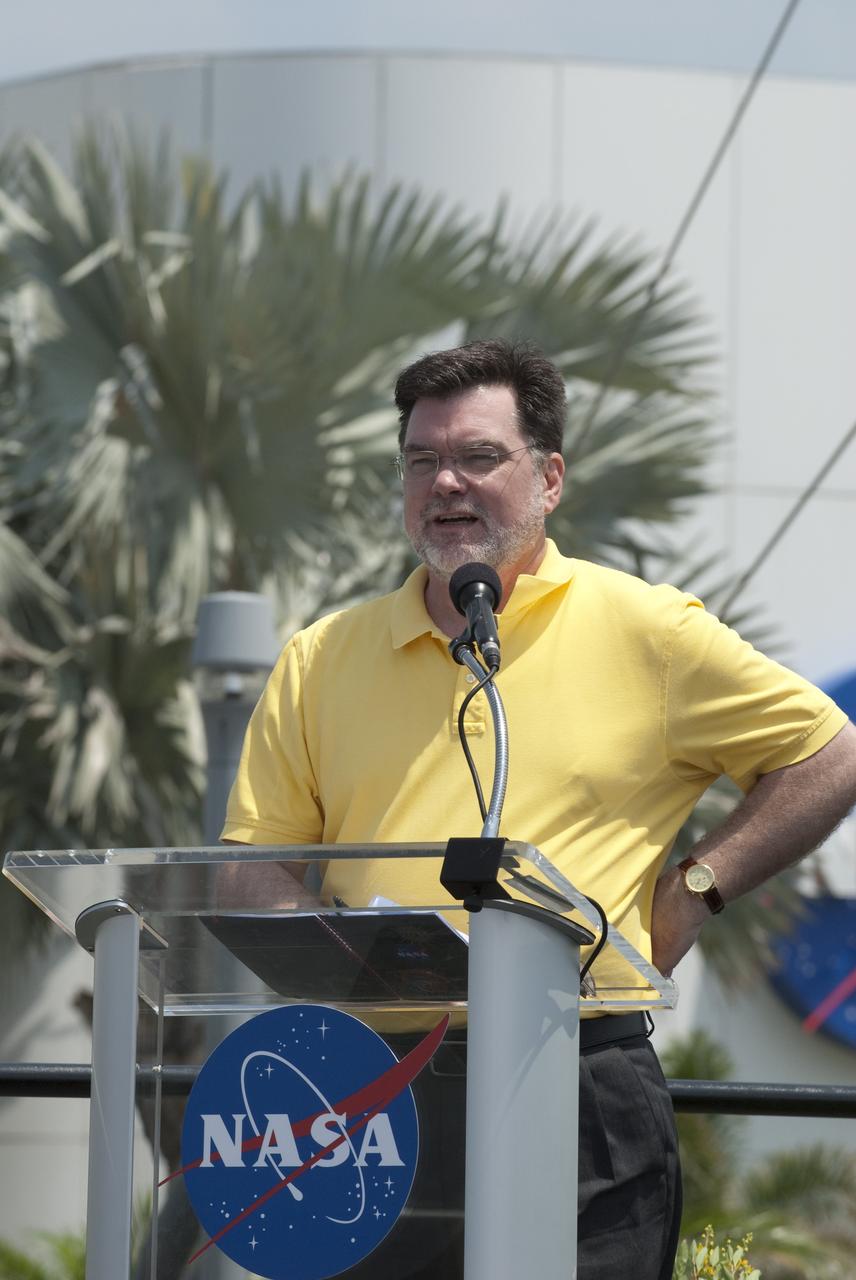
KSC · 2011-05-04 · KSC-2011-3295
KSC-2011-3295
CAPE CANAVERAL, Fla. -- In the Rocket Garden at NASA's Kennedy Space Center Visitor Complex in Florida, NASA's Deputy Director for Planetary Science, Jim Adams speaks to the…
Inspect NASA record
CAPE CANAVERAL, Fla. -- In the Rocket Garden at NASA's Kennedy Space Center Visitor Complex in Florida, NASA's Deputy Director for Planetary Science, Jim Adams speaks to the audience in attendance for the United States Postal Service unveiling of two new stamps that commemorates the 50th anniversary of human spaceflight. One stamp commemorates NASA's Project Mercury and Alan Shepard's historic launch on May 5, 1961, aboard the spacecraft Freedom 7. The second stamp honors NASA's MESSENGER, which reached Mercury in March to become the first spacecraft to orbit the planet. The two missions frame a remarkable 50-year period in which America advanced space exploration through more than 1,500 crewed and uncrewed flights. Photo credit: NASA/Kim Shiflett
- Record ID
- KSC-2011-3295
- NASA center
- KSC
- Date
- 2011-05-04
- Keywords
- stamps, visitor complex

GSFC · 2023-10-31 · GSFC_20231031_PACE_030757
GSFC_20231031_PACE_030757
The Plankton, Aerosol, Cloud, ocean Ecosystem (PACE) in the clean room at NASA's Goddard Space Flight Center in Greenbelt, Maryland on October 31st, 2023. PACE's unprecedented spectral coverage…
Inspect NASA record
The Plankton, Aerosol, Cloud, ocean Ecosystem (PACE) in the clean room at NASA's Goddard Space Flight Center in Greenbelt, Maryland on October 31st, 2023. PACE's unprecedented spectral coverage will provide the first-ever global measurements designed to identify phytoplankton community composition. The mission will make global ocean color measurements, using the Ocean Color Instrument (OCI), to provide extended data records on ocean ecology and global biogeochemistry along with polarimetry measurements, using the Spectro-polarimeter for Planetary Exploration (SPEXone) and the Hyper Angular Research Polarimeter (HARP2) to provide extended data records on clouds and aerosols. The Earth-observing satellite mission, built at Goddard Space Flight Center in Greenbelt, MD, will continue and advance observations of global ocean color, biogeochemistry, and ecology, as well as the carbon cycle, aerosols and clouds.
- Record ID
- GSFC_20231031_PACE_030757
- NASA center
- GSFC
- Date
- 2023-10-31
- Credit
- NASA / Denny Henry
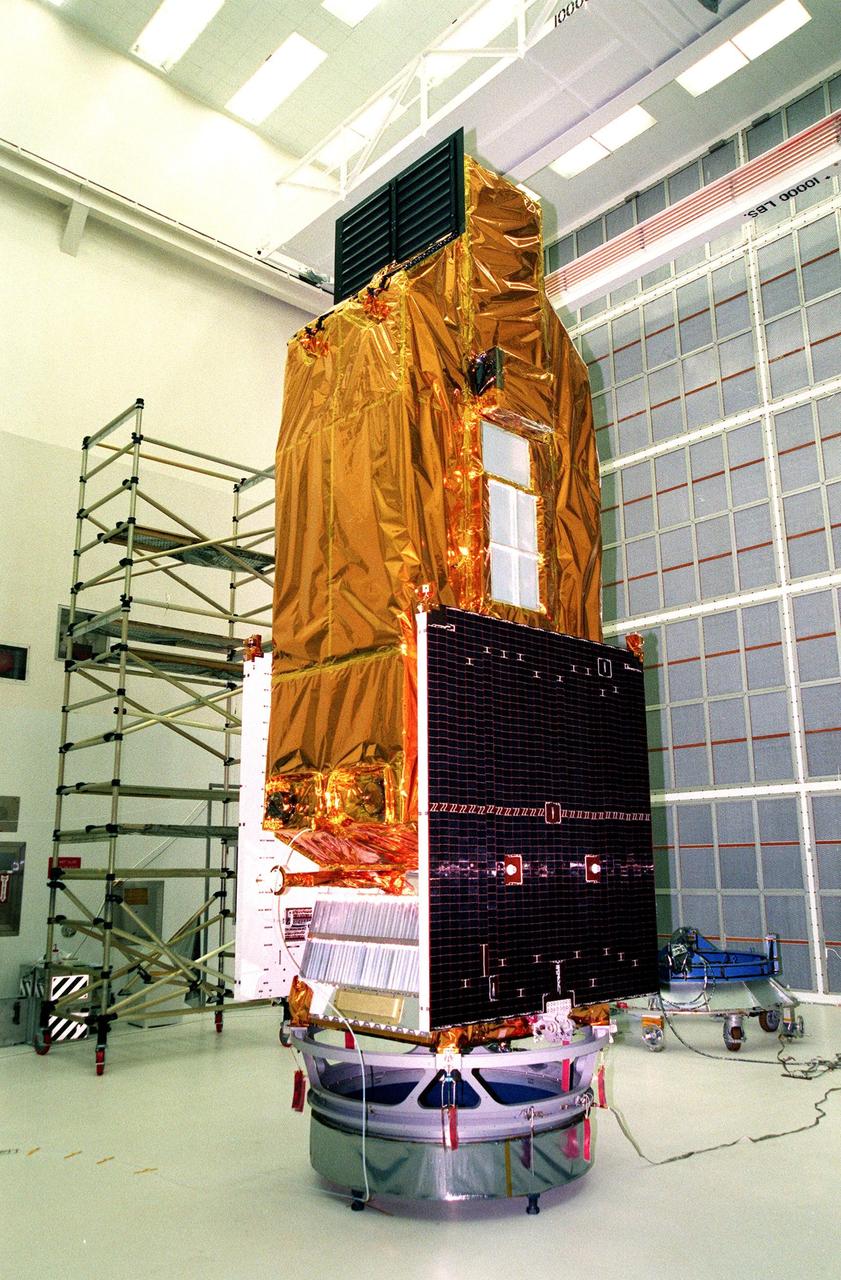
KSC · 1999-06-12 · KSC-99pp0669
KSC-99pp0669
Standing in Hangar AE, Cape Canaveral Air Station (CCAS) is NASA's Far Ultraviolet Spectroscopic Explorer (FUSE) satellite. The black rectangle on top is the optical port; at the…
Inspect NASA record
Standing in Hangar AE, Cape Canaveral Air Station (CCAS) is NASA's Far Ultraviolet Spectroscopic Explorer (FUSE) satellite. The black rectangle on top is the optical port; at the lower right is the solar panel; behind (left) the lower edge of the panel are the radiators. The total length of the instrument is approximately four meters. FUSE was developed by The Johns Hopkins University under contract to Goddard Space Flight Center, Greenbelt, Md., to investigate the origin and evolution of the lightest elements in the universe hydrogen and deuterium. In addition, the FUSE satellite will examine the forces and process involved in the evolution of the galaxies, stars and planetary systems by investigating light in the far ultraviolet portion of the electromagnetic spectrum. Launch is targeted for June 23 from Launch Pad 17A, CCAS, aboard a Boeing Delta II rocket
- Record ID
- KSC-99pp0669
- NASA center
- KSC
- Date
- 1999-06-12
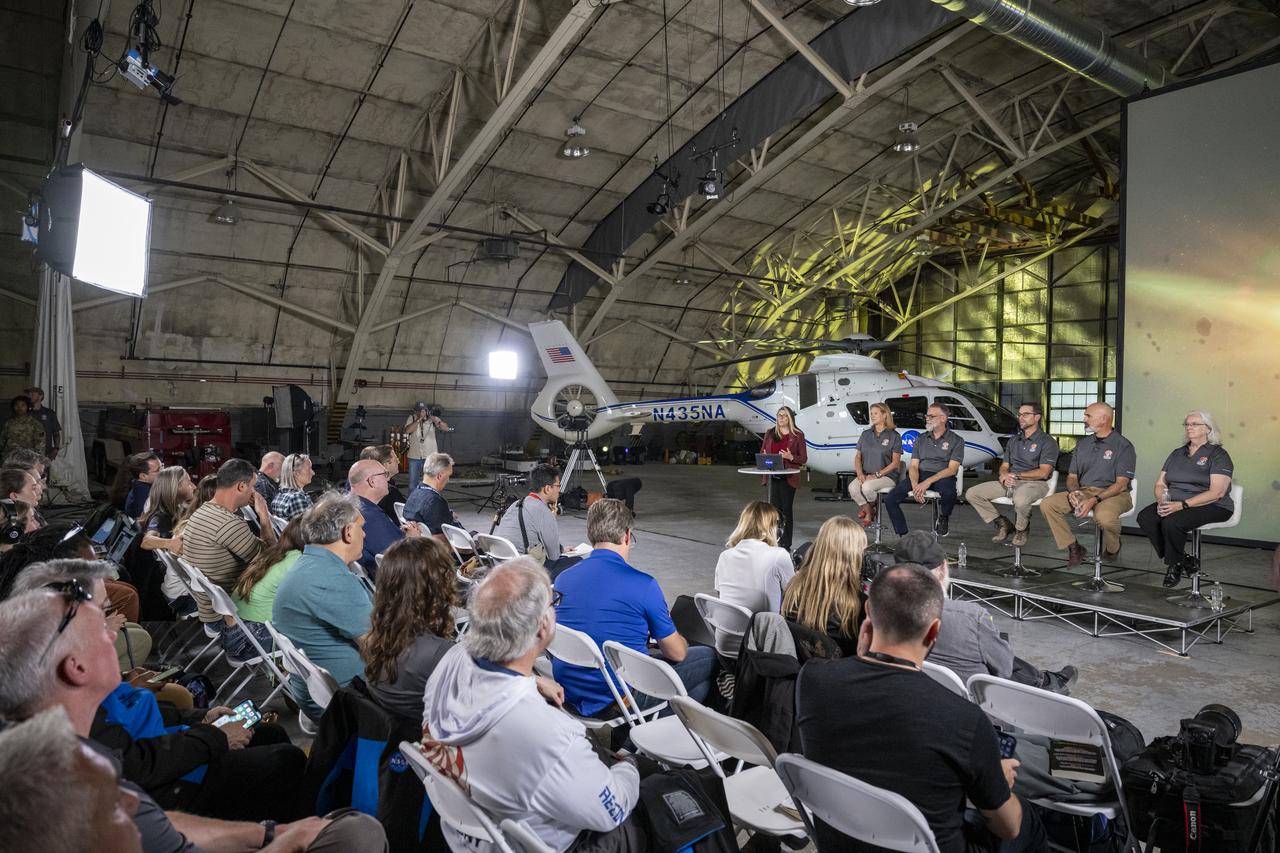
HQ · 2023-09-24 · NHQ202309240029
OSIRIS-REx Sample Return
NASA Office of Communications Senior Science Communications Officer Karen Fox introduces, from left to right, NASA Planetary Science Division Director Lori Glaze, University of Arizona OSIRIS-REx Principal Investigator…
Inspect NASA record
NASA Office of Communications Senior Science Communications Officer Karen Fox introduces, from left to right, NASA Planetary Science Division Director Lori Glaze, University of Arizona OSIRIS-REx Principal Investigator Dante Lauretta, NASA OSIRIS-REx Deputy Project Manager Mike Moreau, Lockheed Martin Deep Space Exploration Chief Engineer Tim Priser, and NASA Chief Scientist Eileen Stansbery during an OSIRIS-REx sample return press conference, Sunday, Sept. 24, 2023, shortly after the capsule landed at the Department of Defense's Utah Test and Training Range. The sample was collected from the asteroid Bennu in October 2020 by NASA’s OSIRIS-REx spacecraft. Photo Credit: (NASA/Keegan Barber)
- Record ID
- NHQ202309240029
- NASA center
- HQ
- Date
- 2023-09-24
- Credit
- NASA/Keegan Barber
- Keywords
- Asteroid Sample Return, Origins Spectral Interpretation Resource Identification Security, Utah, Utah Test and Training Range, press conference

KSC · 1998-09-16 · KSC-98pc1098
KSC-98pc1098
The Plasma Experiment for Planetary Exploration (PEPE), one of two advanced science experiments flying on the Deep Space l mission, is being installed on the spacecraft in the…
Inspect NASA record
The Plasma Experiment for Planetary Exploration (PEPE), one of two advanced science experiments flying on the Deep Space l mission, is being installed on the spacecraft in the Payload Hazardous Servicing Facility. PEPE combines several instruments that study space plasma in one compact 13-pound (6-kilogram) package. Space plasma is composed of charged particles, most of which flow outward from the Sun. The first flight in NASA's New Millennium Program, Deep Space 1 is designed to validate 12 new technologies for scientific space missions of the next century. The spacecraft is scheduled to launch during a period opening Oct. 15 and closing Nov. 10, 1998. Most of its mission objectives will be completed within the first two months. A near-earth asteroid, 1992 KD, has also been selected for a possible flyby
- Record ID
- KSC-98pc1098
- NASA center
- KSC
- Date
- 1998-09-16
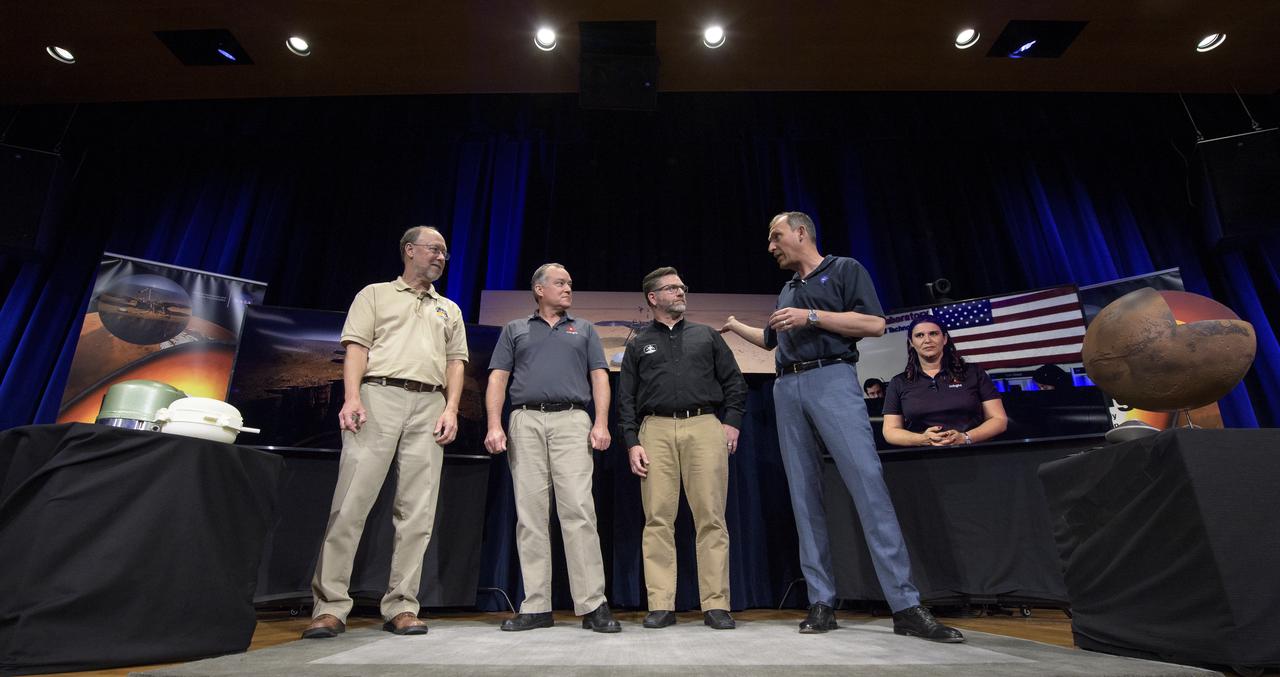
HQ · 2018-11-25 · NHQ201811250017
Mars InSight Pre-Landing Briefing
From left to right: Bruce Banerdt, InSight Principal Investigator, NASA JPL; Tom Hoffman, InSight Project Manager, NASA JPL; Brian Clement, Planetary Protection lead for MarCO, NASA JPL; Thomas…
Inspect NASA record
From left to right: Bruce Banerdt, InSight Principal Investigator, NASA JPL; Tom Hoffman, InSight Project Manager, NASA JPL; Brian Clement, Planetary Protection lead for MarCO, NASA JPL; Thomas Zurbuchen, Associate Administrator of NASA’s Science Mission Directorate, NASA Headquarters; and Julie Wertz-Chen, Entry, Descent and Landing systems engineer, NASA JPL, talk about Mars InSight and Mars Cube One (MarCO) during a pre-landing briefing, Sunday, Nov. 25, 2018 at NASA's Jet Propulsion Laboratory in Pasadena, California. InSight, short for Interior Exploration using Seismic Investigations, Geodesy and Heat Transport, is a Mars lander designed to study the "inner space" of Mars: its crust, mantle, and core. InSight is scheduled to touch down on the Red Planet at approximately noon PST (3 p.m. EST) on Nov. 26. Photo Credit: (NASA/Bill Ingalls)
- Record ID
- NHQ201811250017
- NASA center
- HQ
- Date
- 2018-11-25
- Credit
- NASA/Bill Ingalls
- Keywords
- Brian Clement, Bruce Banerdt, California, Jet Propulsion Laboratory (JPL), Julie Wertz-Chen, Mars Cube One (MarCO), Mars Interior Exploration using Seismic Investigations Geodesy a, Pasadena, Thomas Zurbuchen, Tom Hoffman

KSC · 1998-09-14 · KSC-98pc1095
KSC-98pc1095
KENNEDY SPACE CENTER, FLA. - The Plasma Experiment for Planetary Exploration (PEPE), one of two advanced science experiments flying on the Deep Space 1 mission, is being installed…
Inspect NASA record
KENNEDY SPACE CENTER, FLA. - The Plasma Experiment for Planetary Exploration (PEPE), one of two advanced science experiments flying on the Deep Space 1 mission, is being installed on the spacecraft in the Payload Hazardous Servicing Facility. PEPE combines several instruments that study space plasma into one compact 13-pound (6-kilogram) package. Space plasma is composed of charged particles, most of wich flow outward from the Sun. The first flight in NASA's New Millennium Program, Deep Space 1 is designed to validate 12 new technologies for scientific space missions of the next century. The spacecraft is scheduled to launch during a period opening Oct. 15 and closing Nov. 10, 1998. Most of its mission objectives will be competed within the first two months. A near-Earth asteroid, 1992 KD, has also been selected for a possible flyby.
- Record ID
- KSC-98pc1095
- NASA center
- KSC
- Date
- 1998-09-14