
Update Site (from NASA)
Explore NASA’s Image and Video Library.
Suggest one object per day for the Interstellar Minds collection. We review each suggestion before adding it.
Sign in to suggest a Marvel.
Find a NASA image ID. Open a NASA record and copy its ID from the end of the details URL.
NASA image records
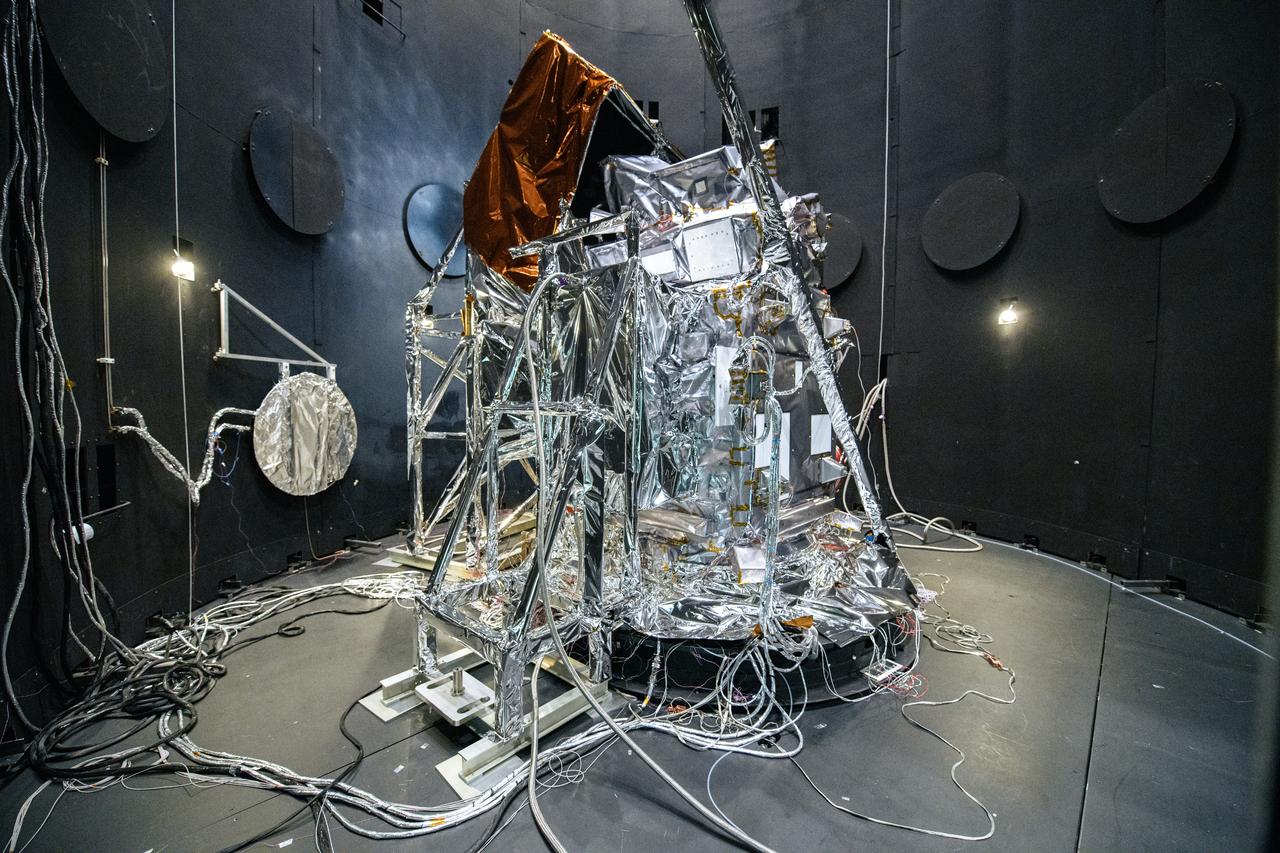
GSFC · 2023-06-17 · GSFC_20230617_PACE_019381
GSFC_20230617_PACE_019381
The Plankton, Aerosol, Cloud, ocean Ecosystem (PACE) Observatory inside the Space Environment Simulator (SES) thermal vacuuum chamber before thermal environmental testing at NASA's Goddard Space Flight Center in…
Inspect NASA record
The Plankton, Aerosol, Cloud, ocean Ecosystem (PACE) Observatory inside the Space Environment Simulator (SES) thermal vacuuum chamber before thermal environmental testing at NASA's Goddard Space Flight Center in Greenbelt, Maryland on June 17th, 2023. PACE's unprecedented spectral coverage will provide the first-ever global measurements designed to identify phytoplankton community composition. The mission will make global ocean color measurements, using the Ocean Color Instrument (OCI), to provide extended data records on ocean ecology and global biogeochemistry along with polarimetry measurements, using the Spectro-polarimeter for Planetary Exploration (SPEXone) and the Hyper Angular Research Polarimeter (HARP2) to provide extended data records on clouds and aerosols. The Earth-observing satellite mission, built at Goddard Space Flight Center in Greenbelt, MD, will continue and advance observations of global ocean color, biogeochemistry, and ecology, as well as the carbon cycle, aerosols and clouds.
- Record ID
- GSFC_20230617_PACE_019381
- NASA center
- GSFC
- Date
- 2023-06-17
- Credit
- NASA / Denny Henry

KSC · 1998-09-16 · KSC-98pc1096
KSC-98pc1096
The Plasma Experiment for Planetary Exploration (PEPE), one of two advanced science experiments flying on the Deep Space l mission, is being installed on the spacecraft in the…
Inspect NASA record
The Plasma Experiment for Planetary Exploration (PEPE), one of two advanced science experiments flying on the Deep Space l mission, is being installed on the spacecraft in the Payload Hazardous Servicing Facility. PEPE combines several instruments that study space plasma in one compact 13-pound (6-kilogram) package. Space plasma is composed of charged particles, most of which flow outward from the Sun. The first flight in NASA's New Millennium Program, Deep Space 1 is designed to validate 12 new technologies for scientific space missions of the next century. The spacecraft is scheduled to launch during a period opening Oct. 15 and closing Nov. 10, 1998. Most of its mission objectives will be completed within the first two months. A near-earth asteroid, 1992 KD, has also been selected for a possible flyby
- Record ID
- KSC-98pc1096
- NASA center
- KSC
- Date
- 1998-09-16
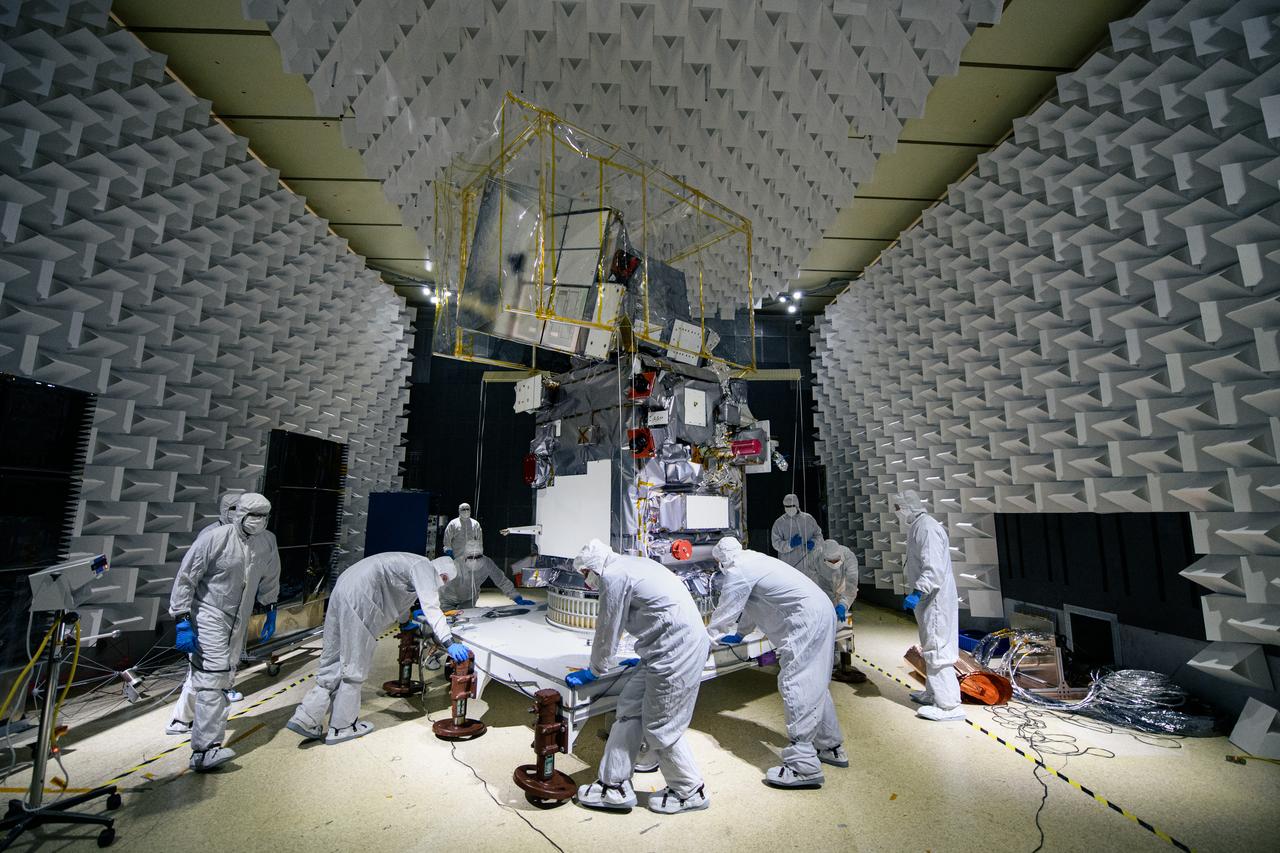
GSFC · 2023-01-30 · GSFC_20230130_PACE_003201
GSFC_20230130_PACE_003201
Technicians move the Plankton, Aerosol, Cloud, ocean Ecosystem (PACE) observatory inside the Electromagnetic Interference testing facility at NASA's Goddard Space Flight Center in Greenbelt, Maryland on January 30th,…
Inspect NASA record
Technicians move the Plankton, Aerosol, Cloud, ocean Ecosystem (PACE) observatory inside the Electromagnetic Interference testing facility at NASA's Goddard Space Flight Center in Greenbelt, Maryland on January 30th, 2023. PACE's unprecedented spectral coverage will provide the first-ever global measurements designed to identify phytoplankton community composition. The mission will make global ocean color measurements, using the Ocean Color Instrument (OCI), to provide extended data records on ocean ecology and global biogeochemistry along with polarimetry measurements, using the Spectro-polarimeter for Planetary Exploration (SPEXone) and the Hyper Angular Research Polarimeter (HARP2) to provide extended data records on clouds and aerosols. The Earth-observing satellite mission, built at Goddard Space Flight Center in Greenbelt, MD, will continue and advance observations of global ocean color, biogeochemistry, and ecology, as well as the carbon cycle, aerosols and clouds.
- Record ID
- GSFC_20230130_PACE_003201
- NASA center
- GSFC
- Date
- 2023-01-30
- Credit
- NASA / Denny Henry

KSC · 1999-04-05 · KSC-99pp0381
KSC-99pp0381
At Hangar AE, Cape Canaveral Air Station, NASA's Far Ultraviolet Spectroscopic Explorer (FUSE) satellite is unveiled before prelaunch processing. FUSE will undergo a functional test of its systems,…
Inspect NASA record
At Hangar AE, Cape Canaveral Air Station, NASA's Far Ultraviolet Spectroscopic Explorer (FUSE) satellite is unveiled before prelaunch processing. FUSE will undergo a functional test of its systems, followed by installation of the flight batteries and solar arrays. Tests are also scheduled for the communications and data systems linking FUSE with the spacecraft control center at The Johns Hopkins University, Baltimore, Md. FUSE was developed and will be operated by The Johns Hopkins University under contract to Goddard Space Flight Center, Greenbelt, Md. FUSE will investigate the origin and evolution of the lightest elements in the universe hydrogen and deuterium. In addition, the FUSE satellite will examine the forces and process involved in the evolution of the galaxies, stars and planetary systems by investigating light in the far ultraviolet portion of the electromagnetic spectrum. The launch aboard a Boeing Delta II rocket is targeted for May 20 at Launch Complex 17
- Record ID
- KSC-99pp0381
- NASA center
- KSC
- Date
- 1999-04-05
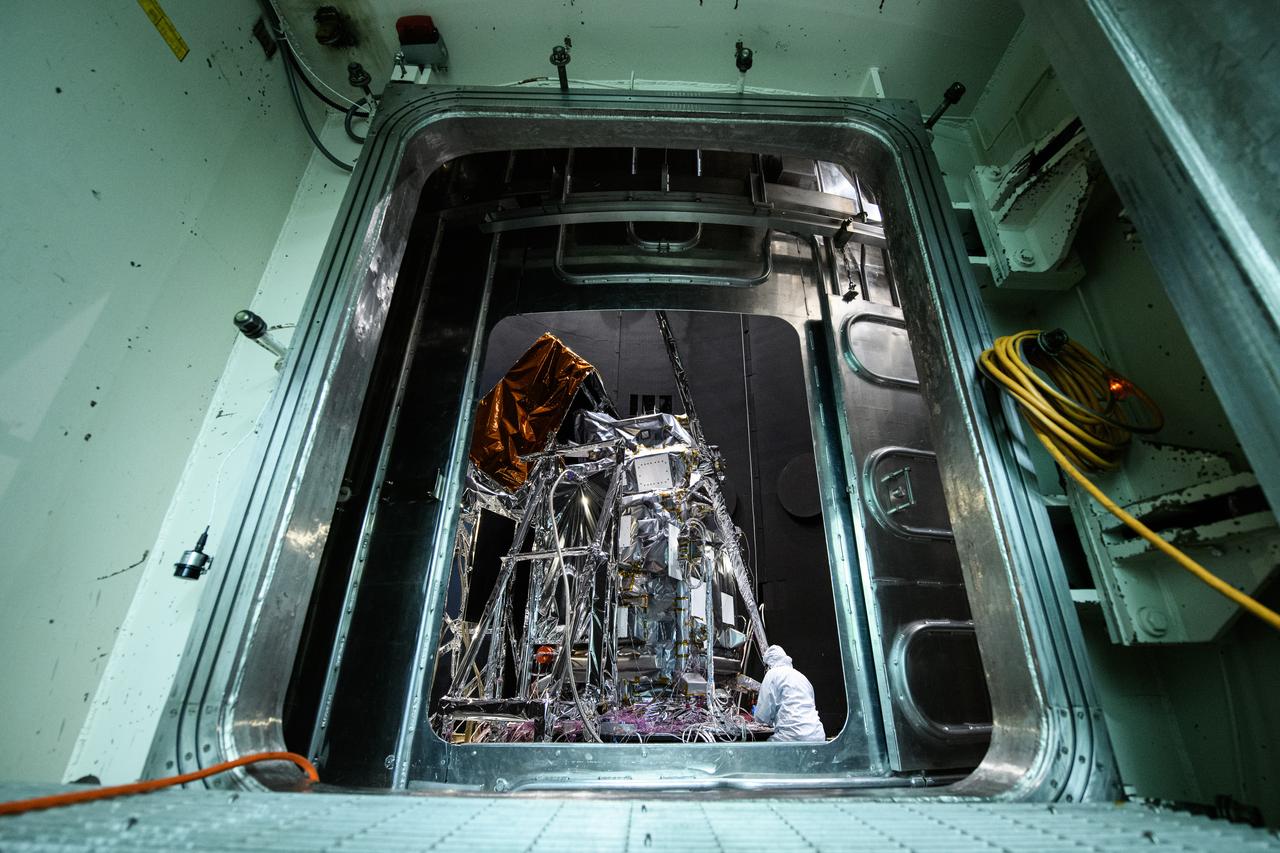
GSFC · 2023-06-16 · GSFC_20230616_PACE_020019
GSFC_20230616_PACE_020019
The Plankton, Aerosol, Cloud, ocean Ecosystem (PACE) Observatory inside the Space Environment Simulator (SES) thermal vacuuum chamber before thermal environmental testing at NASA's Goddard Space Flight Center in…
Inspect NASA record
The Plankton, Aerosol, Cloud, ocean Ecosystem (PACE) Observatory inside the Space Environment Simulator (SES) thermal vacuuum chamber before thermal environmental testing at NASA's Goddard Space Flight Center in Greenbelt, Maryland on June 16th, 2023. PACE's unprecedented spectral coverage will provide the first-ever global measurements designed to identify phytoplankton community composition. The mission will make global ocean color measurements, using the Ocean Color Instrument (OCI), to provide extended data records on ocean ecology and global biogeochemistry along with polarimetry measurements, using the Spectro-polarimeter for Planetary Exploration (SPEXone) and the Hyper Angular Research Polarimeter (HARP2) to provide extended data records on clouds and aerosols. The Earth-observing satellite mission, built at Goddard Space Flight Center in Greenbelt, MD, will continue and advance observations of global ocean color, biogeochemistry, and ecology, as well as the carbon cycle, aerosols and clouds.
- Record ID
- GSFC_20230616_PACE_020019
- NASA center
- GSFC
- Date
- 2023-06-16
- Credit
- NASA / Denny Henry

KSC · 1998-09-16 · KSC-98pc1092
KSC-98pc1092
The Plasma Experiment for Planetary Exploration (PEPE), one of two advanced science experiments flying on the Deep Space l mission, is prepared for installation on the spacecraft in…
Inspect NASA record
The Plasma Experiment for Planetary Exploration (PEPE), one of two advanced science experiments flying on the Deep Space l mission, is prepared for installation on the spacecraft in the Payload Hazardous Servicing Facility. PEPE combines several instruments that study space plasma in one compact 13-pound (6-kilogram) package. Space plasma is composed of charged particles, most of which flow outward from the Sun. The first flight in NASA's New Millennium Program, Deep Space 1 is designed to validate 12 new technologies for scientific space missions of the next century. The spacecraft is scheduled to launch during a period opening Oct. 15 and closing Nov. 10, 1998. Most of its mission objectives will be completed within the first two months. A near-earth asteroid, 1992 KD, has also been selected for a possible flyby
- Record ID
- KSC-98pc1092
- NASA center
- KSC
- Date
- 1998-09-16
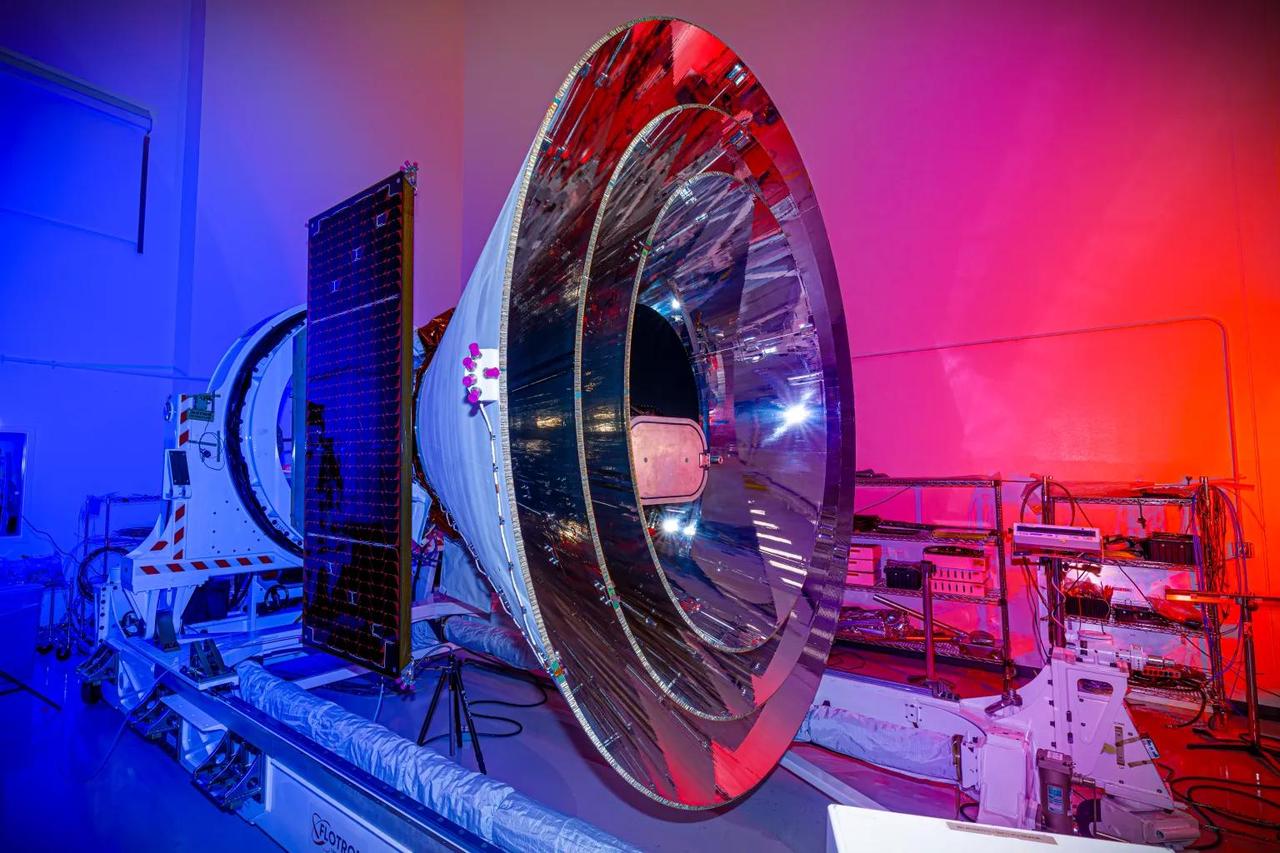
JPL · 2025-01-23 · PIA26536
SPHEREx After Environmental Testing
NASA's SPHEREx space observatory was photographed at BAE Systems in Boulder, Colorado, in November 2024 after completing environmental testing. The spacecraft's three concentric cones help direct heat and…
Inspect NASA record
NASA's SPHEREx space observatory was photographed at BAE Systems in Boulder, Colorado, in November 2024 after completing environmental testing. The spacecraft's three concentric cones help direct heat and light away from the telescope and other components, keeping them cool. Short for Spectro-Photometer for the History of the Universe, Epoch of Reionization and Ices Explorer, SPHEREx will create a map of the cosmos like no other. Using a technique called spectroscopy to image the entire sky in 102 wavelengths of infrared light, SPHEREx will gather information about the composition of and distance to millions of galaxies and stars. With this map, scientists will study what happened in the first fraction of a second after the big bang, how galaxies formed and evolved, and the origins of water in planetary systems in our galaxy. https://photojournal.jpl.nasa.gov/catalog/PIA26536
- Record ID
- PIA26536
- NASA center
- JPL
- Date
- 2025-01-23
- Credit
- NASA/JPL-Caltech/BAE Systems
- Keywords
- SPHEREx, Sky
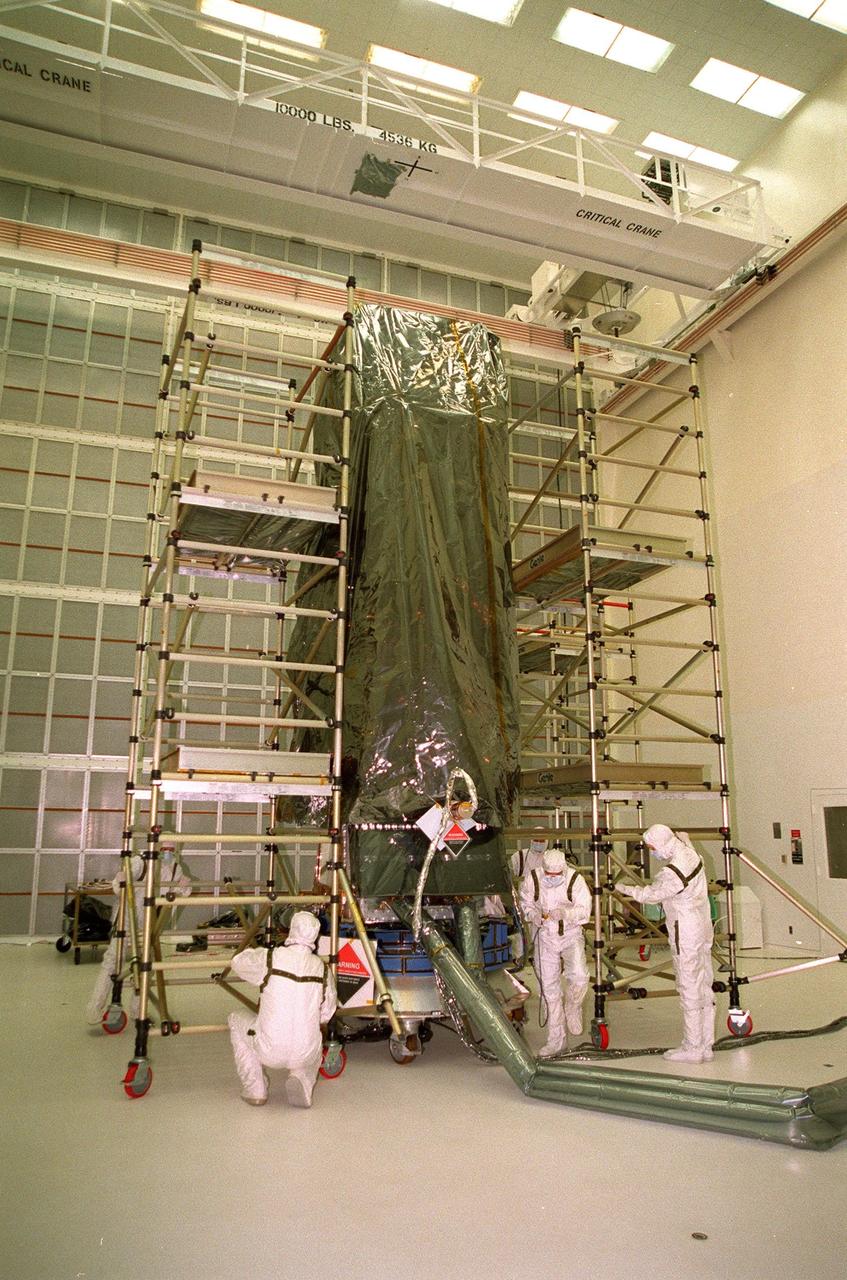
KSC · 1999-04-05 · KSC-99pp0379
KSC-99pp0379
Workers in Hangar AE, Cape Canaveral Air Station, get ready to remove the protective shipping cover from NASA's Far Ultraviolet Spectroscopic Explorer (FUSE) satellite for prelaunch processing. FUSE…
Inspect NASA record
Workers in Hangar AE, Cape Canaveral Air Station, get ready to remove the protective shipping cover from NASA's Far Ultraviolet Spectroscopic Explorer (FUSE) satellite for prelaunch processing. FUSE will undergo a functional test of its systems, followed by installation of the flight batteries and solar arrays. Tests are also scheduled for the communications and data systems linking FUSE with the spacecraft control center at The Johns Hopkins University, Baltimore, Md. FUSE was developed and will be operated by The Johns Hopkins University under contract to Goddard Space Flight Center, Greenbelt, Md. FUSE will investigate the origin and evolution of the lightest elements in the universe hydrogen and deuterium. In addition, the FUSE satellite will examine the forces and process involved in the evolution of the galaxies, stars and planetary systems by investigating light in the far ultraviolet portion of the electromagnetic spectrum. The launch aboard a Boeing Delta II rocket is targeted for May 20 at Launch Complex 17
- Record ID
- KSC-99pp0379
- NASA center
- KSC
- Date
- 1999-04-05
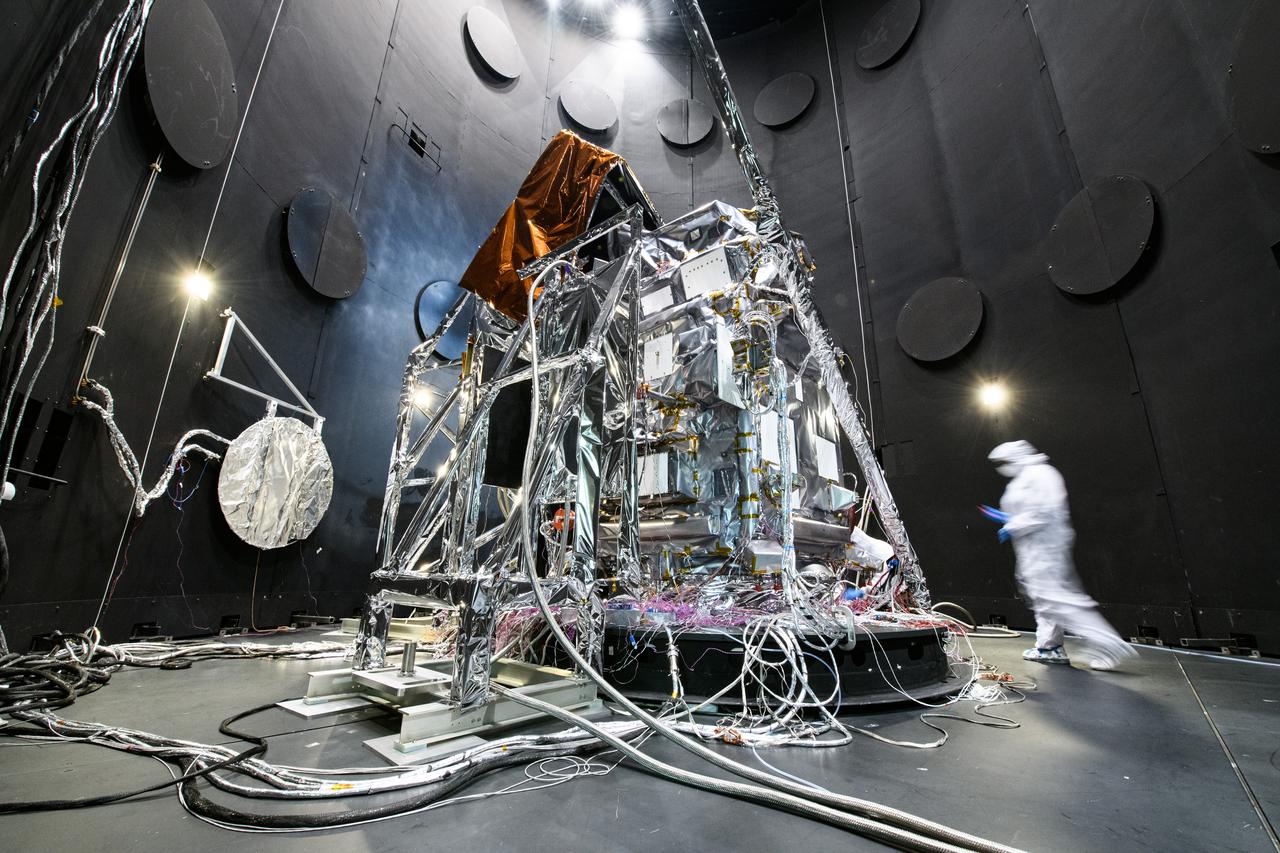
GSFC · 2023-06-16 · GSFC_20230616_PACE_020006
GSFC_20230616_PACE_020006
The Plankton, Aerosol, Cloud, ocean Ecosystem (PACE) Observatory inside the Space Environment Simulator (SES) thermal vacuuum chamber before thermal environmental testing at NASA's Goddard Space Flight Center in…
Inspect NASA record
The Plankton, Aerosol, Cloud, ocean Ecosystem (PACE) Observatory inside the Space Environment Simulator (SES) thermal vacuuum chamber before thermal environmental testing at NASA's Goddard Space Flight Center in Greenbelt, Maryland on June 16th, 2023. PACE's unprecedented spectral coverage will provide the first-ever global measurements designed to identify phytoplankton community composition. The mission will make global ocean color measurements, using the Ocean Color Instrument (OCI), to provide extended data records on ocean ecology and global biogeochemistry along with polarimetry measurements, using the Spectro-polarimeter for Planetary Exploration (SPEXone) and the Hyper Angular Research Polarimeter (HARP2) to provide extended data records on clouds and aerosols. The Earth-observing satellite mission, built at Goddard Space Flight Center in Greenbelt, MD, will continue and advance observations of global ocean color, biogeochemistry, and ecology, as well as the carbon cycle, aerosols and clouds.
- Record ID
- GSFC_20230616_PACE_020006
- NASA center
- GSFC
- Date
- 2023-06-16
- Credit
- NASA / Denny Henry

KSC · 1999-04-05 · KSC-99pp0382
KSC-99pp0382
At Hangar AE, Cape Canaveral Air Station, NASA's Far Ultraviolet Spectroscopic Explorer (FUSE) satellite stands alone after workstands have been removed. As part of prelaunch processing, FUSE will…
Inspect NASA record
At Hangar AE, Cape Canaveral Air Station, NASA's Far Ultraviolet Spectroscopic Explorer (FUSE) satellite stands alone after workstands have been removed. As part of prelaunch processing, FUSE will undergo a functional test of its systems, followed by installation of the flight batteries and solar arrays. Tests are also scheduled for the communications and data systems linking FUSE with the spacecraft control center at The Johns Hopkins University, Baltimore, Md. FUSE was developed and will be operated by The Johns Hopkins University under contract to Goddard Space Flight Center, Greenbelt, Md. FUSE will investigate the origin and evolution of the lightest elements in the universe hydrogen and deuterium. In addition, the FUSE satellite will examine the forces and process involved in the evolution of the galaxies, stars and planetary systems by investigating light in the far ultraviolet portion of the electromagnetic spectrum. The launch aboard a Boeing Delta II rocket is targeted for May 20 at Launch Complex 17
- Record ID
- KSC-99pp0382
- NASA center
- KSC
- Date
- 1999-04-05

HQ · 2013-09-05 · 201309050005HQ
LADEE NASA Social
NASA Associate Administrator for the Science Mission Directorate John Grunsfeld is seen in a video monitor during a NASA Social about the Lunar Atmosphere and Dust Environment Explorer…
Inspect NASA record
NASA Associate Administrator for the Science Mission Directorate John Grunsfeld is seen in a video monitor during a NASA Social about the Lunar Atmosphere and Dust Environment Explorer (LADEE) mission at the NASA Wallops Flight Facility, Thursday, Sept. 5, 2013 on Wallops Island, VA. Fifty of NASA's social media followers are attending a two-day event in support of the LADEE launch. Data from LADEE will provide unprecedented information about the environment around the moon and give scientists a better understanding of other planetary bodies in our solar system and beyond. LADEE is scheduled to launch at 11:27 p.m. Friday, Sept. 6, from NASA's Wallops Flight Facility. Photo Credit: (NASA/Carla Cioffi)
- Record ID
- 201309050005HQ
- NASA center
- HQ
- Date
- 2013-09-05
- Credit
- NASA/Carla Cioffi
- Keywords
- John Grunsfeld, NASA Social, NASA Wallops Flight Facility (WFF), Virginia, Wallops Island
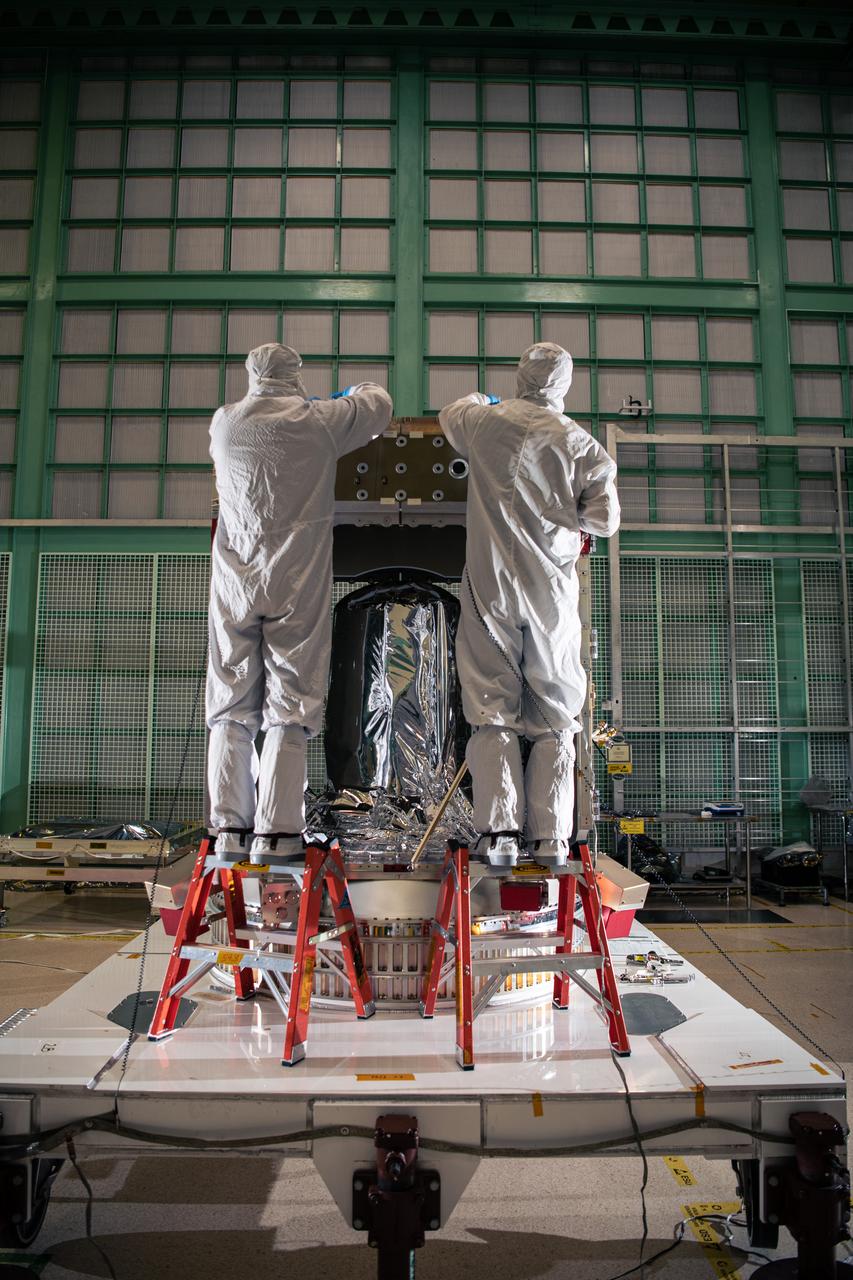
GSFC · 2022-02-24 · GSFC_20220224_PACE_018778
GSFC_20220224_PACE_018778
Engineering Technicians Alex Schaeffer and Eric Norris assemble the Plankton, Aerosol, Cloud, ocean Ecosystem (PACE) Spacecraft structure in the cleanroom at NASA Goddard Space Flight Center in Greenbelt,…
Inspect NASA record
Engineering Technicians Alex Schaeffer and Eric Norris assemble the Plankton, Aerosol, Cloud, ocean Ecosystem (PACE) Spacecraft structure in the cleanroom at NASA Goddard Space Flight Center in Greenbelt, Maryland on February 24th, 2022. PACE's unprecedented spectral coverage will provide the first-ever global measurements designed to identify phytoplankton community composition. The mission will make global ocean color measurements, using the Ocean Color Instrument (OCI), to provide extended data records on ocean ecology and global biogeochemistry along with polarimetry measurements, using the Spectro-polarimeter for Planetary Exploration (SPEXone) and the Hyper Angular Research Polarimeter (HARP2) to provide extended data records on clouds and aerosols. The Earth-observing satellite mission, built at Goddard Space Flight Center in Greenbelt, MD, will continue and advance observations of global ocean color, biogeochemistry, and ecology, as well as the carbon cycle, aerosols and clouds.
- Record ID
- GSFC_20220224_PACE_018778
- NASA center
- GSFC
- Date
- 2022-02-24
- Credit
- NASA / Denny Henry