
Update Site (from NASA)
Explore NASA’s Image and Video Library.
Suggest one object per day for the Interstellar Minds collection. We review each suggestion before adding it.
Sign in to suggest a Marvel.
Find a NASA image ID. Open a NASA record and copy its ID from the end of the details URL.
NASA image records
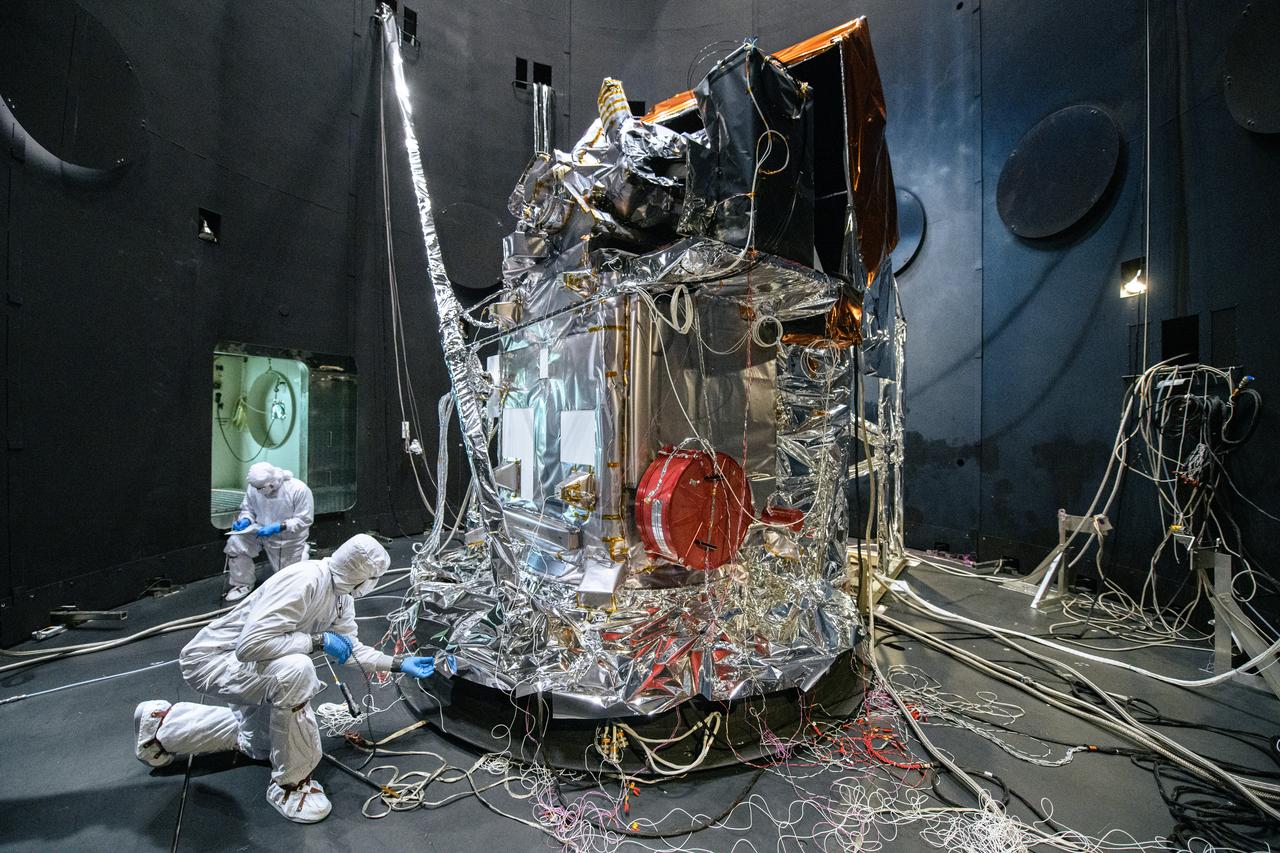
GSFC · 2023-06-17 · GSFC_20230617_PACE_019373
GSFC_20230617_PACE_019373
The Plankton, Aerosol, Cloud, ocean Ecosystem (PACE) Observatory inside the Space Environment Simulator (SES) thermal vacuuum chamber before thermal environmental testing at NASA's Goddard Space Flight Center in…
Inspect NASA record
The Plankton, Aerosol, Cloud, ocean Ecosystem (PACE) Observatory inside the Space Environment Simulator (SES) thermal vacuuum chamber before thermal environmental testing at NASA's Goddard Space Flight Center in Greenbelt, Maryland on June 17th, 2023. PACE's unprecedented spectral coverage will provide the first-ever global measurements designed to identify phytoplankton community composition. The mission will make global ocean color measurements, using the Ocean Color Instrument (OCI), to provide extended data records on ocean ecology and global biogeochemistry along with polarimetry measurements, using the Spectro-polarimeter for Planetary Exploration (SPEXone) and the Hyper Angular Research Polarimeter (HARP2) to provide extended data records on clouds and aerosols. The Earth-observing satellite mission, built at Goddard Space Flight Center in Greenbelt, MD, will continue and advance observations of global ocean color, biogeochemistry, and ecology, as well as the carbon cycle, aerosols and clouds.
- Record ID
- GSFC_20230617_PACE_019373
- NASA center
- GSFC
- Date
- 2023-06-17
- Credit
- NASA / Denny Henry
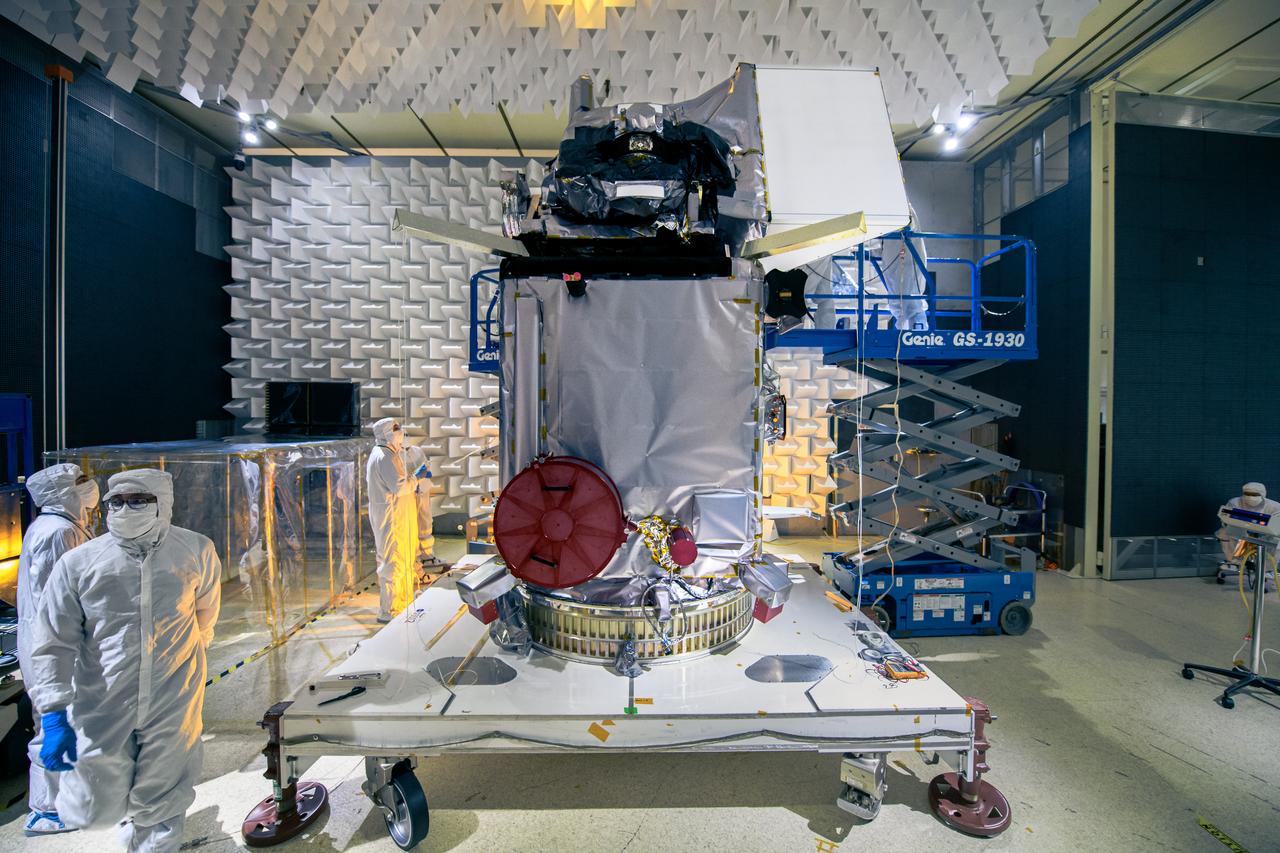
GSFC · 2023-01-30 · GSFC_20230130_PACE_003224
GSFC_20230130_PACE_003224
The Plankton, Aerosol, Cloud, ocean Ecosystem (PACE) observatory inside the Electromagnetic Interference testing facility at NASA's Goddard Space Flight Center in Greenbelt, Maryland on January 30th, 2023. PACE's…
Inspect NASA record
The Plankton, Aerosol, Cloud, ocean Ecosystem (PACE) observatory inside the Electromagnetic Interference testing facility at NASA's Goddard Space Flight Center in Greenbelt, Maryland on January 30th, 2023. PACE's unprecedented spectral coverage will provide the first-ever global measurements designed to identify phytoplankton community composition. The mission will make global ocean color measurements, using the Ocean Color Instrument (OCI), to provide extended data records on ocean ecology and global biogeochemistry along with polarimetry measurements, using the Spectro-polarimeter for Planetary Exploration (SPEXone) and the Hyper Angular Research Polarimeter (HARP2) to provide extended data records on clouds and aerosols. The Earth-observing satellite mission, built at Goddard Space Flight Center in Greenbelt, MD, will continue and advance observations of global ocean color, biogeochemistry, and ecology, as well as the carbon cycle, aerosols and clouds.
- Record ID
- GSFC_20230130_PACE_003224
- NASA center
- GSFC
- Date
- 2023-01-30
- Credit
- NASA / Denny Henry
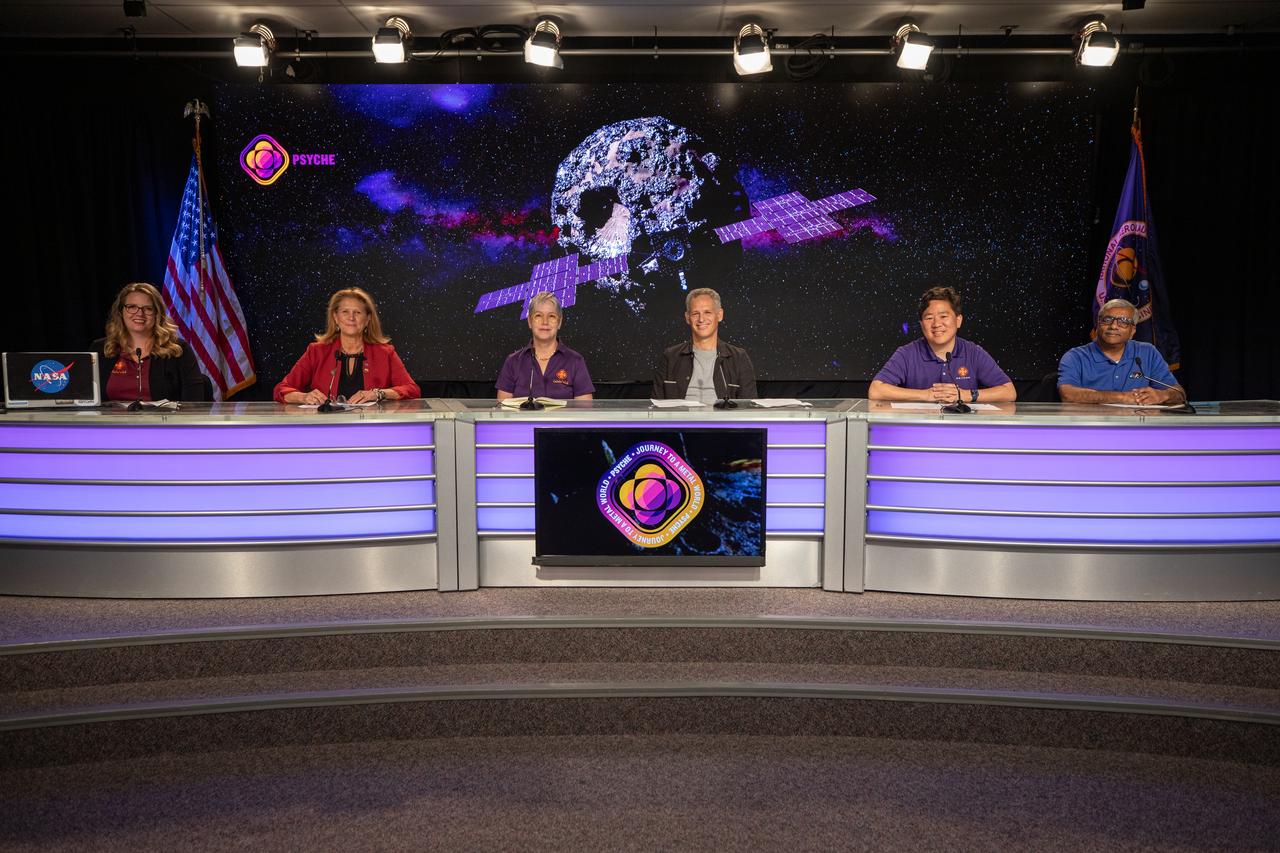
KSC · 2023-10-10 · KSC-20231010-PH-KLS01_0104
Psyche Mission and Science Briefing
A Psyche mission and science briefing takes place at NASA’s Kennedy Space Center in Florida on Tuesday, Oct. 10, 2023. Participants, from left, are: Alana Johnson, NASA Communications;…
Inspect NASA record
A Psyche mission and science briefing takes place at NASA’s Kennedy Space Center in Florida on Tuesday, Oct. 10, 2023. Participants, from left, are: Alana Johnson, NASA Communications; Lori Glaze, Planetary Science division director, NASA Headquarters; Lindy Elkins-Tanton, Psyche principal investigator, Arizona State University; Ben Weiss, Psyche deputy principal investigator and magnetometer lead, Massachusetts Institute of Technology; David Oh, Psyche chief engineer for operations, NASA’s Jet Propulsion Laboratory (JPL); and Abi Biswas, Deep Space Optical Communications project technologist, JPL. Psyche is the first mission to explore an asteroid with a surface that likely contains substantial amounts of metal rather than rock or ice. Liftoff of NASA’s Psyche spacecraft, atop a SpaceX Falcon Heavy rocket, is targeted for 10:16 a.m. EDT Thursday, Oct. 12, from Kennedy’s Launch Complex 39A.
- Record ID
- KSC-20231010-PH-KLS01_0104
- NASA center
- KSC
- Date
- 2023-10-10
- Credit
- NASA/Kim Shiflett
- Keywords
- Arizona State University, DSOC, Deep Space Optical Communications, Falcon Heavy, JPL, Jet Propulsion Lab, KSC, Kennedy Space Center, LC39A, LSP, Launch Services Program, NASA
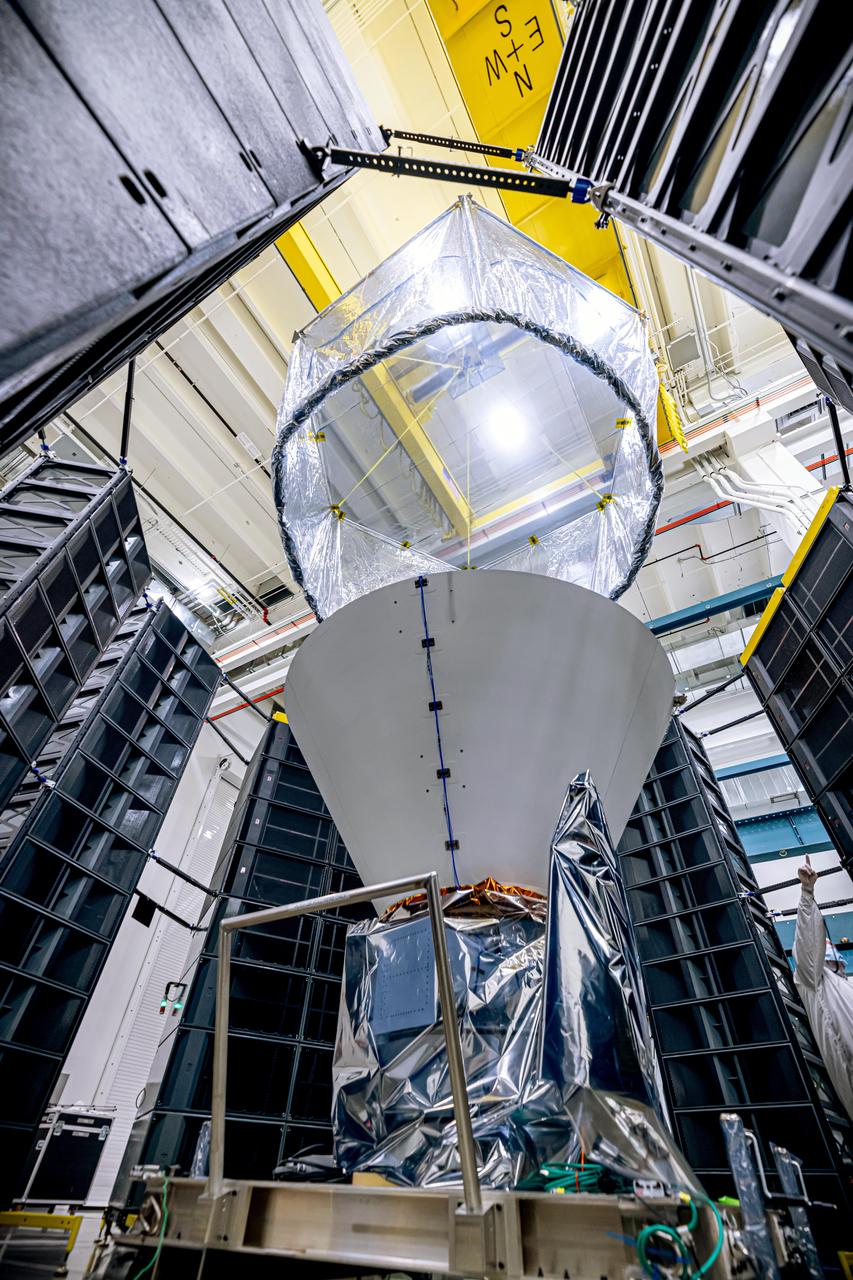
JPL · 2025-01-23 · PIA26540
SPHEREx Undergoes Acoustic Testing
NASA's SPHEREx observatory is installed in the Fiesta Area at BAE Systems in Boulder, Colorado, in July 2024. The observatory is surrounded by speaker stacks used to perform…
Inspect NASA record
NASA's SPHEREx observatory is installed in the Fiesta Area at BAE Systems in Boulder, Colorado, in July 2024. The observatory is surrounded by speaker stacks used to perform acoustics testing, which subjects the spacecraft to the acoustics loads that it will experience during launch. Short for Spectro-Photometer for the History of the Universe, Epoch of Reionization and Ices Explorer, SPHEREx will create a map of the cosmos like no other. Using a technique called spectroscopy to image the entire sky in 102 wavelengths of infrared light, SPHEREx will gather information about the composition of and distance to millions of galaxies and stars. With this map, scientists will study what happened in the first fraction of a second after the big bang, how galaxies formed and evolved, and the origins of water in planetary systems in our galaxy. https://photojournal.jpl.nasa.gov/catalog/PIA26540
- Record ID
- PIA26540
- NASA center
- JPL
- Date
- 2025-01-23
- Credit
- NASA/JPL-Caltech/BAE Systems
- Keywords
- SPHEREx

KSC · 1998-09-16 · KSC-98pc1093
KSC-98pc1093
The Plasma Experiment for Planetary Exploration (PEPE), one of two advanced science experiments flying on the Deep Space l mission, is prepared for installation on the spacecraft in…
Inspect NASA record
The Plasma Experiment for Planetary Exploration (PEPE), one of two advanced science experiments flying on the Deep Space l mission, is prepared for installation on the spacecraft in the Payload Hazardous Servicing Facility. PEPE combines several instruments that study space plasma in one compact 13-pound (6-kilogram) package. Space plasma is composed of charged particles, most of which flow outward from the Sun. The first flight in NASA's New Millennium Program, Deep Space 1 is designed to validate 12 new technologies for scientific space missions of the next century. The spacecraft is scheduled to launch during a period opening Oct. 15 and closing Nov. 10, 1998. Most of its mission objectives will be completed within the first two months. A near-earth asteroid, 1992 KD, has also been selected for a possible flyby.
- Record ID
- KSC-98pc1093
- NASA center
- KSC
- Date
- 1998-09-16
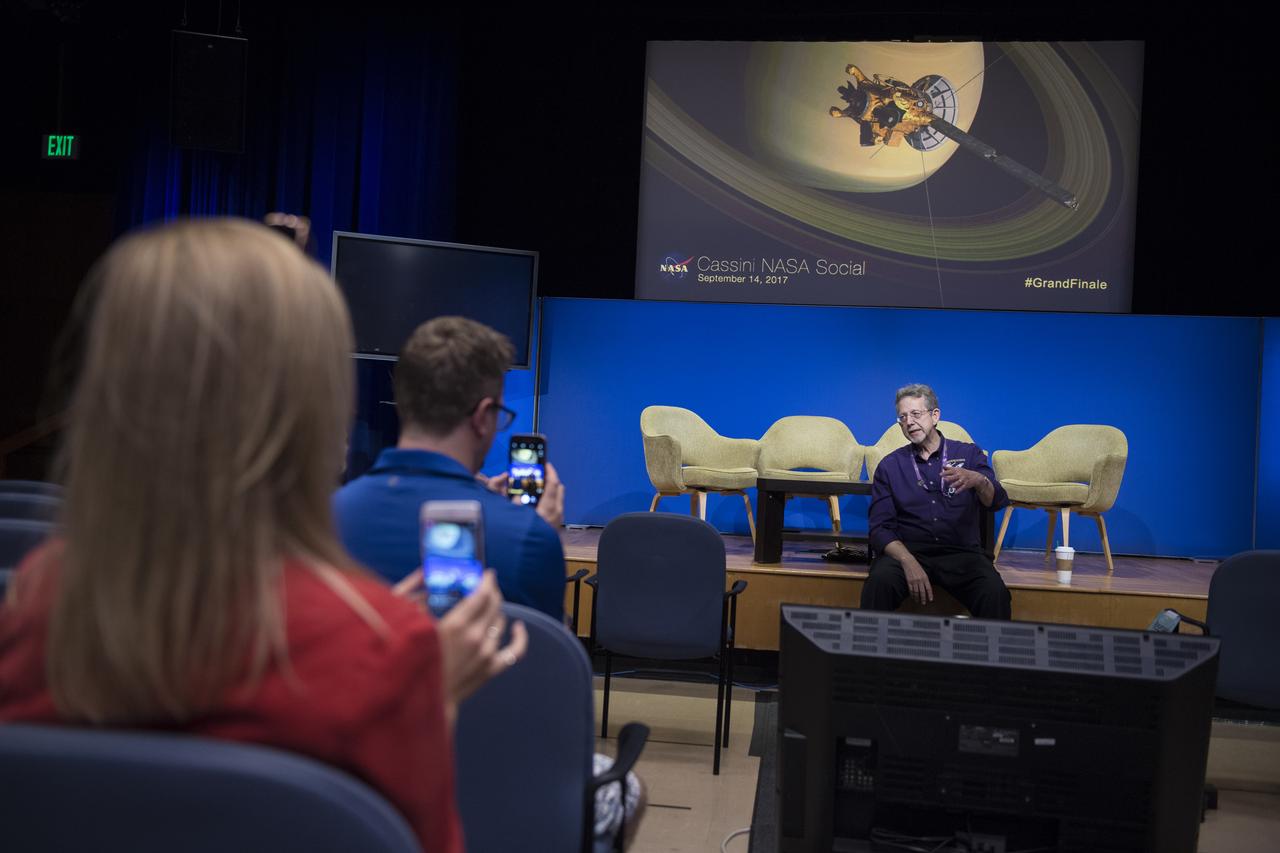
HQ · 2017-09-14 · NHQ201709140009
Cassini NASA Social
NASA Social attendees film director of NASA's Planetary Science Division, Jim Green as he discusses the Cassini mission, Thursday, Sept. 14, 2017 at NASA's Jet Propulsion Laboratory in…
Inspect NASA record
NASA Social attendees film director of NASA's Planetary Science Division, Jim Green as he discusses the Cassini mission, Thursday, Sept. 14, 2017 at NASA's Jet Propulsion Laboratory in Pasadena, California. Since its arrival in 2004, the Cassini-Huygens mission has been a discovery machine, revolutionizing our knowledge of the Saturn system and captivating us with data and images never before obtained with such detail and clarity. On Sept. 15, 2017, operators will deliberately plunge the spacecraft into Saturn, as Cassini gathered science until the end. The “plunge” ensures Saturn’s moons will remain pristine for future exploration. During Cassini’s final days, mission team members from all around the world gathered at NASA’s Jet Propulsion Laboratory, Pasadena, California, to celebrate the achievements of this historic mission. Photo Credit: (NASA/Joel Kowsky)
- Record ID
- NHQ201709140009
- NASA center
- HQ
- Date
- 2017-09-14
- Credit
- NASA/Joel Kowsky
- Keywords
- Cassini, Cassini Grand Finale, Jet Propulsion Laboratory (JPL), Jim Green, NASA Social
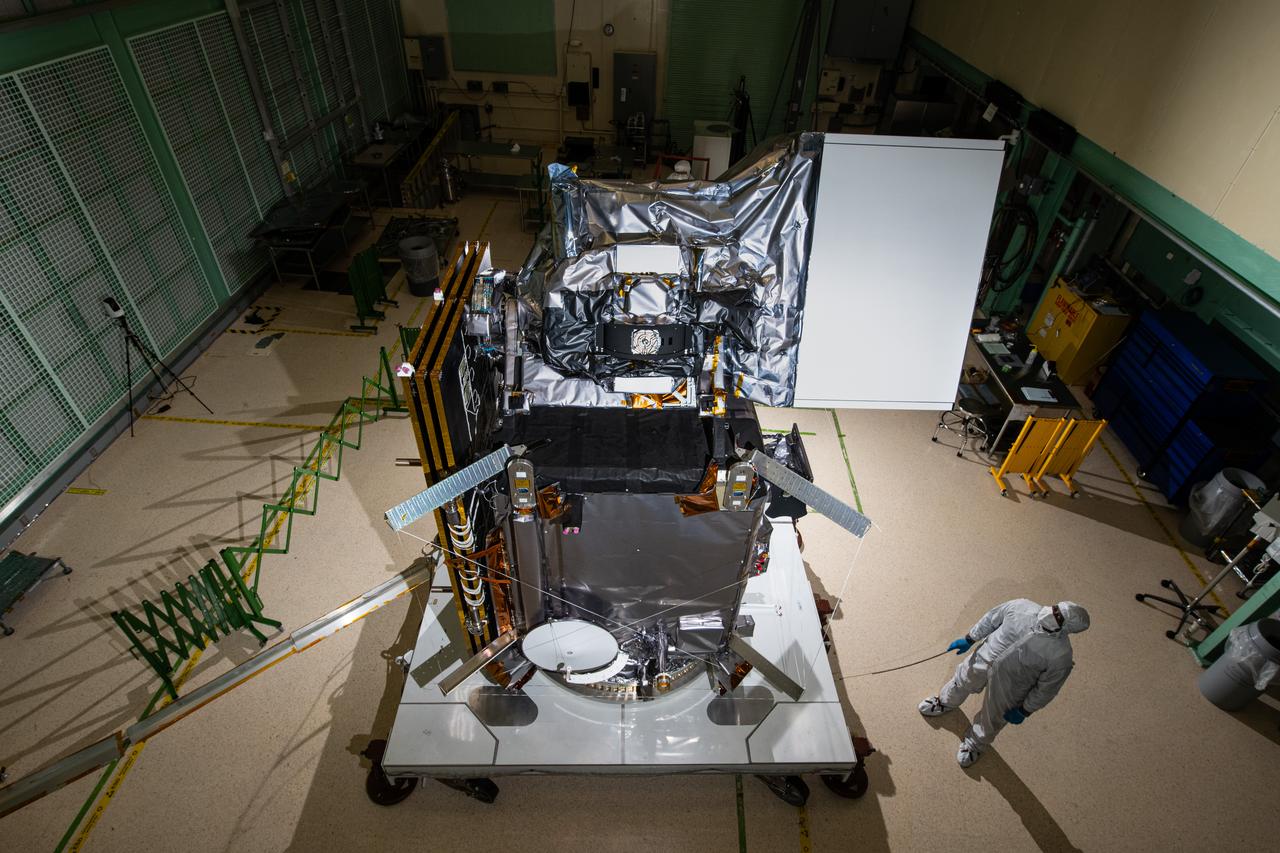
GSFC · 2023-11-02 · GSFC_20231102_PACE_030819
GSFC_20231102_PACE_030819
Quality Engineer Larry Morgan looks at the Plankton, Aerosol, Cloud, ocean Ecosystem (PACE) observatory in the cleanroom at NASA's Goddard Space Flight Center in Greenbelt, Maryland on November…
Inspect NASA record
Quality Engineer Larry Morgan looks at the Plankton, Aerosol, Cloud, ocean Ecosystem (PACE) observatory in the cleanroom at NASA's Goddard Space Flight Center in Greenbelt, Maryland on November 2nd, 2023. PACE's unprecedented spectral coverage will provide the first-ever global measurements designed to identify phytoplankton community composition. The mission will make global ocean color measurements, using the Ocean Color Instrument (OCI), to provide extended data records on ocean ecology and global biogeochemistry along with polarimetry measurements, using the Spectro-polarimeter for Planetary Exploration (SPEXone) and the Hyper Angular Research Polarimeter (HARP2) to provide extended data records on clouds and aerosols. The Earth-observing satellite mission, built at Goddard Space Flight Center in Greenbelt, MD, will continue and advance observations of global ocean color, biogeochemistry, and ecology, as well as the carbon cycle, aerosols and clouds.
- Record ID
- GSFC_20231102_PACE_030819
- NASA center
- GSFC
- Date
- 2023-11-02
- Credit
- NASA / Denny Henry
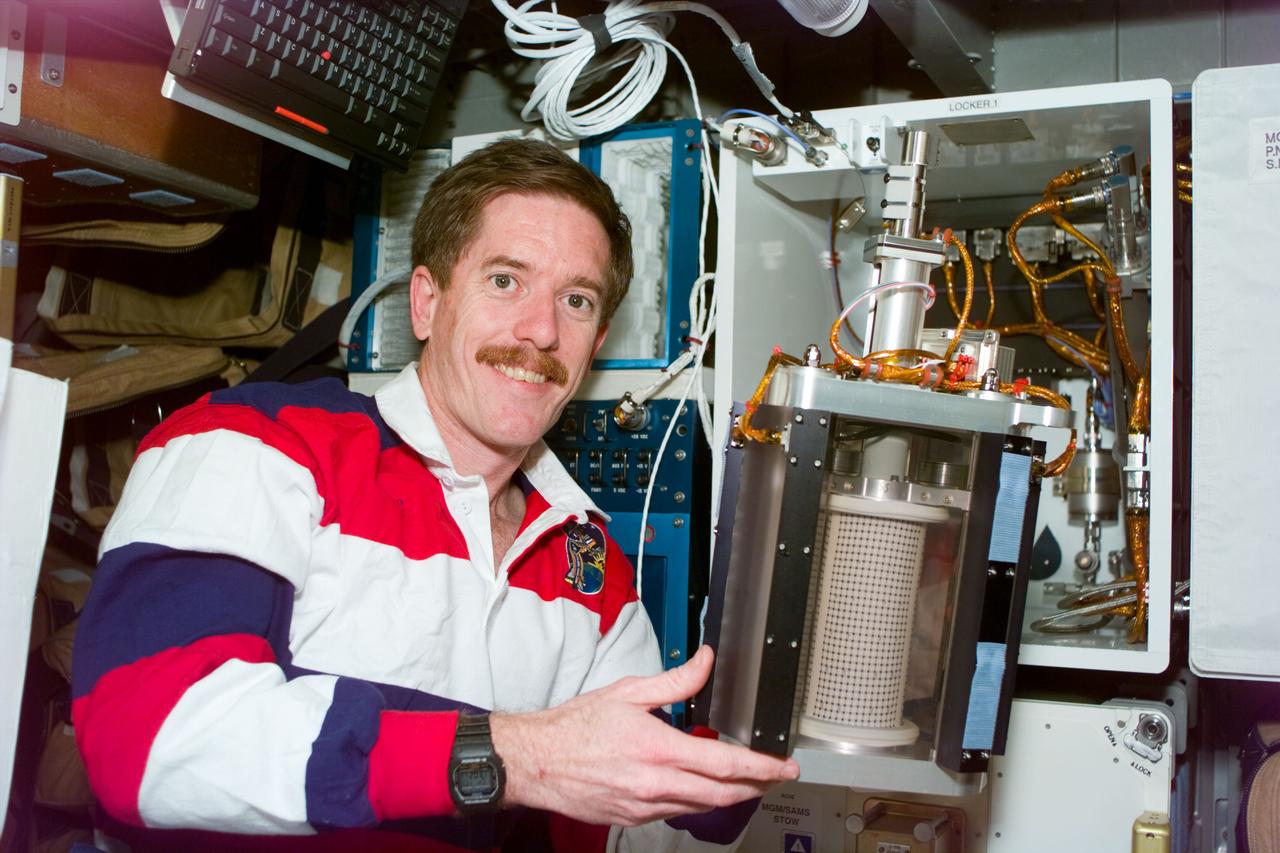
JSC · 1998-03-04 · s89e5328
MGM - MS Reilly holds a container used in the MGM experiment
S89-E-5328 (27 Jan 1998) --- This Electronic Still Camera (ESC) image shows astronaut James F. Reilly, mission specialist, holding the Mechanics of Granular Materials (MGM) experiment. The MGM…
Inspect NASA record
S89-E-5328 (27 Jan 1998) --- This Electronic Still Camera (ESC) image shows astronaut James F. Reilly, mission specialist, holding the Mechanics of Granular Materials (MGM) experiment. The MGM experiment is aimed at understanding the behavior of granular materials, such as sand or salt, under very low confining pressure. This pressure is the force that keeps a granular material ?sticking together?. The experiment has applications in a wide range of fields, including earthquake engineering; coastal and off-shore engineering; mining; transportation of granular materials; soil erosion; the handling of granular materials such as grains and powders; off-road vehicles; geology of the Earth; and planetary geology and exploration. Findings from the experiment may lead to improved selection and preparation of building sites, better management of undeveloped land, and improved handling of materials in chemical, agricultural and other industries.
- Record ID
- s89e5328
- NASA center
- JSC
- Date
- 1998-03-04
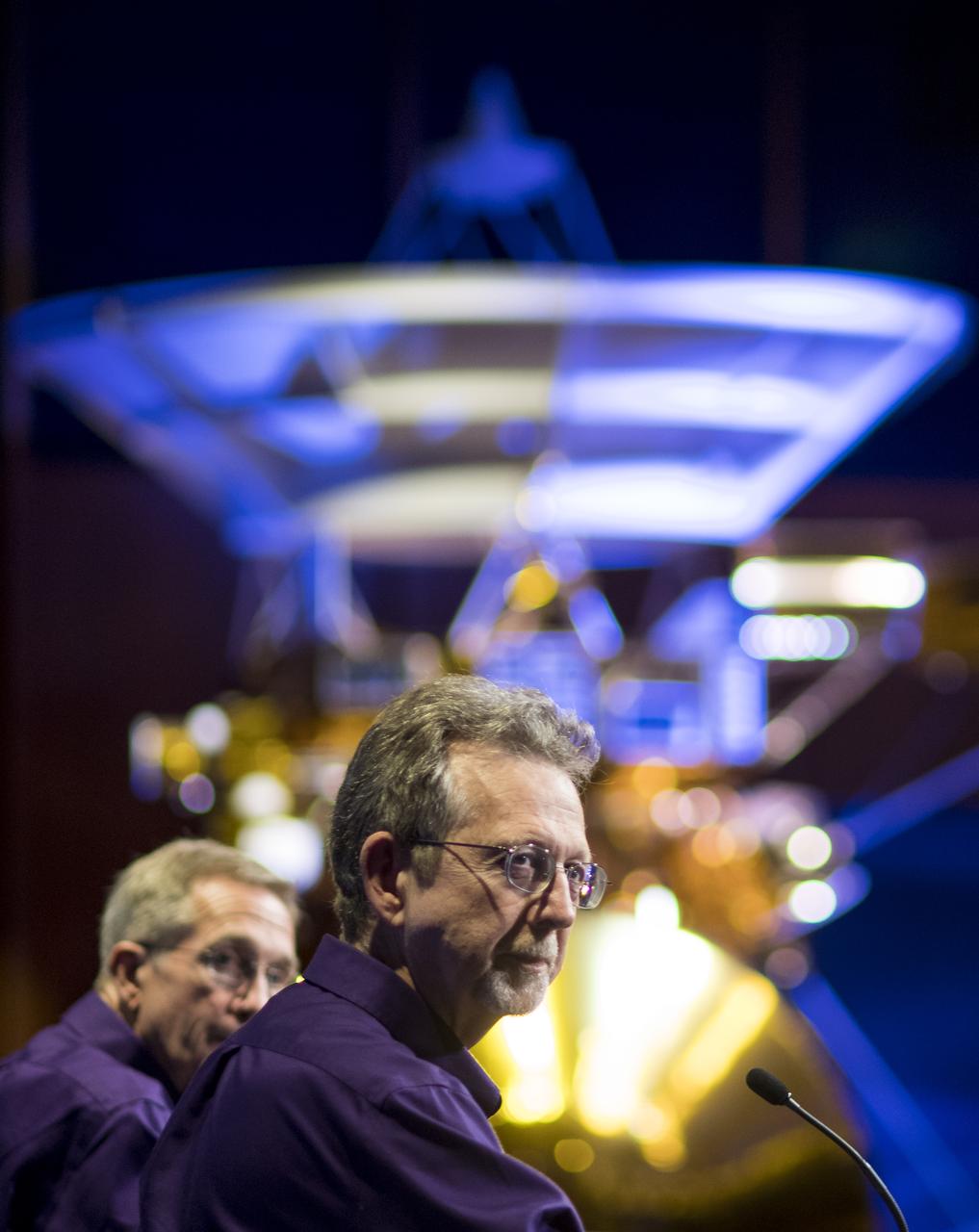
HQ · 2017-09-13 · NHQ201709130117
Cassini End of Mission Preview
Director of NASA's Planetary Science Division, Jim Green, is seen during a press conference previewing Cassini's End of Mission, Wednesday, Sept. 13, 2017 at NASA's Jet Propulsion Laboratory…
Inspect NASA record
Director of NASA's Planetary Science Division, Jim Green, is seen during a press conference previewing Cassini's End of Mission, Wednesday, Sept. 13, 2017 at NASA's Jet Propulsion Laboratory in Pasadena, California. Since its arrival in 2004, the Cassini-Huygens mission has been a discovery machine, revolutionizing our knowledge of the Saturn system and captivating us with data and images never before obtained with such detail and clarity. On Sept. 15, 2017, operators will deliberately plunge the spacecraft into Saturn, as Cassini gathered science until the end. The “plunge” ensures Saturn’s moons will remain pristine for future exploration. During Cassini’s final days, mission team members from all around the world gathered at NASA’s Jet Propulsion Laboratory, Pasadena, California, to celebrate the achievements of this historic mission. Photo Credit: (NASA/Joel Kowsky)
- Record ID
- NHQ201709130117
- NASA center
- HQ
- Date
- 2017-09-13
- Credit
- NASA/Joel Kowsky
- Keywords
- Cassini, Cassini Grand Finale, Jet Propulsion Laboratory (JPL), Jim Green
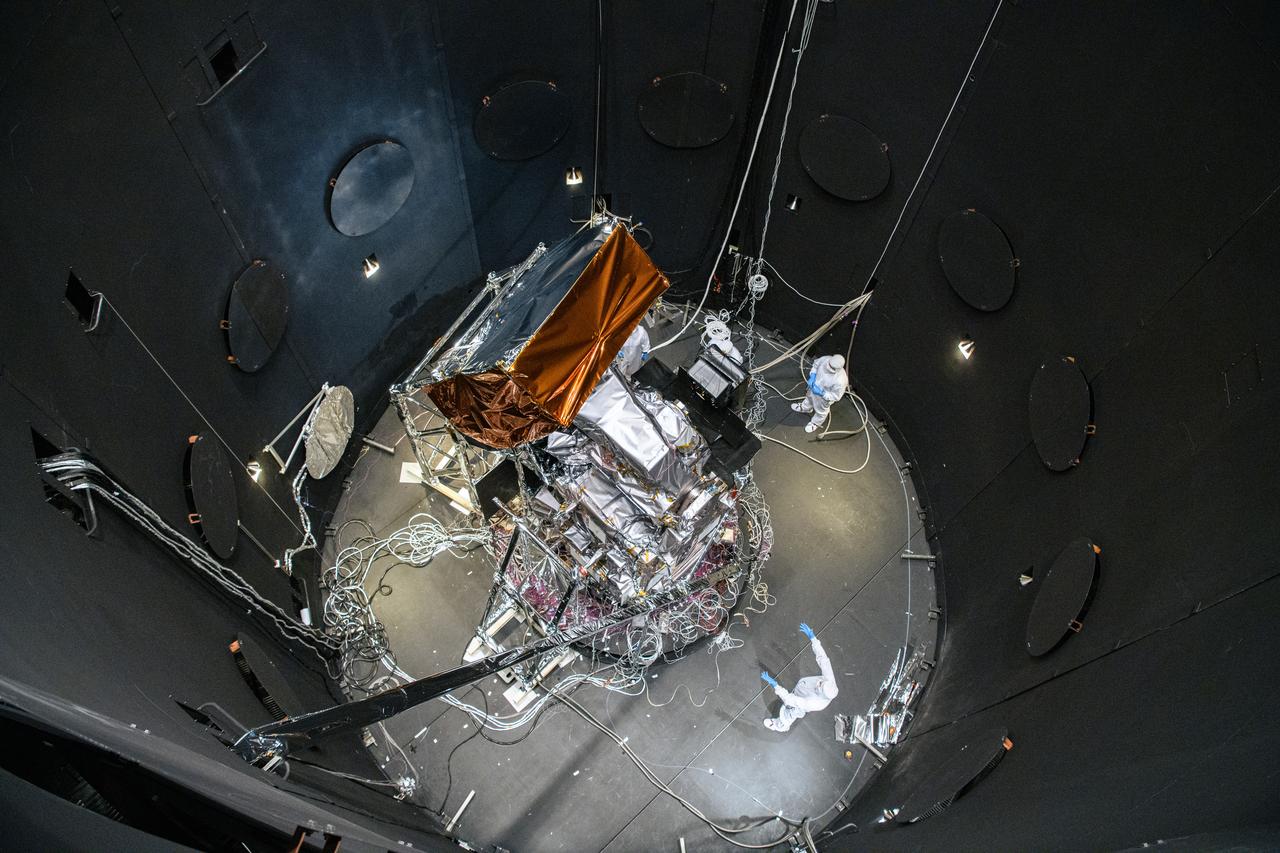
GSFC · 2023-06-16 · GSFC_20230616_PACE_019371
GSFC_20230616_PACE_019371
The Plankton, Aerosol, Cloud, ocean Ecosystem (PACE) Observatory inside the Space Environment Simulator (SES) thermal vacuuum chamber before thermal environmental testing at NASA's Goddard Space Flight Center in…
Inspect NASA record
The Plankton, Aerosol, Cloud, ocean Ecosystem (PACE) Observatory inside the Space Environment Simulator (SES) thermal vacuuum chamber before thermal environmental testing at NASA's Goddard Space Flight Center in Greenbelt, Maryland on June 16th, 2023. PACE's unprecedented spectral coverage will provide the first-ever global measurements designed to identify phytoplankton community composition. The mission will make global ocean color measurements, using the Ocean Color Instrument (OCI), to provide extended data records on ocean ecology and global biogeochemistry along with polarimetry measurements, using the Spectro-polarimeter for Planetary Exploration (SPEXone) and the Hyper Angular Research Polarimeter (HARP2) to provide extended data records on clouds and aerosols. The Earth-observing satellite mission, built at Goddard Space Flight Center in Greenbelt, MD, will continue and advance observations of global ocean color, biogeochemistry, and ecology, as well as the carbon cycle, aerosols and clouds.
- Record ID
- GSFC_20230616_PACE_019371
- NASA center
- GSFC
- Date
- 2023-06-16
- Credit
- NASA / Denny Henry
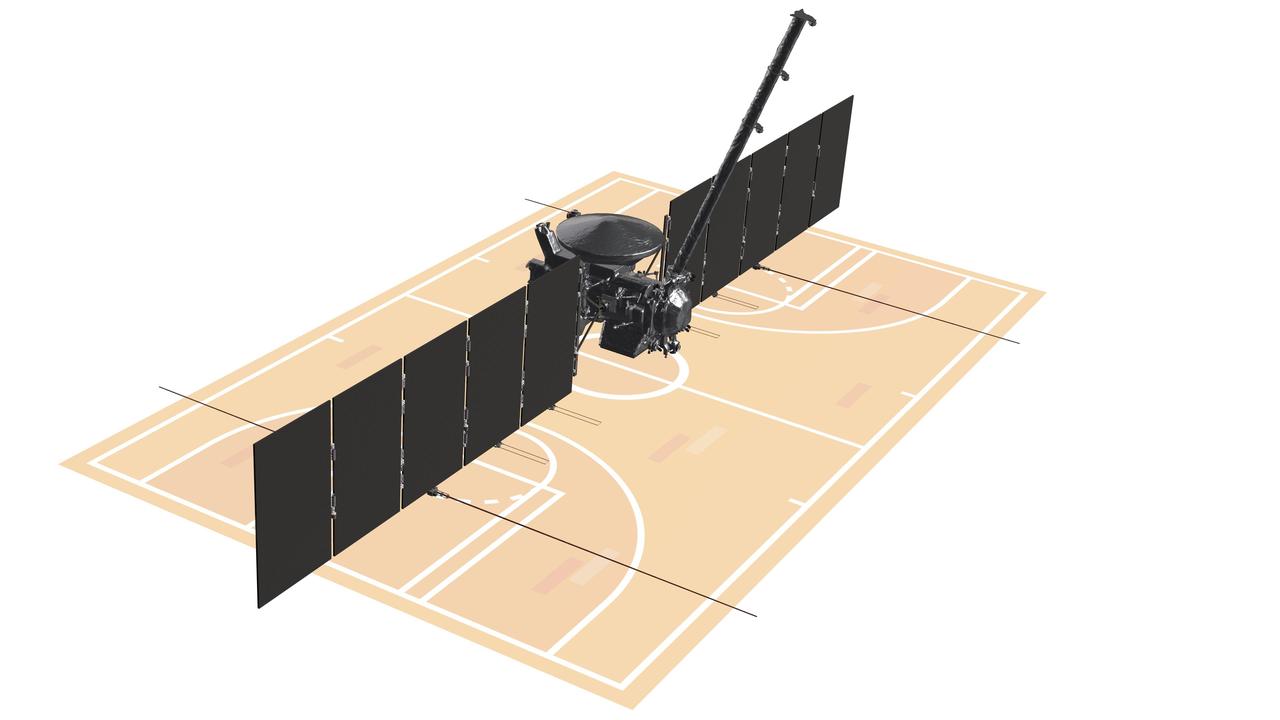
JPL · 2024-09-10 · PIA26433
Europa Clipper: NASA's Largest Planetary Spacecraft (Artist's Concept)
With its solar arrays and antennas fully extended, the Europa Clipper spacecraft stretches out larger than a basketball court: approximately 100 feet (30.5 meters) long and 58 feet…
Inspect NASA record
With its solar arrays and antennas fully extended, the Europa Clipper spacecraft stretches out larger than a basketball court: approximately 100 feet (30.5 meters) long and 58 feet (17.6 meters) wide. Depicted in this artist's concept against an illustration of a basketball court, Europa Clipper is the largest spacecraft NASA has ever built for a planetary mission. Europa Clipper is bound for the Jupiter system, where it will study the gas giant's icy moon Europa. Europa Clipper's three main science objectives are to determine the thickness of the moon's icy shell and its interactions with the ocean below, to investigate its composition, and to characterize its geology. The mission's detailed exploration of Europa will help scientists better understand the astrobiological potential for habitable worlds beyond our planet. https://photojournal.jpl.nasa.gov/catalog/PIA26433
- Record ID
- PIA26433
- NASA center
- JPL
- Date
- 2024-09-10
- Credit
- NASA/JPL-Caltech
- Keywords
- Europa Clipper, Europa
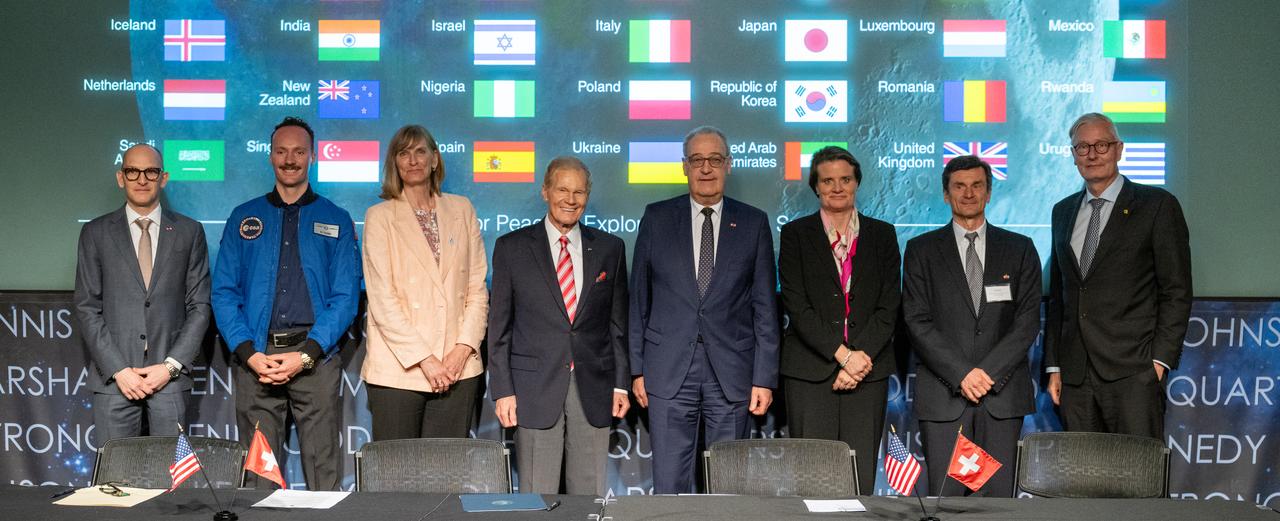
HQ · 2024-04-15 · NHQ202404150011
Switzerland Artemis Accords Signing
From left to right, Head of Swiss Space Office Renato Krpoun, ESA (European Space Agency) astronaut Marco Sieber, Acting Department of State Deputy Assistant Secretary Valda Vikmanis, NASA…
Inspect NASA record
From left to right, Head of Swiss Space Office Renato Krpoun, ESA (European Space Agency) astronaut Marco Sieber, Acting Department of State Deputy Assistant Secretary Valda Vikmanis, NASA Administrator Bill Nelson, Swiss Federal Councillor Guy Parmelin, and Swiss State Secretary Martina Hirayama, University of Bern Director Space & Planetary Sciences Peter Wurz, and Swiss Ambassador to the United States Jacques Pitteloud, pose for a photo during an Artemis Accords signing ceremony, Monday, April 15, 2024, at the Mary W. Jackson NASA Headquarters building in Washington. Switzerland is the 37th country to sign the Artemis Accords, which establish a practical set of principles to guide space exploration cooperation among nations participating in NASA’s Artemis program. Photo Credit: (NASA/Keegan Barber)
- Record ID
- NHQ202404150011
- NASA center
- HQ
- Date
- 2024-04-15
- Credit
- NASA/Keegan Barber
- Keywords
- Artemis Accords, Bill Nelson, DC, Department of State, Guy Parmelin, Jacques Pitteloud, Marco Sieber, Martina Hirayama, Mary W. Jackson NASA Headquarters, NASA Administrator, Peter Wurz, Renato Krpoun