
Update Site (from NASA)
Explore NASA’s Image and Video Library.
Suggest one object per day for the Interstellar Minds collection. We review each suggestion before adding it.
Sign in to suggest a Marvel.
Find a NASA image ID. Open a NASA record and copy its ID from the end of the details URL.
NASA image records
KSC · 2012-06-12 · KSC-2012-3316
KSC-2012-3316
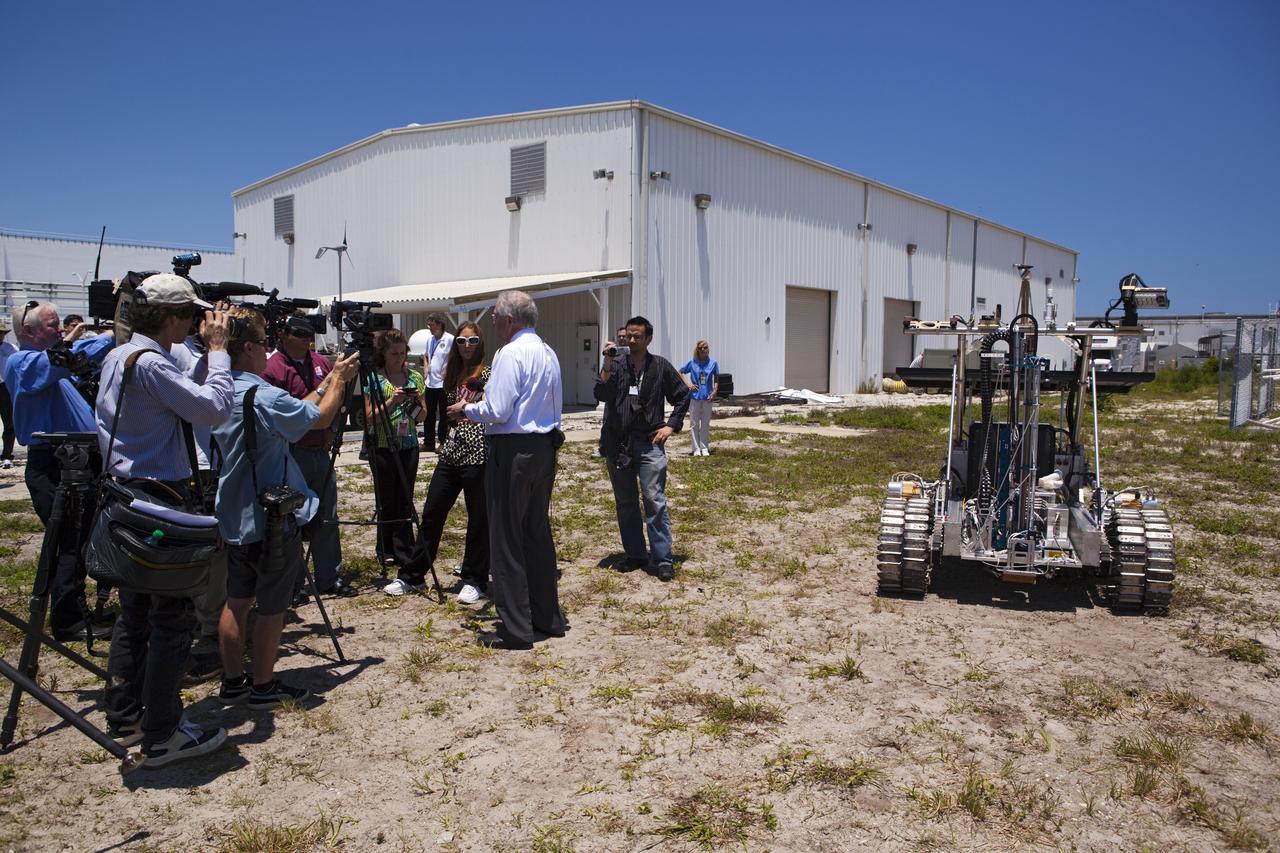
CAPE CANAVERAL, Fla. – NASA In Situ Resource Utilization Project Manager William Larson, back to rover, discusses the design and operation of the prototype rover Artemis Jr. for…
Inspect NASA record
CAPE CANAVERAL, Fla. – NASA In Situ Resource Utilization Project Manager William Larson, back to rover, discusses the design and operation of the prototype rover Artemis Jr. for NASA’s Regolith and Environment Science and Oxygen and Lunar Volatile Extraction, or RESOLVE, project with media representatives during a rover demonstration in a field beside the Operations and Checkout Building at NASA’s Kennedy Space Center in Florida. The rover and its drill are provided by the Canadian Space Agency and work in concert with NASA science instruments to prospect for water, ice and other lunar resources. RESOLVE also will demonstrate how future explorers can take advantage of resources at potential landing sites by manufacturing oxygen from soil. NASA will conduct field tests in July outside of Hilo, Hawaii, with equipment and concept vehicles that demonstrate how explorers might prospect for resources and make their own oxygen for survival while on other planetary bodies. For more information, visit http://www.nasa.gov/exploration/analogs/index.html. Photo credit: NASA/Dimitri Gerondidakis
- Record ID
- KSC-2012-3316
- NASA center
- KSC
- Date
- 2012-06-12
KSC · 2012-08-01 · KSC-2012-4163
KSC-2012-4163
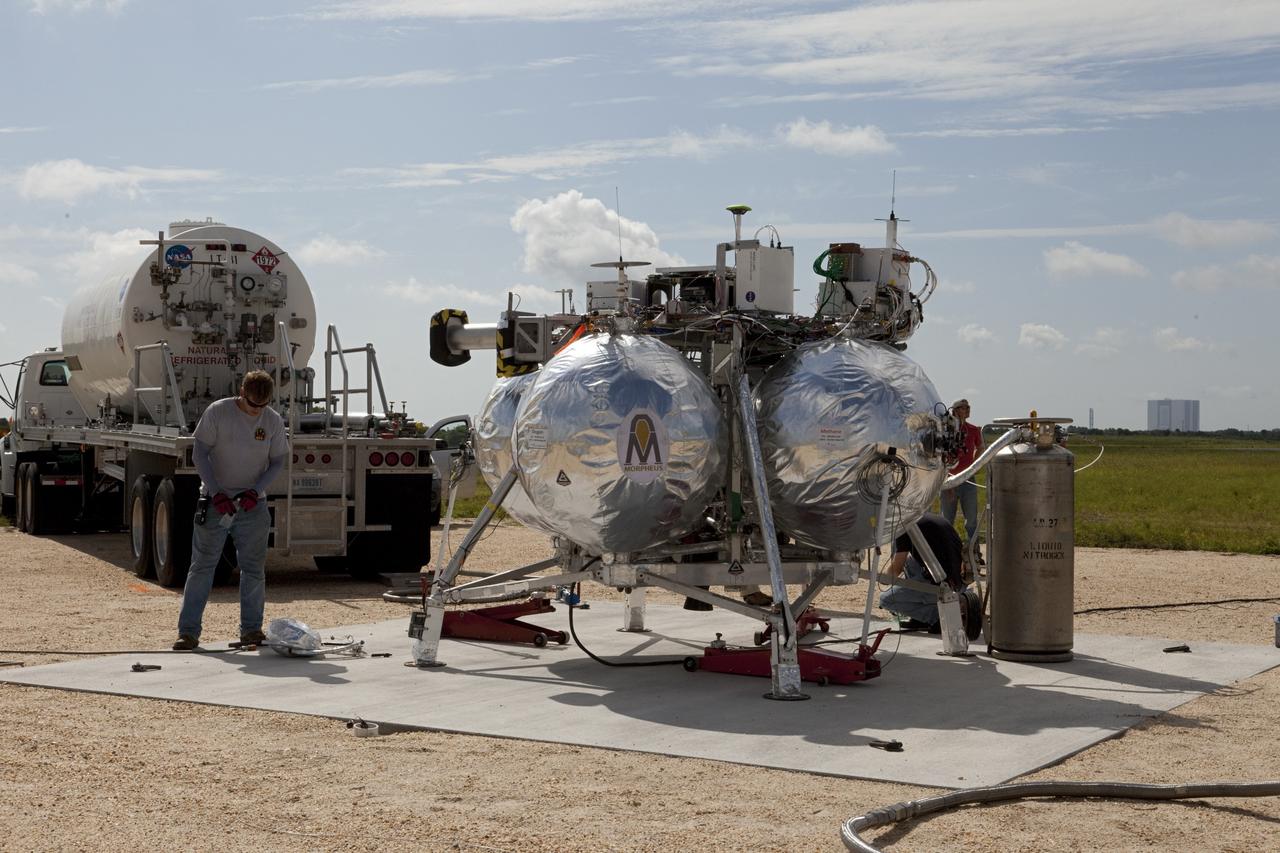
CAPE CANAVERAL, Fla. - At the north end of the Shuttle Landing Facility, or SLF, at the Kennedy Space Center in Florida, NASA's Morpheus lander, a vertical test…
Inspect NASA record
CAPE CANAVERAL, Fla. - At the north end of the Shuttle Landing Facility, or SLF, at the Kennedy Space Center in Florida, NASA's Morpheus lander, a vertical test bed vehicle is being checked out. A rock and crater-filled planetary scape, has been built so engineers can test the Autonomous Landing and Hazard Avoidance Technology, or ALHAT, system on the Project Morpheus lander. Checkout of the prototype lander has been ongoing at NASA’s Johnson Space Center in Houston in preparation for its first free flight. The SLF site will provide the lander with the kind of field necessary for realistic testing. Project Morpheus is one of 20 small projects comprising the Advanced Exploration Systems, or AES, program in NASA’s Human Exploration and Operations Mission Directorate. AES projects pioneer new approaches for rapidly developing prototype systems, demonstrating key capabilities and validating operational concepts for future human missions beyond Earth orbit. For more information on Project Morpheus, visit http://www.nasa.gov/centers/johnson/exploration/morpheus/index.html Photo credit: NASA/Kim Shiflett
- Record ID
- KSC-2012-4163
- NASA center
- KSC
- Date
- 2012-08-01
- Keywords
- SLF, Morpheus, lander, test, ALHAT
JPL · 2021-07-20 · PIA24762
PIXL's First Chemical Maps
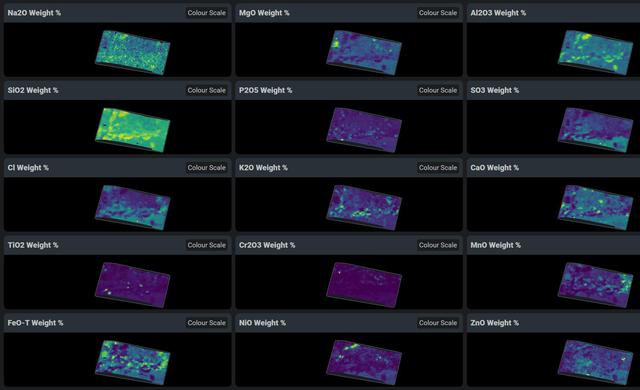
This data shows chemicals detected within a single rock on Mars by the Planetary Instrument for X-ray Lithochemistry (PIXL), one of the instruments on the end of the…
Inspect NASA record
This data shows chemicals detected within a single rock on Mars by the Planetary Instrument for X-ray Lithochemistry (PIXL), one of the instruments on the end of the robotic arm aboard NASA's Perseverance Mars rover. PIXL allows scientists to study where specific chemicals can be found within an area as small as a postage stamp. A key objective for Perseverance's mission on Mars is astrobiology, including the search for signs of ancient microbial life. The rover will characterize the planet's geology and past climate, pave the way for human exploration of the Red Planet, and be the first mission to collect and cache Martian rock and regolith (broken rock and dust). Subsequent NASA missions, in cooperation with ESA (European Space Agency), would send spacecraft to Mars to collect these sealed samples from the surface and return them to Earth for in-depth analysis. The Mars 2020 Perseverance mission is part of NASA's Moon to Mars exploration approach, which includes Artemis missions to the Moon that will help prepare for human exploration of the Red Planet. https://photojournal.jpl.nasa.gov/catalog/PIA24762
- Record ID
- PIA24762
- NASA center
- JPL
- Date
- 2021-07-20
- Credit
- NASA/JPL-Caltech
- Keywords
- Mars 2020, Mars
KSC · 2011-05-04 · KSC-2011-3291
KSC-2011-3291
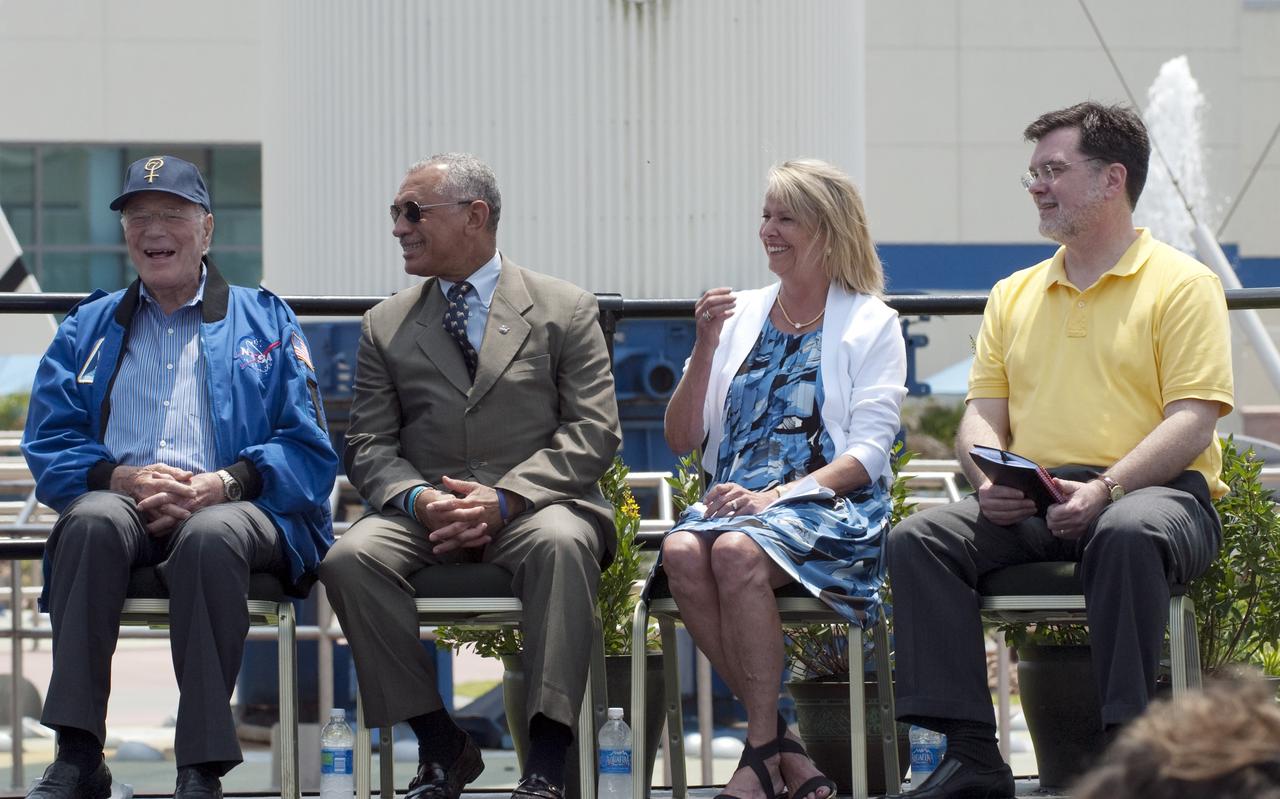
CAPE CANAVERAL, Fla. -- In the Rocket Garden at NASA's Kennedy Space Center Visitor Complex in Florida, Mercury Astronaut Scott Carpenter, NASA Administrator Charlie Bolden, Julie Jenkins, daughter…
Inspect NASA record
CAPE CANAVERAL, Fla. -- In the Rocket Garden at NASA's Kennedy Space Center Visitor Complex in Florida, Mercury Astronaut Scott Carpenter, NASA Administrator Charlie Bolden, Julie Jenkins, daughter of Mercury Astronaut Alan Shepard, and NASA's Deputy Director for Planetary Science, Jim Adams, enjoy a light moment during an event unveiling two new stamps to commemorate the 50th anniversary of human spaceflight from the United States Postal Service. One stamp commemorates NASA's Project Mercury and Alan Shepard's historic launch on May 5, 1961, aboard the spacecraft Freedom 7. The second stamp honors NASA's MESSENGER, which reached Mercury in March to become the first spacecraft to orbit the planet. The two missions frame a remarkable 50-year period in which America advanced space exploration through more than 1,500 crewed and uncrewed flights. Photo credit: NASA/Kim Shiflett
- Record ID
- KSC-2011-3291
- NASA center
- KSC
- Date
- 2011-05-04
- Keywords
- stamps, visitor complex
JPL · 2021-12-20 · PIA24896
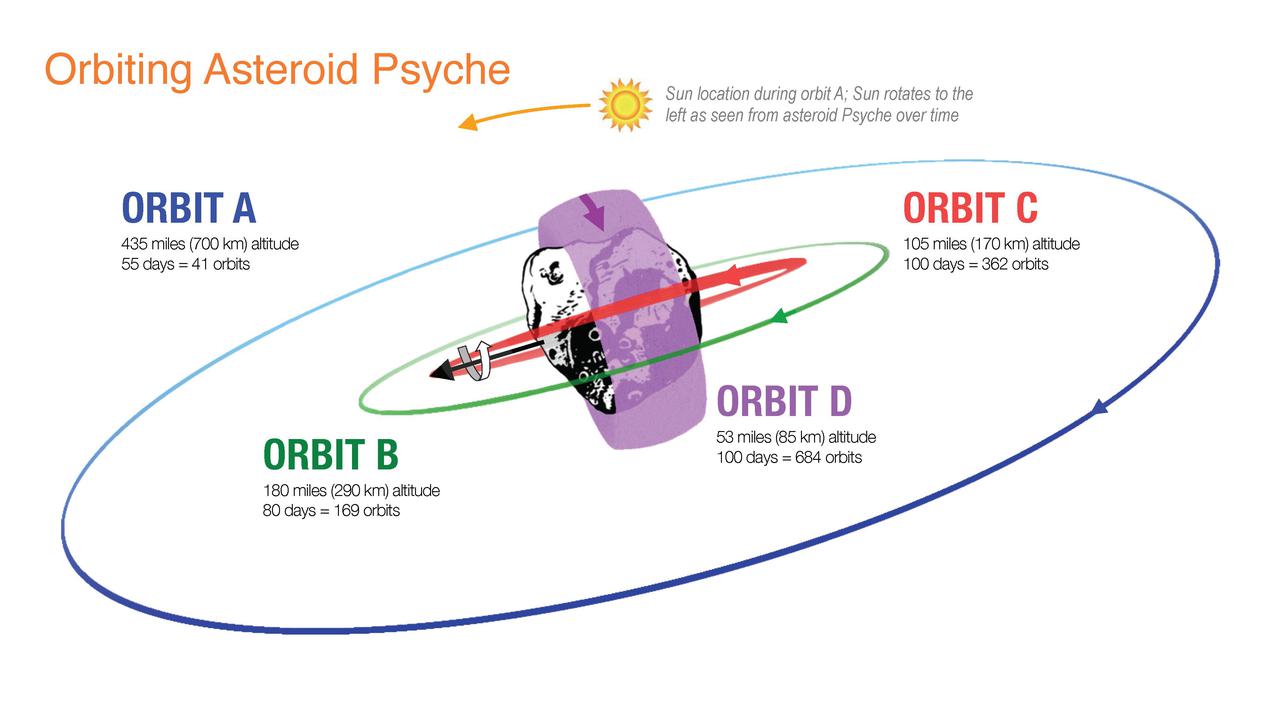
Orbiting Asteroid Psyche (Illustration)
This illustration shows how NASA's Psyche spacecraft will explore the asteroid Psyche, beginning with Orbit A when it arrives at the asteroid in early 2026. The initial orbit…
Inspect NASA record
This illustration shows how NASA's Psyche spacecraft will explore the asteroid Psyche, beginning with Orbit A when it arrives at the asteroid in early 2026. The initial orbit is designed to be at a high altitude – about 435 miles (700 kilometers) above the asteroid's surface. Over the following 20 months, the spacecraft will use its electric propulsion system to dip into lower and lower orbits as it conducts its science investigation. Eventually, the spacecraft will establish a final orbit (Orbit D) about 53 miles (85 kilometers) above the surface. Set to launch in August 2022, Psyche will investigate a metal-rich asteroid of the same name, which lies in the main asteroid belt between Mars and Jupiter. Scientists believe the asteroid could be part or all of the iron-rich interior of an early planetary building block that was stripped of its outer rocky shell as it repeatedly collided with other large bodies during the early formation of the solar system. https://photojournal.jpl.nasa.gov/catalog/PIA24896
- Record ID
- PIA24896
- NASA center
- JPL
- Date
- 2021-12-20
- Credit
- NASA/JPL-Caltech
- Keywords
- Psyche, Asteroid
GSFC · 2023-06-01 · GSFC_20230601_PACE_017587
GSFC_20230601_PACE_017587
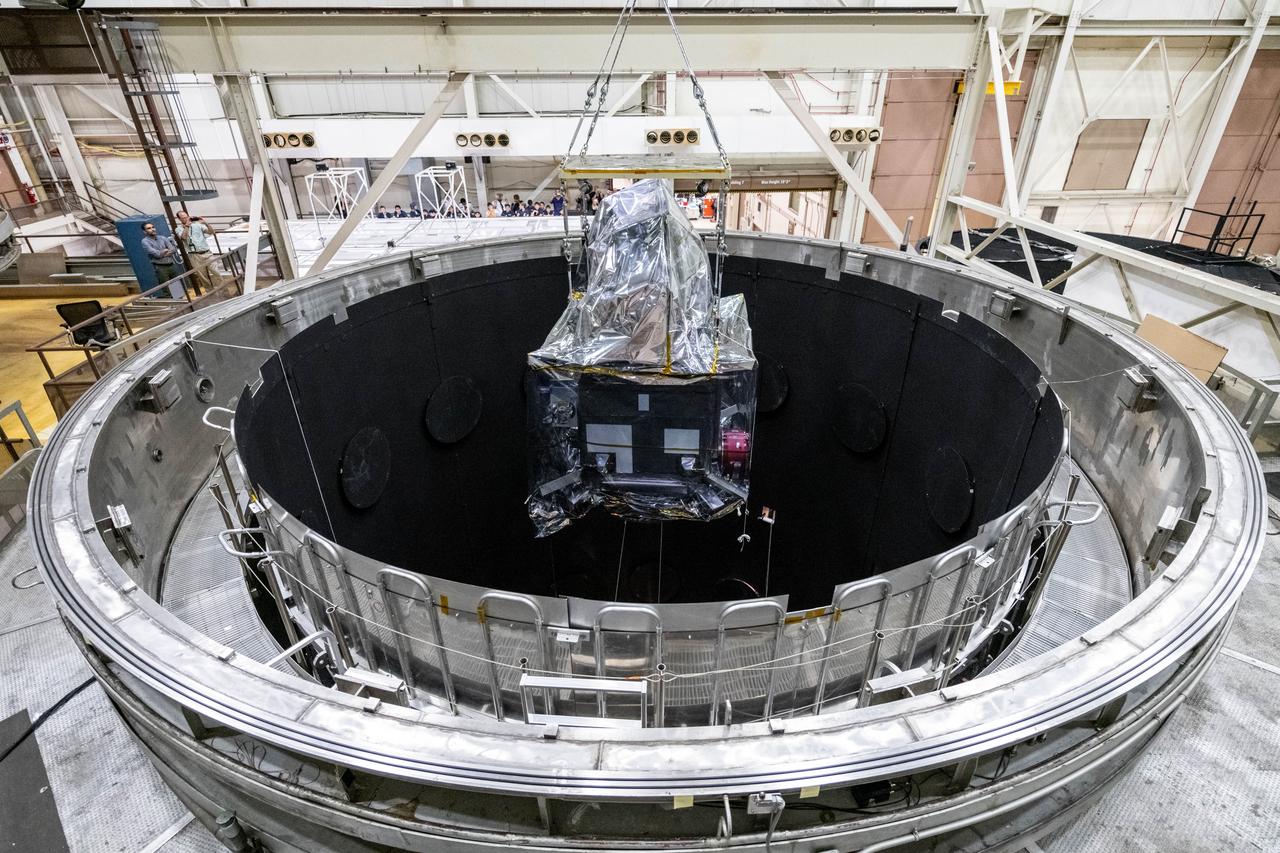
The Plankton, Aerosol, Cloud, ocean Ecosystem (PACE) Observatory is lowered into the Space Environment Simulator (SES) thermal vacuuum chamber at NASA's Goddard Space Flight Center in Greenbelt, Maryland…
Inspect NASA record
The Plankton, Aerosol, Cloud, ocean Ecosystem (PACE) Observatory is lowered into the Space Environment Simulator (SES) thermal vacuuum chamber at NASA's Goddard Space Flight Center in Greenbelt, Maryland on June 1st, 2023. PACE's unprecedented spectral coverage will provide the first-ever global measurements designed to identify phytoplankton community composition. The mission will make global ocean color measurements, using the Ocean Color Instrument (OCI), to provide extended data records on ocean ecology and global biogeochemistry along with polarimetry measurements, using the Spectro-polarimeter for Planetary Exploration (SPEXone) and the Hyper Angular Research Polarimeter (HARP2) to provide extended data records on clouds and aerosols. The Earth-observing satellite mission, built at Goddard Space Flight Center in Greenbelt, MD, will continue and advance observations of global ocean color, biogeochemistry, and ecology, as well as the carbon cycle, aerosols and clouds.
- Record ID
- GSFC_20230601_PACE_017587
- NASA center
- GSFC
- Date
- 2023-06-01
- Credit
- NASA / Katie Mellos
HQ · 2018-11-25 · NHQ201811250016
Mars InSight Pre-Landing Briefing
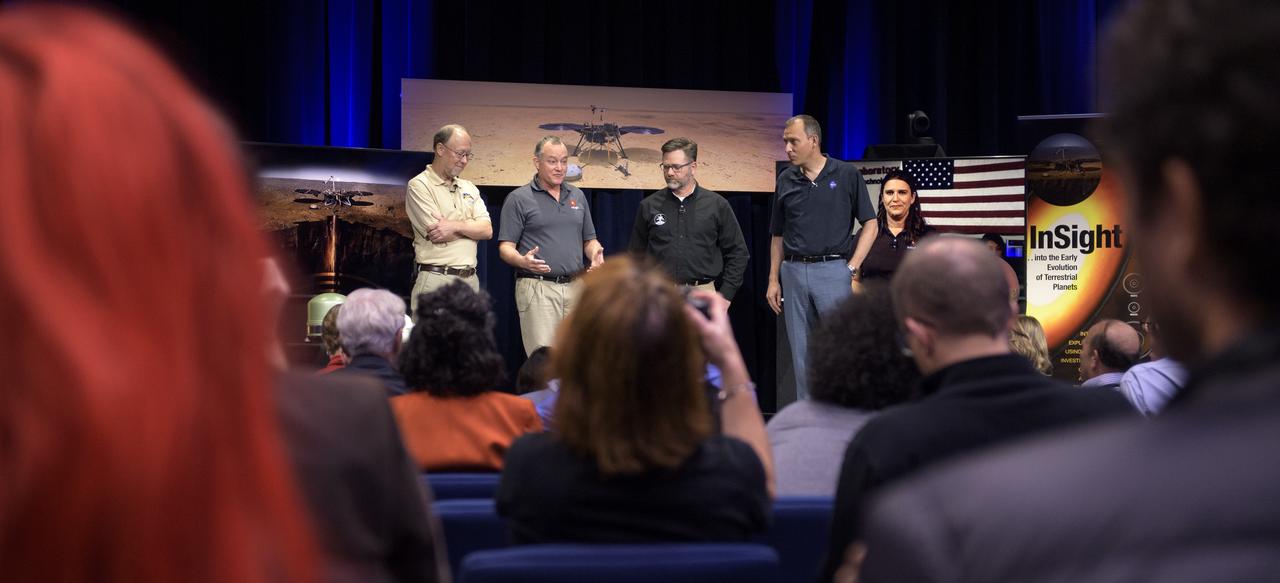
From left to right: Bruce Banerdt, InSight Principal Investigator, NASA JPL; Tom Hoffman, InSight Project Manager, NASA JPL; Brian Clement, Planetary Protection lead for MarCO, NASA JPL; Thomas…
Inspect NASA record
From left to right: Bruce Banerdt, InSight Principal Investigator, NASA JPL; Tom Hoffman, InSight Project Manager, NASA JPL; Brian Clement, Planetary Protection lead for MarCO, NASA JPL; Thomas Zurbuchen, Associate Administrator of NASA’s Science Mission Directorate, NASA Headquarters; and Julie Wertz-Chen, Entry, Descent and Landing systems engineer, NASA JPL, talk about Mars InSight and Mars Cube One (MarCO) during a pre-landing briefing, Sunday, Nov. 25, 2018 at NASA's Jet Propulsion Laboratory in Pasadena, California. InSight, short for Interior Exploration using Seismic Investigations, Geodesy and Heat Transport, is a Mars lander designed to study the "inner space" of Mars: its crust, mantle, and core. InSight is scheduled to touch down on the Red Planet at approximately noon PST (3 p.m. EST) on Nov. 26. Photo Credit: (NASA/Bill Ingalls)
- Record ID
- NHQ201811250016
- NASA center
- HQ
- Date
- 2018-11-25
- Credit
- NASA/Bill Ingalls
- Keywords
- Brian Clement, Bruce Banerdt, California, Jet Propulsion Laboratory (JPL), Julie Wertz-Chen, Mars Cube One (MarCO), Mars Interior Exploration using Seismic Investigations Geodesy a, Pasadena, Thomas Zurbuchen, Tom Hoffman
HQ · 2018-11-25 · NHQ201811250018
Mars InSight Pre-Landing Briefing
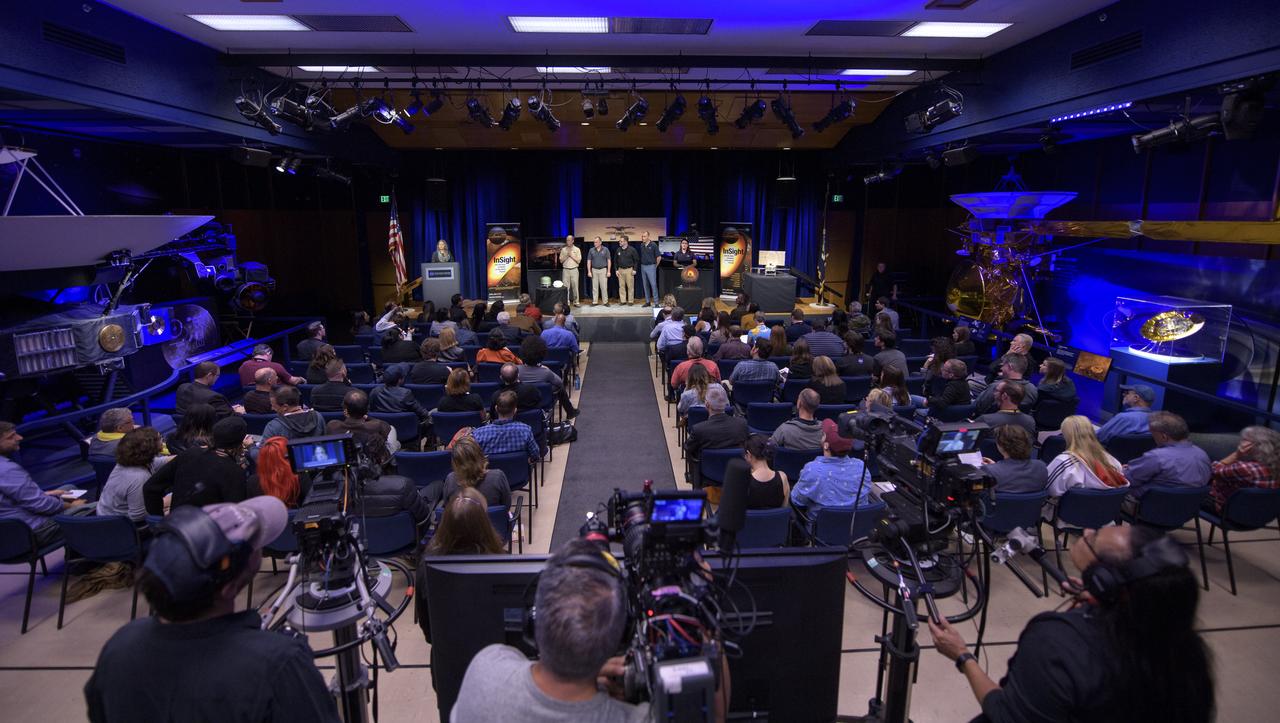
From left to right: Bruce Banerdt, InSight Principal Investigator, NASA JPL; Tom Hoffman, InSight Project Manager, NASA JPL; Brian Clement, Planetary Protection lead for MarCO, NASA JPL; Thomas…
Inspect NASA record
From left to right: Bruce Banerdt, InSight Principal Investigator, NASA JPL; Tom Hoffman, InSight Project Manager, NASA JPL; Brian Clement, Planetary Protection lead for MarCO, NASA JPL; Thomas Zurbuchen, Associate Administrator of NASA’s Science Mission Directorate, NASA Headquarters; and Julie Wertz-Chen, Entry, Descent and Landing systems engineer, NASA JPL, talk about Mars InSight and Mars Cube One (MarCO) during a pre-landing briefing, Sunday, Nov. 25, 2018 at NASA's Jet Propulsion Laboratory in Pasadena, California. InSight, short for Interior Exploration using Seismic Investigations, Geodesy and Heat Transport, is a Mars lander designed to study the "inner space" of Mars: its crust, mantle, and core. InSight is scheduled to touch down on the Red Planet at approximately noon PST (3 p.m. EST) on Nov. 26. Photo Credit: (NASA/Bill Ingalls)
- Record ID
- NHQ201811250018
- NASA center
- HQ
- Date
- 2018-11-25
- Credit
- NASA/Bill Ingalls
- Keywords
- Brian Clement, Bruce Banerdt, California, Jet Propulsion Laboratory (JPL), Julie Wertz-Chen, Mars Cube One (MarCO), Mars Interior Exploration using Seismic Investigations Geodesy a, Pasadena, Thomas Zurbuchen, Tom Hoffman

HQ · 2017-09-13 · NHQ201709130109
Cassini End of Mission Preview
director of NASA's Planetary Science Division, Jim Green answers questions a press conference previewing Cassini's End of Mission, Wednesday, Sept. 13, 2017 at NASA's Jet Propulsion Laboratory in…
Inspect NASA record
director of NASA's Planetary Science Division, Jim Green answers questions a press conference previewing Cassini's End of Mission, Wednesday, Sept. 13, 2017 at NASA's Jet Propulsion Laboratory in Pasadena, California. Since its arrival in 2004, the Cassini-Huygens mission has been a discovery machine, revolutionizing our knowledge of the Saturn system and captivating us with data and images never before obtained with such detail and clarity. On Sept. 15, 2017, operators will deliberately plunge the spacecraft into Saturn, as Cassini gathered science until the end. The “plunge” ensures Saturn’s moons will remain pristine for future exploration. During Cassini’s final days, mission team members from all around the world gathered at NASA’s Jet Propulsion Laboratory, Pasadena, California, to celebrate the achievements of this historic mission. Photo Credit: (NASA/Joel Kowsky)
- Record ID
- NHQ201709130109
- NASA center
- HQ
- Date
- 2017-09-13
- Credit
- NASA/Joel Kowsky
- Keywords
- Cassini, Cassini Grand Finale, Jet Propulsion Laboratory (JPL), Jim Green

KSC · 1999-04-05 · KSC-99pp0380
KSC-99pp0380
Workers in Hangar AE, Cape Canaveral Air Station, begin removing the plastic covering from NASA's Far Ultraviolet Spectroscopic Explorer (FUSE) satellite before prelaunch processing. FUSE will undergo a…
Inspect NASA record
Workers in Hangar AE, Cape Canaveral Air Station, begin removing the plastic covering from NASA's Far Ultraviolet Spectroscopic Explorer (FUSE) satellite before prelaunch processing. FUSE will undergo a functional test of its systems, followed by installation of the flight batteries and solar arrays. Tests are also scheduled for the communications and data systems linking FUSE with the spacecraft control center at The Johns Hopkins University, Baltimore, Md. FUSE was developed and will be operated by The Johns Hopkins University under contract to Goddard Space Flight Center, Greenbelt, Md. FUSE will investigate the origin and evolution of the lightest elements in the universe hydrogen and deuterium. In addition, the FUSE satellite will examine the forces and process involved in the evolution of the galaxies, stars and planetary systems by investigating light in the far ultraviolet portion of the electromagnetic spectrum. The launch aboard a Boeing Delta II rocket is targeted for May 20 at Launch Complex 17
- Record ID
- KSC-99pp0380
- NASA center
- KSC
- Date
- 1999-04-05
GSFC · 2023-10-31 · GSFC_20231031_PACE_030764
GSFC_20231031_PACE_030764
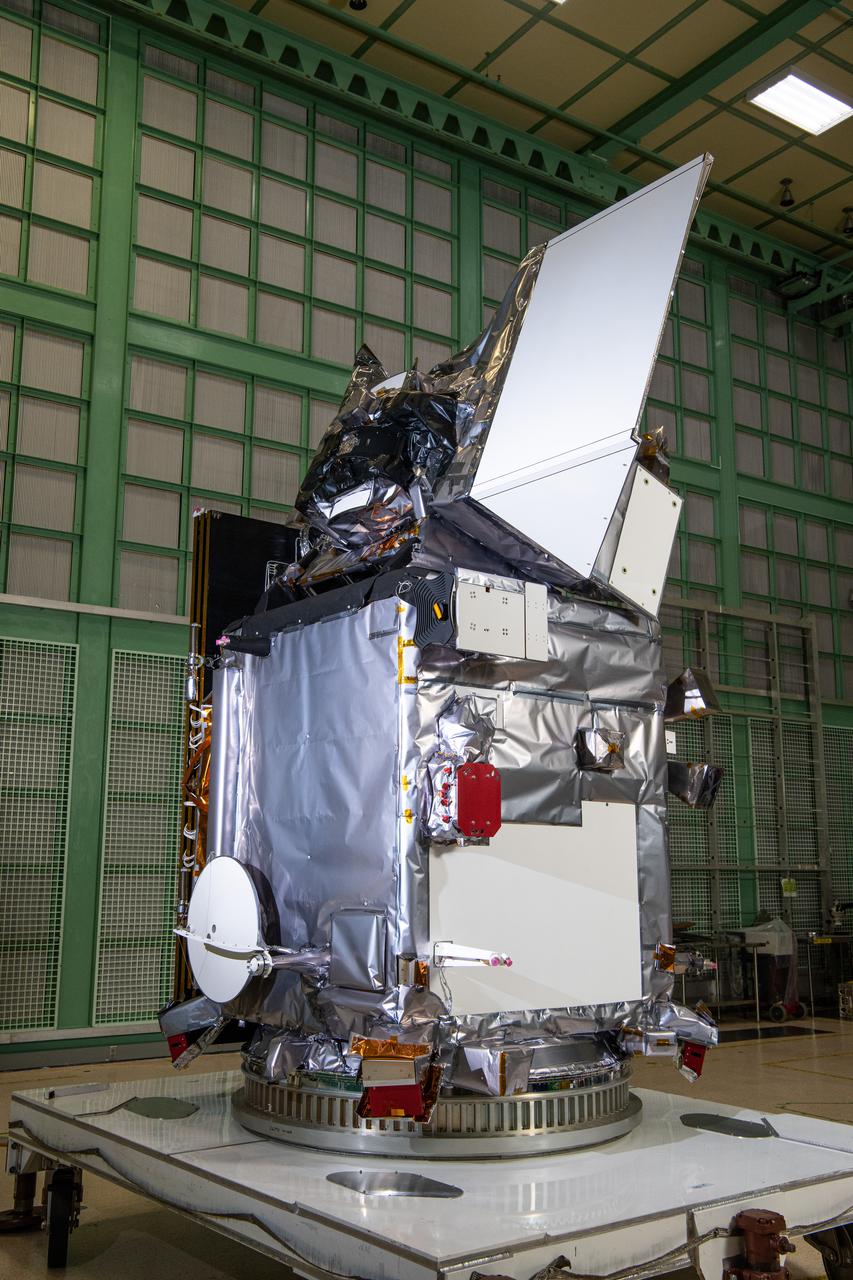
The Plankton, Aerosol, Cloud, ocean Ecosystem (PACE) in the clean room at NASA's Goddard Space Flight Center in Greenbelt, Maryland on October 31st, 2023. PACE's unprecedented spectral coverage…
Inspect NASA record
The Plankton, Aerosol, Cloud, ocean Ecosystem (PACE) in the clean room at NASA's Goddard Space Flight Center in Greenbelt, Maryland on October 31st, 2023. PACE's unprecedented spectral coverage will provide the first-ever global measurements designed to identify phytoplankton community composition. The mission will make global ocean color measurements, using the Ocean Color Instrument (OCI), to provide extended data records on ocean ecology and global biogeochemistry along with polarimetry measurements, using the Spectro-polarimeter for Planetary Exploration (SPEXone) and the Hyper Angular Research Polarimeter (HARP2) to provide extended data records on clouds and aerosols. The Earth-observing satellite mission, built at Goddard Space Flight Center in Greenbelt, MD, will continue and advance observations of global ocean color, biogeochemistry, and ecology, as well as the carbon cycle, aerosols and clouds.
- Record ID
- GSFC_20231031_PACE_030764
- NASA center
- GSFC
- Date
- 2023-10-31
- Credit
- NASA / Denny Henry
HQ · 2021-06-02 · NHQ202106020002
State of NASA
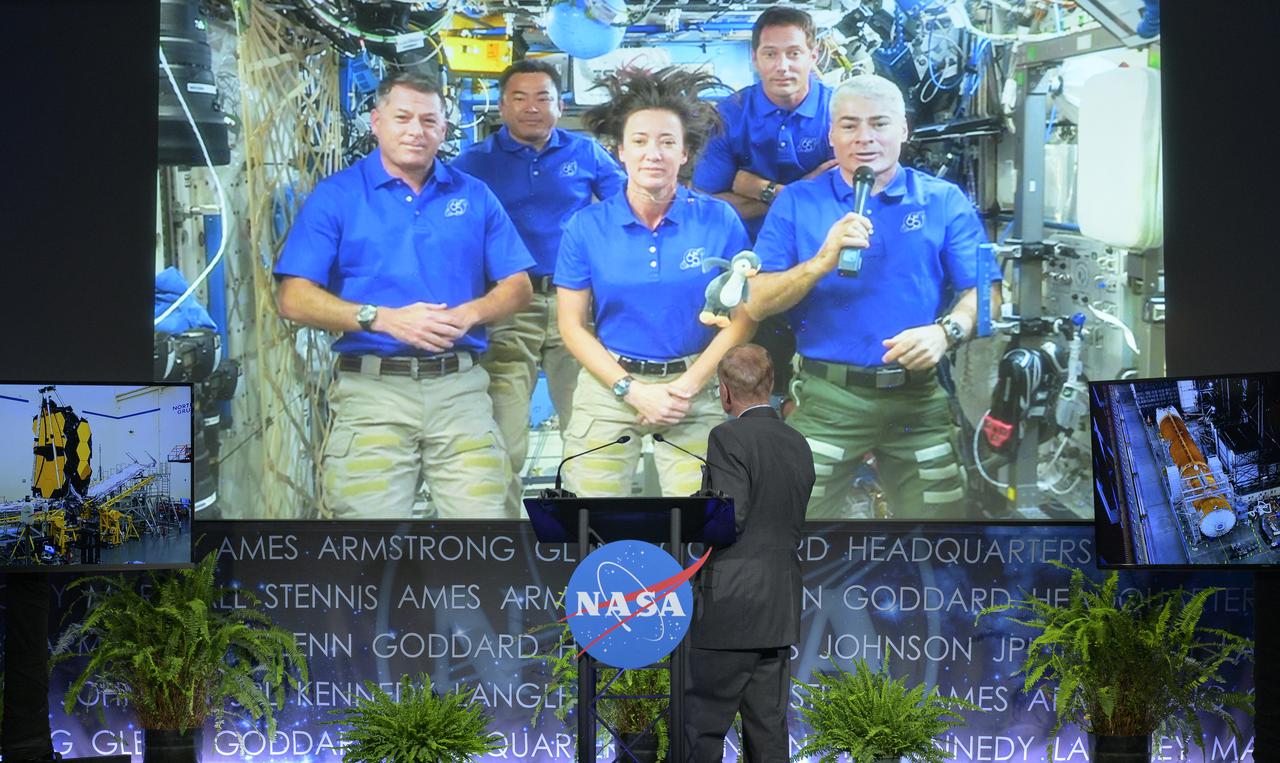
NASA Administrator Bill Nelson is welcomed by Japan Aerospace Exploration Agency (JAXA) astronaut Akihiko Hoshide, back left, ESA (European Space Agency) astronaut Thomas Pesquet, back right, NASA astronauts…
Inspect NASA record
NASA Administrator Bill Nelson is welcomed by Japan Aerospace Exploration Agency (JAXA) astronaut Akihiko Hoshide, back left, ESA (European Space Agency) astronaut Thomas Pesquet, back right, NASA astronauts Shane Kimbrough, left, Megan McArthur and Mark Vande Hei, right, from onboard the International Space Station as Nelson began to address the agency’s workforce during his first State of NASA event Wednesday, June 2, 2021, at NASA Headquarters Mary W. Jackson Building in Washington. Nelson remarked on his long history with NASA, and among other topics, discussed the agency’s plans for future Earth-focused missions to address climate change and a robotic and human return to the Moon through the Artemis program, as well as announcing two new planetary science missions to Venus – VERITAS and DAVINCI+. Photo Credit: (NASA/Bill Ingalls)
- Record ID
- NHQ202106020002
- NASA center
- HQ
- Date
- 2021-06-02
- Credit
- NASA/Bill Ingalls
- Keywords
- Akihiko Hoshide, Astronaut, Bill Nelson, DC, ESA (European Space Agency), Japan Aerospace Exploration Agency (JAXA), Mark Vande Hei, Mary W. Jackson NASA Headquarters, Megan McArthur, NASA Administrator, Shane Kimbrough, Thomas Pesquet