
Update Site (from NASA)
Explore NASA’s Image and Video Library.
Suggest one object per day for the Interstellar Minds collection. We review each suggestion before adding it.
Sign in to suggest a Marvel.
Find a NASA image ID. Open a NASA record and copy its ID from the end of the details URL.
NASA image records
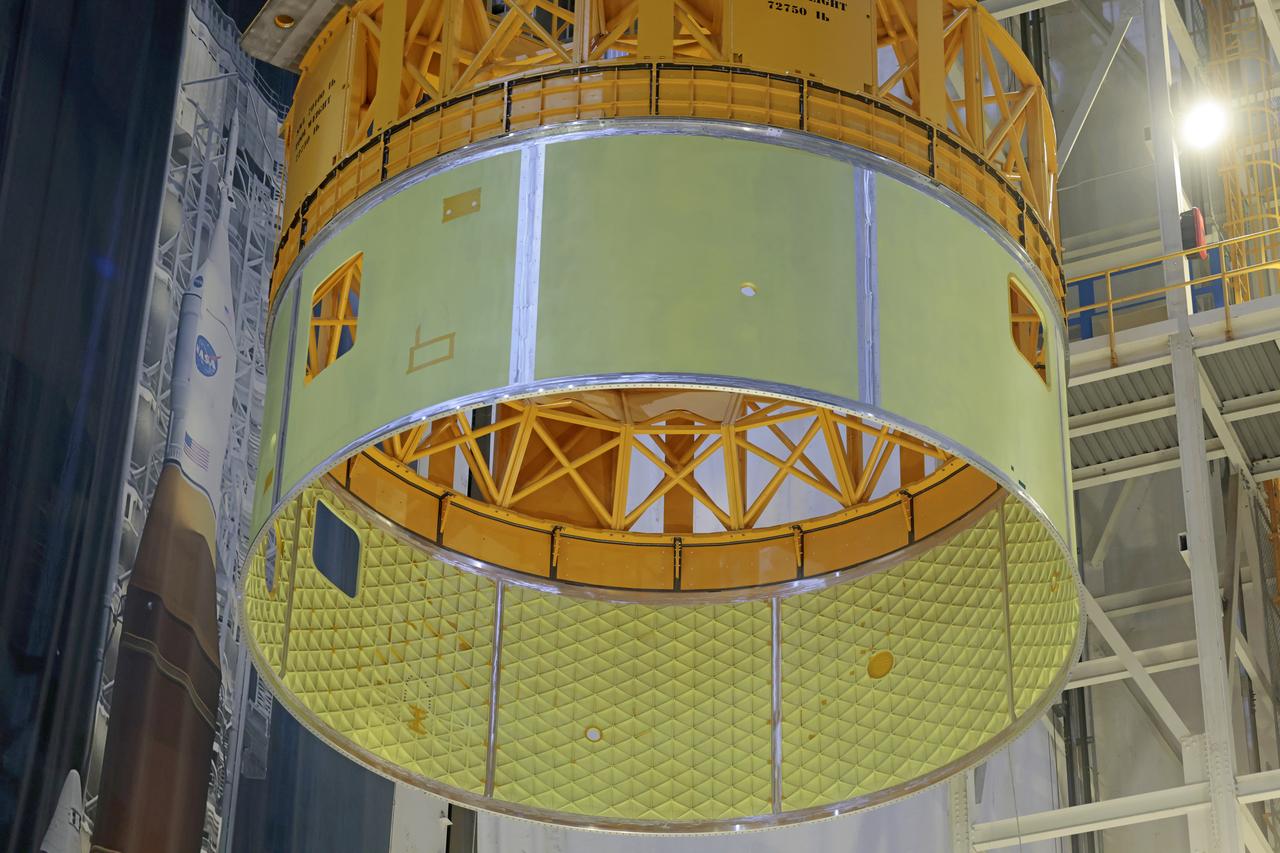
MSFC · 2025-01-31 · MAF_20250131_CS4_FSoutVAC04
Structurally Complete Forward Skirt Lifts Out of Vertical Assembly Center
This image shows teams at NASA’s Michoud Assembly Facility in New Orleans lifting a forward skirt out of its vertical assembly center on Jan. 31, 2025. The forward…
Inspect NASA record
This image shows teams at NASA’s Michoud Assembly Facility in New Orleans lifting a forward skirt out of its vertical assembly center on Jan. 31, 2025. The forward skirt, which will be used on the core stage for the agency’s SLS (Space Launch System) rocket for its Artemis IV mission, houses flight computers, cameras, and avionics. While inside the vertical assembly center, technicians attached the forward skirt’s forward and aft rings, which serve as attachments points to the launch vehicle stage adapter and the liquid oxygen tank, respectively. The forward skirt is one of five major elements that make up the 212-foot-tall rocket stage. The core stage, along with its four RS-25 engines, produce more than two million pounds of thrust to help launch NASA’s Orion spacecraft, astronauts, and supplies beyond Earth’s orbit and to the lunar surface for Artemis. Image credit: NASA/Michael DeMocker
- Record ID
- MAF_20250131_CS4_FSoutVAC04
- NASA center
- MSFC
- Date
- 2025-01-31
- Credit
- NASA/Michael DeMocker
- Keywords
- SLS, Michoud Assembly Facility, MAF, MSFC, Marshall Space Flight Center, Artemis IV, Artemis, Space Launch System, Louisiana, Mars, Moon, NASA
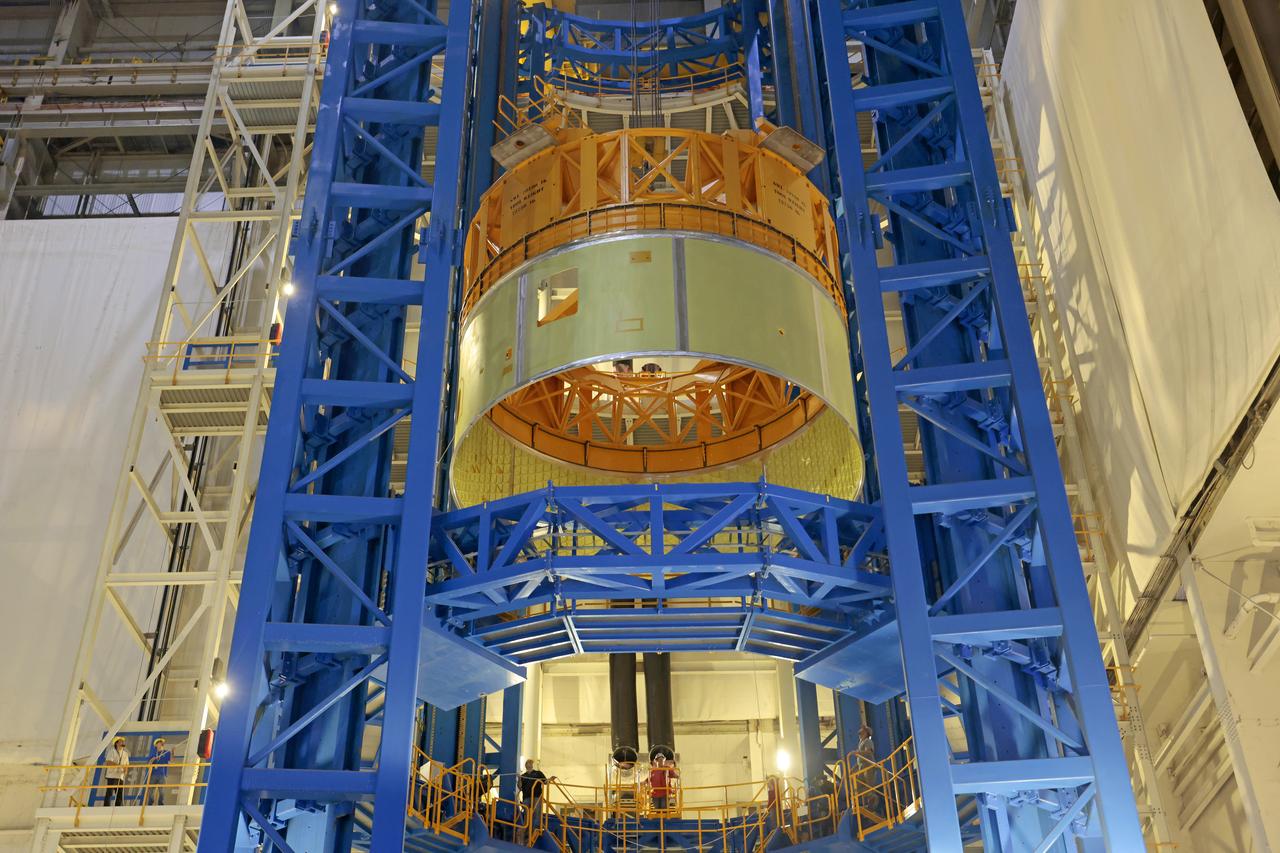
MSFC · 2025-01-31 · MAF_20250131_CS4_FSoutVAC01
Structurally Complete Forward Skirt Lifts Out of Vertical Assembly Center
This image shows teams at NASA’s Michoud Assembly Facility in New Orleans lifting a forward skirt out of its vertical assembly center on Jan. 31, 2025. The forward…
Inspect NASA record
This image shows teams at NASA’s Michoud Assembly Facility in New Orleans lifting a forward skirt out of its vertical assembly center on Jan. 31, 2025. The forward skirt, which will be used on the core stage for the agency’s SLS (Space Launch System) rocket for its Artemis IV mission, houses flight computers, cameras, and avionics. While inside the vertical assembly center, technicians attached the forward skirt’s forward and aft rings, which serve as attachments points to the launch vehicle stage adapter and the liquid oxygen tank, respectively. The forward skirt is one of five major elements that make up the 212-foot-tall rocket stage. The core stage, along with its four RS-25 engines, produce more than two million pounds of thrust to help launch NASA’s Orion spacecraft, astronauts, and supplies beyond Earth’s orbit and to the lunar surface for Artemis. Image credit: NASA/Michael DeMocker
- Record ID
- MAF_20250131_CS4_FSoutVAC01
- NASA center
- MSFC
- Date
- 2025-01-31
- Credit
- NASA/Michael DeMocker
- Keywords
- SLS, Michoud Assembly Facility, MAF, MSFC, Marshall Space Flight Center, Artemis IV, Artemis, Space Launch System, Louisiana, Mars, Moon, NASA
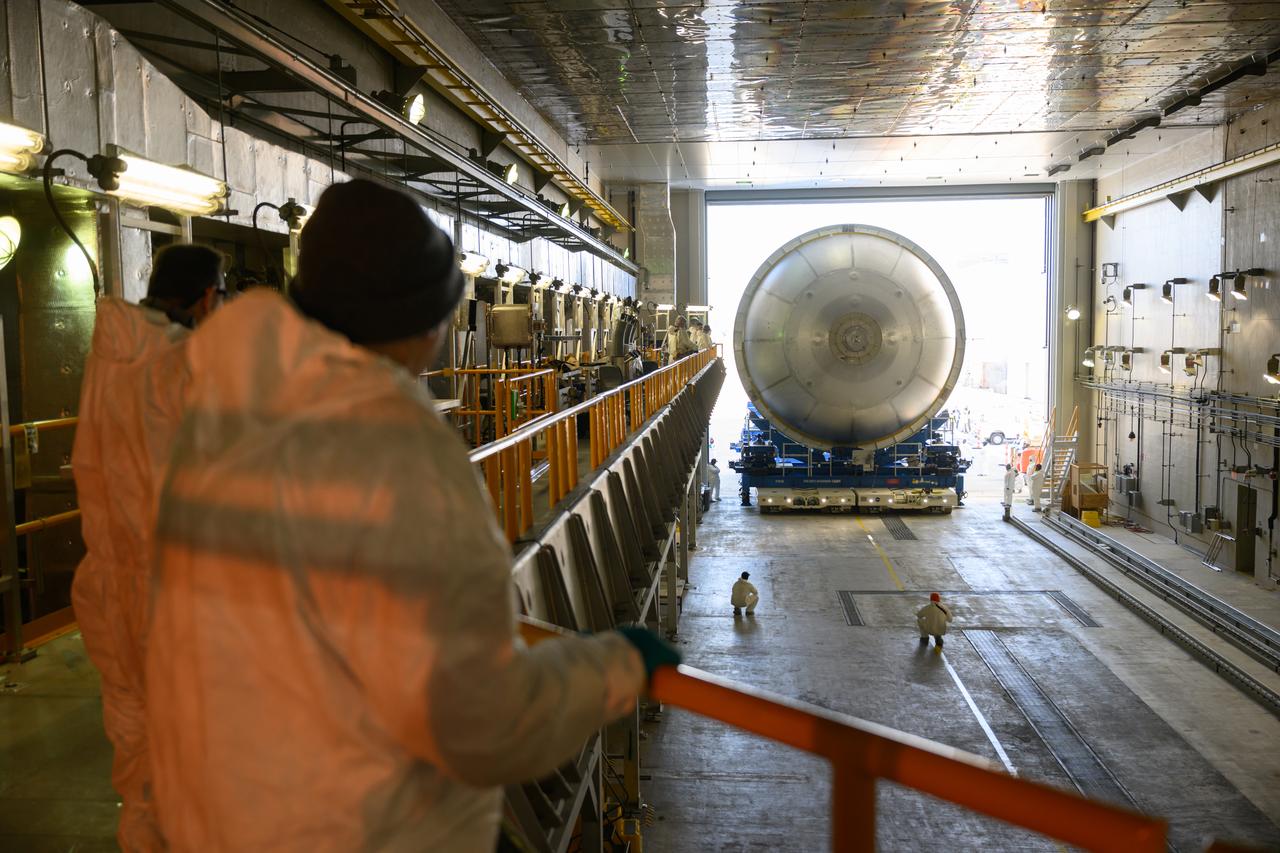
MAF · 2024-12-23 · MAF_20241223_CS3_LOX_VABtoCellP_21
Artemis III Liquid Oxygen Tank Moves to Next Phase of Production
Move crews at NASA’s Michoud Assembly Facility in New Orleans move a liquid oxygen tank for its SLS (Space Launch System) rocket from the vertical assembly building into…
Inspect NASA record
Move crews at NASA’s Michoud Assembly Facility in New Orleans move a liquid oxygen tank for its SLS (Space Launch System) rocket from the vertical assembly building into a nearby cell on Dec. 23. The tank, which will be used on the core stage of the agency’s Artemis III mission, will be primed using an automated process in preparation for application of its thermal protection system. The propellant tank is one of five major elements that make up the 212-foot-tall rocket stage. The core stage, along with its four RS-25 engines, produce more than two million pounds of thrust to help launch NASA’s Orion spacecraft, astronauts, and supplies beyond Earth’s orbit and to the lunar surface for Artemis.
- Record ID
- MAF_20241223_CS3_LOX_VABtoCellP_21
- NASA center
- MAF
- Date
- 2024-12-23
- Credit
- NASA/Eric Bordelon
- Keywords
- SLS, Michoud Assembly Facility, MAF, MSFC, Marshall Space Flight, Center, Artemis III, Artemis, Space Launch System, Louisiana, Mars, Moon
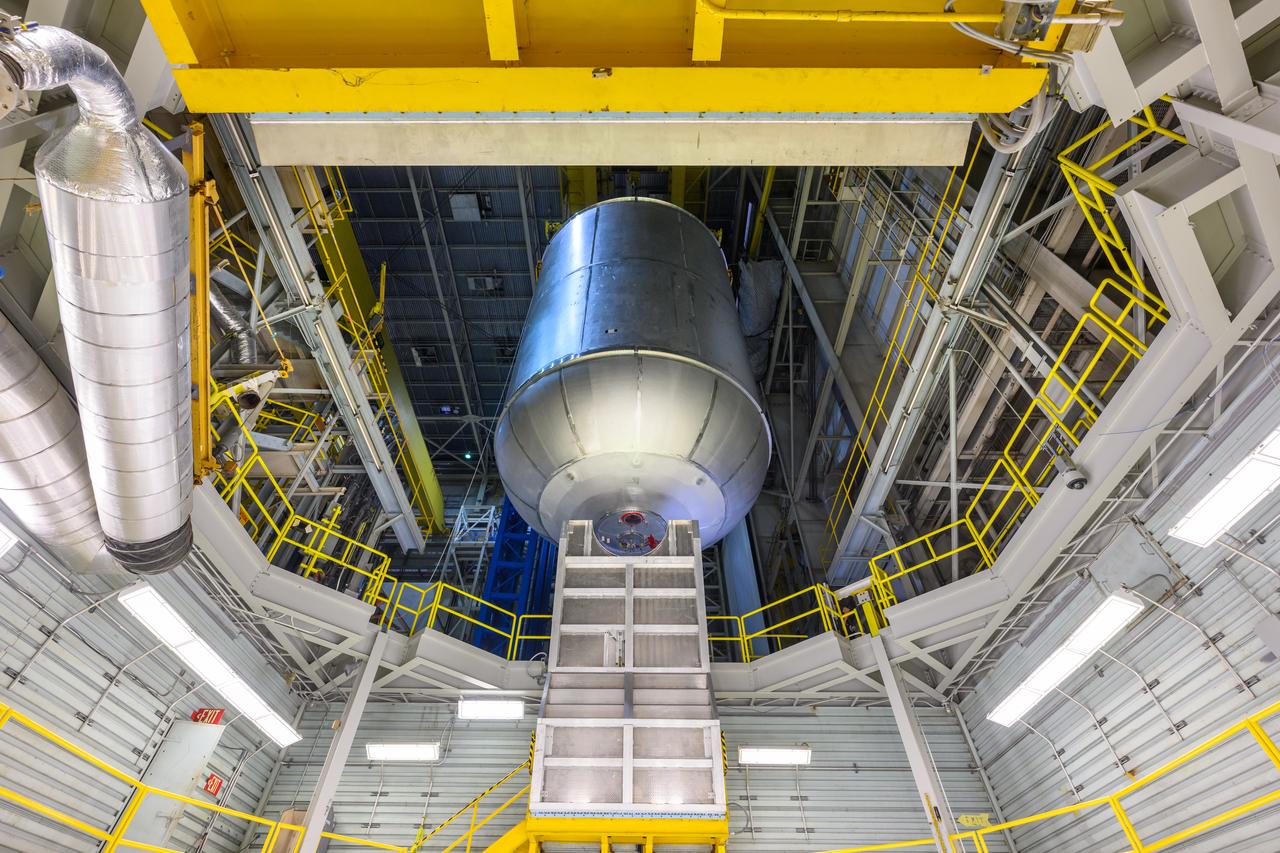
MAF · 2024-06-12 · MAF_20240612_CS3_LOX_LFTfromCellF_03
Artemis III Liquid Oxygen Tank Completes Production Milestones
Teams at NASA’s Michoud Assembly Facility in New Orleans successfully completed hydrostatic proof testing of the core stage liquid oxygen tank for the agency’s Artemis III mission. The…
Inspect NASA record
Teams at NASA’s Michoud Assembly Facility in New Orleans successfully completed hydrostatic proof testing of the core stage liquid oxygen tank for the agency’s Artemis III mission. The non-destructive evaluation method tests the structural integrity of the tank’s welds by filling the tank with water, simulating the propellant used during launch. The hardware was then moved to an adjacent cell for internal cleaning. Next, the tank will be readied for primer and application of its thermal protection system. The propellant tank is one of five major elements that make up the 212-foot-tall rocket stage. The core stage, along with its four RS-25 engines, produce two million pounds of thrust to help launch NASA’s Orion spacecraft, astronauts, and supplies beyond Earth’s orbit and to the lunar surface for Artemis.
- Record ID
- MAF_20240612_CS3_LOX_LFTfromCellF_03
- NASA center
- MAF
- Date
- 2024-06-12
- Credit
- NASA/Eric Bordelon
- Keywords
- SLS, Michoud Assembly Facility, MAF, MSFC, Marshall Space Flight Center, Artemis III, Artemis, Space Launch System, Louisiana, Mars, Moon, NASA
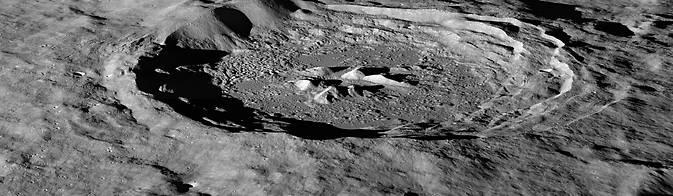
GSFC · 2017-12-08 · GSFC_20171208_Archive_e000796
NASA's LRO Discovers Lunar Hydrogen More Abundant on Moon's Pole-Facing Slopes
Space travel is difficult and expensive – it would cost thousands of dollars to launch a bottle of water to the moon. The recent discovery of hydrogen-bearing molecules,…
Inspect NASA record
Space travel is difficult and expensive – it would cost thousands of dollars to launch a bottle of water to the moon. The recent discovery of hydrogen-bearing molecules, possibly including water, on the moon has explorers excited because these deposits could be mined if they are sufficiently abundant, sparing the considerable expense of bringing water from Earth. Lunar water could be used for drinking or its components – hydrogen and oxygen – could be used to manufacture important products on the surface that future visitors to the moon will need, like rocket fuel and breathable air. Recent observations by NASA's Lunar Reconnaissance Orbiter (LRO) spacecraft indicate these deposits may be slightly more abundant on crater slopes in the southern hemisphere that face the lunar South Pole. "There’s an average of about 23 parts-per-million-by-weight (ppmw) more hydrogen on Pole-Facing Slopes (PFS) than on Equator-Facing Slopes (EFS)," said Timothy McClanahan of NASA's Goddard Space Flight Center in Greenbelt, Maryland. This is the first time a widespread geochemical difference in hydrogen abundance between PFS and EFS on the moon has been detected. It is equal to a one-percent difference in the neutron signal detected by LRO's Lunar Exploration Neutron Detector (LEND) instrument. McClanahan is lead author of a paper about this research published online October 19 in the journal Icarus. Read more: 1.usa.gov/1uaa8s2 Photo caption: LRO image of the moon's Hayn Crater, located just northeast of Mare Humboldtianum, dramatically illuminated by the low Sun casting long shadows across the crater floor. Image Credit: NASA/GSFC/Arizona State University NASA image use policy. NASA Goddard Space Flight Center enables NASA’s mission through four scientific endeavors: Earth Science, Heliophysics, Solar System Exploration, and Astrophysics. Goddard plays a leading role in NASA’s accomplishments by contributing compelling scientific knowledge to advance the Agency’s mission. Follow us on Twitter Like us on Facebook Find us on Instagram
- Record ID
- GSFC_20171208_Archive_e000796
- NASA center
- GSFC
- Date
- 2017-12-08
- Keywords
- NASA's LRO Discovers Lunar Hydrogen More Abundant on Moon's Pole-Facing Slopes, moon, water, space, nasa, lro, lunarreconnaissanceorbiter, nasagoddard
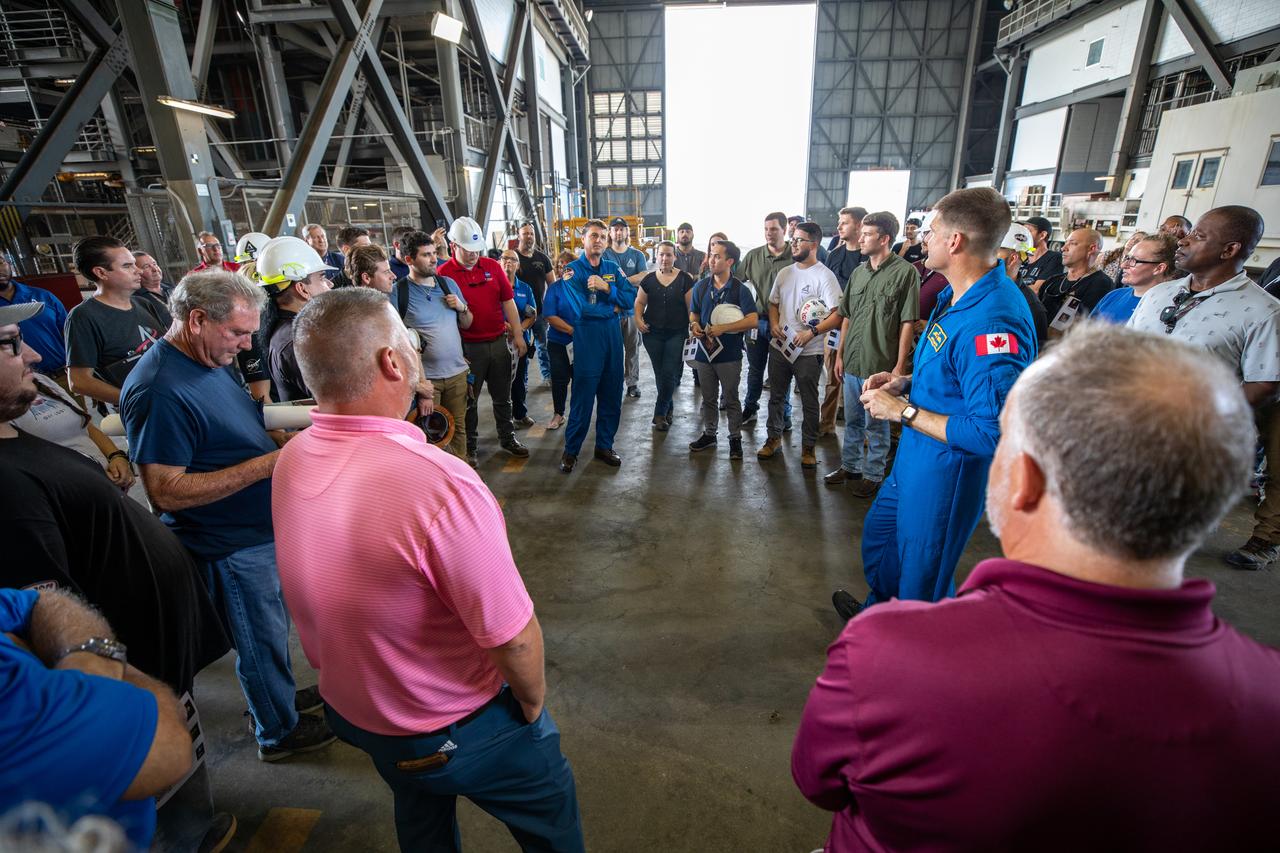
KSC · 2023-08-07 · KSC-20230807-PH-KLS01_0141
Artemis II Crew with EGS
Artemis II NASA astronaut Reid Wiseman, in the center, and Jeremy Hansen, at right, CSA (Canadian Space Agency) Artemis II astronaut, talk with members of the Exploration Ground…
Inspect NASA record
Artemis II NASA astronaut Reid Wiseman, in the center, and Jeremy Hansen, at right, CSA (Canadian Space Agency) Artemis II astronaut, talk with members of the Exploration Ground Systems team inside the transfer aisle of the Vehicle Assembly Building during a visit to the agency’s Kennedy Space Center in Florida on Aug. 7, 2023. The approximately 10-day Artemis II flight will test NASA’s foundational human deep space exploration capabilities, the Space Launch System rocket and Orion spacecraft, for the first time with astronauts and will pave the way for lunar surface missions, including landing the first woman and the first person of color on the Moon.
- Record ID
- KSC-20230807-PH-KLS01_0141
- NASA center
- KSC
- Date
- 2023-08-07
- Credit
- NASA/Kim Shiflett
- Keywords
- Artemis II, Artemis II crew, Astronauts, EGS, Exploration Ground Systems, KSC, Kennedy Space Center
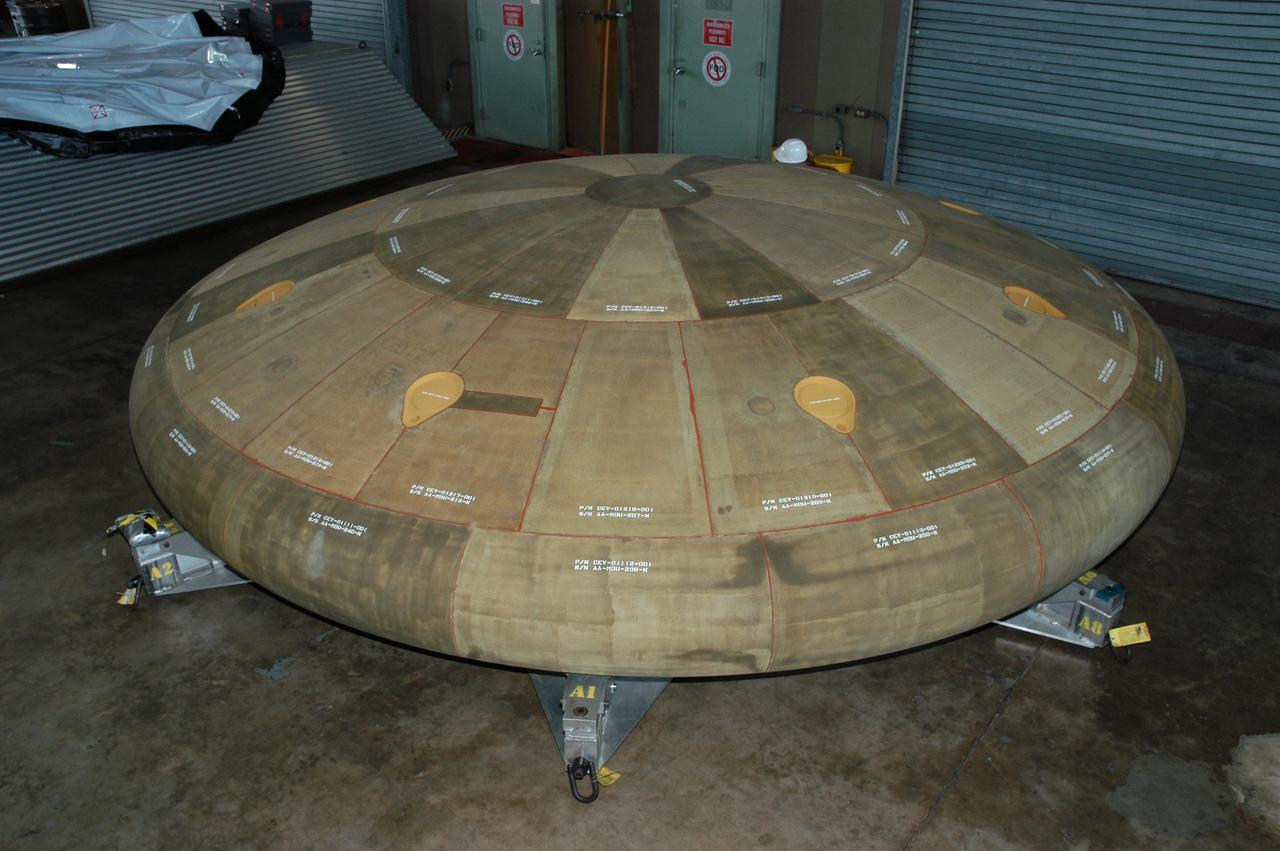
KSC · 2007-11-27 · KSC-07PD-3482
Constellation crew exploration vehicle, or CEV, is being prepare
In Hangar N at NASA's Kennedy Space Center, a heat shield for the Constellation crew exploration vehicle, or CEV, is being prepared for a demonstration. A developmental heat…
Inspect NASA record
In Hangar N at NASA's Kennedy Space Center, a heat shield for the Constellation crew exploration vehicle, or CEV, is being prepared for a demonstration. A developmental heat shield for the Orion spacecraft is being tested and evaluated at Kennedy. The shield was designed and assembled by the Boeing Company in Huntington Beach, Calif., for NASA's Constellation Program. The thermal protection system manufacturing demonstration unit is designed to protect astronauts from extreme heat during re-entry to Earth's atmosphere from low Earth orbit and lunar missions. The CEV will be used to dock and gain access to the International Space Station, travel to the moon in the 2018 timeframe and play a crucial role in exploring Mars.
- Record ID
- KSC-07PD-3482
- NASA center
- KSC
- Date
- 2007-11-27
- Credit
- NASA
- Keywords
- CEV, heat shield
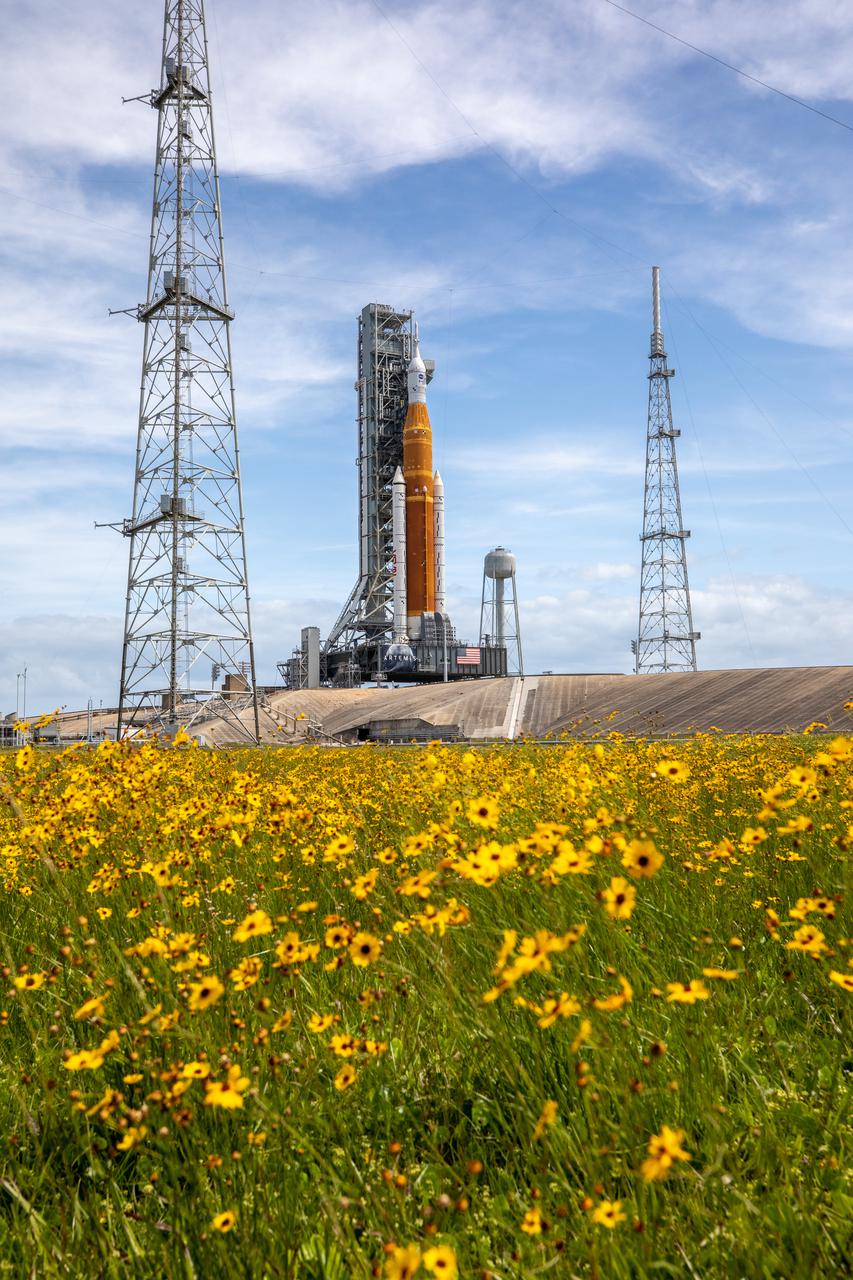
KSC · 2022-04-21 · KSC-20220421-PH-JBS01_0063
Artemis I at Pad 39B
Wildflowers frame a view of the Artemis I Space Launch System (SLS) and Orion spacecraft on Launch Pad 39B at NASA’s Kennedy Space Center in Florida on April…
Inspect NASA record
Wildflowers frame a view of the Artemis I Space Launch System (SLS) and Orion spacecraft on Launch Pad 39B at NASA’s Kennedy Space Center in Florida on April 21, 2022. Also in view are two of the three lightning protection towers and the water tower. The SLS and Orion atop the mobile launcher were transported to the pad on crawler-transporter 2 for a prelaunch test called a wet dress rehearsal. Artemis I will be the first integrated test of the SLS and Orion spacecraft. In future Artemis missions, NASA will land the first woman and the first person of color on the surface of the Moon, paving the way for a long-term lunar presence and serving as a steppingstone on the way to Mars.
- Record ID
- KSC-20220421-PH-JBS01_0063
- NASA center
- KSC
- Date
- 2022-04-21
- Credit
- NASA/Ben Smegelsky
- Keywords
- Artemis, Artemis I, KSC, Kennedy Space Center, Launch Complex 39B, Launch Pad 39B, Moon to Mars, Orion, Pad 39B, SLS, Space Launch System

JSC · 1970-04-17 · s70-35644
Apollo 13 spacecraft splashdown in the South Pacific Ocean
S70-35644 (17 April 1970) --- The Apollo 13 Command Module (CM) splashes down and its three main parachutes collapse, as the week-long problem-plagued Apollo 13 mission comes to…
Inspect NASA record
S70-35644 (17 April 1970) --- The Apollo 13 Command Module (CM) splashes down and its three main parachutes collapse, as the week-long problem-plagued Apollo 13 mission comes to a premature, but safe end. The spacecraft, with astronauts James A. Lovell Jr., commander; John L. Swigert Jr., command module pilot; and Fred W. Haise Jr., lunar module pilot, aboard splashed down at 12:07:44 p.m. (CST) April 17, 1970, in the South Pacific Ocean, only about four miles from the USS Iwo Jima, prime recovery ship.
- Record ID
- s70-35644
- NASA center
- JSC
- Date
- 1970-04-17
- Keywords
- APOLLO 13, APOLLO PROJECT, APOLLO SPACECRAFT, COMMAND MODULES, PACIFIC OCEAN PARACHUTES, WATER LANDING

KSC · 2022-03-16 · KSC-20220316-PH-GEB01_0100
Artemis I WDR Pre-Rollout Activities - Beauty Shots, All Platfor
In this view looking down in High Bay 3 of the Vehicle Assembly Building at NASA’s Kennedy Space Center in Florida, all of the work platforms that surround…
Inspect NASA record
In this view looking down in High Bay 3 of the Vehicle Assembly Building at NASA’s Kennedy Space Center in Florida, all of the work platforms that surround the Artemis I Space Launch System (SLS) and Orion spacecraft are fully retracted on March 16, 2022. The Artemis I stack atop the mobile launcher will roll out to Launch Complex 39B atop the crawler-transporter 2 for a wet dress rehearsal ahead of launch. Artemis I will be the first integrated test of the SLS and Orion spacecraft. In later missions, NASA will land the first woman the first person of color on the surface of the Moon, paving the way for a long-term lunar presence and serving as a steppingstone on the way to Mars.
- Record ID
- KSC-20220316-PH-GEB01_0100
- NASA center
- KSC
- Date
- 2022-03-16
- Credit
- NASA/Glenn Benson
- Keywords
- Artemis, Artemis I, EGS, KSC, ML, Orion, SLS, VAB, WDR, rollout, wet dress rehearsal

KSC · 2021-10-19 · KSC-20211019-PH-ILW01_0059
Orion Transport to VAB
The Orion spacecraft for NASA’s Artemis I mission, fully assembled with its launch abort system, begins the move out of the Launch Abort System Facility at Kennedy Space…
Inspect NASA record
The Orion spacecraft for NASA’s Artemis I mission, fully assembled with its launch abort system, begins the move out of the Launch Abort System Facility at Kennedy Space Center in Florida on Oct. 19, 2021. Orion will be transported to the Vehicle Assembly Building where it will join the already stacked flight hardware and be raised into position atop the Space Launch System rocket in High Bay 3. Launching in 2021, Artemis I will be an uncrewed test flight of the Orion spacecraft and Space Launch System rocket as an integrated system ahead of crewed flights to the Moon. Under Artemis, NASA aims to land the first woman and first person of color on the Moon and establish sustainable lunar exploration.
- Record ID
- KSC-20211019-PH-ILW01_0059
- NASA center
- KSC
- Date
- 2021-10-19
- Credit
- NASA/Isaac Watson
- Keywords
- Artemis, Artemis I, EGS, Exploration Ground System, KSC, Kennedy Space Center, LASF, Launch Abort System Facility, Moon to Mars, NASA, Orion, SLS
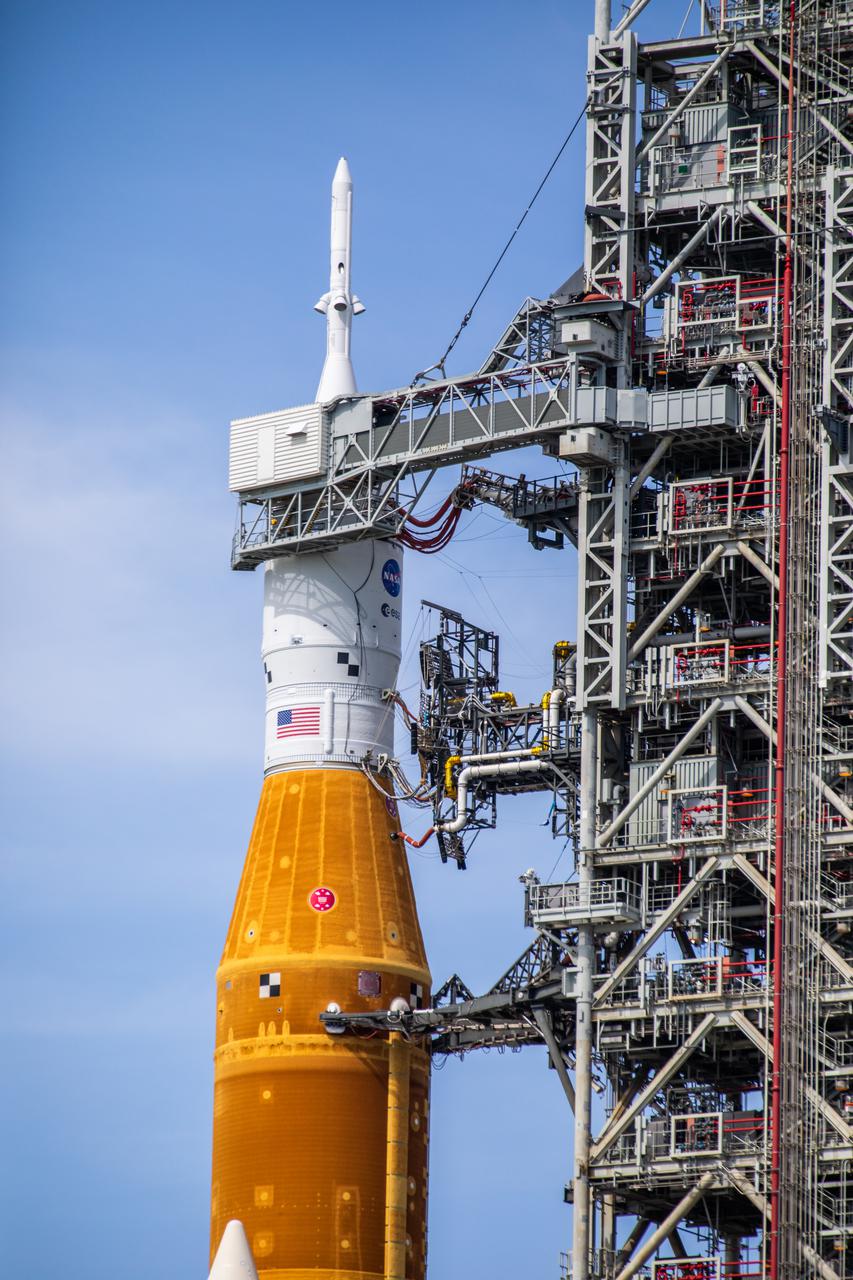
KSC · 2022-04-21 · KSC-20220421-PH-JBS01_0035
Artemis I at Pad 39B
A close-up view of the Artemis I Space Launch System (SLS) and Orion spacecraft on Launch Pad 39B at NASA’s Kennedy Space Center in Florida on April 21,…
Inspect NASA record
A close-up view of the Artemis I Space Launch System (SLS) and Orion spacecraft on Launch Pad 39B at NASA’s Kennedy Space Center in Florida on April 21, 2022. A portion of the mobile launcher and umbilical connections are in view, as well as the crew access arm. The SLS and Orion atop the mobile launcher were transported to the pad on crawler-transporter 2 for a prelaunch test called a wet dress rehearsal. Artemis I will be the first integrated test of the SLS and Orion spacecraft. In future Artemis missions, NASA will land the first woman and the first person of color on the surface of the Moon, paving the way for a long-term lunar presence and serving as a steppingstone on the way to Mars.
- Record ID
- KSC-20220421-PH-JBS01_0035
- NASA center
- KSC
- Date
- 2022-04-21
- Credit
- NASA/Ben Smegelsky
- Keywords
- Artemis, Artemis I, KSC, Kennedy Space Center, Launch Complex 39B, Launch Pad 39B, Moon to Mars, Orion, Pad 39B, SLS, Space Launch System