
Update Site (from NASA)
Explore NASA’s Image and Video Library.
Suggest one object per day for the Interstellar Minds collection. We review each suggestion before adding it.
Sign in to suggest a Marvel.
Find a NASA image ID. Open a NASA record and copy its ID from the end of the details URL.
NASA image records
GSFC · 2017-12-08 · GSFC_20171208_Archive_e001129
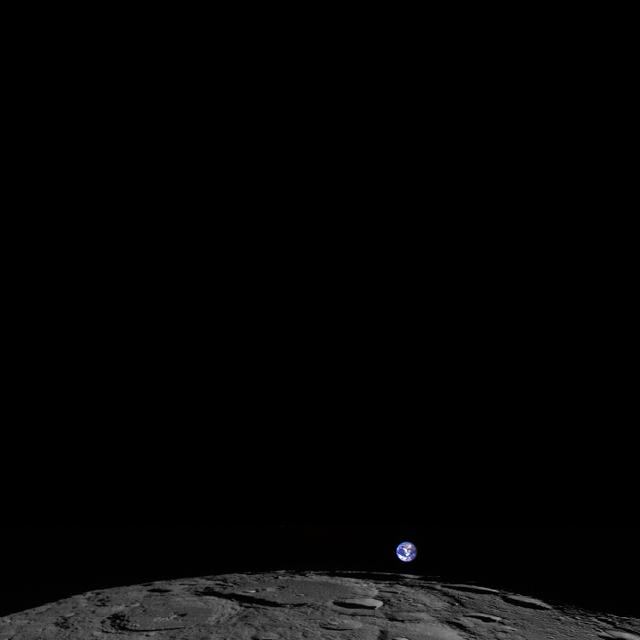
Lunar Satellite Snaps Image of Earth
This image, captured Feb. 1, 2014, shows a colorized view of Earth from the moon-based perspective of NASA's Lunar Reconnaissance Orbiter. Credit: NASA/Goddard/Arizona State University -- NASA's Lunar…
Inspect NASA record
This image, captured Feb. 1, 2014, shows a colorized view of Earth from the moon-based perspective of NASA's Lunar Reconnaissance Orbiter. Credit: NASA/Goddard/Arizona State University -- NASA's Lunar Reconnaissance Orbiter (LRO) experiences 12 "earthrises" every day, however LROC (short for LRO Camera) is almost always busy imaging the lunar surface so only rarely does an opportunity arise such that LROC can capture a view of Earth. On Feb. 1, 2014, LRO pitched forward while approaching the moon's north pole allowing the LROC Wide Angle Camera to capture Earth rising above Rozhdestvenskiy crater (112 miles, or 180 km, in diameter). Read more: go.nasa.gov/1oqMlgu NASA image use policy. NASA Goddard Space Flight Center enables NASA’s mission through four scientific endeavors: Earth Science, Heliophysics, Solar System Exploration, and Astrophysics. Goddard plays a leading role in NASA’s accomplishments by contributing compelling scientific knowledge to advance the Agency’s mission. Follow us on Twitter Like us on Facebook Find us on Instagram
- Record ID
- GSFC_20171208_Archive_e001129
- NASA center
- GSFC
- Date
- 2017-12-08
- Keywords
- Lunar Satellite Snaps Image of Earth, moon, earth, space, nasa, rise, earthrise, lro
GSFC · 2017-12-08 · GSFC_20171208_Archive_e001021
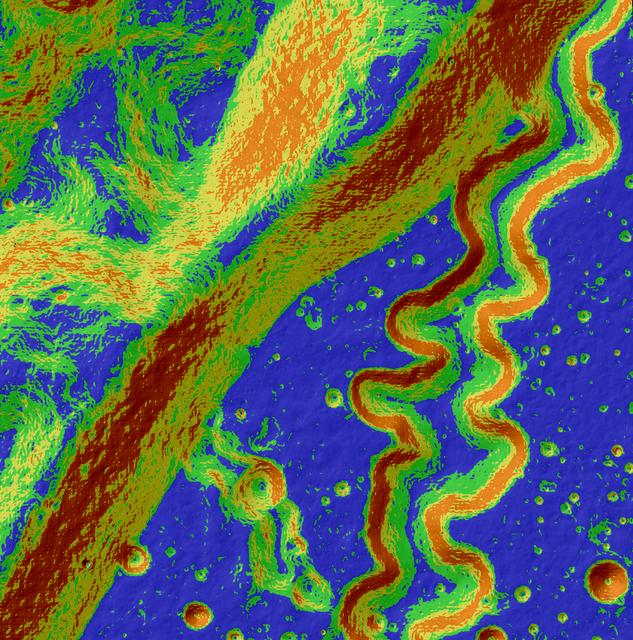
A Tortuous Path in Posidonius
This may look like a work of abstract art, but in reality, it's our Moon and is for science. The Lunar Reconnaissance Orbiter Camera, or LROC, is a…
Inspect NASA record
This may look like a work of abstract art, but in reality, it's our Moon and is for science. The Lunar Reconnaissance Orbiter Camera, or LROC, is a system of three cameras mounted on the Lunar Reconnaissance Orbiter (LRO) that capture high resolution photos of the lunar surface. This colorful image is an LROC slope map of the northwestern portion of the floor of Posidonius crater. Warmer colors indicate steeper slopes, whereas cooler colors are shallower slopes. A rille winds its way across the floor and flows along a southerly course, diverging from its path along the crater rim. A tributary rille (or narrow channel) can be seen joining the main rille at the bottom center. Image width is approximately 3.4 miles. North is up. Read more: lroc.sese.asu.edu/posts/796 Credit: NASA/GSFC/Arizona State University NASA image use policy. NASA Goddard Space Flight Center enables NASA’s mission through four scientific endeavors: Earth Science, Heliophysics, Solar System Exploration, and Astrophysics. Goddard plays a leading role in NASA’s accomplishments by contributing compelling scientific knowledge to advance the Agency’s mission. Follow us on Twitter Like us on Facebook Find us on Instagram
- Record ID
- GSFC_20171208_Archive_e001021
- NASA center
- GSFC
- Date
- 2017-12-08
- Keywords
- A Tortuous Path in Posidonius, moon, nasa, goddard, lro
KSC · 2014-07-21 · KSC-2014-3234
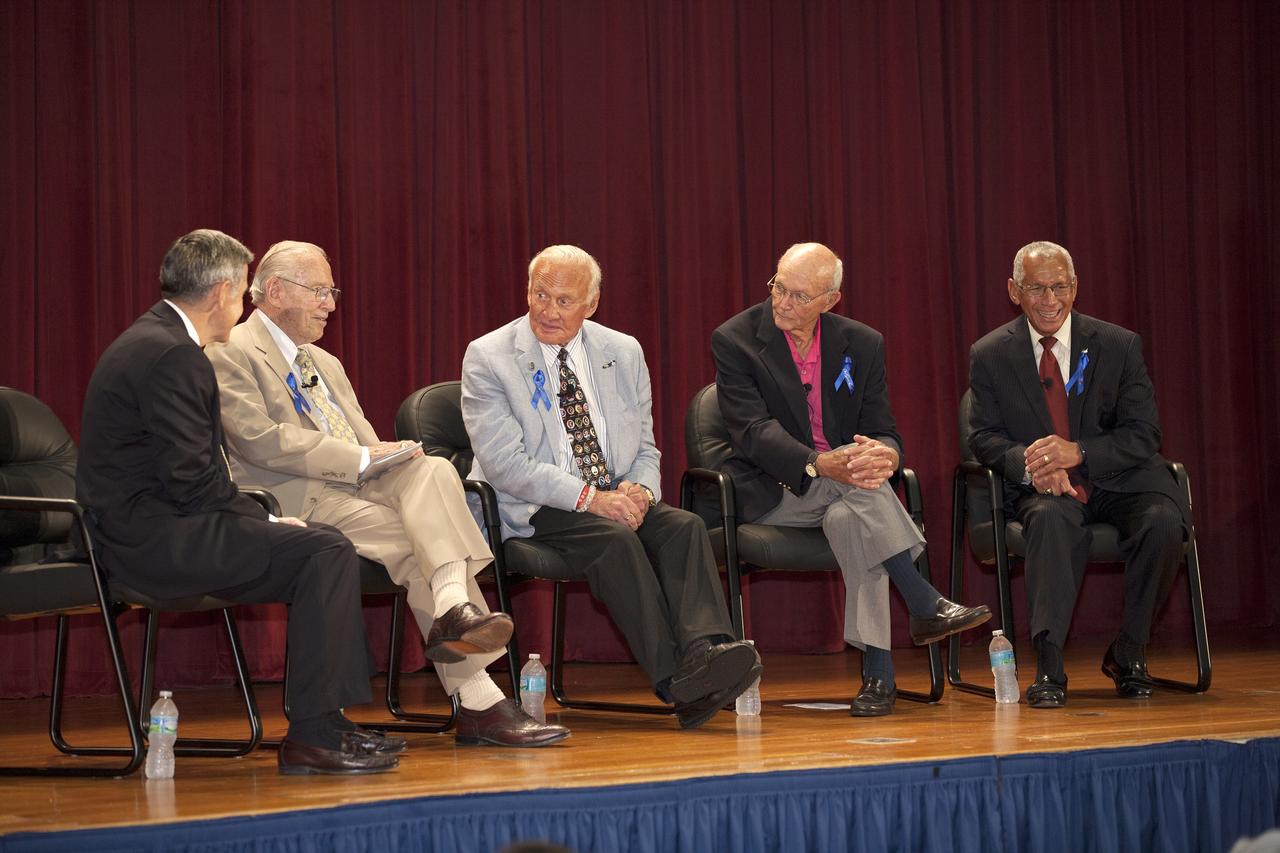
KSC-2014-3234
CAPE CANAVERAL, Fla. -- Apollo astronauts participate in a panel discussion held for employees in the KSC Training Auditorium at NASA's Kennedy Space Center in Florida. From left…
Inspect NASA record
CAPE CANAVERAL, Fla. -- Apollo astronauts participate in a panel discussion held for employees in the KSC Training Auditorium at NASA's Kennedy Space Center in Florida. From left are Center Director Robert Cabana, Apollo 8 and Apollo 13 crew member Jim Lovell, Apollo 11 moonwalker Buzz Aldrin, Apollo 11 command module pilot Michael Collins, and NASA Administrator Charles Bolden. Cabana and Bolden, both shuttle astronauts, asked the questions to which the panel members responded. The panel discussion followed a ceremony renaming the refurbished Operations and Checkout Building for Apollo 11 astronaut Neil Armstrong, the first person to set foot on the moon. The building's high bay, the site for the ceremony, is being used to support the agency's new Orion spacecraft and is the same spaceport facility where the Apollo 11 command/service module and lunar module were prepped for the first lunar landing mission in 1969. Orion is designed to take humans farther than they’ve ever gone before, serving as the exploration vehicle that will carry astronauts to deep space and sustain the crew during travel to destinations such as an asteroid or Mars. The ceremony and panel discussion were part of NASA's 45th anniversary celebration of the Apollo 11 moon landing. As the world watched, Neil Armstrong and Buzz Aldrin landed in the moon's Sea of Tranquility on July 20, 1969, aboard the lunar module Eagle. Meanwhile, crewmate Michael Collins orbited above in the command module Columbia. For more, visit http://www.nasa.gov/press/2014/july/nasa-honors-historic-first-moon-landing-eyes-first-mars-mission. Photo credit: NASA/Kim Shiflett
- Record ID
- KSC-2014-3234
- NASA center
- KSC
- Date
- 2014-07-21
KSC · 2014-07-21 · KSC-2014-3241
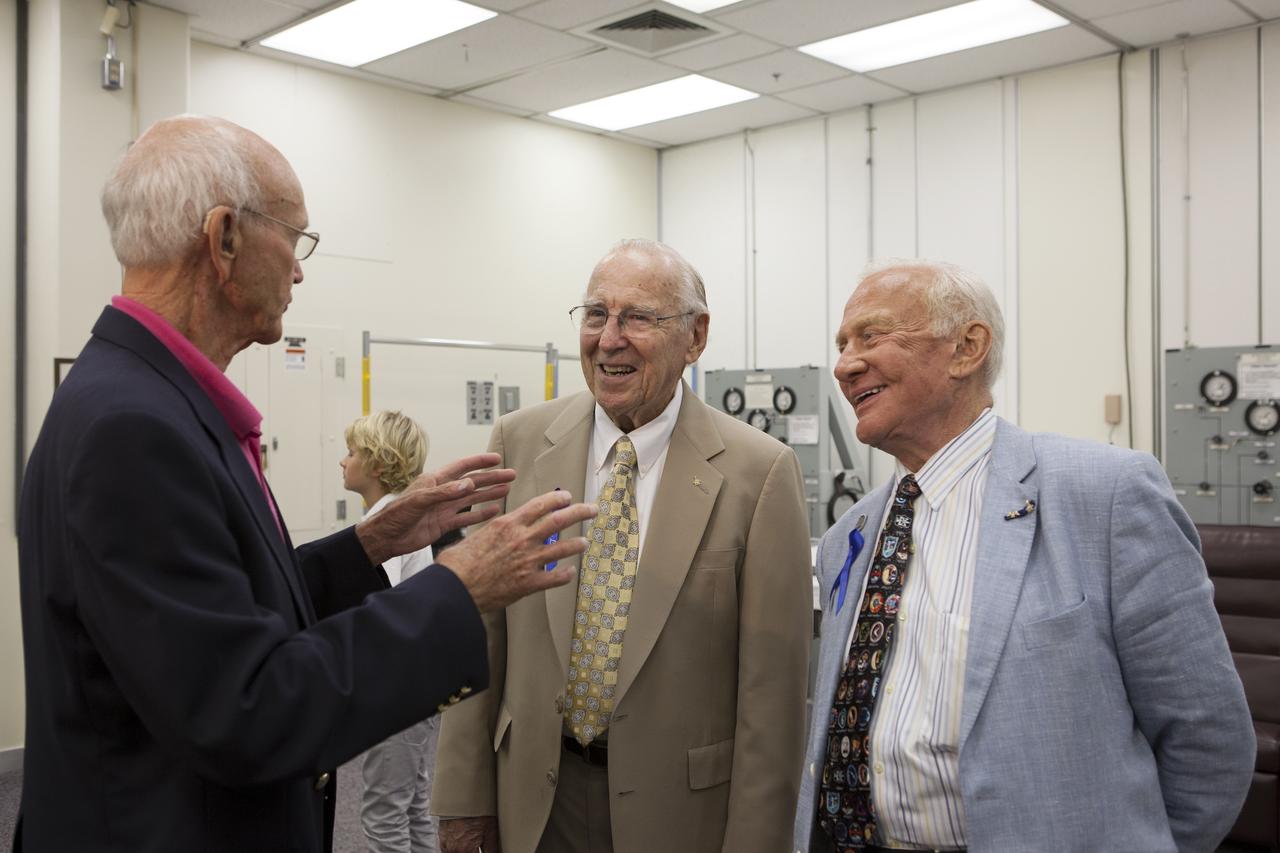
KSC-2014-3241
CAPE CANAVERAL, Fla. -- Apollo astronauts and their families tour the astronaut crew quarters in the Operations and Checkout Building at NASA's Kennedy Space Center in Florida. Here,…
Inspect NASA record
CAPE CANAVERAL, Fla. -- Apollo astronauts and their families tour the astronaut crew quarters in the Operations and Checkout Building at NASA's Kennedy Space Center in Florida. Here, from left, Apollo 11 command module pilot Michael Collins, Apollo 8 and Apollo 13 crew member Jim Lovell, and Apollo 11 moonwalker Buzz Aldrin share a light moment. The tour followed a ceremony renaming the refurbished Operations and Checkout Building for Apollo 11 astronaut Neil Armstrong, the first person to set foot on the moon. Besides housing the crew quarters, the building's high bay is being used to support the agency's new Orion spacecraft and is the same spaceport facility where the Apollo 11 command/service module and lunar module were prepped for the first lunar landing mission in 1969. Orion is designed to take humans farther than they’ve ever gone before, serving as the exploration vehicle that will carry astronauts to deep space and sustain the crew during travel to destinations such as an asteroid or Mars. The visit of the former astronauts was part of NASA's 45th anniversary celebration of the moon landing. As the world watched, Neil Armstrong and Aldrin landed in the moon's Sea of Tranquility aboard the lunar module Eagle on July 20, 1969. Meanwhile, crewmate Collins orbited above in the command module Columbia. For more, visit http://www.nasa.gov/press/2014/july/nasa-honors-historic-first-moon-landing-eyes-first-mars-mission. Photo credit: NASA/Kim Shiflett
- Record ID
- KSC-2014-3241
- NASA center
- KSC
- Date
- 2014-07-21
- Keywords
- O&C
KSC · 2014-07-21 · KSC-2014-3235
KSC-2014-3235
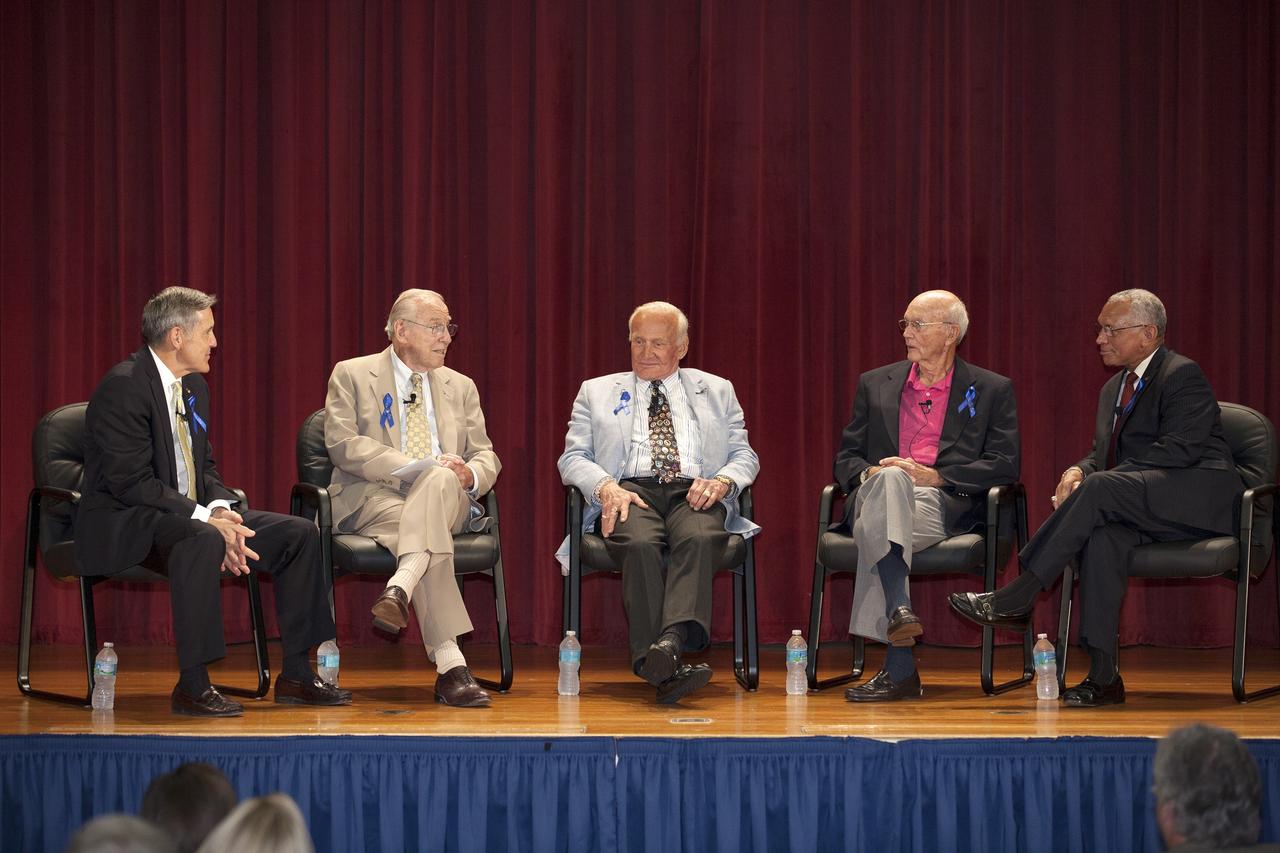
CAPE CANAVERAL, Fla. -- Apollo astronauts participate in a panel discussion held for employees in the KSC Training Auditorium at NASA's Kennedy Space Center in Florida. From left…
Inspect NASA record
CAPE CANAVERAL, Fla. -- Apollo astronauts participate in a panel discussion held for employees in the KSC Training Auditorium at NASA's Kennedy Space Center in Florida. From left are Center Director Robert Cabana, Apollo 8 and Apollo 13 crew member Jim Lovell, Apollo 11 moonwalker Buzz Aldrin, Apollo 11 command module pilot Michael Collins, and NASA Administrator Charles Bolden. Cabana and Bolden, both shuttle astronauts, asked the questions to which the panel members responded. The panel discussion followed a ceremony renaming the refurbished Operations and Checkout Building for Apollo 11 astronaut Neil Armstrong, the first person to set foot on the moon. The building's high bay, the site for the ceremony, is being used to support the agency's new Orion spacecraft and is the same spaceport facility where the Apollo 11 command/service module and lunar module were prepped for the first lunar landing mission in 1969. Orion is designed to take humans farther than they’ve ever gone before, serving as the exploration vehicle that will carry astronauts to deep space and sustain the crew during travel to destinations such as an asteroid or Mars. The ceremony and panel discussion were part of NASA's 45th anniversary celebration of the Apollo 11 moon landing. As the world watched, Neil Armstrong and Buzz Aldrin landed in the moon's Sea of Tranquility on July 20, 1969, aboard the lunar module Eagle. Meanwhile, crewmate Michael Collins orbited above in the command module Columbia. For more, visit http://www.nasa.gov/press/2014/july/nasa-honors-historic-first-moon-landing-eyes-first-mars-mission. Photo credit: NASA/Kim Shiflett
- Record ID
- KSC-2014-3235
- NASA center
- KSC
- Date
- 2014-07-21
MSFC · 1969-07-24 · 6901184
Saturn Apollo Program
The Apollo 11 mission, the first manned lunar mission, launched from the Kennedy Space Center, Florida via the Marshall Space Flight Center (MSFC) developed Saturn V launch vehicle…
Inspect NASA record
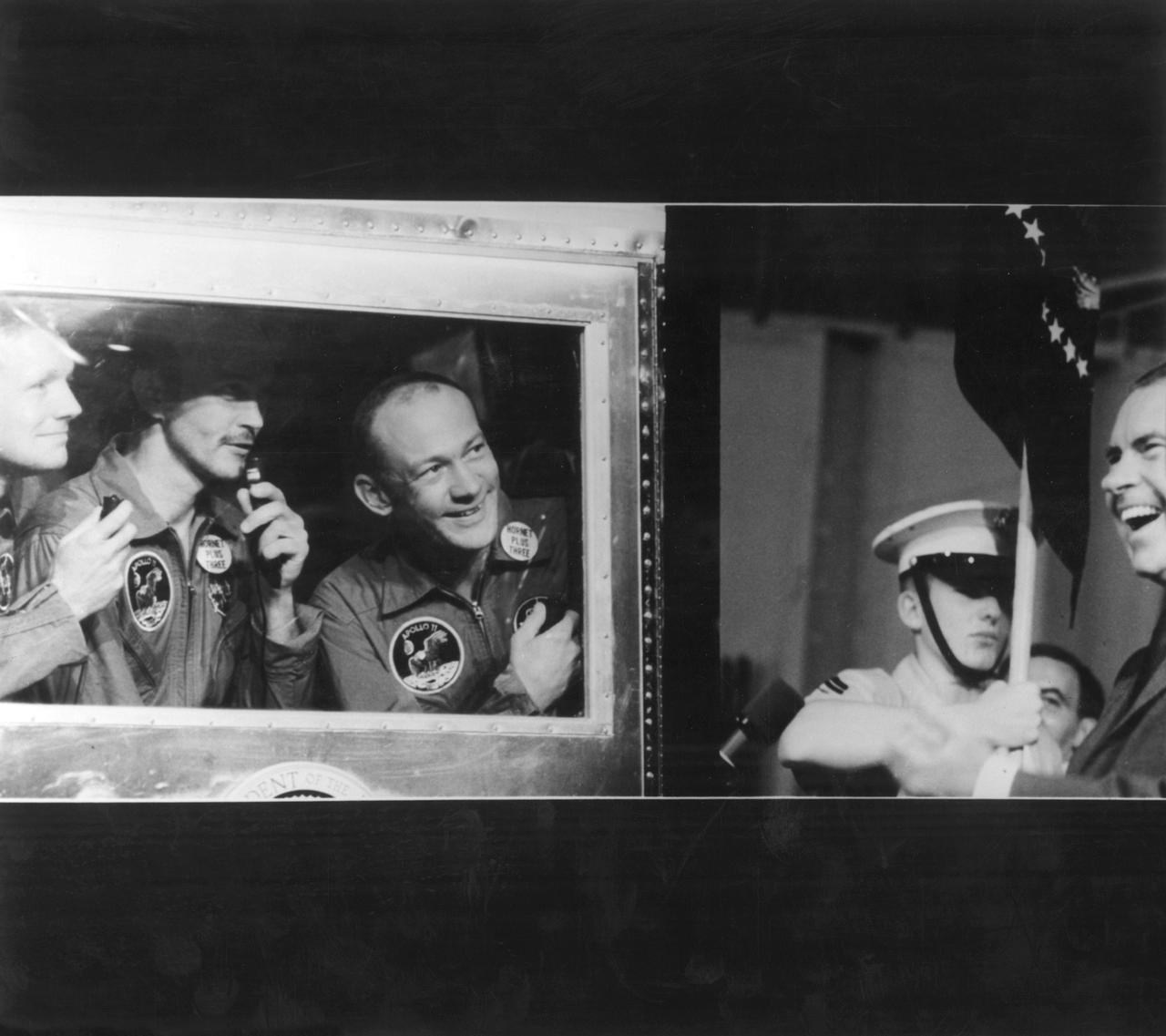
The Apollo 11 mission, the first manned lunar mission, launched from the Kennedy Space Center, Florida via the Marshall Space Flight Center (MSFC) developed Saturn V launch vehicle on July 16, 1969 and safely returned to Earth on July 24, 1969. Aboard the space craft were astronauts Neil A. Armstrong, commander; Michael Collins, Command Module (CM) pilot; and Edwin E. Aldrin Jr., Lunar Module (LM) pilot. The CM, piloted by Michael Collins remained in a parking orbit around the Moon while the LM, named “Eagle’’, carrying astronauts Neil Armstrong and Edwin Aldrin, landed on the Moon. During 2½ hours of surface exploration, the crew collected 47 pounds of lunar surface material for analysis back on Earth. The recovery operation took place in the Pacific Ocean where Navy para-rescue men recovered the capsule housing the 3-man Apollo 11 crew. The crew was airlifted to safety aboard the U.S.S. Hornet, where they were quartered in a Mobile Quarantine Facility (MQF) for 21 days. Here, U.S. President Richard Milhous Nixon gets a good laugh at something being said by Astronaut Collins (center) as astronauts Armstrong (left), and Aldrin (right) listen. The president was aboard the recovery vessel awaiting return of the astronauts. With the success of Apollo 11, the national objective to land men on the Moon and return them safely to Earth had been accomplished.
- Record ID
- 6901184
- NASA center
- MSFC
- Date
- 1969-07-24
- Keywords
- Apollo 11, Moon, Quarantine, Armstrong, Collins, Aldrin, Nixon
KSC · 2014-07-21 · KSC-2014-3236
KSC-2014-3236
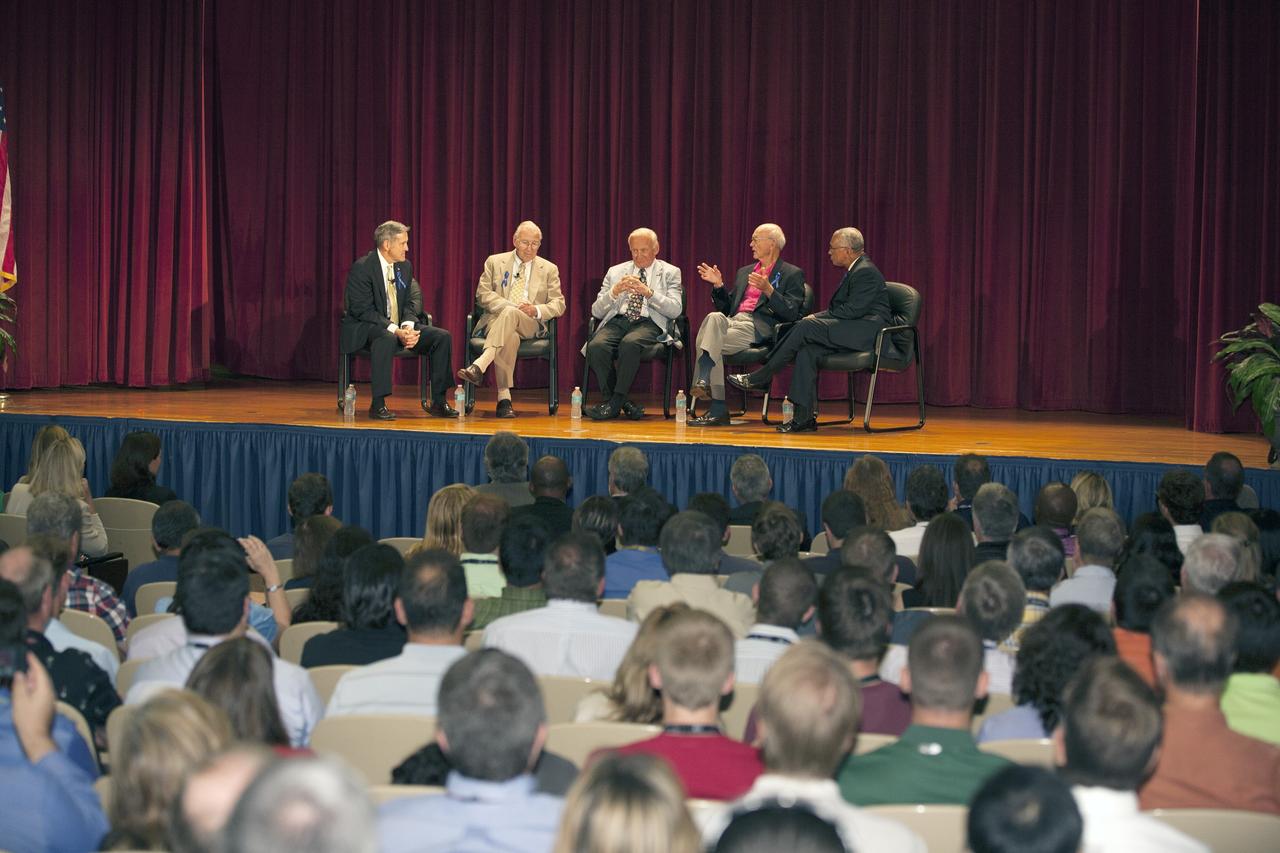
CAPE CANAVERAL, Fla. -- Apollo astronauts participate in a panel discussion held for employees in the KSC Training Auditorium at NASA's Kennedy Space Center in Florida. From left…
Inspect NASA record
CAPE CANAVERAL, Fla. -- Apollo astronauts participate in a panel discussion held for employees in the KSC Training Auditorium at NASA's Kennedy Space Center in Florida. From left are Center Director Robert Cabana, Apollo 8 and Apollo 13 crew member Jim Lovell, Apollo 11 moonwalker Buzz Aldrin, Apollo 11 command module pilot Michael Collins, and NASA Administrator Charles Bolden. Cabana and Bolden, both shuttle astronauts, asked the questions to which the panel members responded. The panel discussion followed a ceremony renaming the refurbished Operations and Checkout Building for Apollo 11 astronaut Neil Armstrong, the first person to set foot on the moon. The building's high bay, the site for the ceremony, is being used to support the agency's new Orion spacecraft and is the same spaceport facility where the Apollo 11 command/service module and lunar module were prepped for the first lunar landing mission in 1969. Orion is designed to take humans farther than they’ve ever gone before, serving as the exploration vehicle that will carry astronauts to deep space and sustain the crew during travel to destinations such as an asteroid or Mars. The ceremony and panel discussion were part of NASA's 45th anniversary celebration of the Apollo 11 moon landing. As the world watched, Neil Armstrong and Buzz Aldrin landed in the moon's Sea of Tranquility on July 20, 1969, aboard the lunar module Eagle. Meanwhile, crewmate Michael Collins orbited above in the command module Columbia. For more, visit http://www.nasa.gov/press/2014/july/nasa-honors-historic-first-moon-landing-eyes-first-mars-mission. Photo credit: NASA/Kim Shiflett
- Record ID
- KSC-2014-3236
- NASA center
- KSC
- Date
- 2014-07-21
KSC · 2014-07-21 · KSC-2014-3238
KSC-2014-3238
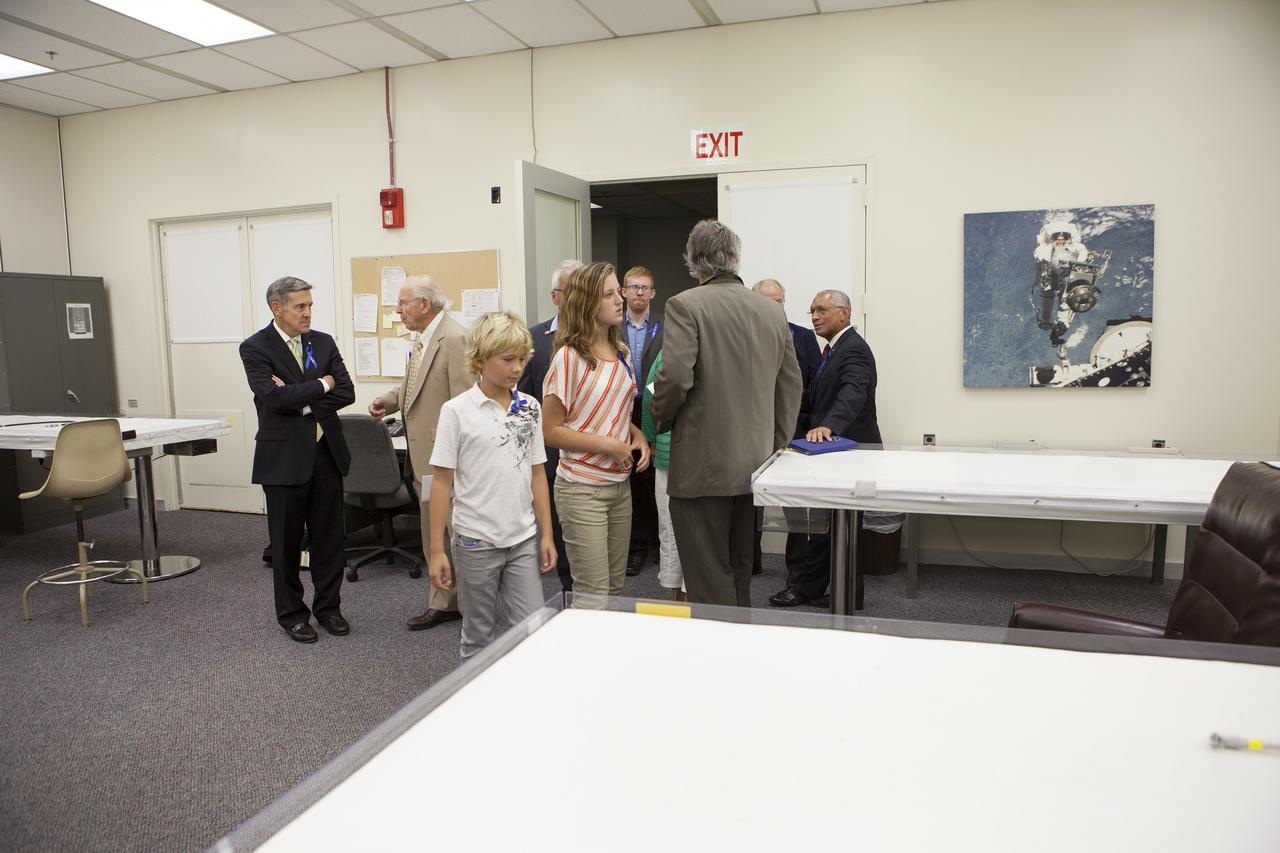
CAPE CANAVERAL, Fla. -- Apollo astronauts and their families tour the astronaut crew quarters in the Operations and Checkout Building at NASA's Kennedy Space Center in Florida. The…
Inspect NASA record
CAPE CANAVERAL, Fla. -- Apollo astronauts and their families tour the astronaut crew quarters in the Operations and Checkout Building at NASA's Kennedy Space Center in Florida. The tour followed a ceremony renaming the refurbished Operations and Checkout Building for Apollo 11 astronaut Neil Armstrong, the first person to set foot on the moon. Here, Armstrong's grandchildren, Bryce and Lily, in front, make their way into the room. Center Director Robert Cabana talks with Apollo 8 and Apollo 13 crew member Jim Lovell, at left, as NASA Administrator Charles Bolden talks with other Armstrong family members, at right. Besides housing the crew quarters, the building's high bay is being used to support the agency's new Orion spacecraft and is the same spaceport facility where the Apollo 11 command/service module and lunar module were prepped for the first lunar landing mission in 1969. Orion is designed to take humans farther than they’ve ever gone before, serving as the exploration vehicle that will carry astronauts to deep space and sustain the crew during travel to destinations such as an asteroid or Mars. The ceremony was part of NASA's 45th anniversary celebration of the Apollo 11 moon landing. As the world watched, Neil Armstrong and Buzz Aldrin landed in the moon's Sea of Tranquility on July 20, 1969, aboard the lunar module Eagle. Meanwhile, crewmate Michael Collins orbited above in the command module Columbia. For more, visit http://www.nasa.gov/press/2014/july/nasa-honors-historic-first-moon-landing-eyes-first-mars-mission. Photo credit: NASA/Kim Shiflett
- Record ID
- KSC-2014-3238
- NASA center
- KSC
- Date
- 2014-07-21
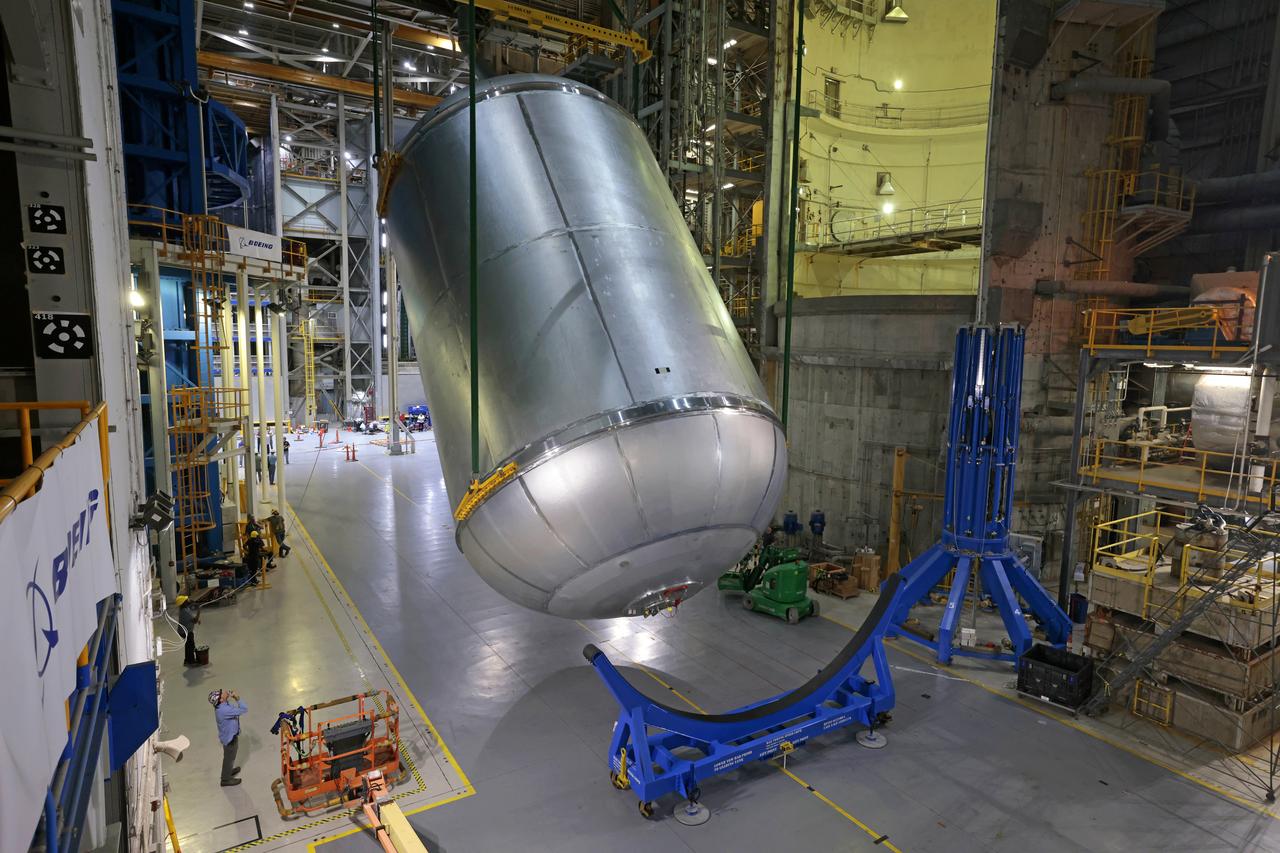
MSFC · 2024-06-12 · MAF_20240612_CS3_LoxOutCellF11
Artemis III Liquid Oxygen Tank Completes Production Milestones
Teams at NASA’s Michoud Assembly Facility in New Orleans successfully completed hydrostatic proof testing of the core stage liquid oxygen tank for the agency’s Artemis III mission. The…
Inspect NASA record
Teams at NASA’s Michoud Assembly Facility in New Orleans successfully completed hydrostatic proof testing of the core stage liquid oxygen tank for the agency’s Artemis III mission. The non-destructive evaluation method tests the structural integrity of the tank’s welds by filling the tank with water, simulating the propellant used during launch. The hardware was then moved to an adjacent cell for internal cleaning. Next, the tank will be readied for primer and application of its thermal protection system. The propellant tank is one of five major elements that make up the 212-foot-tall rocket stage. The core stage, along with its four RS-25 engines, produce two million pounds of thrust to help launch NASA’s Orion spacecraft, astronauts, and supplies beyond Earth’s orbit and to the lunar surface for Artemis. Image credit: NASA/Michael DeMocker
- Record ID
- MAF_20240612_CS3_LoxOutCellF11
- NASA center
- MSFC
- Date
- 2024-06-12
- Credit
- NASA/Michael DeMocker
- Keywords
- SLS, Michoud Assembly Facility, MAF, MSFC, Marshall Space Flight Center, Artemis III, Artemis, Space Launch System, Louisiana, Mars, Moon, NASA
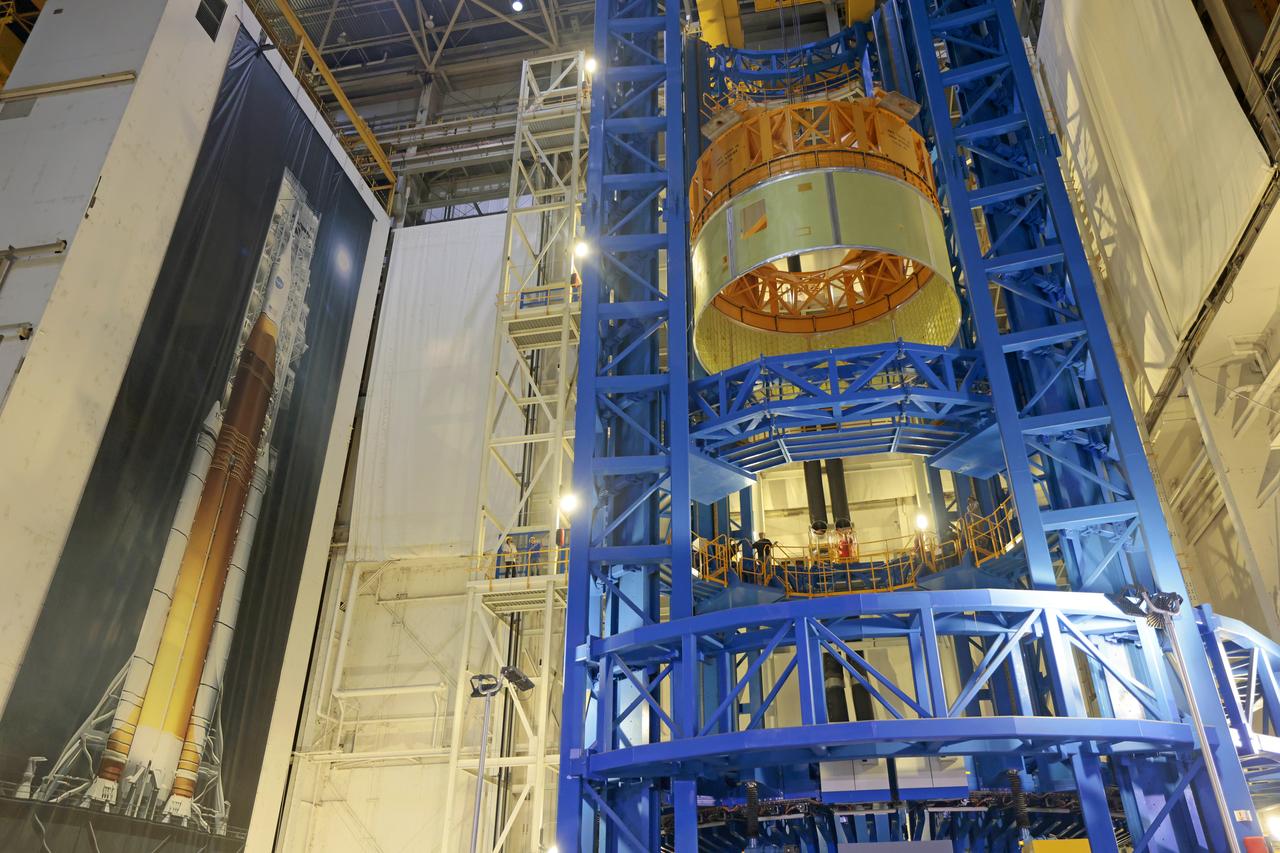
MSFC · 2025-01-31 · MAF_20250131_CS4_FSoutVAC02
Structurally Complete Forward Skirt Lifts Out of Vertical Assembly Center
This image shows teams at NASA’s Michoud Assembly Facility in New Orleans lifting a forward skirt out of its vertical assembly center on Jan. 31, 2025. The forward…
Inspect NASA record
This image shows teams at NASA’s Michoud Assembly Facility in New Orleans lifting a forward skirt out of its vertical assembly center on Jan. 31, 2025. The forward skirt, which will be used on the core stage for the agency’s SLS (Space Launch System) rocket for its Artemis IV mission, houses flight computers, cameras, and avionics. While inside the vertical assembly center, technicians attached the forward skirt’s forward and aft rings, which serve as attachments points to the launch vehicle stage adapter and the liquid oxygen tank, respectively. The forward skirt is one of five major elements that make up the 212-foot-tall rocket stage. The core stage, along with its four RS-25 engines, produce more than two million pounds of thrust to help launch NASA’s Orion spacecraft, astronauts, and supplies beyond Earth’s orbit and to the lunar surface for Artemis. Image credit: NASA/Michael DeMocker
- Record ID
- MAF_20250131_CS4_FSoutVAC02
- NASA center
- MSFC
- Date
- 2025-01-31
- Credit
- NASA/Michael DeMocker
- Keywords
- SLS, Michoud Assembly Facility, MAF, MSFC, Marshall Space Flight Center, Artemis IV, Artemis, Space Launch System, Louisiana, Mars, Moon, NASA

MAF · 2024-12-23 · MAF_20241223_CS3_LOX_VABtoCellP_09
Artemis III Liquid Oxygen Tank Moves to Next Phase of Production
Move crews at NASA’s Michoud Assembly Facility in New Orleans move a liquid oxygen tank for its SLS (Space Launch System) rocket from the vertical assembly building into…
Inspect NASA record
Move crews at NASA’s Michoud Assembly Facility in New Orleans move a liquid oxygen tank for its SLS (Space Launch System) rocket from the vertical assembly building into a nearby cell on Dec. 23. The tank, which will be used on the core stage of the agency’s Artemis III mission, will be primed using an automated process in preparation for application of its thermal protection system. The propellant tank is one of five major elements that make up the 212-foot-tall rocket stage. The core stage, along with its four RS-25 engines, produce more than two million pounds of thrust to help launch NASA’s Orion spacecraft, astronauts, and supplies beyond Earth’s orbit and to the lunar surface for Artemis.
- Record ID
- MAF_20241223_CS3_LOX_VABtoCellP_09
- NASA center
- MAF
- Date
- 2024-12-23
- Credit
- NASA/Eric Bordelon
- Keywords
- SLS, Michoud Assembly Facility, MAF, MSFC, Marshall Space Flight, Center, Artemis III, Artemis, Space Launch System, Louisiana, Mars, Moon
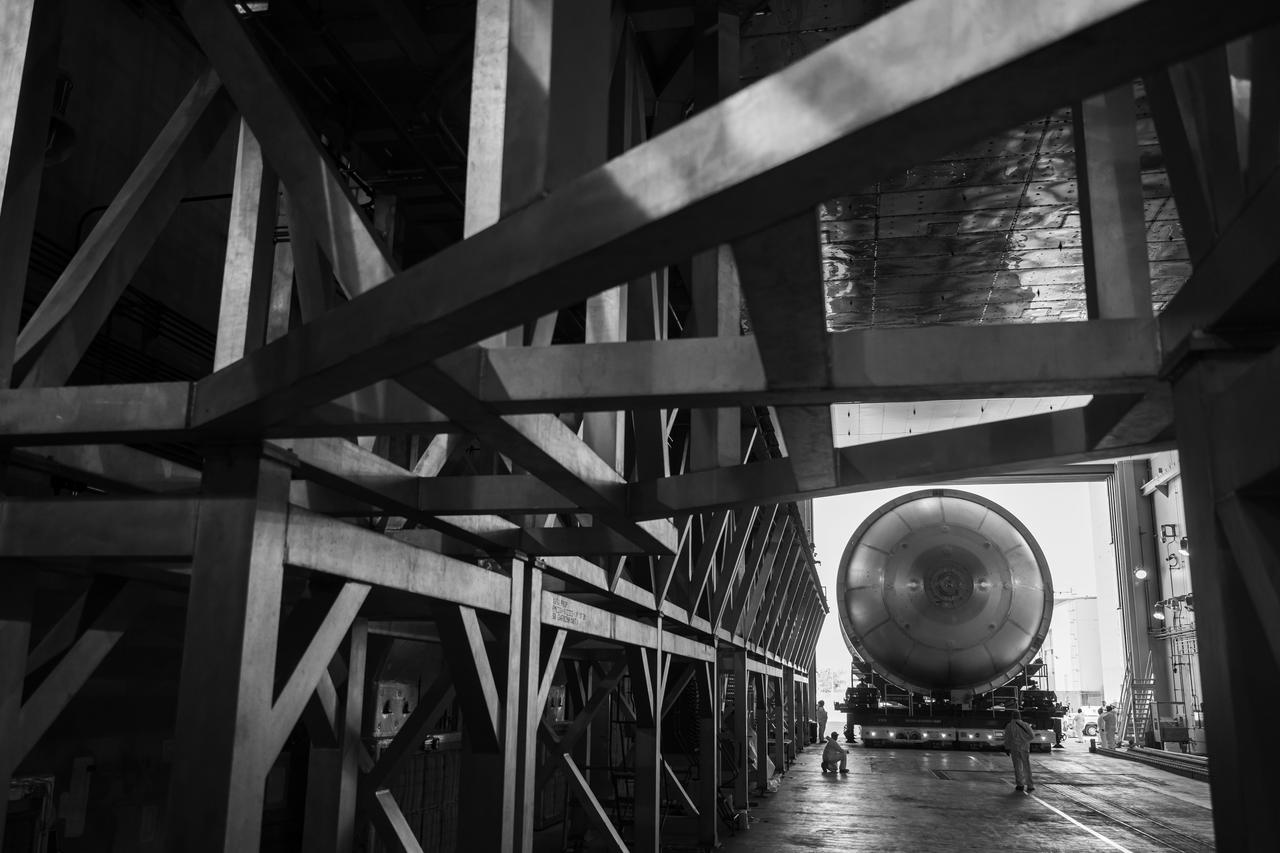
MAF · 2024-12-23 · MAF_20241223_CS3_LOX_VABtoCellP_22
Artemis III Liquid Oxygen Tank Moves to Next Phase of Production
Move crews at NASA’s Michoud Assembly Facility in New Orleans move a liquid oxygen tank for its SLS (Space Launch System) rocket from the vertical assembly building into…
Inspect NASA record
Move crews at NASA’s Michoud Assembly Facility in New Orleans move a liquid oxygen tank for its SLS (Space Launch System) rocket from the vertical assembly building into a nearby cell on Dec. 23. The tank, which will be used on the core stage of the agency’s Artemis III mission, will be primed using an automated process in preparation for application of its thermal protection system. The propellant tank is one of five major elements that make up the 212-foot-tall rocket stage. The core stage, along with its four RS-25 engines, produce more than two million pounds of thrust to help launch NASA’s Orion spacecraft, astronauts, and supplies beyond Earth’s orbit and to the lunar surface for Artemis.
- Record ID
- MAF_20241223_CS3_LOX_VABtoCellP_22
- NASA center
- MAF
- Date
- 2024-12-23
- Credit
- NASA/Eric Bordelon
- Keywords
- SLS, Michoud Assembly Facility, MAF, MSFC, Marshall Space Flight, Center, Artemis III, Artemis, Space Launch System, Louisiana, Mars, Moon