
Update Site (from NASA)
Explore NASA’s Image and Video Library.
Suggest one object per day for the Interstellar Minds collection. We review each suggestion before adding it.
Sign in to suggest a Marvel.
Find a NASA image ID. Open a NASA record and copy its ID from the end of the details URL.
NASA image records
AFRC · 2026-02-03 · AFRC2026-0012-420
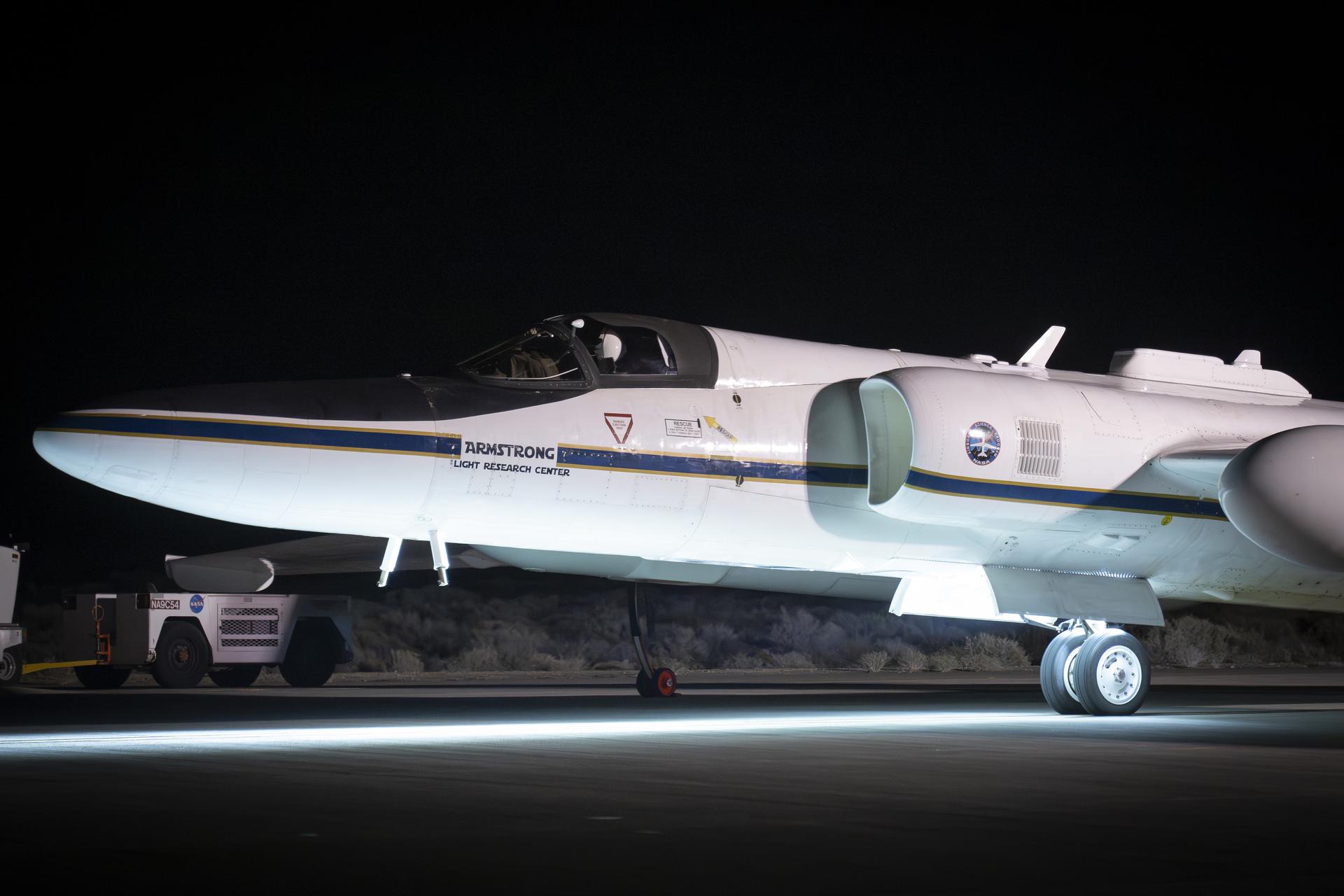
NASA ER-2 Moonlight Mission Improves Space Sensors
NASA’s ER-2 high-altitude aircraft prepares for a night flight with the Airborne Lunar Spectral Irradiance (air-LUSI) instrument on Monday, Feb. 2, 2026. The instrument measures Moonlight to improve accuracy…
Inspect NASA record
NASA’s ER-2 high-altitude aircraft prepares for a night flight with the Airborne Lunar Spectral Irradiance (air-LUSI) instrument on Monday, Feb. 2, 2026. The instrument measures Moonlight to improve accuracy of space-based sensors that forecast the weather, monitor agriculture, and study Earth’s ecosystem.
- Record ID
- AFRC2026-0012-420
- NASA center
- AFRC
- Date
- 2026-02-03
- Credit
- NASA/Christopher LC Clark
- Keywords
- NASA’s Armstrong Flight Research Center, AFRC, ER-2 high altitude aircraft, air-LUSI, airborne LUnar Spectral Irradiance mission, Moon, space-based sensors, Edwards Air Force Base, California
JSC · 1972-04-16 · as16-113-18289
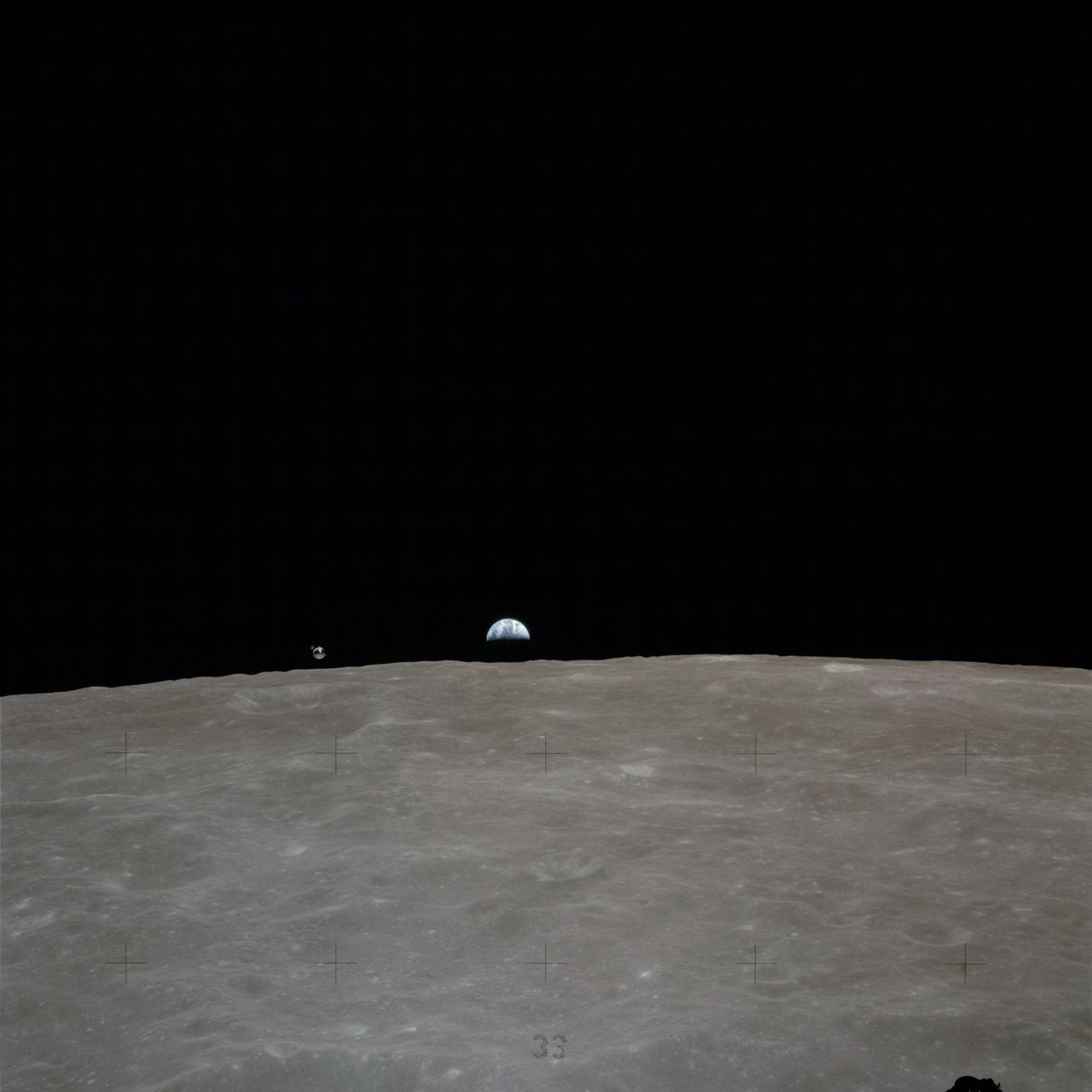
Apollo 16 Mission image - Earth rises over the lunar horizon, with the Apollo 16 Command and Services Modules (CSM) to the left of the Earth.
AS16-113-18289 (16-27 April 1972) --- Earth rises over the lunar horizon, with the Apollo 16 Command and Services Modules (CSM) to the left of Earth. This photograph was…
Inspect NASA record
AS16-113-18289 (16-27 April 1972) --- Earth rises over the lunar horizon, with the Apollo 16 Command and Services Modules (CSM) to the left of Earth. This photograph was taken from the Lunar Module (LM) "Orion" before the two Apollo 16 spacecraft re-joined following the CSM's failure to make the circularization burn on April 20, 1972. Astronaut Thomas K. Mattingly II, command module pilot, was inside the CSM "Casper", while astronauts John W. Young, commander, and Charles M. Duke Jr., lunar module pilot, were manning the LM. While astronauts Young and Duke descended in the LM to explore the Descartes region of the moon, astronaut Mattingly remained with the CSM in lunar orbit. Photo credit: NASA
- Record ID
- as16-113-18289
- NASA center
- JSC
- Date
- 1972-04-16
- Keywords
- Apollo, Apollo 16
AFRC · 2007-12-21 · ED07-0294-09
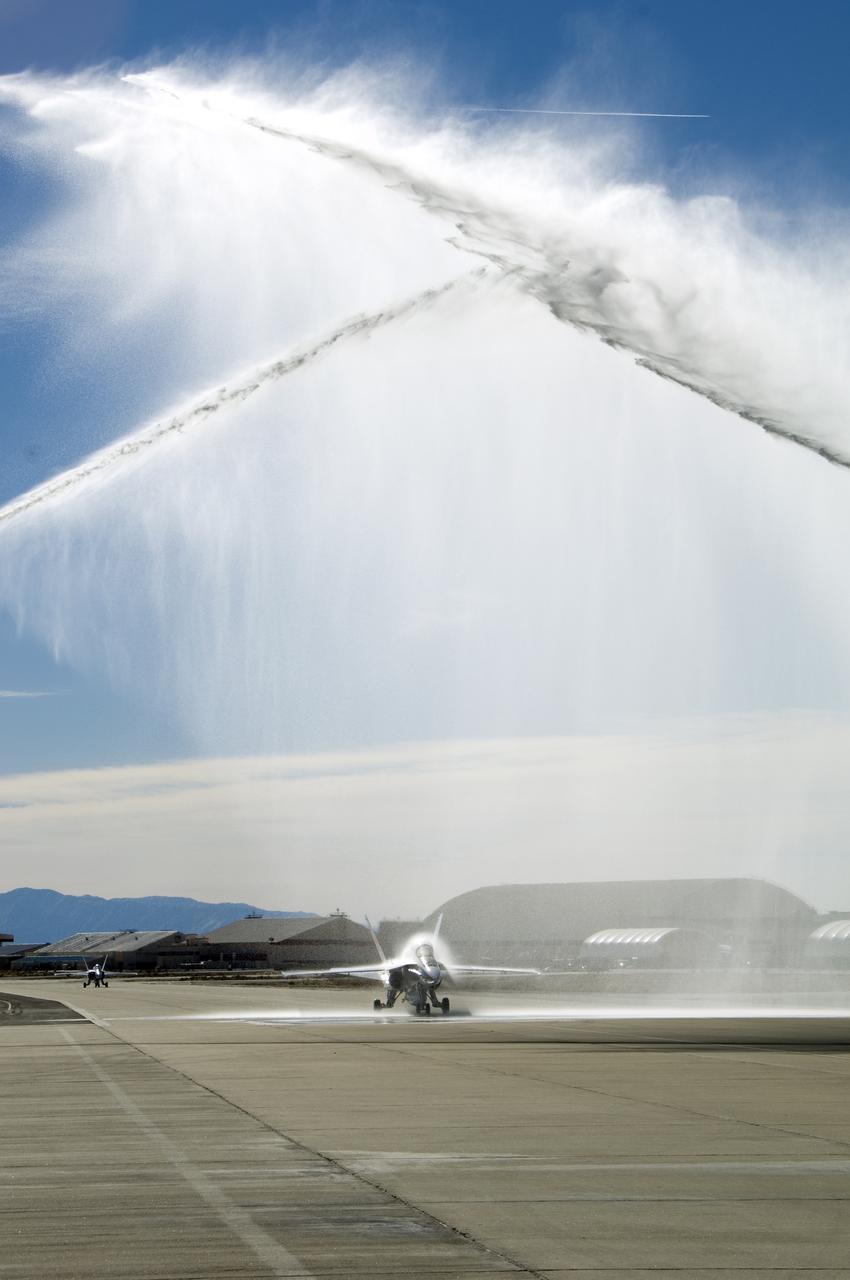
A water-cannon salute from two Air Force fire trucks heralds NASA research pilot Gordon Fullerton's final mission as his NASA F/A-18 taxis beneath the spray.
Long-time NASA Dryden research pilot and former astronaut C. Gordon Fullerton capped an almost 50-year flying career, including more than 38 years with NASA, with a final flight…
Inspect NASA record
Long-time NASA Dryden research pilot and former astronaut C. Gordon Fullerton capped an almost 50-year flying career, including more than 38 years with NASA, with a final flight in a NASA F/A-18 on Dec. 21, 2007. Fullerton and Dryden research pilot Jim Smolka flew a 90-minute pilot proficiency formation aerobatics flight with another Dryden F/A-18 and a Dryden T-38 before concluding with two low-level formation flyovers of Dryden before landing. Fullerton was honored with a water-cannon spray arch provided by two fire trucks from the Edwards Air Force Base fire department as he taxied the F/A-18 up to the Dryden ramp, and was then greeted by his wife Marie and several hundred Dryden staff after his final flight. Fullerton began his flying career with the U.S. Air Force in 1958 after earning bachelor's and master's degrees in mechanical engineering from the California Institute of Technology. Initially trained as a fighter pilot, he later transitioned to multi-engine bombers and became a bomber operations test pilot after attending the Air Force Aerospace Research Pilot School at Edwards Air Force Base, Calif. He then was assigned to the flight crew for the planned Air Force Manned Orbital Laboratory in 1966. Upon cancellation of that program, the Air Force assigned Fullerton to NASA's astronaut corps in 1969. He served on the support crews for the Apollo 14, 15, 16 and 17 lunar missions, and was later assigned to one of the two flight crews that piloted the space shuttle prototype Enterprise during the Approach and Landing Test program at Dryden. He then logged some 382 hours in space when he flew on two early space shuttle missions, STS-3 on Columbia in 1982 and STS-51F on Challenger in 1985. He joined the flight crew branch at NASA Dryden after leaving the astronaut corps in 1986. During his 21 years at Dryden, Fullerton was project pilot on a number of high-profile research efforts, including the Propulsion Controlled Aircraft, the high-speed landing tests of
- Record ID
- ED07-0294-09
- NASA center
- AFRC
- Date
- 2007-12-21
- Credit
- NASA/Tony Landis
- Keywords
- Flight Research Pilots, C. Gordon Fullerton, National Aeronautics and Space Administration, NASA Dryden Flight Research Center, Edwards-California, B-52, 747 Shuttle Carrier Aircraft, SCA, astronaut, U.S. Air Force, Convair 990 aircraft, F-18
AFRC · 2007-12-21 · ED07-0294-03
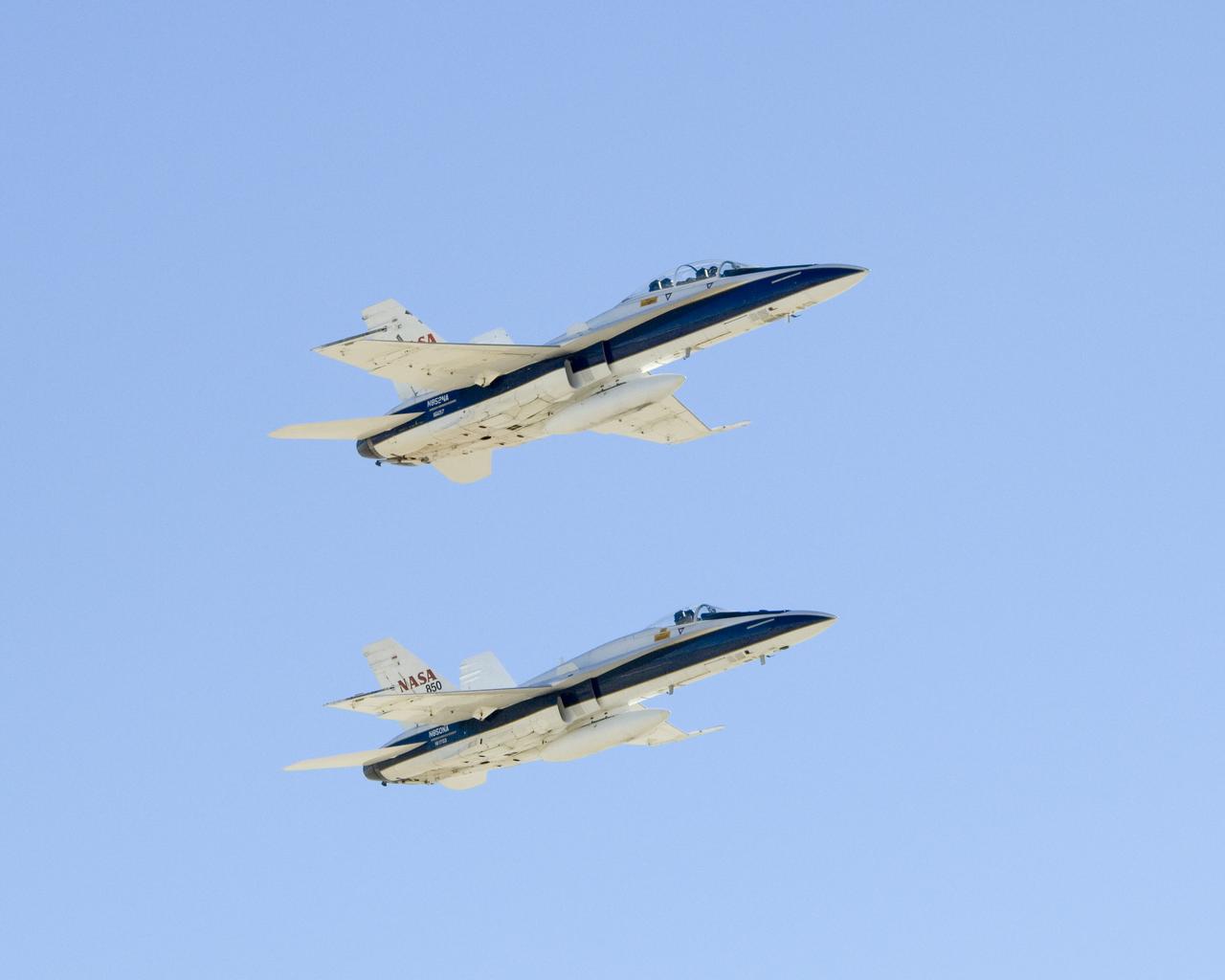
Two NASA Dryden F/A-18s flown by Gordon Fullerton and Nils Larson fly in tight formation Dec. 21, 2007 during Fullerton's final flight before his retirement.
Long-time NASA Dryden research pilot and former astronaut C. Gordon Fullerton capped an almost 50-year flying career, including more than 38 years with NASA, with a final flight…
Inspect NASA record
Long-time NASA Dryden research pilot and former astronaut C. Gordon Fullerton capped an almost 50-year flying career, including more than 38 years with NASA, with a final flight in a NASA F/A-18 on Dec. 21, 2007. Fullerton and Dryden research pilot Jim Smolka flew a 90-minute pilot proficiency formation aerobatics flight with another Dryden F/A-18 and a Dryden T-38 before concluding with two low-level formation flyovers of Dryden before landing. Fullerton was honored with a water-cannon spray arch provided by two fire trucks from the Edwards Air Force Base fire department as he taxied the F/A-18 up to the Dryden ramp, and was then greeted by his wife Marie and several hundred Dryden staff after his final flight. Fullerton began his flying career with the U.S. Air Force in 1958 after earning bachelor's and master's degrees in mechanical engineering from the California Institute of Technology. Initially trained as a fighter pilot, he later transitioned to multi-engine bombers and became a bomber operations test pilot after attending the Air Force Aerospace Research Pilot School at Edwards Air Force Base, Calif. He then was assigned to the flight crew for the planned Air Force Manned Orbital Laboratory in 1966. Upon cancellation of that program, the Air Force assigned Fullerton to NASA's astronaut corps in 1969. He served on the support crews for the Apollo 14, 15, 16 and 17 lunar missions, and was later assigned to one of the two flight crews that piloted the space shuttle prototype Enterprise during the Approach and Landing Test program at Dryden. He then logged some 382 hours in space when he flew on two early space shuttle missions, STS-3 on Columbia in 1982 and STS-51F on Challenger in 1985. He joined the flight crew branch at NASA Dryden after leaving the astronaut corps in 1986. During his 21 years at Dryden, Fullerton was project pilot on a number of high-profile research efforts, including the Propulsion Controlled Aircraft, the high-speed landing tests of
- Record ID
- ED07-0294-03
- NASA center
- AFRC
- Date
- 2007-12-21
- Credit
- NASA/Jim Ross
- Keywords
- Flight Research Pilots, C. Gordon Fullerton, National Aeronautics and Space Administration, NASA Dryden Flight Research Center, Edwards-California, B-52, 747 Shuttle Carrier Aircraft, SCA, astronaut, U.S. Air Force, Convair 990 aircraft, F-18
AFRC · 2007-12-21 · ED07-0294-35
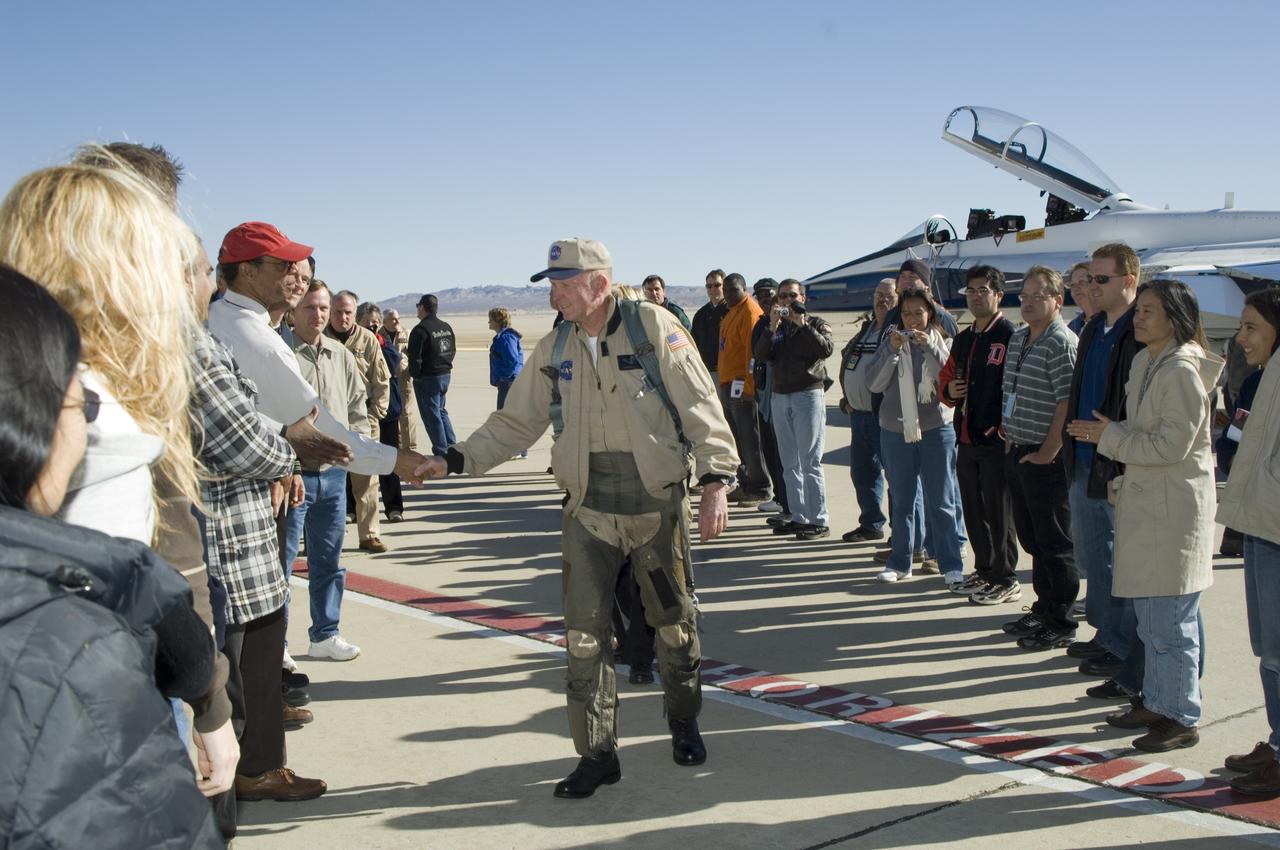
Retired NASA research pilot and former astronaut Gordon Fullerton was greeted by scores of NASA Dryden staff who bid him farewell after his final NASA flight.
Long-time NASA Dryden research pilot and former astronaut C. Gordon Fullerton capped an almost 50-year flying career, including more than 38 years with NASA, with a final flight…
Inspect NASA record
Long-time NASA Dryden research pilot and former astronaut C. Gordon Fullerton capped an almost 50-year flying career, including more than 38 years with NASA, with a final flight in a NASA F/A-18 on Dec. 21, 2007. Fullerton and Dryden research pilot Jim Smolka flew a 90-minute pilot proficiency formation aerobatics flight with another Dryden F/A-18 and a Dryden T-38 before concluding with two low-level formation flyovers of Dryden before landing. Fullerton was honored with a water-cannon spray arch provided by two fire trucks from the Edwards Air Force Base fire department as he taxied the F/A-18 up to the Dryden ramp, and was then greeted by his wife Marie and several hundred Dryden staff after his final flight. Fullerton began his flying career with the U.S. Air Force in 1958 after earning bachelor's and master's degrees in mechanical engineering from the California Institute of Technology. Initially trained as a fighter pilot, he later transitioned to multi-engine bombers and became a bomber operations test pilot after attending the Air Force Aerospace Research Pilot School at Edwards Air Force Base, Calif. He then was assigned to the flight crew for the planned Air Force Manned Orbital Laboratory in 1966. Upon cancellation of that program, the Air Force assigned Fullerton to NASA's astronaut corps in 1969. He served on the support crews for the Apollo 14, 15, 16 and 17 lunar missions, and was later assigned to one of the two flight crews that piloted the space shuttle prototype Enterprise during the Approach and Landing Test program at Dryden. He then logged some 382 hours in space when he flew on two early space shuttle missions, STS-3 on Columbia in 1982 and STS-51F on Challenger in 1985. He joined the flight crew branch at NASA Dryden after leaving the astronaut corps in 1986. During his 21 years at Dryden, Fullerton was project pilot on a number of high-profile research efforts, including the Propulsion Controlled Aircraft, the high-speed landing tests of
- Record ID
- ED07-0294-35
- NASA center
- AFRC
- Date
- 2007-12-21
- Credit
- NASA/Tony Landis
- Keywords
- Flight Research Pilots, C. Gordon Fullerton, National Aeronautics and Space Administration, NASA Dryden Flight Research Center, Edwards-California, B-52, 747 Shuttle Carrier Aircraft, SCA, astronaut, U.S. Air Force, Convair 990 aircraft, F-18
AFRC · 2007-12-21 · ED07-0294-44
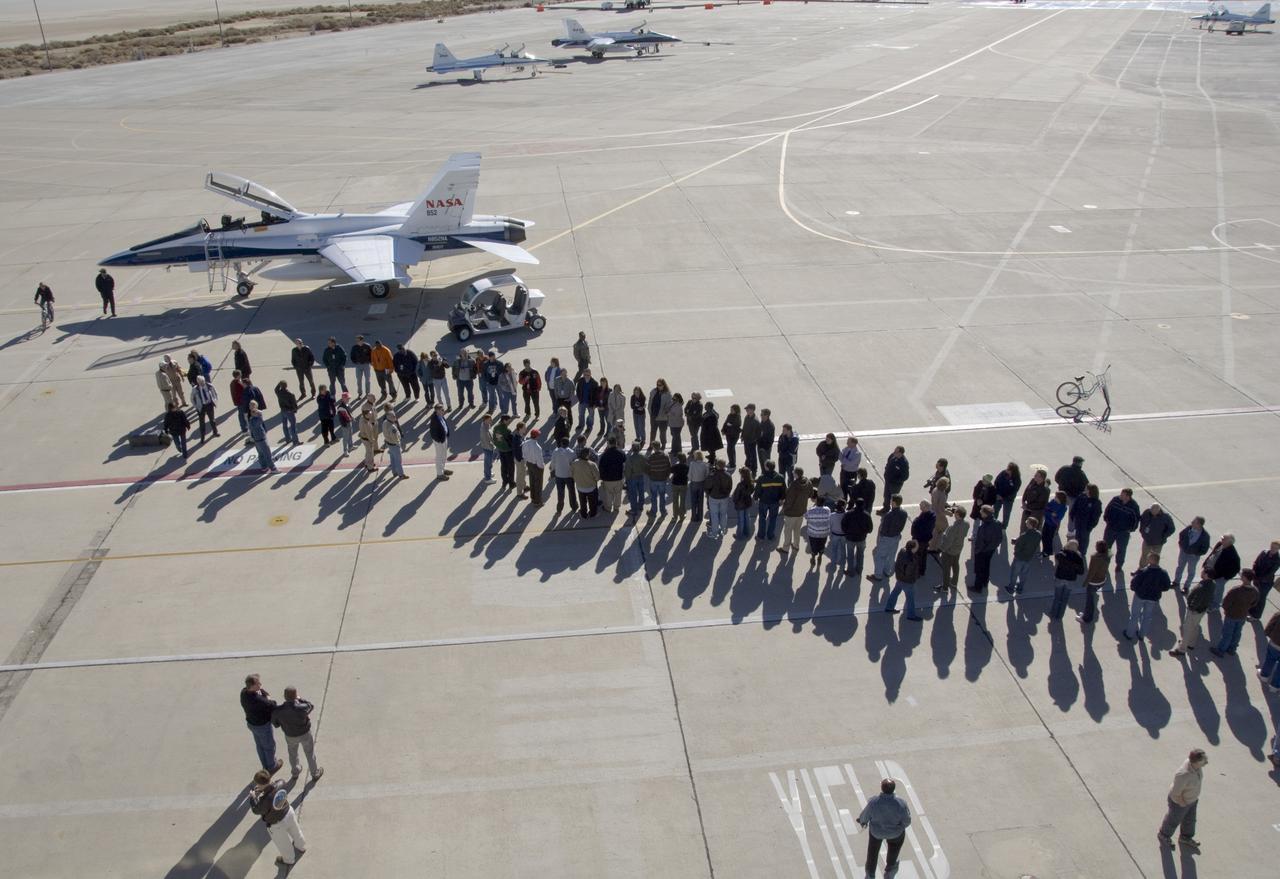
More than 200 Dryden staff formed two long lines on the Dryden ramp to greet retired research pilot Gordon Fullerton after his final flight in a NASA F/A-18.
Long-time NASA Dryden research pilot and former astronaut C. Gordon Fullerton capped an almost 50-year flying career, including more than 38 years with NASA, with a final flight…
Inspect NASA record
Long-time NASA Dryden research pilot and former astronaut C. Gordon Fullerton capped an almost 50-year flying career, including more than 38 years with NASA, with a final flight in a NASA F/A-18 on Dec. 21, 2007. Fullerton and Dryden research pilot Jim Smolka flew a 90-minute pilot proficiency formation aerobatics flight with another Dryden F/A-18 and a Dryden T-38 before concluding with two low-level formation flyovers of Dryden before landing. Fullerton was honored with a water-cannon spray arch provided by two fire trucks from the Edwards Air Force Base fire department as he taxied the F/A-18 up to the Dryden ramp, and was then greeted by his wife Marie and several hundred Dryden staff after his final flight. Fullerton began his flying career with the U.S. Air Force in 1958 after earning bachelor's and master's degrees in mechanical engineering from the California Institute of Technology. Initially trained as a fighter pilot, he later transitioned to multi-engine bombers and became a bomber operations test pilot after attending the Air Force Aerospace Research Pilot School at Edwards Air Force Base, Calif. He then was assigned to the flight crew for the planned Air Force Manned Orbital Laboratory in 1966. Upon cancellation of that program, the Air Force assigned Fullerton to NASA's astronaut corps in 1969. He served on the support crews for the Apollo 14, 15, 16 and 17 lunar missions, and was later assigned to one of the two flight crews that piloted the space shuttle prototype Enterprise during the Approach and Landing Test program at Dryden. He then logged some 382 hours in space when he flew on two early space shuttle missions, STS-3 on Columbia in 1982 and STS-51F on Challenger in 1985. He joined the flight crew branch at NASA Dryden after leaving the astronaut corps in 1986. During his 21 years at Dryden, Fullerton was project pilot on a number of high-profile research efforts, including the Propulsion Controlled Aircraft, the high-speed landing tests of
- Record ID
- ED07-0294-44
- NASA center
- AFRC
- Date
- 2007-12-21
- Credit
- NASA/Tom Tschida
- Keywords
- Flight Research Pilots, C. Gordon Fullerton, National Aeronautics and Space Administration, NASA Dryden Flight Research Center, Edwards-California, B-52, 747 Shuttle Carrier Aircraft, SCA, astronaut, U.S. Air Force, Convair 990 aircraft, F-18
AFRC · 2007-12-21 · ED07-0294-12
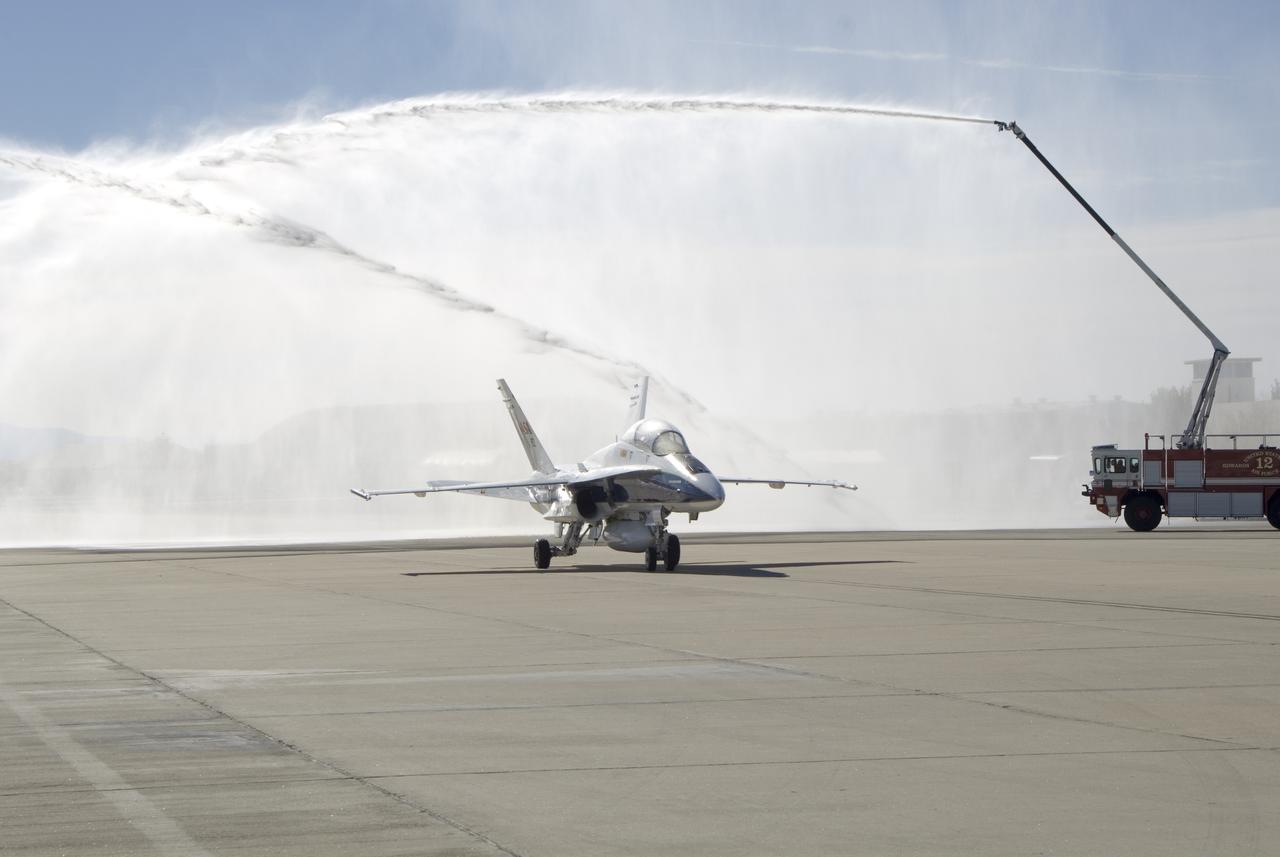
A water-cannon salute from two Air Force fire trucks heralds NASA research pilot Gordon Fullerton's final mission as his NASA F/A-18 taxis beneath the spray.
Long-time NASA Dryden research pilot and former astronaut C. Gordon Fullerton capped an almost 50-year flying career, including more than 38 years with NASA, with a final flight…
Inspect NASA record
Long-time NASA Dryden research pilot and former astronaut C. Gordon Fullerton capped an almost 50-year flying career, including more than 38 years with NASA, with a final flight in a NASA F/A-18 on Dec. 21, 2007. Fullerton and Dryden research pilot Jim Smolka flew a 90-minute pilot proficiency formation aerobatics flight with another Dryden F/A-18 and a Dryden T-38 before concluding with two low-level formation flyovers of Dryden before landing. Fullerton was honored with a water-cannon spray arch provided by two fire trucks from the Edwards Air Force Base fire department as he taxied the F/A-18 up to the Dryden ramp, and was then greeted by his wife Marie and several hundred Dryden staff after his final flight. Fullerton began his flying career with the U.S. Air Force in 1958 after earning bachelor's and master's degrees in mechanical engineering from the California Institute of Technology. Initially trained as a fighter pilot, he later transitioned to multi-engine bombers and became a bomber operations test pilot after attending the Air Force Aerospace Research Pilot School at Edwards Air Force Base, Calif. He then was assigned to the flight crew for the planned Air Force Manned Orbital Laboratory in 1966. Upon cancellation of that program, the Air Force assigned Fullerton to NASA's astronaut corps in 1969. He served on the support crews for the Apollo 14, 15, 16 and 17 lunar missions, and was later assigned to one of the two flight crews that piloted the space shuttle prototype Enterprise during the Approach and Landing Test program at Dryden. He then logged some 382 hours in space when he flew on two early space shuttle missions, STS-3 on Columbia in 1982 and STS-51F on Challenger in 1985. He joined the flight crew branch at NASA Dryden after leaving the astronaut corps in 1986. During his 21 years at Dryden, Fullerton was project pilot on a number of high-profile research efforts, including the Propulsion Controlled Aircraft, the high-speed landing tests of
- Record ID
- ED07-0294-12
- NASA center
- AFRC
- Date
- 2007-12-21
- Credit
- NASA/Tony Landis
- Keywords
- Flight Research Pilots, C. Gordon Fullerton, National Aeronautics and Space Administration, NASA Dryden Flight Research Center, Edwards-California, B-52, 747 Shuttle Carrier Aircraft, SCA, astronaut, U.S. Air Force, Convair 990 aircraft, F-18
AFRC · 2007-12-21 · ED07-0294-01
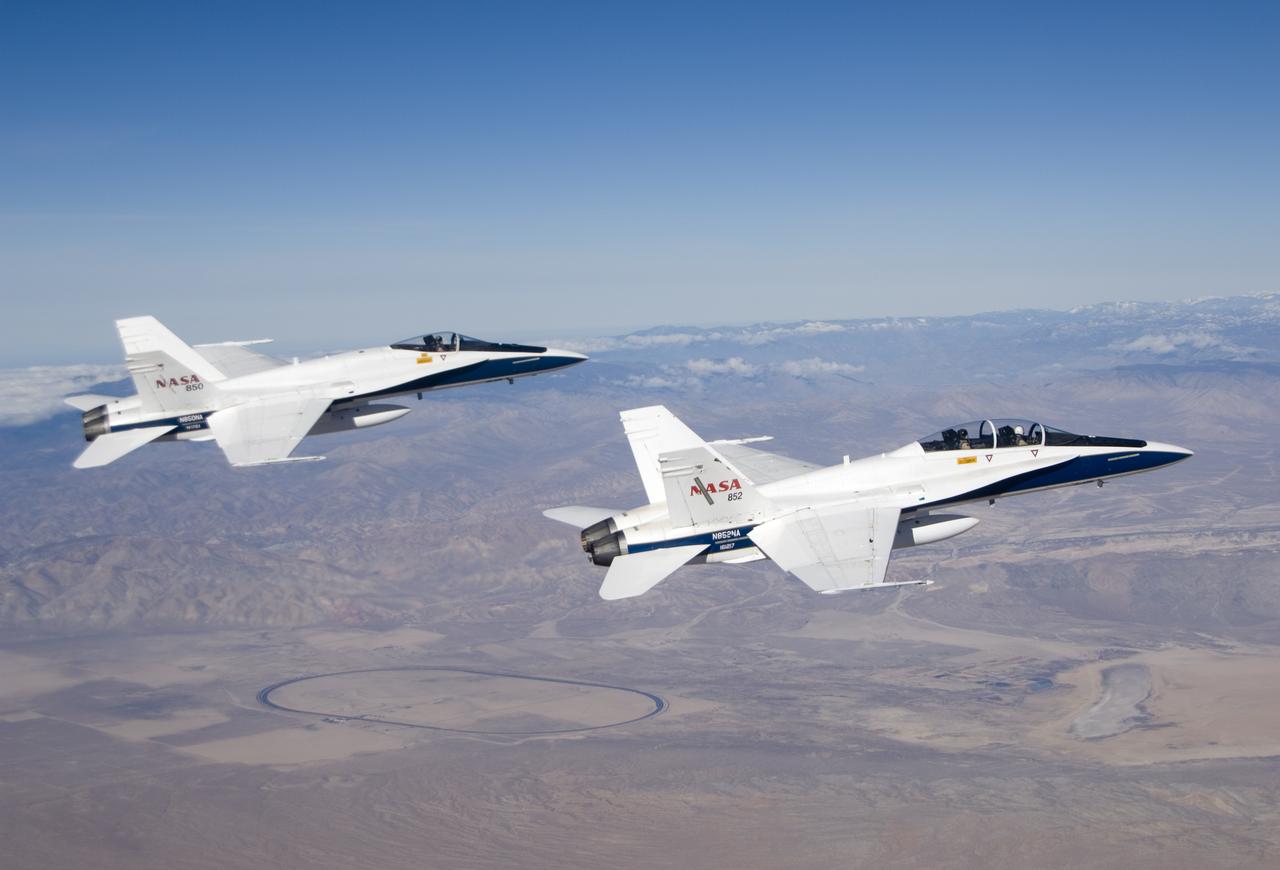
NASA Dryden research pilot Gordon Fullerton flies his final mission in NASA F/A-18B #852 in formation with NASA F/A-18A #850 on Dec. 21, 2007.
Long-time NASA Dryden research pilot and former astronaut C. Gordon Fullerton capped an almost 50-year flying career, including more than 38 years with NASA, with a final flight…
Inspect NASA record
Long-time NASA Dryden research pilot and former astronaut C. Gordon Fullerton capped an almost 50-year flying career, including more than 38 years with NASA, with a final flight in a NASA F/A-18 on Dec. 21, 2007. Fullerton and Dryden research pilot Jim Smolka flew a 90-minute pilot proficiency formation aerobatics flight with another Dryden F/A-18 and a Dryden T-38 before concluding with two low-level formation flyovers of Dryden before landing. Fullerton was honored with a water-cannon spray arch provided by two fire trucks from the Edwards Air Force Base fire department as he taxied the F/A-18 up to the Dryden ramp, and was then greeted by his wife Marie and several hundred Dryden staff after his final flight. Fullerton began his flying career with the U.S. Air Force in 1958 after earning bachelor's and master's degrees in mechanical engineering from the California Institute of Technology. Initially trained as a fighter pilot, he later transitioned to multi-engine bombers and became a bomber operations test pilot after attending the Air Force Aerospace Research Pilot School at Edwards Air Force Base, Calif. He then was assigned to the flight crew for the planned Air Force Manned Orbital Laboratory in 1966. Upon cancellation of that program, the Air Force assigned Fullerton to NASA's astronaut corps in 1969. He served on the support crews for the Apollo 14, 15, 16 and 17 lunar missions, and was later assigned to one of the two flight crews that piloted the space shuttle prototype Enterprise during the Approach and Landing Test program at Dryden. He then logged some 382 hours in space when he flew on two early space shuttle missions, STS-3 on Columbia in 1982 and STS-51F on Challenger in 1985. He joined the flight crew branch at NASA Dryden after leaving the astronaut corps in 1986. During his 21 years at Dryden, Fullerton was project pilot on a number of high-profile research efforts, including the Propulsion Controlled Aircraft, the high-speed landing tests of sp
- Record ID
- ED07-0294-01
- NASA center
- AFRC
- Date
- 2007-12-21
- Credit
- NASA/Jim Ross
- Keywords
- Flight Research Pilots, C. Gordon Fullerton, National Aeronautics and Space Administration, NASA Dryden Flight Research Center, Edwards-California, B-52, 747 Shuttle Carrier Aircraft, SCA, astronaut, U.S. Air Force, Convair 990 aircraft, F-18
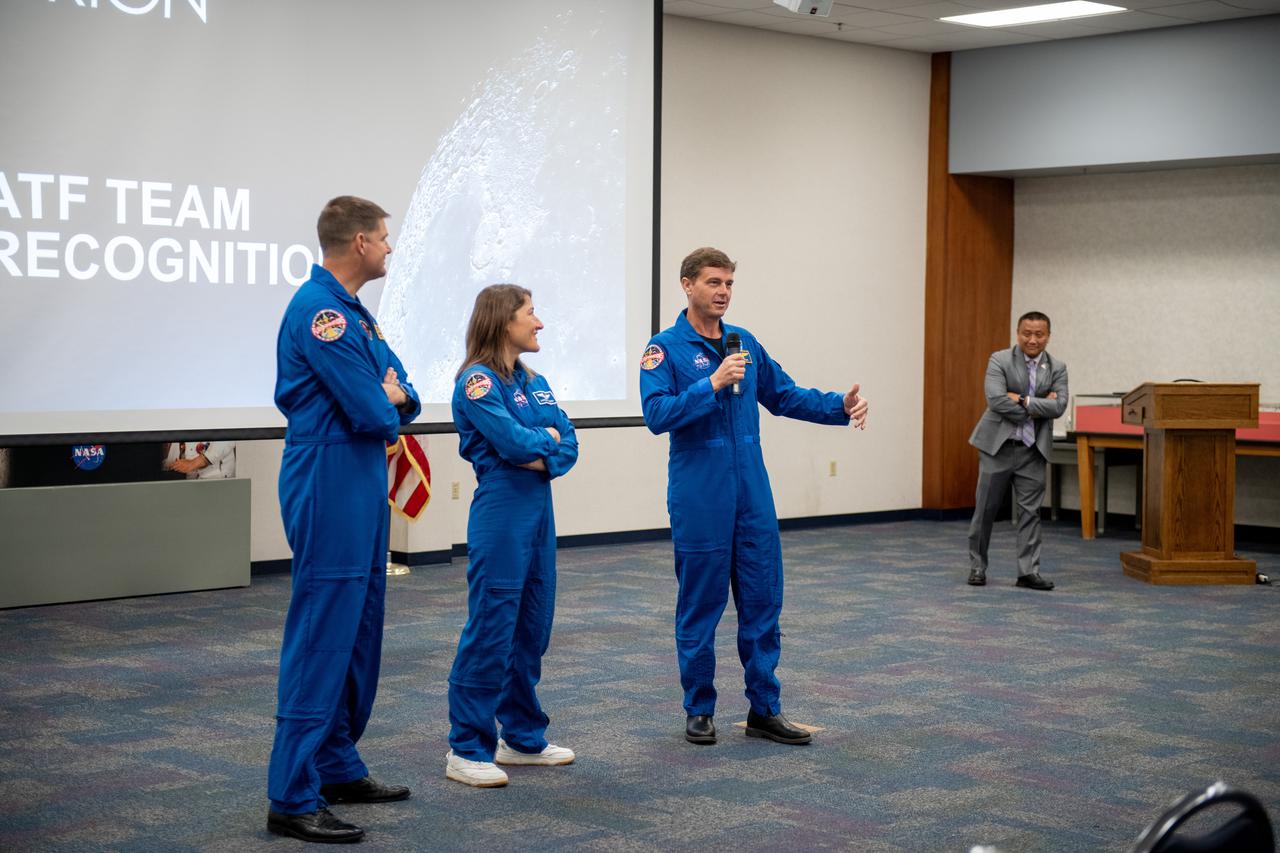
GRC · 2024-09-11 · GRC-2024-C-09992
Orion Technical Visit and Artemis II All Hands
Employees meet three of the four astronauts who will venture around the Moon on Artemis II, the first crewed flight paving the way for future lunar surface missions.…
Inspect NASA record
Employees meet three of the four astronauts who will venture around the Moon on Artemis II, the first crewed flight paving the way for future lunar surface missions. Commander Reid Wiseman and Mission Specialists Christina Koch and Jeremy Hansen will be on hand to discuss their upcoming mission and participate in a Question and Answer session with employees afterward. Hansen is an astronaut with the Canadian Space Agency. Victor Glover, the pilot and fourth crew member, will not be present. Awards were given to employees that participated in Orion for Artemis I. The crew of four astronauts will lift off on an approximately 10-day mission from Launch Complex 39B at NASA’s Kennedy Space Center in Florida, blazing beyond Earth’s grasp atop the agency’s mega Moon rocket. The crew will check out Orion’s systems and perform a targeting demonstration test relatively close to Earth before venturing around the Moon.
- Record ID
- GRC-2024-C-09992
- NASA center
- GRC
- Date
- 2024-09-11
- Credit
- NASA/GRC/Sara Lowthian-Hanna
- Keywords
- GRC-2024-C-09992.jpg, 270SLH_1754.JPG, Jeremy Hansen, Christina Koch, Reid Wiseman, Howard Hu, Artemis, Artemis II, Astronauts, Awards, Orion

KSC · 2022-05-11 · KSC-20220511-PH-KLS01_0272
Artemis II CTV Demo
Technicians from Johnson Space Center, dressed in flight suits, secure themselves inside a prototype of a crew transportation vehicle (CTV) for Artemis crewed missions outside the Neil Armstrong…
Inspect NASA record
Technicians from Johnson Space Center, dressed in flight suits, secure themselves inside a prototype of a crew transportation vehicle (CTV) for Artemis crewed missions outside the Neil Armstrong Operations and Checkout Building at NASA’s Kennedy Space Center in Florida on May 11, 2022. Canoo Technologies Inc., was awarded a contract to design and provide the next generation of CTVs for the Artemis crewed missions. Representatives with Canoo were at the spaceport demonstrating the environmentally friendly fleet of vehicles. Artemis II will be the first Artemis mission flying crew aboard Orion. In later missions, NASA will land the first woman and the first person of color on the surface of the Moon, paving the way for a long-term lunar presence and serving as a steppingstone on the way to Mars.
- Record ID
- KSC-20220511-PH-KLS01_0272
- NASA center
- KSC
- Date
- 2022-05-11
- Credit
- NASA/Kim Shiflett
- Keywords
- Artemis, Artemis II, Astronauts, CTV, Crew Transport Vehicles, KSC, O&C, Orion, Pad 39B, Training Auditorium, VAB
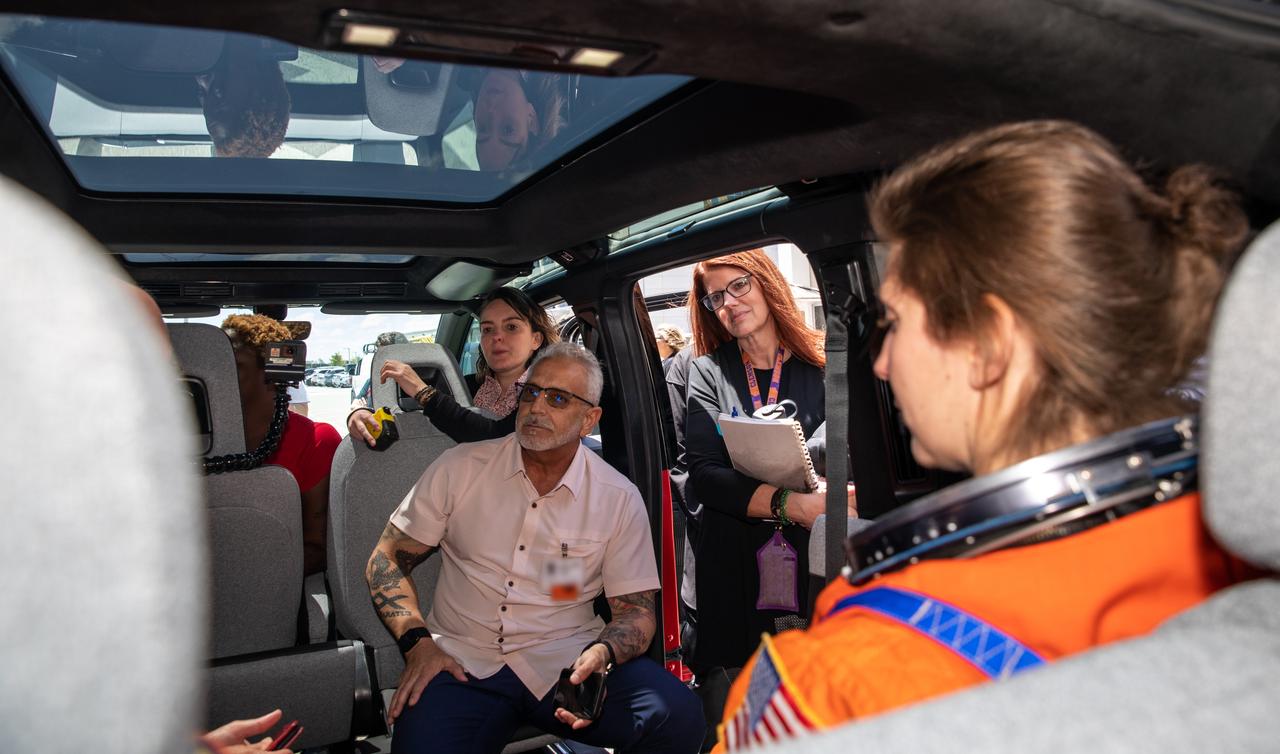
KSC · 2022-05-11 · KSC-20220511-PH-KLS01_0293
Artemis II CTV Demo
Technicians from Johnson Space Center, dressed in flight suits, secure themselves inside a prototype of a crew transportation vehicle (CTV) for Artemis crewed missions for a test drive…
Inspect NASA record
Technicians from Johnson Space Center, dressed in flight suits, secure themselves inside a prototype of a crew transportation vehicle (CTV) for Artemis crewed missions for a test drive near the Neil Armstrong Operations and Checkout Building at NASA’s Kennedy Space Center in Florida on May 11, 2022. Canoo Technologies Inc., was awarded a contract to design and provide the next generation of CTVs for the Artemis crewed missions Representatives with Canoo were at the spaceport demonstrating the environmentally friendly fleet of vehicles. Also in view near the vehicle’s door is Artemis I Launch Director Charlie Blackwell Thompson, and at left, is Anthony Aquila, chief executive officer of Canoo Technologies Inc.. Artemis II will be the first Artemis mission flying crew aboard Orion. In later missions, NASA will land the first woman and the first person of color on the surface of the Moon, paving the way for a long-term lunar presence and serving as a steppingstone on the way to Mars.
- Record ID
- KSC-20220511-PH-KLS01_0293
- NASA center
- KSC
- Date
- 2022-05-11
- Credit
- NASA/Kim Shiflett
- Keywords
- Artemis, Artemis II, Astronauts, CTV, Crew Transport Vehicles, KSC, O&C, Orion, Pad 39B, Training Auditorium, VAB
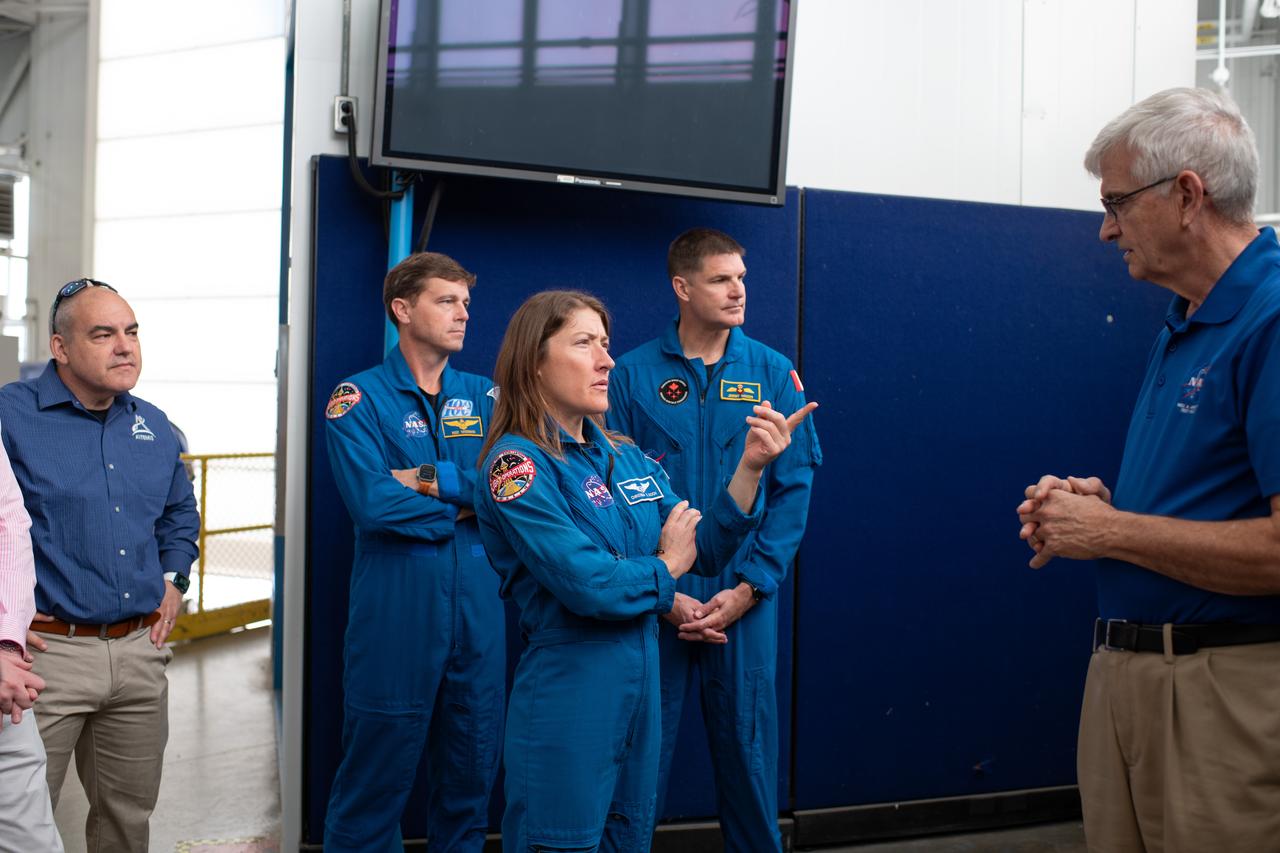
GRC · 2024-09-11 · GRC-2024-C-09932
Orion Technical Visit and Artemis II All Hands
Tours were given of the In Space Propulsion Facility (ISP) in Sandusky, OH at Neil Armstrong Test Facility. NASA’s Facility is the world’s only high altitude test facility…
Inspect NASA record
Tours were given of the In Space Propulsion Facility (ISP) in Sandusky, OH at Neil Armstrong Test Facility. NASA’s Facility is the world’s only high altitude test facility capable of full-scale rocket engine and launch vehicle system level tests. The facility supports mission profile thermal vacuum simulation and engine firing. Employees meet three of the four astronauts who will venture around the Moon on Artemis II, the first crewed flight paving the way for future lunar surface missions. Commander Reid Wiseman and Mission Specialists Christina Koch and Jeremy Hansen will be on hand to discuss their upcoming mission and participate in a Question and Answer session with employees afterward. Hansen is an astronaut with the Canadian Space Agency. Victor Glover, the pilot and fourth crew member, will not be present. Awards were given to employees that participated in Orion for Artemis I.
- Record ID
- GRC-2024-C-09932
- NASA center
- GRC
- Date
- 2024-09-11
- Credit
- NASA/GRC/Sara Lowthian-Hanna
- Keywords
- GRC-2024-C-09932.jpg, 210_SLH9623.JPG, Carlos Garcia-Galan, Reid Wiseman, Christina Koch, Jeremy Hansen, David Stringer, Armstrong Test Facility, ATF, Artemis, Astronauts, Artemis II Astronauts