
Update Site (from NASA)
Explore NASA’s Image and Video Library.
Suggest one object per day for the Interstellar Minds collection. We review each suggestion before adding it.
Sign in to suggest a Marvel.
Find a NASA image ID. Open a NASA record and copy its ID from the end of the details URL.
NASA image records

KSC · 2023-08-08 · KSC-20230808-PH-KLS04_0007
NASA Briefing with Artemis II Crew
Pam Melroy, NASA deputy administrator, participates in a news conference on Aug. 8, 2023, at the agency’s Kennedy Space Center in Florida. NASA senior leadership and the Artemis…
Inspect NASA record
Pam Melroy, NASA deputy administrator, participates in a news conference on Aug. 8, 2023, at the agency’s Kennedy Space Center in Florida. NASA senior leadership and the Artemis II crew discussed the mission – the first with astronauts under Artemis, which will send NASA astronauts Reid Wiseman, Victor Glover, and Christina Koch, as well as Canadian Space Agency astronaut Jeremy Hansen around the Moon and back. Artemis II is the first crewed mission on NASA’s path to establishing a long-term lunar presence for science and exploration under Artemis and is the first mission with astronauts to the Moon.
- Record ID
- KSC-20230808-PH-KLS04_0007
- NASA center
- KSC
- Date
- 2023-08-08
- Credit
- NASA/Kim Shiflett
- Keywords
- Artemis, Artemis II, Cape Canaveral, Christina Hammock Koch, Florida, Jeremy Hansen, John. F. Kennedy Space Center, KSC, Kennedy, Kennedy Space Center, NASA, Reid Wiseman

KSC · 2023-02-21 · KSC-20230221-PH-KLS03_0007
Artemis IV Pressure Vessel and Artemis II European Service Modul
Seen here is the pressure vessel for the Artemis IV mission inside the Neil Armstrong Operations and Checkout Building at NASA’s Kennedy Space Center in Florida on Feb.…
Inspect NASA record
Seen here is the pressure vessel for the Artemis IV mission inside the Neil Armstrong Operations and Checkout Building at NASA’s Kennedy Space Center in Florida on Feb. 21, 2023. The pressure vessel is the underlying structure of the Orion crew module, containing the pressurized atmosphere astronauts will breathe and work in while in the vacuum of deep space. Artemis IV will be the first operational mission to Gateway – an outpost in lunar orbit serving as a staging point for deep space exploration – followed by a week-long surface mission on the Moon. Using Gateway, NASA will develop a long-term presence on the Moon, using this as a steppingstone before venturing on to Mars.
- Record ID
- KSC-20230221-PH-KLS03_0007
- NASA center
- KSC
- Date
- 2023-02-21
- Credit
- NASA/Kim Shiflett
- Keywords
- Artemis, Artemis II, Artemis IV, ESM, European service module, O&C, Operations and Checkout Building, Orion, pressure vessel
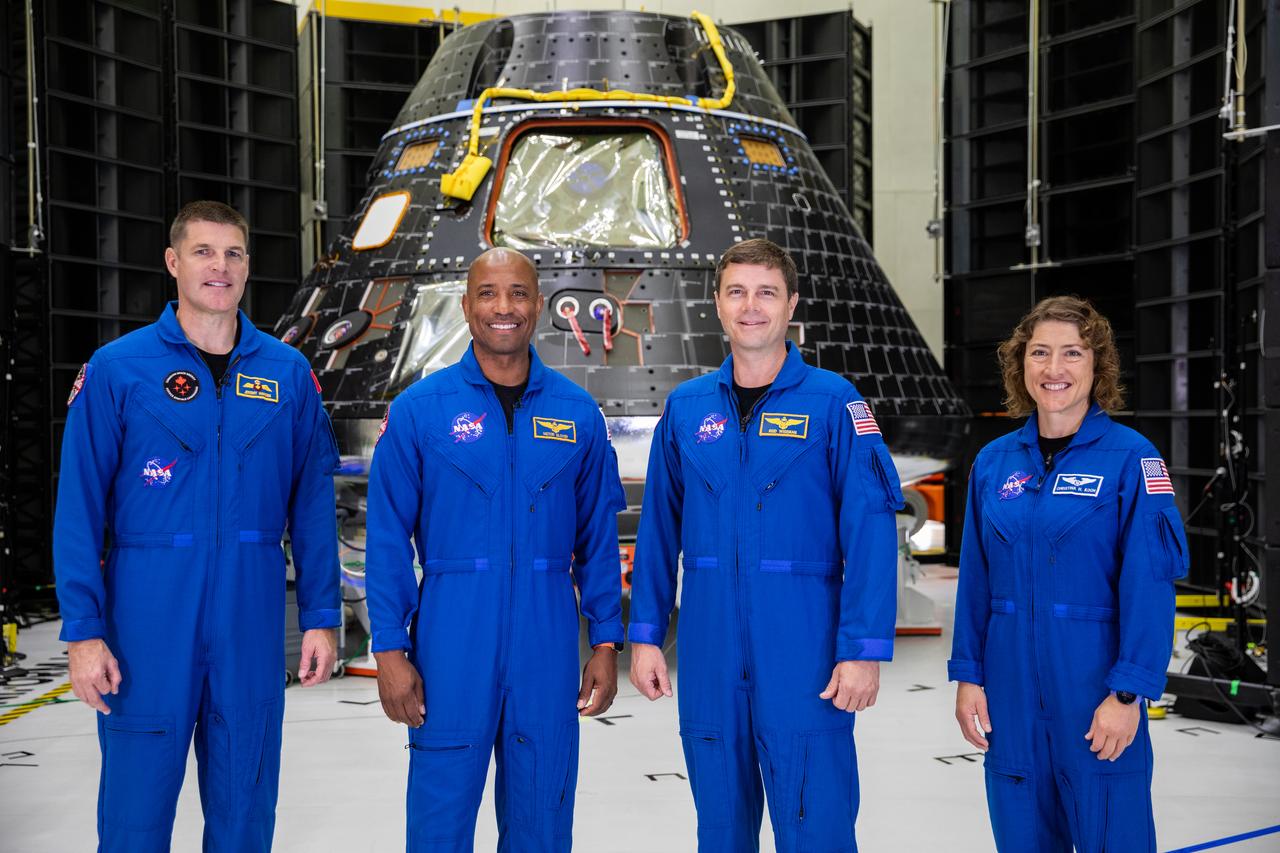
KSC · 2023-08-08 · KSC-20230808-PH-KLS02_0098
KSC Orion Media Day - Artemis II Crew
Artemis II crew members, shown inside the Neil Armstrong Operations and Checkout Building at NASA’s Kennedy Space Center in Florida, stand in front of their Orion crew module…
Inspect NASA record
Artemis II crew members, shown inside the Neil Armstrong Operations and Checkout Building at NASA’s Kennedy Space Center in Florida, stand in front of their Orion crew module on Aug. 8, 2023. From left are: Jeremy Hansen, mission specialist; Victor Glover, pilot; Reid Wiseman, commander; and Christina Hammock Koch, mission specialist. The crew module is undergoing acoustic testing ahead of integration with the European Service Module. Artemis II is the first crewed mission on NASA’s path to establishing a long-term lunar presence for science and exploration under Artemis.
- Record ID
- KSC-20230808-PH-KLS02_0098
- NASA center
- KSC
- Date
- 2023-08-08
- Credit
- NASA/Kim Shiflett
- Keywords
- Artemis, Artemis II, Artemis III, Artemis IV, CM, ESM, European service module, KSC, Kennedy Space Center, Moon, Moon to Mars, O&C

KSC · 2022-05-11 · KSC-20220511-PH-KLS01_0237
Artemis II CTV Demo
Several concept designs for Artemis crew transportation vehicles (CTV) are lined up at Launch Complex 39B at NASA’s Kennedy Space Center in Florida on May 11, 2022. Canoo…
Inspect NASA record
Several concept designs for Artemis crew transportation vehicles (CTV) are lined up at Launch Complex 39B at NASA’s Kennedy Space Center in Florida on May 11, 2022. Canoo Technologies Inc., was awarded a contract to design and provide the next generation of CTVs for the Artemis crewed missions. Representatives with Canoo were at the spaceport demonstrating the environmentally friendly fleet of vehicles. Artemis II will be the first Artemis mission flying crew aboard Orion. In later missions, NASA will land the first woman and the first person of color on the surface of the Moon, paving the way for a long-term lunar presence and serving as a steppingstone on the way to Mars.
- Record ID
- KSC-20220511-PH-KLS01_0237
- NASA center
- KSC
- Date
- 2022-05-11
- Credit
- NASA/Kim Shiflett
- Keywords
- Artemis, Artemis II, Astronauts, CTV, Crew Transport Vehicles, KSC, O&C, Orion, Pad 39B, Training Auditorium, VAB

MAF · 2022-12-20 · MAF_20221220_CS3_LH2toCellA11
Liquid Hydrogen Tank for Artemis III Moves on to Next Phase of Production
Technicians at NASA’s Michoud Assembly Facility in New Orleans move the liquid hydrogen tank of NASA’s Space Launch System (SLS) rocket to Cell A for white light scans…
Inspect NASA record
Technicians at NASA’s Michoud Assembly Facility in New Orleans move the liquid hydrogen tank of NASA’s Space Launch System (SLS) rocket to Cell A for white light scans of the tank’s dimensions in preparation of multiple join activities throughout the manufacturing process. The flight hardware will be used for Artemis III, one of the first crewed Artemis missions. The liquid hydrogen tank holds 537,000 gallons of liquid hydrogen cooled to minus 432 degrees Fahrenheit and is the largest of the five elements that make up the rocket’s 212-foot-tall core stage. The liquid hydrogen tank is situated between the core stage’s intertank and engine section. The liquid hydrogen hardware, along with the liquid oxygen tank, will provide propellant to the four RS-25 engines at the bottom of the core stage to produce more than two million pounds of thrust to launch NASA’s Artemis missions to the Moon. Together with its four RS-25 engines, the rocket’s massive 212-foot-tall core stage — the largest stage NASA has ever built — and its twin solid rocket boosters produce 8.8 million pounds of thrust to send NASA’s Orion spacecraft, astronauts and supplies beyond Earth’s orbit to the Moon and, ultimately, Mars. Offering more payload mass, volume capability and energy to speed missions through space, the SLS rocket, along with NASA’s Gateway in lunar orbit, the Human Landing System, and Orion spacecraft, is part of NASA’s backbone for deep space exploration and the Artemis lunar program. No other rocket is capable of carrying astronauts in Orion around the Moon in a single mission. Image credit: NASA/Michael DeMocker
- Record ID
- MAF_20221220_CS3_LH2toCellA11
- NASA center
- MAF
- Date
- 2022-12-20
- Credit
- Michael DeMocker
- Keywords
- SLS, MAF, Michoud Assembly Facility, MSFC, Marshall Space Flight Center, Artemis III, Artemis, Space Launch System, Louisiana, Mars, Moon, NASA

MAF · 2021-03-03 · MAF_20210303_ArtII_LH2_movePto48_epb_12
NASA Readies Artemis II Liquid Hydrogen Tank for Next Phase of Manufacturing
This image highlights the liquid hydrogen tank that will be used on the core stage of NASA’s Space Launch System rocket for Artemis II, the first crewed mission…
Inspect NASA record
This image highlights the liquid hydrogen tank that will be used on the core stage of NASA’s Space Launch System rocket for Artemis II, the first crewed mission of NASA’s Artemis program. The tank is being built at NASA’s Michoud Assembly Facility in New Orleans. The SLS core stage is made up of five unique elements: the forward skirt, liquid oxygen tank, intertank, liquid hydrogen tank, and the engine section. The liquid hydrogen tank holds 537,000 gallons of liquid hydrogen cooled to minus 423 degrees Fahrenheit and sits between the core stage’s intertank and engine section. The liquid hydrogen hardware, along with the liquid oxygen tank, will provide propellant to the four RS-25 engines at the bottom of the cores stage to produce more than two million pounds of thrust to launch NASA’s Artemis missions to the Moon. Together with its four RS-25 engines, the rocket’s massive 212-foot-tall core stage — the largest stage NASA has ever built — and its twin solid rocket boosters will produce 8.8 million pounds of thrust to send NASA’s Orion spacecraft, astronauts and supplies beyond Earth’s orbit to the Moon and, ultimately, Mars. Offering more payload mass, volume capability and energy to speed missions through space, the SLS rocket, along with NASA’s Gateway in lunar orbit, the human landing system, and Orion spacecraft, is part of NASA’s backbone for deep space exploration and the Artemis lunar program. No other rocket can send astronauts in Orion around the Moon in a single mission.
- Record ID
- MAF_20210303_ArtII_LH2_movePto48_epb_12
- NASA center
- MAF
- Date
- 2021-03-03
- Credit
- NASA/Eric Bordelon
- Keywords
- Space Launch System, SLS, Artemis, NASA, Marshall Space Flight Center, Michoud Assembly Facility, rocket science, rocket, launch vehicle, Moon, liquid hydrogen

MAF · 2020-11-09 · MAF_20201108_LoxBreakover03
NASA Readies Artemis II Liquid Oxygen Tank for Next Phase of Manufacturing
This image highlights the liquid oxygen tank, which will be used on the core stage of NASA’ Space Launch System rocket for Artemis II, the first crewed mission…
Inspect NASA record
This image highlights the liquid oxygen tank, which will be used on the core stage of NASA’ Space Launch System rocket for Artemis II, the first crewed mission of NASA’s Artemis program, at NASA’s Michoud Assembly Facility. The SLS core stage is made up of five unique elements: the forward skirt, liquid oxygen tank, intertank, liquid hydrogen tank, and the engine section. The forward skirt houses flight computers, cameras, and avionics systems. The liquid oxygen tank holds 196,000 gallons of liquid oxygen cooled to minus 297 degrees Fahrenheit. The LOX hardware sits between the core stage’s forward skirt and the intertank. Along with the liquid hydrogen tank, it will provide fuel to the four RS-25 engines at the bottom of the core stage to produce more than two million pounds of thrust to launch NASA’s Artemis missions to the Moon. Together with its four RS-25 engines, the rocket’s massive 212-foot-tall core stage — the largest stage NASA has ever built — and its twin solid rocket boosters will produce 8.8 million pounds of thrust to send NASA’s Orion spacecraft, astronauts and supplies beyond Earth’s orbit to the Moon and, ultimately, Mars. Offering more payload mass, volume capability and energy to speed missions through space, the SLS rocket, along with NASA’s Gateway in lunar orbit, the Human Landing System, and Orion spacecraft, is part of NASA’s backbone for deep space exploration and the Artemis lunar program. No other rocket can send astronauts in Orion around the Moon in a single mission.
- Record ID
- MAF_20201108_LoxBreakover03
- NASA center
- MAF
- Date
- 2020-11-09
- Credit
- NASA/Michael DeMocker
- Keywords
- Space Launch System, SLS, Artemis, NASA, Marshall Space Flight Center, Michoud Assembly Facility, rocket science, rocket, launch vehicle, Moon, Liquid Oxygen Tank

MAF · 2021-03-03 · MAF_20210303_ArtII_LH2_movePto48_epb_05
NASA Readies Artemis II Liquid Hydrogen Tank for Next Phase of Manufacturing
This image highlights the liquid hydrogen tank that will be used on the core stage of NASA’s Space Launch System rocket for Artemis II, the first crewed mission…
Inspect NASA record
This image highlights the liquid hydrogen tank that will be used on the core stage of NASA’s Space Launch System rocket for Artemis II, the first crewed mission of NASA’s Artemis program. The tank is being built at NASA’s Michoud Assembly Facility in New Orleans. The SLS core stage is made up of five unique elements: the forward skirt, liquid oxygen tank, intertank, liquid hydrogen tank, and the engine section. The liquid hydrogen tank holds 537,000 gallons of liquid hydrogen cooled to minus 423 degrees Fahrenheit and sits between the core stage’s intertank and engine section. The liquid hydrogen hardware, along with the liquid oxygen tank, will provide propellant to the four RS-25 engines at the bottom of the cores stage to produce more than two million pounds of thrust to launch NASA’s Artemis missions to the Moon. Together with its four RS-25 engines, the rocket’s massive 212-foot-tall core stage — the largest stage NASA has ever built — and its twin solid rocket boosters will produce 8.8 million pounds of thrust to send NASA’s Orion spacecraft, astronauts and supplies beyond Earth’s orbit to the Moon and, ultimately, Mars. Offering more payload mass, volume capability and energy to speed missions through space, the SLS rocket, along with NASA’s Gateway in lunar orbit, the human landing system, and Orion spacecraft, is part of NASA’s backbone for deep space exploration and the Artemis lunar program. No other rocket can send astronauts in Orion around the Moon in a single mission.
- Record ID
- MAF_20210303_ArtII_LH2_movePto48_epb_05
- NASA center
- MAF
- Date
- 2021-03-03
- Credit
- NASA/Eric Bordelon
- Keywords
- Space Launch System, SLS, Artemis, NASA, Marshall Space Flight Center, Michoud Assembly Facility, rocket science, rocket, launch vehicle, Moon, liquid hydrogen
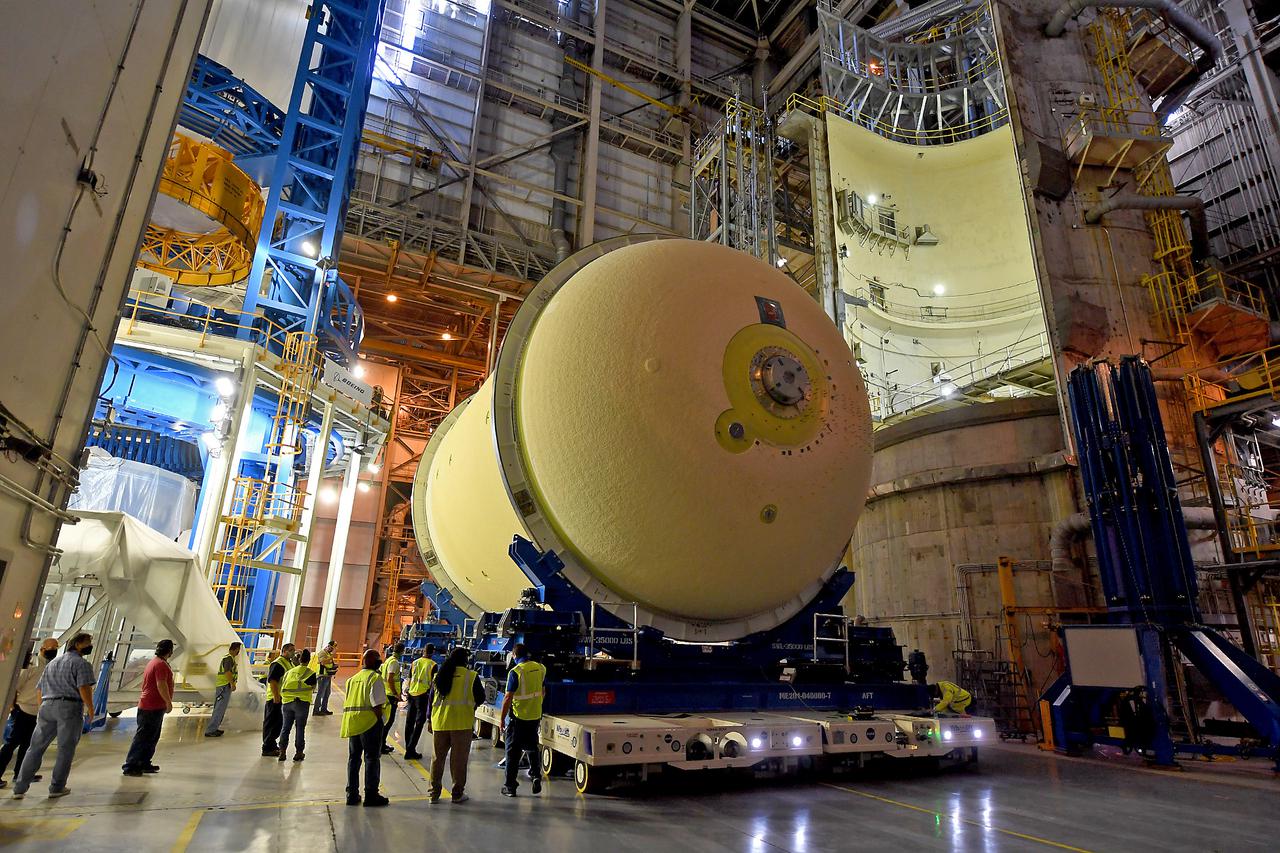
MAF · 2020-11-06 · MAF_20201106_Cs2LoxMove25
NASA Readies Artemis II Liquid Oxygen Tank for Next Phase of Manufacturing
This image highlights the liquid oxygen tank, which will be used on the core stage of NASA’ Space Launch System rocket for Artemis II, the first crewed mission…
Inspect NASA record
This image highlights the liquid oxygen tank, which will be used on the core stage of NASA’ Space Launch System rocket for Artemis II, the first crewed mission of NASA’s Artemis program, at NASA’s Michoud Assembly Facility. The SLS core stage is made up of five unique elements: the forward skirt, liquid oxygen tank, intertank, liquid hydrogen tank, and the engine section. The forward skirt houses flight computers, cameras, and avionics systems. The liquid oxygen tank holds 196,000 gallons of liquid oxygen cooled to minus 297 degrees Fahrenheit. The LOX hardware sits between the core stage’s forward skirt and the intertank. Along with the liquid hydrogen tank, it will provide fuel to the four RS-25 engines at the bottom of the core stage to produce more than two million pounds of thrust to launch NASA’s Artemis missions to the Moon. Together with its four RS-25 engines, the rocket’s massive 212-foot-tall core stage — the largest stage NASA has ever built — and its twin solid rocket boosters will produce 8.8 million pounds of thrust to send NASA’s Orion spacecraft, astronauts and supplies beyond Earth’s orbit to the Moon and, ultimately, Mars. Offering more payload mass, volume capability and energy to speed missions through space, the SLS rocket, along with NASA’s Gateway in lunar orbit, the Human Landing System, and Orion spacecraft, is part of NASA’s backbone for deep space exploration and the Artemis lunar program. No other rocket can send astronauts in Orion around the Moon in a single mission.
- Record ID
- MAF_20201106_Cs2LoxMove25
- NASA center
- MAF
- Date
- 2020-11-06
- Credit
- NASA/Michael DeMocker
- Keywords
- Space Launch System, SLS, Artemis, NASA, Marshall Space Flight Center, Michoud Assembly Facility, rocket science, rocket, launch vehicle, Moon, Liquid Oxygen Tank