
Update Site (from NASA)
Explore NASA’s Image and Video Library.
Suggest one object per day for the Interstellar Minds collection. We review each suggestion before adding it.
Sign in to suggest a Marvel.
Find a NASA image ID. Open a NASA record and copy its ID from the end of the details URL.
NASA image records
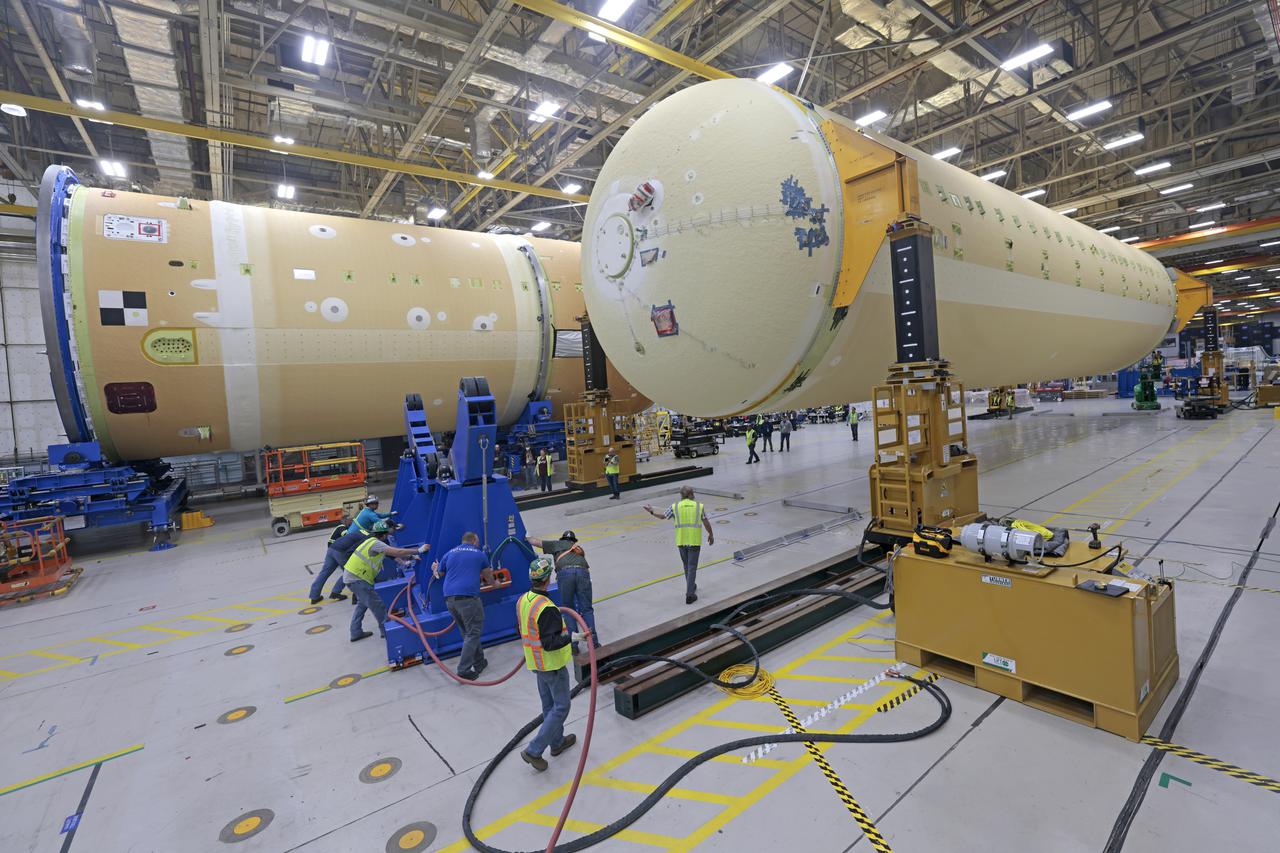
MAF · 2022-03-03 · MAF_20220303_CS2_LH2xferPRS14
NASA Makes Progress on Artemis II Core Stage Assembly
NASA is preparing major pieces of the Space Launch System rocket’s core stage to be joined as part of assembling the core stage for the Artemis II mission…
Inspect NASA record
NASA is preparing major pieces of the Space Launch System rocket’s core stage to be joined as part of assembling the core stage for the Artemis II mission that will send crews to lunar orbit. Crews will soon connect the forward assembly with the 130-foot liquid hydrogen tank in the final assembly area at NASA’s Michoud Assembly Facility in New Orleans. When this process is completed, four of the five large structures that make up the core stage will be joined. The 66-foot forward assembly consists of the forward skirt, liquid oxygen tank and the intertank, which were mated earlier. This forward assembly will be joined with the 130-foot liquid hydrogen tank, the largest part of the stage that holds more than 500,000 gallons of cryogenic propellant. To compete the Artemis II core stage, engineers will add the engine section, which is currently being outfitted and includes the main propulsion systems that connect to the four RS-25 engines, Together, with the SLS twin solid rocket boosters, the core stage will produce 8.8 million pounds of thrust to send NASA’s Orion spacecraft, astronauts, and supplies beyond Earth’s orbit to the Moon. The SLS rocket and the Orion spacecraft form the foundation for deep space exploration and the Artemis lunar program. For more on the core stage: https://www.nasa.gov/exploration/systems/sls/multimedia/infographics/corestage101.html Image credit: NASA/Michael DeMocker
- Record ID
- MAF_20220303_CS2_LH2xferPRS14
- NASA center
- MAF
- Date
- 2022-03-03
- Credit
- Michael DeMocker
- Keywords
- Space Launch System, SLS, Orion, Artemis production, Artemis II, Artemis, testing, hardware, core stage, Marshall Space Flight Center, Michoud Assembly Facility
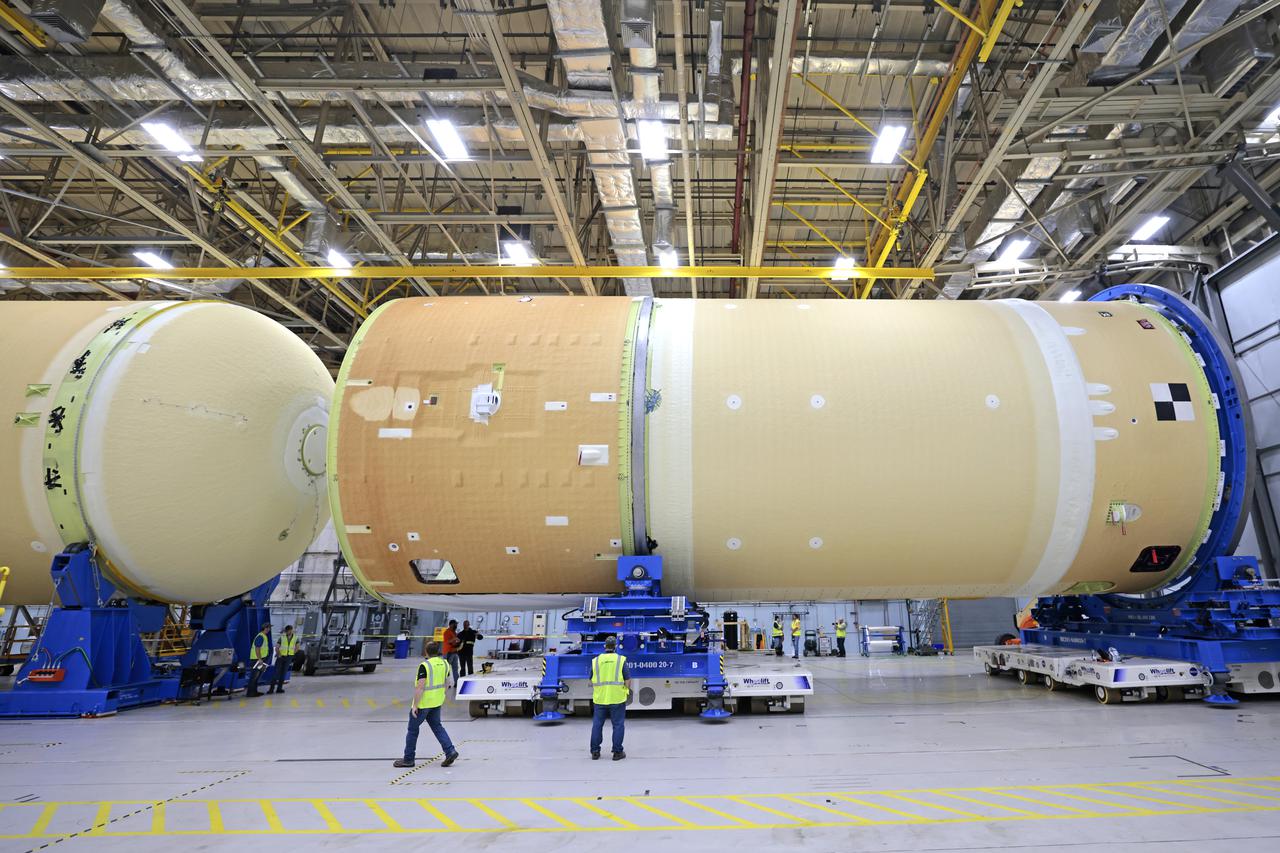
MAF · 2022-03-07 · MAF_20220307_CS2_MJto48_0016
NASA Makes Progress on Artemis II Core Stage Assembly
NASA is preparing major pieces of the Space Launch System rocket’s core stage to be joined as part of assembling the core stage for the Artemis II mission…
Inspect NASA record
NASA is preparing major pieces of the Space Launch System rocket’s core stage to be joined as part of assembling the core stage for the Artemis II mission that will send crews to lunar orbit. Crews will soon connect the forward assembly with the 130-foot liquid hydrogen tank in the final assembly area at NASA’s Michoud Assembly Facility in New Orleans. When this process is completed, four of the five large structures that make up the core stage will be joined. The 66-foot forward assembly consists of the forward skirt, liquid oxygen tank and the intertank, which were mated earlier. This forward assembly will be joined with the 130-foot liquid hydrogen tank, the largest part of the stage that holds more than 500,000 gallons of cryogenic propellant. To compete the Artemis II core stage, engineers will add the engine section, which is currently being outfitted and includes the main propulsion systems that connect to the four RS-25 engines, Together, with the SLS twin solid rocket boosters, the core stage will produce 8.8 million pounds of thrust to send NASA’s Orion spacecraft, astronauts, and supplies beyond Earth’s orbit to the Moon. The SLS rocket and the Orion spacecraft form the foundation for deep space exploration and the Artemis lunar program. For more on the core stage: https://www.nasa.gov/exploration/systems/sls/multimedia/infographics/corestage101.html Image credit: NASA/Michael DeMocker
- Record ID
- MAF_20220307_CS2_MJto48_0016
- NASA center
- MAF
- Date
- 2022-03-07
- Credit
- Michael DeMocker
- Keywords
- Space Launch System, SLS, Orion, Artemis production, Artemis II, Artemis, testing, hardware, core stage, Marshall Space Flight Center, Michoud Assembly Facility
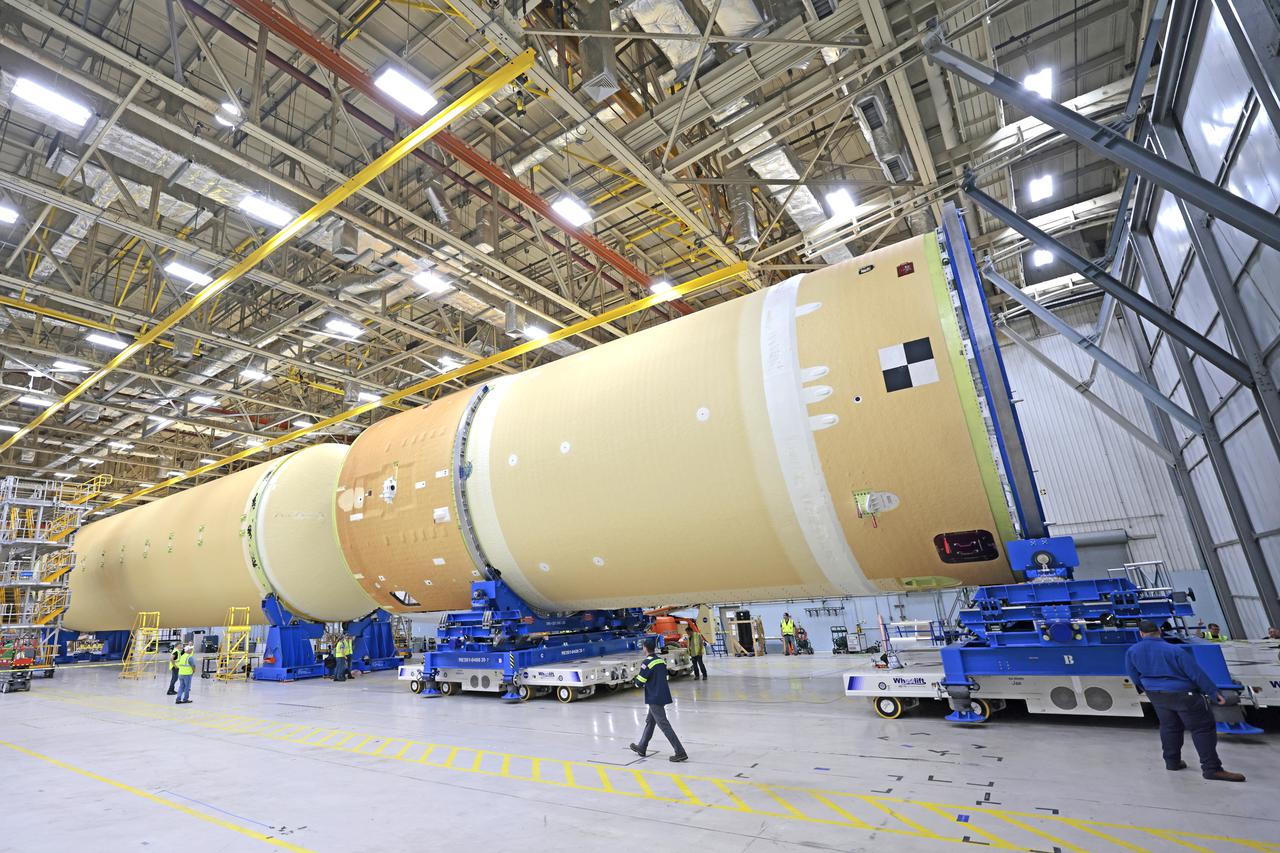
MAF · 2022-03-07 · MAF_20220307_CS2_MJto48_0018
NASA Makes Progress on Artemis II Core Stage Assembly
NASA is preparing major pieces of the Space Launch System rocket’s core stage to be joined as part of assembling the core stage for the Artemis II mission…
Inspect NASA record
NASA is preparing major pieces of the Space Launch System rocket’s core stage to be joined as part of assembling the core stage for the Artemis II mission that will send crews to lunar orbit. Crews will soon connect the forward assembly with the 130-foot liquid hydrogen tank in the final assembly area at NASA’s Michoud Assembly Facility in New Orleans. When this process is completed, four of the five large structures that make up the core stage will be joined. The 66-foot forward assembly consists of the forward skirt, liquid oxygen tank and the intertank, which were mated earlier. This forward assembly will be joined with the 130-foot liquid hydrogen tank, the largest part of the stage that holds more than 500,000 gallons of cryogenic propellant. To compete the Artemis II core stage, engineers will add the engine section, which is currently being outfitted and includes the main propulsion systems that connect to the four RS-25 engines, Together, with the SLS twin solid rocket boosters, the core stage will produce 8.8 million pounds of thrust to send NASA’s Orion spacecraft, astronauts, and supplies beyond Earth’s orbit to the Moon. The SLS rocket and the Orion spacecraft form the foundation for deep space exploration and the Artemis lunar program. For more on the core stage: https://www.nasa.gov/exploration/systems/sls/multimedia/infographics/corestage101.html Image credit: NASA/Michael DeMocker
- Record ID
- MAF_20220307_CS2_MJto48_0018
- NASA center
- MAF
- Date
- 2022-03-07
- Credit
- Michael DeMocker
- Keywords
- Space Launch System, SLS, Orion, Artemis production, Artemis II, Artemis, testing, hardware, core stage, Marshall Space Flight Center, Michoud Assembly Facility
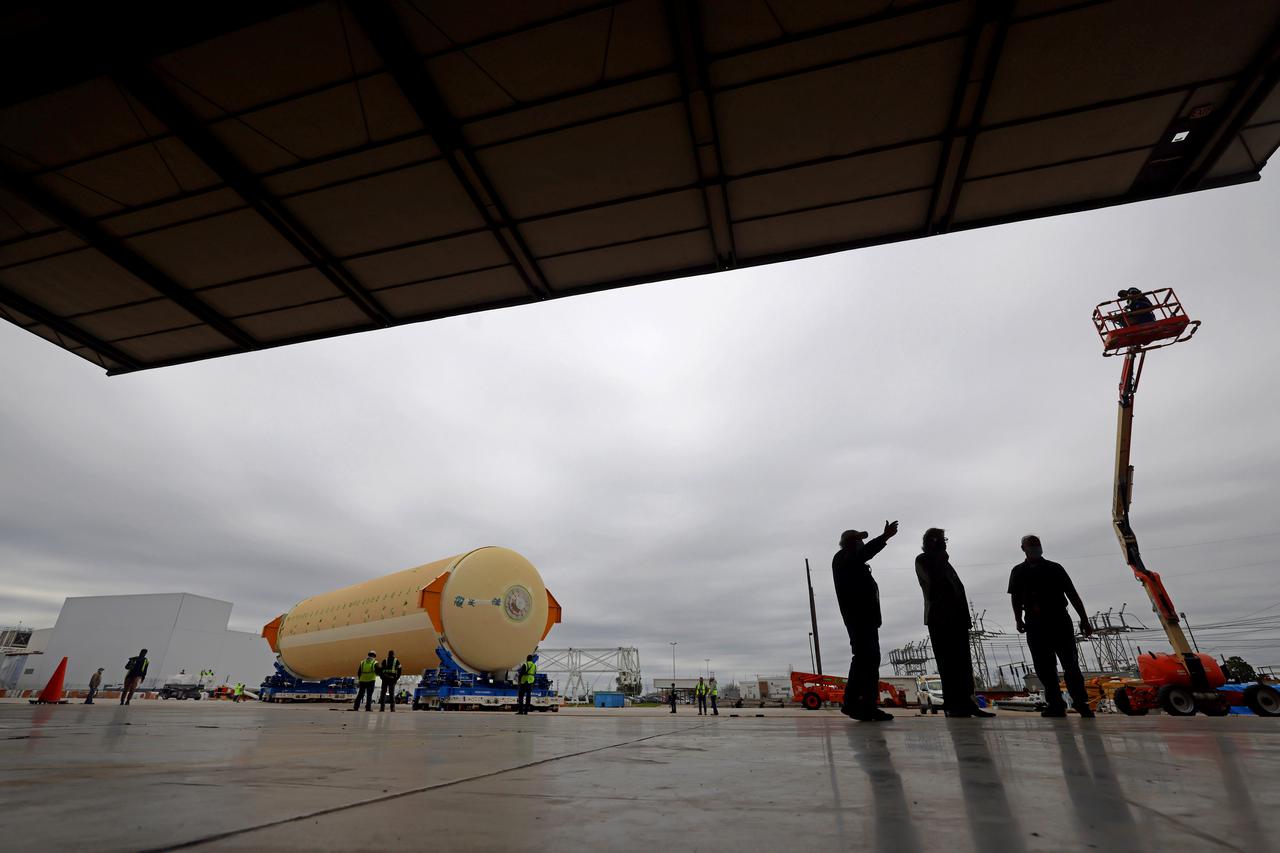
MAF · 2022-02-25 · MAF_20220225_CS2_LH2_Area48_09
NASA Makes Progress on Artemis II Core Stage Assembly
NASA is preparing major pieces of the Space Launch System rocket’s core stage to be joined as part of assembling the core stage for the Artemis II mission…
Inspect NASA record
NASA is preparing major pieces of the Space Launch System rocket’s core stage to be joined as part of assembling the core stage for the Artemis II mission that will send crews to lunar orbit. Crews will soon connect the forward assembly with the 130-foot liquid hydrogen tank in the final assembly area at NASA’s Michoud Assembly Facility in New Orleans. When this process is completed, four of the five large structures that make up the core stage will be joined. The 66-foot forward assembly consists of the forward skirt, liquid oxygen tank and the intertank, which were mated earlier. This forward assembly will be joined with the 130-foot liquid hydrogen tank, the largest part of the stage that holds more than 500,000 gallons of cryogenic propellant. To compete the Artemis II core stage, engineers will add the engine section, which is currently being outfitted and includes the main propulsion systems that connect to the four RS-25 engines, Together, with the SLS twin solid rocket boosters, the core stage will produce 8.8 million pounds of thrust to send NASA’s Orion spacecraft, astronauts, and supplies beyond Earth’s orbit to the Moon. The SLS rocket and the Orion spacecraft form the foundation for deep space exploration and the Artemis lunar program. For more on the core stage: https://www.nasa.gov/exploration/systems/sls/multimedia/infographics/corestage101.html Image credit: NASA/Michael DeMocker
- Record ID
- MAF_20220225_CS2_LH2_Area48_09
- NASA center
- MAF
- Date
- 2022-02-25
- Credit
- Michael DeMocker
- Keywords
- Space Launch System, SLS, Orion, Artemis production, Artemis II, Artemis, testing, hardware, core stage, Marshall Space Flight Center, Michoud Assembly Facility
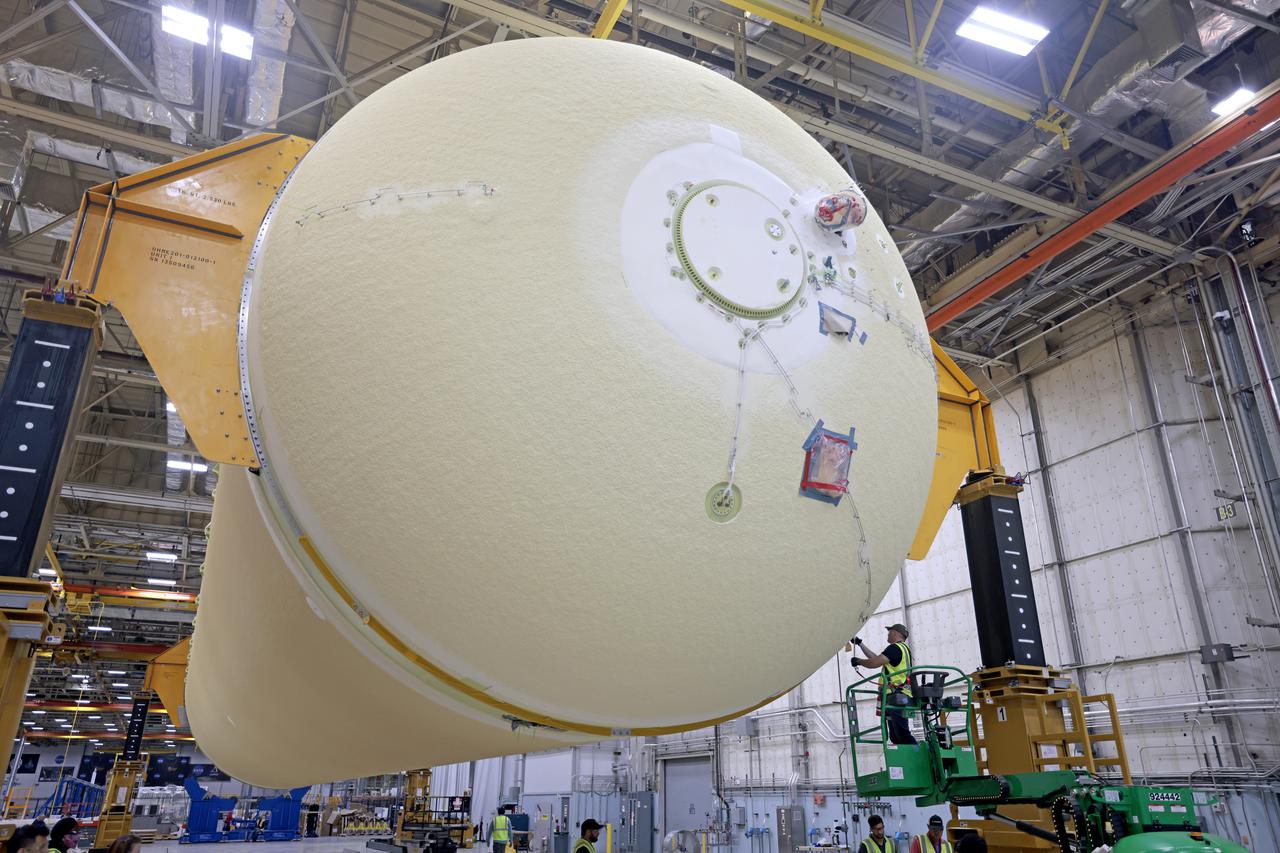
MAF · 2022-03-03 · MAF_20220303_CS2_LH2xferPRS12
NASA Makes Progress on Artemis II Core Stage Assembly
NASA is preparing major pieces of the Space Launch System rocket’s core stage to be joined as part of assembling the core stage for the Artemis II mission…
Inspect NASA record
NASA is preparing major pieces of the Space Launch System rocket’s core stage to be joined as part of assembling the core stage for the Artemis II mission that will send crews to lunar orbit. Crews will soon connect the forward assembly with the 130-foot liquid hydrogen tank in the final assembly area at NASA’s Michoud Assembly Facility in New Orleans. When this process is completed, four of the five large structures that make up the core stage will be joined. The 66-foot forward assembly consists of the forward skirt, liquid oxygen tank and the intertank, which were mated earlier. This forward assembly will be joined with the 130-foot liquid hydrogen tank, the largest part of the stage that holds more than 500,000 gallons of cryogenic propellant. To compete the Artemis II core stage, engineers will add the engine section, which is currently being outfitted and includes the main propulsion systems that connect to the four RS-25 engines, Together, with the SLS twin solid rocket boosters, the core stage will produce 8.8 million pounds of thrust to send NASA’s Orion spacecraft, astronauts, and supplies beyond Earth’s orbit to the Moon. The SLS rocket and the Orion spacecraft form the foundation for deep space exploration and the Artemis lunar program. For more on the core stage: https://www.nasa.gov/exploration/systems/sls/multimedia/infographics/corestage101.html Image credit: NASA/Michael DeMocker
- Record ID
- MAF_20220303_CS2_LH2xferPRS12
- NASA center
- MAF
- Date
- 2022-03-03
- Credit
- Michael DeMocker
- Keywords
- Space Launch System, SLS, Orion, Artemis production, Artemis II, Artemis, testing, hardware, core stage, Marshall Space Flight Center, Michoud Assembly Facility
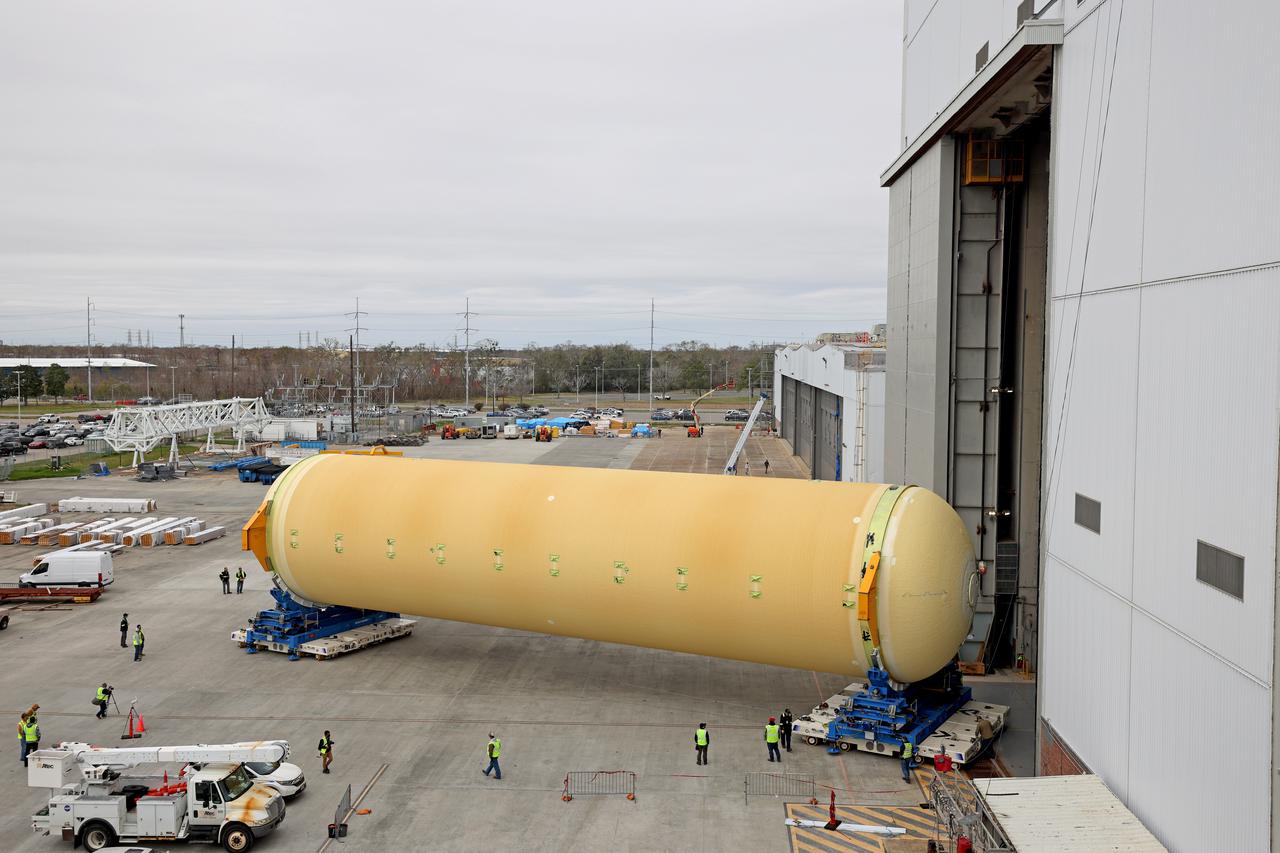
MAF · 2022-02-25 · MAF_20220225_CS2_LH2_Area48_02
NASA Makes Progress on Artemis II Core Stage Assembly
NASA is preparing major pieces of the Space Launch System rocket’s core stage to be joined as part of assembling the core stage for the Artemis II mission…
Inspect NASA record
NASA is preparing major pieces of the Space Launch System rocket’s core stage to be joined as part of assembling the core stage for the Artemis II mission that will send crews to lunar orbit. Crews will soon connect the forward assembly with the 130-foot liquid hydrogen tank in the final assembly area at NASA’s Michoud Assembly Facility in New Orleans. When this process is completed, four of the five large structures that make up the core stage will be joined. The 66-foot forward assembly consists of the forward skirt, liquid oxygen tank and the intertank, which were mated earlier. This forward assembly will be joined with the 130-foot liquid hydrogen tank, the largest part of the stage that holds more than 500,000 gallons of cryogenic propellant. To compete the Artemis II core stage, engineers will add the engine section, which is currently being outfitted and includes the main propulsion systems that connect to the four RS-25 engines, Together, with the SLS twin solid rocket boosters, the core stage will produce 8.8 million pounds of thrust to send NASA’s Orion spacecraft, astronauts, and supplies beyond Earth’s orbit to the Moon. The SLS rocket and the Orion spacecraft form the foundation for deep space exploration and the Artemis lunar program. For more on the core stage: https://www.nasa.gov/exploration/systems/sls/multimedia/infographics/corestage101.html Image credit: NASA/Michael DeMocker
- Record ID
- MAF_20220225_CS2_LH2_Area48_02
- NASA center
- MAF
- Date
- 2022-02-25
- Credit
- Michael DeMocker
- Keywords
- Space Launch System, SLS, Orion, Artemis production, Artemis II, Artemis, testing, hardware, core stage, Marshall Space Flight Center, Michoud Assembly Facility
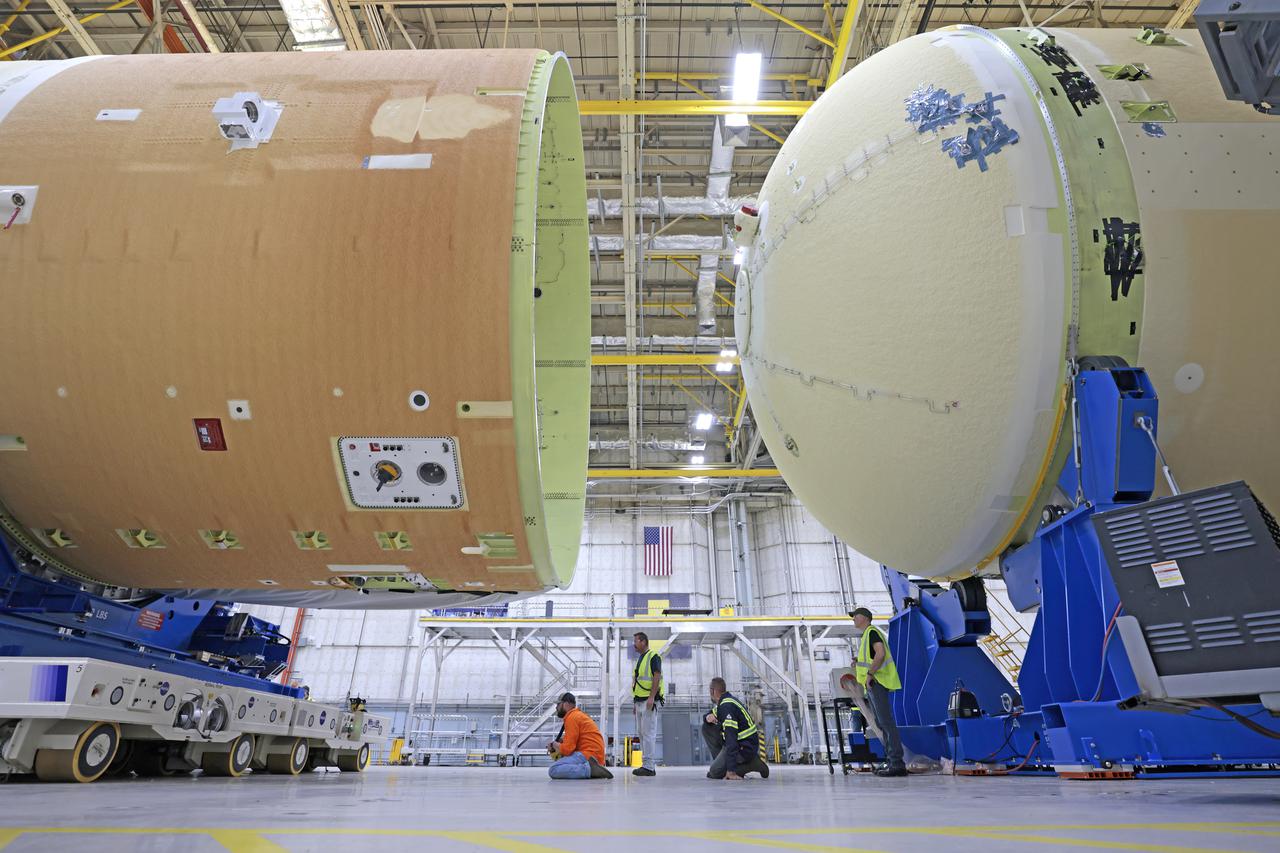
MAF · 2022-03-07 · MAF_20220307_CS2_MJto48_0010
NASA Makes Progress on Artemis II Core Stage Assembly
NASA is preparing major pieces of the Space Launch System rocket’s core stage to be joined as part of assembling the core stage for the Artemis II mission…
Inspect NASA record
NASA is preparing major pieces of the Space Launch System rocket’s core stage to be joined as part of assembling the core stage for the Artemis II mission that will send crews to lunar orbit. Crews will soon connect the forward assembly with the 130-foot liquid hydrogen tank in the final assembly area at NASA’s Michoud Assembly Facility in New Orleans. When this process is completed, four of the five large structures that make up the core stage will be joined. The 66-foot forward assembly consists of the forward skirt, liquid oxygen tank and the intertank, which were mated earlier. This forward assembly will be joined with the 130-foot liquid hydrogen tank, the largest part of the stage that holds more than 500,000 gallons of cryogenic propellant. To compete the Artemis II core stage, engineers will add the engine section, which is currently being outfitted and includes the main propulsion systems that connect to the four RS-25 engines, Together, with the SLS twin solid rocket boosters, the core stage will produce 8.8 million pounds of thrust to send NASA’s Orion spacecraft, astronauts, and supplies beyond Earth’s orbit to the Moon. The SLS rocket and the Orion spacecraft form the foundation for deep space exploration and the Artemis lunar program. For more on the core stage: https://www.nasa.gov/exploration/systems/sls/multimedia/infographics/corestage101.html Image credit: NASA/Michael DeMocker
- Record ID
- MAF_20220307_CS2_MJto48_0010
- NASA center
- MAF
- Date
- 2022-03-07
- Credit
- Michael DeMocker
- Keywords
- Space Launch System, SLS, Orion, Artemis production, Artemis II, Artemis, testing, hardware, core stage, Marshall Space Flight Center, Michoud Assembly Facility
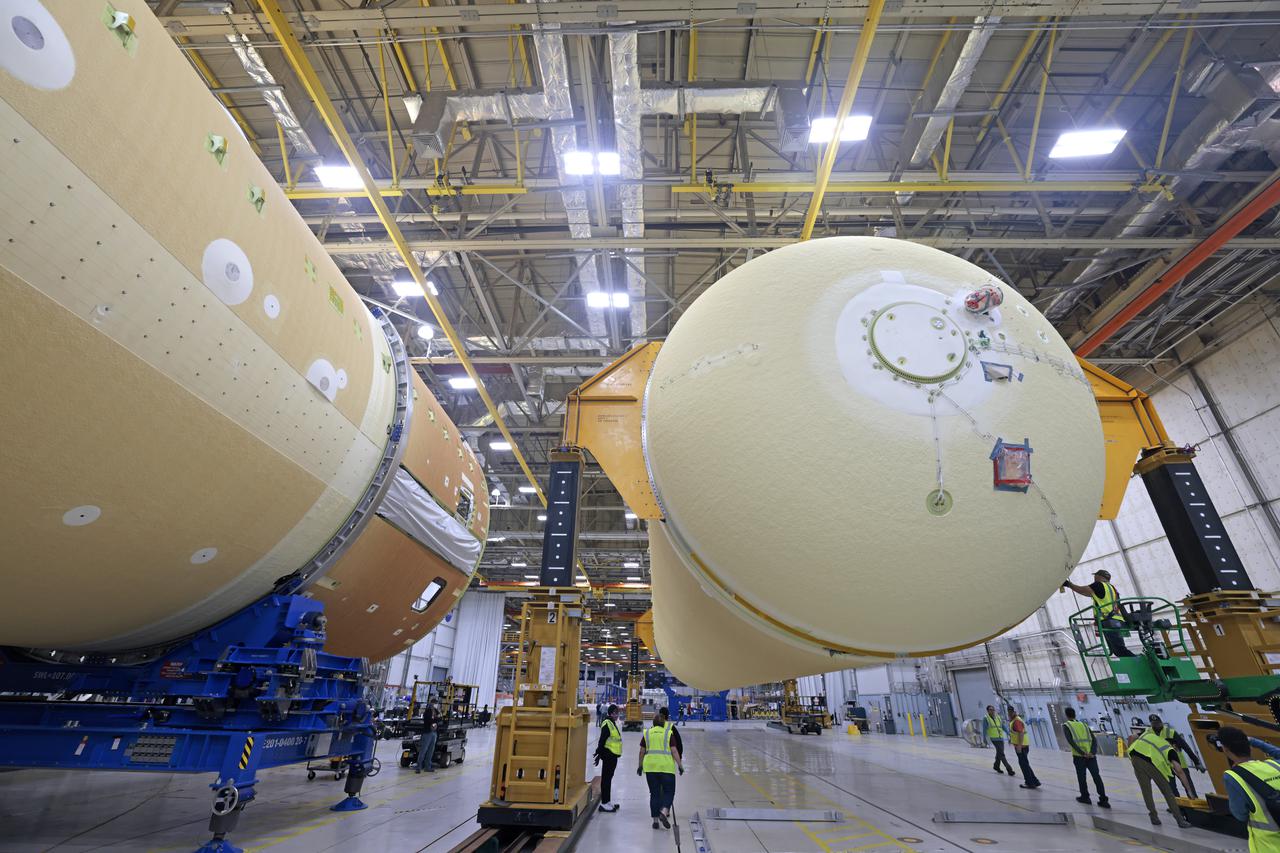
MAF · 2022-03-03 · MAF_20220303_CS2_LH2xferPRS13
NASA Makes Progress on Artemis II Core Stage Assembly
NASA is preparing major pieces of the Space Launch System rocket’s core stage to be joined as part of assembling the core stage for the Artemis II mission…
Inspect NASA record
NASA is preparing major pieces of the Space Launch System rocket’s core stage to be joined as part of assembling the core stage for the Artemis II mission that will send crews to lunar orbit. Crews will soon connect the forward assembly with the 130-foot liquid hydrogen tank in the final assembly area at NASA’s Michoud Assembly Facility in New Orleans. When this process is completed, four of the five large structures that make up the core stage will be joined. The 66-foot forward assembly consists of the forward skirt, liquid oxygen tank and the intertank, which were mated earlier. This forward assembly will be joined with the 130-foot liquid hydrogen tank, the largest part of the stage that holds more than 500,000 gallons of cryogenic propellant. To compete the Artemis II core stage, engineers will add the engine section, which is currently being outfitted and includes the main propulsion systems that connect to the four RS-25 engines, Together, with the SLS twin solid rocket boosters, the core stage will produce 8.8 million pounds of thrust to send NASA’s Orion spacecraft, astronauts, and supplies beyond Earth’s orbit to the Moon. The SLS rocket and the Orion spacecraft form the foundation for deep space exploration and the Artemis lunar program. For more on the core stage: https://www.nasa.gov/exploration/systems/sls/multimedia/infographics/corestage101.html Image credit: NASA/Michael DeMocker
- Record ID
- MAF_20220303_CS2_LH2xferPRS13
- NASA center
- MAF
- Date
- 2022-03-03
- Credit
- Michael DeMocker
- Keywords
- Space Launch System, SLS, Orion, Artemis production, Artemis II, Artemis, testing, hardware, core stage, Marshall Space Flight Center, Michoud Assembly Facility
MSFC · 1969-07-24 · 6900602
Saturn Apollo Program
The Apollo 11 mission, the first manned lunar mission, launched from the Kennedy Space Center, Florida via the Saturn V launch vehicle on July 16, 1969 and safely…
Inspect NASA record
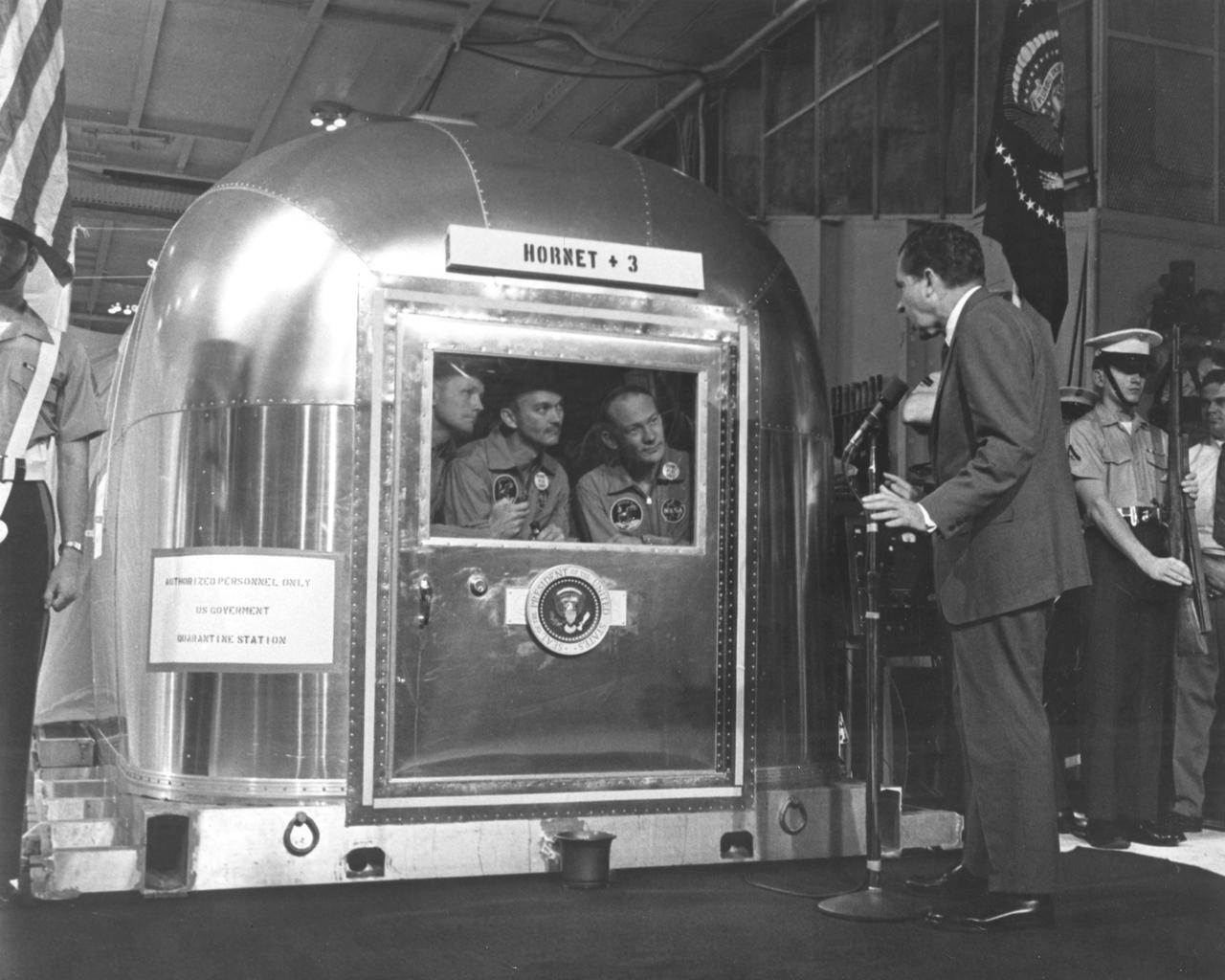
The Apollo 11 mission, the first manned lunar mission, launched from the Kennedy Space Center, Florida via the Saturn V launch vehicle on July 16, 1969 and safely returned to Earth on July 24, 1969. The Saturn V vehicle was developed by the Marshall Space Flight Center (MSFC) under the direction of Dr. Wernher von Braun. Aboard were Neil A. Armstrong, commander; Michael Collins, Command Module (CM) pilot; and Edwin E. Aldrin Jr., Lunar Module (LM) pilot. The CM, piloted by Michael Collins remained in a parking orbit around the Moon while the LM, named “Eagle’’, carrying astronauts Neil Armstrong and Edwin Aldrin, landed on the Moon. Armstrong was the first human to ever stand on the lunar surface, followed by Edwin (Buzz) Aldrin. During 2½ hours of surface exploration, the crew collected 47 pounds of lunar surface material for analysis back on Earth. The recovery operation took place in the Pacific Ocean where Navy para-rescue men recovered the capsule housing the 3-man Apollo 11 crew. The crew was airlifted by helicopter and taken to safety aboard the U.S.S. Hornet, where they were quartered in a Mobile Quarantine Facility (MQF). Shown here are the Apollo 11 crew members (L to R) Neil Armstrong, Michael Collins, and Edwin Aldrin inside the MQF as U.S. President Richard Milhous Nixon speaks to them via intercom. The president was aboard the recovery vessel awaiting return of the astronauts. With the success of Apollo 11, the national objective to land men on the Moon and return them safely to Earth had been accomplished.
- Record ID
- 6900602
- NASA center
- MSFC
- Date
- 1969-07-24
- Keywords
- Apollo 11, Moon, Quarantine, Armstrong, Collins, Aldrin, Nixon
MSFC · 1969-07-03 · 6903826
Saturn Apollo Program
Millions of people on Earth watched via television as a message for all mankind was delivered to the Mare Tranquilitatis (Sea of Tranquility) region of the Moon during…
Inspect NASA record
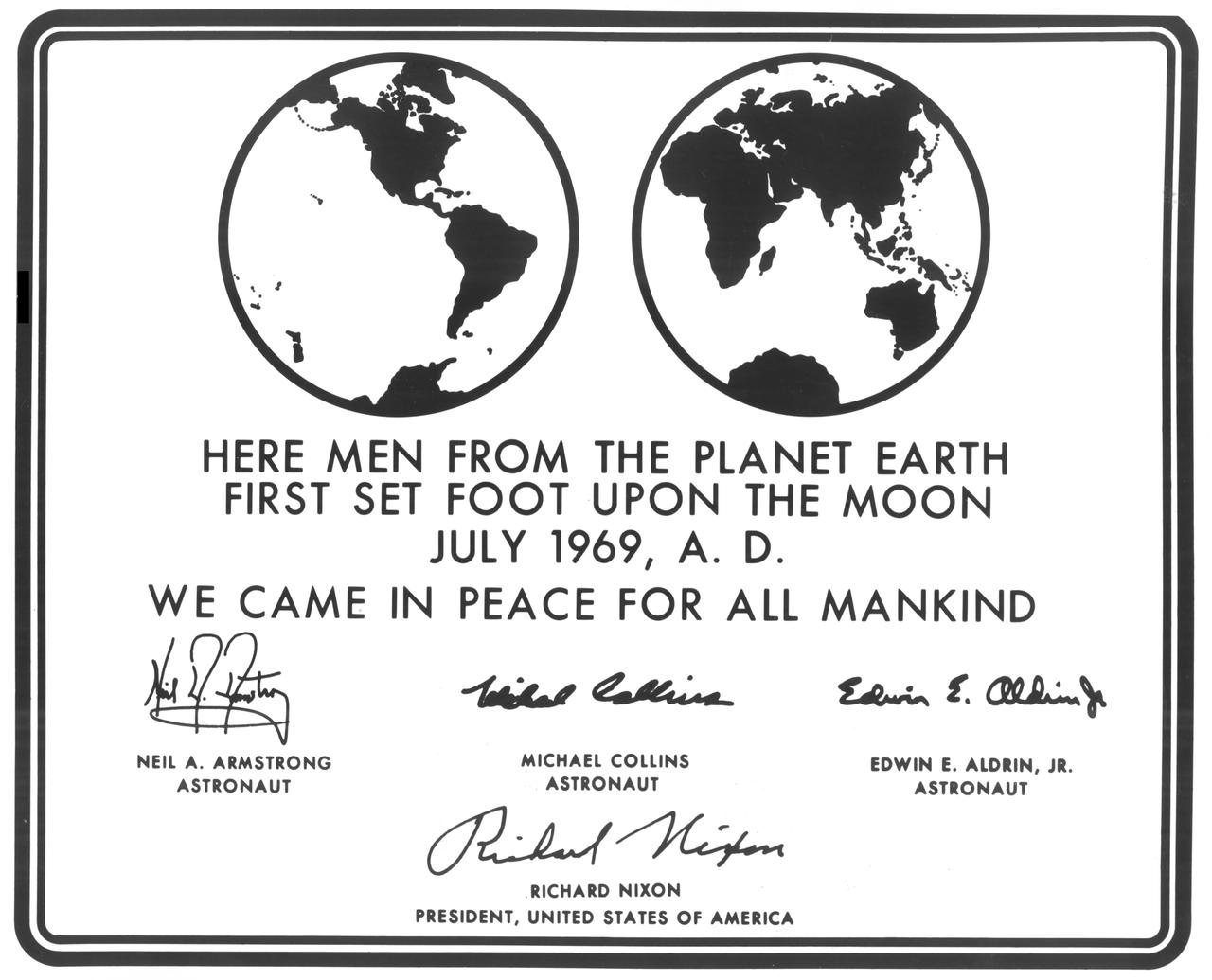
Millions of people on Earth watched via television as a message for all mankind was delivered to the Mare Tranquilitatis (Sea of Tranquility) region of the Moon during the historic Apollo 11 mission, where it still remains today. This photograph is a reproduction of the commemorative plaque that was attached to the leg of the Lunar Module (LM), Eagle, engraved with the following words: “Here men from the planet Earth first set foot upon the Moon July, 1969 A.D. We came in peace for all of mankind.” It bears the signatures of the Apollo 11 astronauts Neil A. Armstrong, commander; Michael Collins, Command Module (CM) pilot; and Edwin E. Aldrin, Jr., Lunar Module (LM) pilot along with the signature of the U.S. President Richard M. Nixon. The Apollo 11 mission launched from the Kennedy Space Center (KSC) in Florida via the Marshall Space Flight Center (MSFC) developed Saturn V launch vehicle on July 16, 1969 and safely returned to Earth on July 24, 1969. The CM, “Columbia”, piloted by Collins, remained in a parking orbit around the Moon while the LM, “Eagle’’, carrying astronauts Armstrong and Aldrin, landed on the Moon. On July 20, 1969, Armstrong was the first human to ever stand on the lunar surface, followed by Aldrin. During 2½ hours of surface exploration, the crew collected 47 pounds of lunar surface material for analysis back on Earth. With the success of Apollo 11, the national objective to land men on the Moon and return them safely to Earth had been accomplished.
- Record ID
- 6903826
- NASA center
- MSFC
- Date
- 1969-07-03
- Keywords
- Apollo 11, Commemorative Plaque, Reproduction, Message for Mankind, Sea of Tranquility
MSFC · 1969-07-27 · 6901507
n/a
The Apollo 11 mission, the first manned lunar mission, launched from the Kennedy Space Center, Florida via the Marshall Space Flight Center (MSFC) developed Saturn V launch vehicle…
Inspect NASA record
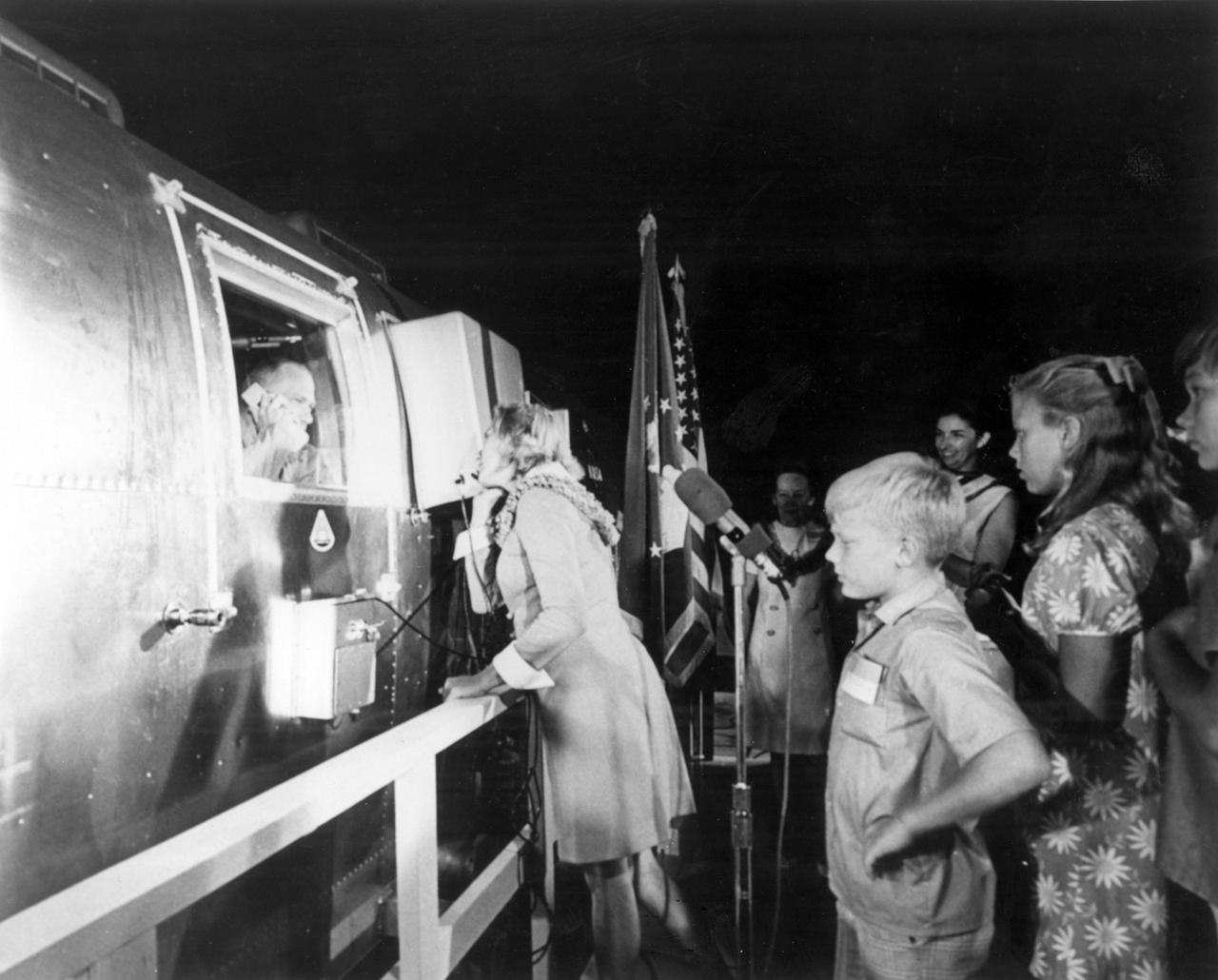
The Apollo 11 mission, the first manned lunar mission, launched from the Kennedy Space Center, Florida via the Marshall Space Flight Center (MSFC) developed Saturn V launch vehicle on July 16, 1969 and safely returned to Earth on July 24, 1969. Aboard the space craft were astronauts Neil A. Armstrong, commander; Michael Collins, Command Module (CM) pilot; and Edwin E. (Buzz) Aldrin Jr., Lunar Module (LM) pilot. The CM, piloted by Michael Collins remained in a parking orbit around the Moon while the LM, named “Eagle’’, carrying astronauts Neil Armstrong and Edwin Aldrin, landed on the Moon. During 2½ hours of surface exploration, the crew collected 47 pounds of lunar surface material for analysis back on Earth. The recovery operation took place in the Pacific Ocean where Navy para-rescue men recovered the capsule housing the 3-man Apollo 11 crew. The crew was airlifted to safety aboard the U.S.S. Hornet, where they were quartered in a Mobile Quarantine Facility (MQF) which served as their home until they reached the NASA Manned Spacecraft Center (MSC) Lunar Receiving Laboratory in Houston, Texas. On arrival at Ellington Air Force base near the MSC, the crew, still under a 21 day quarantine in the MQF, were greeted by their wives. Pictured here is Joan Aldrin, wife of Buzz Aldrin, speaking with her husband via telephone patch.
- Record ID
- 6901507
- NASA center
- MSFC
- Date
- 1969-07-27
- Keywords
- Apollo 11, Moon, Mobile Quarantine Facility, MQF, Aldrin, Joan, Manned Spacecraft Center, MSC
MSFC · 1959-07-21 · 6900948
Saturn Apollo Program
Millions of people on Earth watched via television as a message for all mankind was delivered to the Mare Tranquilitatis (Sea of Tranquility) region of the Moon during…
Inspect NASA record
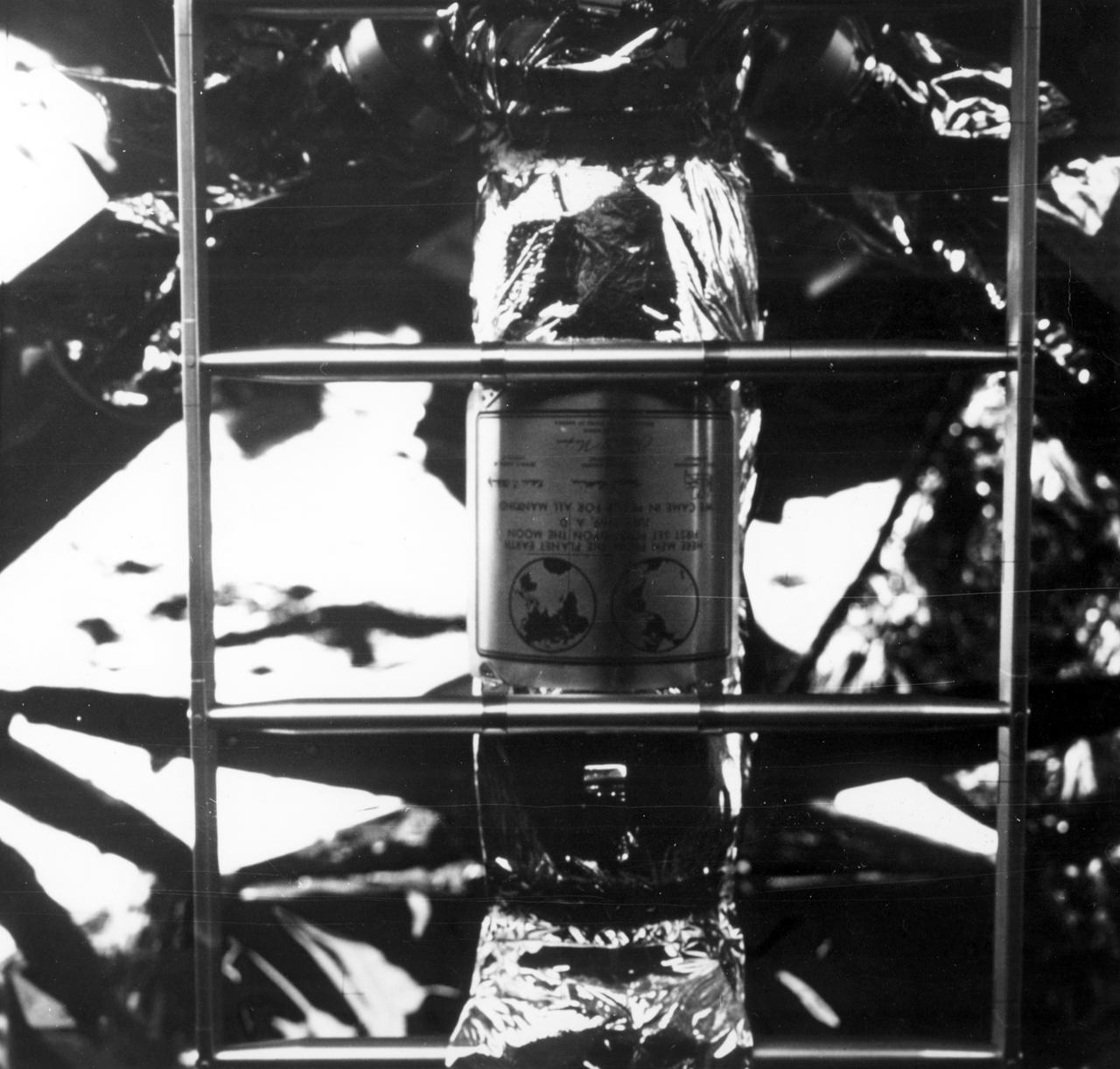
Millions of people on Earth watched via television as a message for all mankind was delivered to the Mare Tranquilitatis (Sea of Tranquility) region of the Moon during the historic Apollo 11 mission, where it still remains today. This commemorative plaque, attached to the leg of the Lunar Module (LM), Eagle, is engraved with the following words: “Here men from the planet Earth first set foot upon the Moon July, 1969 A.D. We came in peace for all of mankind.” It bears the signatures of the Apollo 11 astronauts Neil A. Armstrong, commander; Michael Collins, Command Module (CM) pilot; and Edwin E. Aldrin, Jr., Lunar Module (LM) pilot along with the signature of the U.S. President Richard M. Nixon. The Apollo 11 mission launched from the Kennedy Space Center (KSC) in Florida via the Marshall Space Flight Center (MSFC) developed Saturn V launch vehicle on July 16, 1969 and safely returned to Earth on July 24, 1969. The CM, “Columbia”, piloted by Collins, remained in a parking orbit around the Moon while the LM, “Eagle’’, carrying astronauts Armstrong and Aldrin, landed on the Moon. On July 20, 1969, Armstrong was the first human to ever stand on the lunar surface, followed by Aldrin. During 2½ hours of surface exploration, the crew collected 47 pounds of lunar surface material for analysis back on Earth. With the success of Apollo 11, the national objective to land men on the Moon and return them safely to Earth had been accomplished.
- Record ID
- 6900948
- NASA center
- MSFC
- Date
- 1959-07-21
- Keywords
- Apollo 11, Moon, Commemorative Plaque, Message for Mankind, Sea of Tranquility