
Update Site (from NASA)
Explore NASA’s Image and Video Library.
Suggest one object per day for the Interstellar Minds collection. We review each suggestion before adding it.
Sign in to suggest a Marvel.
Find a NASA image ID. Open a NASA record and copy its ID from the end of the details URL.
NASA image records
KSC · 2023-08-08 · KSC-20230808-PH-KLS01_0016
KSC Orion Media Day
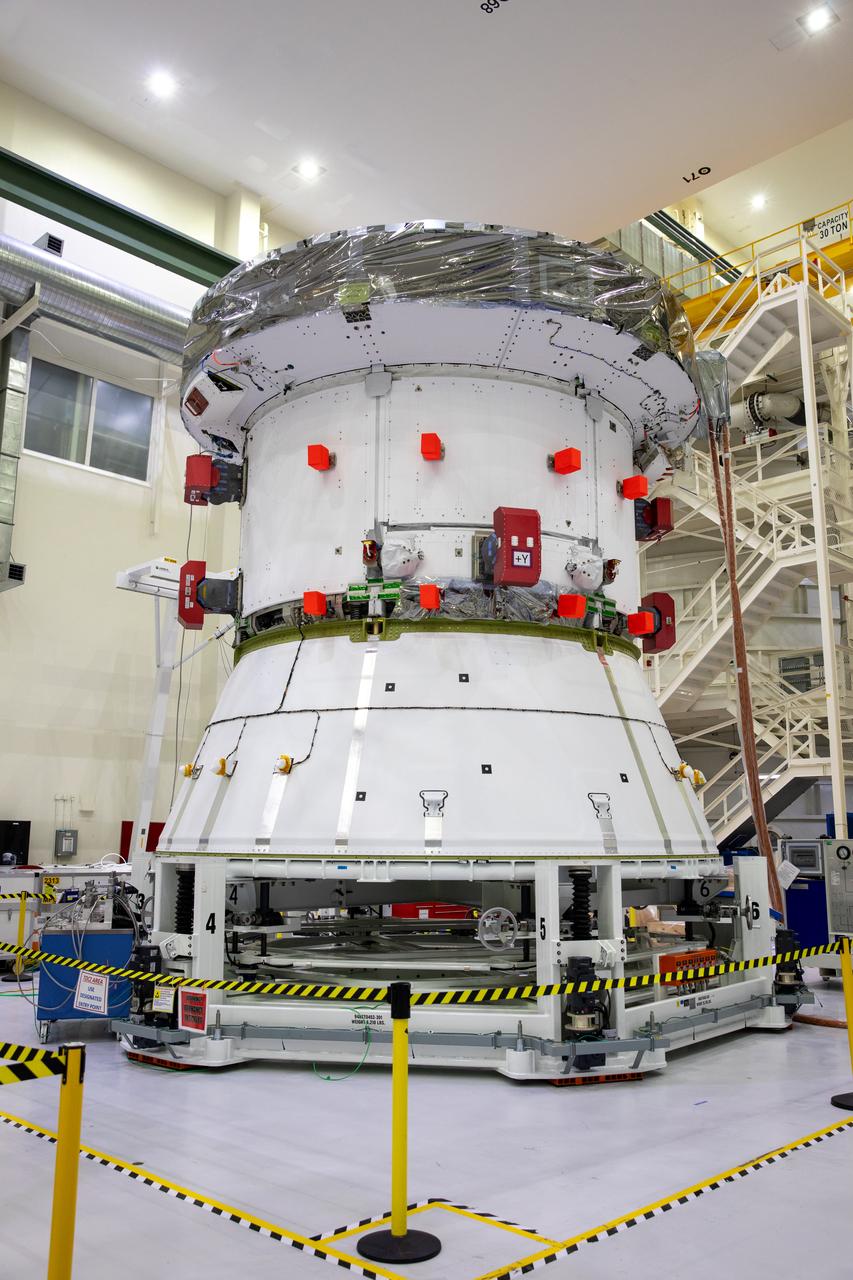
The European Service Module for NASA’s Artemis II mission is shown inside Kennedy Space Center’s Neil Armstrong Operations and Checkout Building on Aug. 8, 2023. Artemis II is…
Inspect NASA record
The European Service Module for NASA’s Artemis II mission is shown inside Kennedy Space Center’s Neil Armstrong Operations and Checkout Building on Aug. 8, 2023. Artemis II is the first crewed mission on NASA’s path to establishing a long-term lunar presence for science and exploration under Artemis. Crew members are: Reid Wiseman, commander; Victor Glover, pilot; Christina Hammock Koch, mission specialist; and Jeremy Hansen, mission specialist.
- Record ID
- KSC-20230808-PH-KLS01_0016
- NASA center
- KSC
- Date
- 2023-08-08
- Credit
- NASA/Kim Shiflett
- Keywords
- Artemis, Artemis II, Artemis III, Artemis IV, CM, ESM, European service module, KSC, Kennedy Space Center, Moon, Moon to Mars, O&C
KSC · 2023-08-08 · KSC-20230808-PH-KLS01_0056
KSC Orion Media Day
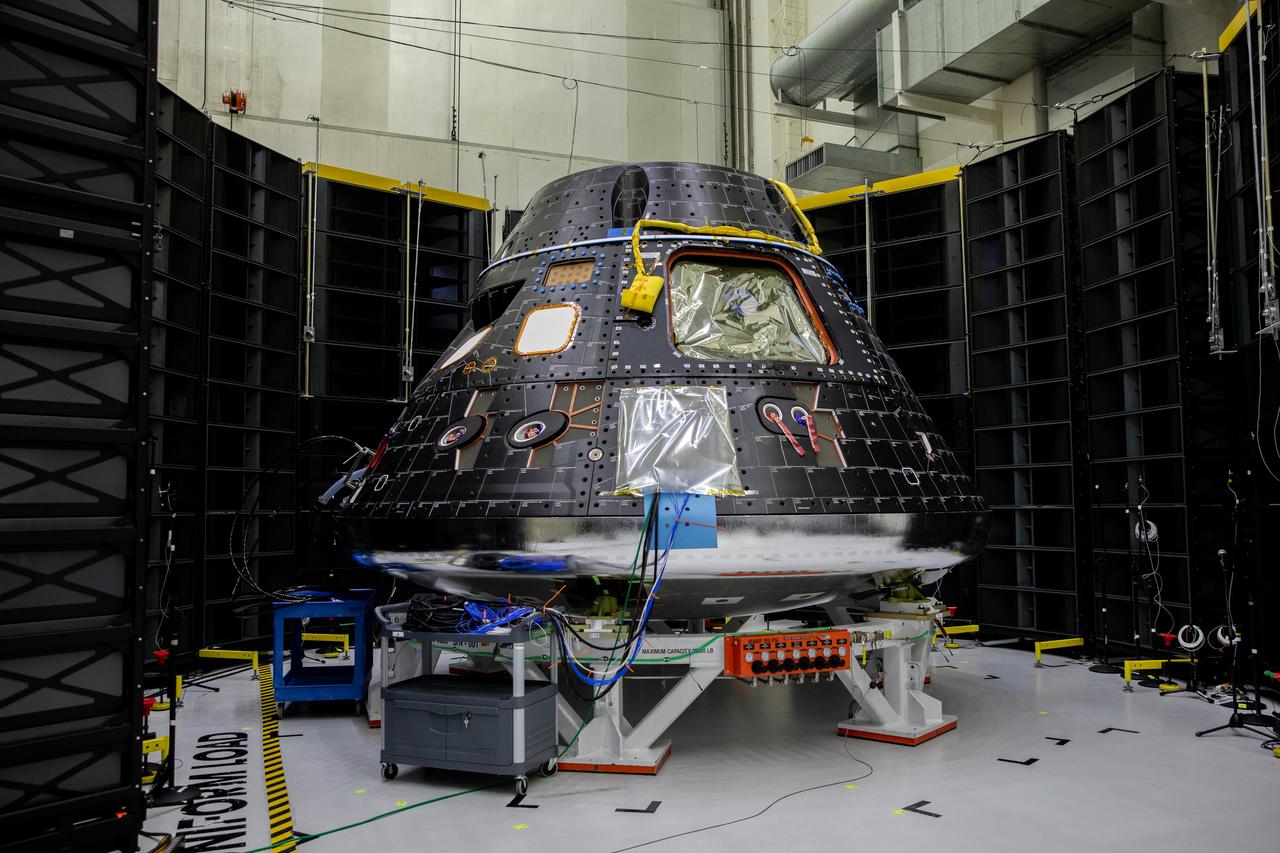
Shown inside the Neil Armstrong Operations and Checkout Building at NASA’s Kennedy Space Center in Florida on Aug. 8, 2023, is the Orion crew module for NASA’s Artemis…
Inspect NASA record
Shown inside the Neil Armstrong Operations and Checkout Building at NASA’s Kennedy Space Center in Florida on Aug. 8, 2023, is the Orion crew module for NASA’s Artemis II mission. The crew features Reid Wiseman, commander; Victor Glover, pilot; Christina Hammock Koch, mission specialist; and Jeremy Hansen, mission specialist. Artemis II is the first crewed mission on NASA’s path to establishing a long-term lunar presence for science and exploration under Artemis.
- Record ID
- KSC-20230808-PH-KLS01_0056
- NASA center
- KSC
- Date
- 2023-08-08
- Credit
- NASA/Kim Shiflett
- Keywords
- Artemis, Artemis II, Artemis III, Artemis IV, CM, ESM, European service module, KSC, Kennedy Space Center, Moon, Moon to Mars, O&C
KSC · 2023-08-08 · KSC-20230808-PH-KLS01_0055
KSC Orion Media Day
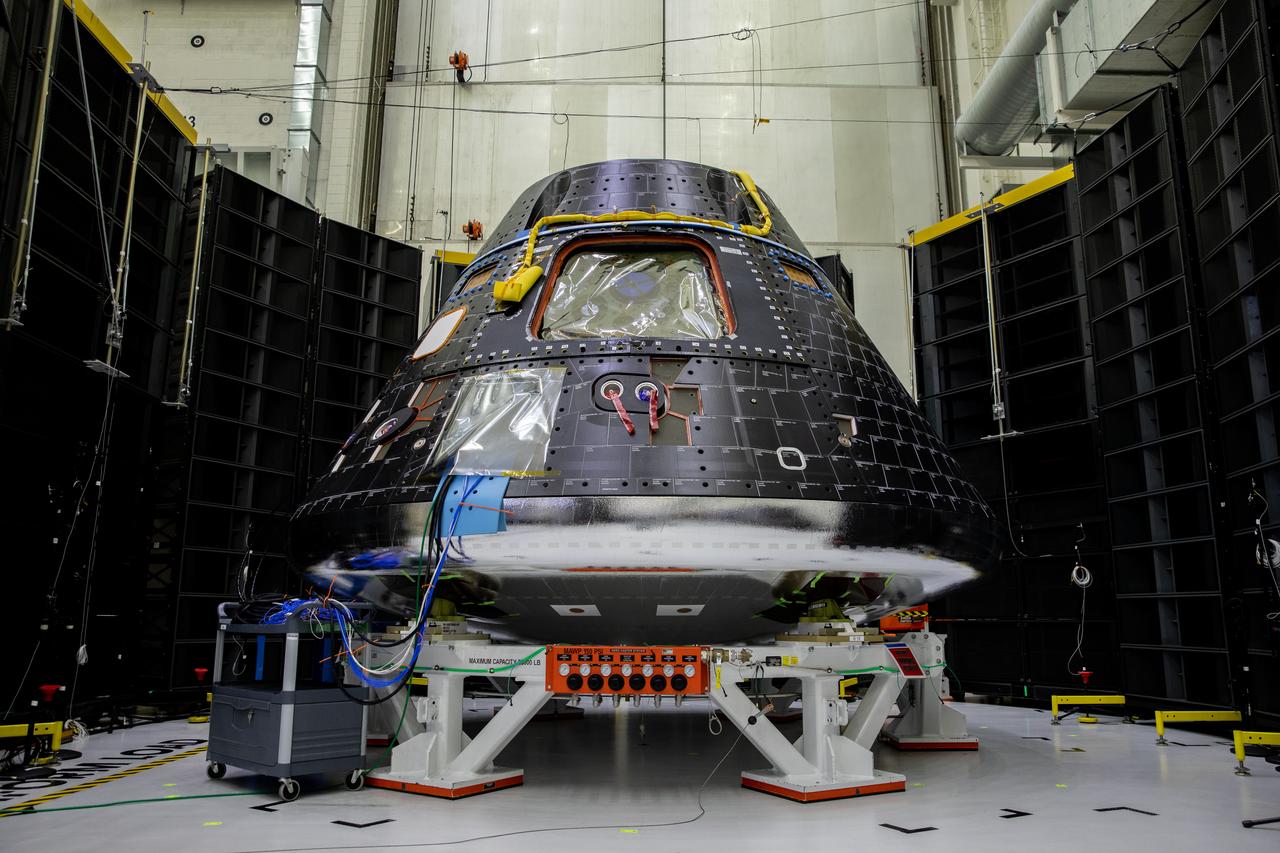
Shown inside the Neil Armstrong Operations and Checkout Building at NASA’s Kennedy Space Center in Florida on Aug. 8, 2023, is the Orion crew module for NASA’s Artemis…
Inspect NASA record
Shown inside the Neil Armstrong Operations and Checkout Building at NASA’s Kennedy Space Center in Florida on Aug. 8, 2023, is the Orion crew module for NASA’s Artemis II mission. The crew features Reid Wiseman, commander; Victor Glover, pilot; Christina Hammock Koch, mission specialist; and Jeremy Hansen, mission specialist. Artemis II is the first crewed mission on NASA’s path to establishing a long-term lunar presence for science and exploration under Artemis.
- Record ID
- KSC-20230808-PH-KLS01_0055
- NASA center
- KSC
- Date
- 2023-08-08
- Credit
- NASA/Kim Shiflett
- Keywords
- Artemis, Artemis II, Artemis III, Artemis IV, CM, ESM, European service module, KSC, Kennedy Space Center, Moon, Moon to Mars, O&C
GSFC · 2017-12-08 · GSFC_20171208_Archive_e001393
LADEE Test
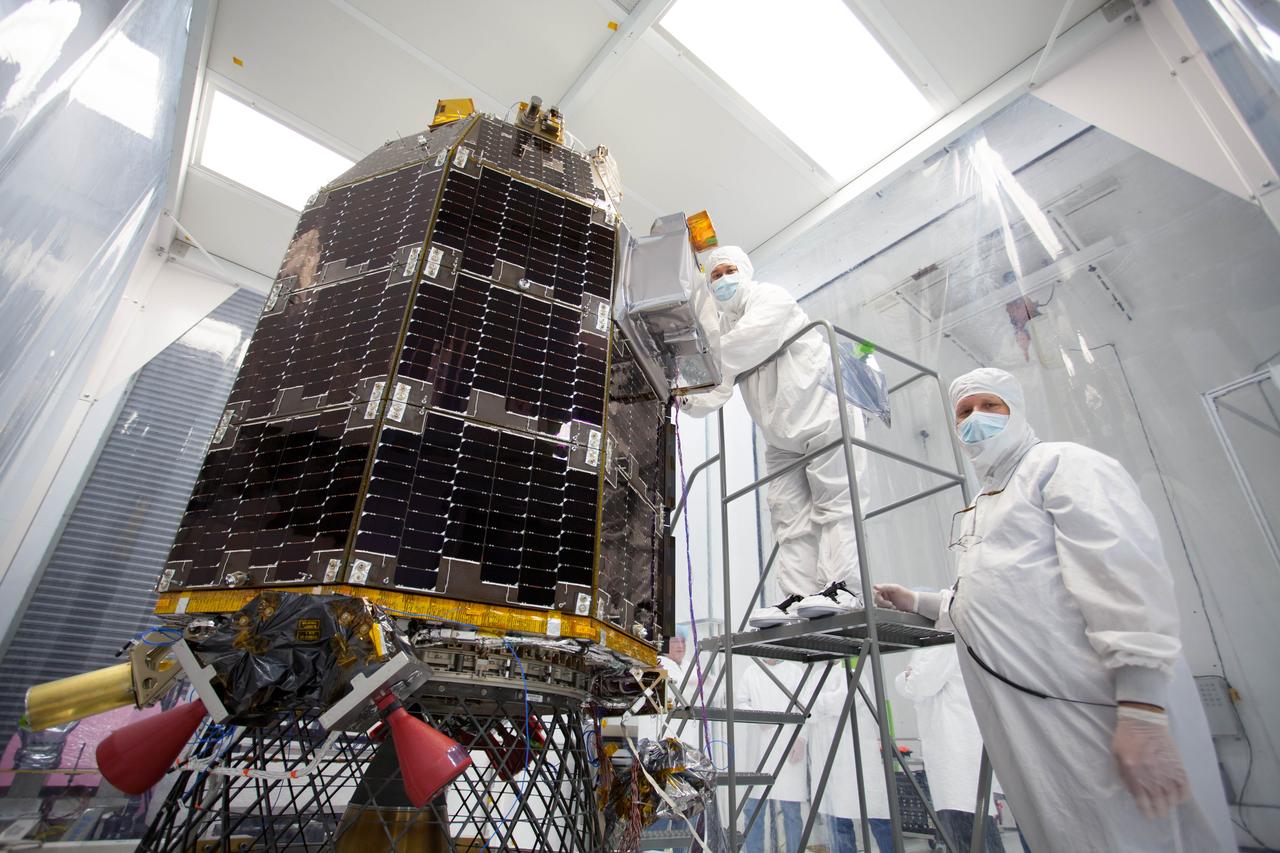
Engineers at NASA's Ames Research Center, Moffett Field, Calif., prepare NASA's Lunar Atmosphere and Dust Environment Explorer (LADEE) Observatory for acoustic environmental testing. Credit: NASA/Ames ----- What is…
Inspect NASA record
Engineers at NASA's Ames Research Center, Moffett Field, Calif., prepare NASA's Lunar Atmosphere and Dust Environment Explorer (LADEE) Observatory for acoustic environmental testing. Credit: NASA/Ames ----- What is LADEE? The Lunar Atmosphere and Dust Environment Explorer (LADEE) is designed to study the Moon's thin exosphere and the lunar dust environment. An "exosphere" is an atmosphere that is so thin and tenuous that molecules don't collide with each other. Studying the Moon's exosphere will help scientists understand other planetary bodies with exospheres too, like Mercury and some of Jupiter's bigger moons. The orbiter will determine the density, composition and temporal and spatial variability of the Moon's exosphere to help us understand where the species in the exosphere come from and the role of the solar wind, lunar surface and interior, and meteoric infall as sources. The mission will also examine the density and temporal and spatial variability of dust particles that may get lofted into the atmosphere. The mission also will test several new technologies, including a modular spacecraft bus that may reduce the cost of future deep space missions and demonstrate two-way high rate laser communication for the first time from the Moon. LADEE now is ready to launch when the window opens on Sept. 6, 2013. Read more: www.nasa.gov/ladee NASA image use policy. NASA Goddard Space Flight Center enables NASA’s mission through four scientific endeavors: Earth Science, Heliophysics, Solar System Exploration, and Astrophysics. Goddard plays a leading role in NASA’s accomplishments by contributing compelling scientific knowledge to advance the Agency’s mission. Follow us on Twitter Like us on Facebook Find us on Instagram
- Record ID
- GSFC_20171208_Archive_e001393
- NASA center
- GSFC
- Date
- 2017-12-08
- Keywords
- LADEE Test, moon, nasa, rocket, launch, goddard, ladee
GSFC · 2017-12-08 · GSFC_20171208_Archive_e001395
LADEE Preparations
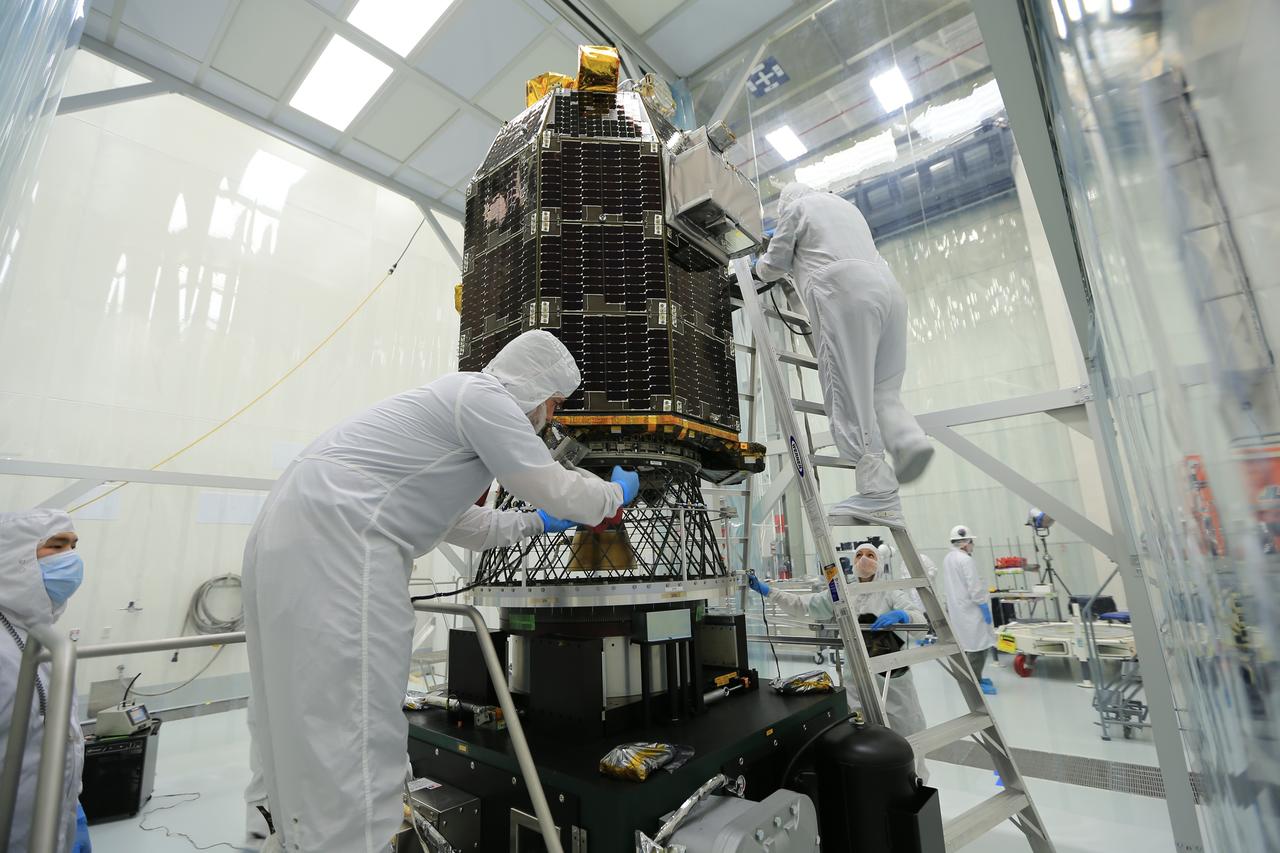
NASA's Lunar Atmosphere and Dust Environment Explorer (LADEE) spacecraft being prepared in the clean room at Wallops Flight Facility. Credit: NASA ----- What is LADEE? The Lunar Atmosphere…
Inspect NASA record
NASA's Lunar Atmosphere and Dust Environment Explorer (LADEE) spacecraft being prepared in the clean room at Wallops Flight Facility. Credit: NASA ----- What is LADEE? The Lunar Atmosphere and Dust Environment Explorer (LADEE) is designed to study the Moon's thin exosphere and the lunar dust environment. An "exosphere" is an atmosphere that is so thin and tenuous that molecules don't collide with each other. Studying the Moon's exosphere will help scientists understand other planetary bodies with exospheres too, like Mercury and some of Jupiter's bigger moons. The orbiter will determine the density, composition and temporal and spatial variability of the Moon's exosphere to help us understand where the species in the exosphere come from and the role of the solar wind, lunar surface and interior, and meteoric infall as sources. The mission will also examine the density and temporal and spatial variability of dust particles that may get lofted into the atmosphere. The mission also will test several new technologies, including a modular spacecraft bus that may reduce the cost of future deep space missions and demonstrate two-way high rate laser communication for the first time from the Moon. LADEE now is ready to launch when the window opens on Sept. 6, 2013. Read more: www.nasa.gov/ladee NASA image use policy. NASA Goddard Space Flight Center enables NASA’s mission through four scientific endeavors: Earth Science, Heliophysics, Solar System Exploration, and Astrophysics. Goddard plays a leading role in NASA’s accomplishments by contributing compelling scientific knowledge to advance the Agency’s mission. Follow us on Twitter Like us on Facebook Find us on Instagram
- Record ID
- GSFC_20171208_Archive_e001395
- NASA center
- GSFC
- Date
- 2017-12-08
- Keywords
- LADEE Preparations, moon, nasa, rocket, launch, goddard, ladee

GSFC · 2017-12-08 · GSFC_20171208_Archive_e000496
NASA Releases New High-Resolution Earthrise Image
NASA's Lunar Reconnaissance Orbiter (LRO) recently captured a unique view of Earth from the spacecraft's vantage point in orbit around the moon. "The image is simply stunning," said…
Inspect NASA record
NASA's Lunar Reconnaissance Orbiter (LRO) recently captured a unique view of Earth from the spacecraft's vantage point in orbit around the moon. "The image is simply stunning," said Noah Petro, Deputy Project Scientist for LRO at NASA's Goddard Space Flight Center in Greenbelt, Maryland. "The image of the Earth evokes the famous 'Blue Marble' image taken by Astronaut Harrison Schmitt during Apollo 17, 43 years ago, which also showed Africa prominently in the picture." In this composite image we see Earth appear to rise over the lunar horizon from the viewpoint of the spacecraft, with the center of the Earth just off the coast of Liberia (at 4.04 degrees North, 12.44 degrees West). The large tan area in the upper right is the Sahara Desert, and just beyond is Saudi Arabia. The Atlantic and Pacific coasts of South America are visible to the left. On the moon, we get a glimpse of the crater Compton, which is located just beyond the eastern limb of the moon, on the lunar farside. LRO was launched on June 18, 2009, and has collected a treasure trove of data with its seven powerful instruments, making an invaluable contribution to our knowledge about the moon. LRO experiences 12 earthrises every day; however the spacecraft is almost always busy imaging the lunar surface so only rarely does an opportunity arise such that its camera instrument can capture a view of Earth. Occasionally LRO points off into space to acquire observations of the extremely thin lunar atmosphere and perform instrument calibration measurements. During these movements sometimes Earth (and other planets) pass through the camera's field of view and dramatic images such as the one shown here are acquired. This image was composed from a series of images taken Oct. 12, when LRO was about 83 miles (134 kilometers) above the moon's farside crater Compton. Capturing an image of the Earth and moon with LRO's Lunar Reconnaissance Orbiter Camera (LROC) instrument is a complicated task. First the spacecraft must be rolled to the side (in this case 67 degrees), then the spacecraft slews with the direction of travel to maximize the width of the lunar horizon in LROC's Narrow Angle Camera image. All this takes place while LRO is traveling faster than 3,580 miles per hour (over 1,600 meters per second) relative to the lunar surface below the spacecraft! The high-resolution Narrow Angle Camera (NAC) on LRO takes black-and-white images, while the lower resolution Wide Angle Camera (WAC) takes color images, so you might wonder how we got a high-resolution picture of the Earth in color. Since the spacecraft, Earth, and moon are all in motion, we had to do some special processing to create an image that represents the view of the Earth and moon at one particular time. The final Earth image contains both WAC and NAC information. WAC provides the color, and the NAC provides high-resolution detail. "From the Earth, the daily moonrise and moonset are always inspiring moments," said Mark Robinson of Arizona State University in Tempe, principal investigator for LROC. "However, lunar astronauts will see something very different: viewed from the lunar surface, the Earth never rises or sets. Since the moon is tidally locked, Earth is always in the same spot above the horizon, varying only a small amount with the slight wobble of the moon. The Earth may not move across the 'sky', but the view is not static. Future astronauts will see the continents rotate in and out of view and the ever-changing pattern of clouds will always catch one's eye, at least on the nearside. The Earth is never visible from the farside; imagine a sky with no Earth or moon - what will farside explorers think with no Earth overhead?" NASA's first Earthrise image was taken with the Lunar Orbiter 1 spacecraft in 1966. Perhaps NASA's most iconic Earthrise photo was taken by the crew of the Apollo 8 mission as the spacecraft entered lunar orbit on Christmas Eve Dec. 24, 1968. That evening, the astronauts -- Commander Frank Borman, Command Module Pilot Jim Lovell, and Lunar Module Pilot William Anders -- held a live broadcast from lunar orbit, in which they showed pictures of the Earth and moon as seen from their spacecraft. Said Lovell, "The vast loneliness is awe-inspiring and it makes you realize just what you have back there on Earth." Credit: NASA/Goddard/Arizona State University NASA image use policy. NASA Goddard Space Flight Center enables NASA’s mission through four scientific endeavors: Earth Science, Heliophysics, Solar System Exploration, and Astrophysics. Goddard plays a leading role in NASA’s accomplishments by contributing compelling scientific knowledge to advance the Agency’s mission. Follow us on Twitter Like us on Facebook Find us on Instagram
- Record ID
- GSFC_20171208_Archive_e000496
- NASA center
- GSFC
- Date
- 2017-12-08
- Keywords
- NASA Releases New High-Resolution Earthrise Image, moon, earth, nasa, earthrise, bluemarble, lro, nasagoddard

JSC · 2026-04-06 · jsc2026e021924
Artemis II Flight Control Team during Lunar Flyby
jsc2026e021924 (April 6, 2026) - Artemis II Flight Control Team pictured at consoles within the White Flight Control Room in the Mission Control Center at NASA’s Johnson Space…
Inspect NASA record
jsc2026e021924 (April 6, 2026) - Artemis II Flight Control Team pictured at consoles within the White Flight Control Room in the Mission Control Center at NASA’s Johnson Space Center during the Artemis II mission. This image was taken when NASA astronauts Reid Wiseman, commander; Victor Glover, pilot; Christina Koch, mission specialist; and CSA (Canadian Space Agency) astronaut Jeremy Hansen conducted the flyby of the Moon. Credit: NASA/Robert Markowitz
- Record ID
- jsc2026e021924
- NASA center
- JSC
- Date
- 2026-04-06
- Credit
- ROBERT MARKOWITZ NASA-JSC
- Keywords
- Artemis II, Artemis, Artemis 2, Lunar Flyby, White Flight Control Room, Mission Control Center, Johnson Space Center, JSC
GSFC · 2017-12-08 · GSFC_20171208_Archive_e002220
First Images from NASA's New Moon Mission
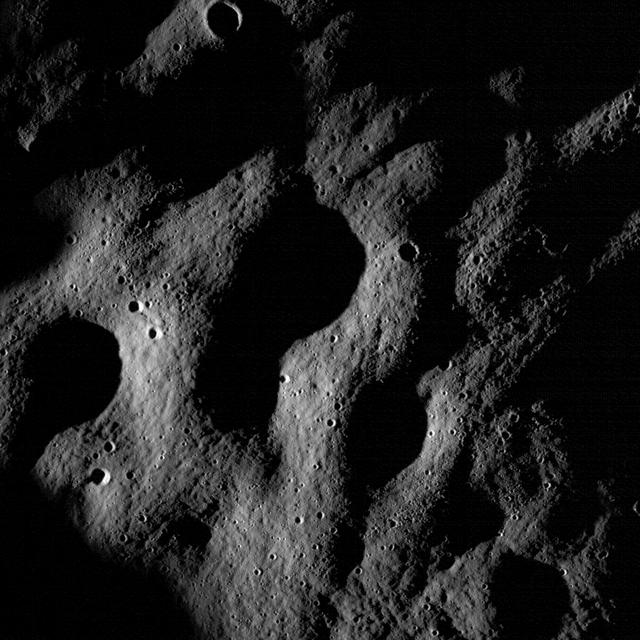
These images show cratered regions near the moon's Mare Nubium region, as photographed by the Lunar Reconnaissance Orbiter's LROC instrument. Each image shows a region 1,400 meters (0.87…
Inspect NASA record
These images show cratered regions near the moon's Mare Nubium region, as photographed by the Lunar Reconnaissance Orbiter's LROC instrument. Each image shows a region 1,400 meters (0.87 miles) wide. the bottoms of both images face lunar north. The image below shows the location of these two images in relation to each other. Credit: NASA/Goddard Space Flight Center/Arizona State University
- Record ID
- GSFC_20171208_Archive_e002220
- NASA center
- GSFC
- Date
- 2017-12-08
- Keywords
- First Images from NASA's New Moon Mission, camera, photo, mare, images, nasa, lunar, goddard, orbiter, arizonastateuniversity, lro, nubium
KSC · 2014-11-03 · KSC-314D-0485_0126
Moon Express Media Event
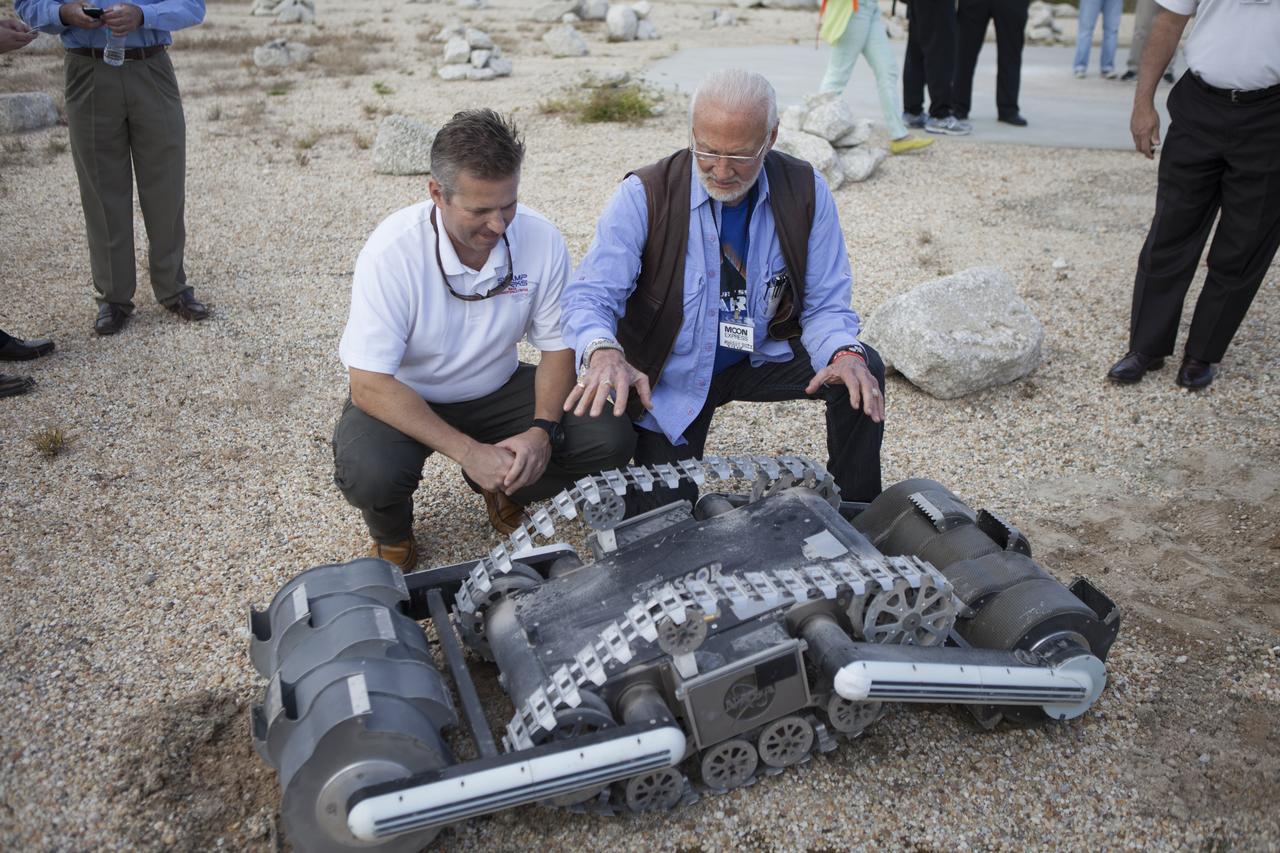
Rob Mueller, left, NASA senior technologist in the Surface Systems Office in Kennedy Space Center's Engineering and Technology Directorate, talks with former NASA Apollo astronaut Buzz Aldrin during…
Inspect NASA record
Rob Mueller, left, NASA senior technologist in the Surface Systems Office in Kennedy Space Center's Engineering and Technology Directorate, talks with former NASA Apollo astronaut Buzz Aldrin during a demonstration of the Regolith Advanced Surface Systems Operations Robot, or RASSOR, at the automated landing and hazard avoidance technology, or ALHAT, hazard field at the north end of the Shuttle Landing Facility at NASA's Kennedy Space Center in Florida. The event was held to announce Moon Express Inc., of Moffett Field, California is selected to utilize Kennedy facilities for NASA's Lunar Cargo Transportation and Landing by Soft Touchdown, or Lunar CATALYST, initiative. Moon Express is developing a lander with capabilities that will enable delivery of payloads to the surface of the moon, as well as new science and exploration missions of interest to NASA and scientific and academic communities. Moon Express will base its activities at Kennedy and utilize the Morpheus ALHAT field and a hangar nearby for CATALYST testing. The Advanced Exploration Systems Division of NASA's Human Exploration and Operations Mission Directorate manages Lunar CATALYST.
- Record ID
- KSC-314D-0485_0126
- NASA center
- KSC
- Date
- 2014-11-03
- Keywords
- KSC-2014-4378
KSC · 2014-07-21 · KSC-2014-3252
KSC-2014-3252
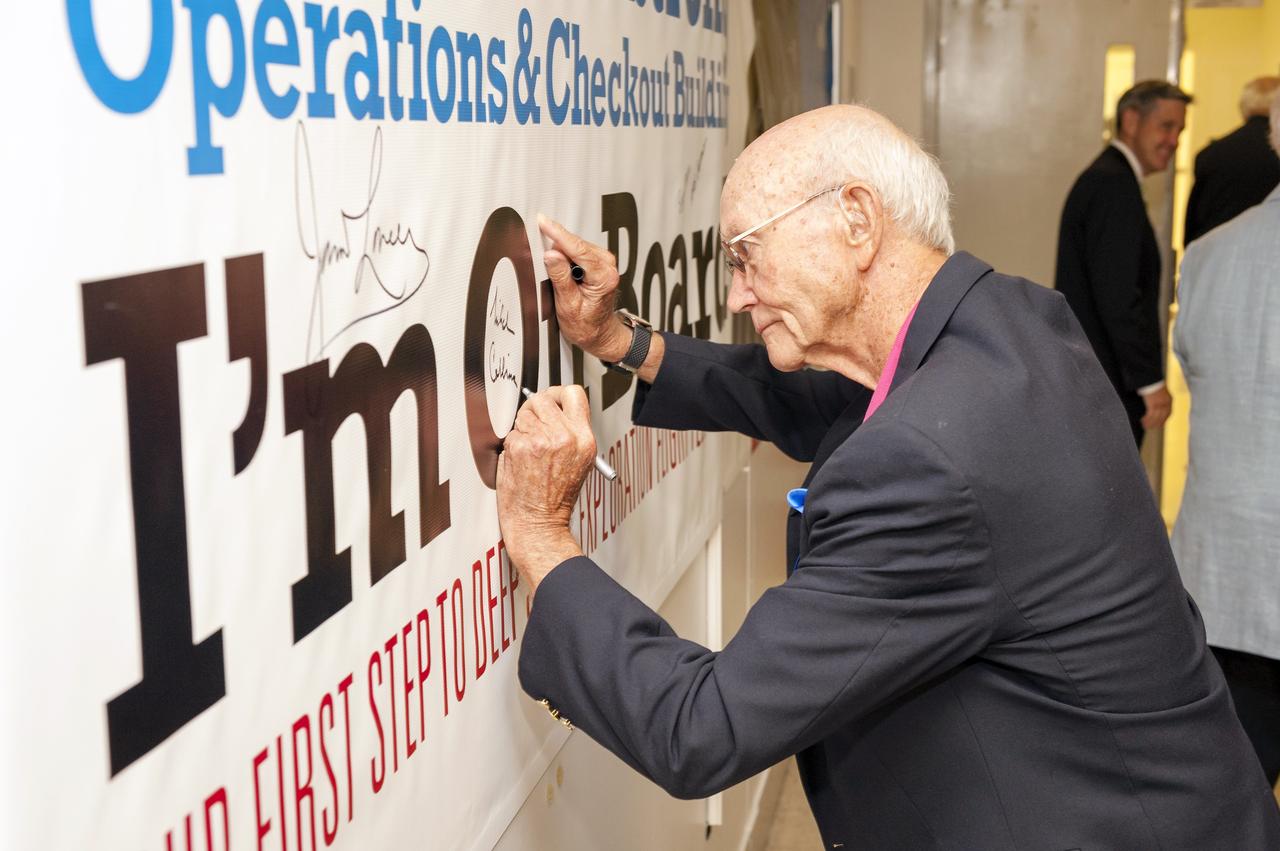
CAPE CANAVERAL, Fla. -- Apollo 11 command module pilot Michael Collins signs a banner displaying the new name of the Operations and Checkout Building at NASA's Kennedy Space…
Inspect NASA record
CAPE CANAVERAL, Fla. -- Apollo 11 command module pilot Michael Collins signs a banner displaying the new name of the Operations and Checkout Building at NASA's Kennedy Space Center in Florida. The banner signing followed a ceremony renaming the refurbished building for Apollo 11 astronaut Neil Armstrong, the first person to set foot on the moon. The building's high bay is being used to support the agency's new Orion spacecraft and is the same spaceport facility where the Apollo 11 command/service module and lunar module were prepped for the first lunar landing mission in 1969. Orion is designed to take humans farther than they’ve ever gone before, serving as the exploration vehicle that will carry astronauts to deep space and sustain the crew during travel to destinations such as an asteroid or Mars. The ceremony was part of NASA's 45th anniversary celebration of the Apollo 11 moon landing. As the world watched, Neil Armstrong and Buzz Aldrin landed in the moon's Sea of Tranquility on July 20, 1969, aboard the lunar module Eagle. Meanwhile, crewmate Michael Collins orbited above in the command module Columbia. For more, visit http://www.nasa.gov/press/2014/july/nasa-honors-historic-first-moon-landing-eyes-first-mars-mission. Photo credit: NASA/Kevin O'Connell
- Record ID
- KSC-2014-3252
- NASA center
- KSC
- Date
- 2014-07-21
- Keywords
- O&C
KSC · 2014-07-21 · KSC-2014-3222
KSC-2014-3222
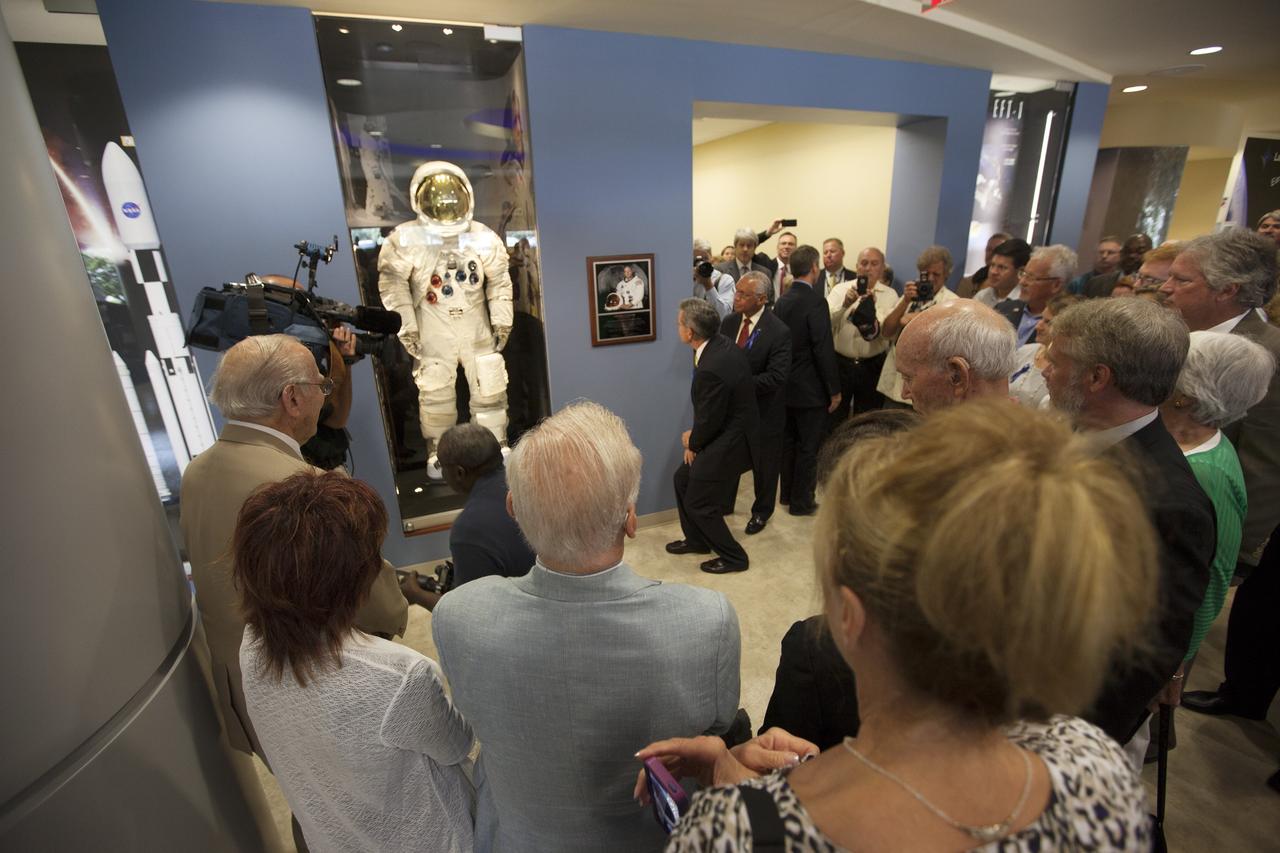
CAPE CANAVERAL, Fla. -- At the Kennedy Space Center in Florida, Center Director Robert Cabana reads the inscription on a plaque to invited guests following its unveiling in…
Inspect NASA record
CAPE CANAVERAL, Fla. -- At the Kennedy Space Center in Florida, Center Director Robert Cabana reads the inscription on a plaque to invited guests following its unveiling in the lobby of the newly named Neil Armstrong Operations and Checkout Building. NASA Administrator Charles Bolden is at his right. The facility has been renamed for Apollo 11 astronaut Neil Armstrong, the first person to set foot on the moon. The building's high bay is being used to support the agency's new Orion spacecraft and is the same spaceport facility where the Apollo 11 command/service module and lunar module were prepped for the first lunar landing mission in 1969. Orion is designed to take humans farther than they’ve ever gone before, serving as the exploration vehicle that will carry astronauts to deep space and sustain the crew during travel to destinations such as an asteroid or Mars. The unveiling was part of NASA's 45th anniversary celebration of the Apollo 11 moon landing. As the world watched, Apollo 11 astronauts landed in the moon's Sea of Tranquility aboard the lunar module, Eagle, on July 20, 1969, as the command module, Columbia, orbited overhead. For more: http://www.nasa.gov/press/2014/july/nasa-honors-historic-first-moon-landing-eyes-first-mars-mission/ Photo credit: NASA/Kim Shiflett
- Record ID
- KSC-2014-3222
- NASA center
- KSC
- Date
- 2014-07-21
KSC · 2014-11-03 · KSC-2014-4374
KSC-2014-4374
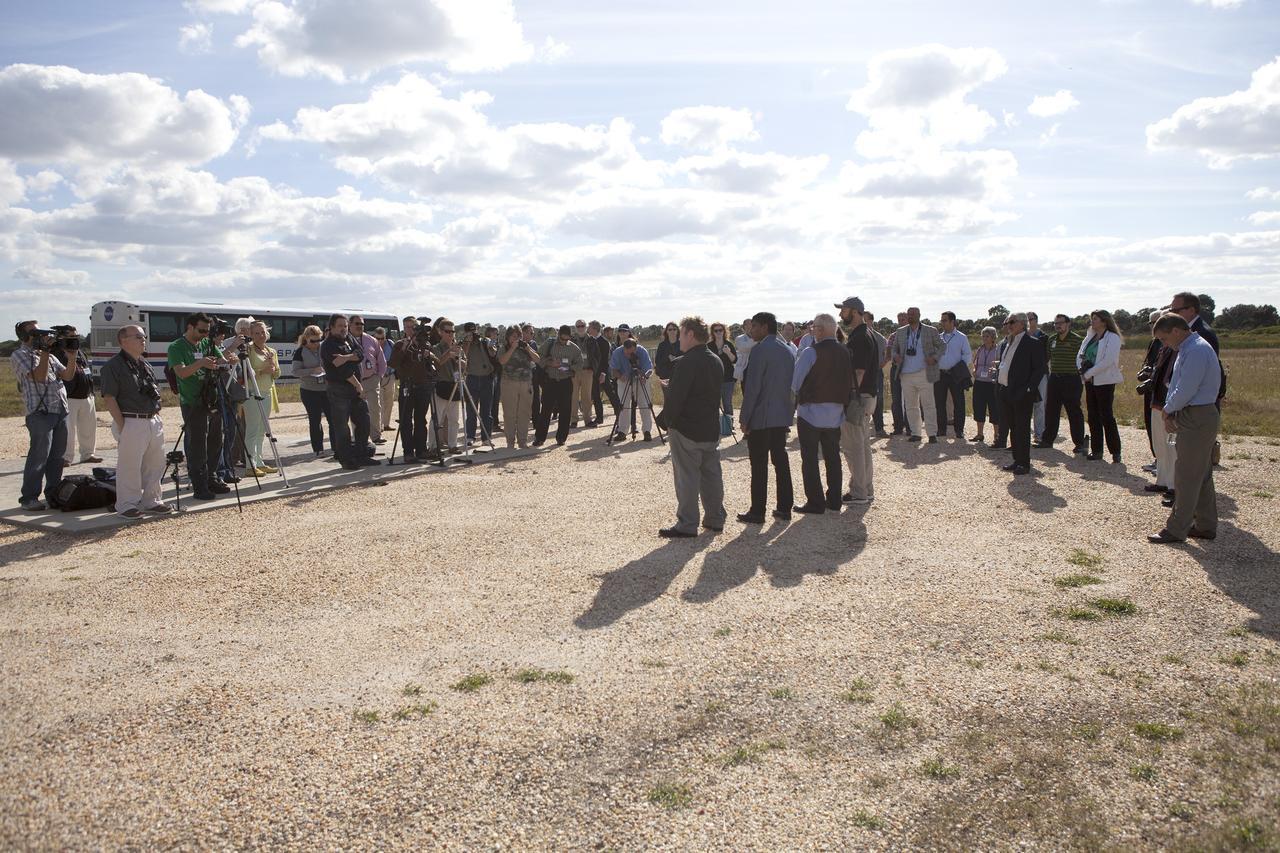
CAPE CANAVERAL, Fla. - Bob Richards, standing at left in front of the cameras, co-founder and chief executive officer of Moon Express Inc., of Moffett Field, California, speaks…
Inspect NASA record
CAPE CANAVERAL, Fla. - Bob Richards, standing at left in front of the cameras, co-founder and chief executive officer of Moon Express Inc., of Moffett Field, California, speaks to the media during an event to announce the company's selection to utilize Kennedy Space Center facilities as part of NASA's Lunar Cargo Transportation and Landing by Soft Touchdown, or Lunar CATALYST, initiative. Third from left in the group is former NASA Apollo astronaut Buzz Aldrin. The event took place at Kennedy's automated landing and hazard avoidance technology, or ALHAT, hazard field at the north end of the Shuttle Landing Facility. Moon Express is developing a lander with capabilities that will enable delivery of payloads to the surface of the moon, as well as new science and exploration missions of interest to NASA and scientific and academic communities. Moon Express will base its activities at Kennedy and utilize the Morpheus ALHAT field and a hangar nearby for CATALYST testing. The Advanced Exploration Systems Division of NASA's Human Exploration and Operations Mission Directorate manages Lunar CATALYST. Photo credit: NASA/Ben Smegelsky
- Record ID
- KSC-2014-4374
- NASA center
- KSC
- Date
- 2014-11-03
- Keywords
- Moon Express, ALHAT, CATALYST