
Update Site (from NASA)
Explore NASA’s Image and Video Library.
Suggest one object per day for the Interstellar Minds collection. We review each suggestion before adding it.
Sign in to suggest a Marvel.
Find a NASA image ID. Open a NASA record and copy its ID from the end of the details URL.
NASA image records
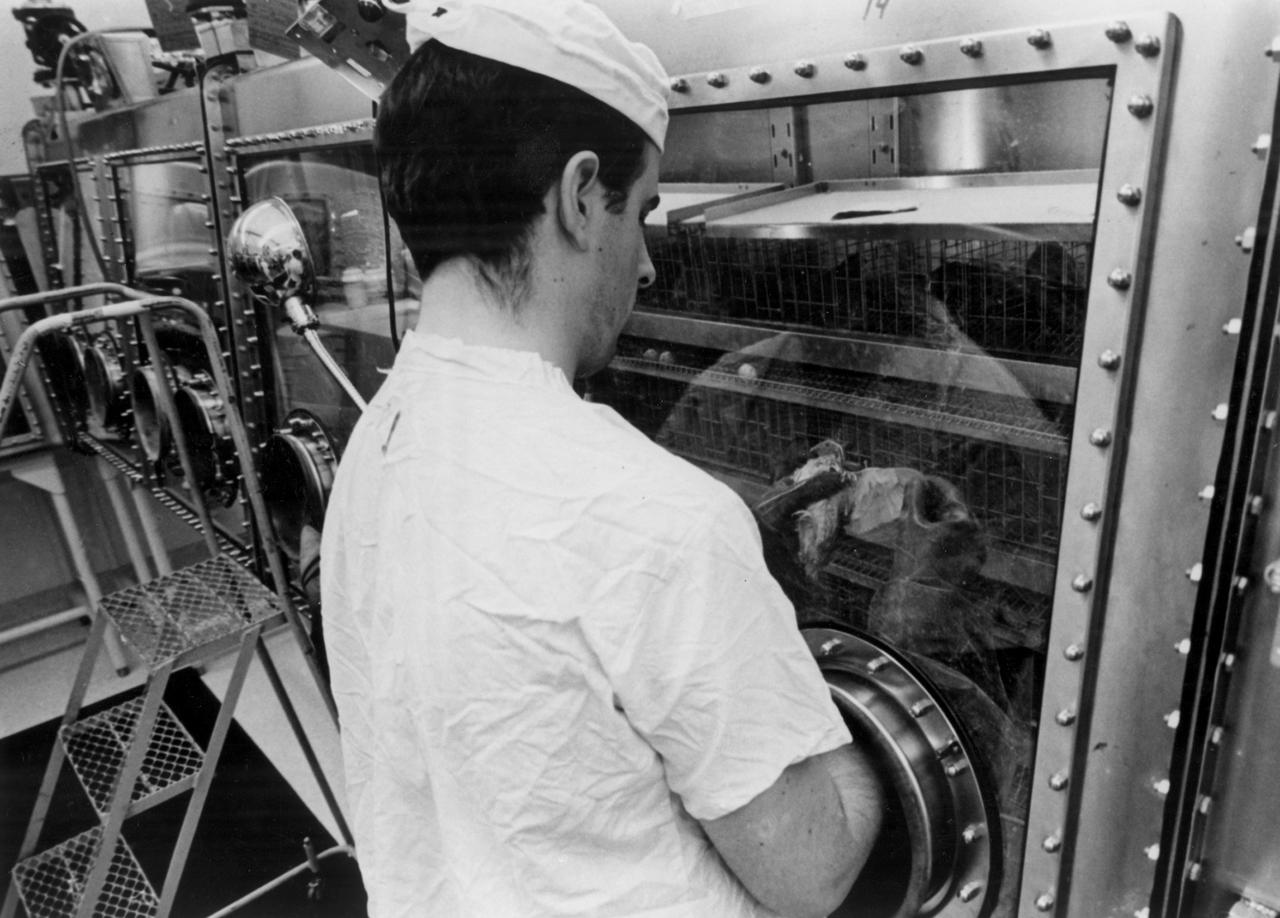
MSFC · 1969-07-09 · 6901318
Saturn Apollo Program
In this photograph, laboratory technician Bart Ruark visually inspects a Japanese Qail confined within a class III cabinet in the Intervertebrae, Aves, and Fish Laboratory of the Lunar…
Inspect NASA record
In this photograph, laboratory technician Bart Ruark visually inspects a Japanese Qail confined within a class III cabinet in the Intervertebrae, Aves, and Fish Laboratory of the Lunar Receiving Laboratory, Building 37 of the Manned Spacecraft Center (MSC) in Houston, Texas. This laboratory was part of the overall physical, chemical, and biological test program of the Apollo 11 returned lunar samples. Aboard the Marshall Space Flight Center (MSFC) developed Saturn V launch vehicle, the Apollo 11 mission launched from The Kennedy Space Center, Florida on July 16, 1969 and safely returned to Earth on July 24, 1969. The 3-man crew aboard the flight consisted of astronauts Neil A. Armstrong, commander; Edwin Aldrin, Lunar Module (LM) pilot; and Michael Collins, Command Module (CM) pilot. The CM, piloted by Michael Collins remained in a parking orbit around the Moon while the LM, named “Eagle’’, carrying astronauts Neil Armstrong and Edwin Aldrin, landed on the Moon. In 2 1/2 hours, the crew collected 47 pounds of lunar surface material which was returned to Earth for analysis.
- Record ID
- 6901318
- NASA center
- MSFC
- Date
- 1969-07-09
- Keywords
- pollo 11, Lunar Samples, Manned Spacecraft Center, Lunar Receiving Laboratory
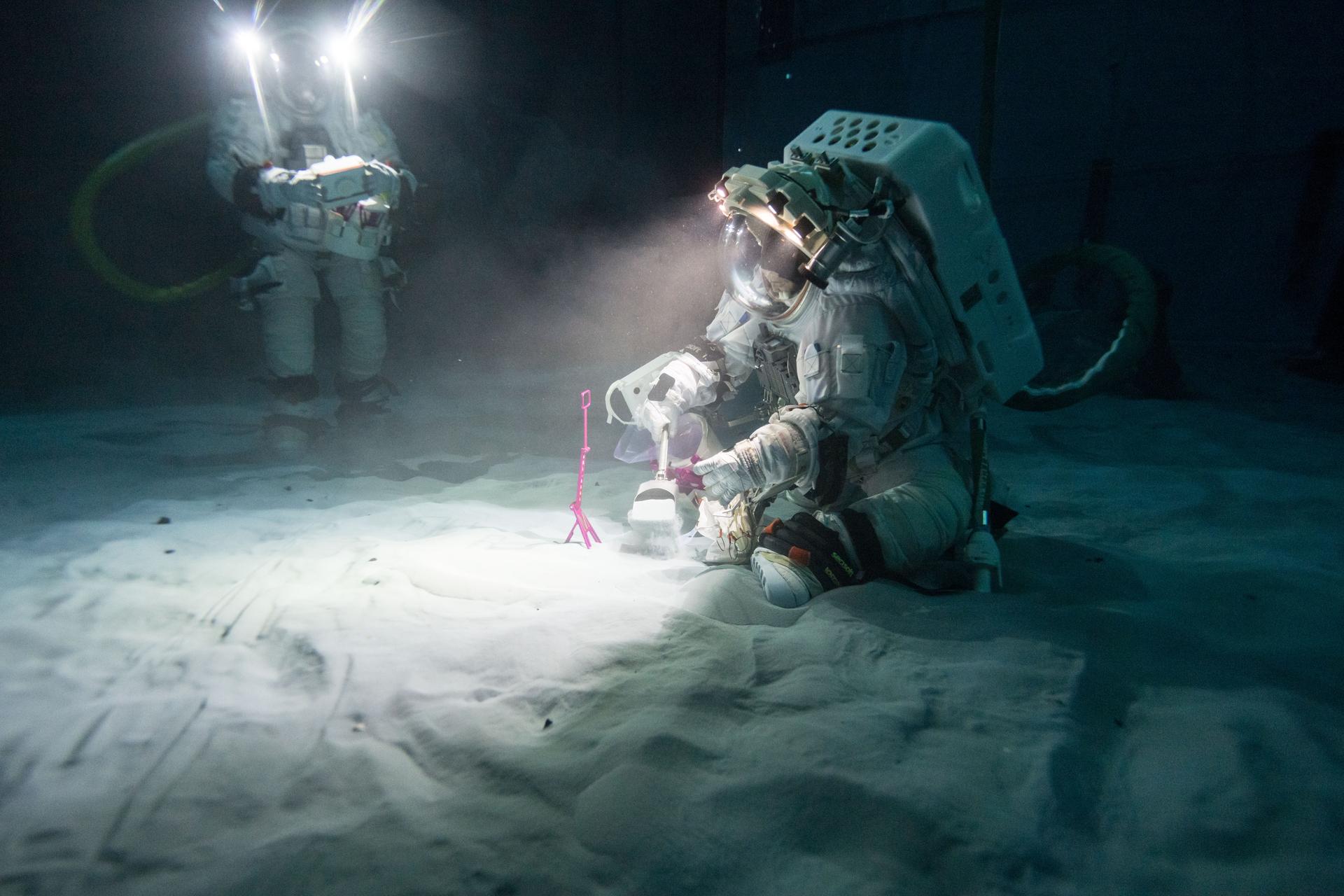
JSC · 2026-06-01 · jsc2026e390972
Artemis Lunar Spacesuit Testing
Exploration geologists and Artemis science officers Trevor Graff, left, and Angela Garcia carry out a lunar training development run at NASA’s Neutral Buoyancy Laboratory (NBL) in Houston. The…
Inspect NASA record
Exploration geologists and Artemis science officers Trevor Graff, left, and Angela Garcia carry out a lunar training development run at NASA’s Neutral Buoyancy Laboratory (NBL) in Houston. The NBL is a 40-foot deep pool at NASA’s Johnson Space Center where astronauts train for spacewalks in a neutrally buoyant environment. During the session, Garcia and Graff conducted tests of Artemis geology tools and deployed a mock lunar payload under low-angle lighting conditions similar to what astronauts will encounter at the Moon’s south pole. A section of the NBL, which contains full-scale mockups of the International Space Station modules, has been transformed into a lunar training area with soil and rocks that mimic the Moon’s landscape. This testing run marked the first time in the Artemis program that two geologists were suited up simultaneously for lunar geology training in the NBL. The team is using insights from these tests to build the training program for astronauts assigned to future landed missions on the Moon. Credit: NASA
- Record ID
- jsc2026e390972
- NASA center
- JSC
- Date
- 2026-06-01
- Credit
- NASA
- Keywords
- Artemis, Lunar Spacesuit, Spacesuit Testing, Johnson Space Center, Moon, NBL, Neutral Buoyancy Laboratory

MSFC · 2025-05-09 · CEB_1442
NASA Engineers Simulate Lunar Lighting for Artemis III Moon Landing
These photos show how teams at NASA’s Marshall Space Flight Center in Huntsville, Alabama, are using the Flat Floor Facility (Building 4619) to understand the lunar lighting environment…
Inspect NASA record
These photos show how teams at NASA’s Marshall Space Flight Center in Huntsville, Alabama, are using the Flat Floor Facility (Building 4619) to understand the lunar lighting environment in preparation for the Artemis III crewed lunar landing mission, slated for 2027. The Flat Floor Facility is an air-bearing floor, providing full-scale simulation capabilities for lunar surface systems by simulating zero gravity in two dimensions. Wearing low-fidelity materials, test engineers can understand how the extreme lighting of the Moon’s South Pole could affect surface operations during Artemis III. High-intensity lights are positioned at a low angle to replicate the strong shadows that are cast across the lunar South Pole by the Sun. Data and analysis from testing at NASA Marshall are improving models Artemis astronauts will use in preparation for lander and surface operations on the Moon during Artemis III. Testing in the facility is also helping cross-agency teams evaluate various tools astronauts may use. NASA Marshall manages the Human Landing System (HLS) Program. For more information, contact NASA Marshall’s Office of Communications at 256-544-0034.
- Record ID
- CEB_1442
- NASA center
- MSFC
- Date
- 2025-05-09
- Credit
- NASA/Charles Beason
- Keywords
- NASA, MSFC, Flat Floor, shadows, HLS, Lander, Marshall Space Flight Center, Flat Floor Facility, Human Landing System, Artemis III
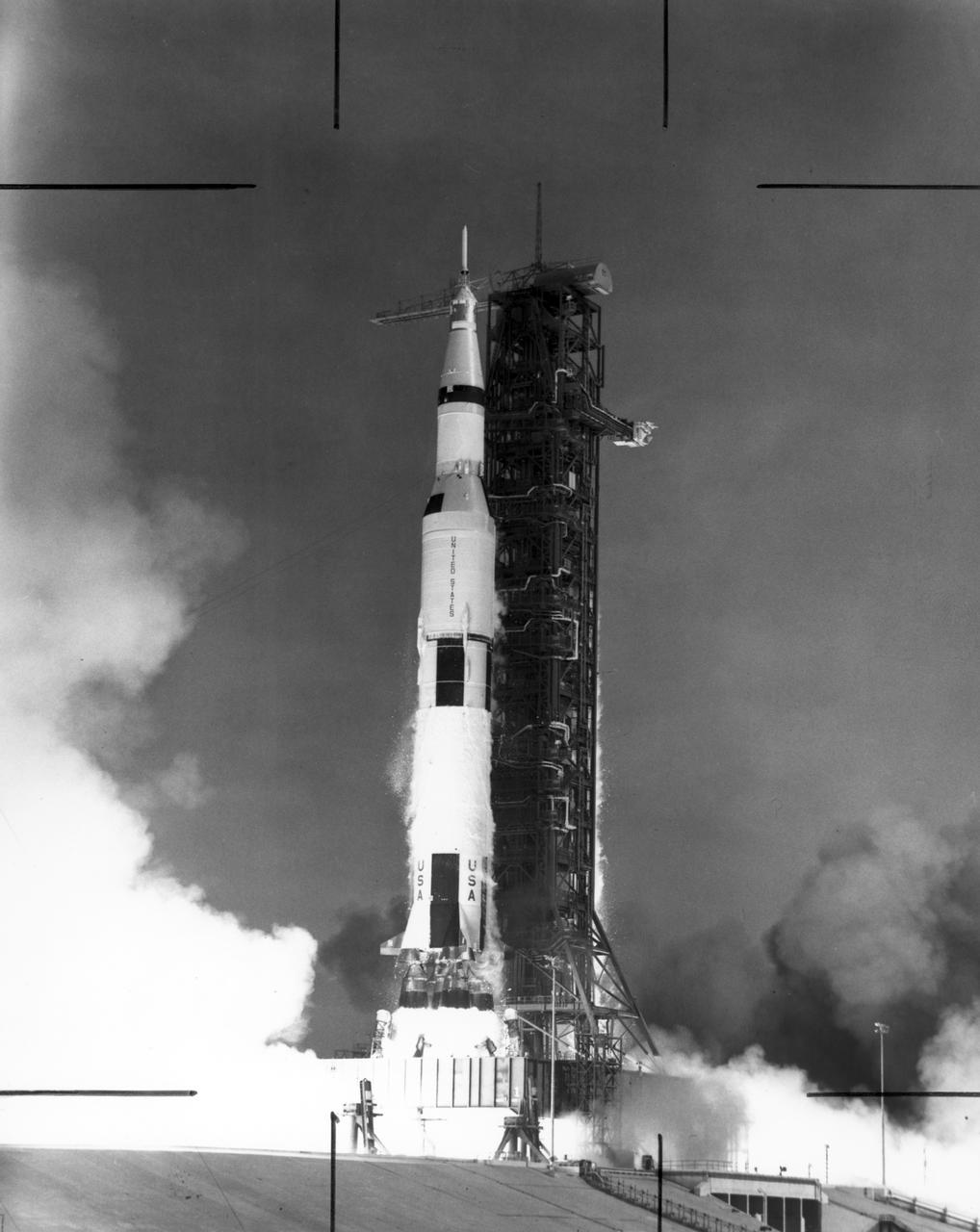
MSFC · 1969-07-16 · 6900553
Saturn Apollo Program
The Saturn V launch vehicle, developed by the Marshall Space Flight Center (MSFC) under the direction of Dr. Wernher von Braun, lifts off from the Kennedy Space Center…
Inspect NASA record
The Saturn V launch vehicle, developed by the Marshall Space Flight Center (MSFC) under the direction of Dr. Wernher von Braun, lifts off from the Kennedy Space Center (KSC), Florida carrying the Apollo 11 spacecraft and crew. The massive rocket hurled the spacecraft into Earth orbit and then onto the trajectory to the Moon. Apollo 11, the first manned lunar mission, launched from KSC on July 16, 1969 and safely returned to Earth on July 24, 1969. Aboard were astronauts Neil A. Armstrong, commander; Michael Collins, Command Module (CM) pilot; and Edwin E. Aldrin Jr., Lunar Module (LM) pilot. The CM, piloted by Michael Collins remained in a parking orbit around the Moon while the LM, named “Eagle’’, carrying astronauts Neil Armstrong and Edwin Aldrin, landed on the Moon. Armstrong was the first human to ever stand on the lunar surface, followed by Edwin (Buzz) Aldrin. During 2½ hours of surface exploration, the crew collected 47 pounds of lunar surface material for analysis back on Earth. With the success of Apollo 11, the national objective to land men on the Moon and return them safely to Earth had been accomplished.
- Record ID
- 6900553
- NASA center
- MSFC
- Date
- 1969-07-16
- Keywords
- Apollo 11, Launch, Saturn V, Moon
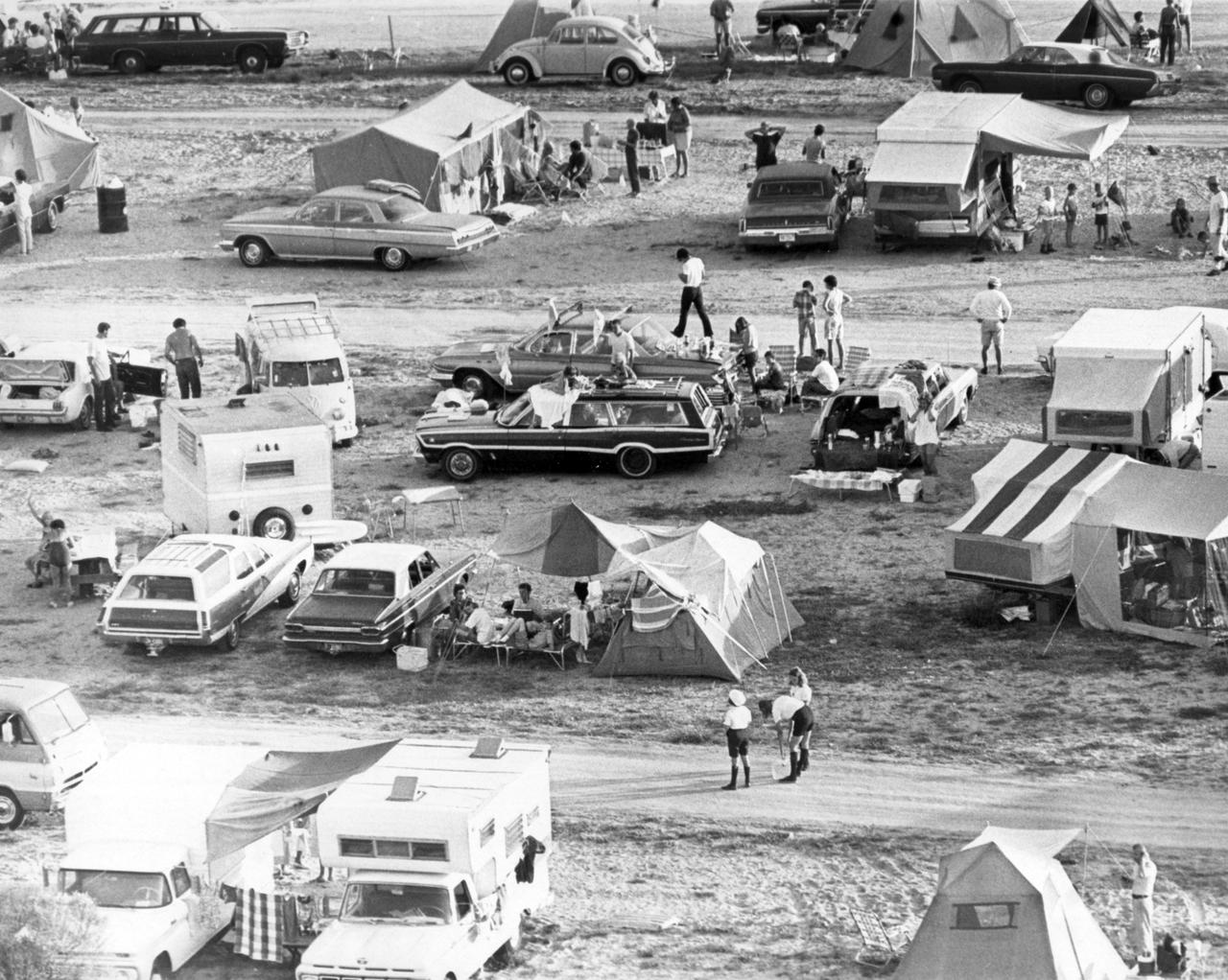
MSFC · 1969-07-16 · 6900588
Saturn Apollo Program
The early morning sun found hundreds of spectators on the beaches and roadways near the NASA Kennedy Space Center (KSC) where they had camped the night before to…
Inspect NASA record
The early morning sun found hundreds of spectators on the beaches and roadways near the NASA Kennedy Space Center (KSC) where they had camped the night before to witness history by watching the epic beginning of the journey of Apollo 11. The first manned lunar landing mission launched from KSC via the Marshall Space Flight Center (MSFC) developed Saturn V launch vehicle on July 16, 1969 and safely returned to Earth on July 24, 1969. Aboard the space craft were astronauts Neil A. Armstrong, commander; Michael Collins, Command Module (CM) pilot; and Edwin E. (Buzz) Aldrin Jr., Lunar Module (LM) pilot. The CM, “Columbia”, piloted by Collins, remained in a parking orbit around the Moon while the LM, “Eagle’’, carrying astronauts Armstrong and Aldrin, landed on the Moon. On July 20, 1969, Armstrong was the first human to ever stand on the lunar surface, followed by Aldrin. During 2½ hours of surface exploration, the crew collected 47 pounds of lunar surface material for analysis back on Earth. With the success of Apollo 11, the national objective to land men on the Moon and return them safely to Earth had been accomplished.
- Record ID
- 6900588
- NASA center
- MSFC
- Date
- 1969-07-16
- Keywords
- Apollo 11, Moon, Launch, Spectators
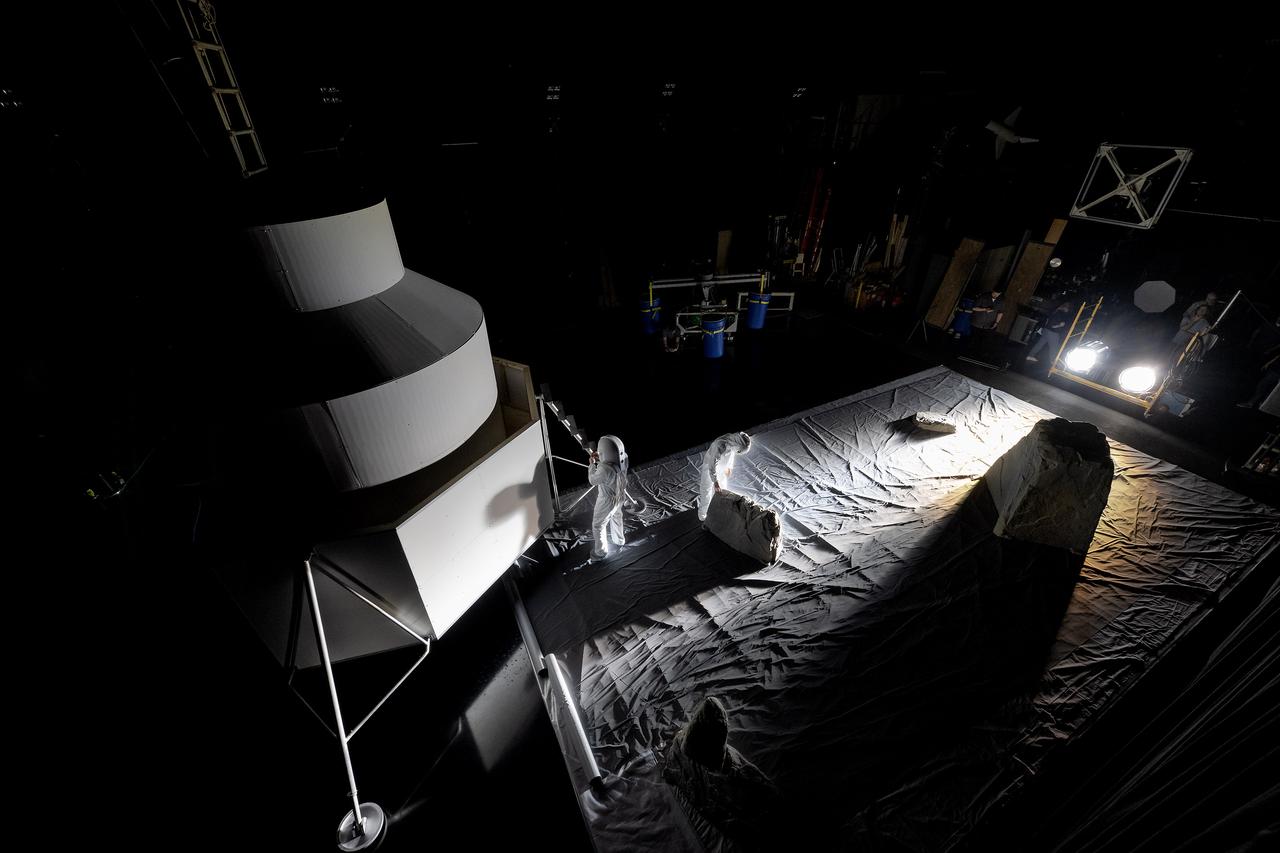
MSFC · 2025-05-09 · CEB_1407
NASA Engineers Simulate Lunar Lighting for Artemis III Moon Landing
These photos show how teams at NASA’s Marshall Space Flight Center in Huntsville, Alabama, are using the Flat Floor Facility (Building 4619) to understand the lunar lighting environment…
Inspect NASA record
These photos show how teams at NASA’s Marshall Space Flight Center in Huntsville, Alabama, are using the Flat Floor Facility (Building 4619) to understand the lunar lighting environment in preparation for the Artemis III crewed lunar landing mission, slated for 2027. The Flat Floor Facility is an air-bearing floor, providing full-scale simulation capabilities for lunar surface systems by simulating zero gravity in two dimensions. Wearing low-fidelity materials, test engineers can understand how the extreme lighting of the Moon’s South Pole could affect surface operations during Artemis III. High-intensity lights are positioned at a low angle to replicate the strong shadows that are cast across the lunar South Pole by the Sun. Data and analysis from testing at NASA Marshall are improving models Artemis astronauts will use in preparation for lander and surface operations on the Moon during Artemis III. Testing in the facility is also helping cross-agency teams evaluate various tools astronauts may use. NASA Marshall manages the Human Landing System (HLS) Program. For more information, contact NASA Marshall’s Office of Communications at 256-544-0034.
- Record ID
- CEB_1407
- NASA center
- MSFC
- Date
- 2025-05-09
- Credit
- NASA/Charles Beason
- Keywords
- NASA, MSFC, Flat Floor, shadows, HLS, Lander, Marshall Space Flight Center, Flat Floor Facility, Human Landing System, Artemis III
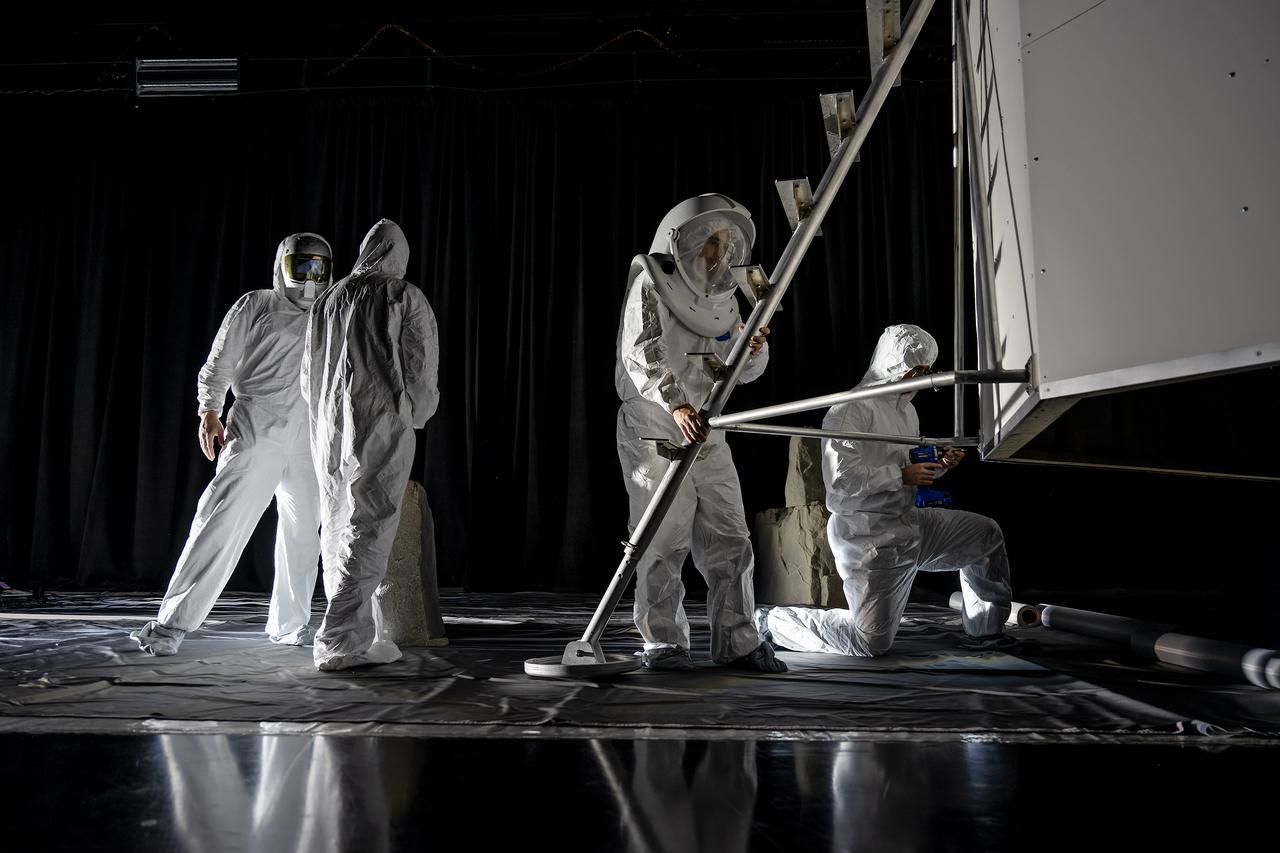
MSFC · 2025-05-09 · CEB_1497
NASA Engineers Simulate Lunar Lighting for Artemis III Moon Landing
These photos show how teams at NASA’s Marshall Space Flight Center in Huntsville, Alabama, are using the Flat Floor Facility (Building 4619) to understand the lunar lighting environment…
Inspect NASA record
These photos show how teams at NASA’s Marshall Space Flight Center in Huntsville, Alabama, are using the Flat Floor Facility (Building 4619) to understand the lunar lighting environment in preparation for the Artemis III crewed lunar landing mission, slated for 2027. The Flat Floor Facility is an air-bearing floor, providing full-scale simulation capabilities for lunar surface systems by simulating zero gravity in two dimensions. Wearing low-fidelity materials, test engineers can understand how the extreme lighting of the Moon’s South Pole could affect surface operations during Artemis III. High-intensity lights are positioned at a low angle to replicate the strong shadows that are cast across the lunar South Pole by the Sun. Data and analysis from testing at NASA Marshall are improving models Artemis astronauts will use in preparation for lander and surface operations on the Moon during Artemis III. Testing in the facility is also helping cross-agency teams evaluate various tools astronauts may use. NASA Marshall manages the Human Landing System (HLS) Program. For more information, contact NASA Marshall’s Office of Communications at 256-544-0034.
- Record ID
- CEB_1497
- NASA center
- MSFC
- Date
- 2025-05-09
- Credit
- NASA/Charles Beason
- Keywords
- NASA, MSFC, Flat Floor, shadows, HLS, Lander, Marshall Space Flight Center, Flat Floor Facility, Human Landing System, Artemis III
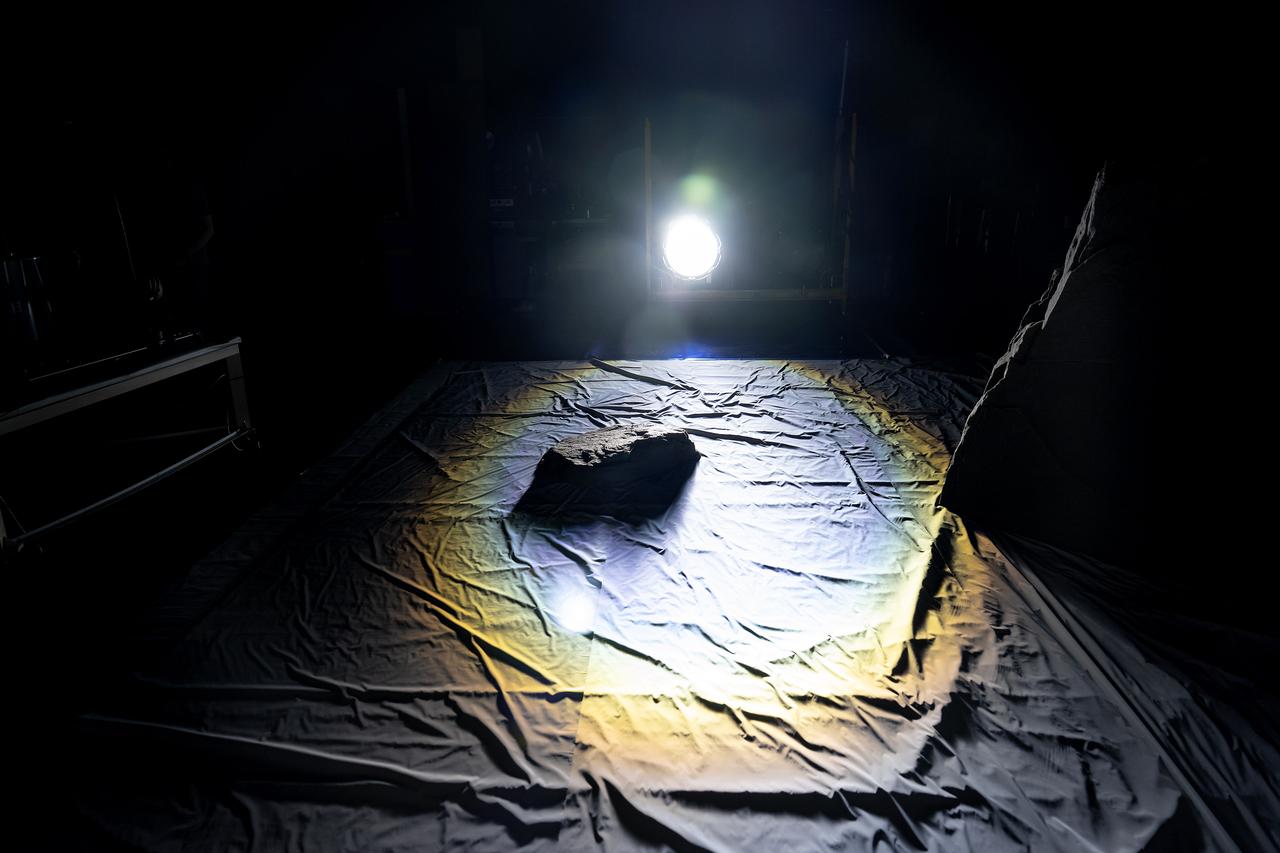
MSFC · 2025-05-09 · CEB_1528
NASA Engineers Simulate Lunar Lighting for Artemis III Moon Landing
These photos show how teams at NASA’s Marshall Space Flight Center in Huntsville, Alabama, are using the Flat Floor Facility (Building 4619) to understand the lunar lighting environment…
Inspect NASA record
These photos show how teams at NASA’s Marshall Space Flight Center in Huntsville, Alabama, are using the Flat Floor Facility (Building 4619) to understand the lunar lighting environment in preparation for the Artemis III crewed lunar landing mission, slated for 2027. The Flat Floor Facility is an air-bearing floor, providing full-scale simulation capabilities for lunar surface systems by simulating zero gravity in two dimensions. Wearing low-fidelity materials, test engineers can understand how the extreme lighting of the Moon’s South Pole could affect surface operations during Artemis III. High-intensity lights are positioned at a low angle to replicate the strong shadows that are cast across the lunar South Pole by the Sun. Data and analysis from testing at NASA Marshall are improving models Artemis astronauts will use in preparation for lander and surface operations on the Moon during Artemis III. Testing in the facility is also helping cross-agency teams evaluate various tools astronauts may use. NASA Marshall manages the Human Landing System (HLS) Program. For more information, contact NASA Marshall’s Office of Communications at 256-544-0034.
- Record ID
- CEB_1528
- NASA center
- MSFC
- Date
- 2025-05-09
- Credit
- NASA/Charles Beason
- Keywords
- NASA, MSFC, Flat Floor, shadows, HLS, Lander, Marshall Space Flight Center, Flat Floor Facility, Human Lander System, Artemis III
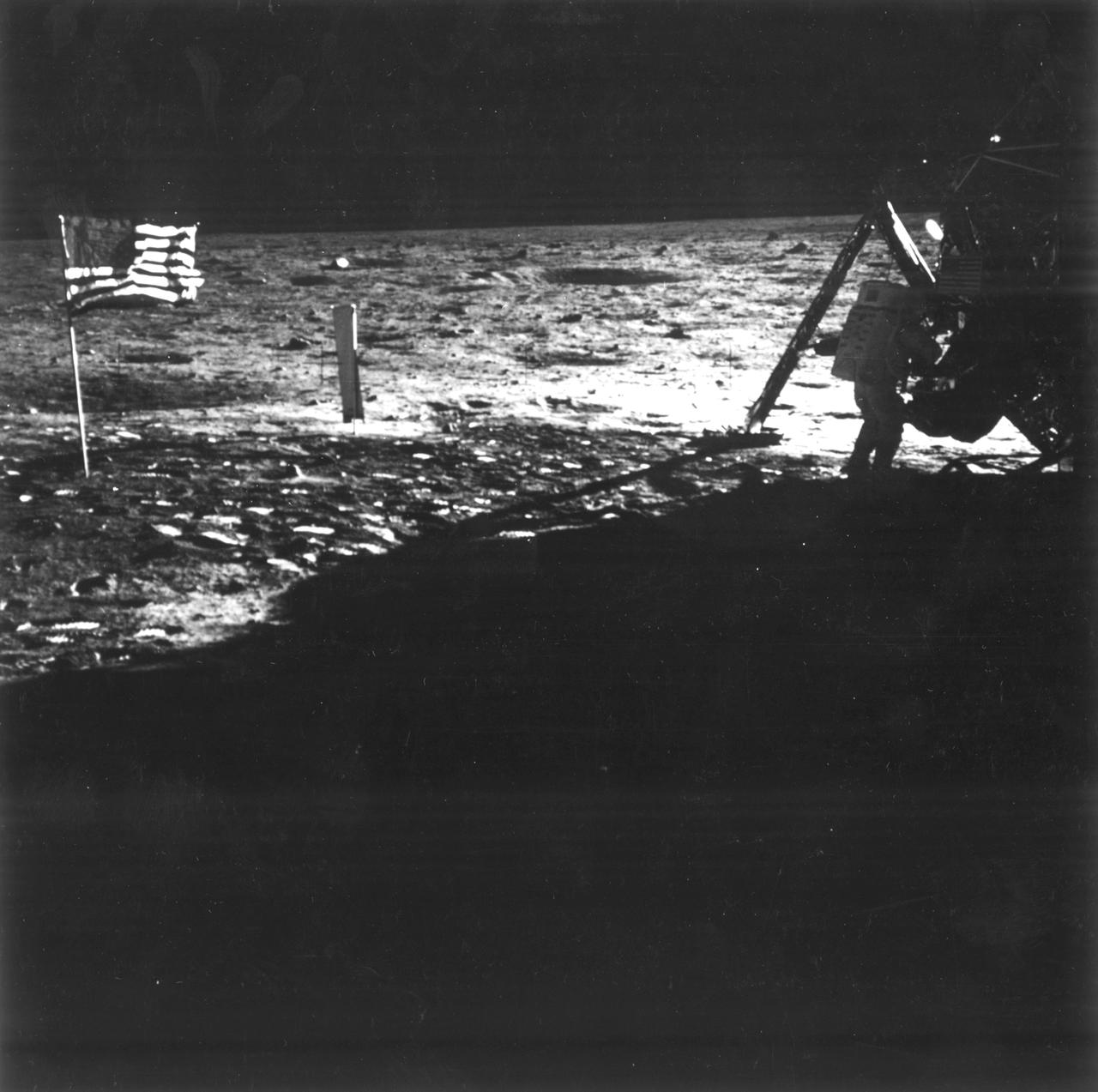
MSFC · 1969-07-20 · 6901252
n/a
The first manned lunar landing mission, Apollo 11, launched from the Kennedy Space Flight Center (KSC) in Florida via the Marshall Space Flight Center (MSFC) developed Saturn V…
Inspect NASA record
The first manned lunar landing mission, Apollo 11, launched from the Kennedy Space Flight Center (KSC) in Florida via the Marshall Space Flight Center (MSFC) developed Saturn V launch vehicle on July 16, 1969 and safely returned to Earth on July 24, 1969. Astronauts onboard included Neil A. Armstrong, commander; Michael Collins, Command Module (CM) pilot; and Edwin E. Aldrin, Jr., Lunar Module (LM) pilot. The CM, “Columbia”, piloted by Collins, remained in a parking orbit around the Moon while the LM, “Eagle'', carrying astronauts Armstrong and Aldrin, landed on the Moon in the Sea of Tranquility. On July 20, 1969, Armstrong was the first human to ever stand on the lunar surface, followed by Aldrin. During 2½ hours of surface exploration, the crew set up experiments, collected 47 pounds of lunar surface material for analysis back on Earth, planted the U.S Flag, and left a message for all mankind. In this photograph, Armstrong is removing scientific equipment from a storage bay of the LM. The brilliant sunlight emphasizes the U. S. Flag to the left. The object near the flag is the Solar Wind Composition Experiment deployed by Aldrin earlier.
- Record ID
- 6901252
- NASA center
- MSFC
- Date
- 1969-07-20
- Keywords
- Apollo 11, Moon, Aldrin, Lunar Surface, Lunar Module, LM, Storage Bay

JSC · 2026-06-01 · jsc2026e391022
Artemis Lunar Spacesuit Testing
Exploration geologists and Artemis science officers Trevor Graff, left, and Angela Garcia carry out a lunar training development run at NASA’s Neutral Buoyancy Laboratory (NBL) in Houston. The…
Inspect NASA record
Exploration geologists and Artemis science officers Trevor Graff, left, and Angela Garcia carry out a lunar training development run at NASA’s Neutral Buoyancy Laboratory (NBL) in Houston. The NBL is a 40-foot deep pool at NASA’s Johnson Space Center where astronauts train for spacewalks in a neutrally buoyant environment. During the session, Garcia and Graff conducted tests of Artemis geology tools and deployed a mock lunar payload under low-angle lighting conditions similar to what astronauts will encounter at the Moon’s south pole. A section of the NBL, which contains full-scale mockups of the International Space Station modules, has been transformed into a lunar training area with soil and rocks that mimic the Moon’s landscape. This testing run marked the first time in the Artemis program that two geologists were suited up simultaneously for lunar geology training in the NBL. The team is using insights from these tests to build the training program for astronauts assigned to future landed missions on the Moon. Credit: NASA
- Record ID
- jsc2026e391022
- NASA center
- JSC
- Date
- 2026-06-01
- Credit
- NASA
- Keywords
- Artemis, Lunar Spacesuit, Spacesuit Testing, Johnson Space Center, Moon, NBL, Neutral Buoyancy Laboratory
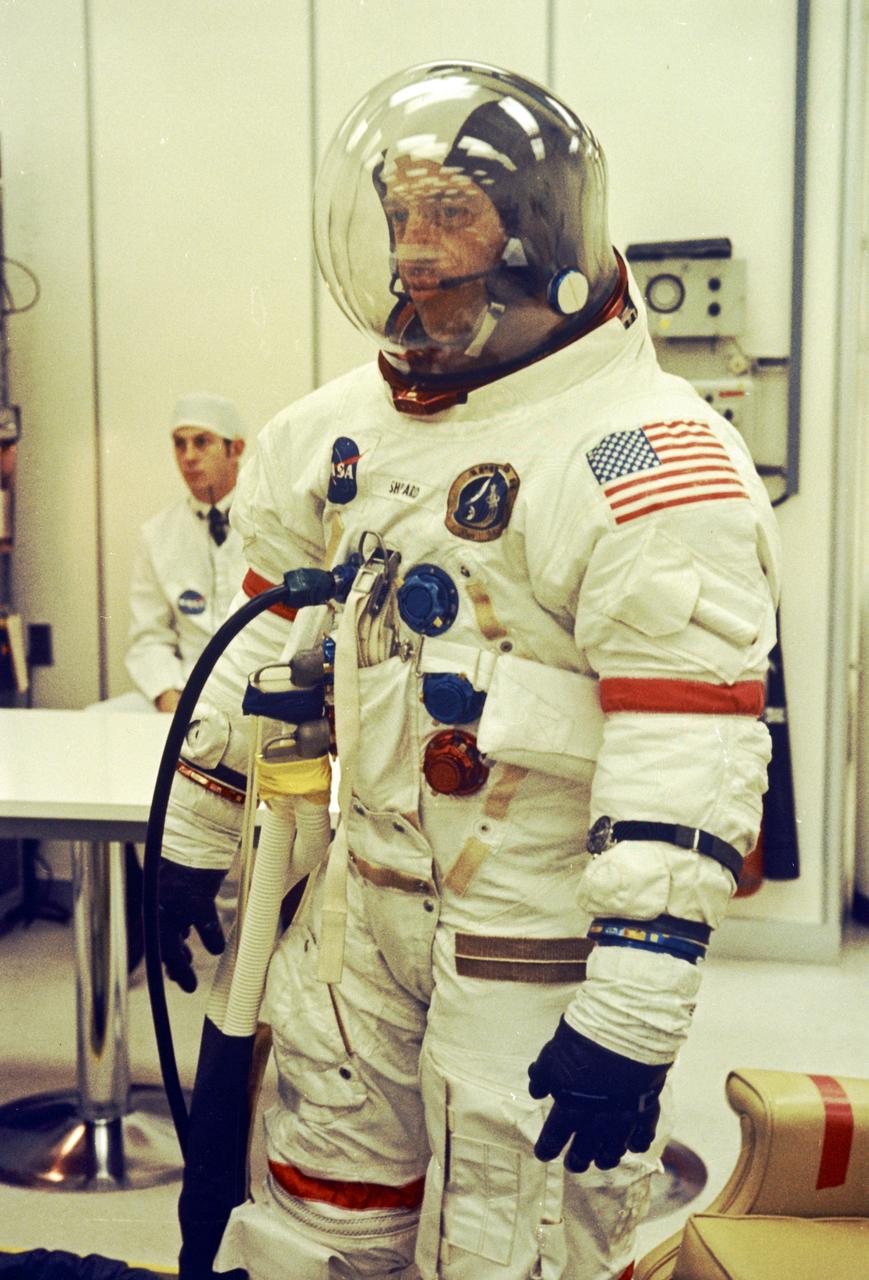
MSFC · 1971-01-18 · 9309374
Saturn Apollo Program
Alan B. Shepard, Jr., Apollo 14 mission commander, watches a technician conduct space suit checks during a demonstration test prior to countdown. The Apollo 14, carrying a crew…
Inspect NASA record
Alan B. Shepard, Jr., Apollo 14 mission commander, watches a technician conduct space suit checks during a demonstration test prior to countdown. The Apollo 14, carrying a crew of three astronauts: Shepard; Command Module pilot Stuart A. Roosa, and Lunar Module pilot Edgar D. Mitchell, lifted off from launch complex 39A at KSC on January 31, 1971. It was the third manned lunar landing, the first manned landing in exploration of the lunar highlands, and it demonstrated pinpoint landing capability. The major goal of Apollo 14 was the scientific exploration of the Moon in the foothills of the rugged Fra Mauro region. The extravehicular activities (EVA) of astronauts Shepard and Mitchell included setting up an automated scientific laboratory called Apollo Lunar Scientific Experiments Package (ALSEP), and collecting a total of about 95 pounds (43 kilograms) of Moon rock and soil for a geological investigation back on the Earth. Apollo 14 safely returned to Earth on February 9, 1971.
- Record ID
- 9309374
- NASA center
- MSFC
- Date
- 1971-01-18
- Keywords
- Apollo 14, Shepard, Space Suit, Check
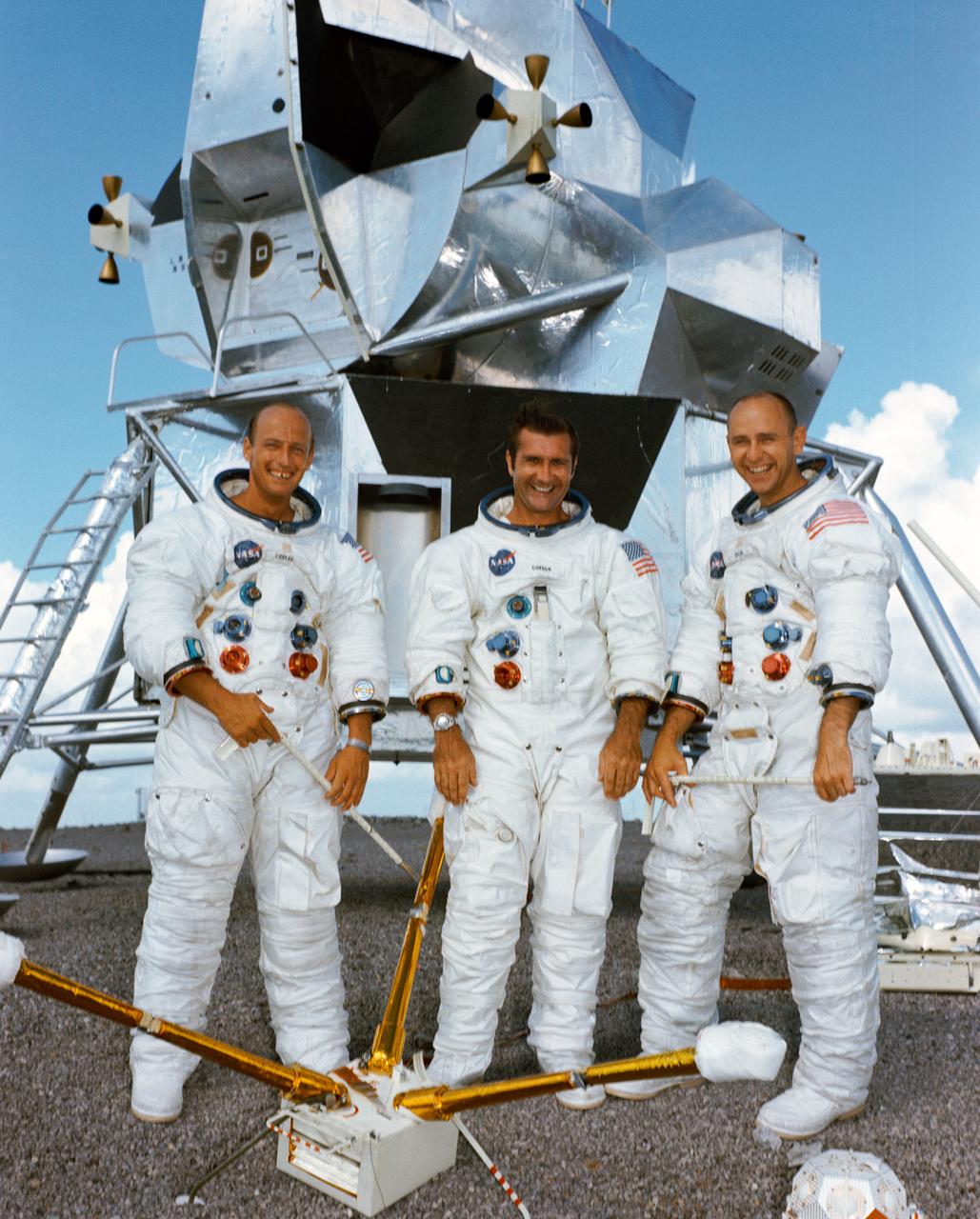
JSC · 1969-09-01 · S69-38992
Portraits - Apollo 12 - MSC
S69-38992 (September 1969) --- These three astronauts have been named by the National Aeronautics and Space Administration (NASA) as the prime crew of the Apollo 12 lunar landing…
Inspect NASA record
S69-38992 (September 1969) --- These three astronauts have been named by the National Aeronautics and Space Administration (NASA) as the prime crew of the Apollo 12 lunar landing mission. Left to right, are Charles Conrad Jr., Richard F. Gordon Jr., and Alan L. Bean.
- Record ID
- S69-38992
- NASA center
- JSC
- Date
- 1969-09-01
- Credit
- 1996-98 AccuSoft Inc., All right
- Keywords
- Astronauts, Portrait, Apollo, Apollo 12