
Update Site (from NASA)
Explore NASA’s Image and Video Library.
Suggest one object per day for the Interstellar Minds collection. We review each suggestion before adding it.
Sign in to suggest a Marvel.
Find a NASA image ID. Open a NASA record and copy its ID from the end of the details URL.
NASA image records
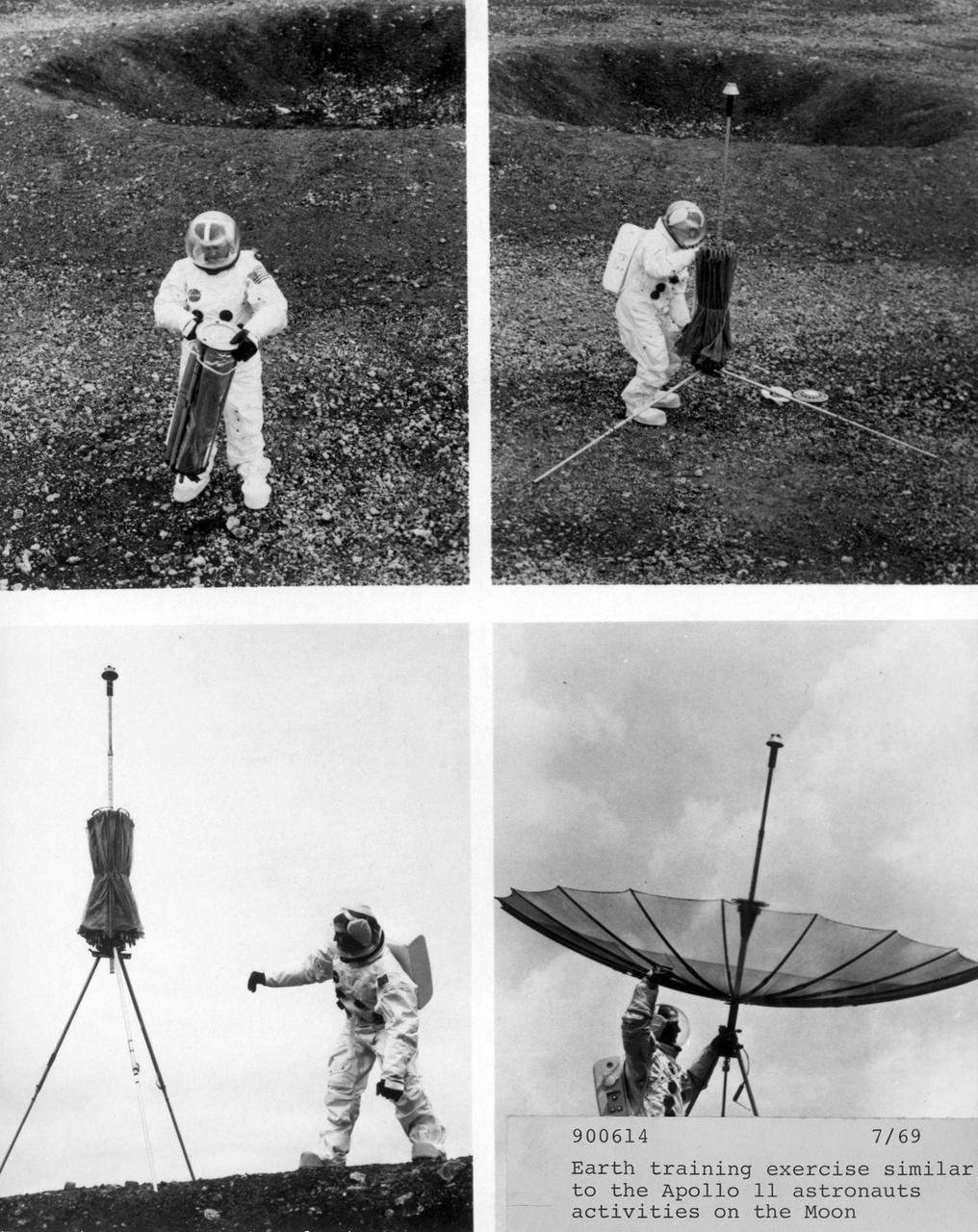
MSFC · 1969-07-09 · 6900614
Saturn Apollo Program
In preparation of the nation’s first lunar landing mission, Apollo 11 crew members underwent training to practice activities they would be performing during the mission. In this photograph,…
Inspect NASA record
In preparation of the nation’s first lunar landing mission, Apollo 11 crew members underwent training to practice activities they would be performing during the mission. In this photograph, taken at the Manned Spacecraft Center in Houston, Texas, an engineer, Bob Mason, donned in a space suit, goes through some of those training exercises on the mock lunar surface. He performed activites similar to those planned for astronauts Neil Armstrong and Edwin Aldrin during their moon walk. The Apollo 11 mission launched from the Kennedy Space Center (KSC) in Florida via the Marshall Space Flight Center (MSFC) developed Saturn V launch vehicle on July 16, 1969 and safely returned to Earth on July 24, 1969. Aboard the space craft were astronauts Neil A. Armstrong, commander; Michael Collins, Command Module (CM) pilot; and Edwin E. (Buzz) Aldrin Jr., Lunar Module (LM) pilot. The CM, “Columbia”, piloted by Collins, remained in a parking orbit around the Moon while the LM, “Eagle’’, carrying astronauts Armstrong and Aldrin, landed on the Moon. On July 20, 1969, Armstrong was the first human to ever stand on the lunar surface, followed by Aldrin. During 2½ hours of surface exploration, the crew collected 47 pounds of lunar surface material for analysis back on Earth. With the success of Apollo 11, the national objective to land men on the Moon and return them safely to Earth had been accomplished.
- Record ID
- 6900614
- NASA center
- MSFC
- Date
- 1969-07-09
- Keywords
- Apollo 11, Moon, Training
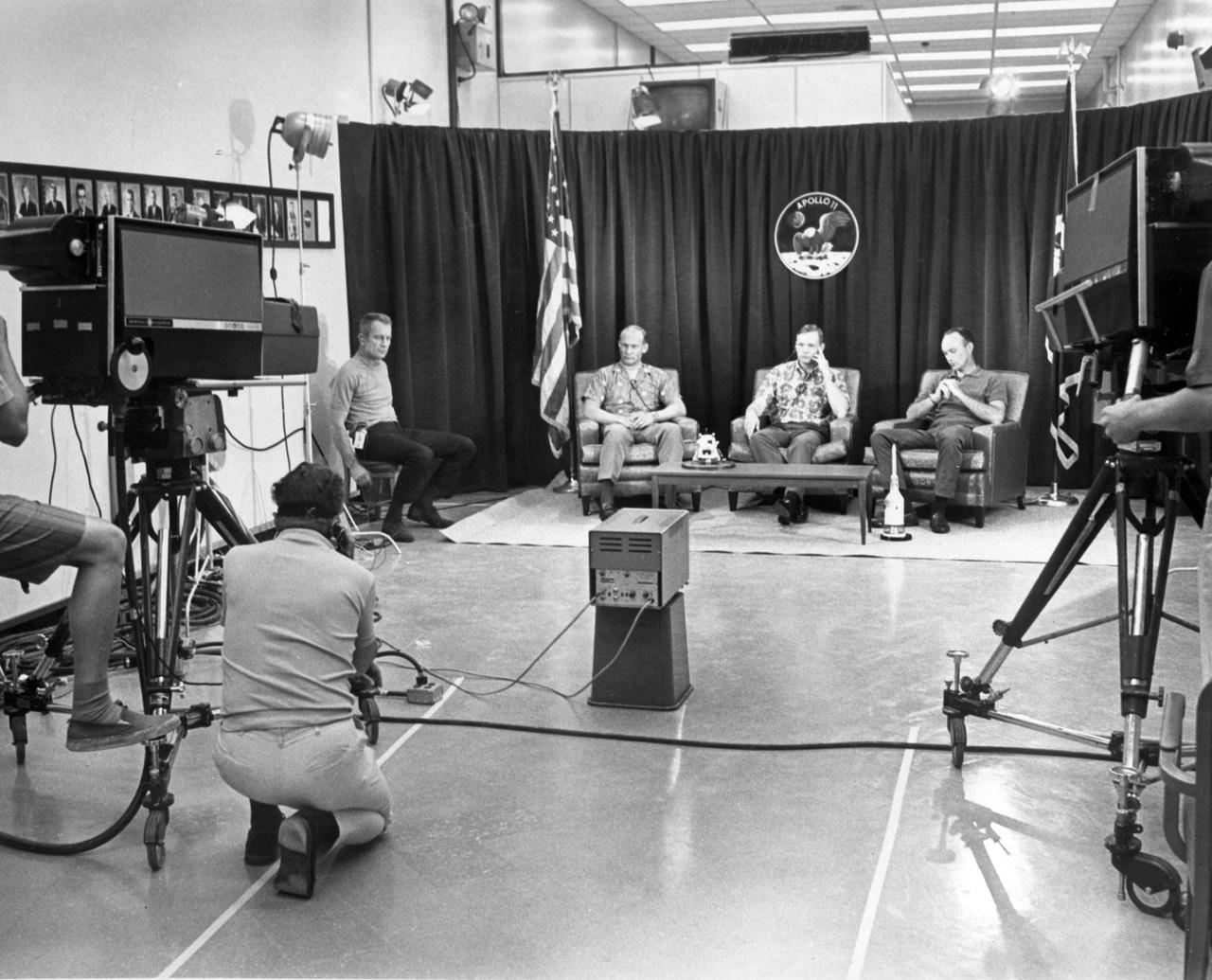
MSFC · 1969-07-15 · 6900616
Saturn Apollo Program
The night before launch day, Apollo 11 crew members (R-L) Michael Collins, Neil Armstrong, and Edwin Aldrin, participated in a closed circuit press conference the night before they…
Inspect NASA record
The night before launch day, Apollo 11 crew members (R-L) Michael Collins, Neil Armstrong, and Edwin Aldrin, participated in a closed circuit press conference the night before they began their historic lunar landing mission. At far left is chief astronaut and director of flight crew operations, Donald K. Slayton. The press conference with questions via intercom, was held under semi-isolation conditions to avoid exposing the astronauts to possible illness at the last minute. The Apollo 11 mission, the first lunar landing mission, launched from the Kennedy Space Center (KSC) in Florida via the Marshall Space Flight Center (MSFC) developed Saturn V launch vehicle on July 16, 1969 and safely returned to Earth on July 24, 1969. Aboard the space craft were astronauts Neil A. Armstrong, commander; Michael Collins, Command Module (CM) pilot; and Edwin E. (Buzz) Aldrin Jr., Lunar Module (LM) pilot. The CM, “Columbia”, piloted by Collins, remained in a parking orbit around the Moon while the LM, “Eagle’’, carrying astronauts Armstrong and Aldrin, landed on the Moon. On July 20, 1969, Armstrong was the first human to ever stand on the lunar surface, followed by Aldrin. During 2½ hours of surface exploration, the crew collected 47 pounds of lunar surface material for analysis back on Earth. With the success of Apollo 11, the national objective to land men on the Moon and return them safely to Earth had been accomplished.
- Record ID
- 6900616
- NASA center
- MSFC
- Date
- 1969-07-15
- Keywords
- Apollo 11, Moon, Collins, Armstrong, Aldrin, Slayton, Press Conference
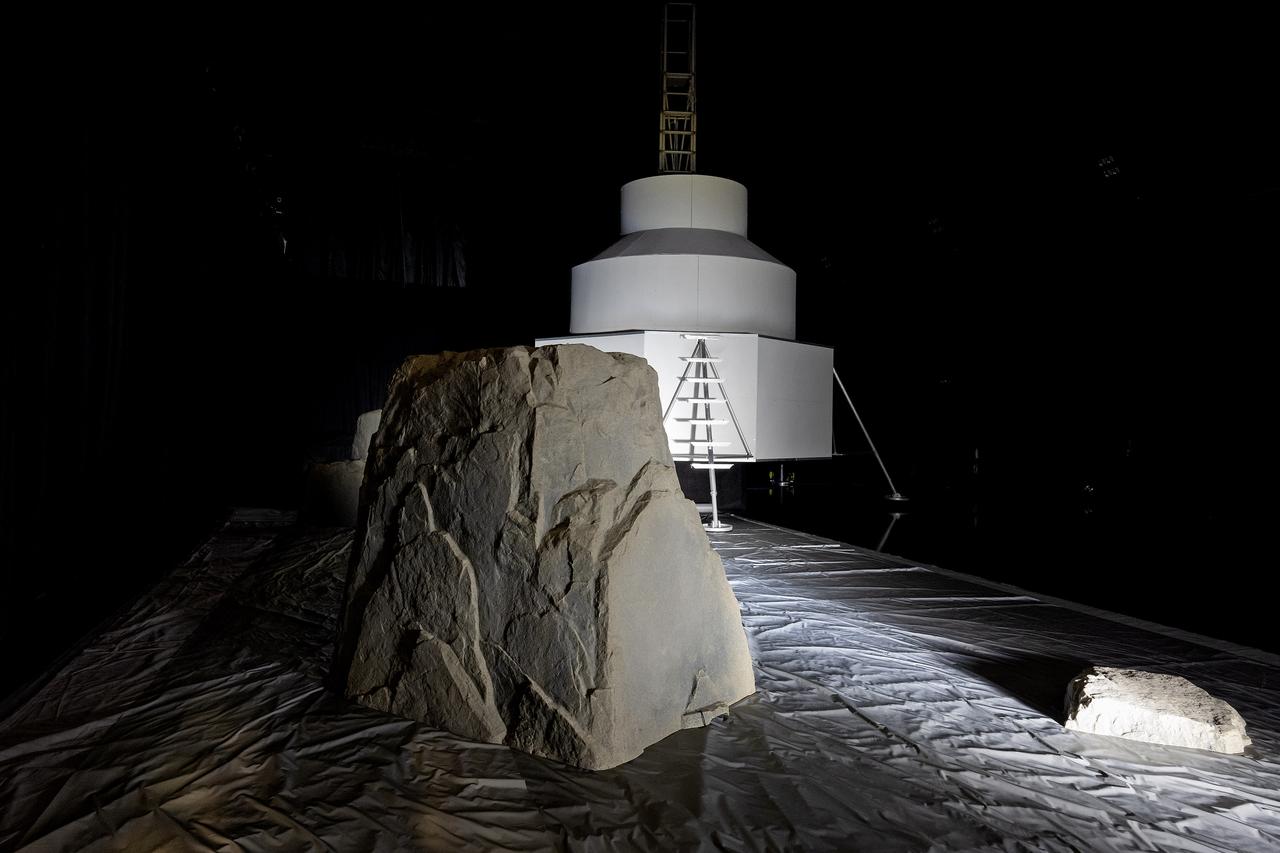
MSFC · 2025-05-09 · CEB_1381
NASA Engineers Simulate Lunar Lighting for Artemis III Moon Landing
These photos show how teams at NASA’s Marshall Space Flight Center in Huntsville, Alabama, are using the Flat Floor Facility (Building 4619) to understand the lunar lighting environment…
Inspect NASA record
These photos show how teams at NASA’s Marshall Space Flight Center in Huntsville, Alabama, are using the Flat Floor Facility (Building 4619) to understand the lunar lighting environment in preparation for the Artemis III crewed lunar landing mission, slated for 2027. The Flat Floor Facility is an air-bearing floor, providing full-scale simulation capabilities for lunar surface systems by simulating zero gravity in two dimensions. Wearing low-fidelity materials, test engineers can understand how the extreme lighting of the Moon’s South Pole could affect surface operations during Artemis III. High-intensity lights are positioned at a low angle to replicate the strong shadows that are cast across the lunar South Pole by the Sun. Data and analysis from testing at NASA Marshall are improving models Artemis astronauts will use in preparation for lander and surface operations on the Moon during Artemis III. Testing in the facility is also helping cross-agency teams evaluate various tools astronauts may use. NASA Marshall manages the Human Landing System (HLS) Program. For more information, contact NASA Marshall’s Office of Communications at 256-544-0034.
- Record ID
- CEB_1381
- NASA center
- MSFC
- Date
- 2025-05-09
- Credit
- NASA/Charles Beason
- Keywords
- NASA, MSFC, Flat Floor, shadows, HLS, Lander, Marshall Space Flight Center, Human Landing System, Flat Floor Facility, Artemis III
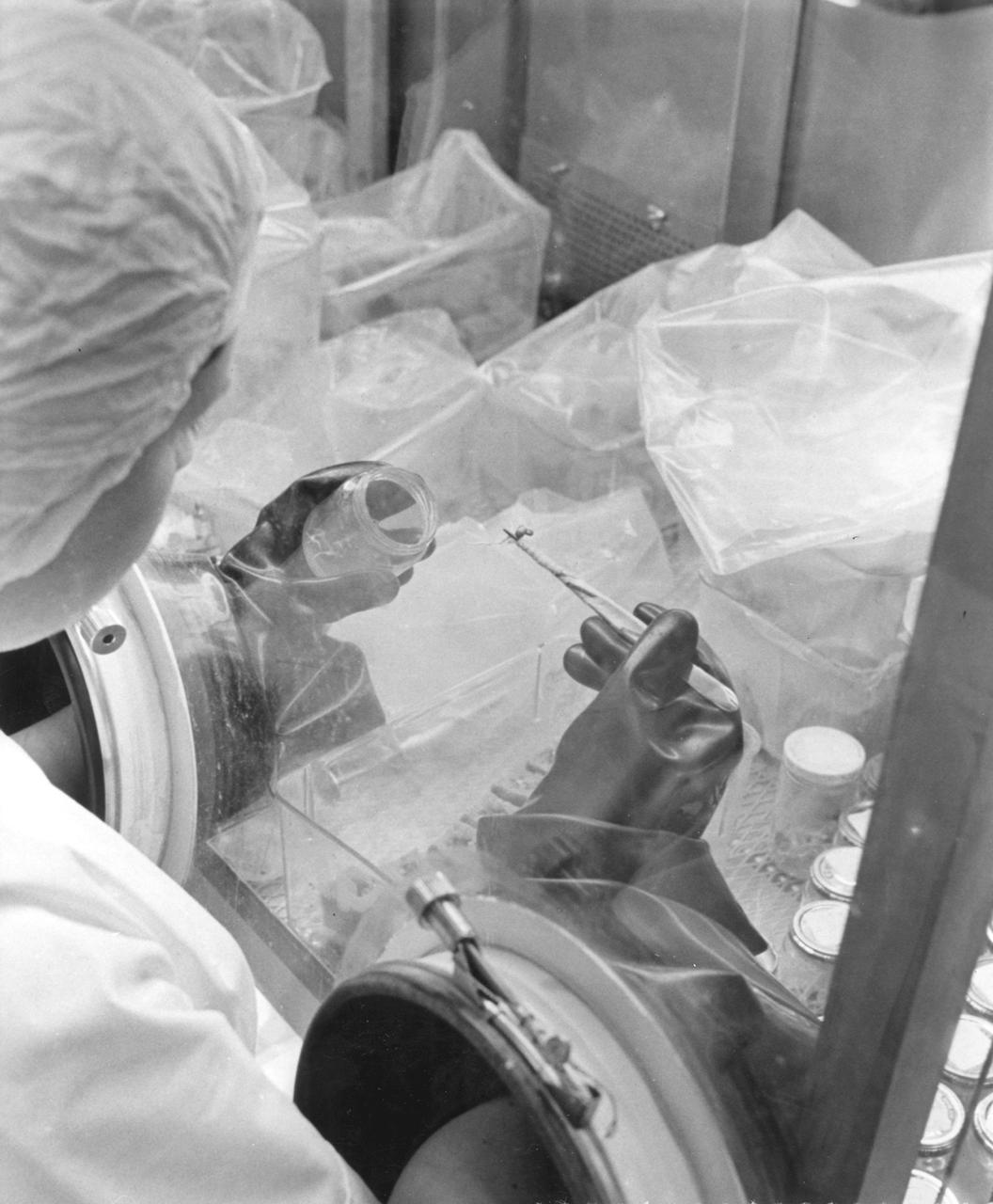
MSFC · 1969-07-09 · 6901321
Saturn Apollo Program
In this photograph, a laboratory technician handles a portion of the more than 20 different plant lines that were used within the Lunar Receiving Laboratory, Building 37 of…
Inspect NASA record
In this photograph, a laboratory technician handles a portion of the more than 20 different plant lines that were used within the Lunar Receiving Laboratory, Building 37 of the Manned Spacecraft Center (MSC) in Houston, Texas. This laboratory was part of the overall physical, chemical, and biological test program of the Apollo 11 returned lunar samples. Aboard the Marshall Space Flight Center (MSFC) developed Saturn V launch vehicle, the Apollo 11 mission launched from The Kennedy Space Center, Florida on July 16, 1969 and safely returned to Earth on July 24, 1969. The 3-man crew aboard the flight consisted of astronauts Neil A. Armstrong, commander; Edwin Aldrin, Lunar Module (LM) pilot; and Michael Collins, Command Module (CM) pilot. The CM, piloted by Michael Collins remained in a parking orbit around the Moon while the LM, named “Eagle’’, carrying astronauts Neil Armstrong and Edwin Aldrin, landed on the Moon. In 2 1/2 hours, the crew collected 47 pounds of lunar surface material which was returned to Earth for analysis.
- Record ID
- 6901321
- NASA center
- MSFC
- Date
- 1969-07-09
- Keywords
- Apollo 11, Lunar Samples, Manned Spacecraft Center, Lunar Receiving Laboratory
MSFC · 1969-07-16 · 6900563
Saturn Apollo Program
Every console was manned in firing room 1 of the Kennedy Space Flight Center (KSC) control center during the launch countdown for Apollo 11. Apollo 11, the first…
Inspect NASA record
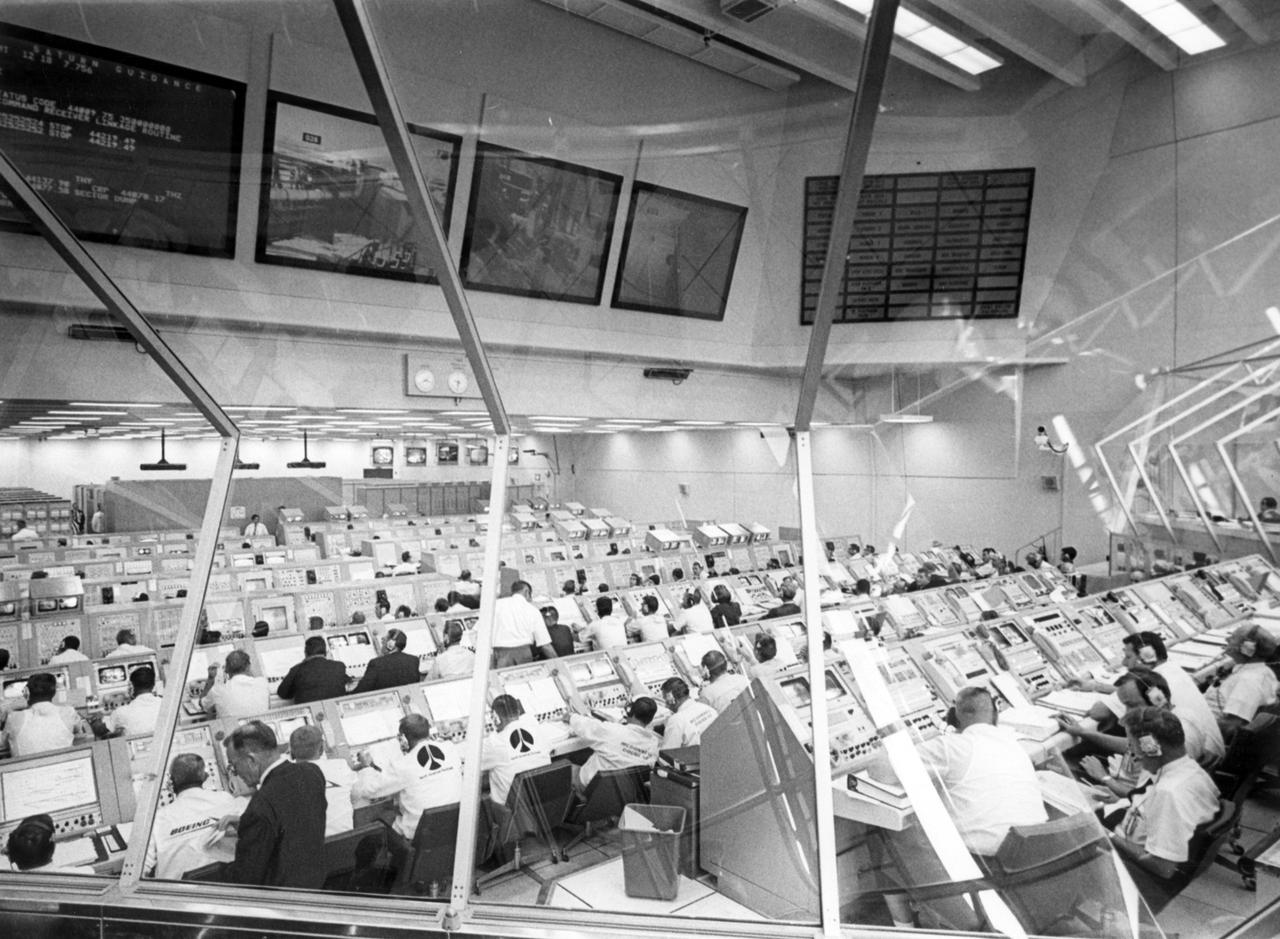
Every console was manned in firing room 1 of the Kennedy Space Flight Center (KSC) control center during the launch countdown for Apollo 11. Apollo 11, the first lunar landing mission, launched from KSC in Florida via the Marshall Space Flight Center (MSFC) developed Saturn V launch vehicle on July 16, 1969 and safely returned to Earth on July 24, 1969. Aboard the space craft were astronauts Neil A. Armstrong, commander; Michael Collins, Command Module (CM) pilot; and Edwin E. (Buzz) Aldrin Jr., Lunar Module (LM) pilot. The CM, “Columbia”, piloted by Collins, remained in a parking orbit around the Moon while the LM, “Eagle’’, carrying astronauts Armstrong and Aldrin, landed on the Moon. On July 20, 1969, Armstrong was the first human to ever stand on the lunar surface, followed by Aldrin. During 2½ hours of surface exploration, the crew collected 47 pounds of lunar surface material for analysis back on Earth. With the success of Apollo 11, the national objective to land men on the Moon and return them safely to Earth had been accomplished.
- Record ID
- 6900563
- NASA center
- MSFC
- Date
- 1969-07-16
- Keywords
- Apollo 11, Moon, Firing Room 1, Control Center, KSC, Countdown
JSC · 2026-06-01 · jsc2026e390971
Artemis Lunar Spacesuit Testing
Exploration geologist and Artemis science officer Angela Garcia carries out a lunar training development run at NASA’s Neutral Buoyancy Laboratory (NBL) in Houston. The NBL is a 40-foot…
Inspect NASA record
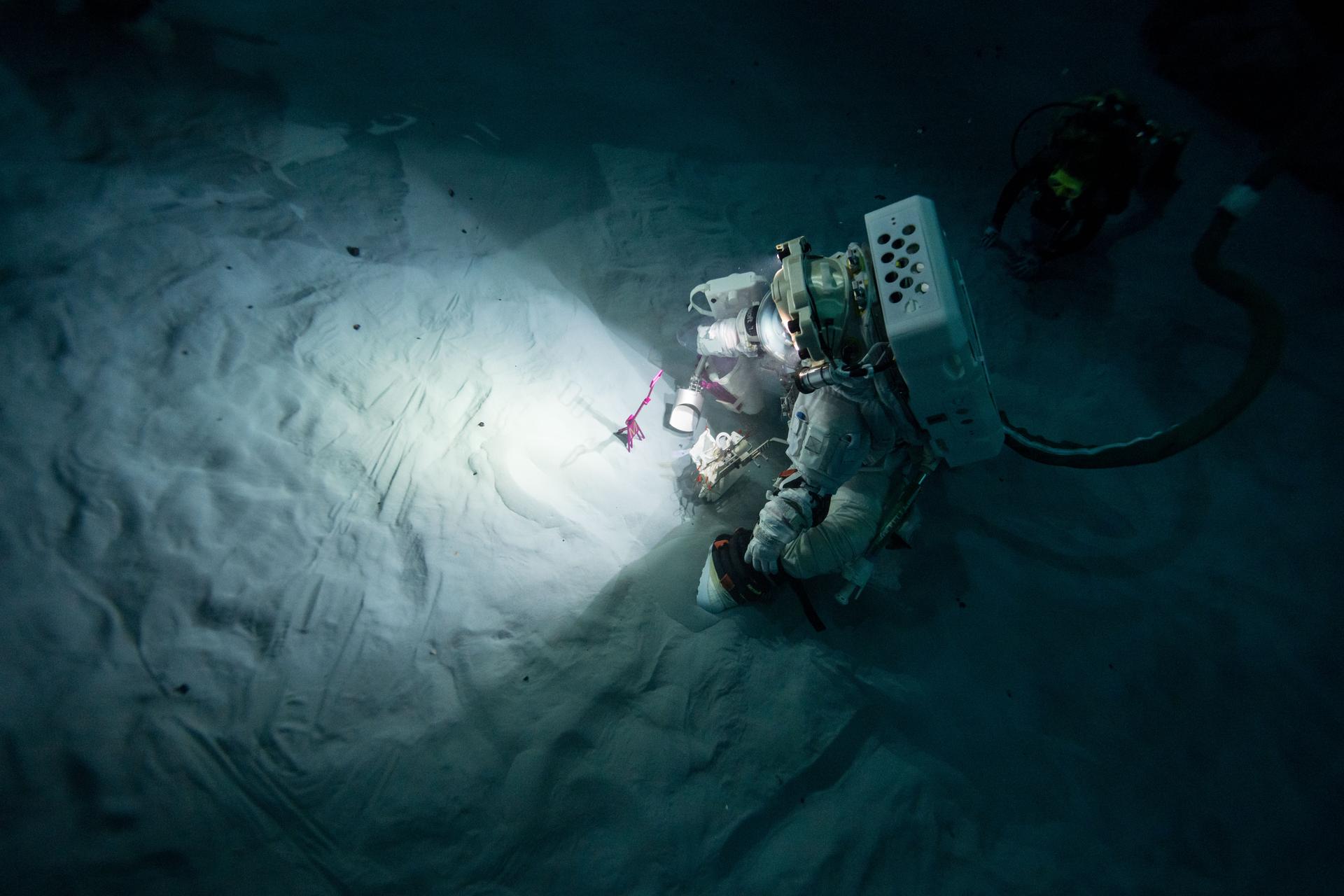
Exploration geologist and Artemis science officer Angela Garcia carries out a lunar training development run at NASA’s Neutral Buoyancy Laboratory (NBL) in Houston. The NBL is a 40-foot deep pool at NASA’s Johnson Space Center where astronauts train for spacewalks in a neutrally buoyant environment. During the session, Garcia and fellow exploration geologist and Artemis science officer Trevor Graff conducted tests of Artemis geology tools and deployed a mock lunar payload under low-angle lighting conditions similar to what astronauts will encounter at the Moon’s south pole. A section of the NBL, which contains full-scale mockups of the International Space Station modules, has been transformed into a lunar training area with soil and rocks that mimic the Moon’s landscape. This testing run marked the first time in the Artemis program that two geologists were suited up simultaneously for lunar geology training in the NBL. The team is using insights from these tests to build the training program for astronauts assigned to future landed missions on the Moon. Credit: NASA
- Record ID
- jsc2026e390971
- NASA center
- JSC
- Date
- 2026-06-01
- Credit
- NASA
- Keywords
- Artemis, Lunar Spacesuit, Spacesuit Testing, Johnson Space Center, Moon, NBL, Neutral Buoyancy Laboratory

JSC · 2026-06-01 · jsc2026e391046
Artemis Lunar Spacesuit Testing
Exploration geologists and Artemis science officers Trevor Graff, left, and Angela Garcia carry out a lunar training development run at NASA’s Neutral Buoyancy Laboratory (NBL) in Houston. The…
Inspect NASA record
Exploration geologists and Artemis science officers Trevor Graff, left, and Angela Garcia carry out a lunar training development run at NASA’s Neutral Buoyancy Laboratory (NBL) in Houston. The NBL is a 40-foot deep pool at NASA’s Johnson Space Center where astronauts train for spacewalks in a neutrally buoyant environment. During the session, Garcia and Graff conducted tests of Artemis geology tools and deployed a mock lunar payload under low-angle lighting conditions similar to what astronauts will encounter at the Moon’s south pole. A section of the NBL, which contains full-scale mockups of the International Space Station modules, has been transformed into a lunar training area with soil and rocks that mimic the Moon’s landscape. This testing run marked the first time in the Artemis program that two geologists were suited up simultaneously for lunar geology training in the NBL. The team is using insights from these tests to build the training program for astronauts assigned to future landed missions on the Moon. Credit: NASA
- Record ID
- jsc2026e391046
- NASA center
- JSC
- Date
- 2026-06-01
- Credit
- NASA
- Keywords
- Artemis, Lunar Spacesuit, Spacesuit Testing, Johnson Space Center, Moon, NBL, Neutral Buoyancy Laboratory
JSC · 1972-12-13 · S72-55170
INFLIGHT - APOLLO 17 (FENDER)
S72-55170 (11 Dec. 1972) --- These five men in the Mission Control Center ponder the solution to the problem of the damage to the right rear fender of…
Inspect NASA record
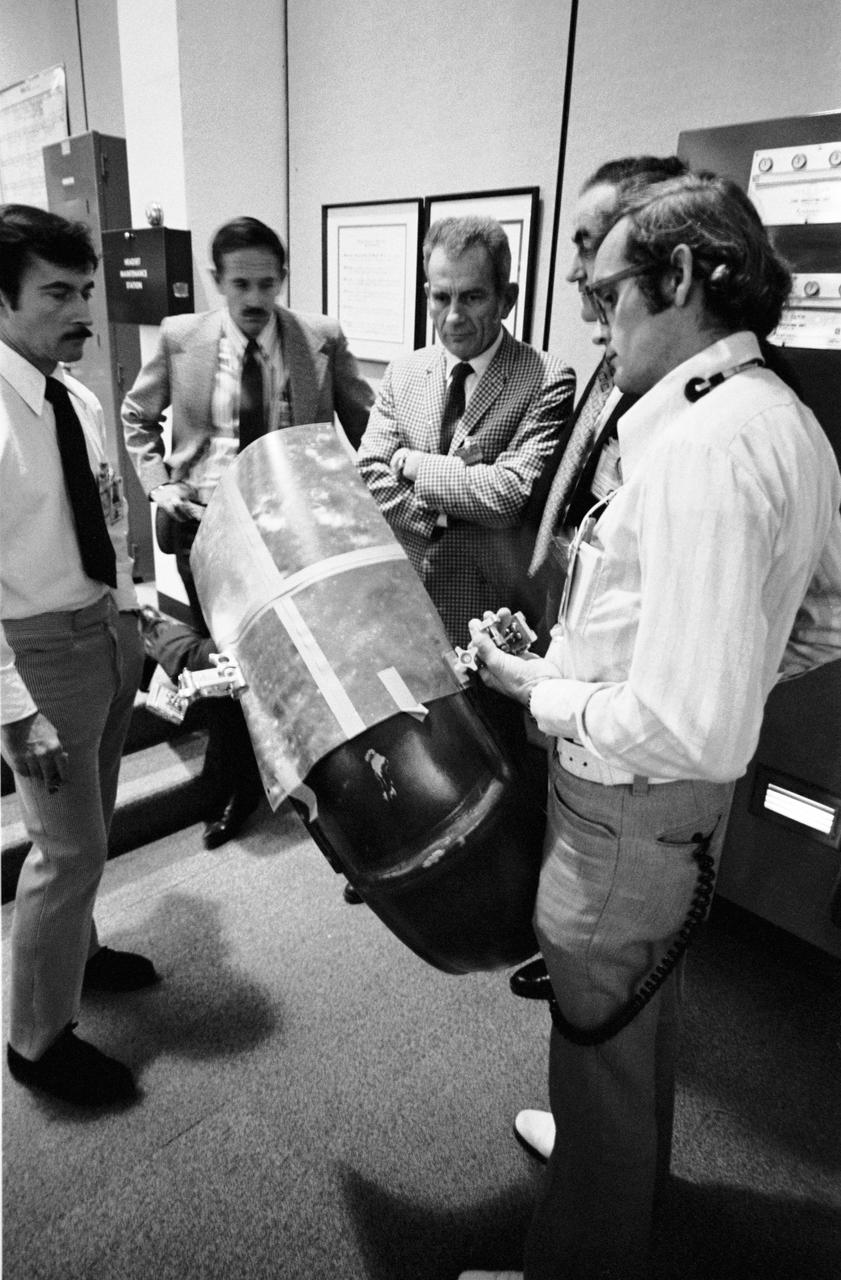
S72-55170 (11 Dec. 1972) --- These five men in the Mission Control Center ponder the solution to the problem of the damage to the right rear fender of the Apollo 17 Lunar Roving Vehicle at the Taurus-Littrow landing site. During the first lunar surface extravehicular activity a hammer got underneath the fender and a part of it was knocked off. Astronauts Eugene A. Cernan and Harrison H. Schmitt were reporting a problem with lunar dust because of the damaged fender. They sought some way to repair the broken fender. Clockwise are astronauts John W. Young and Charles M. Duke Jr., two Apollo 17 CAPCOM; Donald K. Slayton, director of flight crew operations at MSC; Dr. Roco A. Petrone, Apollo program director, Office of Manned Space Flight, NASA HQ; and Ronald V. Blevins, an EVA-1 flight controller with General Electric. They are looking over a makeshift repair arrangement which uses lunar maps and clamps from the optical alignment telescope lamp, a repair suggestion made by astronaut Young. The suggestion was relayed to Cernan and Schmitt and the repair made at the beginning of EVA-2. The problem was solved satisfactorily.
- Record ID
- S72-55170
- NASA center
- JSC
- Date
- 1972-12-13
MSFC · 2025-05-09 · CEB_1408
NASA Engineers Simulate Lunar Lighting for Artemis III Moon Landing
These photos show how teams at NASA’s Marshall Space Flight Center in Huntsville, Alabama, are using the Flat Floor Facility (Building 4619) to understand the lunar lighting environment…
Inspect NASA record
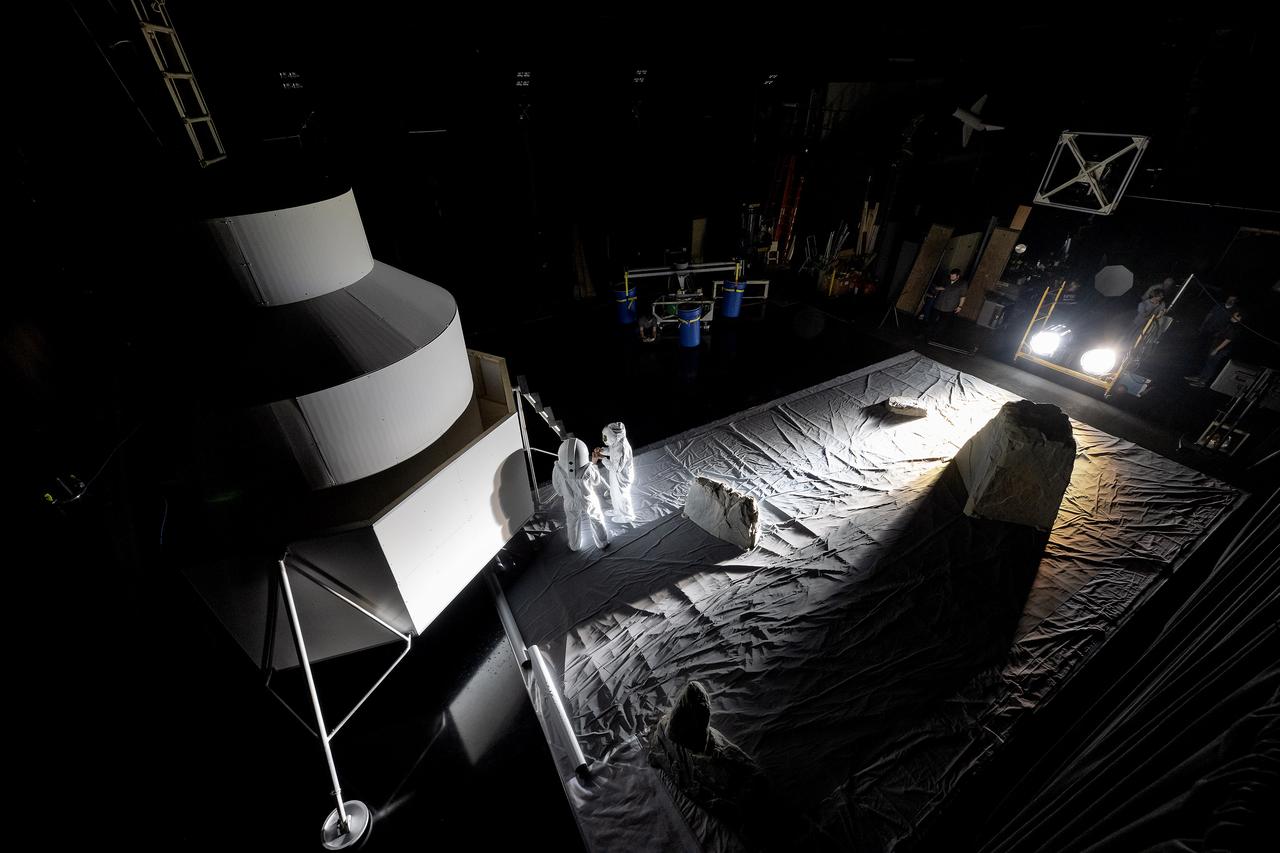
These photos show how teams at NASA’s Marshall Space Flight Center in Huntsville, Alabama, are using the Flat Floor Facility (Building 4619) to understand the lunar lighting environment in preparation for the Artemis III crewed lunar landing mission, slated for 2027. The Flat Floor Facility is an air-bearing floor, providing full-scale simulation capabilities for lunar surface systems by simulating zero gravity in two dimensions. Wearing low-fidelity materials, test engineers can understand how the extreme lighting of the Moon’s South Pole could affect surface operations during Artemis III. High-intensity lights are positioned at a low angle to replicate the strong shadows that are cast across the lunar South Pole by the Sun. Data and analysis from testing at NASA Marshall are improving models Artemis astronauts will use in preparation for lander and surface operations on the Moon during Artemis III. Testing in the facility is also helping cross-agency teams evaluate various tools astronauts may use. NASA Marshall manages the Human Landing System (HLS) Program. For more information, contact NASA Marshall’s Office of Communications at 256-544-0034.
- Record ID
- CEB_1408
- NASA center
- MSFC
- Date
- 2025-05-09
- Credit
- NASA/Charles Beason
- Keywords
- NASA, MSFC, Flat Floor, shadows, HLS, Lander, Marshall Space Flight Center, Flat Floor Facility, Human Landing System, Artemis III
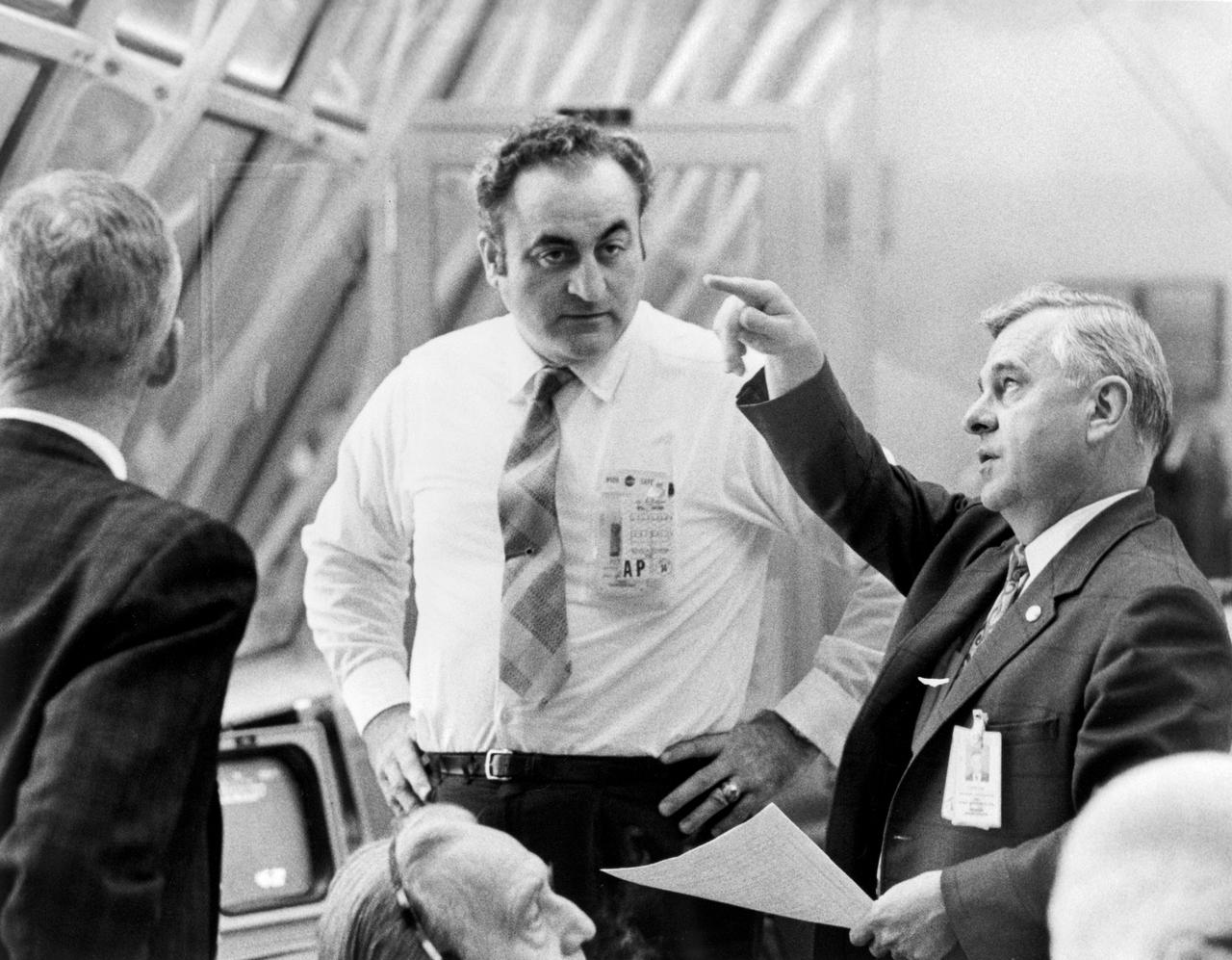
MSFC · 1971-01-31 · 9309295
Saturn Apollo Program
In the launch control center at Kennedy Space Flight Center (KSC), Walter J. Kapryan, Director of Launch Operations (center), discusses an aspect of the Apollo 14 flight with…
Inspect NASA record
In the launch control center at Kennedy Space Flight Center (KSC), Walter J. Kapryan, Director of Launch Operations (center), discusses an aspect of the Apollo 14 flight with Marshall Space Flight Center’s (MSFC) Dr. Rocco A. Petrone, Apollo Program Director (right). The Apollo 14, carrying a crew of three astronauts: Mission commander Alan B. Shepard Jr., Command Module pilot Stuart A. Roosa, and Lunar Module pilot Edgar D. Mitchell, lifted off from launch complex 39A at KSC on January 31, 1971. It was the third manned lunar landing, the first manned landing in exploration of the lunar highlands, and it demonstrated pinpoint landing capability. The major goal of Apollo 14 was the scientific exploration of the Moon in the foothills of the rugged Fra Mauro region. The extravehicular activity (EVA) of astronauts Shepard and Mitchell included setting up an automated scientific laboratory called Apollo Lunar Scientific Experiments Package (ALSEP), and collecting a total of about 95 pounds (43 kilograms) of Moon rock and soil for a geological investigation back on the Earth. Apollo 14 safely returned to Earth on February 9, 1971.
- Record ID
- 9309295
- NASA center
- MSFC
- Date
- 1971-01-31
- Keywords
- Apollo 14, Kapryan, Petrone
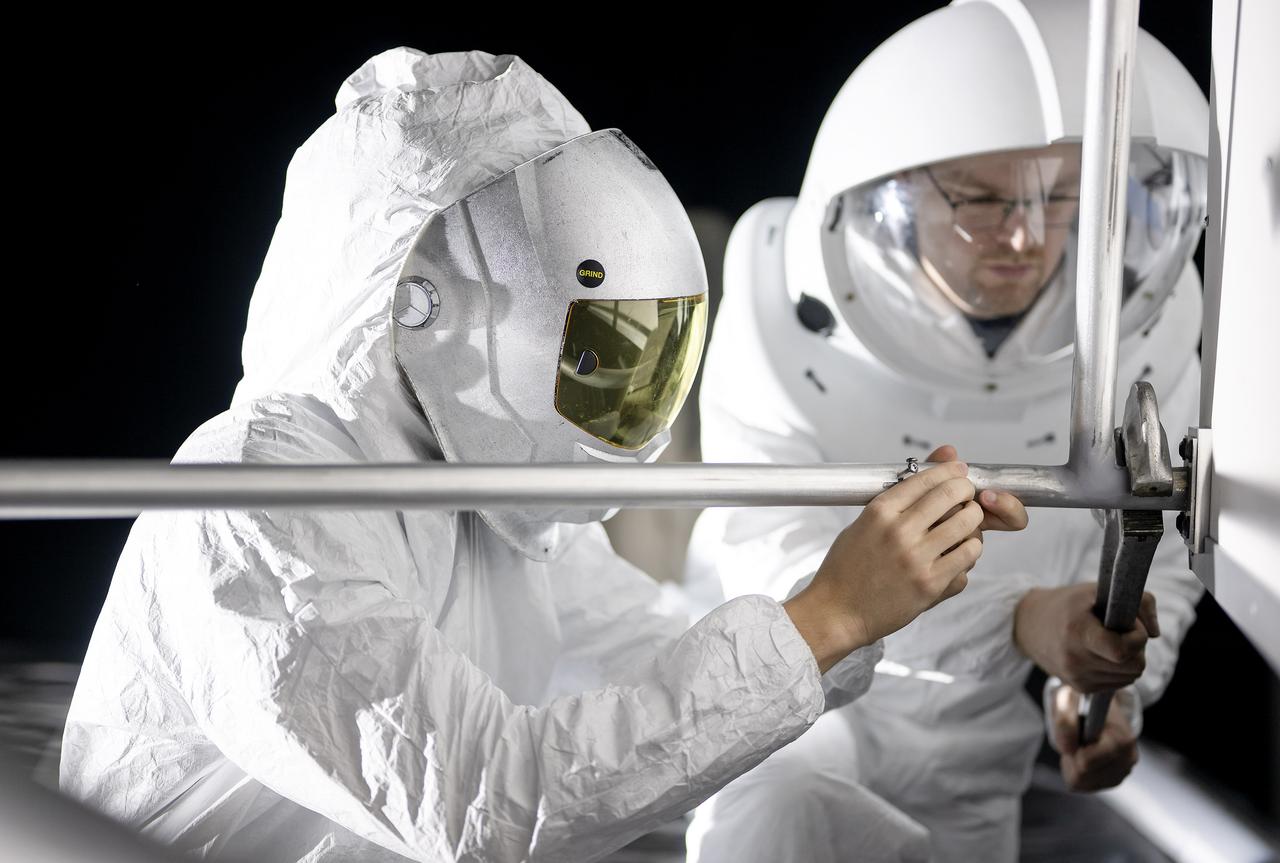
MSFC · 2025-05-09 · CEB_1454
NASA Engineers Simulate Lunar Lighting for Artemis III Moon Landing
These photos show how teams at NASA’s Marshall Space Flight Center in Huntsville, Alabama, are using the Flat Floor Facility (Building 4619) to understand the lunar lighting environment…
Inspect NASA record
These photos show how teams at NASA’s Marshall Space Flight Center in Huntsville, Alabama, are using the Flat Floor Facility (Building 4619) to understand the lunar lighting environment in preparation for the Artemis III crewed lunar landing mission, slated for 2027. The Flat Floor Facility is an air-bearing floor, providing full-scale simulation capabilities for lunar surface systems by simulating zero gravity in two dimensions. Wearing low-fidelity materials, test engineers can understand how the extreme lighting of the Moon’s South Pole could affect surface operations during Artemis III. High-intensity lights are positioned at a low angle to replicate the strong shadows that are cast across the lunar South Pole by the Sun. Data and analysis from testing at NASA Marshall are improving models Artemis astronauts will use in preparation for lander and surface operations on the Moon during Artemis III. Testing in the facility is also helping cross-agency teams evaluate various tools astronauts may use. NASA Marshall manages the Human Landing System (HLS) Program. For more information, contact NASA Marshall’s Office of Communications at 256-544-0034.
- Record ID
- CEB_1454
- NASA center
- MSFC
- Date
- 2025-05-09
- Credit
- NASA/Charles Beason
- Keywords
- NASA, MSFC, Flat Floor, shadows, HLS, Lander, Marshall Space Flight Center, Flat Floor Facility, Human Landing System, Artemis III

MSFC · 1969-07-16 · 6900591
Saturn Apollo Program
This is a view of a roadway near the NASA Kennedy Space Center (KSC), shortly before dawn, where spectators from all over the world jammed into KSC to…
Inspect NASA record
This is a view of a roadway near the NASA Kennedy Space Center (KSC), shortly before dawn, where spectators from all over the world jammed into KSC to watch the liftoff of Apollo 11, the first manned lunar landing mission. Apollo 11 launched from KSC via the Marshall Space Flight Center (MSFC) developed Saturn V launch vehicle on July 16, 1969 and safely returned to Earth on July 24, 1969. Aboard the space craft were astronauts Neil A. Armstrong, commander; Michael Collins, Command Module (CM) pilot; and Edwin E. (Buzz) Aldrin Jr., Lunar Module (LM) pilot. The CM, “Columbia”, piloted by Collins, remained in a parking orbit around the Moon while the LM, “Eagle’’, carrying astronauts Armstrong and Aldrin, landed on the Moon. On July 20, 1969, Armstrong was the first human to ever stand on the lunar surface, followed by Aldrin. During 2½ hours of surface exploration, the crew collected 47 pounds of lunar surface material for analysis back on Earth. With the success of Apollo 11, the national objective to land men on the Moon and return them safely to Earth had been accomplished.
- Record ID
- 6900591
- NASA center
- MSFC
- Date
- 1969-07-16
- Keywords
- Apollo 11, Moon, Launch, Spectators