
Update Site (from NASA)
Explore NASA’s Image and Video Library.
Suggest one object per day for the Interstellar Minds collection. We review each suggestion before adding it.
Sign in to suggest a Marvel.
Find a NASA image ID. Open a NASA record and copy its ID from the end of the details URL.
NASA image records
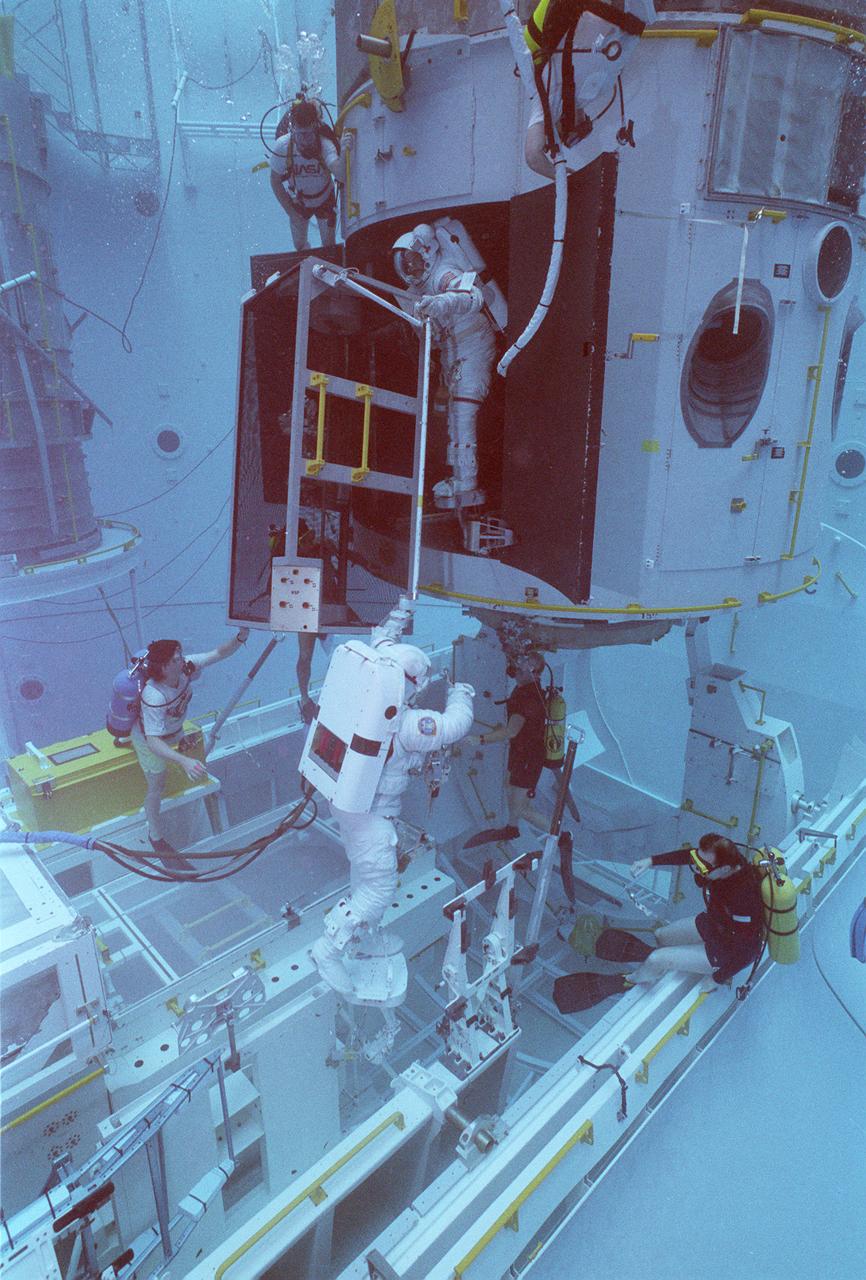
MSFC · 1993-07-09 · 9307457
History of Hubble Space Telescope (HST)
This photograph shows an STS-61 astronaut training for the Hubble Space Telescope (HST) servicing mission (STS-61) in the Marshall Space Flight Center's (MSFC's) Neutral Buoyancy Simulator (NBS). Two…
Inspect NASA record
This photograph shows an STS-61 astronaut training for the Hubble Space Telescope (HST) servicing mission (STS-61) in the Marshall Space Flight Center's (MSFC's) Neutral Buoyancy Simulator (NBS). Two months after its deployment in space, scientists detected a 2-micron spherical aberration in the primary mirror of the HST that affected the telescope's ability to focus faint light sources into a precise point. This imperfection was very slight, one-fiftieth of the width of a human hair. A scheduled Space Service servicing mission (STS-61) in 1993 permitted scientists to correct the problem. The MSFC NBS provided an excellent environment for testing hardware to examine how it would operate in space and for evaluating techniques for space construction and spacecraft servicing.
- Record ID
- 9307457
- NASA center
- MSFC
- Date
- 1993-07-09
- Keywords
- Neutral Buoyancy Simulator, NBS, Hubble Space Telescope, HST, STS-61
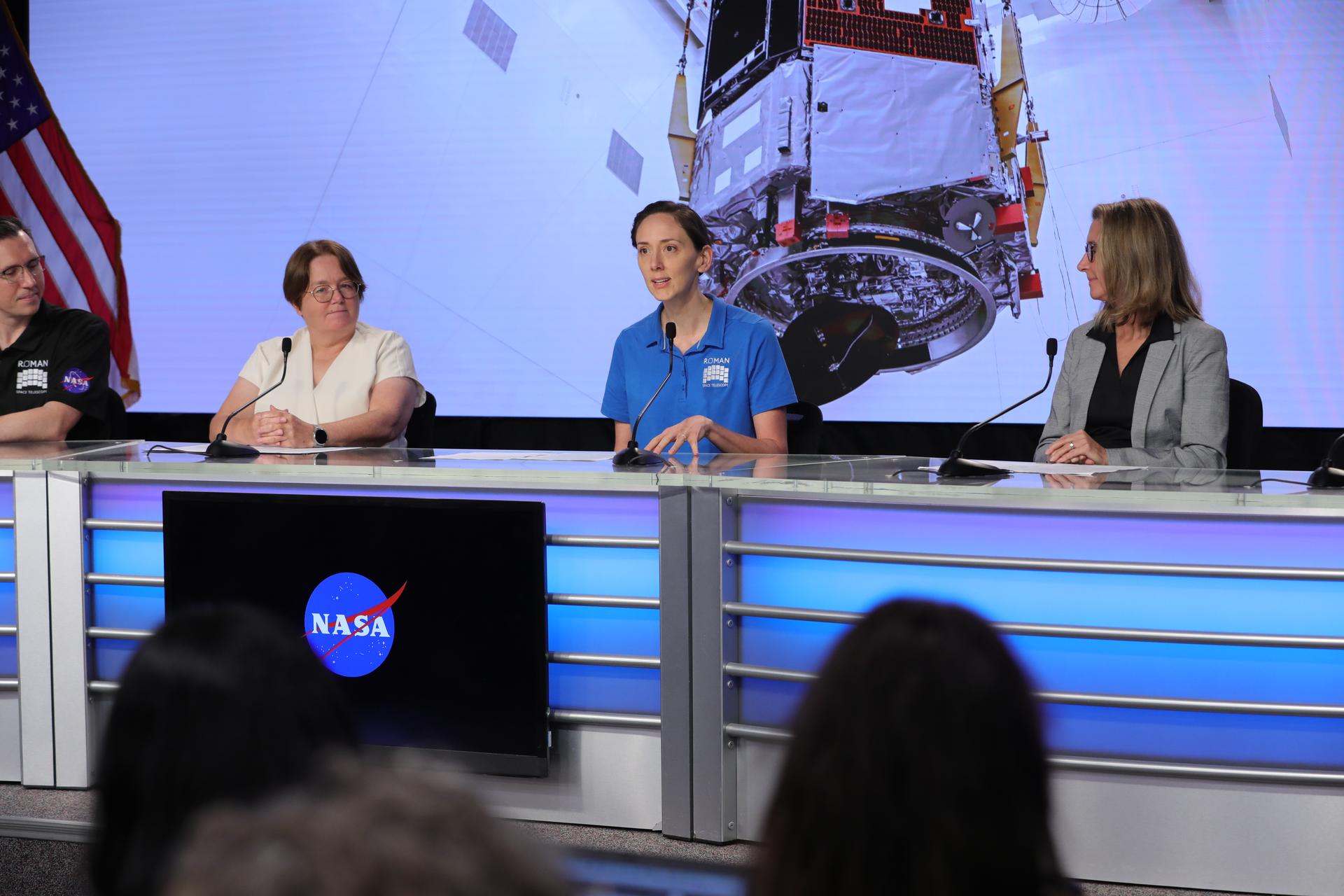
KSC · 2026-08-29 · KSC-20260829-PH-KLS01_0059
Roman Space Telescope Science Briefing
From left, Shawn Domagal-Goldman, director, Astrophysics Division, NASA Headquarters in Washington; Julie McEnery, Roman telescope senior project scientist, NASA’s Goddard Space Flight Center in Greenbelt, Maryland; Vanessa Bailey,…
Inspect NASA record
From left, Shawn Domagal-Goldman, director, Astrophysics Division, NASA Headquarters in Washington; Julie McEnery, Roman telescope senior project scientist, NASA’s Goddard Space Flight Center in Greenbelt, Maryland; Vanessa Bailey, Roman Coronagraph Instrument scientist, NASA’s Jet Propulsion Laboratory in Southern California; and Kristen McQuinn, Roman Science Operations Center lead, Space Telescope Science Institute, participate in a science briefing for NASA’s Nancy Grace Roman Space Telescope inside the NASA News Center’s John Holliman Auditorium at Kennedy Space Center in Florida, on Saturday, Aug. 29, 2026. Roman will investigate dark energy and dark matter, conduct a statistical census of planetary systems, and enable a broad range of additional astrophysics research. Liftoff from Launch Complex 39A at Kennedy is targeted for no earlier than Sunday, Aug. 30, 2026.
- Record ID
- KSC-20260829-PH-KLS01_0059
- NASA center
- KSC
- Date
- 2026-08-29
- Credit
- NASA/Kim Shiflett
- Keywords
- John. F. Kennedy Space Center, Kennedy, Kennedy Space Center, KSC, Spaceport, Cape Canaveral, NASA, rocket ranch, Florida, multi-user spaceport, premier spaceport, space coast
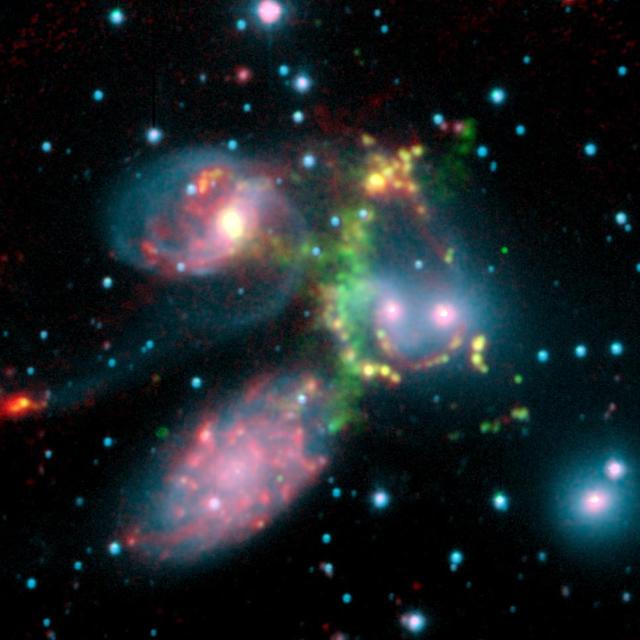
JPL · 2006-03-03 · PIA02587
A Shocking Surprise in Stephan Quintet
The false-color composite image of the Stephan’s Quintet galaxy cluster is made up of data from NASA Spitzer Space Telescope and a ground-based telescope in Spain.
Inspect NASA record
The false-color composite image of the Stephan’s Quintet galaxy cluster is made up of data from NASA Spitzer Space Telescope and a ground-based telescope in Spain.
- Record ID
- PIA02587
- NASA center
- JPL
- Date
- 2006-03-03
- Credit
- NASA/JPL-Caltech/Max Planck Institute
- Keywords
- Spitzer Space Telescope
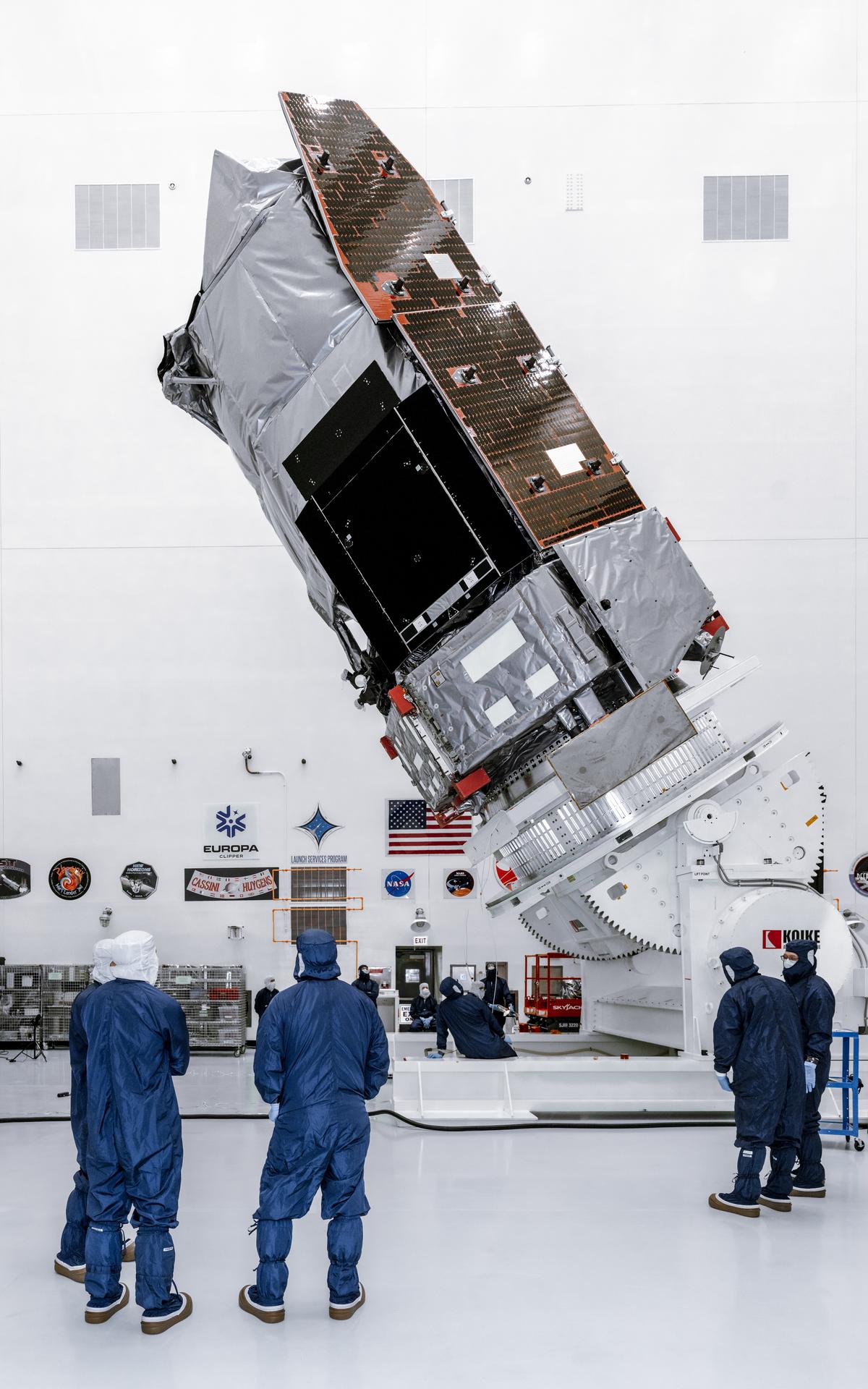
KSC · 2026-06-25 · KSC-20260625-PH-SER01_0001
Roman Space Telescope - Rotate to Vertical
Technicians and engineers inside the Payload Hazardous Servicing Facility at NASA’s Kennedy Space Center in Florida rotate the agency’s Nancy Grace Roman Space Telescope to vertical Thursday, June…
Inspect NASA record
Technicians and engineers inside the Payload Hazardous Servicing Facility at NASA’s Kennedy Space Center in Florida rotate the agency’s Nancy Grace Roman Space Telescope to vertical Thursday, June 25, 2026, using precision handling hardware. Named for NASA’s first chief astronomer and “mother of the Hubble Space Telescope,” the Roman Space Telescope will offer a field of view at least 100 times larger than Hubble’s, resulting in deep, sweeping explorations of the cosmos.
- Record ID
- KSC-20260625-PH-SER01_0001
- NASA center
- KSC
- Date
- 2026-06-25
- Credit
- NASA/Sydney Rohde (Rocz)
- Keywords
- Nancy Grace Roman Space Telescope, Payload Hazardous Servicing Facility, PHSF, KSC, Kennedy Space Center, LSP, Launch Services Program, Goddard Space Flight Center
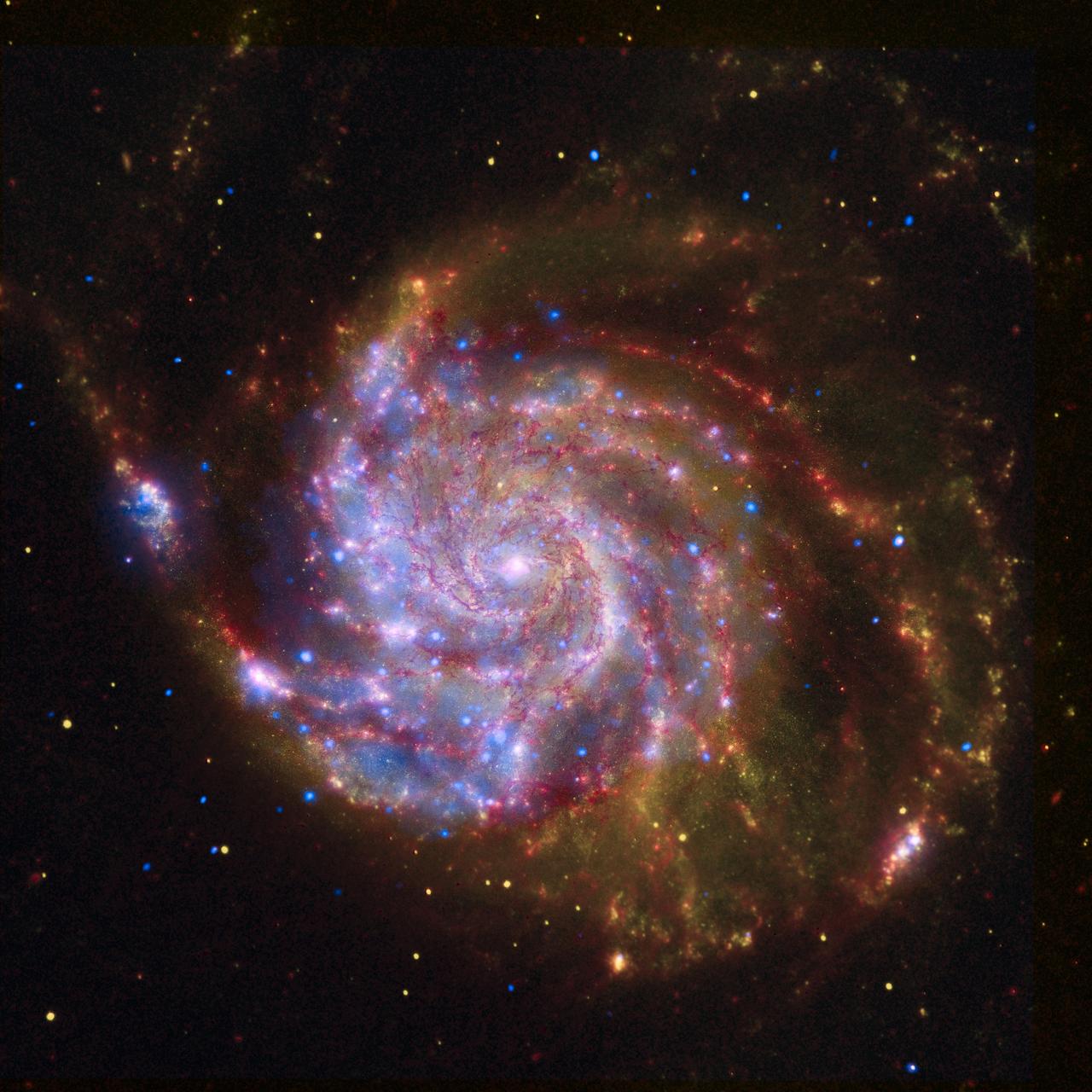
JPL · 2009-02-10 · PIA11797
NASA Great Observatories Celebrate the International Year of Astronomy
NASA Great Observatories continue Galileo legacy with stunning images and breakthrough science from the Hubble Space Telescope, the Spitzer Space Telescope, and the Chandra X-ray Observatory.
Inspect NASA record
NASA Great Observatories continue Galileo legacy with stunning images and breakthrough science from the Hubble Space Telescope, the Spitzer Space Telescope, and the Chandra X-ray Observatory.
- Record ID
- PIA11797
- NASA center
- JPL
- Date
- 2009-02-10
- Credit
- NASA/ESA/CXC/SSC/STScI
- Keywords
- Messier 101, Hubble Space Telescope,Spitzer Space Telescope
KSC · 2026-06-21 · NHQ20260621_admin_0003
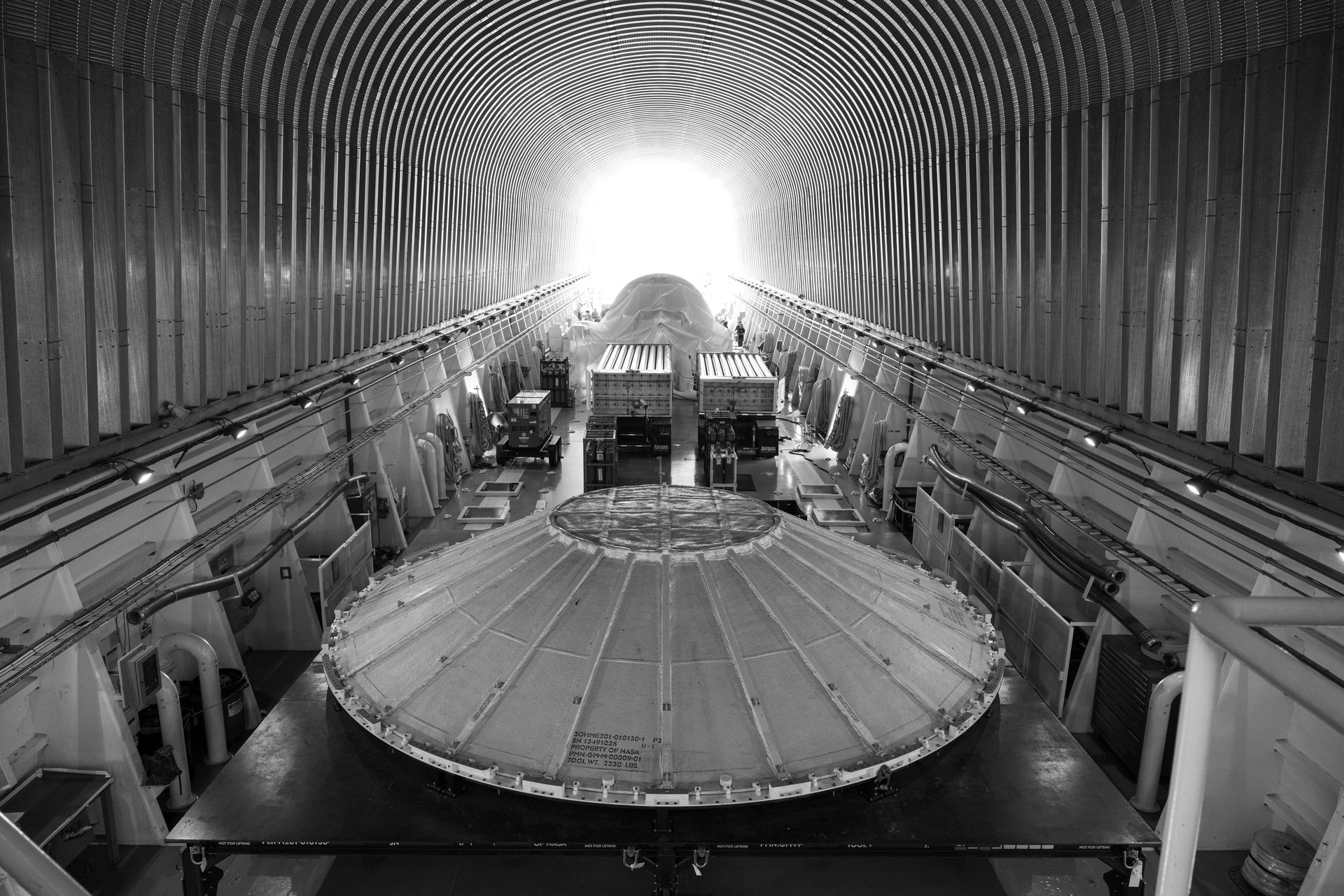
Roman Space Telescope Arrival
An interior view of NASA’s Pegasus barge, carrying a weather cover for Artemis III SLS (Space Launch System) rocket core stage and NASA’s Nancy Grace Roman Telescope, is…
Inspect NASA record
An interior view of NASA’s Pegasus barge, carrying a weather cover for Artemis III SLS (Space Launch System) rocket core stage and NASA’s Nancy Grace Roman Telescope, is seen, Sunday, June 21, at NASA’s Kennedy Space Center in Florida. Photo Credit: (NASA/John Kraus)
- Record ID
- NHQ20260621_admin_0003
- NASA center
- KSC
- Date
- 2026-06-21
- Credit
- NASA/John Kraus
- Keywords
- Artemis, Artemis III, Artemis III Preflight, Florida, Kennedy, Kennedy Space Center, NASA, Nancy Grace Roman Space Telescope, Pegasus barge
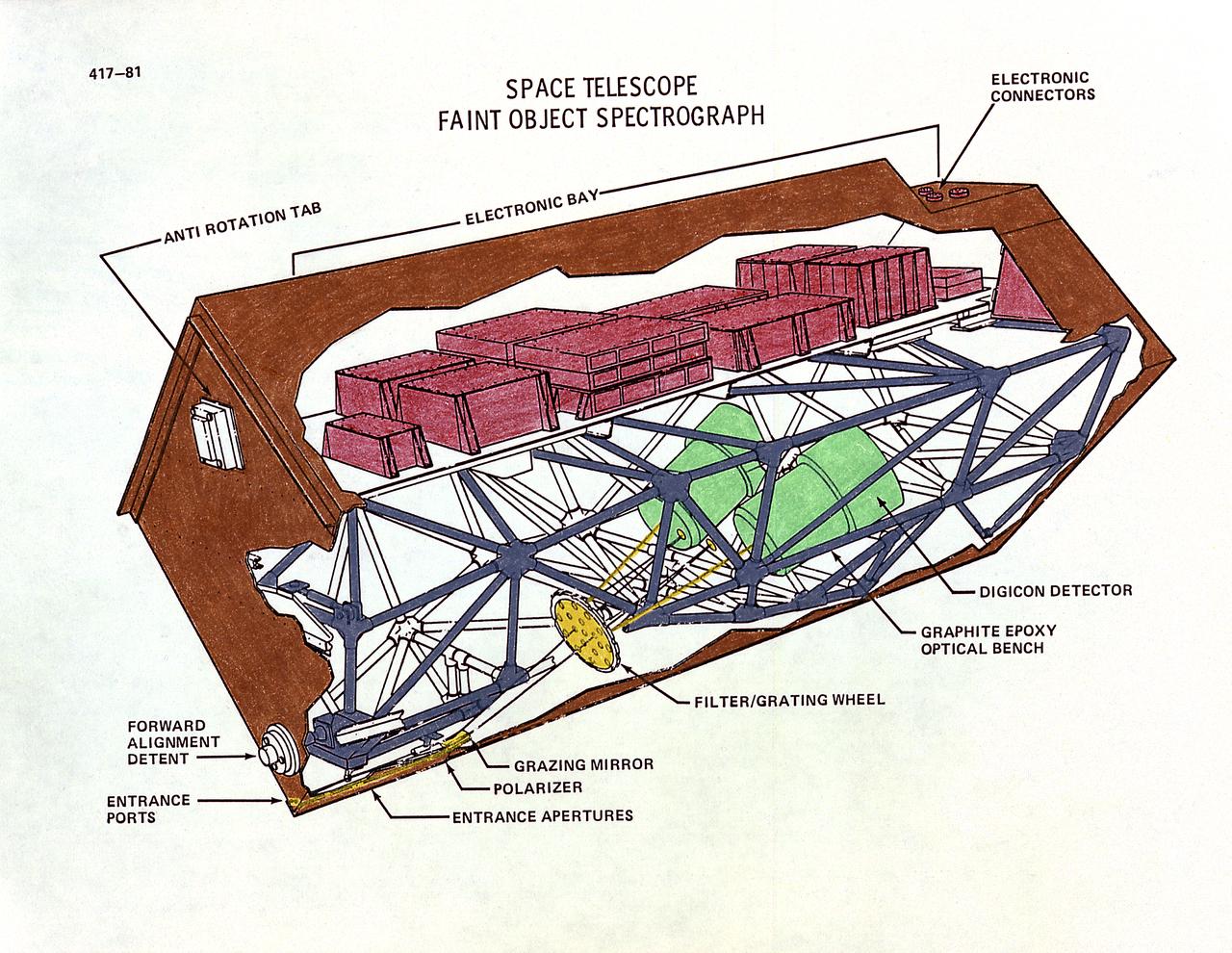
MSFC · 1981-01-01 · 8113714
History of Hubble Space Telescope (HST)
This drawing illustrates the Hubble Space Telescope's (HST's), Faint Object Spectrograph (FOS). The HST's two spectrographs, the Goddard High-Resolution Spectrograph and the FOS, can detect a broader range…
Inspect NASA record
This drawing illustrates the Hubble Space Telescope's (HST's), Faint Object Spectrograph (FOS). The HST's two spectrographs, the Goddard High-Resolution Spectrograph and the FOS, can detect a broader range of wavelengths than is possible from the Earth because there is no atmosphere to absorb certain wavelengths. Scientists can determine the chemical composition, temperature, pressure, and turbulence of the stellar atmosphere producing the light, all from spectral data. The FOC can detect detail in very faint objects, such as those at great distances, and light ranging from ultraviolet to red spectral bands. Both spectrographs operate in essentially the same way. The incoming light passes through a small entrance aperture, then passes through filters and diffraction gratings, that work like prisms. The filter or grating used determines what range of wavelength will be examined and in what detail. Then the spectrograph detectors record the strength of each wavelength band and sends it back to Earth. The purpose of the HST, the most complex and sensitive optical telescope ever made, is to study the cosmos from a low-Earth orbit. By placing the telescope in space, astronomers are able to collect data that is free of the Earth's atmosphere. The HST views galaxies, stars, planets, comets, possibly other solar systems, and even unusual phenomena such as quasars, with 10 times the clarity of ground-based telescopes. The HST was deployed from the Space Shuttle Discovery (STS-31 mission) into Earth orbit in April 1990. The Marshall Space Flight Center had responsibility for design, development, and construction of the HST. The Perkin-Elmer Corporation, in Danbury, Cornecticut, developed the optical system and guidance sensors.
- Record ID
- 8113714
- NASA center
- MSFC
- Date
- 1981-01-01
- Keywords
- Hubble Space Telescope, HST, Faint Object Spectrograph, FOS
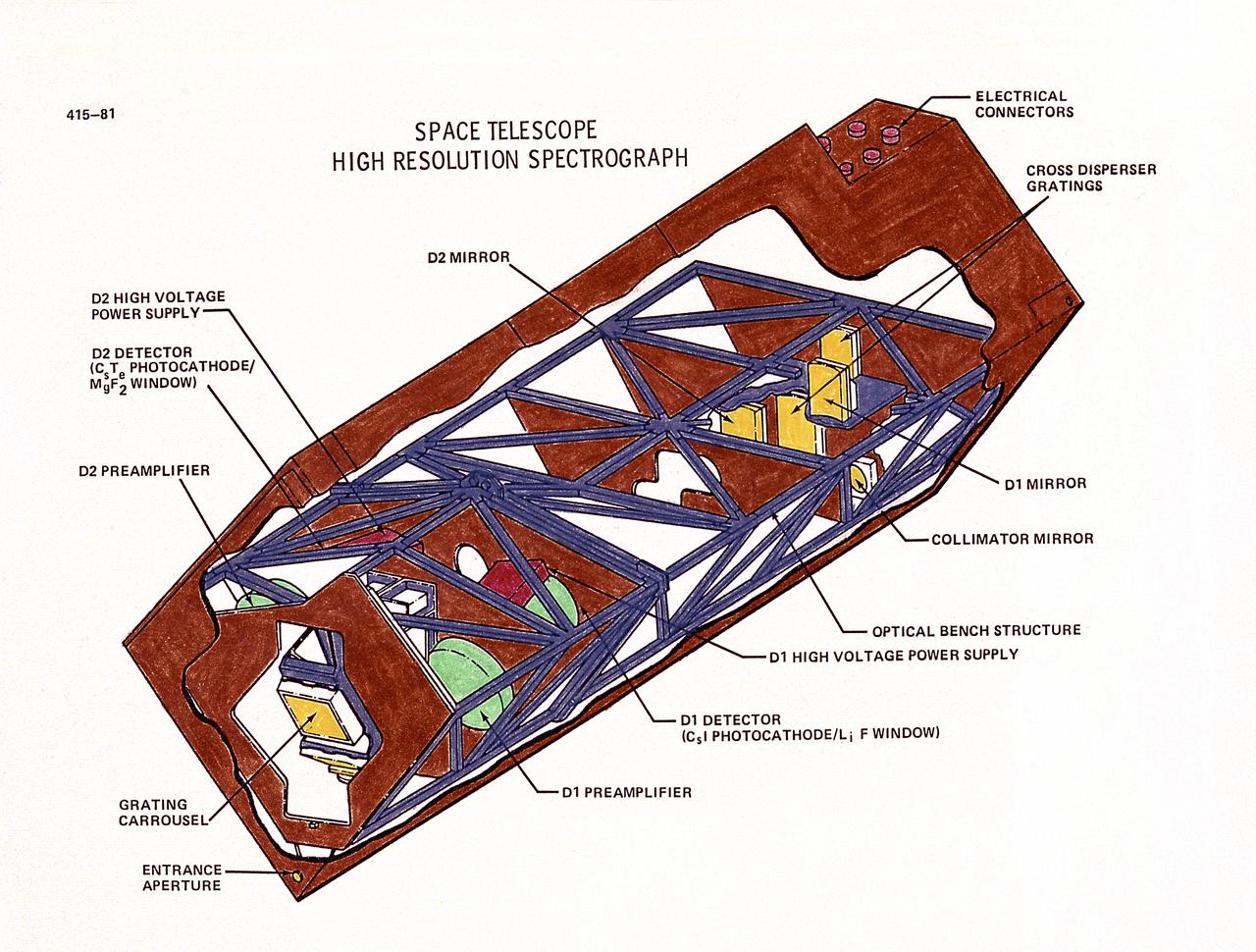
MSFC · 1981-01-01 · 8113712
History of Hubble Space Telescope (HST)
This drawing illustrates the Hubble Space Telescope's (HST's), Goddard High-Resolution Spectrograph (GHRS). The HST's two spectrographs, the GHRS and the Faint Object Spectrograph (FOS), can detect a broader…
Inspect NASA record
This drawing illustrates the Hubble Space Telescope's (HST's), Goddard High-Resolution Spectrograph (GHRS). The HST's two spectrographs, the GHRS and the Faint Object Spectrograph (FOS), can detect a broader range of wavelengths than is possible from Earth because there is no atmosphere to absorb certain wavelengths. Scientists can determine the chemical composition, temperature, pressure, and turbulence of the stellar atmosphere producing the light, all from spectral data. The GHRS can detect fine details in the light from somewhat brighter objects but only ultraviolet light. Both spectrographs operate in essentially the same way. The incoming light passes through a small entrance aperture, then passes through filters and diffraction gratings, that work like prisms. The filter or grating used determines what range of wavelength will be examined and in what detail. Then the spectrograph detectors record the strength of each wavelength band and sends it back to Earth. The purpose of the HST, the most complex and sensitive optical telescope ever made, is to study the cosmos from a low-Earth orbit. By placing the telescope in space, astronomers are able to collect data that is free of the Earth's atmosphere. The HST views galaxies, stars, planets, comets, possibly other solar systems, and even unusual phenomena such as quasars, with 10 times the clarity of ground-based telescopes. The HST was deployed from the Space Shuttle Discovery (STS-31 mission) into Earth orbit in April 1990. The Marshall Space Flight Center had responsibility for design, development, and construction of the HST. The Perkin-Elmer Corporation, in Danbury, Cornecticut, developed the optical system and guidance sensors.
- Record ID
- 8113712
- NASA center
- MSFC
- Date
- 1981-01-01
- Keywords
- Hubble Space Telescope, HST, Goddard High-Resolution Spectrograph, GHRS
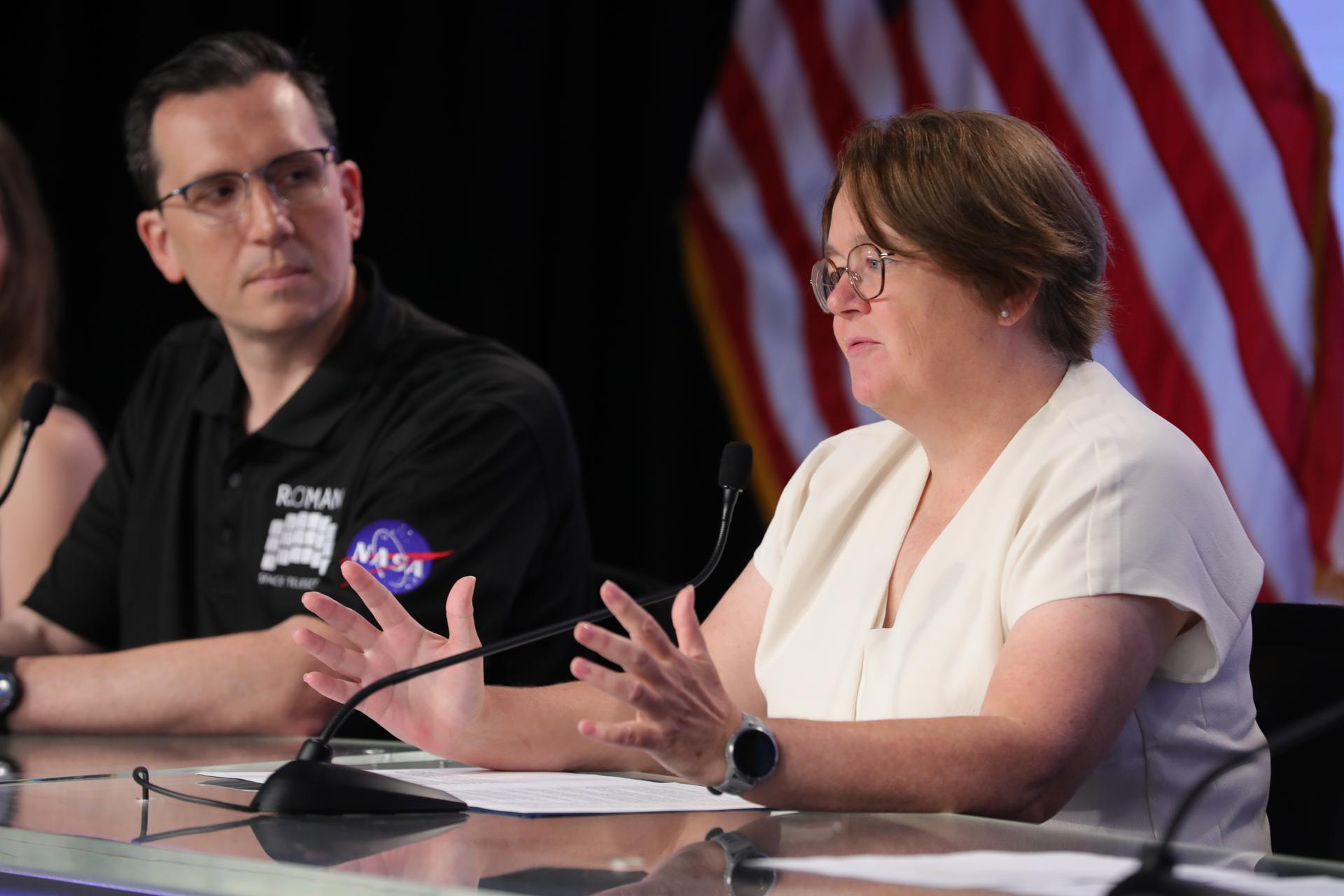
KSC · 2026-08-29 · KSC-20260829-PH-KLS01_0082
Roman Space Telescope Science Briefing
From left, Shawn Domagal-Goldman, director, Astrophysics Division, NASA Headquarters in Washington, and Julie McEnery, Roman telescope senior project scientist, NASA’s Goddard Space Flight Center in Greenbelt, Maryland, participate…
Inspect NASA record
From left, Shawn Domagal-Goldman, director, Astrophysics Division, NASA Headquarters in Washington, and Julie McEnery, Roman telescope senior project scientist, NASA’s Goddard Space Flight Center in Greenbelt, Maryland, participate in a science briefing for NASA’s Nancy Grace Roman Space Telescope inside the NASA News Center’s John Holliman Auditorium at Kennedy Space Center in Florida, on Saturday, Aug. 29, 2026. Roman will investigate dark energy and dark matter, conduct a statistical census of planetary systems, and enable a broad range of additional astrophysics research. Liftoff from Launch Complex 39A at Kennedy is targeted for no earlier than Sunday, Aug. 30, 2026.
- Record ID
- KSC-20260829-PH-KLS01_0082
- NASA center
- KSC
- Date
- 2026-08-29
- Credit
- NASA/Kim Shiflett
- Keywords
- John. F. Kennedy Space Center, Kennedy, Kennedy Space Center, KSC, Spaceport, Cape Canaveral, NASA, rocket ranch, Florida, multi-user spaceport, premier spaceport, space coast
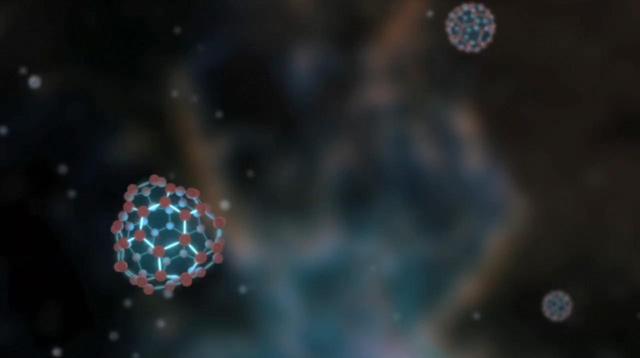
JPL · 2010-07-22 · PIA13290
Buckyballs Jiggle Like Jello Artist Concept
This artist image illustrates vibrating buckyballs -- spherical molecules of carbon discovered in space for the first time by NASA Spitzer Space Telescope.
Inspect NASA record
This artist image illustrates vibrating buckyballs -- spherical molecules of carbon discovered in space for the first time by NASA Spitzer Space Telescope.
- Record ID
- PIA13290
- NASA center
- JPL
- Date
- 2010-07-22
- Credit
- NASA/JPL-Caltech
- Keywords
- Spitzer Space Telescope
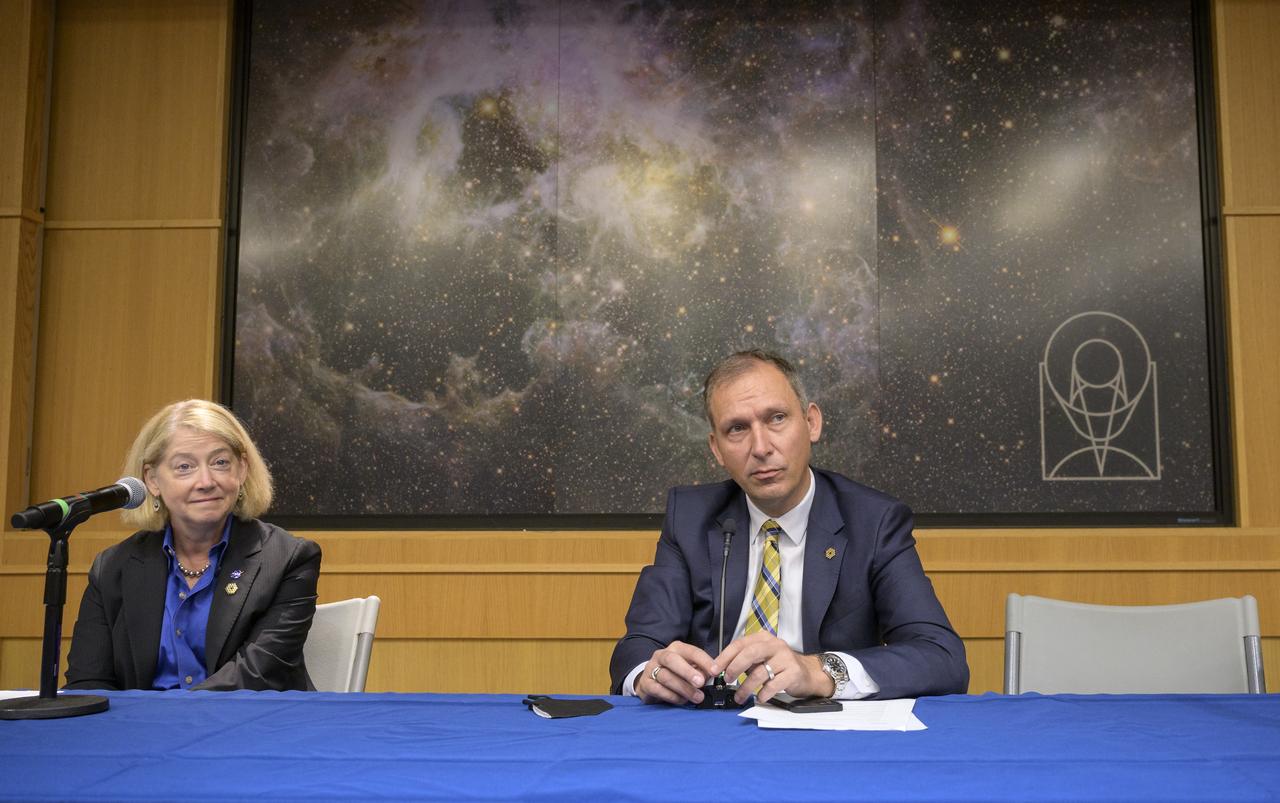
HQ · 2022-06-29 · NHQ202206290013
James Webb Space Telescope Briefing
NASA Deputy Administrator Pam Melroy, left, and NASA Associate Administrator for the Science Mission Directorate Thomas Zurbuchen give remarks during a briefing, Wednesday, June 29, 2022, at the…
Inspect NASA record
NASA Deputy Administrator Pam Melroy, left, and NASA Associate Administrator for the Science Mission Directorate Thomas Zurbuchen give remarks during a briefing, Wednesday, June 29, 2022, at the Space Telescope Science Institute (STScI) in Baltimore. The briefing focused on the status of NASA’s James Webb Space Telescope in its final weeks of preparing for its science mission, as well as overviews of planned science for Webb’s first year of operations. Photo Credit: (NASA/Bill Ingalls)
- Record ID
- NHQ202206290013
- NASA center
- HQ
- Date
- 2022-06-29
- Credit
- NASA/Bill Ingalls
- Keywords
- Baltimore, Canadian Space Agency (CSA), ESA (European Space Agency), James Webb Space Telescope (JWST), Maryland, NASA, NASA Deputy Administrator, Northrop Grumman, Pam Melroy, Space Telescope Science Institute (STScI), Thomas Zurbuchen
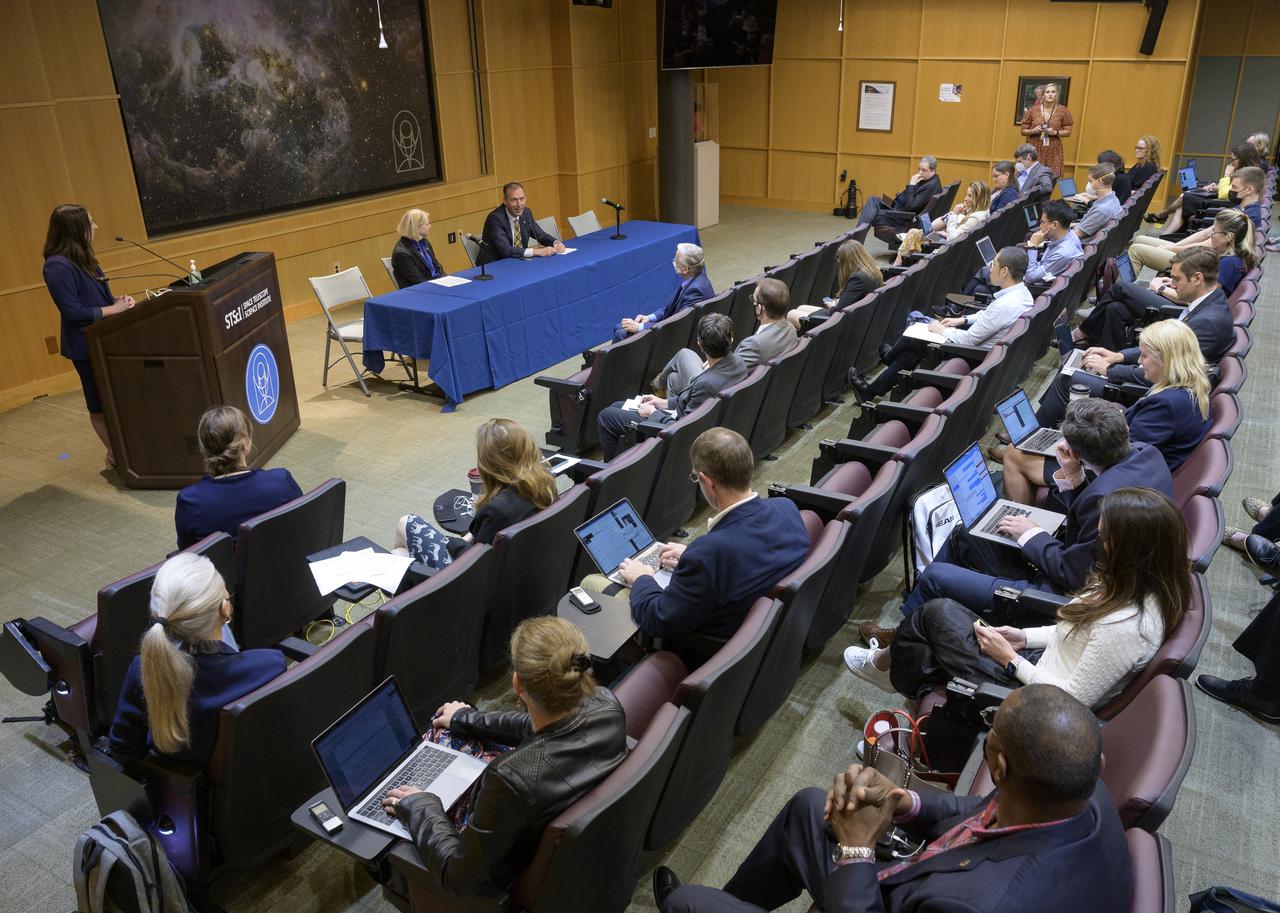
HQ · 2022-06-29 · NHQ202206290009
James Webb Space Telescope Briefing
NASA Deputy Administrator Pam Melroy, left, and NASA Associate Administrator for the Science Mission Directorate Thomas Zurbuchen give remarks during a briefing, Wednesday, June 29, 2022, at the…
Inspect NASA record
NASA Deputy Administrator Pam Melroy, left, and NASA Associate Administrator for the Science Mission Directorate Thomas Zurbuchen give remarks during a briefing, Wednesday, June 29, 2022, at the Space Telescope Science Institute (STScI) in Baltimore. The briefing focused on the status of NASA’s James Webb Space Telescope in its final weeks of preparing for its science mission, as well as overviews of planned science for Webb’s first year of operations. Photo Credit: (NASA/Bill Ingalls)
- Record ID
- NHQ202206290009
- NASA center
- HQ
- Date
- 2022-06-29
- Credit
- NASA/Bill Ingalls
- Keywords
- Baltimore, Canadian Space Agency (CSA), ESA (European Space Agency), James Webb Space Telescope (JWST), Maryland, NASA, NASA Deputy Administrator, Northrop Grumman, Pam Melroy, Space Telescope Science Institute (STScI), Thomas Zurbuchen