
Update Site (from NASA)
Explore NASA’s Image and Video Library.
Suggest one object per day for the Interstellar Minds collection. We review each suggestion before adding it.
Sign in to suggest a Marvel.
Find a NASA image ID. Open a NASA record and copy its ID from the end of the details URL.
NASA image records
KSC · 2009-07-30 · KSC-2009-4350
KSC-2009-4350
CAPE CANAVERAL, Fla. – At NASA Kennedy Space Center's Visitor Complex in Florida, Apollo astronaut Al Worden shares his thoughts about the Space Program after receiving the Ambassador…
Inspect NASA record
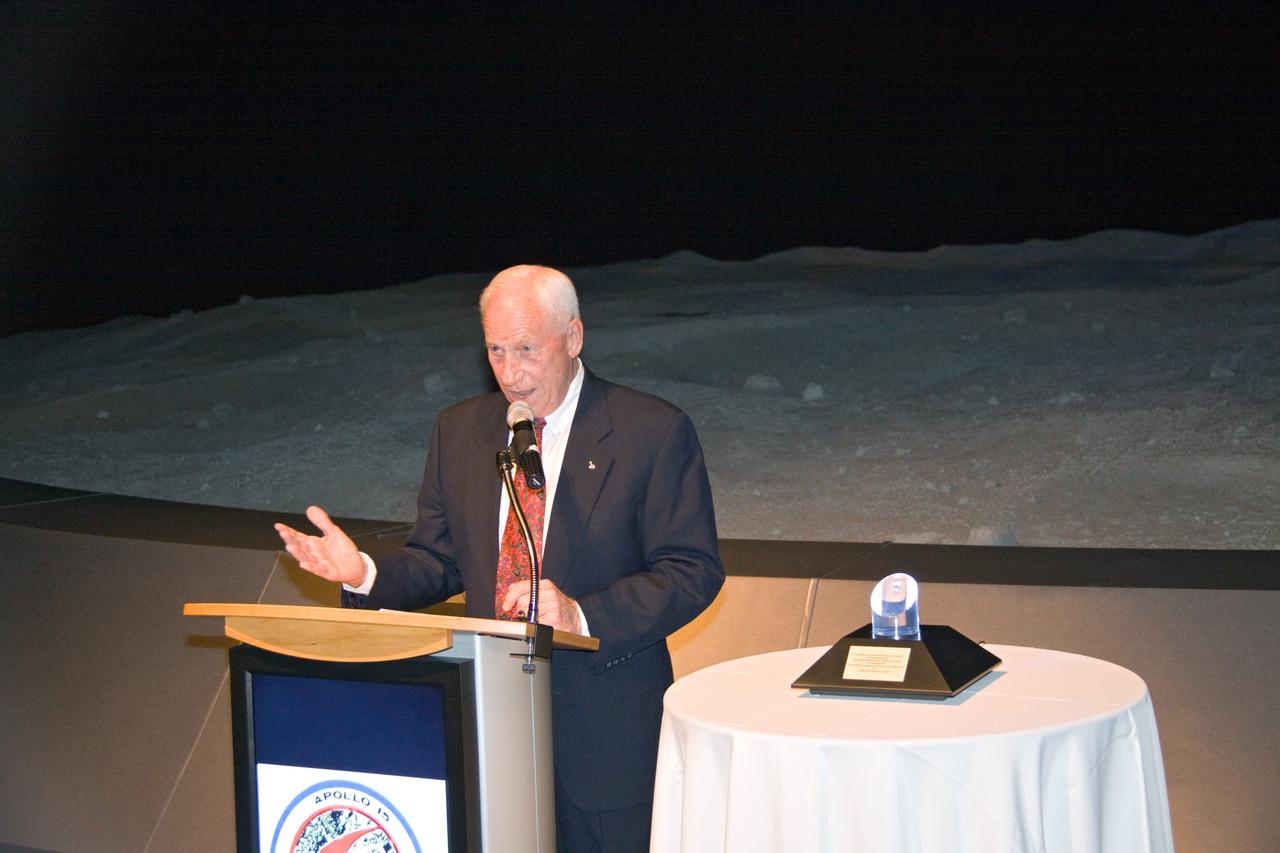
CAPE CANAVERAL, Fla. – At NASA Kennedy Space Center's Visitor Complex in Florida, Apollo astronaut Al Worden shares his thoughts about the Space Program after receiving the Ambassador of Exploration Award. Worden is being honored for his contributions to the U.S. space program. A moon rock encased in Lucite, the award is seen at right and will be displayed at Kennedy. Worden served as command module pilot for the Apollo 15 mission, which set several moon records for NASA, including the longest lunar surface stay time, the longest lunar extravehicular activity and the first use of a lunar roving vehicle. Worden spent 38 minutes in a spacewalk outside the command module and logged a total of 295 hours, 11 minutes in space during the mission. NASA is giving the Ambassador of Exploration Award to the first generation of explorers in the Mercury, Gemini and Apollo space programs for realizing America's goal of going to the moon. The rock is part of the 842 pounds of lunar samples collected during six Apollo expeditions from 1969 to 1972. Those astronauts who receive the award will then present the award to a museum of their choice. Photo credit: NASA/Jack Pfaller
- Record ID
- KSC-2009-4350
- NASA center
- KSC
- Date
- 2009-07-30
MSFC · 1969-08-03 · 6901512
Saturn Apollo Program
The Apollo 11 mission, the first manned lunar mission, launched from the Kennedy Space Center, Florida via the Marshall Space Flight Center (MSFC) developed Saturn V launch vehicle…
Inspect NASA record
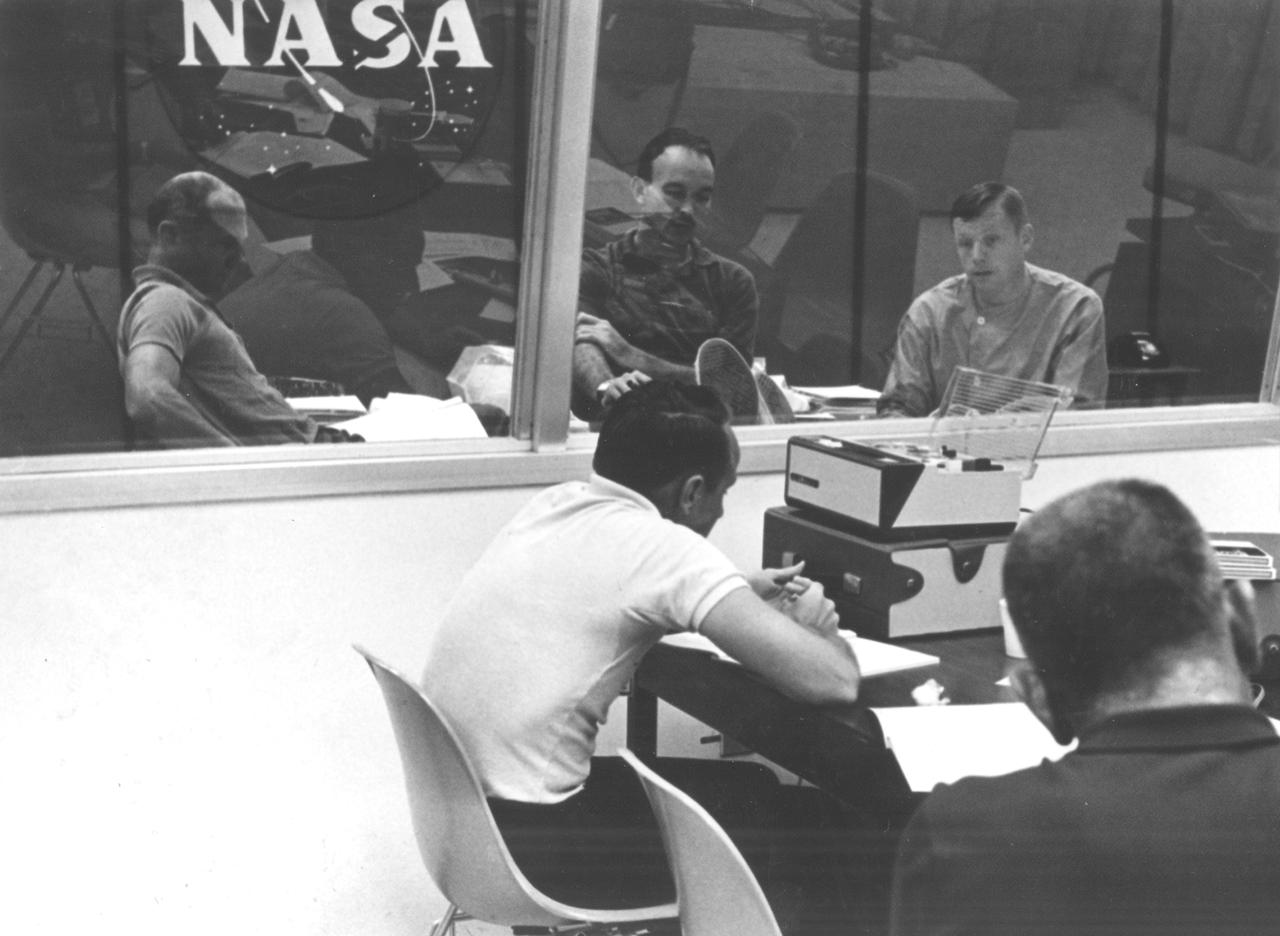
The Apollo 11 mission, the first manned lunar mission, launched from the Kennedy Space Center, Florida via the Marshall Space Flight Center (MSFC) developed Saturn V launch vehicle on July 16, 1969 and safely returned to Earth on July 24, 1969. Aboard the space craft were astronauts Neil A. Armstrong, commander; Michael Collins, Command Module (CM) pilot; and Edwin E. Aldrin Jr., Lunar Module (LM) pilot. The CM, piloted by Michael Collins remained in a parking orbit around the Moon while the LM, named “Eagle’’, carrying astronauts Neil Armstrong and Edwin Aldrin, landed on the Moon. During 2½ hours of surface exploration, the crew collected 47 pounds of lunar surface material for analysis back on Earth. The recovery operation took place in the Pacific Ocean where Navy para-rescue men recovered the capsule housing the 3-man Apollo 11 crew. The crew was airlifted to safety aboard the U.S.S. Hornet, where they were quartered in a Mobile Quarantine Facility (MQF) which served as their home until they reached the NASA Manned Spacecraft Center (MSC) Lunar Receiving Laboratory in Houston, Texas. The three are seen here at the MSC, still inside the MQF, undergoing their first debriefing on Sunday, August 3, 1969. Behind the glass are (L-R): Edwin Aldrin, Michael Collins, and Neil Armstrong.
- Record ID
- 6901512
- NASA center
- MSFC
- Date
- 1969-08-03
- Keywords
- Apollo 11, Moon, Quarantine, Aldrin, Collins, Armstrong, Manned Spacecraft Center, MSC, Debriefing
KSC · 2009-07-30 · KSC-2009-4351
KSC-2009-4351
CAPE CANAVERAL, Fla. – At NASA Kennedy Space Center's Visitor Complex in Florida, Apollo astronaut Al Worden (center) is flanked by Center Director Bob Cabana (left) and NASA…
Inspect NASA record
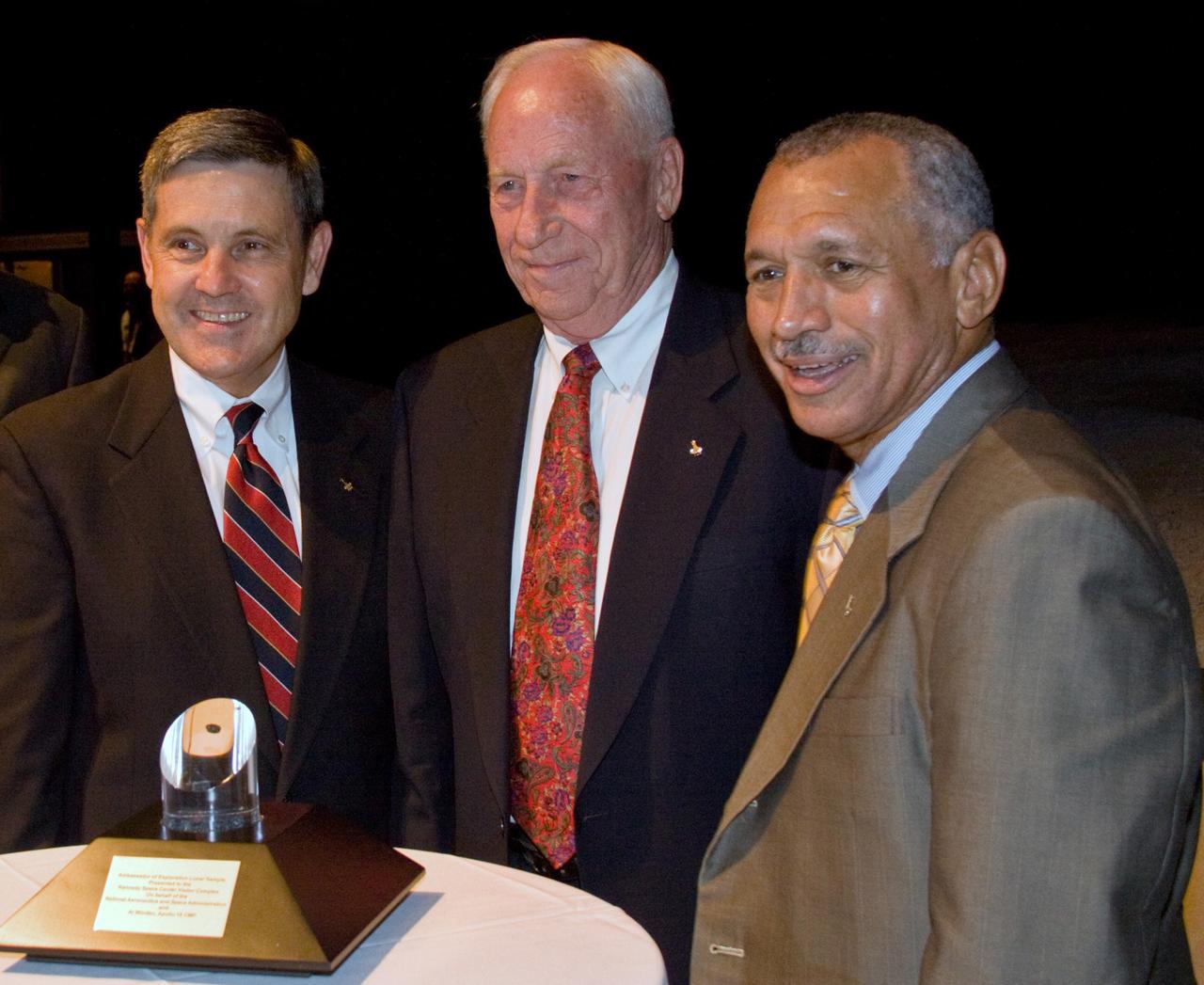
CAPE CANAVERAL, Fla. – At NASA Kennedy Space Center's Visitor Complex in Florida, Apollo astronaut Al Worden (center) is flanked by Center Director Bob Cabana (left) and NASA Administrator Charles Bolden. Worden was presented with the Ambassador of Exploration Award to honor his contributions to the U.S. space program. A moon rock encased in Lucite, the award is seen in the foreground and will be displayed at Kennedy. Worden served as command module pilot for the Apollo 15 mission, which set several moon records for NASA, including the longest lunar surface stay time, the longest lunar extravehicular activity and the first use of a lunar roving vehicle. Worden spent 38 minutes in a spacewalk outside the command module and logged a total of 295 hours, 11 minutes in space during the mission. NASA is giving the Ambassador of Exploration Award to the first generation of explorers in the Mercury, Gemini and Apollo space programs for realizing America's goal of going to the moon. The rock is part of the 842 pounds of lunar samples collected during six Apollo expeditions from 1969 to 1972. Those astronauts who receive the award will then present the award to a museum of their choice. Photo credit: NASA/Jack Pfaller
- Record ID
- KSC-2009-4351
- NASA center
- KSC
- Date
- 2009-07-30
MSFC · 1969-07-24 · 6900604
Saturn Apollo Program
The Apollo 11 mission, the first manned lunar mission, launched from the Kennedy Space Center, Florida via the Saturn V launch vehicle on July 16, 1969 and safely…
Inspect NASA record
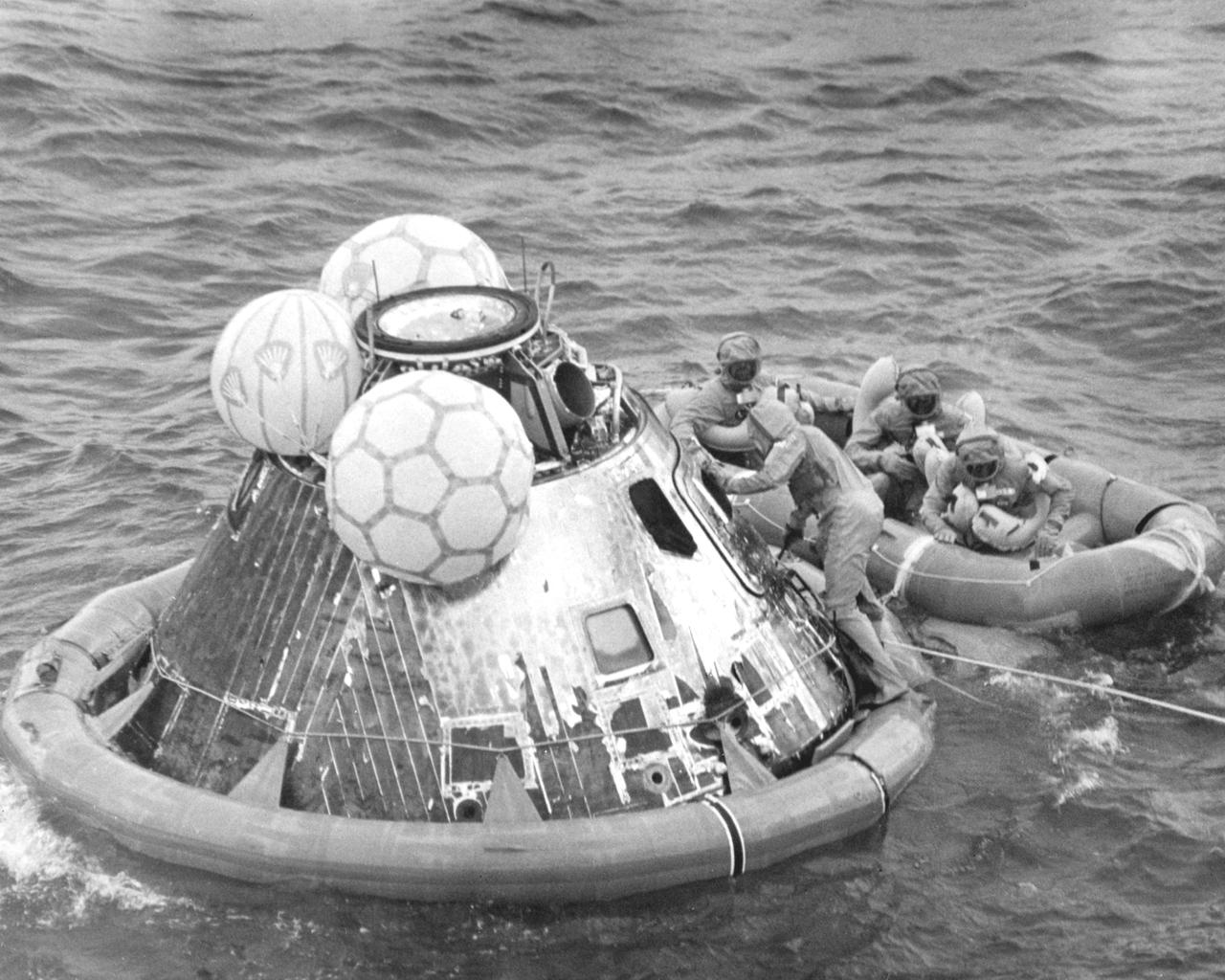
The Apollo 11 mission, the first manned lunar mission, launched from the Kennedy Space Center, Florida via the Saturn V launch vehicle on July 16, 1969 and safely returned to Earth on July 24, 1969. The Saturn V vehicle was developed by the Marshall Space Flight Center (MSFC) under the direction of Dr. Wernher von Braun. Aboard were astronauts Neil A. Armstrong, commander; Michael Collins, Command Module (CM) pilot; and Edwin E. Aldrin Jr., Lunar Module (LM) pilot. The CM, piloted by Michael Collins remained in a parking orbit around the Moon while the LM, named “Eagle’’, carrying astronauts Neil Armstrong and Edwin Aldrin, landed on the Moon. Armstrong was the first human to ever stand on the lunar surface, followed by Edwin (Buzz) Aldrin. During 2½ hours of surface exploration, the crew collected 47 pounds of lunar surface material for analysis back on Earth. Shown here is the recovery operation of the capsule in the Pacific Ocean after splashdown. The three astronauts wait in the life raft as a pararescue man closes and secures the capsule hatch. The crew was then air lifted to the prime recovery ship, the U.S.S. Hornet, where they were housed in a Mobile Quarantine Facility (MQF).
- Record ID
- 6900604
- NASA center
- MSFC
- Date
- 1969-07-24
- Keywords
- Apollo 11, Moon, Recovery, Splashdown, Capsule
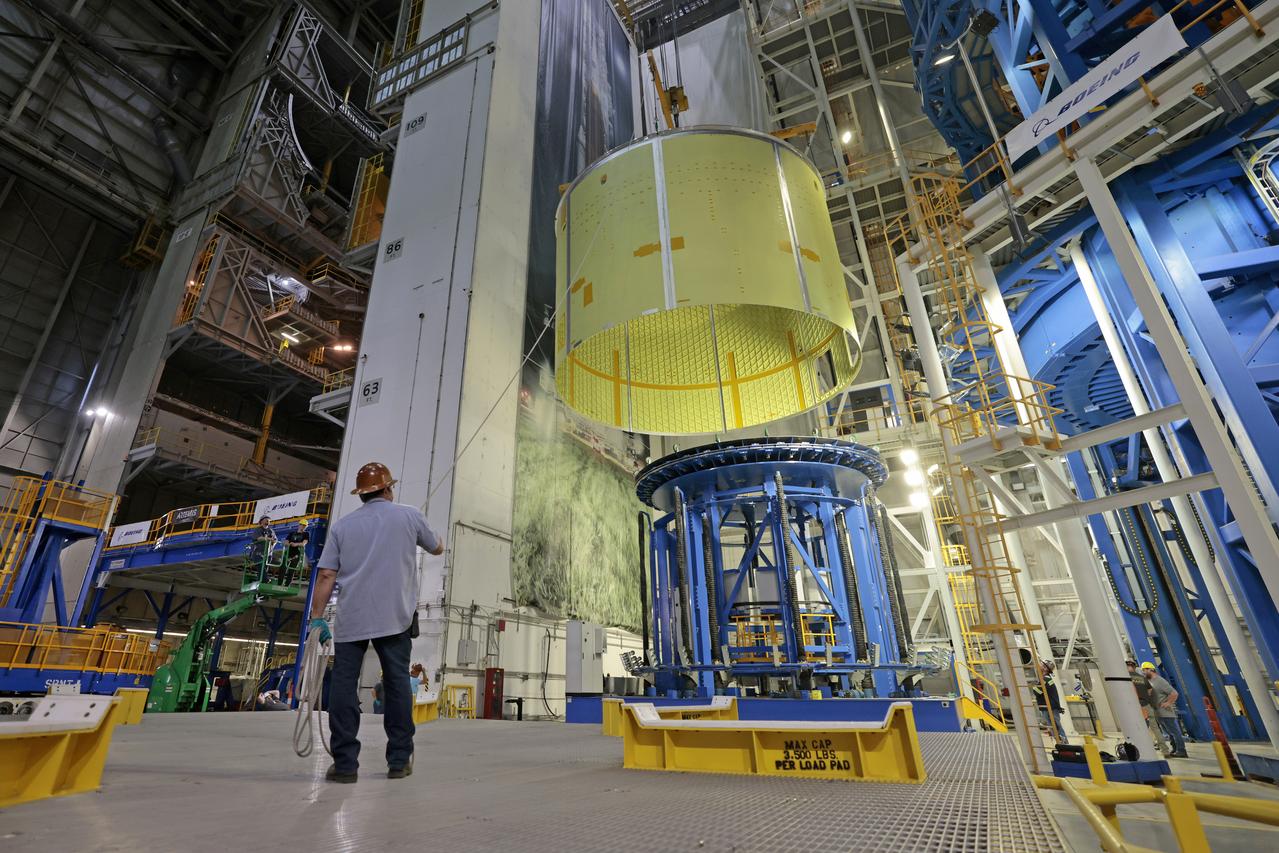
MAF · 2022-06-20 · MAF_20220620_CS4_EStoCellG_04
NASA Moves Artemis IV Engine Section
Technicians at NASA’s Michoud Assembly Facility move the engine section of NASA’s Space Launch System rocket for Artemis IV from the Vertical Assembly Building to Cell G for…
Inspect NASA record
Technicians at NASA’s Michoud Assembly Facility move the engine section of NASA’s Space Launch System rocket for Artemis IV from the Vertical Assembly Building to Cell G for weld priming. This hardware is the first large piece manufactured for the Artemis IV mission and makes up the lowest portion of the 212-foot-tall core stage. When complete, the engine section will house the four RS-25 engines and include vital systems for mounting, controlling and delivering fuel from the propellant tanks to the rocket’s engines. Together with its four RS-25 engines and its twin solid rocket boosters, it will produce 8.8 million pounds of thrust to send NASA’s Orion spacecraft, astronauts, and supplies beyond Earth’s orbit to the Moon and, ultimately, Mars. Offering more payload mass, volume capability, and energy to speed missions through space, the SLS rocket, along with NASA’s Gateway in lunar orbit, the Human Landing System, and Orion spacecraft, is part of NASA’s backbone for deep space exploration and the Artemis lunar program. No other rocket is capable of carrying astronauts in Orion around the Moon in a single mission. Image credit: NASA/Michael DeMocker
- Record ID
- MAF_20220620_CS4_EStoCellG_04
- NASA center
- MAF
- Date
- 2022-06-20
- Credit
- Michael DeMocker
- Keywords
- Space Launch System, SLS, Artemis, Artemis IV, NASA, Marshall Space Flight Center, Michoud Assembly Facility, rocket science, rocket, launch vehicle, Moon, Boeing

MAF · 2022-06-20 · MAF_20220620_CS4_EStoCellG_05
NASA Moves Artemis IV Engine Section
Technicians at NASA’s Michoud Assembly Facility move the engine section of NASA’s Space Launch System rocket for Artemis IV from the Vertical Assembly Building to Cell G for…
Inspect NASA record
Technicians at NASA’s Michoud Assembly Facility move the engine section of NASA’s Space Launch System rocket for Artemis IV from the Vertical Assembly Building to Cell G for weld priming. This hardware is the first large piece manufactured for the Artemis IV mission and makes up the lowest portion of the 212-foot-tall core stage. When complete, the engine section will house the four RS-25 engines and include vital systems for mounting, controlling and delivering fuel from the propellant tanks to the rocket’s engines. Together with its four RS-25 engines and its twin solid rocket boosters, it will produce 8.8 million pounds of thrust to send NASA’s Orion spacecraft, astronauts, and supplies beyond Earth’s orbit to the Moon and, ultimately, Mars. Offering more payload mass, volume capability, and energy to speed missions through space, the SLS rocket, along with NASA’s Gateway in lunar orbit, the Human Landing System, and Orion spacecraft, is part of NASA’s backbone for deep space exploration and the Artemis lunar program. No other rocket is capable of carrying astronauts in Orion around the Moon in a single mission. Image credit: NASA/Michael DeMocker
- Record ID
- MAF_20220620_CS4_EStoCellG_05
- NASA center
- MAF
- Date
- 2022-06-20
- Credit
- Michael DeMocker
- Keywords
- Space Launch System, SLS, Artemis, Artemis IV, NASA, Marshall Space Flight Center, Michoud Assembly Facility, rocket science, rocket, launch vehicle, Moon, Boeing
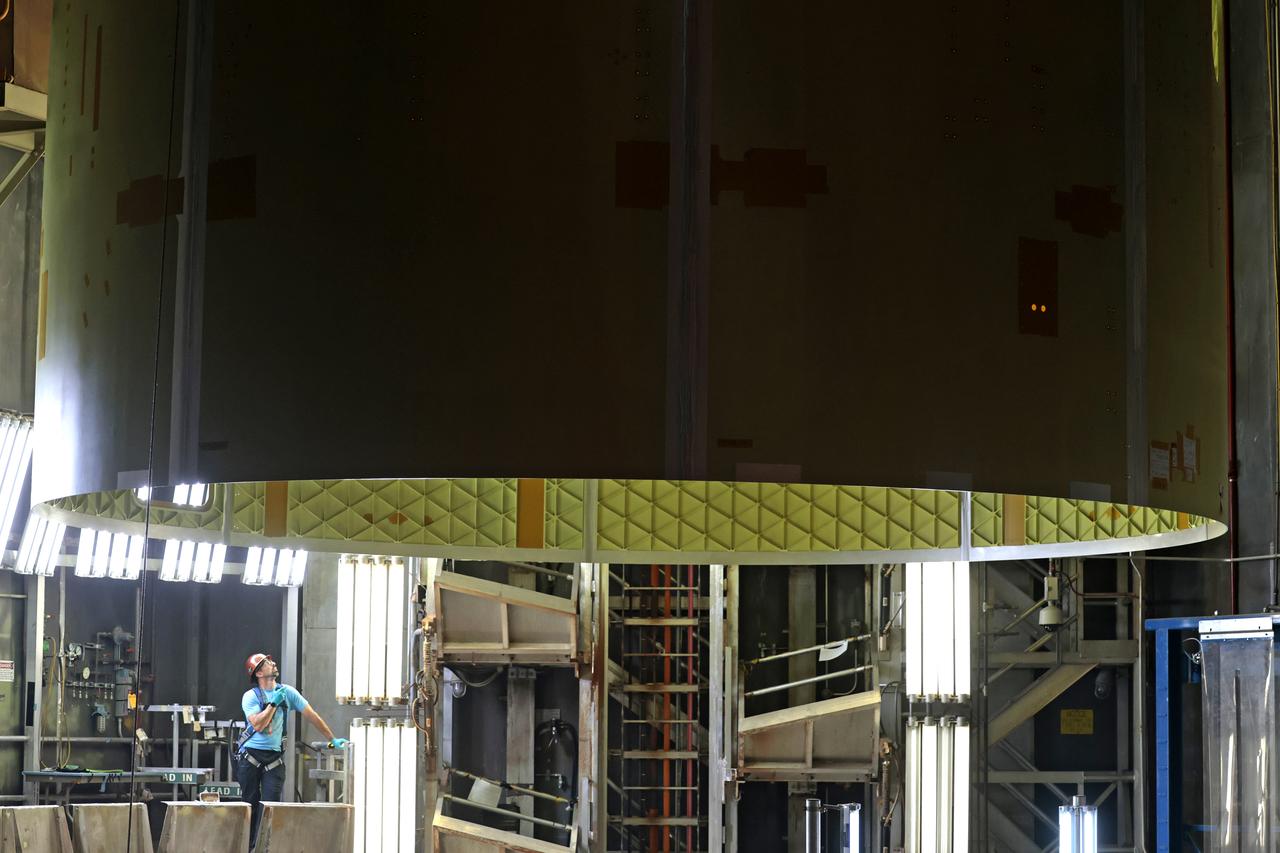
MAF · 2022-06-20 · MAF_20220620_CS4_EStoCellG_15
NASA Moves Artemis IV Engine Section
Technicians at NASA’s Michoud Assembly Facility move the engine section of NASA’s Space Launch System rocket for Artemis IV from the Vertical Assembly Building to Cell G for…
Inspect NASA record
Technicians at NASA’s Michoud Assembly Facility move the engine section of NASA’s Space Launch System rocket for Artemis IV from the Vertical Assembly Building to Cell G for weld priming. This hardware is the first large piece manufactured for the Artemis IV mission and makes up the lowest portion of the 212-foot-tall core stage. When complete, the engine section will house the four RS-25 engines and include vital systems for mounting, controlling and delivering fuel from the propellant tanks to the rocket’s engines. Together with its four RS-25 engines and its twin solid rocket boosters, it will produce 8.8 million pounds of thrust to send NASA’s Orion spacecraft, astronauts, and supplies beyond Earth’s orbit to the Moon and, ultimately, Mars. Offering more payload mass, volume capability, and energy to speed missions through space, the SLS rocket, along with NASA’s Gateway in lunar orbit, the Human Landing System, and Orion spacecraft, is part of NASA’s backbone for deep space exploration and the Artemis lunar program. No other rocket is capable of carrying astronauts in Orion around the Moon in a single mission. Image credit: NASA/Michael DeMocker
- Record ID
- MAF_20220620_CS4_EStoCellG_15
- NASA center
- MAF
- Date
- 2022-06-20
- Credit
- Michael DeMocker
- Keywords
- Space Launch System, SLS, Artemis, Artemis IV, NASA, Marshall Space Flight Center, Michoud Assembly Facility, rocket science, rocket, launch vehicle, Moon, Boeing