
Update Site (from NASA)
Explore NASA’s Image and Video Library.
Suggest one object per day for the Interstellar Minds collection. We review each suggestion before adding it.
Sign in to suggest a Marvel.
Find a NASA image ID. Open a NASA record and copy its ID from the end of the details URL.
NASA image records

KSC · 2021-03-26 · KSC-20210326-PH-ILW01_0059
MSolo Connectivity Test
Kevin Smith, software team and science team liaison for NASA’s Mass Spectrometer observing lunar operations (MSolo), takes part in a joint simulation of the Peregrine One Mission on…
Inspect NASA record
Kevin Smith, software team and science team liaison for NASA’s Mass Spectrometer observing lunar operations (MSolo), takes part in a joint simulation of the Peregrine One Mission on March 26, 2021, at NASA’s Kennedy Space Center in Florida, where MSolo connected from inside the Neil Armstrong Operations and Checkout Building to Astrobotic’s mission control facility in Pittsburgh, Pennsylvania. MSolo is a commercial off-the-shelf mass spectrometer modified to work in space and it will help analyze the chemical makeup of landing sites on the Moon, as well as study water on the lunar surface. This was the first mission round of simulations for Peregrine Mission One to develop and refine procedures between Astrobotic’s Peregrine Lander and MSolo. Later, there will be other simulations with multiple instruments. Peregrine Mission One will be one of NASA’s first Commercial Lunar Payload Delivery Service (CLPS) missions where under the Artemis program, commercial deliveries beginning in 2021 will perform science experiments, test technologies and demonstrate capabilities to help NASA explore the Moon and prepare for human missions.
- Record ID
- KSC-20210326-PH-ILW01_0059
- NASA center
- KSC
- Date
- 2021-03-26
- Credit
- NASA/Isaac Watson
- Keywords
- Connectivity Test, KSC, Kennedy Space Center, MSolo, NASA, Operations and Control Building
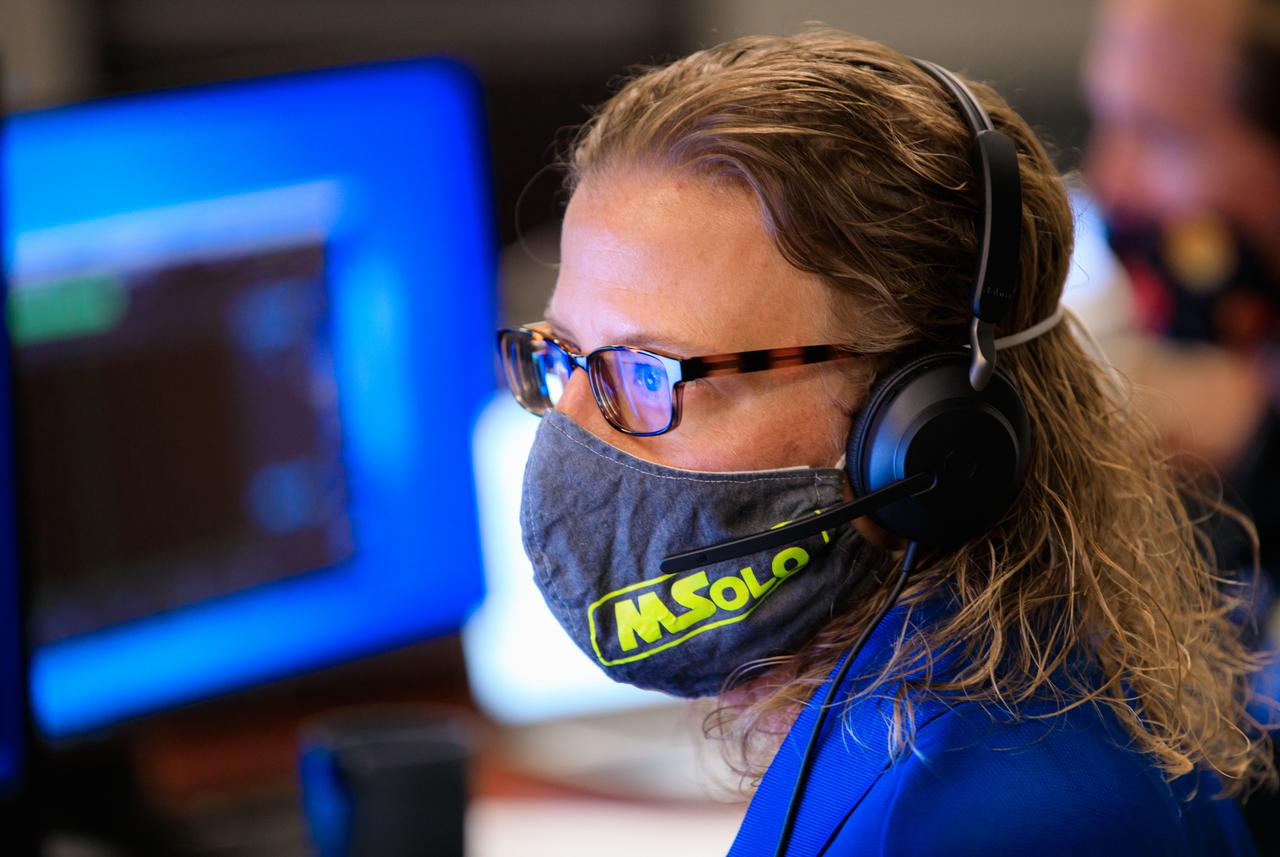
KSC · 2021-03-26 · KSC-20210326-PH-ILW01_0055
MSolo Connectivity Test
Janine Captain, principal investigator for NASA’s Mass Spectrometer observing lunar operations (MSolo) takes part in a joint simulation of the Peregrine One Mission on March 26, 2021, where…
Inspect NASA record
Janine Captain, principal investigator for NASA’s Mass Spectrometer observing lunar operations (MSolo) takes part in a joint simulation of the Peregrine One Mission on March 26, 2021, where MSolo connected from inside the Neil Armstrong Operations and Checkout Building at NASA’s Kennedy Space Center in Florida to Astrobotic’s mission control facility in Pittsburgh, Pennsylvania. MSolo is a commercial off-the-shelf mass spectrometer modified to work in space and it will help analyze the chemical makeup of landing sites on the Moon, as well as study water on the lunar surface. This was the first mission round of simulations for Peregrine Mission One to develop and refine procedures between Astrobotic’s Peregrine Lander and MSolo. Later, there will be other simulations with multiple instruments. Peregrine Mission One will be one of NASA’s first Commercial Lunar Payload Delivery Service (CLPS) missions where under the Artemis program, commercial deliveries beginning in 2021 will perform science experiments, test technologies and demonstrate capabilities to help NASA explore the Moon and prepare for human missions.
- Record ID
- KSC-20210326-PH-ILW01_0055
- NASA center
- KSC
- Date
- 2021-03-26
- Credit
- NASA/Isaac Watson
- Keywords
- Connectivity Test, KSC, Kennedy Space Center, MSolo, NASA, Operations and Control Building
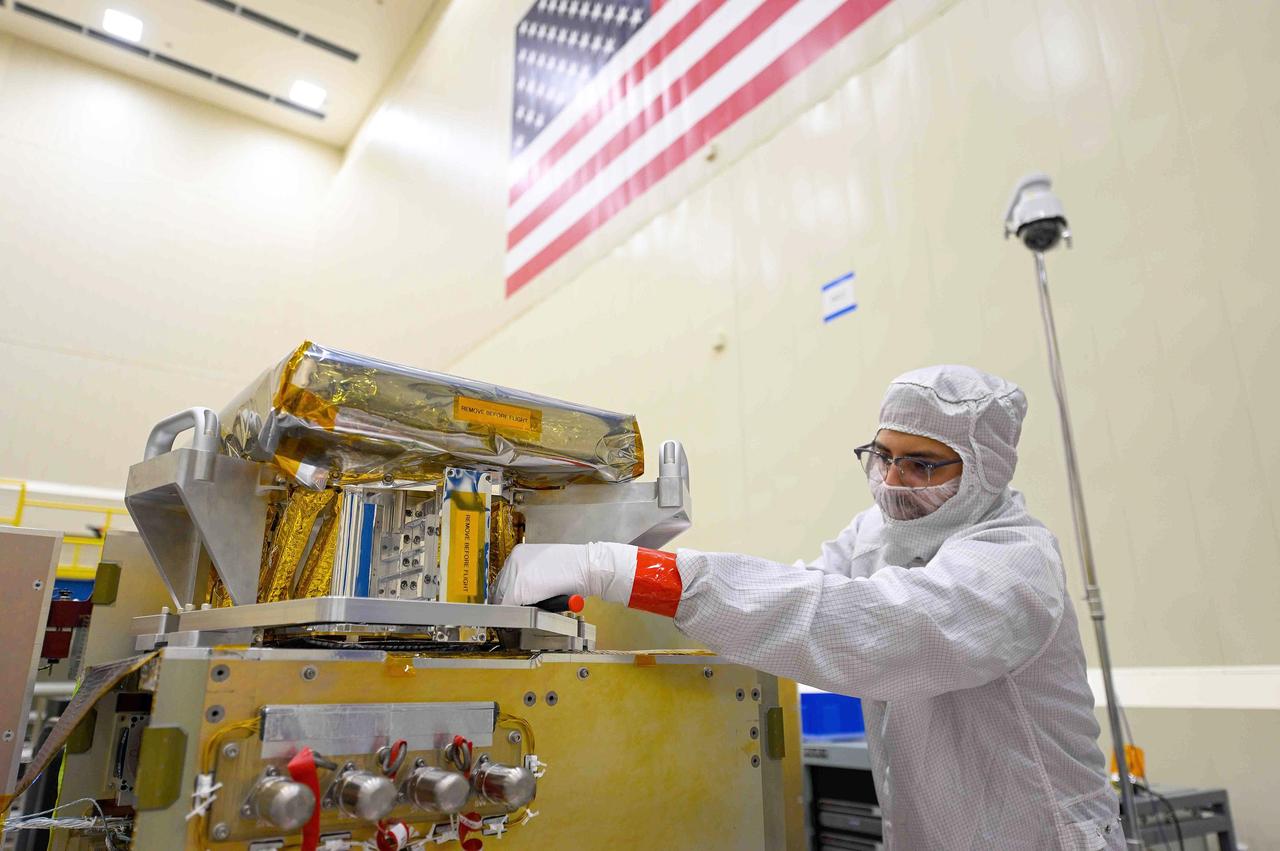
JPL · 2022-12-22 · PIA25255
A Closer View of NASA Lunar Trailblazer's HVM³ Imaging Spectrometer
An engineer works on the High-resolution Volatiles and Minerals Moon Mapper (HVM³) for NASA's Lunar Trailblazer spacecraft in a clean room at Lockheed Martin Space in Littleton, Colorado,…
Inspect NASA record
An engineer works on the High-resolution Volatiles and Minerals Moon Mapper (HVM³) for NASA's Lunar Trailblazer spacecraft in a clean room at Lockheed Martin Space in Littleton, Colorado, shortly after the instrument delivered in December 2022. HVM³ is an imaging spectrometer that was developed at NASA's Jet Propulsion Laboratory in Southern California. It was shipped from JPL to Lockheed Martin Space, where it was integrated with the spacecraft. HVM³ is one of two instruments that will be used by the mission to detect and map water on the Moon's surface to determine its abundance, location, form, and how it changes over time. Lunar Trailblazer was selected under NASA's Small Innovative Missions for Planetary Exploration (SIMPLEx) program in 2019. The Lunar Trailblazer mission is managed by JPL and its science investigation is led by Caltech in Pasadena, California. Managed for NASA by Caltech, JPL also provides system engineering, mission assurance, the HVM³ instrument, as well as navigation. Lockheed Martin Space provides the spacecraft and integrates the flight system, under contract with Caltech. SIMPLEx mission investigations are managed by the Planetary Missions Program Office at NASA's Marshall Space Flight Center in Huntsville, Alabama, as part of the Discovery Program at NASA Headquarters in Washington. The program conducts space science investigations in the Planetary Science Division of NASA's Science Mission Directorate at NASA Headquarters. https://photojournal.jpl.nasa.gov/catalog/PIA25255
- Record ID
- PIA25255
- NASA center
- JPL
- Date
- 2022-12-22
- Credit
- Lockheed Martin Space
- Keywords
- Lunar Trailblazer
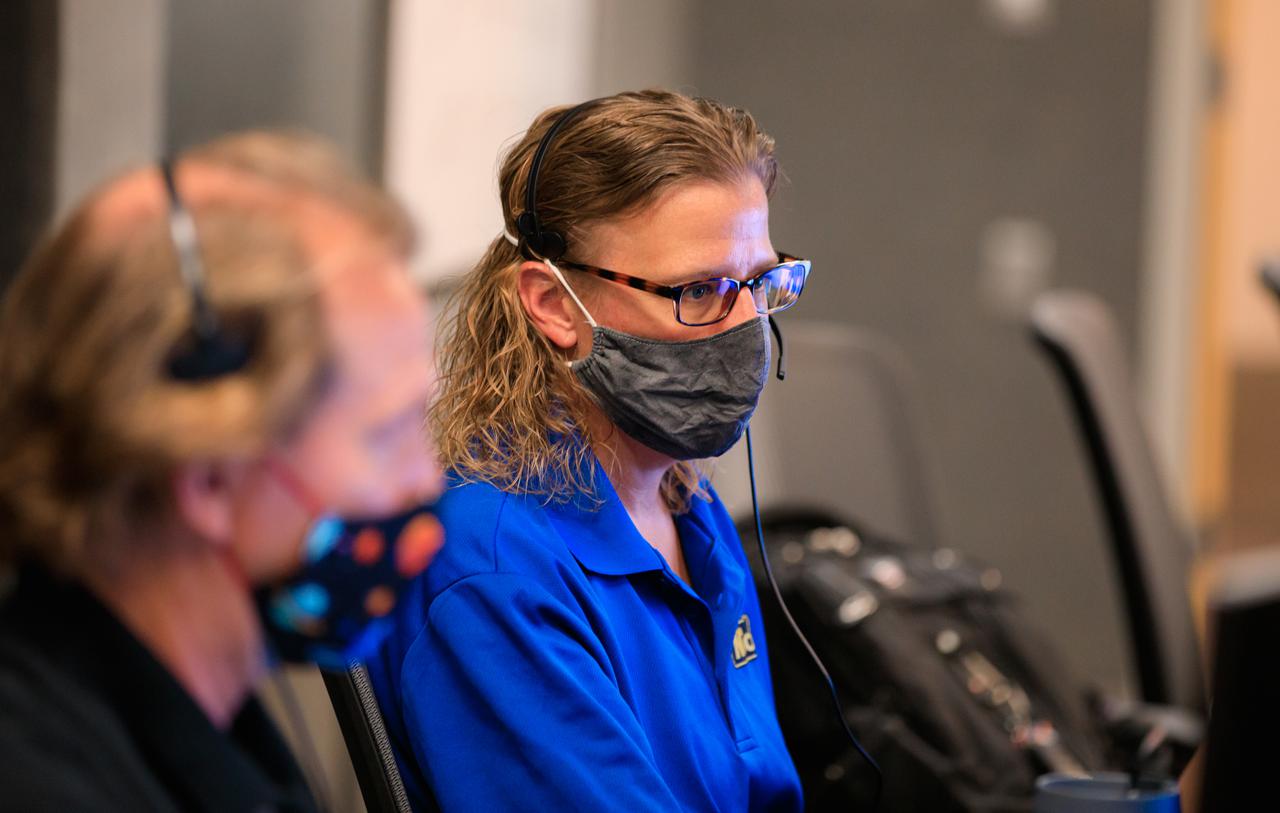
KSC · 2021-03-26 · KSC-20210326-PH-ILW01_0083
MSolo Connectivity Test
Janine Captain, at right, principal investigator for NASA’s Mass Spectrometer observing lunar operations (MSolo) takes part in a simulation of the Peregrine One Mission on March 26, 2021,…
Inspect NASA record
Janine Captain, at right, principal investigator for NASA’s Mass Spectrometer observing lunar operations (MSolo) takes part in a simulation of the Peregrine One Mission on March 26, 2021, where MSolo connected from inside the Neil Armstrong Operations and Checkout Building at NASA’s Kennedy Space Center in Florida to Astrobotic’s mission control facility in Pittsburgh, Pennsylvania. MSolo is a commercial off-the-shelf mass spectrometer modified to work in space and it will help analyze the chemical makeup of landing sites on the Moon, as well as study water on the lunar surface. This was the first mission round of simulations for Peregrine Mission One to develop and refine procedures between Astrobotic’s Peregrine Lander and MSolo. Later, there will be other simulations with multiple instruments. Peregrine Mission One will be one of NASA’s first Commercial Lunar Payload Delivery Service (CLPS) missions where under the Artemis program, commercial deliveries beginning in 2021 will perform science experiments, test technologies and demonstrate capabilities to help NASA explore the Moon and prepare for human missions.
- Record ID
- KSC-20210326-PH-ILW01_0083
- NASA center
- KSC
- Date
- 2021-03-26
- Credit
- NASA/Isaac Watson
- Keywords
- Connectivity Test, KSC, Kennedy Space Center, MSolo, NASA, Operations and Control Building

KSC · 2021-03-26 · KSC-20210326-PH-ILW01_0045
MSolo Connectivity Test
Rolando Nieves, software architect for NASA’s Mass Spectrometer observing lunar operations (MSolo) takes part in a joint simulation of the Peregrine One Mission on March 26, 2021, where…
Inspect NASA record
Rolando Nieves, software architect for NASA’s Mass Spectrometer observing lunar operations (MSolo) takes part in a joint simulation of the Peregrine One Mission on March 26, 2021, where MSolo is connected from inside the Neil Armstrong Operations and Checkout Building at NASA’s Kennedy Space Center in Florida to Astrobotic’s mission control facility in Pittsburgh, Pennsylvania. MSolo is a commercial off-the-shelf mass spectrometer modified to work in space and it will help analyze the chemical makeup of landing sites on the Moon, as well as study water on the lunar surface. This was the first mission round of simulations for Peregrine Mission One to develop and refine procedures between Astrobotic’s Peregrine Lander and MSolo. Later, there will be other simulations with multiple instruments. Peregrine Mission One will be one of NASA’s first Commercial Lunar Payload Delivery Service (CLPS) missions where under the Artemis program, commercial deliveries beginning in 2021 will perform science experiments, test technologies and demonstrate capabilities to help NASA explore the Moon and prepare for human missions.
- Record ID
- KSC-20210326-PH-ILW01_0045
- NASA center
- KSC
- Date
- 2021-03-26
- Credit
- NASA/Isaac Watson
- Keywords
- Connectivity Test, KSC, Kennedy Space Center, MSolo, NASA, Operations and Control Building
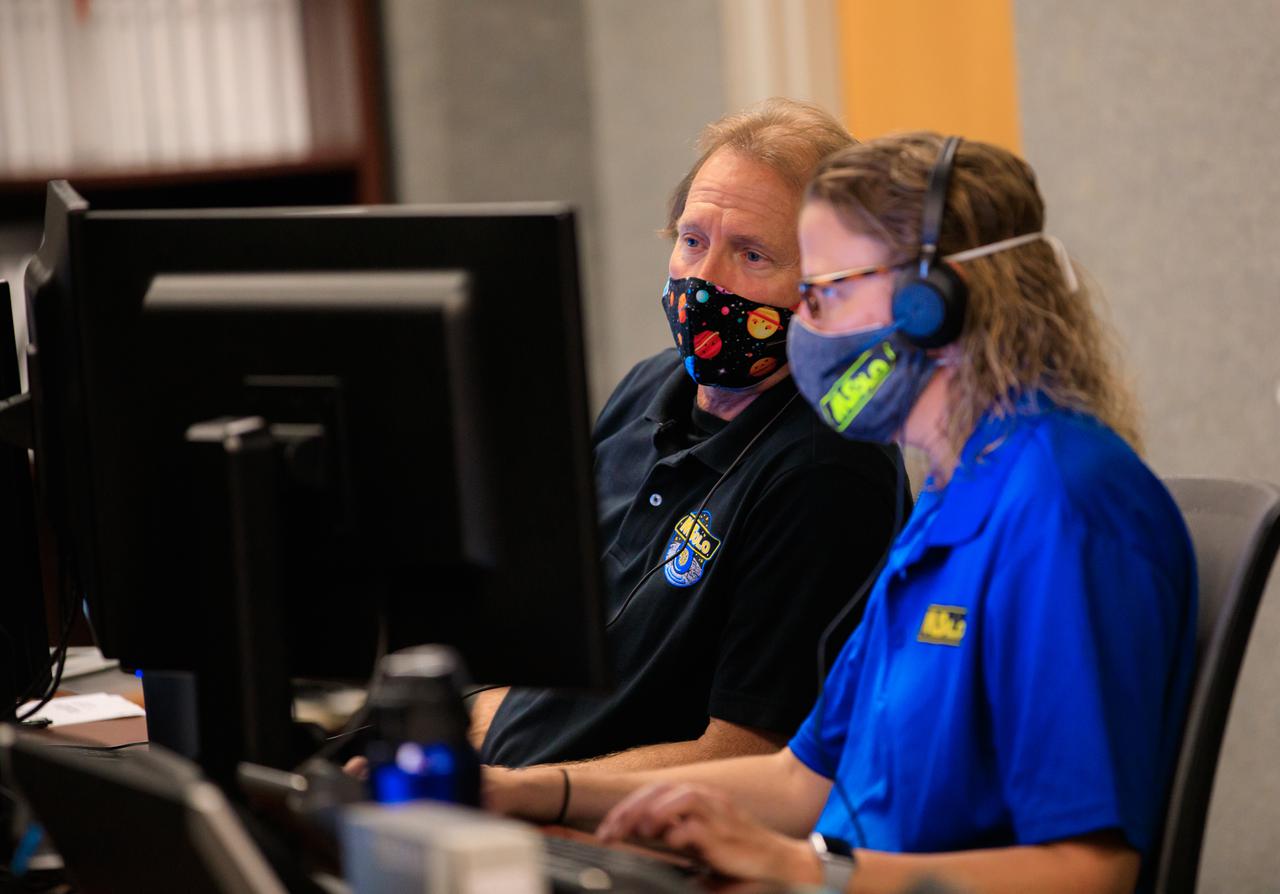
KSC · 2021-03-26 · KSC-20210326-PH-ILW01_0106
MSolo Connectivity Test
Janine Captain, at right, principal investigator for NASA’s Mass Spectrometer observing lunar operations (MSolo) and Kevin Smith, software team and science team liaison at NASA’s Kennedy Space Center…
Inspect NASA record
Janine Captain, at right, principal investigator for NASA’s Mass Spectrometer observing lunar operations (MSolo) and Kevin Smith, software team and science team liaison at NASA’s Kennedy Space Center in Florida, confer during a joint simulation of the Peregrine One Mission on March 26, 2021, where MSolo is connected from inside the Neil Armstrong Operations and Checkout Building to Astrobotic’s mission control facility in Pittsburgh, Pennsylvania. MSolo is a commercial off-the-shelf mass spectrometer modified to work in space and it will help analyze the chemical makeup of landing sites on the Moon, as well as study water on the lunar surface. This was the first mission round of simulations for Peregrine Mission One to develop and refine procedures between Astrobotic’s Peregrine Lander and MSolo. Later, there will be other simulations with multiple instruments. Peregrine Mission One will be one of NASA’s first Commercial Lunar Payload Delivery Service (CLPS) missions where under the Artemis program, commercial deliveries beginning in 2021 will perform science experiments, test technologies and demonstrate capabilities to help NASA explore the Moon and prepare for human missions.
- Record ID
- KSC-20210326-PH-ILW01_0106
- NASA center
- KSC
- Date
- 2021-03-26
- Credit
- NASA/Isaac Watson
- Keywords
- Connectivity Test, KSC, Kennedy Space Center, MSolo, NASA, Operations and Control Building

JSC · 2026-04-05 · jsc2026e021468
Artemis II lunar science team -- jsc2026e021468
Artemis II lunar science team member, foreground, Amber Turner, and David Hollibaugh-Baker, and Cherie Achilles, background, participate in the team’s analysis of crew observations during the lunar flyby…
Inspect NASA record
Artemis II lunar science team member, foreground, Amber Turner, and David Hollibaugh-Baker, and Cherie Achilles, background, participate in the team’s analysis of crew observations during the lunar flyby on April 6, 2026. The team worked in the Science Evaluation Room (SER) in Mission Control at NASA’s Johnson Space Center in Houston. Built specifically for Artemis missions with these science priorities in mind, the SER is equipped to support rapid data interpretation, collaborative analysis, real-time decision making, and seamless coordination between the science and operations teams. Credits: NASA/ Robert Markowitz
- Record ID
- jsc2026e021468
- NASA center
- JSC
- Date
- 2026-04-05
- Credit
- ROBERT MARKOWITZ NASA-JSC
- Keywords
- Artemis, Artemis II, lunar science, lunar geography, Science Evaluation Room, Moon

JSC · 2022-11-21 · art001e000263
Orion Approaches Moon for Outbound Powered Flyby
art001e000263 (Nov. 21, 2022) - A portion of the Moon looms large just beyond the Orion spacecraft in this image taken on the sixth day of the Artemis…
Inspect NASA record
art001e000263 (Nov. 21, 2022) - A portion of the Moon looms large just beyond the Orion spacecraft in this image taken on the sixth day of the Artemis I mission by a camera on the tip of one of Orion’s solar arrays. The spacecraft entered the lunar sphere of influence Sunday, Nov. 20, making the Moon, instead of Earth, the main gravitational force acting on the spacecraft. On Monday, Nov. 21, it came within 80 miles of the lunar surface, the closest approach of the uncrewed Artemis I mission, before moving into a distant retrograde orbit around the Moon. The darkest spot visible near the middle of the image is Mare Orientale.
- Record ID
- art001e000263
- NASA center
- JSC
- Date
- 2022-11-21
- Keywords
- Orion, Artemis I resource reel, Artemis I
MSFC · 1970-01-01 · 9902044
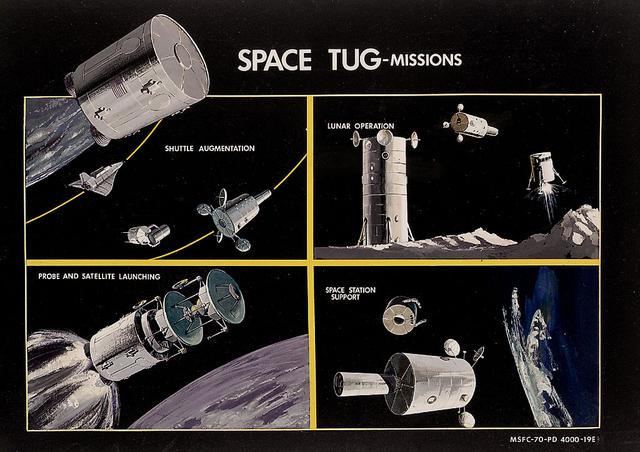
Early Program Development
Managed by Marshall Space Flight Center, the Space Tug concept was intended to be a reusable multipurpose space vehicle designed to transport payloads to different orbital inclinations. Utilizing…
Inspect NASA record
Managed by Marshall Space Flight Center, the Space Tug concept was intended to be a reusable multipurpose space vehicle designed to transport payloads to different orbital inclinations. Utilizing mission-specific combinations of its three primary modules (crew, propulsion, and cargo) and a variety of supplementary kits, the Space Tug was capable of numerous space applications. This 1970 artist's concept illustrates several examples of how the Tug's propulsion module could be implemented to support missions such as landing large payloads on a lunar surface, returning crew and cargo to lunar orbit, launching planetary probes from Earth orbit, and space station support.The Space Tug program was cancelled and did not become a reality.
- Record ID
- 9902044
- NASA center
- MSFC
- Date
- 1970-01-01
- Keywords
- Space
HQ · 2022-12-14 · NHQ202212140018
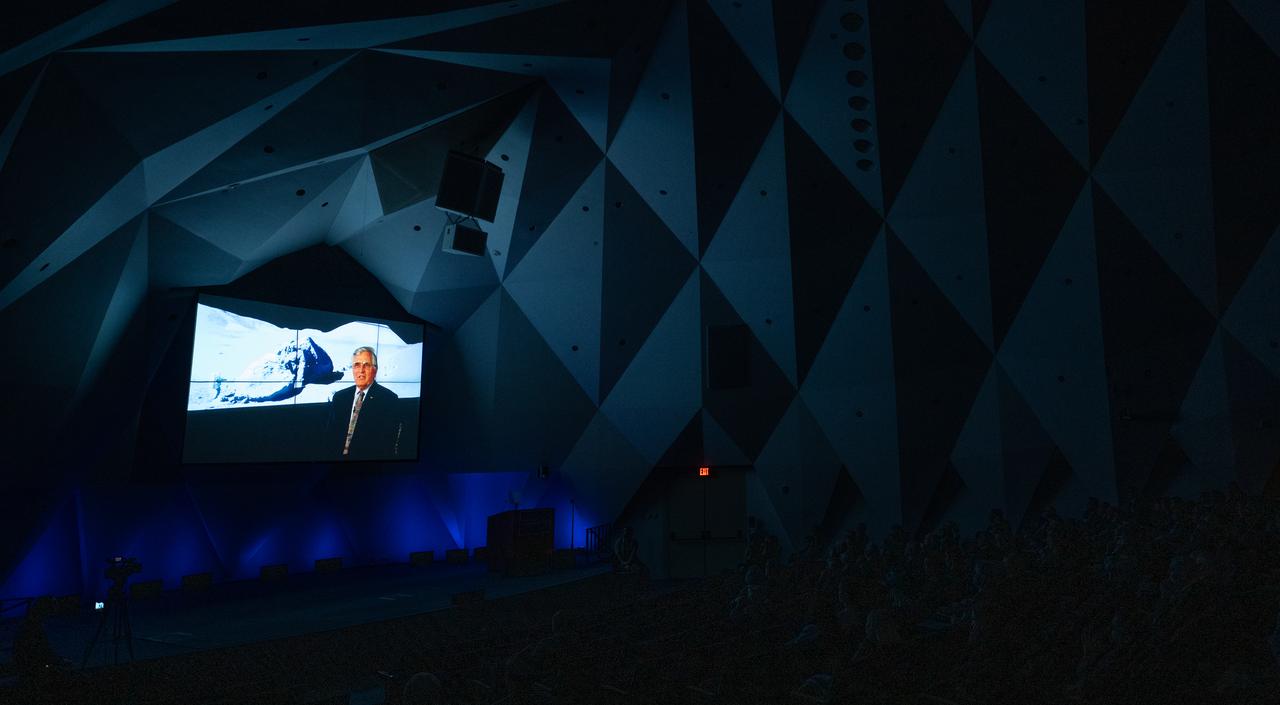
Apollo 17 50th Anniversary Celebration
Apollo 17 astronaut Harrison Schmitt is seen in a video during an event celebrating the 50th anniversary of the Apollo 17 mission, Wednesday, Dec. 14, 2022, at the…
Inspect NASA record
Apollo 17 astronaut Harrison Schmitt is seen in a video during an event celebrating the 50th anniversary of the Apollo 17 mission, Wednesday, Dec. 14, 2022, at the National Academies of Science in Washington. The three-astronaut crew of Apollo 17 - commander Eugene Cernan, lunar module pilot Harrison Schmitt, and command module pilot Ronald Evans, embarked on the last mission of the Apollo program to land humans on the Moon in December of 1972. Cernan and Schmitt spent three days on the lunar surface collecting samples and performing scientific experiments before lifting off from the Taurus-Littrow Valley on December 14, 1972. Photo Credit: (NASA/Joel Kowsky)
- Record ID
- NHQ202212140018
- NASA center
- HQ
- Date
- 2022-12-14
- Credit
- NASA/Joel Kowsky
- Keywords
- Apollo 17, Apollo 50th Anniversary, DC, Harrison Schmitt, National Academy of Sciences, Washington
JSC · 2026-04-05 · jsc2026e021469
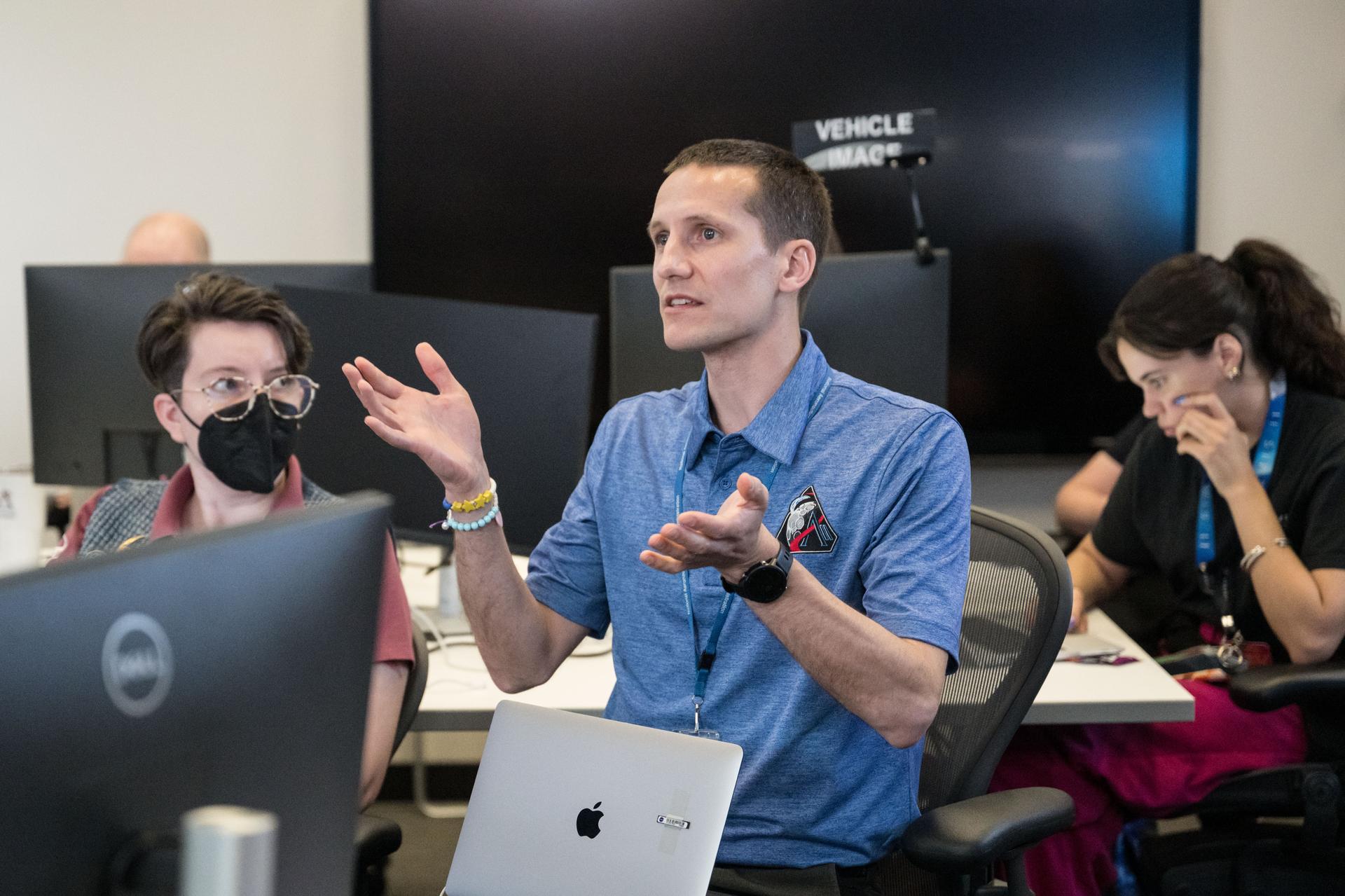
Artemis II lunar science team -- jsc2026e021469
Artemis II lunar science team members, from left, Alexadra Constantinou, David Hollibaugh-Baker, participate in the team’s final preparations for the lunar flyby. NASA Johnson public affairs officer, Victoria…
Inspect NASA record
Artemis II lunar science team members, from left, Alexadra Constantinou, David Hollibaugh-Baker, participate in the team’s final preparations for the lunar flyby. NASA Johnson public affairs officer, Victoria Segovia, is seen in the background. The team worked in the Science Evaluation Room (SER) in Mission Control at NASA’s Johnson Space Center in Houston. Built specifically for Artemis missions with these science priorities in mind, the SER is equipped to support rapid data interpretation, collaborative analysis, real-time decision making, and seamless coordination between the science and operations teams. Credits: Credits: NASA/ Robert Markowitz
- Record ID
- jsc2026e021469
- NASA center
- JSC
- Date
- 2026-04-05
- Credit
- ROBERT MARKOWITZ NASA-JSC
- Keywords
- Artemis, Artemis II, Lunar science, lunar geography, Science Evaluation Room, Moon
HQ · 2023-05-19 · NHQ202305190016
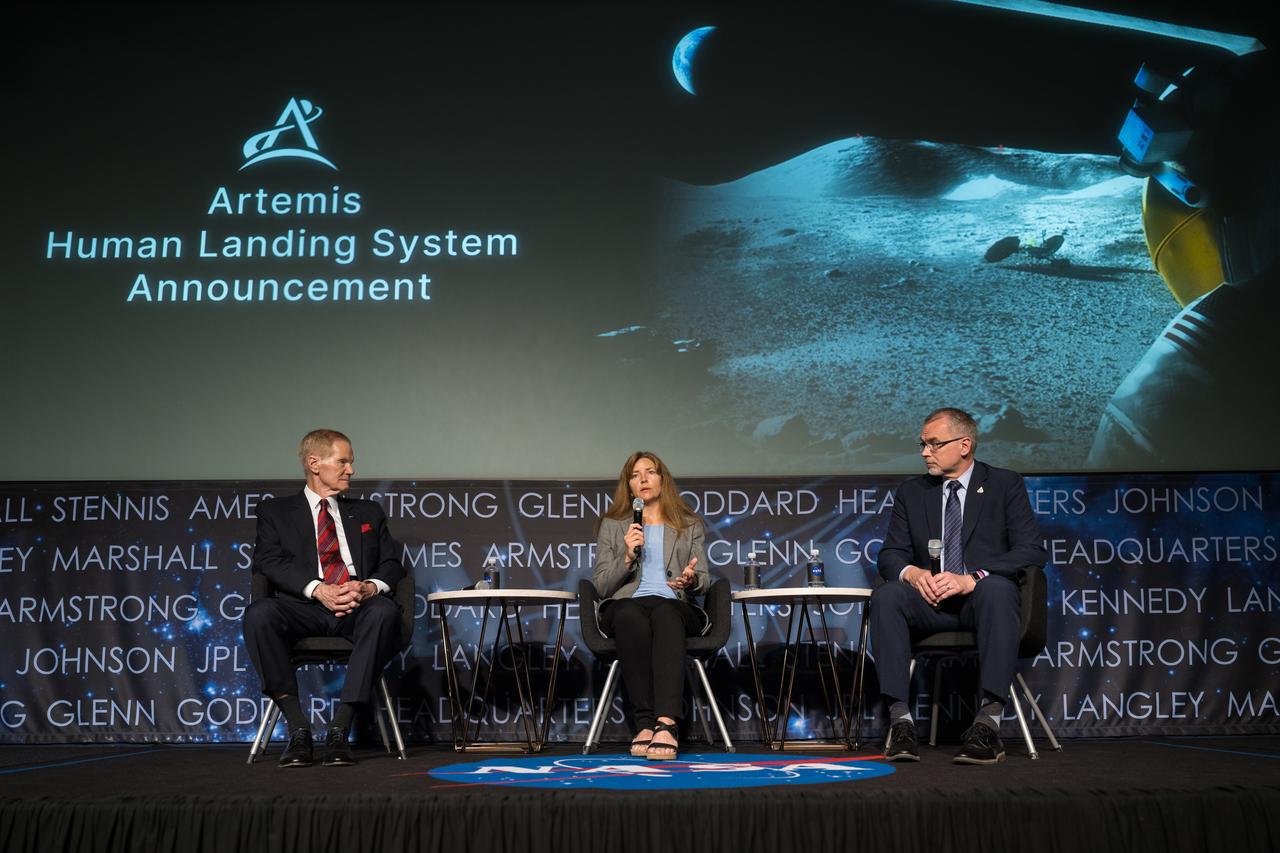
Artemis Human Landing System Announcement
Human Landing System Program Manager Lisa Watson-Morgan gives remarks as NASA Administrator Bill Nelson, left, and NASA Associate Administrator for the Exploration Systems Development Mission Directorate Jim Free,…
Inspect NASA record
Human Landing System Program Manager Lisa Watson-Morgan gives remarks as NASA Administrator Bill Nelson, left, and NASA Associate Administrator for the Exploration Systems Development Mission Directorate Jim Free, right, look on during an event announcing Blue Origin as the company selected to develop a sustainable human landing system for the Artemis V Moon mission, Friday, May 19, 2023 at the Mary W. Jackson NASA Headquarters building in Washington. The human landing system will take astronauts to and from Gateway in lunar orbit to the surface and back to the lunar space station as part of NASA’s return to the Moon for science, exploration, and inspiration. Photo Credit: (NASA/Aubrey Gemignani)
- Record ID
- NHQ202305190016
- NASA center
- HQ
- Date
- 2023-05-19
- Credit
- NASA/Aubrey Gemignani
- Keywords
- Artemis, Bill Nelson, DC, Human Landing System (HLS), Jim Free, Lisa Watson-Morgan, Mary W. Jackson NASA Headquarters, NASA Administrator, Washington