
Update Site (from NASA)
Explore NASA’s Image and Video Library.
Suggest one object per day for the Interstellar Minds collection. We review each suggestion before adding it.
Sign in to suggest a Marvel.
Find a NASA image ID. Open a NASA record and copy its ID from the end of the details URL.
NASA image records
JPL · 2009-09-24 · PIA12221
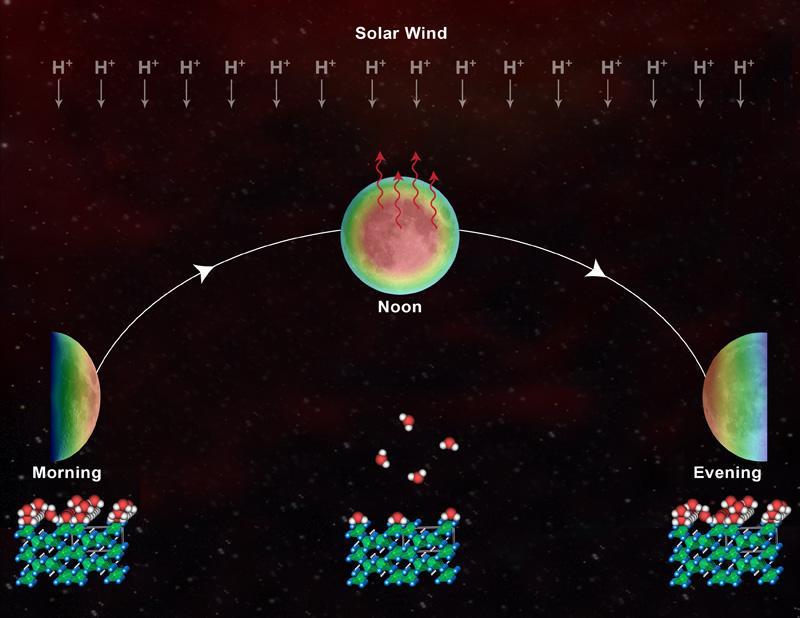
Daytime Water Cycle on the Moon
A schematic shows the daytime cycle of hydration, loss and rehydration on the lunar surface. This theory is based on data from NASA Deep Impact mission.
Inspect NASA record
A schematic shows the daytime cycle of hydration, loss and rehydration on the lunar surface. This theory is based on data from NASA Deep Impact mission.
- Record ID
- PIA12221
- NASA center
- JPL
- Date
- 2009-09-24
- Credit
- University of Maryland/McREL.
- Keywords
- Deep Impact
JSC · 2026-04-06 · art002e009278
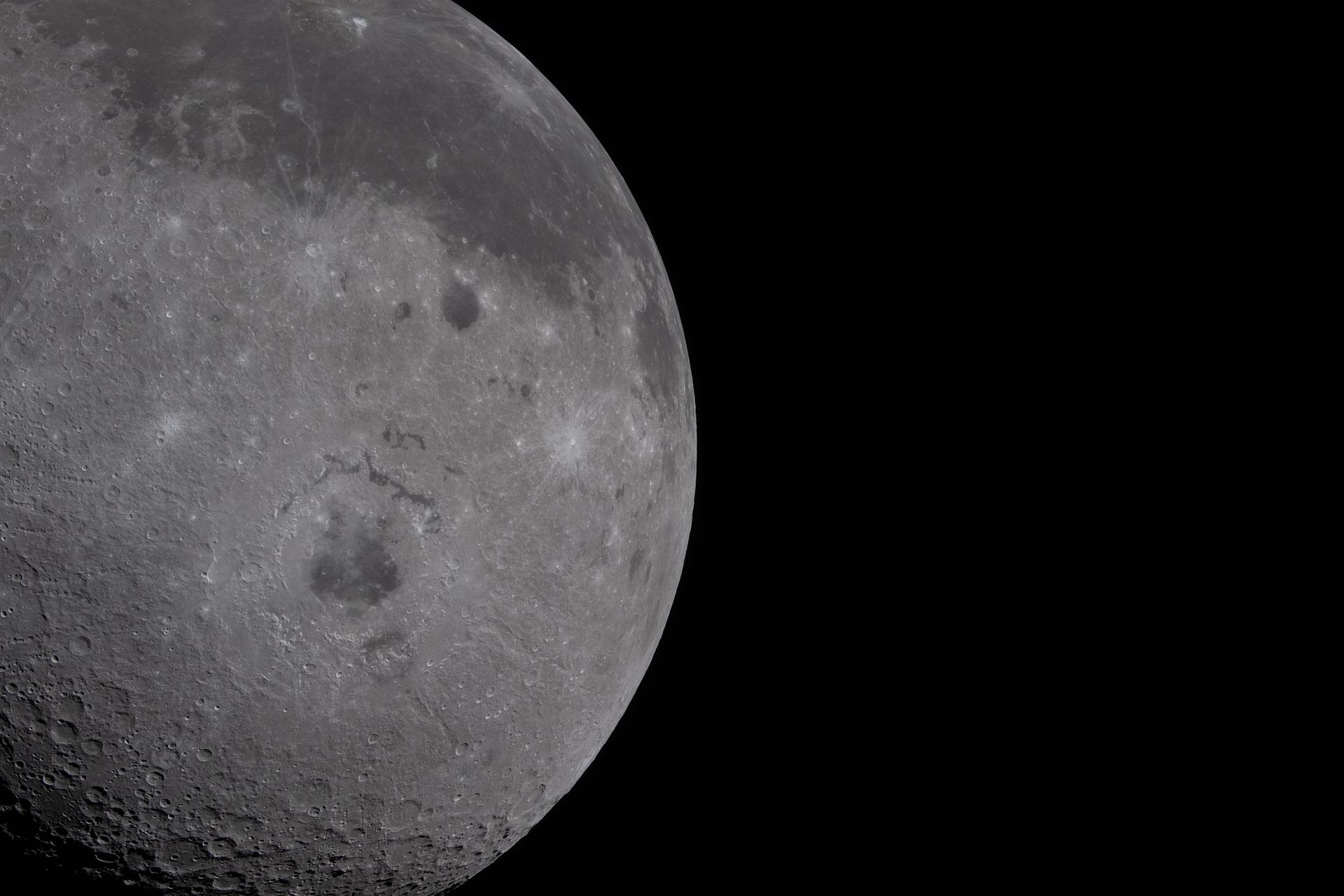
Keeper of the Night Sky
art002e009278 (April 6, 2026) - Just over half of the Moon fills the left half of the image. The near side, characterized by the dark patches of ancient…
Inspect NASA record
art002e009278 (April 6, 2026) - Just over half of the Moon fills the left half of the image. The near side, characterized by the dark patches of ancient lava, is visible on the top third of the lunar disk. Orientale basin, a round crater in the center with a black patch of ancient lava in the center, is wrapped in rings of mountains. The round black spot northeast of Orientale is Grimaldi crater, and Aristarchus crater is the bright white dot in the midst of a dark grey lava flow at the top of the image.
- Record ID
- art002e009278
- NASA center
- JSC
- Date
- 2026-04-06
- Credit
- NASA
- Keywords
- Artemis II, Artemis II mission, Artemis 2 mission, lunar flyby
JSC · 2026-04-06 · art002e009279
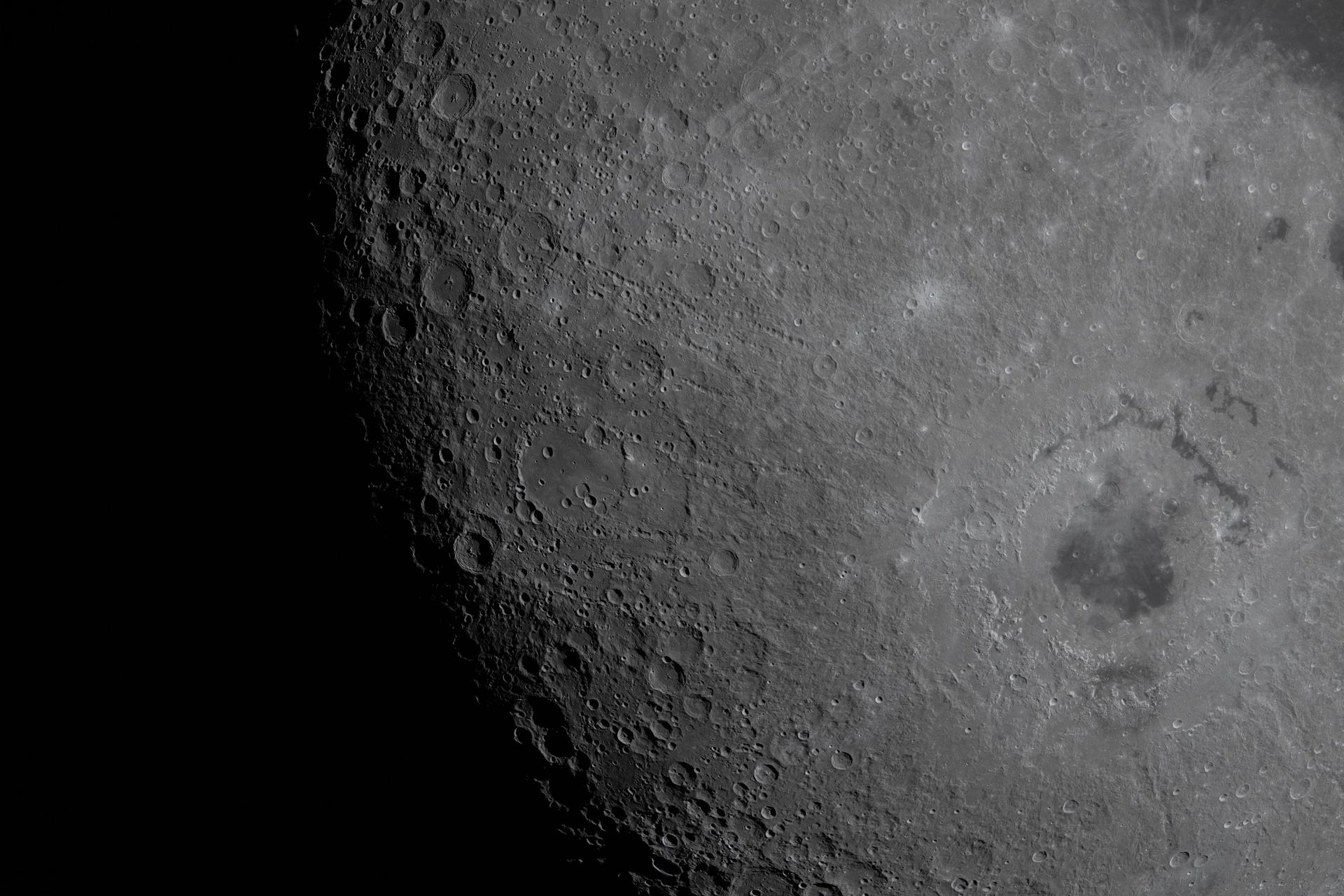
It’s All in the Details
art002e009279 (April 6, 2026) – During their lunar flyby observation period, the Artemis II crew captured this image at 3:41 p.m. EDT, showing the rings of the Orientale…
Inspect NASA record
art002e009279 (April 6, 2026) – During their lunar flyby observation period, the Artemis II crew captured this image at 3:41 p.m. EDT, showing the rings of the Orientale basin, one of the Moon’s youngest and best-preserved large impact craters. These concentric rings offer scientists a rare window into how massive impacts shape planetary surfaces, helping refine models of crater formation and the Moon’s geologic history. At the 10 o’clock position of the Orientale basin, the two smaller craters – which the Artemis II crew has suggested be named Integrity and Carroll – are visible. These features highlight how crew observations can directly support surface feature identification and real-time science.
- Record ID
- art002e009279
- NASA center
- JSC
- Date
- 2026-04-06
- Credit
- NASA
- Keywords
- Artemis II, Artemis II Mission, Artemis 2 Mission, Lunar Flyby
JSC · 2026-04-06 · art002e009277
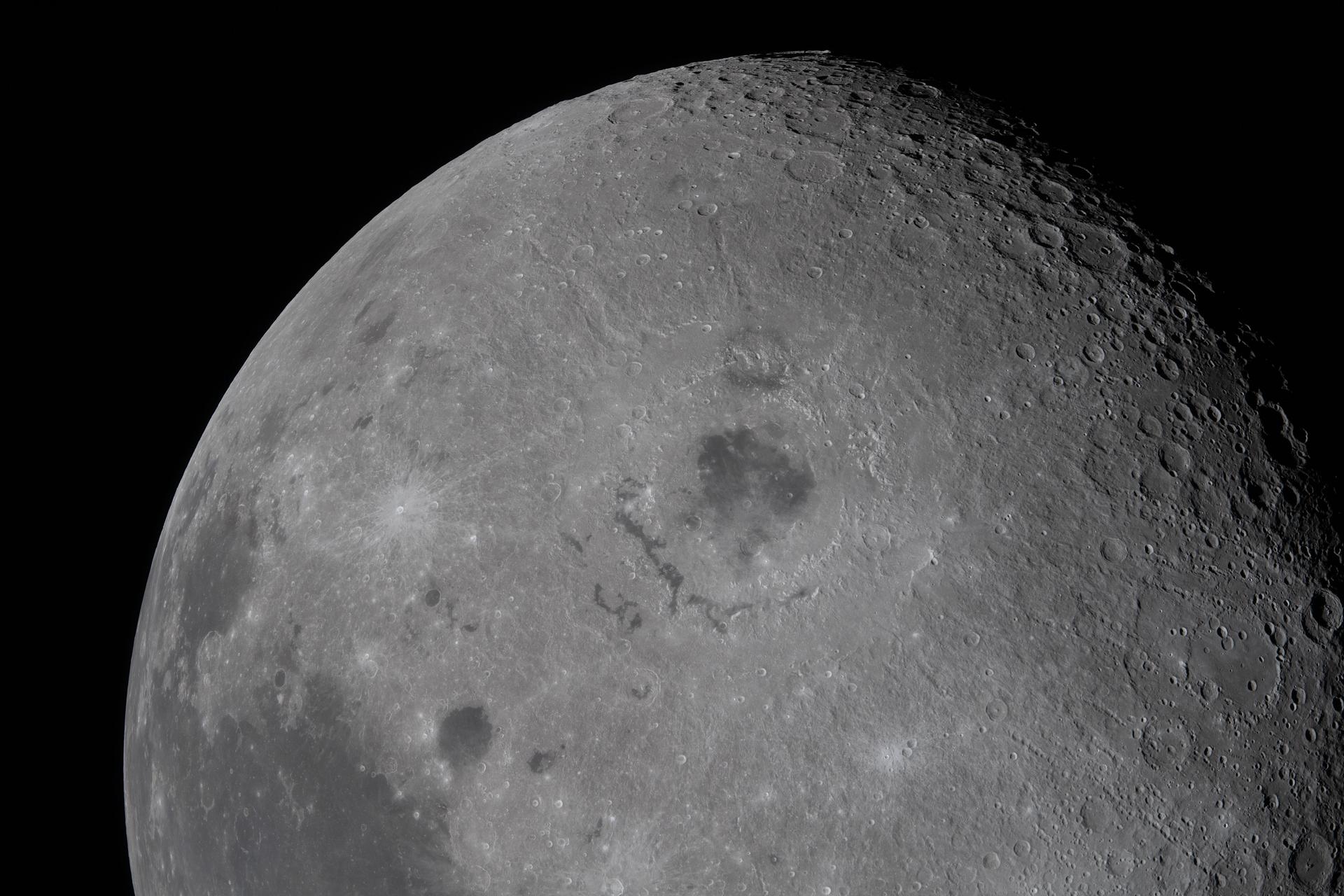
A Moment with the Moon
art002e009277 (April 6, 2026) - In this view of the Moon, taken by the Artemis II crew at 2:19 p.m. EDT, just before the crew began their observation…
Inspect NASA record
art002e009277 (April 6, 2026) - In this view of the Moon, taken by the Artemis II crew at 2:19 p.m. EDT, just before the crew began their observation period, Orientale basin is visible in the center, with a black patch of ancient lava in the center that punched through the Moon’s crust in an eruption billions of years ago. This 600-mile-wide impact crater lies along the transition between the near and far sides and is sometimes partly visible from Earth. The small, bright crater to its left is Byrgius, which has 250-mile rays extending out from its basin.
- Record ID
- art002e009277
- NASA center
- JSC
- Date
- 2026-04-06
- Credit
- NASA
- Keywords
- Artemis II, Artemis II Mission, Artemis 2 Mission, Lunar Flyby

JSC · 2026-04-06 · art002e016204
Lunar Flyby Observations – NASA astronaut Victor Glover
art002e016204 (April 6, 2026) – NASA astronaut and Artemis II Pilot Victor Glover pictured here in the Orion spacecraft during the Artemis II lunar flyby. Glover and his…
Inspect NASA record
art002e016204 (April 6, 2026) – NASA astronaut and Artemis II Pilot Victor Glover pictured here in the Orion spacecraft during the Artemis II lunar flyby. Glover and his fellow crewmates spent approximately seven hours taking turns at the Orion windows capturing science data to share with their team back on Earth. At closest approach, they came within 4,067 miles of the Moon’s surface.
- Record ID
- art002e016204
- NASA center
- JSC
- Date
- 2026-04-06
- Credit
- NASA
- Keywords
- Artemis II, Artemis II mission, Artemis 2 mission, Lunar Flyby
JPL · 2022-12-23 · PIA25257
NASA's Lunar Flashlight Spotted From Earth on Its Way to the Moon
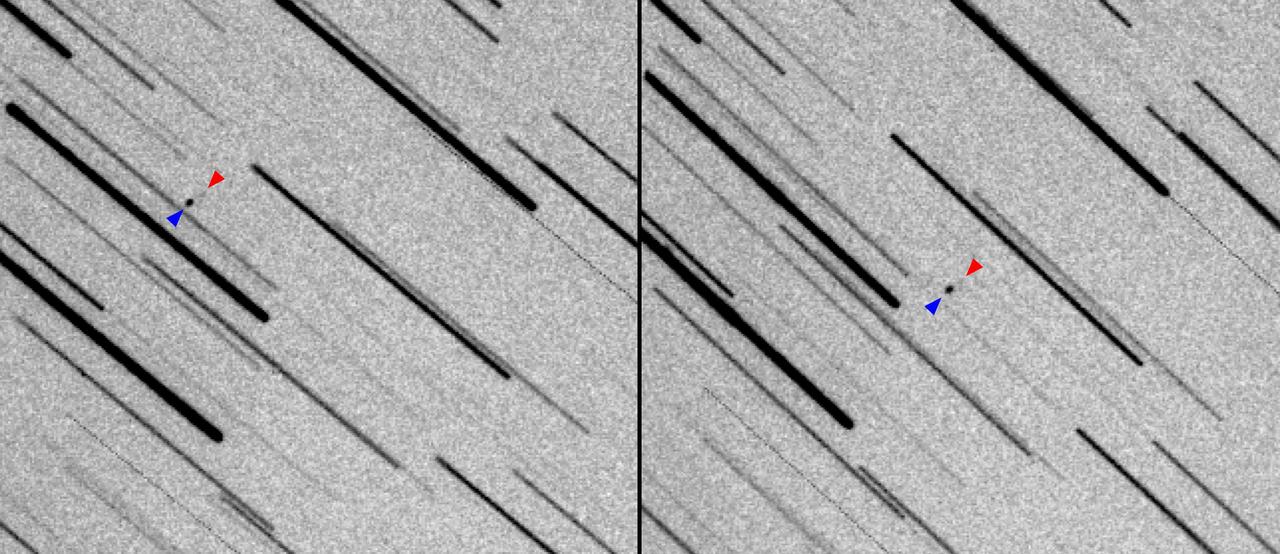
These images show two observations of NASA's Lunar Flashlight and the private ispace HAKUTO-R Mission 1 as the two spacecraft, seen as a pair of dots, journey to…
Inspect NASA record
These images show two observations of NASA's Lunar Flashlight and the private ispace HAKUTO-R Mission 1 as the two spacecraft, seen as a pair of dots, journey to the Moon. In Figure A, the images have been joined sequentially to create an animated GIF. The larger HAKUTO-R lunar lander appears as a large black dot, whereas the smaller Lunar Flashlight, which is about the size of a briefcase, appears as a fuzzy grouping of gray pixels. Stars appear as long trails. Both missions launched on Dec. 11, 2022, aboard a SpaceX Falcon 9 rocket, with Lunar Flashlight and HAKUTO-R spacecraft subsequently deploying from it. Astronomer Vishnu Reddy and graduate student Adam Battle, both from University of Arizona's Lunar and Planetary Laboratory and Space4 Center, used a remote 0.5-meter (1.6-foot) telescope in Australia to track the small spacecraft. They used data from the Horizons System at NASA's Jet Propulsion Laboratory in Southern California to find their position in the sky. These images were acquired about 39 hours after launch, when the two spacecraft were 145,000 miles (235,000 kilometers) from Earth. Black and white in the images have been inverted so that the brighter the object, the darker it is. To detect the faint reflected light from both spacecraft, they stacked 80 images, each from a 10-second exposure (for a total exposure time of 800 seconds), based on the rate of motion and direction of the spacecraft. This method resulted in stars appearing as long trails and the two spacecraft appearing as dots. Lunar Flashlight is a small satellite mission planning to use lasers to seek out surface water ice inside permanently shadowed craters at the Moon's South Pole. The small satellite is expected to reach its science orbit around the Moon in April 2023. Movie available at https://photojournal.jpl.nasa.gov/catalog/PIA25257
- Record ID
- PIA25257
- NASA center
- JPL
- Date
- 2022-12-23
- Credit
- University of Arizona
- Keywords
- Lunar Flashlight, Moon
JSC · 2025-04-10 · jsc2025e037586
The Lunar Gateway Launch Map (jsc2025e037586)
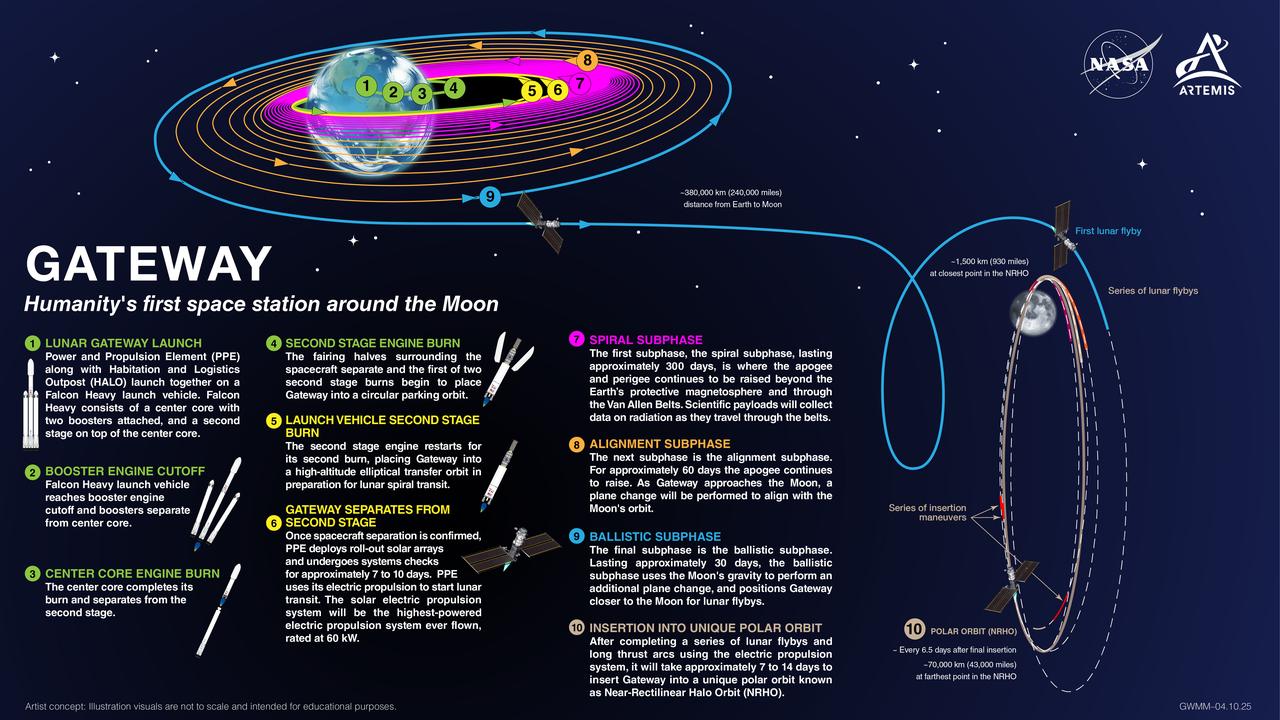
The Lunar Gateway Launch, mapped. Gateway's first elements, the Power and Propulsion Element and HALO (Habitation and Logistics Outpost), will launch together to lunar orbit, where they’ll set…
Inspect NASA record
The Lunar Gateway Launch, mapped. Gateway's first elements, the Power and Propulsion Element and HALO (Habitation and Logistics Outpost), will launch together to lunar orbit, where they’ll set the stage for Artemis IV: the first Gateway assembly mission. During this milestone mission, the Artemis IV crew will deliver the European Space Agency's Lunar I-Hab, dock it to HALO, and enter the space station for the very first time. NASA is currently targeting a 2027 launch for HALO and the Power and Propulsion Element. This timeline allows for the roughly year-long journey to lunar orbit and ensures everything is in place ahead of Artemis IV.
- Record ID
- jsc2025e037586
- NASA center
- JSC
- Date
- 2025-04-10
- Credit
- NASA/Gayle Dibiasio
- Keywords
- Gateway, Artemis, HALO, Power and Propulsion Element, Lunar Gateway Launch, Habitation and Logistics Outpost
JSC · 1969-11-19 · AS12-47-6949
Apollo 12 Mission image - Lunar surface near lunar module
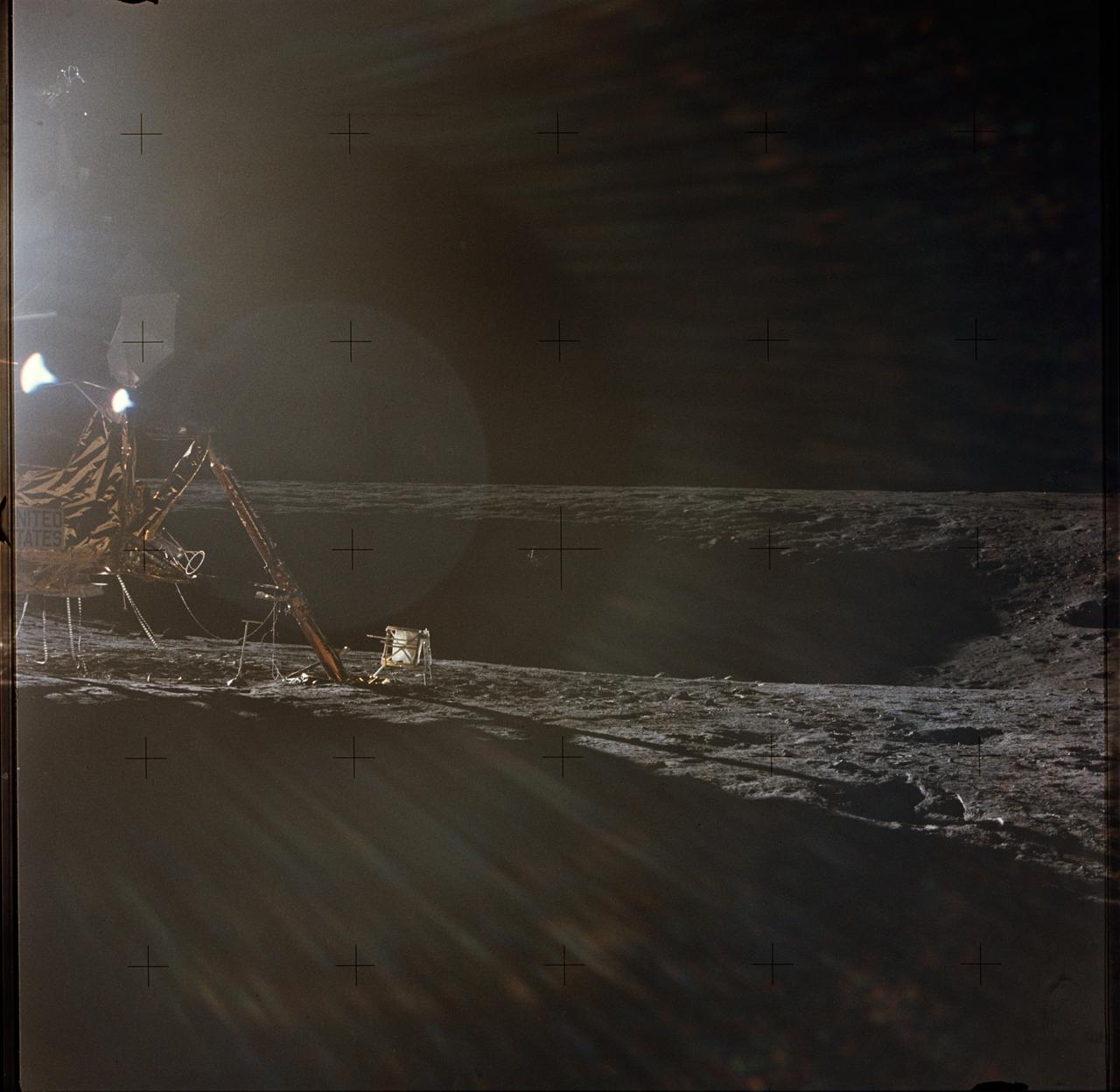
AS12-47-6949 (19-20 Nov. 1969) --- A photograph of the Apollo 12 lunar landing site taken during the extravehicular activity (EVA) of astronauts Charles Conrad Jr., commander; and Alan…
Inspect NASA record
AS12-47-6949 (19-20 Nov. 1969) --- A photograph of the Apollo 12 lunar landing site taken during the extravehicular activity (EVA) of astronauts Charles Conrad Jr., commander; and Alan L. Bean, lunar module pilot. The Apollo 12 Lunar Module (LM) is on the left. Barely visible in the center of the picture, in the shadows on the farside of the crater, is the Surveyor 3 spacecraft. The two spacecraft are about 600 feet apart. Conrad and Bean walked over to Surveyor 3 during their second EVA. The television camera and several other pieces were taken from Surveyor 3 and brought back to Earth for scientific examination. Astronaut Richard F. Gordon Jr., command module pilot, remained with the Command and Service Modules (CSM) in lunar orbit, while astronauts Conrad and Bean descended in the LM to explore the moon. The considerable glare in the picture is caused by the position of the sun. The Apollo tool carrier is the object next to the LM footpad.
- Record ID
- AS12-47-6949
- NASA center
- JSC
- Date
- 1969-11-19
- Keywords
- Apollo, Apollo 12, Moon
JSC · 2009-12-23 · as11-40-5915
Apollo 11 Mission image - Lunar surface and Lunar Module
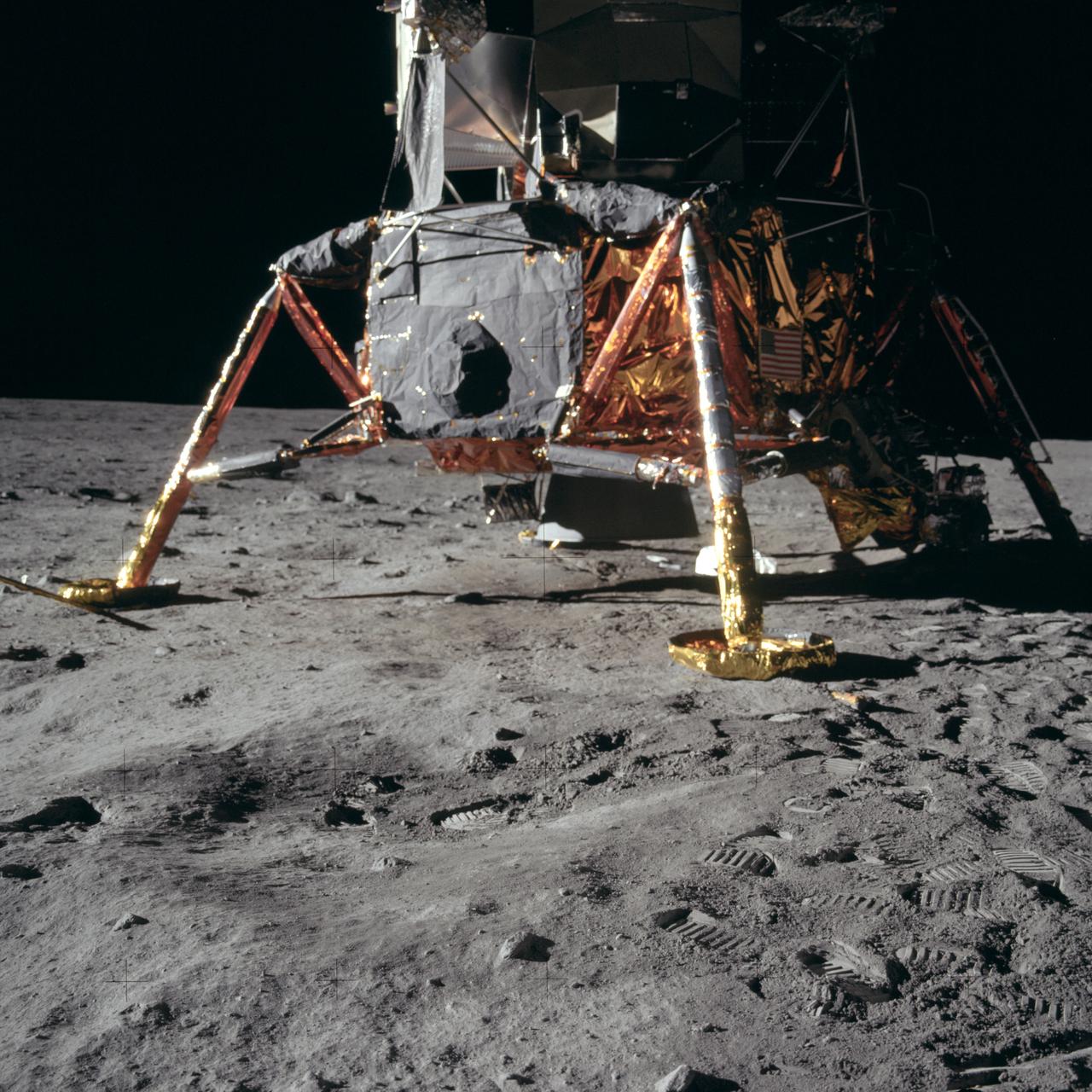
AS11-40-5915 (20 July 1969) --- Apollo 11 LM on lunar surface. Photo credit: NASA
Inspect NASA record
AS11-40-5915 (20 July 1969) --- Apollo 11 LM on lunar surface. Photo credit: NASA
- Record ID
- as11-40-5915
- NASA center
- JSC
- Date
- 2009-12-23
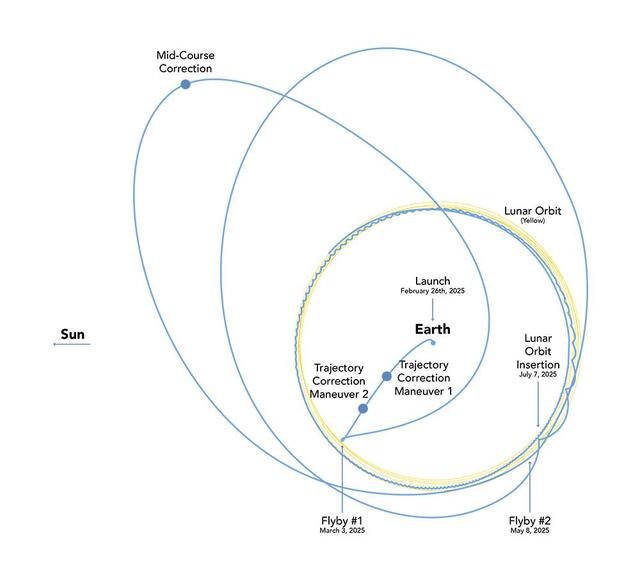
JPL · 2025-02-13 · PIA26459
Lunar Trailblazer's Looping Lunar Voyage
Lunar Trailblazer's voyage to the Moon will take between four and seven months, depending on the day it launches. This orbital diagram shows the low-energy transfer trajectory of…
Inspect NASA record
Lunar Trailblazer's voyage to the Moon will take between four and seven months, depending on the day it launches. This orbital diagram shows the low-energy transfer trajectory of the NASA mission should it launch on Feb. 26, the earliest date in a four-day launch period. If it launches that date, the spacecraft is expected to arrive in lunar orbit about four months later. Shown in this diagram are key dates of trajectory correction maneuvers, when the spacecraft will use its thrusters to shape its orbit, and lunar flybys. Lunar Trailblazer was a selection of NASA's SIMPLEx (Small Innovative Missions for Planetary Exploration), which provides opportunities for low-cost science spacecraft to ride-share with selected primary missions. To maintain the lower overall cost, SIMPLEx missions have a higher risk posture and lighter requirements for oversight and management. This higher risk acceptance allows NASA to test pioneering technologies, and the definition of success for these missions includes the lessons learned from more experimental endeavors. https://photojournal.jpl.nasa.gov/catalog/PIA26459
- Record ID
- PIA26459
- NASA center
- JPL
- Date
- 2025-02-13
- Credit
- Lockheed Martin Space
- Keywords
- Lunar Trailblazer

JSC · 2011-09-09 · jsc2011e118362
jsc2011e118362 - Panorama view of Apollo 16 lunar surface photos of the Station 10 and Sample 381 Rock taken during the second moonwalk of the mission. The panoramas were built by combining Apollo 16 images starting with frame AS16-114-18450 thru end frame
jsc2011e118362 - Panorama view of Apollo 16 lunar surface photos of the Station 10 and Sample 381 Rock taken during the second moonwalk of the mission. The panoramas…
Inspect NASA record
jsc2011e118362 - Panorama view of Apollo 16 lunar surface photos of the Station 10 and Sample 381 Rock taken during the second moonwalk of the mission. The panoramas were built by combining Apollo 16 images starting with frame AS16-114-18450 thru end frame AS16-114-18467. The panoramic images received minimal retouching by NASA imagery specialists, including the removal of lens flares that were problematic in stitching together the individual frames and blacking out the sky to the lunar horizon. These adjustments were made based on observations of the Moon walkers who reported that there are no stars visible in the sky due to the bright lunar surface reflection of the Sun.
- Record ID
- jsc2011e118362
- NASA center
- JSC
- Date
- 2011-09-09