
Update Site (from NASA)
Explore NASA’s Image and Video Library.
Suggest one object per day for the Interstellar Minds collection. We review each suggestion before adding it.
Sign in to suggest a Marvel.
Find a NASA image ID. Open a NASA record and copy its ID from the end of the details URL.
NASA image records
KSC · 1998-11-12 · KSC-98pc1634
KSC-98pc1634
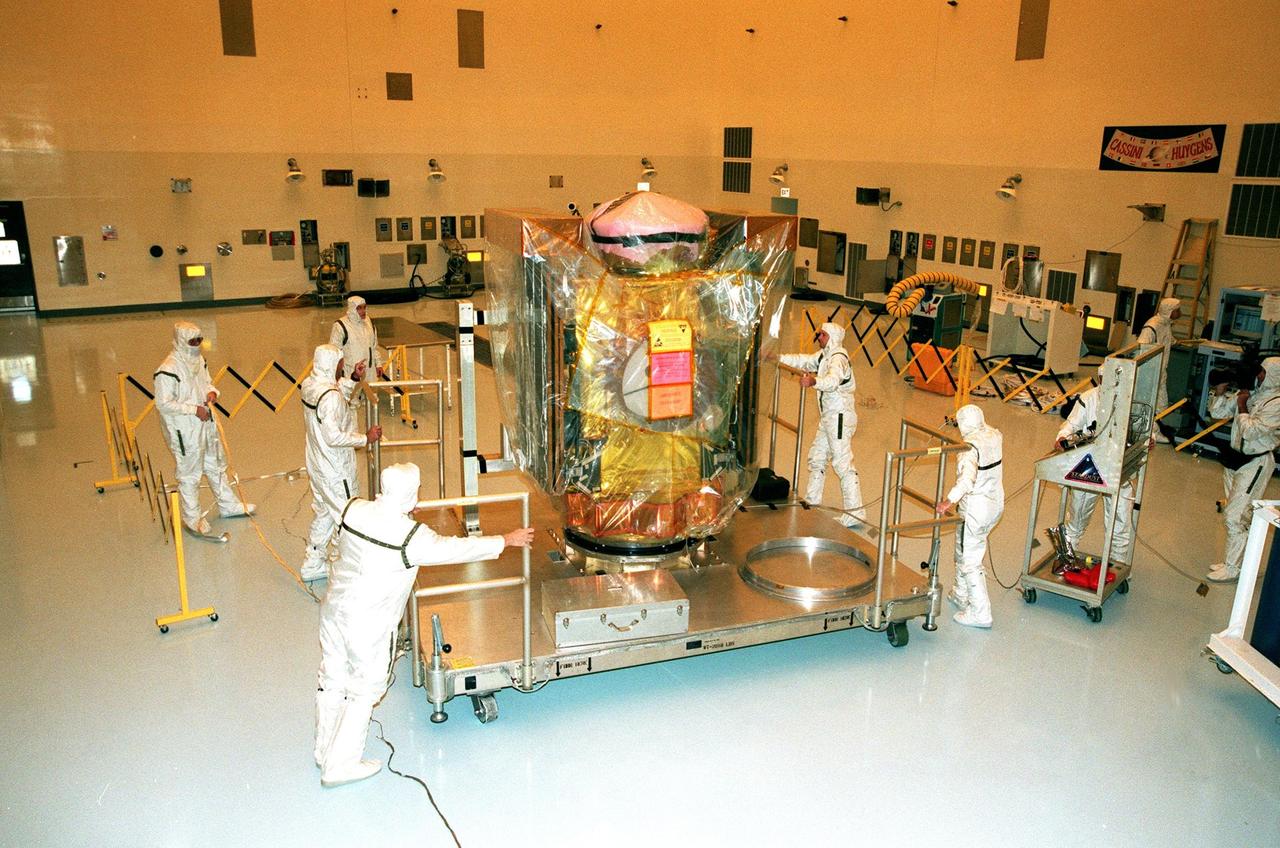
In the Payload Hazardous Service Facility, workers move the Stardust spacecraft on its workstand from the air lock to the high bay. The spacecraft will undergo installation and…
Inspect NASA record
In the Payload Hazardous Service Facility, workers move the Stardust spacecraft on its workstand from the air lock to the high bay. The spacecraft will undergo installation and testing of the solar arrays, plus final installation and testing of spacecraft instruments followed by an overall spacecraft functional test. Built by Lockheed Martin Astronautics near Denver, Colo., for the Jet Propulsion Laboratory (JPL) and NASA, the spacecraft Stardust will use a unique medium called aerogel to capture comet particles flying off the nucleus of comet Wild 2 in January 2004, plus collect interstellar dust for later analysis. Stardust will be launched aboard a Boeing Delta 7426 rocket from Complex 17, Cape Canaveral Air Station, targeted for Feb. 6, 1999. The collected samples will return to Earth in a re-entry capsule to be jettisoned from Stardust as it swings by Earth in January 2006
- Record ID
- KSC-98pc1634
- NASA center
- KSC
- Date
- 1998-11-12
KSC · 1998-11-12 · KSC-98pc1640
KSC-98pc1640
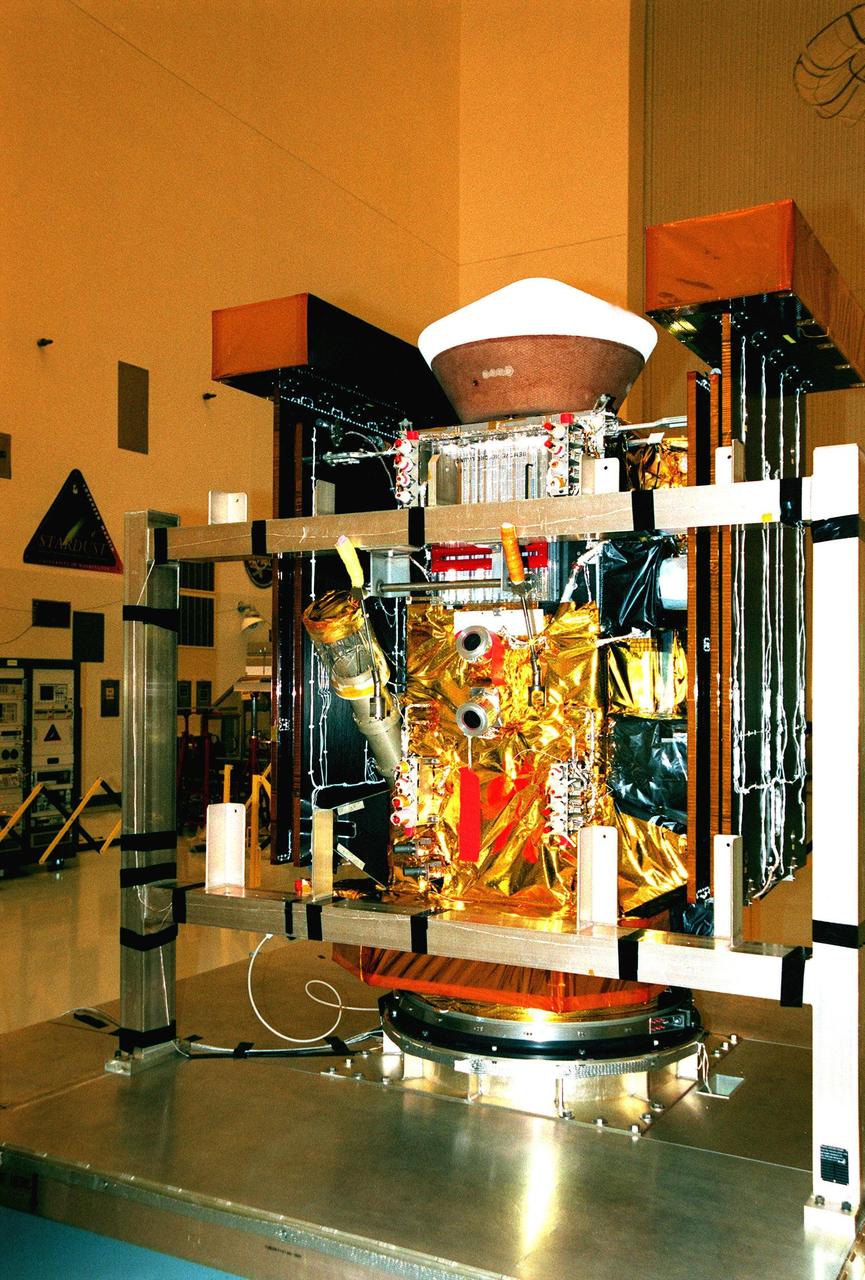
The Stardust spacecraft sits in the Payload Hazardous Service Facility waiting to undergo installation and testing of the solar arrays, plus final installation and testing of spacecraft instruments…
Inspect NASA record
The Stardust spacecraft sits in the Payload Hazardous Service Facility waiting to undergo installation and testing of the solar arrays, plus final installation and testing of spacecraft instruments followed by an overall spacecraft functional test. At the top is the re-entry capsule. Built by Lockheed Martin Astronautics near Denver, Colo., for the Jet Propulsion Laboratory (JPL) and NASA, the spacecraft Stardust will use a unique medium called aerogel to capture comet particles flying off the nucleus of comet Wild 2 in January 2004, plus collect interstellar dust for later analysis. Stardust will be launched aboard a Boeing Delta 7426 rocket from Complex 17, Cape Canaveral Air Station, targeted for Feb. 6, 1999. The collected samples will return to Earth in the re-entry capsule to be jettisoned from Stardust as it swings by Earth in January 2006
- Record ID
- KSC-98pc1640
- NASA center
- KSC
- Date
- 1998-11-12

KSC · 1998-11-12 · KSC-98pc1635
KSC-98pc1635
In the Payload Hazardous Service Facility, workers check the placement of the Stardust spacecraft's workstand in the high bay. The spacecraft will undergo installation and testing of the…
Inspect NASA record
In the Payload Hazardous Service Facility, workers check the placement of the Stardust spacecraft's workstand in the high bay. The spacecraft will undergo installation and testing of the solar arrays, plus final installation and testing of spacecraft instruments followed by an overall spacecraft functional test. Built by Lockheed Martin Astronautics near Denver, Colo., for the Jet Propulsion Laboratory (JPL) and NASA, the spacecraft Stardust will use a unique medium called aerogel to capture comet particles flying off the nucleus of comet Wild 2 in January 20004, plus collect interstellar dust for later analysis. Stardust will be launched aboard a Boeing Delta 7426 rocket from Complex 17, Cape Canaveral Air Station, targeted for Feb. 6, 1999. The collected samples will return to Earth in a re-entry capsule to be jettisoned from Stardust as it swings by Earth in January 2006
- Record ID
- KSC-98pc1635
- NASA center
- KSC
- Date
- 1998-11-12
JPL · 2003-12-12 · PIA04927
Voyager Approaches Final Frontier Artist Concept
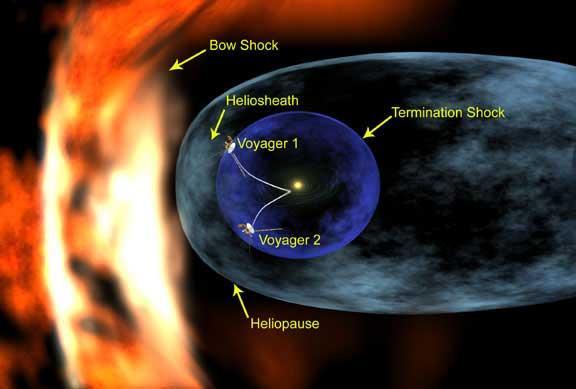
An artist's concept illustrates the positions of the Voyager spacecraft in relation to structures formed around our Sun by the solar wind. Also illustrated is the termination shock,…
Inspect NASA record
An artist's concept illustrates the positions of the Voyager spacecraft in relation to structures formed around our Sun by the solar wind. Also illustrated is the termination shock, a violent region the spacecraft must pass through before reaching the outer limits of the solar system. At the termination shock, the supersonic solar wind abruptly slows from an average speed of 400 kilometers per second to less than 100 kilometer per second (900,000 to less than 225,000 miles per hour). Beyond the termination shock is the solar system's final frontier, the heliosheath, a vast region where the turbulent and hot solar wind is compressed as it presses outward against the interstellar wind that is beyond the heliopause. A bow shock likely forms as the interstellar wind approaches and is deflected around the heliosphere, forcing it into a teardrop-shaped structure with a long, comet-like tail. The exact location of the termination shock is unknown, and it originally was thought to be closer to the Sun than Voyager 1 currently is. As Voyager 1 cruised ever farther from the Sun, it confirmed that all the planets are inside an immense bubble blown by the solar wind and the termination shock was much more distant. http://photojournal.jpl.nasa.gov/catalog/PIA04927
- Record ID
- PIA04927
- NASA center
- JPL
- Date
- 2003-12-12
- Credit
- NASA/JPL/Walt Feimer
- Keywords
- Sun, Voyager, artist concept
JPL · 2017-10-04 · PIA22081
Tabby's Star (Illustration)
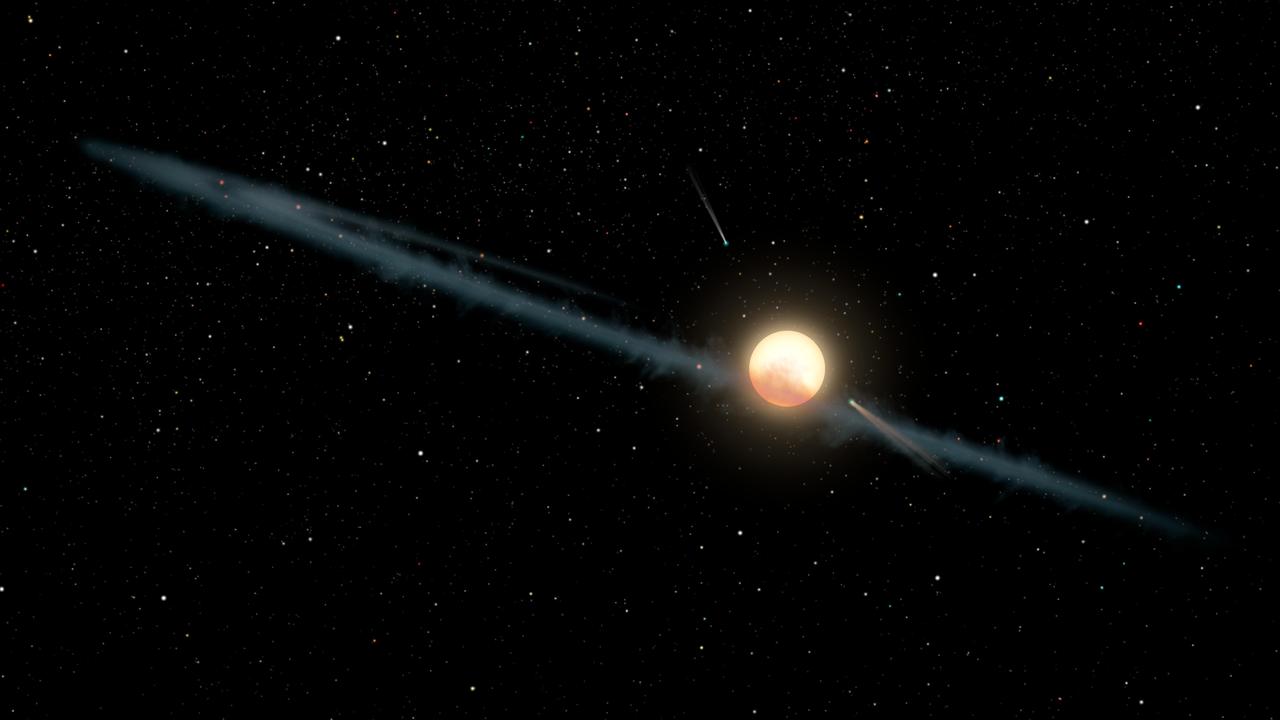
This illustration depicts a hypothetical uneven ring of dust orbiting KIC 8462852, also known as Boyajian's Star or Tabby's Star. Astronomers have found the dimming of the star…
Inspect NASA record
This illustration depicts a hypothetical uneven ring of dust orbiting KIC 8462852, also known as Boyajian's Star or Tabby's Star. Astronomers have found the dimming of the star over long periods appears to be weaker at longer infrared wavelengths of light and stronger at shorter ultraviolet wavelengths. Such reddening is characteristic of dust particles and inconsistent with more fanciful "alien megastructure" concepts, which would evenly dim all wavelengths of light. By studying observations from NASA's Spitzer and Swift telescopes, as well as the Belgian AstroLAB IRIS observatory, the researchers have been able to better constrain the size of the dust particles. This places them within the range found in dust disks orbiting stars, and larger than the particles typically found in interstellar dust. The system is portrayed with a couple of comets, consistent with previous studies that have found evidence for cometary activity within the system. https://photojournal.jpl.nasa.gov/catalog/PIA22081
- Record ID
- PIA22081
- NASA center
- JPL
- Date
- 2017-10-04
- Credit
- NASA/JPL-Caltech
- Keywords
- Spitzer Space Telescope, KIC 8462852, Boyajian's Star

JPL · 2018-12-10 · PIA22921
Voyager 2 and the Scale of the Solar System (Artist Concept)
This artist's concept puts solar system distances -- and the travels of NASA's Voyager 2 spacecraft -- in perspective. The scale bar is in astronomical units, with each…
Inspect NASA record
This artist's concept puts solar system distances -- and the travels of NASA's Voyager 2 spacecraft -- in perspective. The scale bar is in astronomical units, with each set distance beyond 1 AU representing 10 times the previous distance. One AU is the distance from the Sun to Earth, which is about 93 million miles, or 150 million kilometers. Neptune, the most distant planet from the Sun, is about 30 AU. Much of the solar system is actually in interstellar space. Informally, the term "solar system" is often used to mean the space out to the last planet. Scientific consensus, however, says the solar system goes out to the Oort Cloud, the source of the comets that swing by our sun on long time scales. Beyond the outer edge of the Oort Cloud, the gravity of other stars begins to dominate that of the Sun. The inner edge of the main part of the Oort Cloud could be as close as 1,000 AU from our Sun. The outer edge is estimated to be around 100,000 AU. Voyager 2, the second farthest human-made object after Voyager 1, is around 119 AU from the Sun. Indications from the scientific instruments suggest Voyager 2 passed beyond our heliosphere (the bubble of plasma the Sun blows around itself) and into interstellar space (the space between stars) in November 2018. The heliosphere has a turbulent outer boundary known as the heliosheath. The termination shock is the inner boundary of the heliosheath and the heliopause is the outer boundary, beyond which lies interstellar space. Voyager 2 crossed the termination shock at 84 AU in August 2007. It will take about 300 years for Voyager 2 to reach the inner edge of the Oort Cloud and possibly about 30,000 years to fly beyond it. Voyager 2 is heading away from the Sun about 36 degrees out of the ecliptic plane (plane of the planets) to the south, toward the constellations of Sagittarius and Pavo. In about 40,000 years, Voyager 2 will be closer to another star than our own Sun, coming within about 1.7 light years of a star called Ross 248, a small star in the constellation of Andromeda. https://photojournal.jpl.nasa.gov/catalog/PIA22921
- Record ID
- PIA22921
- NASA center
- JPL
- Date
- 2018-12-10
- Credit
- NASA/JPL-Caltech
- Keywords
- Voyager Interstellar Mission, artist concept

MSFC · 1990-12-01 · 9128663
Spacelab
In this photograph, the instruments of the Astro-1 Observatory are erected in the cargo bay of the Columbia orbiter. Astro-1 was launched aboard the the Space Shuttle Orbiter…
Inspect NASA record
In this photograph, the instruments of the Astro-1 Observatory are erected in the cargo bay of the Columbia orbiter. Astro-1 was launched aboard the the Space Shuttle Orbiter Columbia (STS-35) mission on December 2, 1990. The Astro Observatory was designed to explore the universe by observing and measuring the ultraviolet radiation from celestial objects. Astronomical targets of observation selected for Astro missions included planets, stars, star clusters, galaxies, clusters of galaxies, quasars, remnants of exploded stars (supernovae), clouds of gas and dust (nebulae), and the interstellar medium. Astro-1 used a Spacelab pallet system with an instrument pointing system and a cruciform structure for bearing the three ultraviolet instruments mounted in a parallel configuration. The three instruments were:The Hopkins Ultraviolet Telescope (HUT), the Wisconsin Ultraviolet Photo-Polarimeter Experiment (WUPPE), and the Ultraviolet Imaging Telescope (UIT). Also in the payload bay was the Broad Band X-Ray Telescope (BBXRT). Scientific return included approximately 1,000 photographs of the ultraviolet sky in the most extensive ultraviolet imagery ever attempted, the longest ultraviolet spectral observation of a comet ever made, and data never before seen on types of active galaxies called Seyfert galaxies. The mission also provided data on a massive supergiant star captured in outburst and confirmed that a spectral feature observed in the interstellar medium was due to graphite. In addition, Astro-1 acquired superb observations of the Jupiter magnetic interaction with one of its satellites.
- Record ID
- 9128663
- NASA center
- MSFC
- Date
- 1990-12-01
- Keywords
- Astro-1, STS-35, Hopkins Ultraviolet Telescope, Wisconsin Ultraviolet Photo-Polarimeter Experiment, Ultraviolet Imaging Telescope, Broad Band X-Ray Telescope, HUT, WUPP, UIT, BBXRT
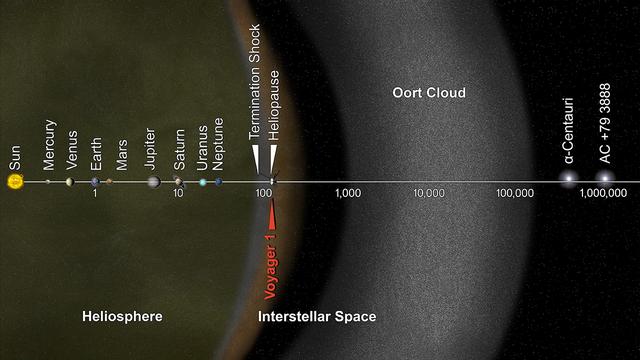
GSFC · 2017-12-08 · GSFC_20171208_Archive_e001171
Solar System, in Perspective
This artist's concept puts solar system distances in perspective. The scale bar is in astronomical units, with each set distance beyond 1 AU representing 10 times the previous…
Inspect NASA record
This artist's concept puts solar system distances in perspective. The scale bar is in astronomical units, with each set distance beyond 1 AU representing 10 times the previous distance. One AU is the distance from the sun to the Earth, which is about 93 million miles or 150 million kilometers. Neptune, the most distant planet from the sun, is about 30 AU. Informally, the term "solar system" is often used to mean the space out to the last planet. Scientific consensus, however, says the solar system goes out to the Oort Cloud, the source of the comets that swing by our sun on long time scales. Beyond the outer edge of the Oort Cloud, the gravity of other stars begins to dominate that of the sun. The inner edge of the main part of the Oort Cloud could be as close as 1,000 AU from our sun. The outer edge is estimated to be around 100,000 AU. NASA's Voyager 1, humankind's most distant spacecraft, is around 125 AU. Scientists believe it entered interstellar space, or the space between stars, on Aug. 25, 2012. Much of interstellar space is actually inside our solar system. It will take about 300 years for Voyager 1 to reach the inner edge of the Oort Cloud and possibly about 30,000 years to fly beyond it. Alpha Centauri is currently the closest star to our solar system. But, in 40,000 years, Voyager 1 will be closer to the star AC +79 3888 than to our own sun. AC +79 3888 is actually traveling faster toward Voyager 1 than the spacecraft is traveling toward it. The Voyager spacecraft were built and continue to be operated by NASA's Jet Propulsion Laboratory, in Pasadena, Calif. Caltech manages JPL for NASA. The Voyager missions are a part of NASA's Heliophysics System Observatory, sponsored by the Heliophysics Division of the Science Mission Directorate at NASA Headquarters in Washington. For more information about Voyager, visit: www.nasa.gov/voyager and voyager.jpl.nasa.gov . Image credit: NASA/JPL-Caltech NASA image use policy. NASA Goddard Space Flight Center enables NASA’s mission through four scientific endeavors: Earth Science, Heliophysics, Solar System Exploration, and Astrophysics. Goddard plays a leading role in NASA’s accomplishments by contributing compelling scientific knowledge to advance the Agency’s mission. Follow us on Twitter Like us on Facebook Find us on Instagram
- Record ID
- GSFC_20171208_Archive_e001171
- NASA center
- GSFC
- Date
- 2017-12-08
- Keywords
- Solar System, in Perspective, space, solarsystem, oort, oortcloud